



Jewelry offers 60-80% gross margins with only 8% return rates, making it the ideal low-risk, high-margin upsell for apparel ecommerce brands.
Published:
July 21, 2026
Author:
Yi Cui
The product category with near-zero returns. For ecommerce operators, the reality of selling apparel is a margin-crushing cycle of sizing issues and reverse logistics. Clothing return rates hit 26% in 2024 [1]. If you are tired of losing hard-earned margin to restocking fees and unsellable inventory, it is time to look at the product category most apparel brands overlook. Jewelry is not just an aesthetic add-on. It is a structurally superior upsell that protects your bottom line.
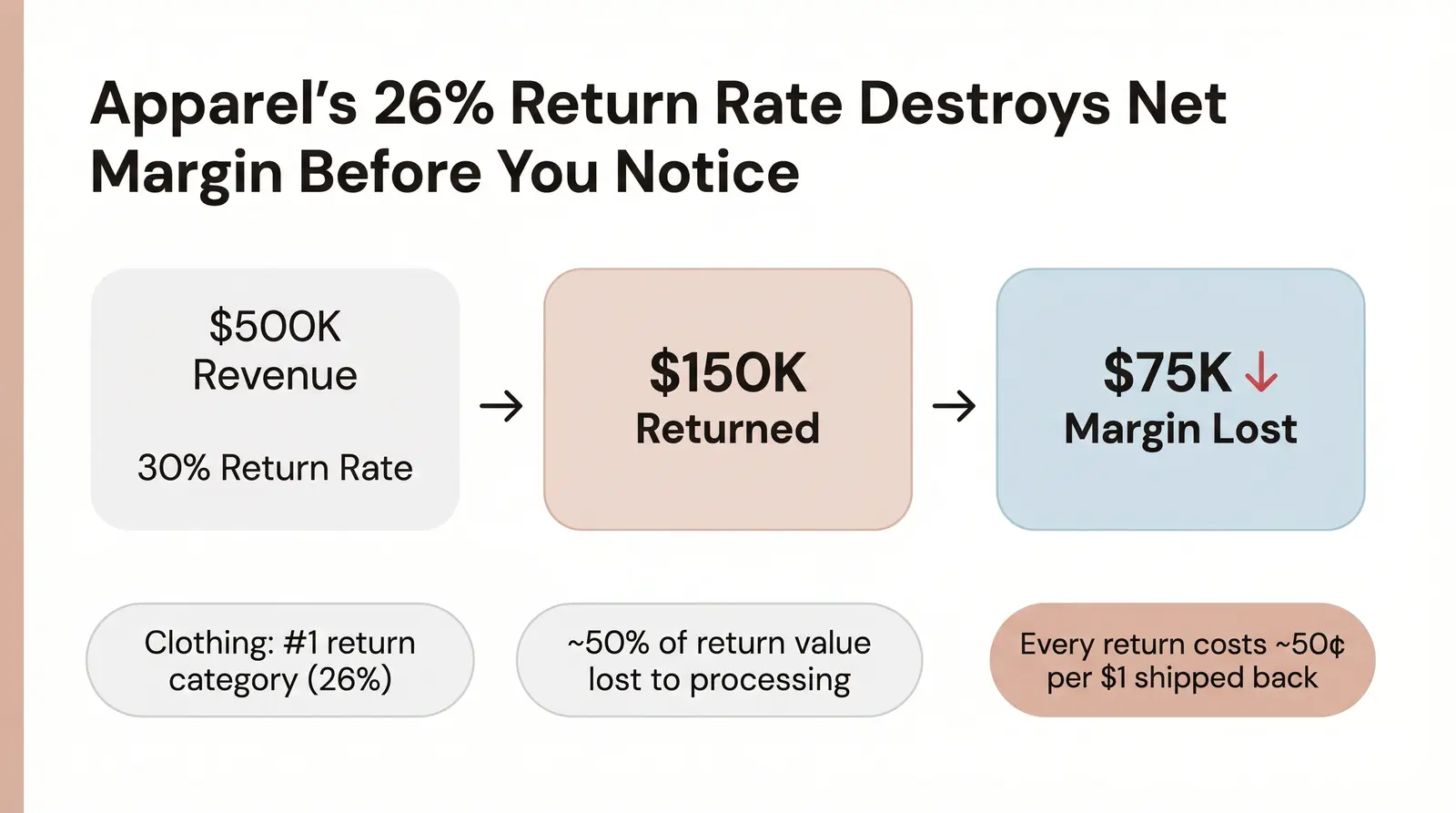
The ecommerce return rate for apparel is not a minor operational inconvenience. It is a category-defining problem. In 2024, clothing accounted for the highest return rate of any major ecommerce category, reaching 26% of all online purchases [1]. For some merchants, especially during peak promotional periods, that number spikes even higher [2].
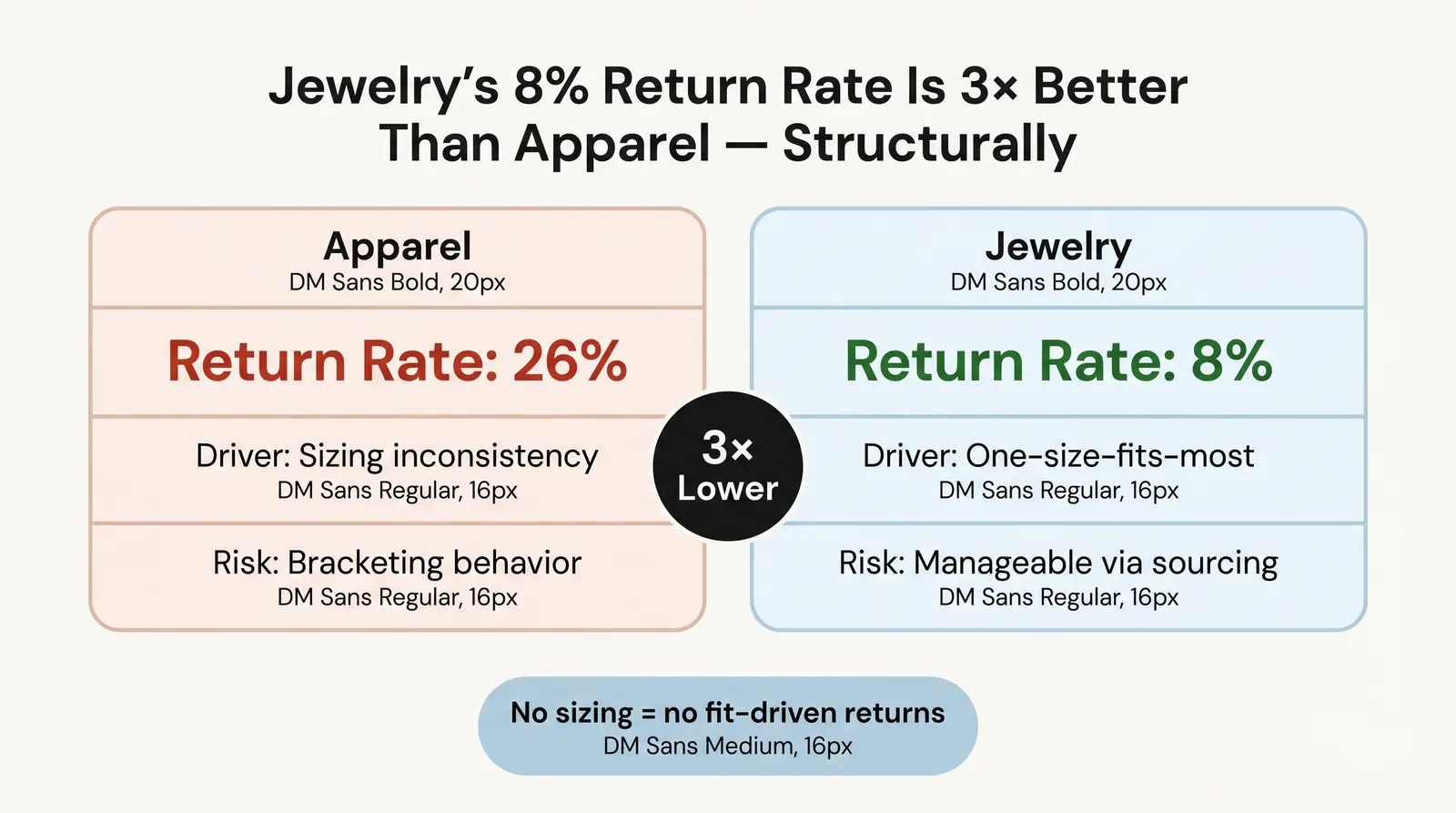
The drivers are structural. Sizing inconsistency across brands, vanity sizing, and the gap between product photography and real-world fit make buying clothes online a gamble for consumers. That uncertainty fuels bracketing behavior, where shoppers buy two or three sizes of the same item with the explicit intent to keep one and return the rest. Roughly half of Gen Z shoppers engage in bracket shopping [2]. What looks like strong conversion on the front end is often a return wave waiting to happen.
Worked Example: The True Cost of a 30% Return Rate
Consider a DTC apparel brand generating $500,000 a year in revenue with a 30% return rate. That means $150,000 worth of merchandise is sent back. Processing those returns is not free. It costs merchants an average of $27 to process a return on a $100 ecommerce order [3]. Reverse logistics can cost up to 66% of the item's original price when you factor in return shipping, warehouse processing, grading, repackaging, and the reality that a significant portion of returned items cannot be resold [4]. At a conservative 50% processing cost on returned value, that $150,000 in returns costs the business $75,000 in pure margin loss, before accounting for customer service time and lost inventory value.
We often see apparel founders come to Branvas after a brutal Q4. They did strong top-line revenue but their net margin collapsed once returns, restocking fees, and customer service costs hit the books.
While apparel struggles with fit, jewelry enjoys a structural advantage that most apparel operators underestimate. Rings aside (and even rings are increasingly sold as adjustable), most jewelry is one-size-fits-most. Necklaces, earrings, and bracelets do not require a fitting room. This eliminates the primary driver of ecommerce returns: sizing inconsistency.
Beyond mechanics, jewelry benefits from consumer psychology. It is frequently a gifted or emotionally-driven purchase. Gifts serve as symbols of relationships, and that emotional weight correlates with lower buyer's remorse and lower return intent [5]. Jewelry also photographs exceptionally well. What you see is what you get. The "it didn't fit like the model" problem is virtually non-existent.
The data reflects this. While apparel return rates hover around 26%, the average return rate for ecommerce jewelry purchases sits around 8% [6]. That is a 3x difference in return frequency, and it compounds directly into margin.
Non-obvious insight: The "high return risk" intuition most apparel sellers have about jewelry, specifically fragility, tarnish, and allergic reactions, is actually dwarfed by the structural fit-driven return risk of apparel. Jewelry's return drivers are far more manageable through product selection and quality control. You can source hypoallergenic, tarnish-resistant pieces to mitigate quality concerns. You cannot fix the fact that human bodies come in infinite shapes and sizes.
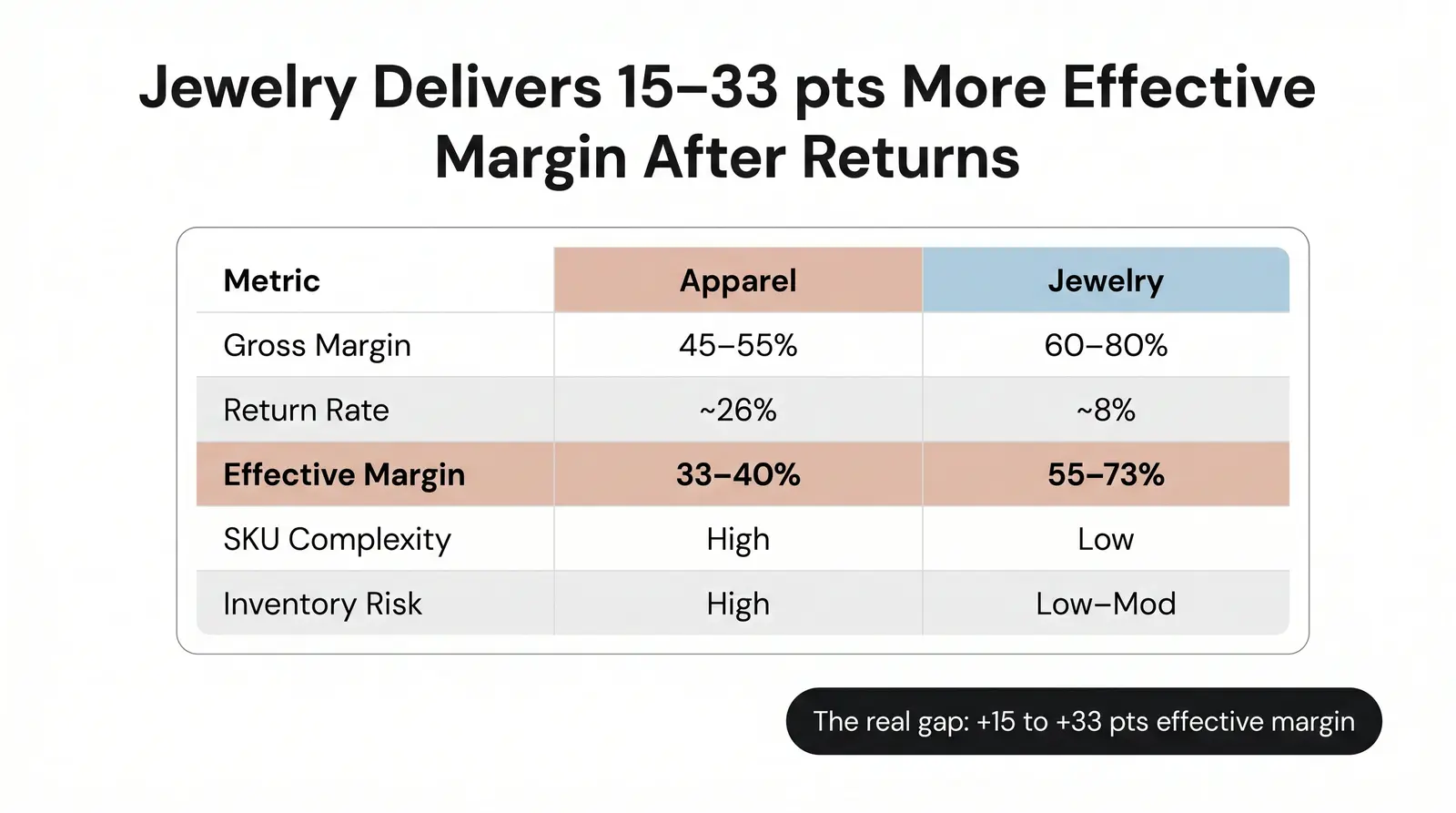
When evaluating product categories, gross margin only tells half the story. The effective margin after accounting for returns is where true profitability lives.
| Metric | Apparel (DTC Average) | Private-Label Jewelry (DTC) |
|---|---|---|
| Gross Margin (pre-returns) | ~45–55% [7] | ~60–80% [8] |
| Average Return Rate | ~26% [1] | ~8% [6] |
| Effective Margin (post-returns) | ~33–40% | ~55–73% |
| Avg. Order Value Impact | Moderate | High (upsell multiplier) |
| SKU Complexity | High (sizes x colors) | Low (style x metal tone) |
| Inventory Risk | High | Low to Moderate |
| Time-to-Launch (private label) | Weeks to Months | Days to Weeks (with Branvas) |
The most critical gap is the effective margin post-returns. Apparel might look healthy on a pre-return basis, but the sheer volume and cost of reverse logistics erodes profitability fast. Jewelry, starting with a higher gross margin and suffering a fraction of the return rate, allows brands to keep significantly more of every dollar they earn. That gap, roughly 15 to 33 percentage points in effective margin, is the real story.
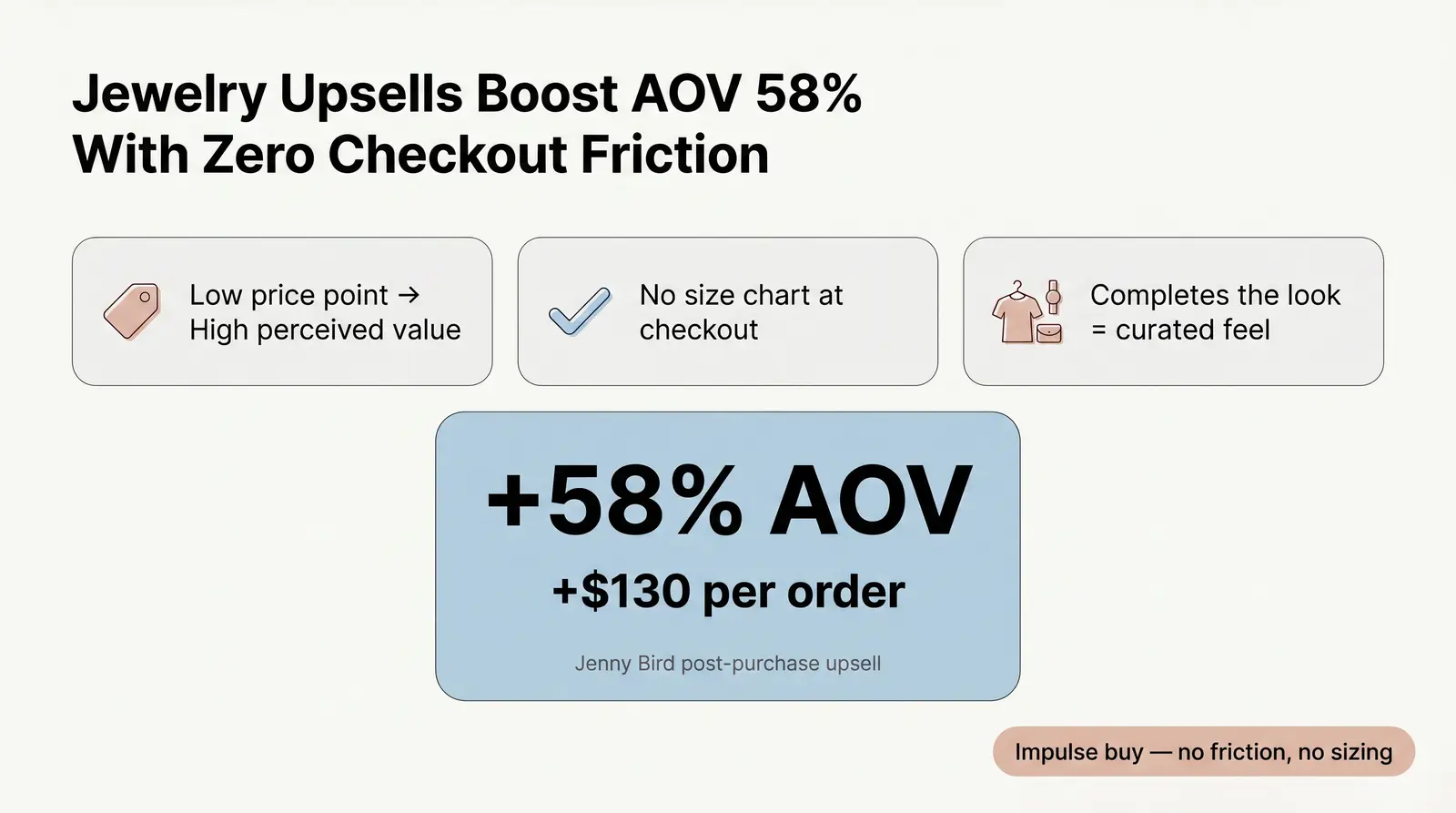
Jewelry is psychologically and mechanically ideal as a cross-sell or upsell for apparel stores. It carries a low price point relative to its perceived value, making it impulse-friendly. There is no size barrier at checkout. A customer buying a dress does not need to consult a size chart to add a matching necklace. It complements outfit-based purchasing decisions, allowing shoppers to complete a look in one transaction.
These mechanics translate into real revenue. Post-purchase upsells are particularly effective in this category. Jewelry brand JENNY BIRD achieved a 58% average order value uplift when post-purchase offers were accepted, with an additional $130 per order on average, by surfacing relevant product recommendations immediately after checkout [9]. The key insight: jewelry upsells feel curated and helpful rather than pushy, because the product naturally completes the purchase a customer just made.
For Shopify merchants, adding a low-SKU accessories line is a margin-accretive move with minimal operational overhead. You are not adding warehouse complexity. You are adding a high-margin, low-return product that your existing customers are already primed to buy.
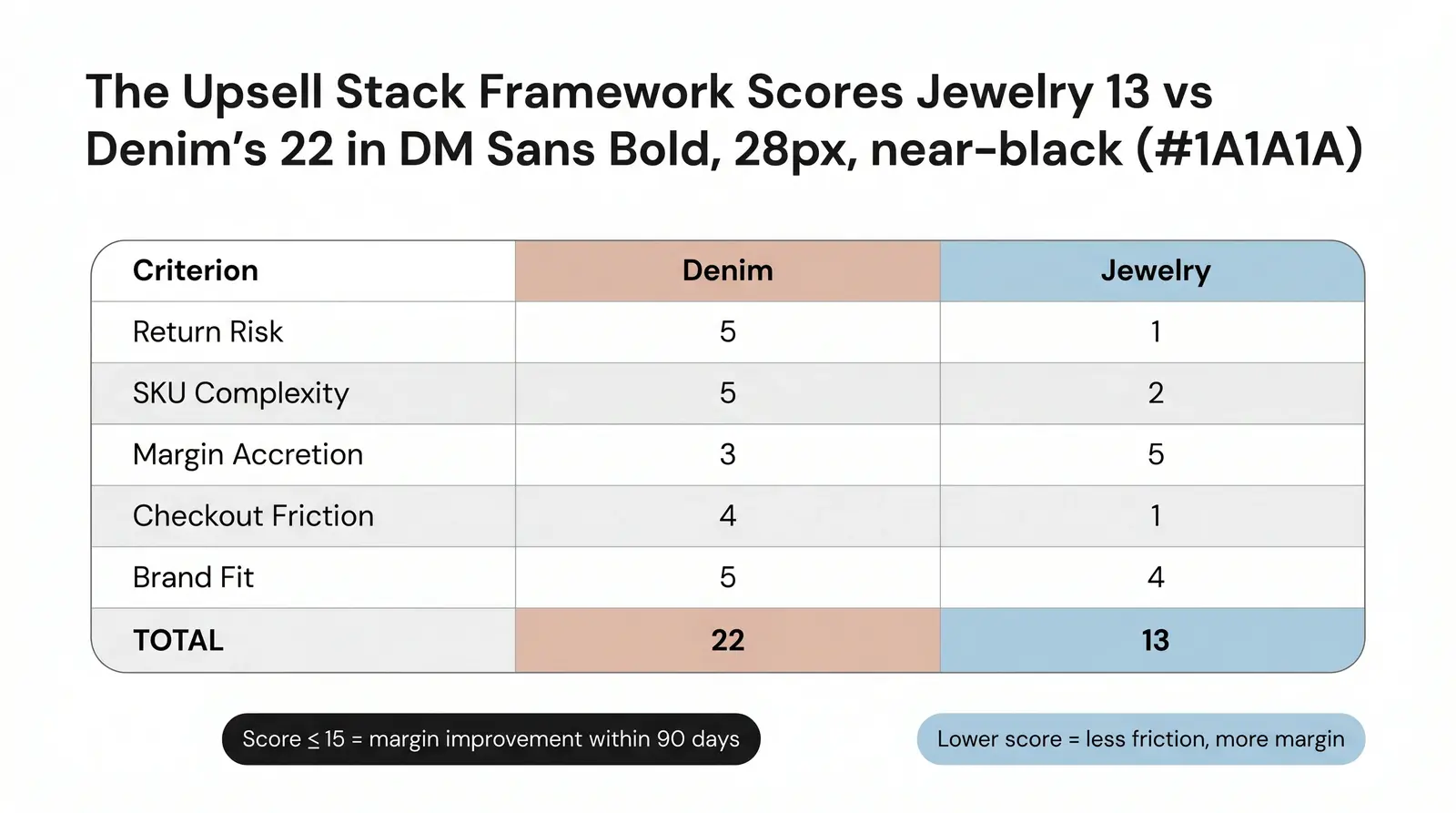
At Branvas, we use a proprietary model called The Upsell Stack Framework to help ecommerce sellers evaluate whether a new product category is worth adding. It is a scored decision matrix with five criteria, each rated on a 1 to 5 scale.
Here is a worked example for a fictional Shopify apparel brand, "Luma Co." They are deciding between adding a new denim line or a private-label jewelry line using Branvas.
Denim Jeans Expansion:
Private-Label Jewelry Expansion:
Luma Co.'s denim expansion scores 22 on the framework. Every point above 15 represents friction, risk, or margin drag. Their jewelry expansion scores 13. That difference is not just theoretical. It shows up in their P&L within 90 days.
In our experience at Branvas, brands that score 15 or below on the Upsell Stack Framework across a new category consistently see margin improvement within their first 90 days of launch.
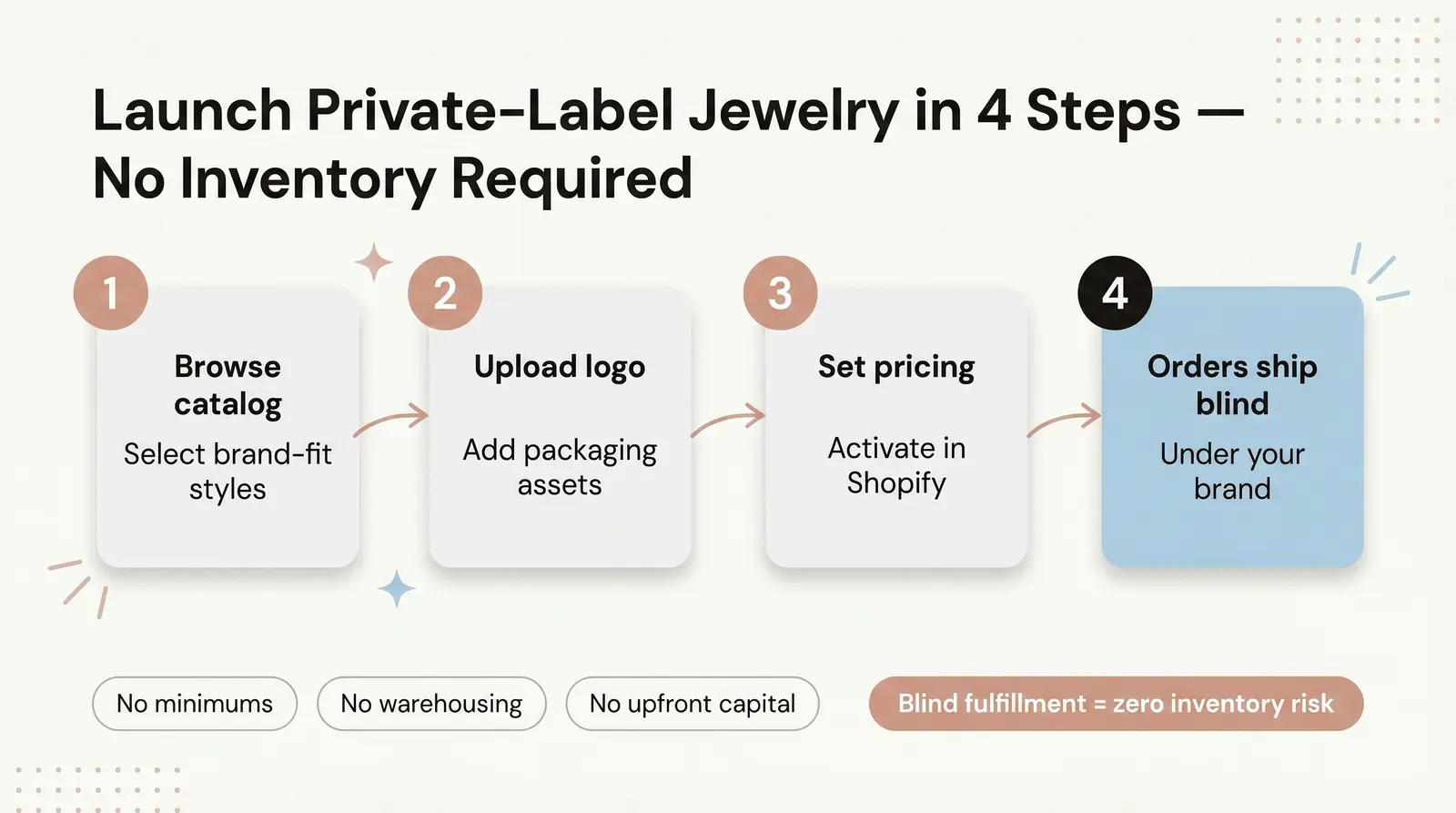
Expanding into jewelry does not require a massive pivot. The process has three components: product curation, private branding, and blind fulfillment. You select pieces that match your brand's aesthetic from a curated catalog, apply your custom packaging and labels, and have orders shipped directly to your customers without them ever knowing a third party was involved.
It is worth acknowledging that jewelry does have quality control considerations. Plating durability, tarnish resistance, and hypoallergenic materials matter to customers. The way to mitigate these is through supplier selection. A reliable sourcing partner handles the vetting, quality checks, and material standards so you are not managing those variables yourself.
The practical steps are straightforward:
If you're evaluating whether a jewelry line fits your brand, Branvas's How It Works page walks through the full process, from catalog selection to branded packaging to blind shipping. The Branvas Catalog is the best starting point for product selection. For apparel brands specifically, the solutions for ecommerce and boutique store owners page covers the most relevant use cases.
What ecommerce product categories have the lowest return rates?
Categories with low sizing dependency and high emotional value consistently see the lowest return rates. Jewelry and accessories rank among the lowest, with average return rates around 8%, compared to apparel which regularly exceeds 26% [1] [6]. Health and beauty products also see lower return rates, largely due to hygiene restrictions that limit returns. The common thread across low-return categories is that the product does not need to "fit" in the same way clothing does.
Is jewelry a good upsell for an apparel or clothing brand?
Yes, and it is one of the most structurally sound upsells available to an apparel brand. Jewelry complements outfit-based purchases, requires no sizing at checkout, and carries a high perceived value relative to its cost. It is an easy impulse addition that boosts average order value without introducing the return risk or SKU complexity that comes with adding more apparel. The fit is both aesthetic and operational.
How do I add a jewelry line to my Shopify store without holding inventory?
You can add a jewelry line using a Brand-as-a-Service platform like Branvas. You select products from a catalog, apply your private label packaging, and orders are fulfilled and shipped blind on your behalf. You only pay for the product when a customer purchases, which eliminates inventory risk entirely. There are no minimums, no warehousing costs, and no upfront capital required.
What is a realistic gross margin for private-label jewelry?
For direct-to-consumer private-label jewelry, a realistic gross margin typically ranges from 60% to 80% [8]. The gap between sourcing cost and retail price is wider in jewelry than in most other categories because perceived value is high and the physical product is small and lightweight. This keeps both product cost and shipping cost low relative to the price customers are willing to pay.
How does jewelry compare to apparel in terms of operational complexity for DTC brands?
Jewelry is significantly less complex operationally. Apparel requires managing a large matrix of SKUs across sizes and colors, which drives high inventory risk, complex forecasting, and expensive reverse logistics. Jewelry is mostly one-size-fits-most, which means fewer SKUs, less warehouse space, lower shipping costs, and a fraction of the return processing burden. For a Shopify merchant looking to add a second product category, jewelry is one of the lowest-friction options available.
For margin-conscious ecommerce operators, jewelry is not just an aesthetic add-on. It is a structurally superior product category with lower return rates, higher effective margins, and lower operational complexity than apparel. While many brands continue to absorb the costs of sizing-driven returns and reverse logistics, the smarter move is to diversify into a category where the product works in your favor. The "safe" product is the one most apparel brands are overlooking.
Ready to add a private-label jewelry line to your brand? See how Branvas works, or explore the catalog to find styles that fit your aesthetic. No minimums. No inventory risk. Just margin.


