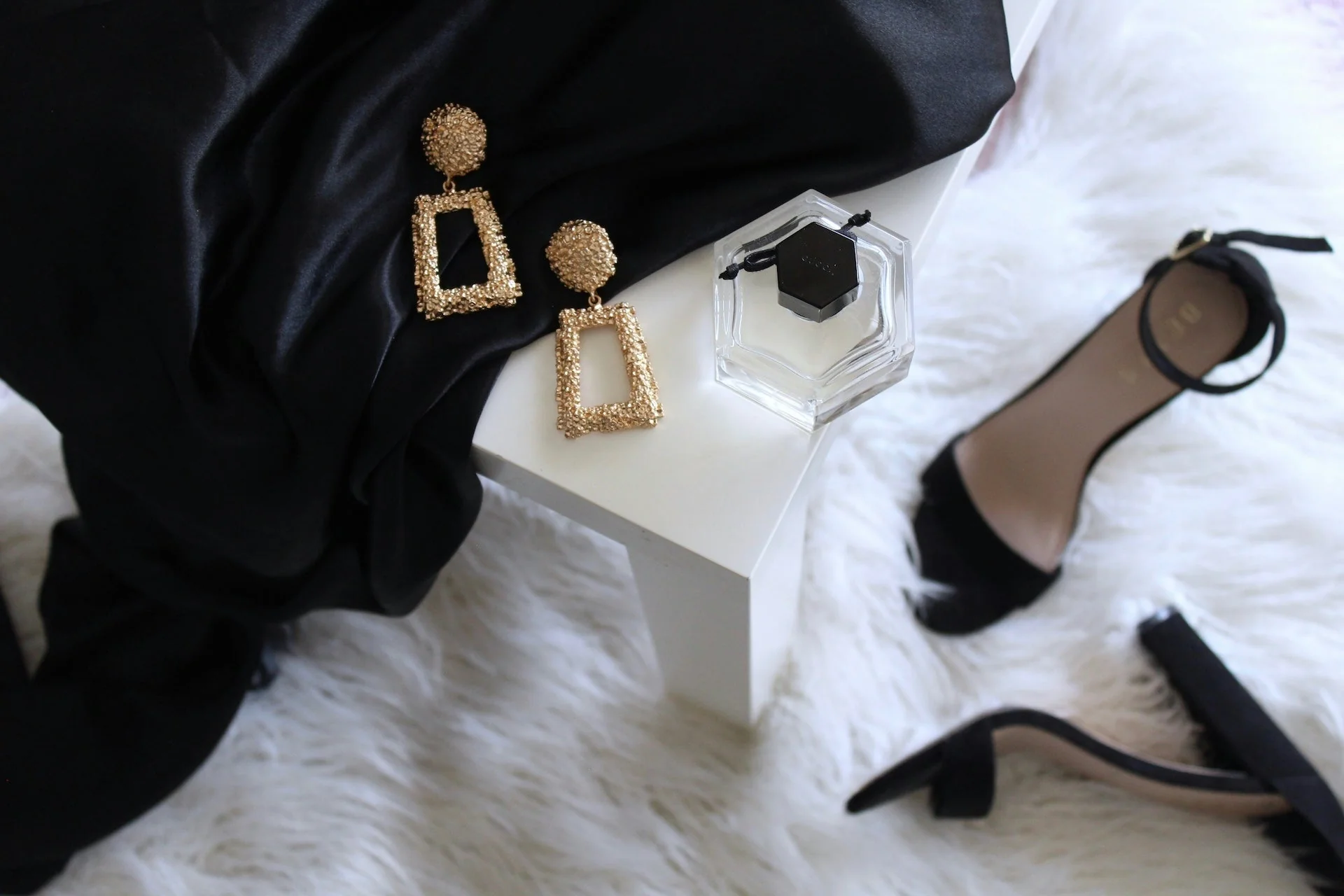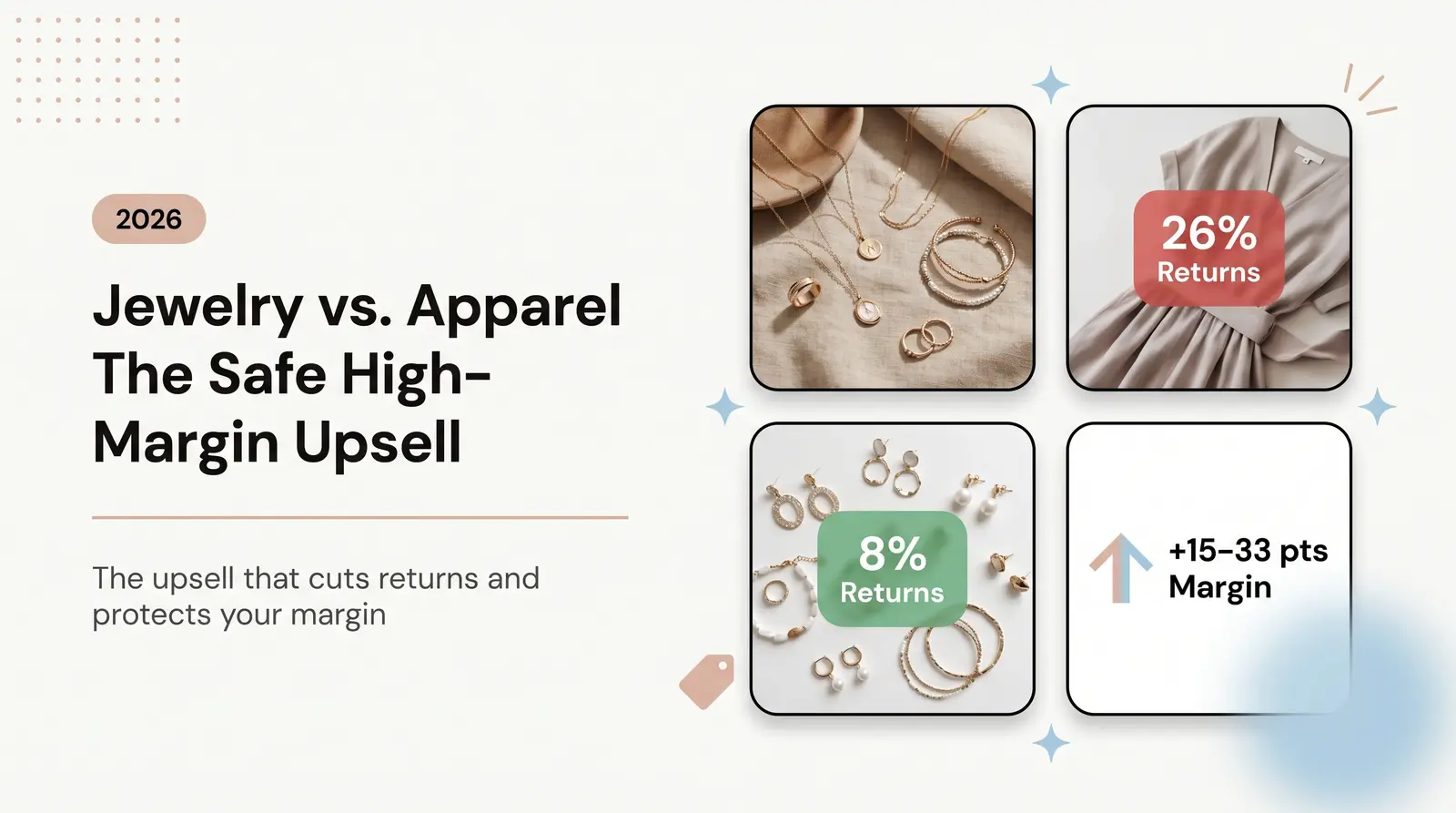



The Outfit Completer Strategy positions jewelry as look-finishing accessories alongside hero apparel, unlocking 55-70% margins and boosting average order value through strategic merchandising.
Published:
May 1, 2026
Author:
Yi Cui
You aren't selling jewelry; you're finishing the look.
Most boutique owners treat accessories as an afterthought SKU. A display-case filler between the "real" products. They pour their capital, marketing budget, and floor space into dresses, denim, and outerwear, assuming apparel is the only true driver of revenue. That assumption is costing them real money.
By treating jewelry as a secondary consideration, fashion sellers are leaving their most profitable transactions on the table. This article introduces the Outfit Completer Strategy: a positioning and merchandising framework that turns low-cost accessories into high-margin revenue drivers. Rather than hoping a customer stumbles upon a necklace before checkout, this approach integrates accessories directly into the styling and purchasing journey.
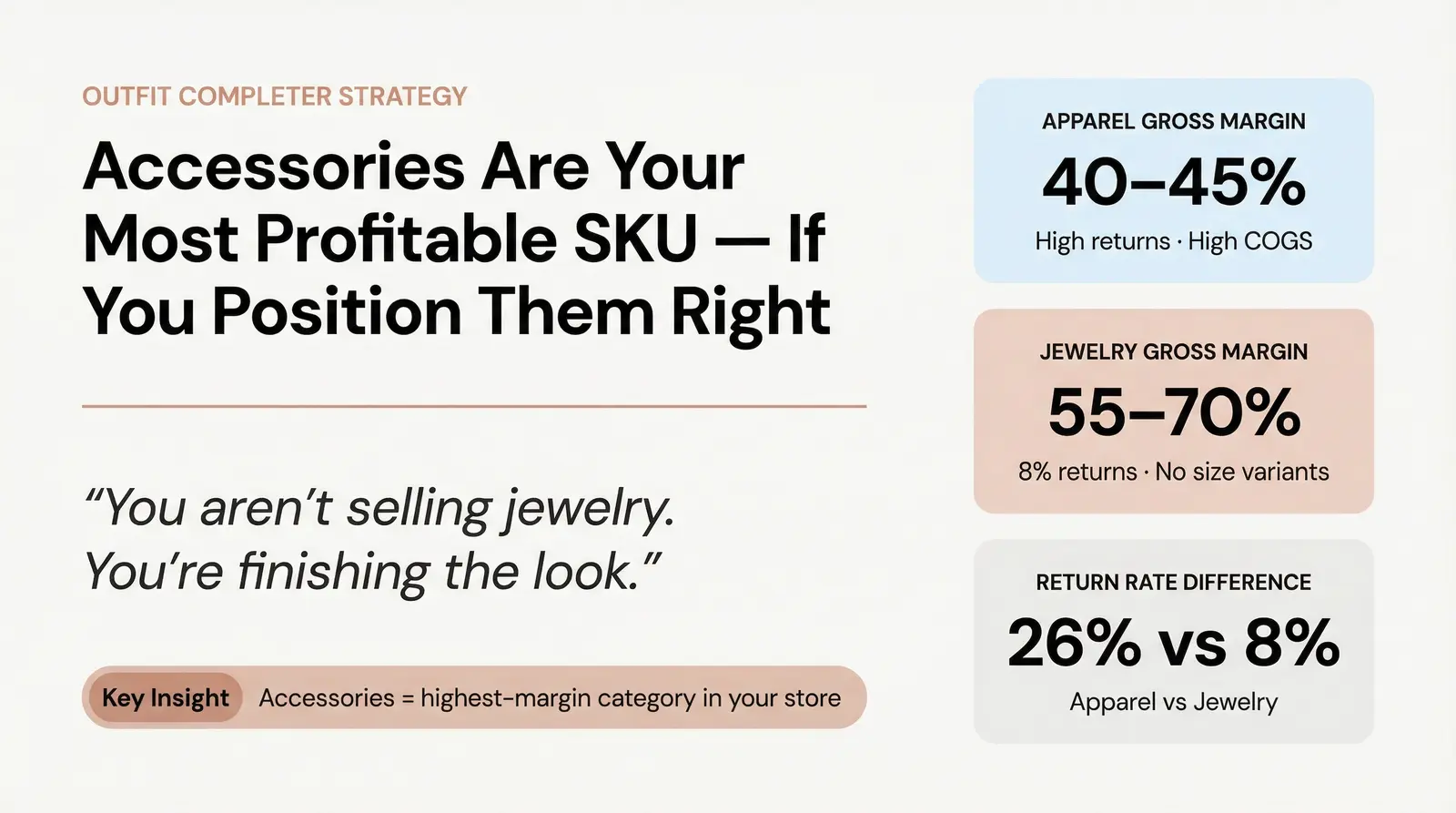
The stakes are clear. While boutique apparel typically yields a 40 to 45% gross margin, jewelry and accessories consistently deliver margins between 55% and 70% [1] [2]. By shifting your perspective from selling isolated items to selling completed looks, you can dramatically increase your average order value (AOV) and transform your bottom line, without adding complex inventory.
The product your customer is least likely to think about is the one most likely to make you profitable.
When a customer buys a dress, they are navigating a minefield of cognitive friction. They worry about the fit, the fabric, the occasion, and the price. Apparel is inherently complex. It requires deep size runs, carries a high cost of goods sold (COGS), and suffers from staggering return rates. Jewelry is different. It is emotionally satisfying, impulse-adjacent, and free from fit anxiety. A necklace either matches the outfit or it doesn't. There is no dressing room required.
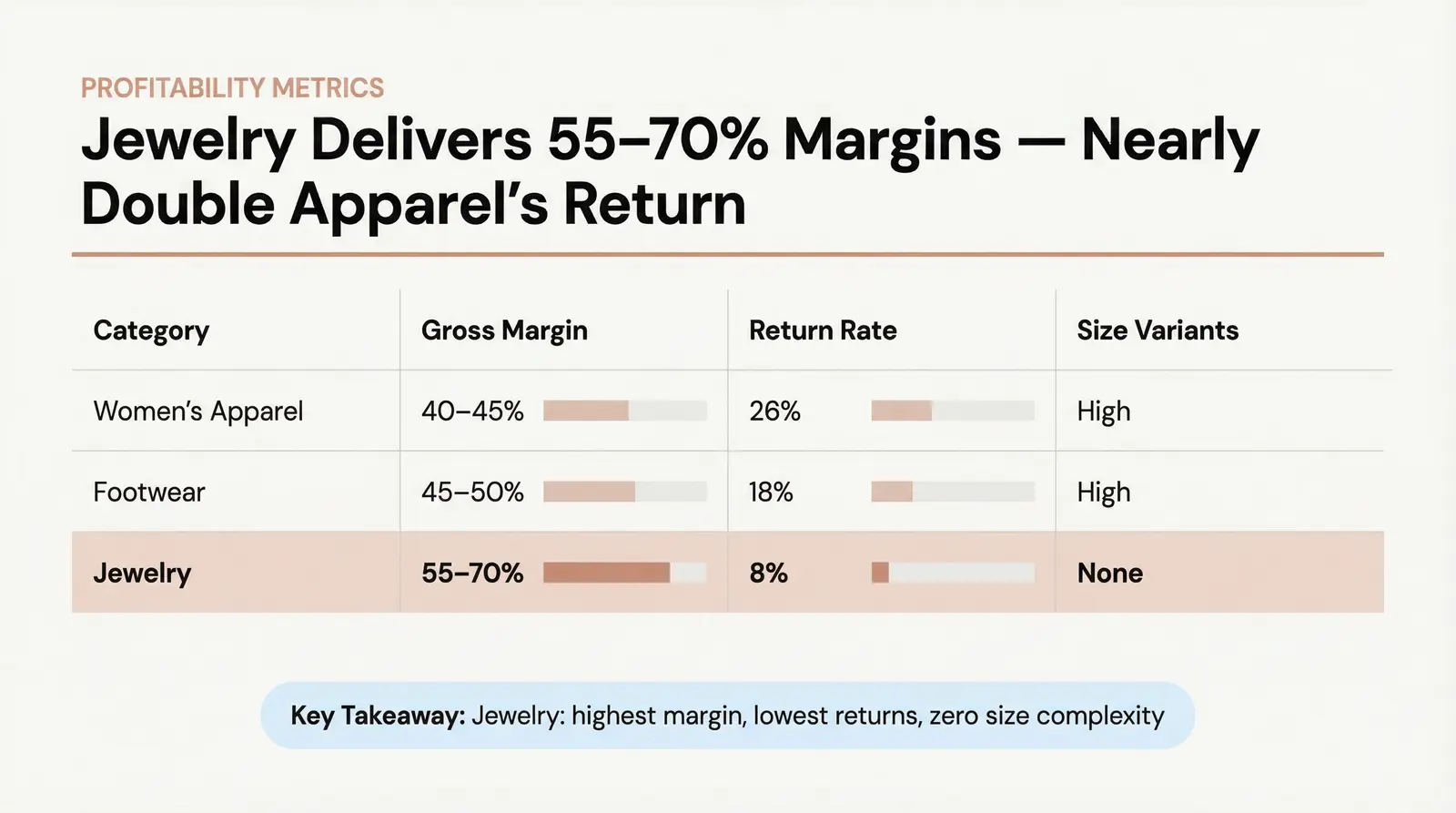
That psychological ease translates directly into superior unit economics. The margin profile of accessories dramatically outperforms traditional apparel categories.
| Product Category | Avg. COGS % | Avg. Gross Margin | Return Rate | Size Complexity |
|---|---|---|---|---|
| Women's Apparel | 55–60% | 40–45% | 26% | High (XS–3XL) |
| Footwear | 50–55% | 45–50% | 18% | High |
| Jewelry / Accessories | 20–35% | 55–70% | 8% | None / minimal |
Data compiled from industry benchmarks including TrueProfit, Radial, and Loop Returns [1] [2] [3].
The numbers tell a clear story. Apparel returns hover around 26%, driven primarily by sizing inconsistencies and buyer's remorse [2]. Jewelry returns sit at a manageable 8% [1]. When you factor in the lack of size variants and the lower initial COGS, the profitability of accessories becomes undeniable.
In our experience at Branvas, boutique sellers who add a private-label jewelry line within their first 90 days consistently report it becoming their highest-margin SKU category within two quarters.
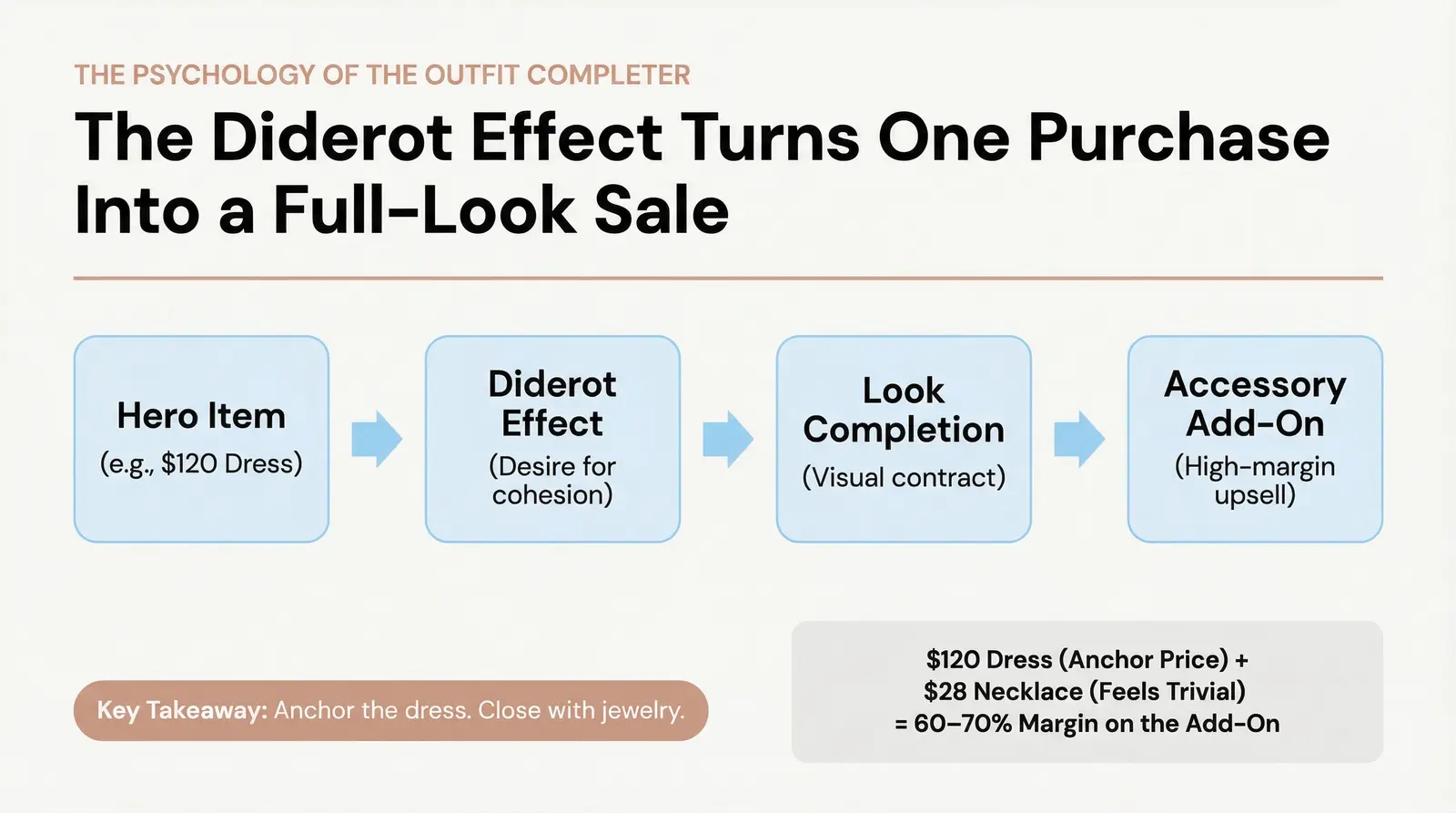
To understand why the Outfit Completer Strategy works, look to the 18th-century French philosopher Denis Diderot. After receiving a large sum of money, Diderot purchased a beautiful scarlet robe. He quickly realized that his new, elegant garment made the rest of his modest possessions look shabby by comparison. He felt compelled to replace his rug, his chairs, and his desk to match the aesthetic standard set by the robe.
This phenomenon is known as the Diderot Effect. It states that obtaining a new possession often creates a spiral of consumption, leading people to acquire more items to maintain a sense of cohesion [4]. In fashion ecommerce, this translates directly to "look completion" psychology. Consumers are wired to seek closure. A styled outfit creates a visual contract. The dress is the foundation, but the jewelry finishes it. When a customer buys a hero item, they are highly susceptible to purchasing the complementary pieces required to fulfill the aesthetic vision.
This behavior is amplified by price anchoring. When a customer commits to spending $120 on a dress, adding a $28 necklace feels trivially small. The dress serves as the anchor price, making the accessory appear as a low-risk, high-reward addition. Yet for the retailer, that $28 necklace carries a 60 to 70% margin. By presenting the jewelry not as a separate purchase, but as the necessary final touch to the primary investment, you bypass price resistance and capitalize on the customer's desire for a complete, cohesive look.
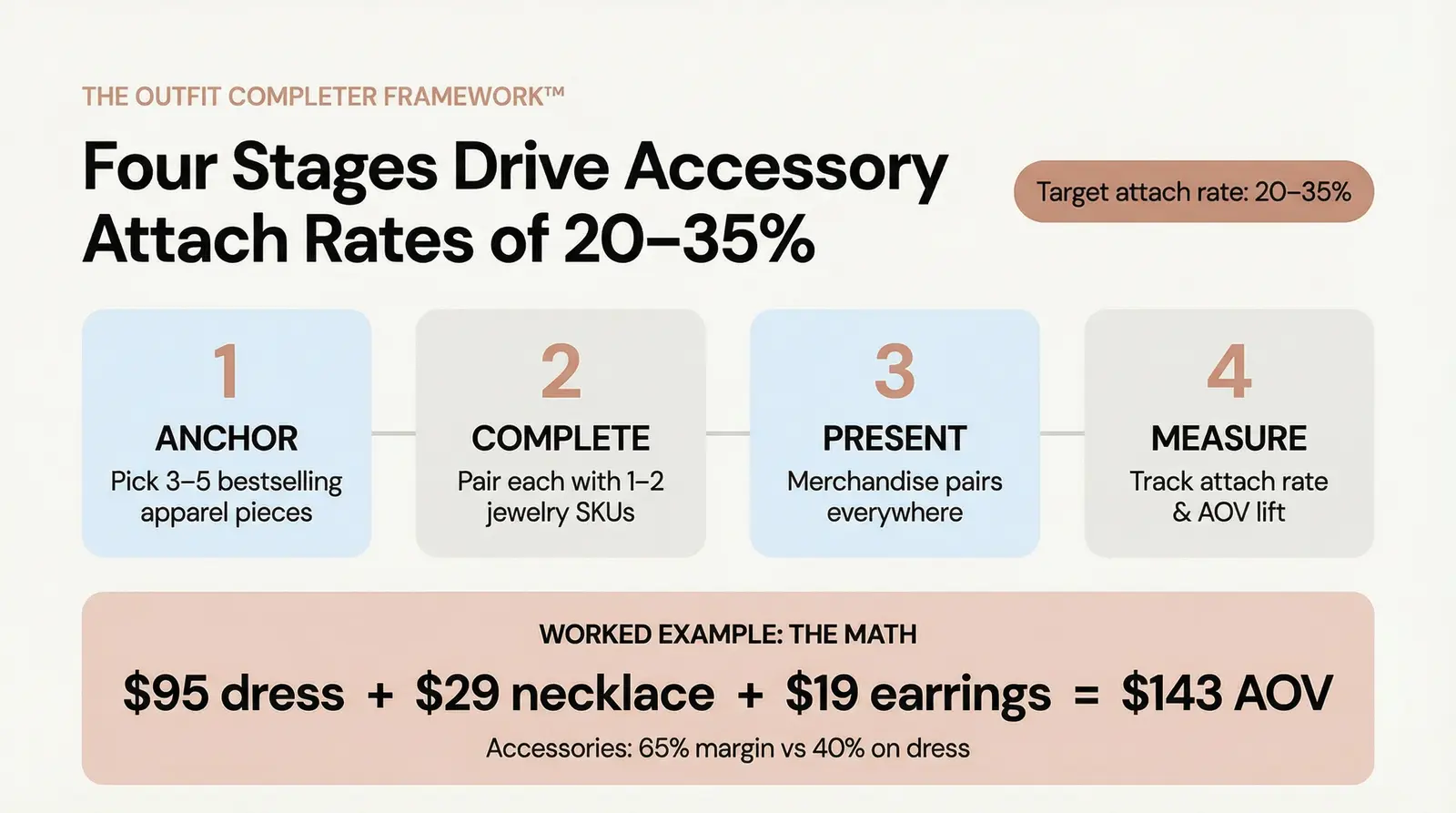
The Outfit Completer Framework™ is Branvas's internal model for helping apparel sellers integrate accessories strategically. It shifts the focus from selling individual SKUs to merchandising cohesive aesthetics. The framework has four actionable stages designed to maximize attach rates and profitability.
Stage 1: ANCHOR. Identify your three to five bestselling apparel pieces. These are your anchors. They are the high-traffic, high-desire items that draw customers to your store in the first place.
Stage 2: COMPLETE. For each anchor, identify one or two jewelry or accessory SKUs that naturally finish the look. Base these pairings on style, color palette, and the intended occasion of the anchor piece.
Stage 3: PRESENT. Merchandise these pairs together relentlessly. Feature them on product pages, integrate them into post-purchase email flows, showcase them in social media content, and display them together in physical store settings. The customer should never see the anchor without its completer.
Stage 4: MEASURE. Track your attach rate (the number of accessories sold per apparel unit) and the AOV lift per paired SKU. A healthy attach rate for accessories in fashion ecommerce is between 20% and 35%.
Worked Example: A boutique's top seller is a $95 floral midi dress. Under the Outfit Completer Framework™, the owner pairs it with a $29 private-label gold layered necklace and a $19 resin hoop earring set. Cart value jumps from $95 to $143 on average when the accessories are recommended at checkout. At 65% margin on accessories vs. 40% on the dress, the accessories generate more gross profit per dollar of revenue than the hero SKU.
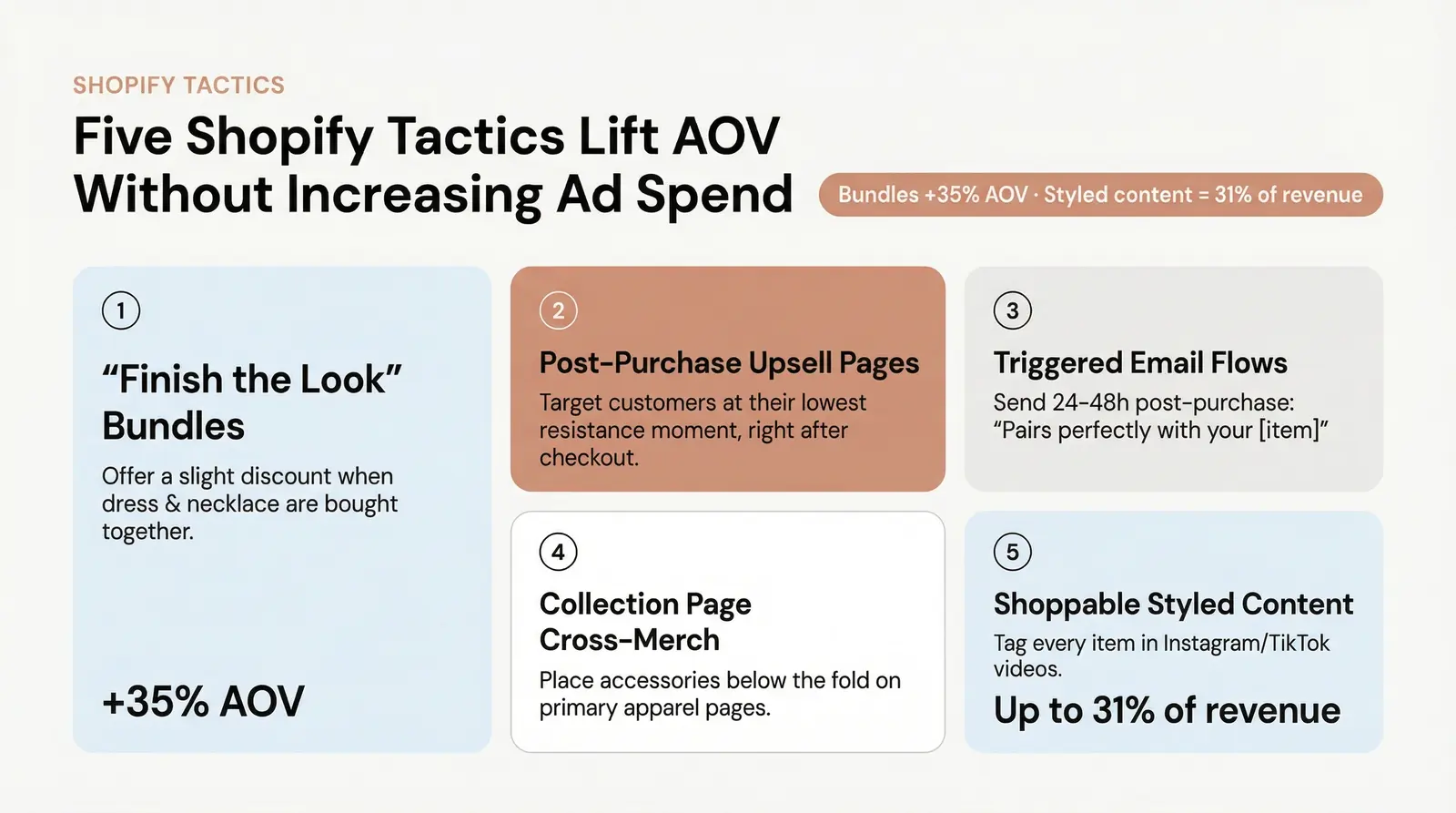
Implementing this strategy requires deliberate merchandising. Here are five tactical ways to execute the outfit completer strategy on your Shopify store and increase Shopify AOV without increasing ad spend.
1. "Finish the Look" Product Bundles. Create curated bundles directly within Shopify. By offering a slight discount (10% off, for example) when the dress and necklace are purchased together, you leverage bundle discount psychology. The perceived value of the complete outfit outweighs the cost, driving higher conversions. Research shows that product bundles increase AOV by 35% compared to single-item sales [5].
2. Post-Purchase Upsell Pages. Use tools like ReConvert or Zipify to present a jewelry upsell immediately after checkout. This targets the customer at their lowest moment of resistance. They have already entered their payment information and committed to the brand. A $25 necklace at this moment converts far more easily than it would on a cold product page.
3. Email Flows Triggered by Apparel Purchase. Set up automated email flows that trigger 24 to 48 hours after an apparel purchase. Send a "what pairs perfectly with your [product name]" email featuring two or three curated jewelry SKUs. This capitalizes on the excitement of the recent purchase while the item is still in transit. It is one of the most underused jewelry upsell ideas in boutique ecommerce.
4. Collection Page Cross-Merchandising. Do not isolate your jewelry on a separate, hidden page. On your primary apparel collection pages, add an "Outfit Completers" accessory section below the fold. This ensures high visibility for your highest-margin items without requiring the customer to navigate elsewhere.
5. Shoppable Styled Content. Create Instagram and TikTok content showing full, styled looks. Tag every item in the video or image, including the jewelry, and drive traffic to a dedicated "Shop the Look" landing page. Research indicates that "complete the look" recommendations can account for up to 31% of ecommerce revenues [6].
If you don't yet have a jewelry line to complete looks with, Branvas makes it easy to launch one under your own brand, without carrying inventory. Explore how it works →
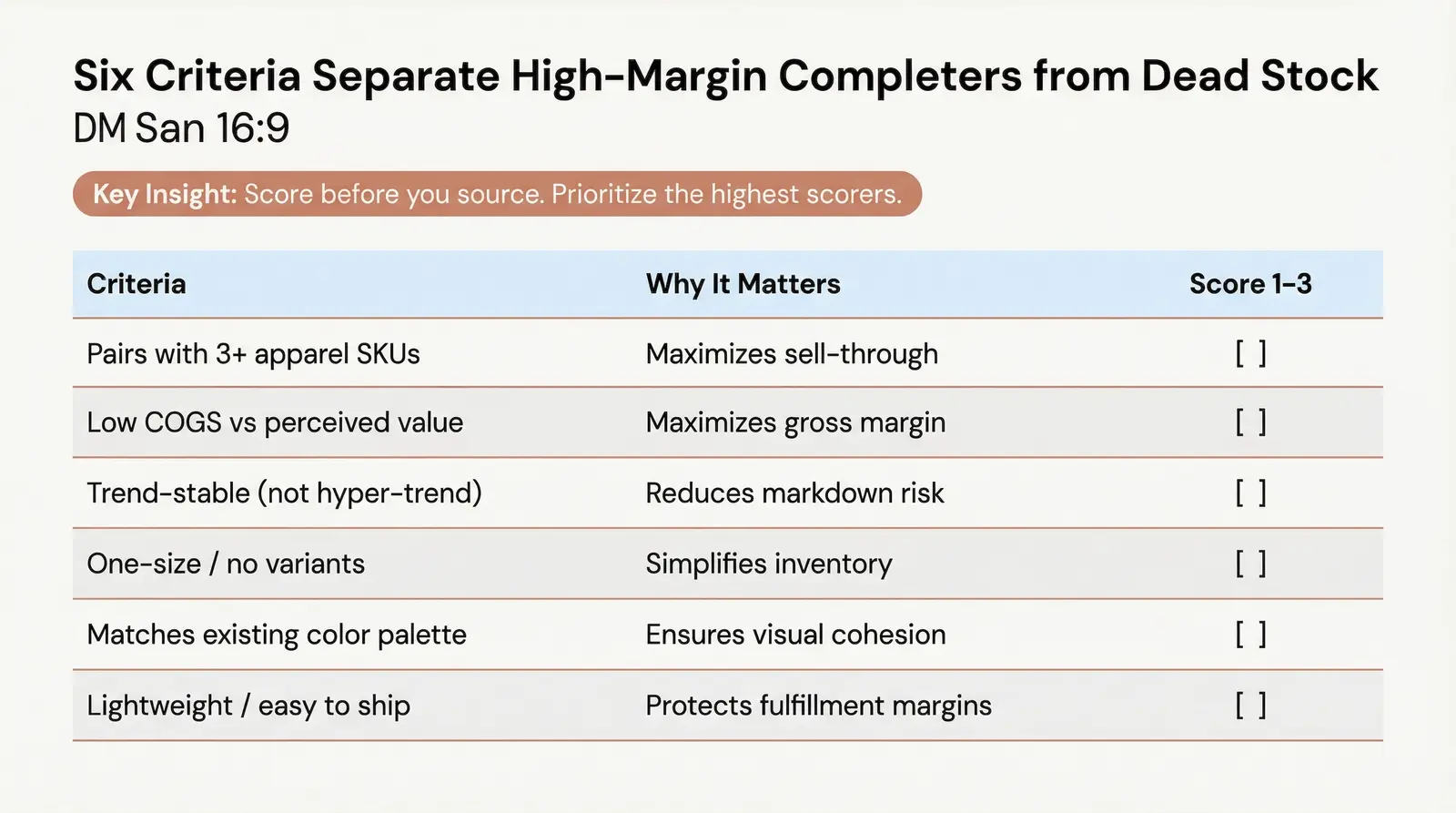
Not all jewelry serves as an effective outfit completer. The goal is to select pieces that maximize sell-through while minimizing operational complexity. We often see founders struggle with "which pieces to start with." This rubric gives you a data-informed answer instead of gut feel.
Use the following scoring table to evaluate potential accessory SKUs. Score each candidate from 1 to 3, and prioritize launching the highest scorers first.
| Criteria | Why It Matters | Score (1–3) |
|---|---|---|
| Versatility (pairs with 3+ apparel SKUs) | Maximizes sell-through across the catalog | |
| Low COGS relative to perceived value | Maximizes gross margin potential | |
| Trend-stable (not hyper-trend) | Reduces markdown risk and extends product lifecycle | |
| One-size / no variants | Simplifies inventory management and reduces returns | |
| Complements existing color palette | Ensures visual cohesion with your core apparel | |
| Lightweight / easy to ship | Reduces fulfillment costs and protects margins |
By rigorously applying these criteria, you ensure that your accessory line acts as a reliable profit engine rather than a source of dead stock. If you want to run the numbers on what this could mean for your specific store, the Branvas profit calculator is a useful starting point.
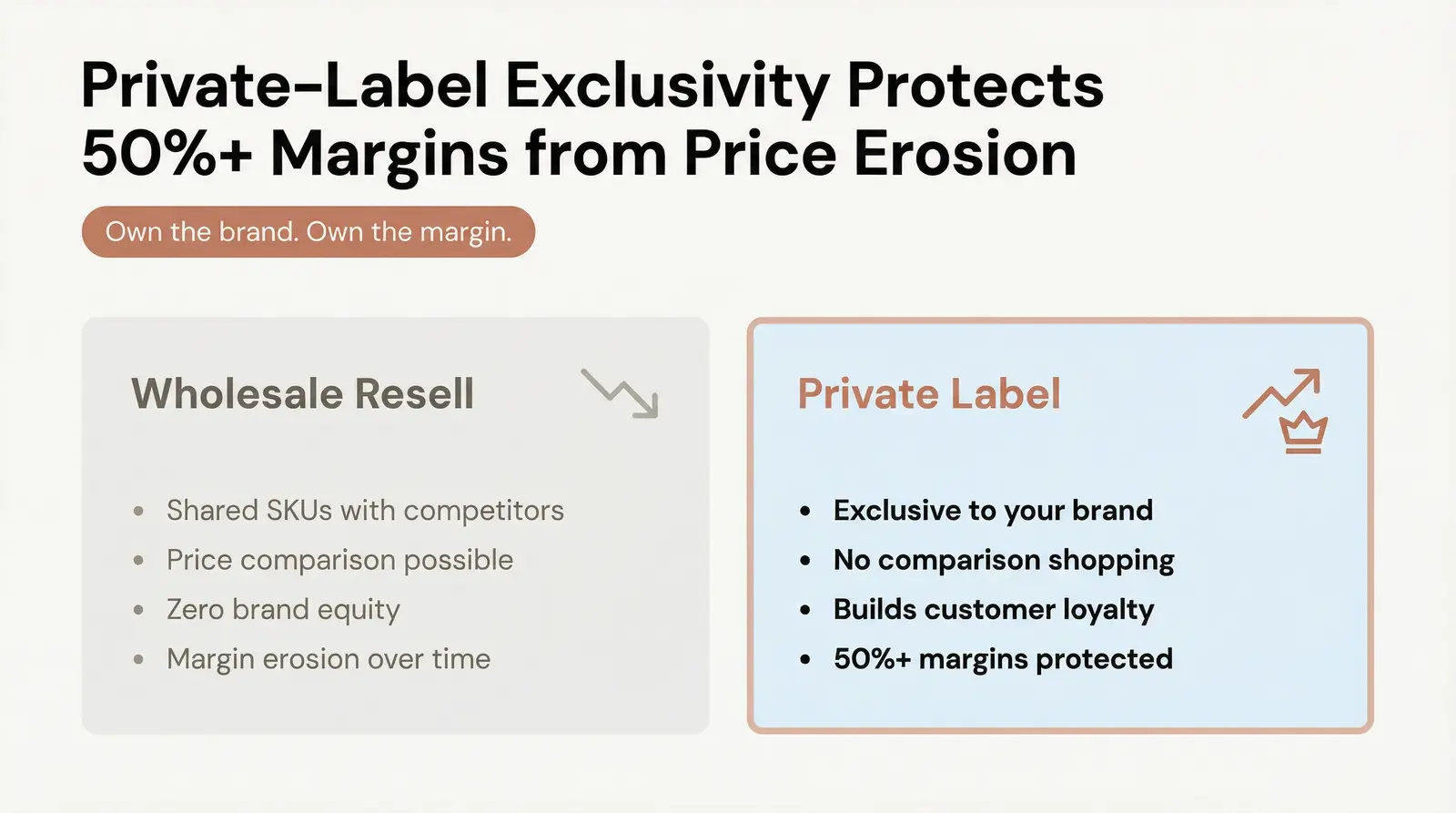
There is a fundamental difference between reselling wholesale jewelry and launching private-label accessories under your own brand. Reselling generic wholesale pieces means sharing SKUs with countless other boutiques. It builds no brand equity and inevitably leads to price competition, eroding the very margins you are trying to capture.
Private-label jewelry is the only version of this strategy that builds a sustainable moat. When you sell accessories under your own brand name, customers cannot comparison-shop your pieces elsewhere. That exclusivity justifies premium pricing and protects your 50%+ margins. It also aligns perfectly with the boutique brand loyalty dynamic. Customers who buy from a boutique are buying a curated identity, not just a product. They trust your taste. Wearing your branded jewelry deepens their emotional connection to your store.
This is exactly the model that boutique and ecommerce store owners are increasingly using to differentiate and scale.
Branvas is built exactly for this: we help boutique owners and influencers launch their own private-label jewelry brand, with sourcing, custom branding, packaging, and blind fulfillment handled for you. See the Branvas catalog → or learn how it works →.
An outfit completer is an accessory, typically jewelry, a belt, or a handbag, strategically positioned to finish a specific apparel look. Rather than being sold as an isolated item, it is merchandised alongside a "hero" product like a dress to encourage a multi-item purchase. It provides visual closure for the customer and higher margins for the retailer. The concept draws on well-established consumer psychology around look completion and the Diderot Effect.
Significantly. Industry data shows that cross-selling tactics can boost revenue by 20% and increase profits by 30% [7]. For Shopify fashion stores, where the global average order value sits between $85 and $92 [8], adding a $30 accessory to one in four orders can lift your overall AOV by nearly 10%. When those accessories carry 60 to 70% margins, the profit impact is even more pronounced than the revenue lift suggests.
The best outfit completers are versatile, trend-stable, and universally sized. Layered gold necklaces, classic resin hoop earrings, and simple chain bracelets consistently perform well. These items pair easily with multiple apparel SKUs, carry low COGS, and appeal to a broad demographic. They minimize inventory risk while maximizing attach rates. Avoid hyper-trend pieces that will date quickly and require markdowns.
No. The most effective approach is to start small. Identify your top three apparel anchors and source just one or two specific jewelry pieces to complete those looks. Utilizing on-demand or private-label services allows you to test the strategy and generate high-margin sales without tying up capital in upfront inventory. You can validate the attach rate before committing to larger orders.
Traditional dropshipping often involves selling unbranded, generic products shipped directly from overseas manufacturers, with long lead times and zero brand equity. Private-label jewelry means selling products under your own brand name, often with custom packaging and branded presentation. This builds customer loyalty, prevents price comparison on Google Shopping or Amazon, and allows you to command higher retail prices. The margin difference between the two models is substantial.
Accessories aren't an add-on. They are the most profitable category in your store if you position them correctly.
By shifting your merchandising strategy away from isolated SKUs and toward cohesive aesthetics, you unlock a powerful psychological trigger in your customers. You are not selling jewelry; you are finishing the look. That reframe is what justifies the price, drives the emotional connection, and closes the sale.
When you implement the Outfit Completer Strategy, you transform low-cost items into high-margin revenue drivers, stabilize your profitability, and build the kind of brand loyalty that keeps customers coming back. The math is on your side. The psychology is on your side. The only thing left is execution.
Ready to build your own outfit completer line? Explore Branvas →
[1] Return Policy Strategies for Jewelry Brands in 2025. Loop Returns. https://www.loopreturns.com/blog/return-policy-strategies-for-jewelry-brands/. 2025.
[2] Online Fashion Retailers' Guide to Reducing Returns in 2024. Radial. https://www.radial.com/insights/online-fashion-retailers-guide-to-reducing-returns-in-2024. 2024.
[3] Apparel Profit Margin Benchmarks for 2026 (Gross, Operating and Net). TrueProfit. https://trueprofit.io/blog/apparel-profit-margin. 2026.
[4] The Diderot Effect: Why We Want Things We Don't Need. James Clear. https://jamesclear.com/diderot-effect.
[5] Why Most of E-commerce Revenue Comes from Cross-Selling. MBC Builder (citing Forrester Research). https://mbc-builder.com/blog/cross-selling-statistics. 2025.
[6] Complete The Look Recommendations: How to Maximize Conversion. Intelistyle. https://intelistyle.com/complete-the-look-recommendations-best-examples-on-how-to-maximize-conversion.
[7] Ecommerce Growth with Upselling and Cross Selling Tactics. BigCommerce (citing McKinsey Research). https://www.bigcommerce.com/articles/ecommerce/upselling-and-cross-selling/.
[8] Average Order Value on Shopify: 2026 Data Benchmarks. Red Stag Fulfillment. https://redstagfulfillment.com/average-order-value-for-shopify-stores/. 2026.