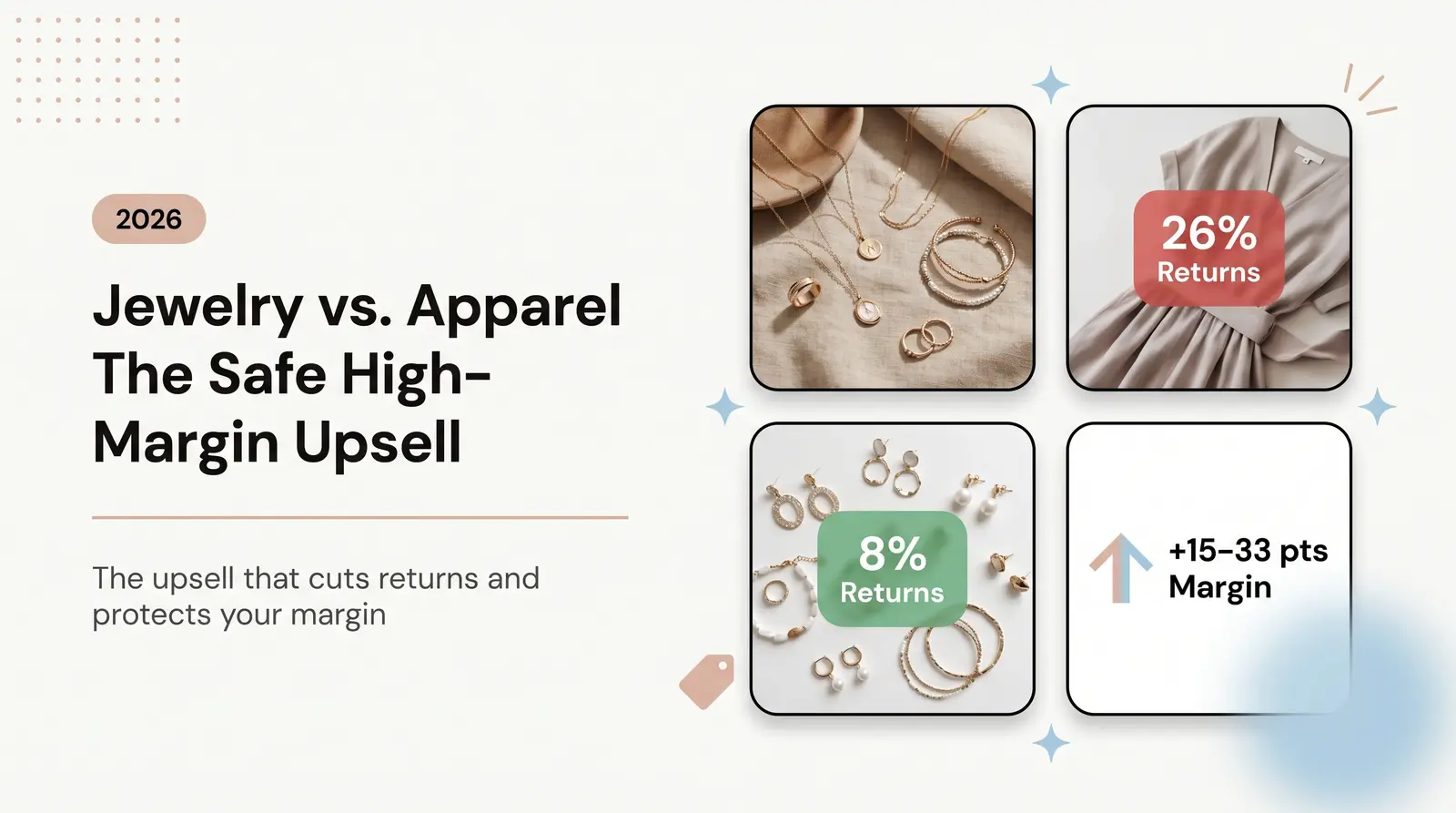



The “niche vs. general” debate is dead. Learn how to transform your single-category store into a profitable lifestyle brand by strategically adding high-margin “completer” accessories like jewelry.
Published:
January 29, 2026
Author:
Yi Cui
The debate over niche vs general store dropshipping has dominated founder forums for years. Aspiring entrepreneurs are often told to either “niche down” to a tiny, passionate audience or “go broad” to test countless products. But in our experience at Branvas, we see founders struggle with this binary choice, and frankly, it’s an outdated model. The future of profitable apparel commerce isn’t about being a niche or a general store; it’s about becoming a lifestyle brand.
Top fashion brands like Zara, ASOS, and Revolve consistently push accessories (jewelry, bags, belts, etc.) at checkout because it raises Average Order Value (AOV) and strengthens brand identity. They aren’t just selling clothes; they are selling a complete look, an identity. This is the crucial shift in thinking that separates struggling one-product stores from scalable, profitable lifestyle brands. This article provides a roadmap to expand your apparel store coherently, increase profitability, and build a brand that lasts.
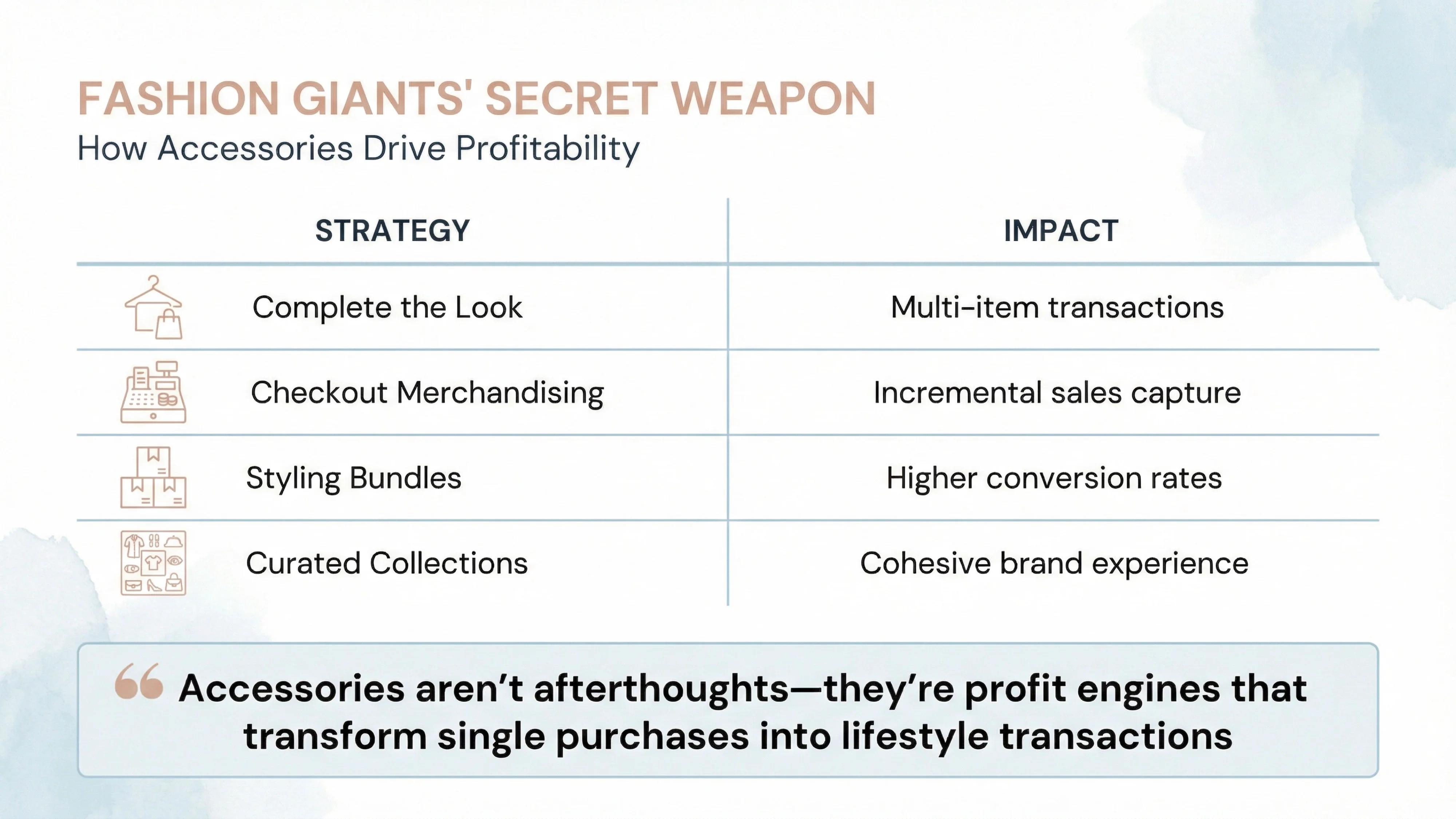
Major fashion brands have long understood that accessories are not just add-ons; they are a core component of their profit strategy. These brands masterfully use accessories to “complete the look,” turning a single clothing purchase into a multi-item transaction. They strategically merchandise their stores to present a complete lifestyle, where accessories are not an afterthought but an integral part of the brand’s identity. This approach is not just about aesthetics; it’s a powerful driver of AOV and brand loyalty.
At checkout, both online and in-store, you’ll notice that brands like Zara and ASOS prominently feature accessories. This isn’t by accident. It’s a deliberate strategy to capture incremental sales and increase the value of each customer. By offering styling bundles and curated collections, they make it easy for customers to visualize how accessories can enhance their outfits, leading to higher conversion rates and a more cohesive brand experience. This focus on the complete look is a key reason why these brands have been so successful in building massive, loyal customer bases. '''
While starting with a single apparel category can be a great way to launch a brand, many founders eventually find themselves hitting a growth ceiling. This is because apparel-only stores face a unique set of challenges that can limit their profitability and scalability. Understanding these limitations is the first step toward building a more resilient and profitable business.
One of the biggest constraints is Average Order Value (AOV). When you only sell clothing, you are limited to the price of a single item or a few items per transaction. According to a 2025 Shopify report, the AOV for apparel and accessories is between $40 and $170 [1]. While this is a respectable range, it pales in comparison to luxury and jewelry, where AOVs can exceed $300 [1]. By not offering complementary products, you are leaving money on the table with every transaction.
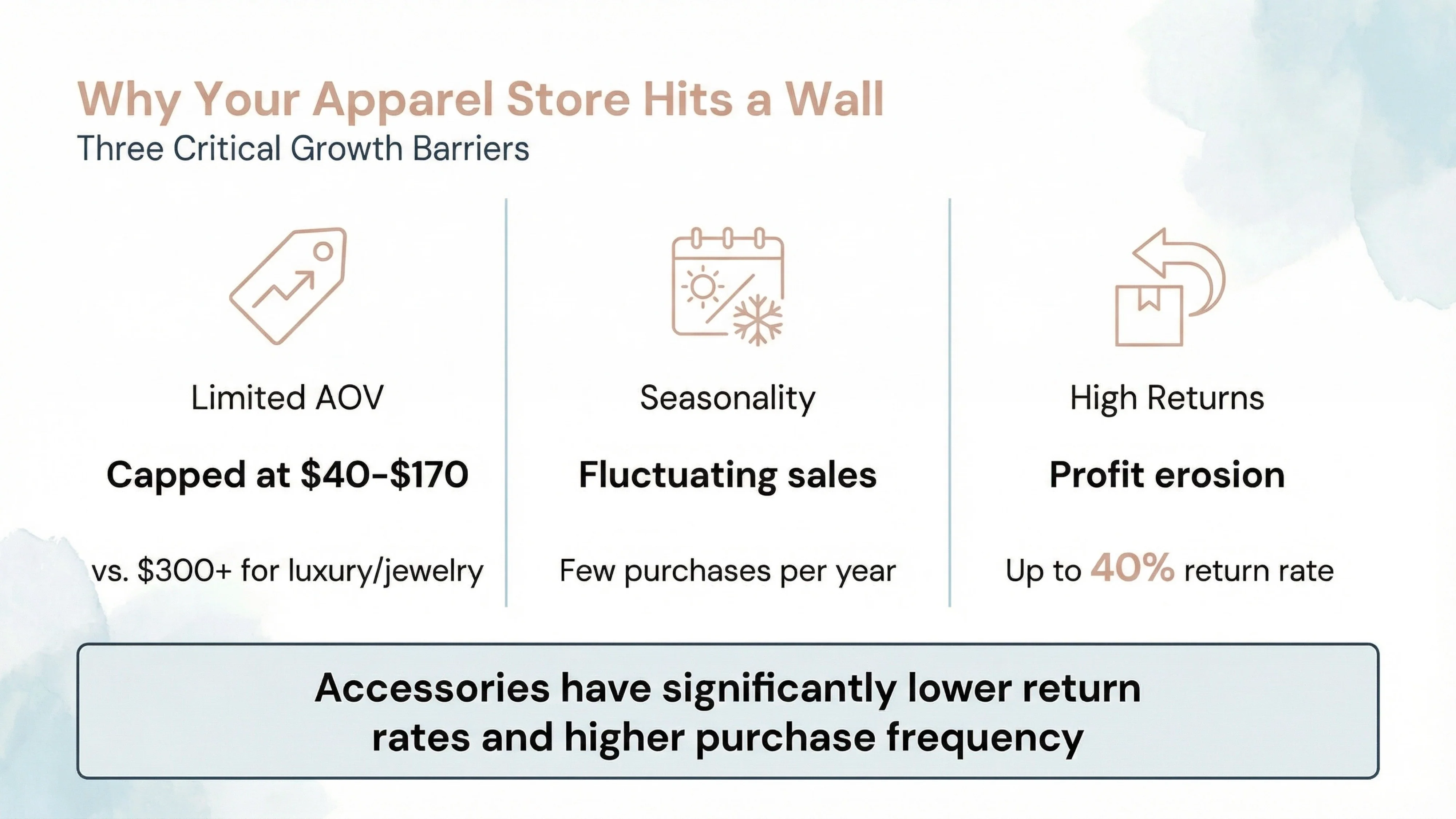
Seasonality and repeat purchase limits also pose a significant challenge. Apparel is often tied to specific seasons, which can lead to fluctuating sales throughout the year. Furthermore, customers may only purchase new clothing items a few times a year, limiting the opportunities for repeat business. This makes it difficult to build a consistent revenue stream and can lead to cash flow problems. Accessories, on the other hand, are less susceptible to seasonality and can be purchased more frequently, providing a more stable source of income.
Finally, high returns risk is a major issue for apparel-only stores. Clothing has one of the highest return rates in eCommerce, with some studies showing that up to 40% of online clothing purchases are returned. This is often due to issues with fit, color, or style. Returns not only eat into your profits but also create a logistical nightmare. Accessories, with their one-size-fits-most nature, have a much lower return rate, which can significantly improve your bottom line.
At Branvas, we developed The Lifestyle Expansion Map (LEM) to help apparel founders move beyond the limitations of a single-category store. This framework provides a clear, repeatable system for adding adjacent categories in a way that strengthens your brand identity and increases profitability. It’s not about becoming a random general store; it’s about building a coherent lifestyle brand, one layer at a time.

This is the foundation of your brand. It’s the apparel category you’re known for, whether it’s vintage-inspired graphic tees, minimalist linen dresses, or performance-driven activewear. Your core category establishes your brand’s identity and attracts your initial customer base. It’s the hero of your story, and every other category you add should complement and enhance it.
Completers are the accessories that finish the look. They are the logical next step for an apparel brand because they have a direct relationship with your core products. A customer who buys a dress from you is likely also in the market for a necklace or a belt to go with it. By offering completers, you are not only increasing your AOV but also providing a more complete solution for your customers.
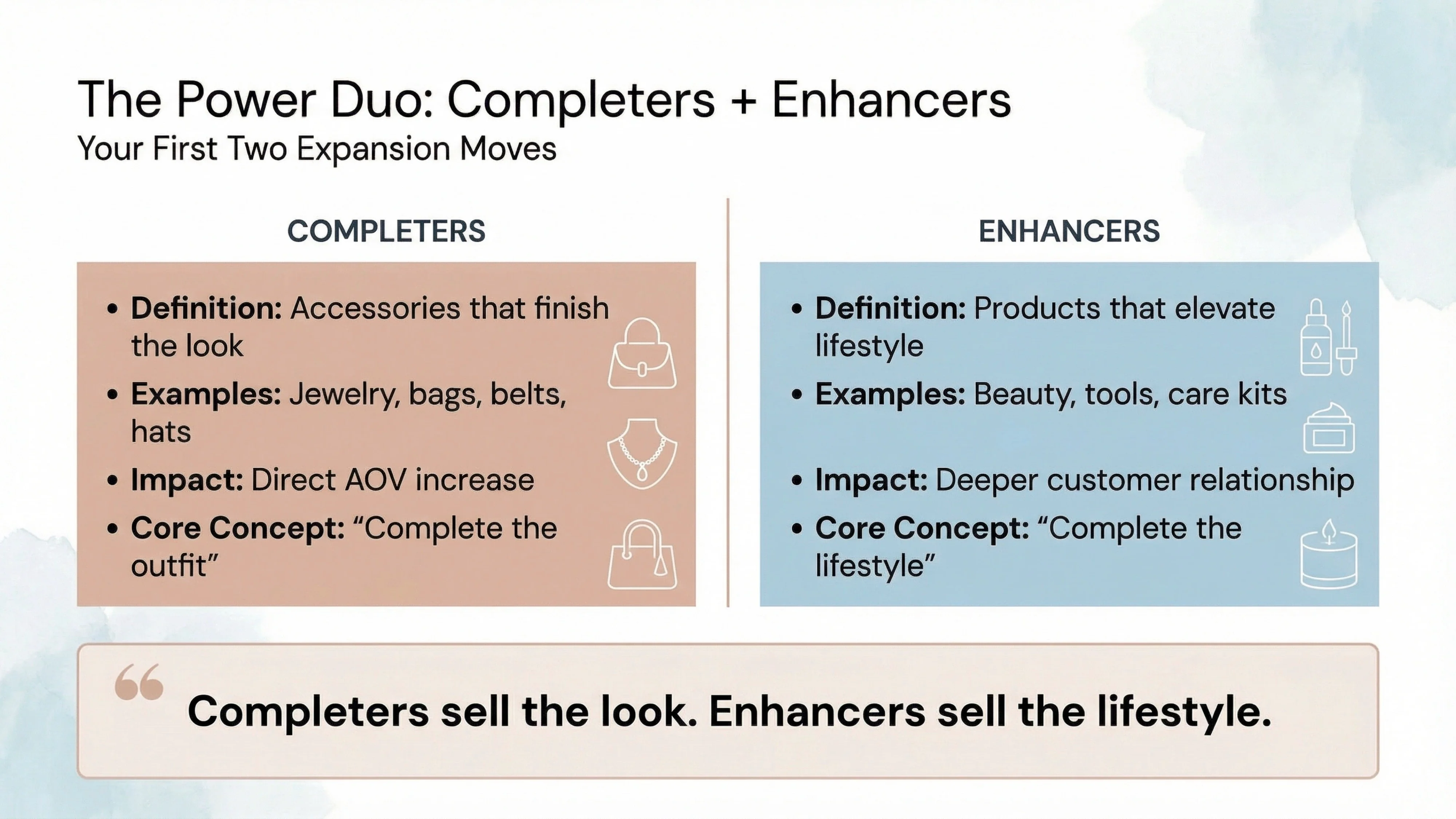
Enhancers are products that elevate the customer’s lifestyle beyond just their outfit. These are items that align with your brand’s values and aesthetic but are not directly worn. For a brand that sells sustainable swimwear, an enhancer could be a reef-safe sunscreen. For a brand that focuses on cozy loungewear, it could be a set of artisanal candles. Enhancers show that you understand your customer’s world and are committed to serving them in a more holistic way.
Identity signals are the non-product elements that communicate your brand’s story and values. This includes your packaging, your brand’s mission and story, and the way you showcase user-generated content (UGC). These signals are crucial for building a strong brand identity and creating an emotional connection with your customers. They are what make your brand more than just a collection of products.
Retention loops are the strategies you use to keep customers coming back. This includes limited-edition “drops,” product bundles, and seasonal capsules. These strategies create a sense of urgency and excitement, encouraging customers to make repeat purchases. They also allow you to test new products and categories without committing to a large amount of inventory.
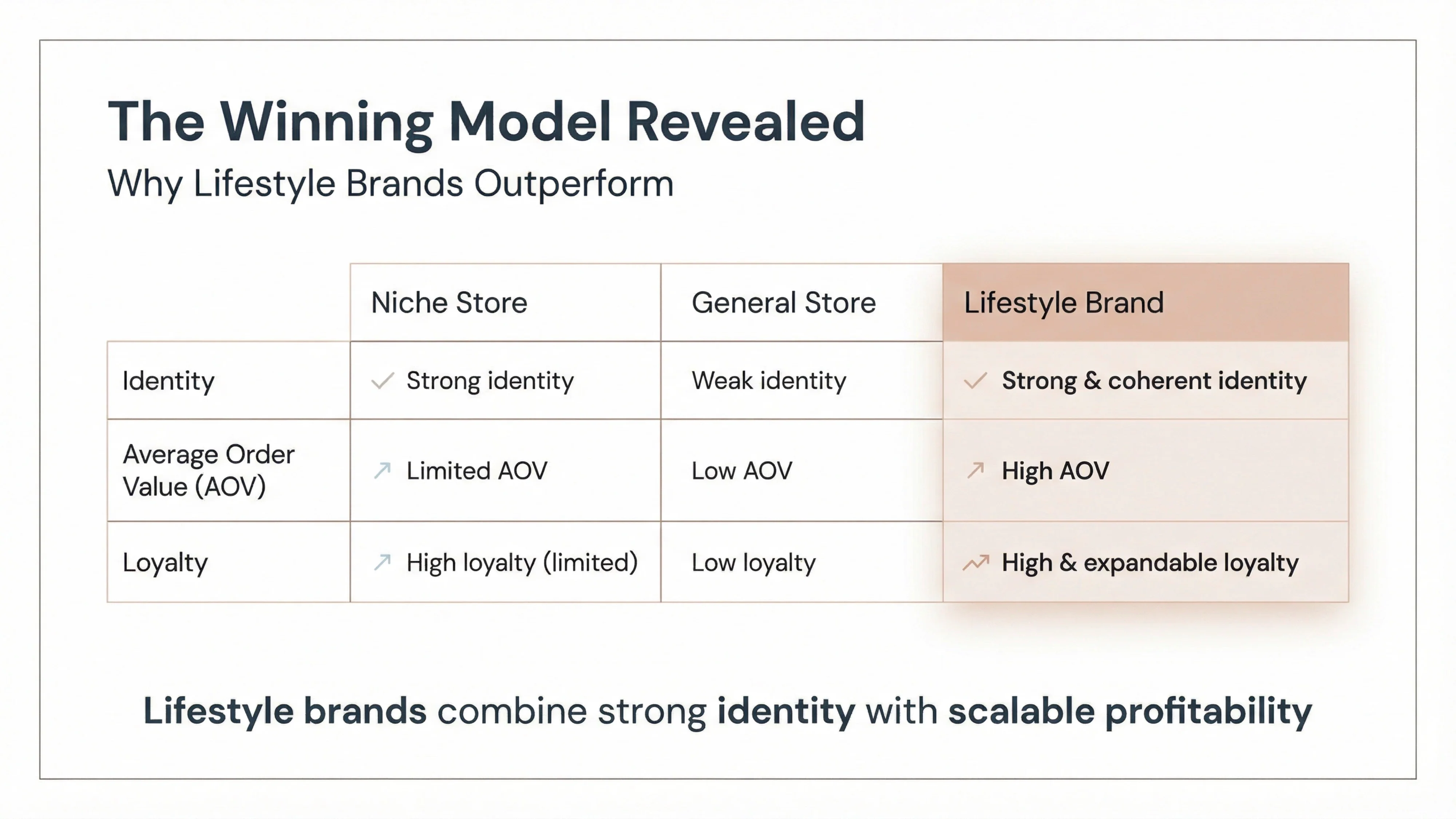
The question of niche vs general store dropshipping is one that every founder grapples with. However, as we've discussed, this is a false dichotomy. The real question is not whether to be niche or general, but how to build a coherent brand that can scale. To help you make a better decision, we’ve created a comparison table that breaks down the key differences between a niche store, a general store, and a lifestyle brand.
|
Feature |
Niche Store (Single Category) |
General Store (Random Products) |
Lifestyle Brand (Adjacent Categories) |
|---|---|---|---|
|
Brand Identity |
Strong, focused identity |
Weak, unfocused identity |
Strong, coherent identity |
|
Target Audience |
Highly specific, passionate audience |
Broad, undefined audience |
Specific, but expandable audience |
|
Product Curation |
Deep expertise in one category |
Random, unrelated products |
Curated products that complement the core identity |
|
AOV Potential |
Limited by single category |
Low, driven by impulse buys |
High, driven by multi-item purchases |
|
Customer Loyalty |
High, but limited to one category |
Low, customers are price-sensitive |
High, customers are loyal to the brand and its lifestyle |
|
Operational Complexity |
Low, focused on one product type |
High, managing multiple unrelated products |
Moderate, requires careful curation and inventory management |
|
Marketing Strategy |
Highly targeted, content-driven |
Broad, ad-driven |
Targeted, content-driven, with a focus on brand storytelling |
As you can see, the lifestyle brand model offers the best of both worlds. It allows you to maintain a strong brand identity while also expanding your product offerings and increasing your AOV. It’s a more sustainable and profitable way to build an eCommerce business.
Many founders are afraid to expand beyond their core apparel category because they fear it will dilute their brand. They believe that adding new products will make them look unfocused and random, like a general store. But we believe the opposite is true: multi-category doesn’t dilute your brand—it reveals it.
When you carefully select adjacent categories that complement your core identity, you are not diluting your brand; you are defining it. You are showing your customers that you understand their world and are committed to serving them in a more holistic way. You are moving beyond just selling products and are starting to build a true lifestyle brand.
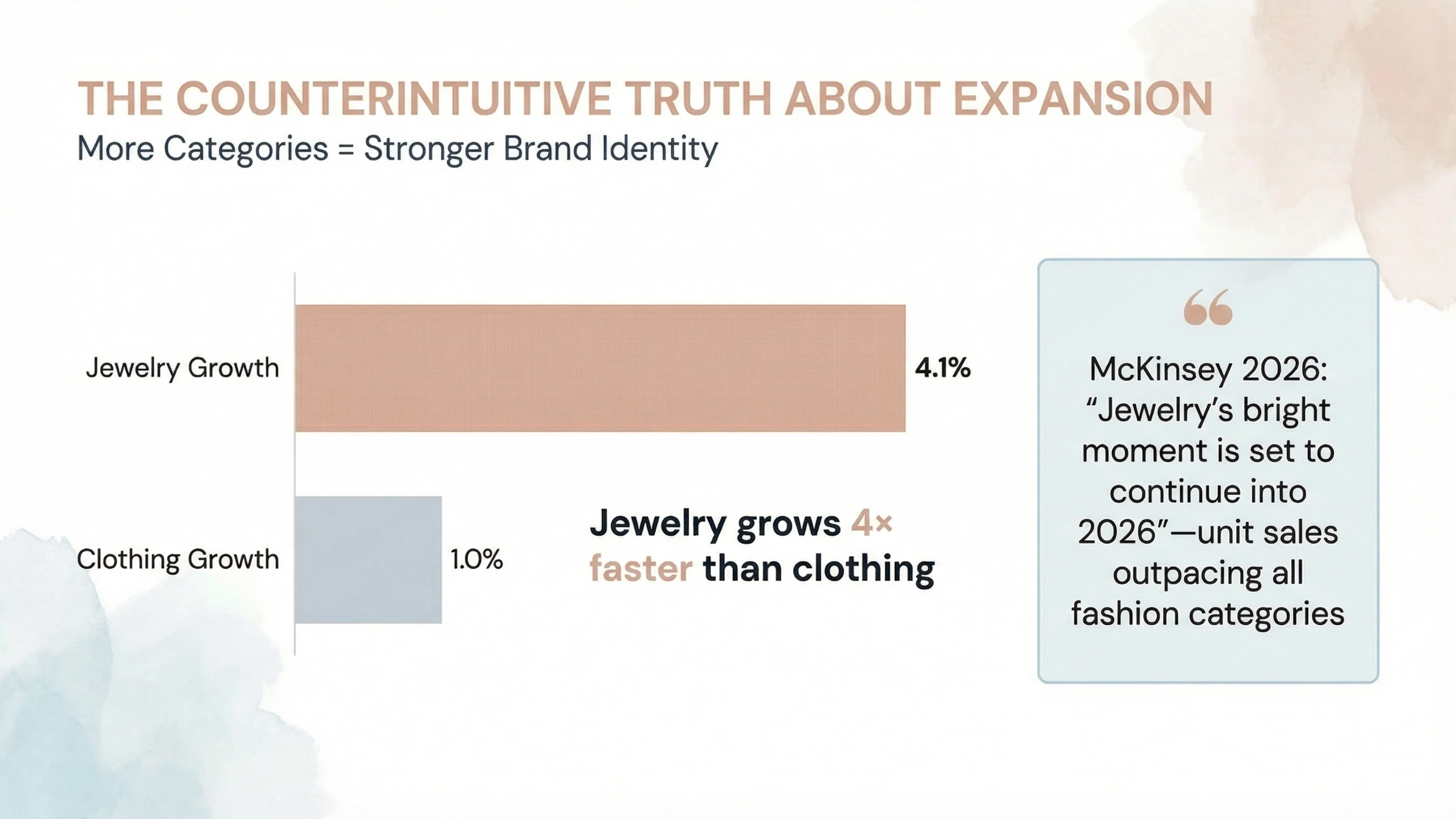
Recent data supports this. A 2026 McKinsey report highlights that "jewelry’s bright moment is set to continue into 2026," with unit sales growth outpacing all other fashion categories [2]. This presents a massive opportunity for apparel brands to expand into a high-growth, high-margin category that is a natural complement to clothing. By adding jewelry to your store, you are not just increasing your AOV; you are also signaling to your customers that you are a fashion-forward brand that is on top of the latest trends.
Furthermore, a 2025 report from Business of Fashion found that between 2025 and 2028, jewelry is projected to record an annual unit growth of 4.1%—four times the rate of clothing [3]. This is a clear indication that consumers are actively looking to purchase jewelry, and apparel brands are perfectly positioned to meet this demand. By offering a curated selection of jewelry that aligns with your brand’s aesthetic, you can capture a larger share of your customers’ wallets and build a more resilient business.
Expanding into new categories can be intimidating, but it doesn’t have to be. The key is to be strategic and intentional. Instead of randomly adding products, you need to have a clear plan for how you will expand your offerings in a way that is consistent with your brand identity. Here is a simple playbook to help you get started.
The easiest and most logical way to expand your product offerings is to start with “Completers.” These are the accessories that directly complement your core apparel category. If you sell dresses, start by adding jewelry, belts, and bags. If you sell activewear, consider adding hats, socks, and gym bags. By starting with completers, you are making it easy for your customers to see the value in your new products and are increasing the likelihood of a multi-item purchase.
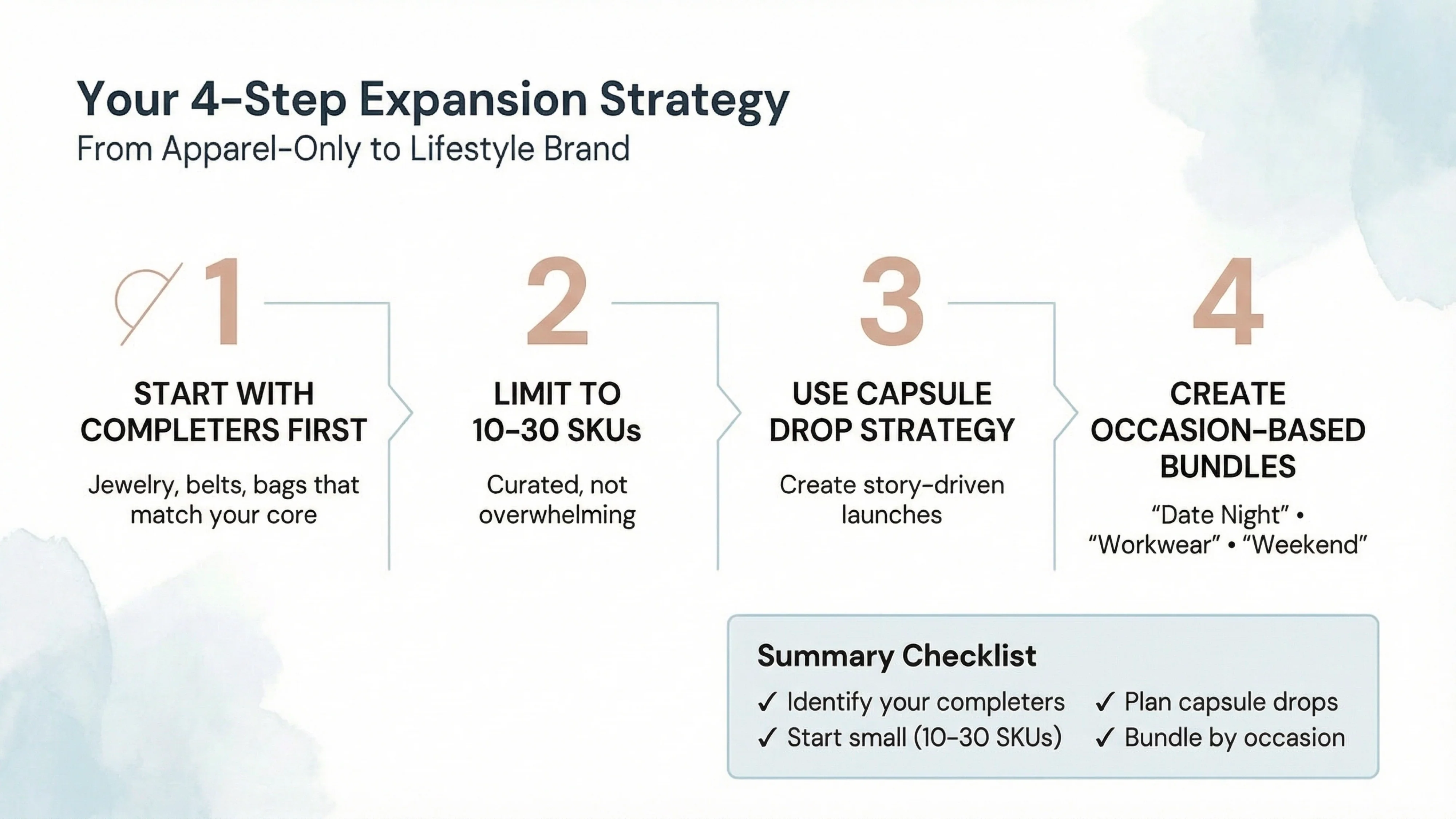
When you are first starting to expand your product offerings, it’s important to start small. Don’t try to add hundreds of new products at once. Instead, focus on a curated selection of 10–30 SKUs that are a perfect fit for your brand. This will allow you to test the waters and see what resonates with your customers without overwhelming them or creating a logistical nightmare for yourself.
A “capsule drop” is a great way to introduce new products to your customers. Instead of adding new products to your store on an ongoing basis, you can release them in small, curated collections. This creates a sense of urgency and excitement, and it allows you to test new products without committing to a large amount of inventory. It also gives you a great opportunity to tell a story around your new products and to show your customers how they can be styled with your core apparel items.
Occasion-based bundles are another great way to increase your AOV and to show your customers how your products can be styled together. For example, you could create a “date night” bundle that includes a dress, a necklace, and a clutch. Or you could create a “workwear” bundle that includes a blouse, a pair of trousers, and a tote bag. By creating these bundles, you are making it easy for your customers to shop and are increasing the likelihood of a multi-item purchase.
To help you stay on track, here is a simple checklist for expanding your product offerings:
✅ Identify your “Completers”: What accessories are a natural fit for your core apparel category?
✅ Start small: Curate a selection of 10–30 SKUs to start.
✅ Plan your “Capsule Drop”: Create a story around your new products and plan your launch.
✅ Create “Occasion-Based Bundles”: Make it easy for your customers to shop and to see the value in your new products.
✅ Test and iterate: Pay attention to what resonates with your customers and adjust your strategy accordingly.
The biggest hurdle for most founders when it comes to expanding their product offerings is inventory. The thought of investing in a large amount of new inventory can be terrifying, especially when you are not sure what will sell. But the good news is that you don’t have to take on a lot of inventory risk to expand your product offerings. There are a number of asset-light models that you can use to test new products and categories without breaking the bank.
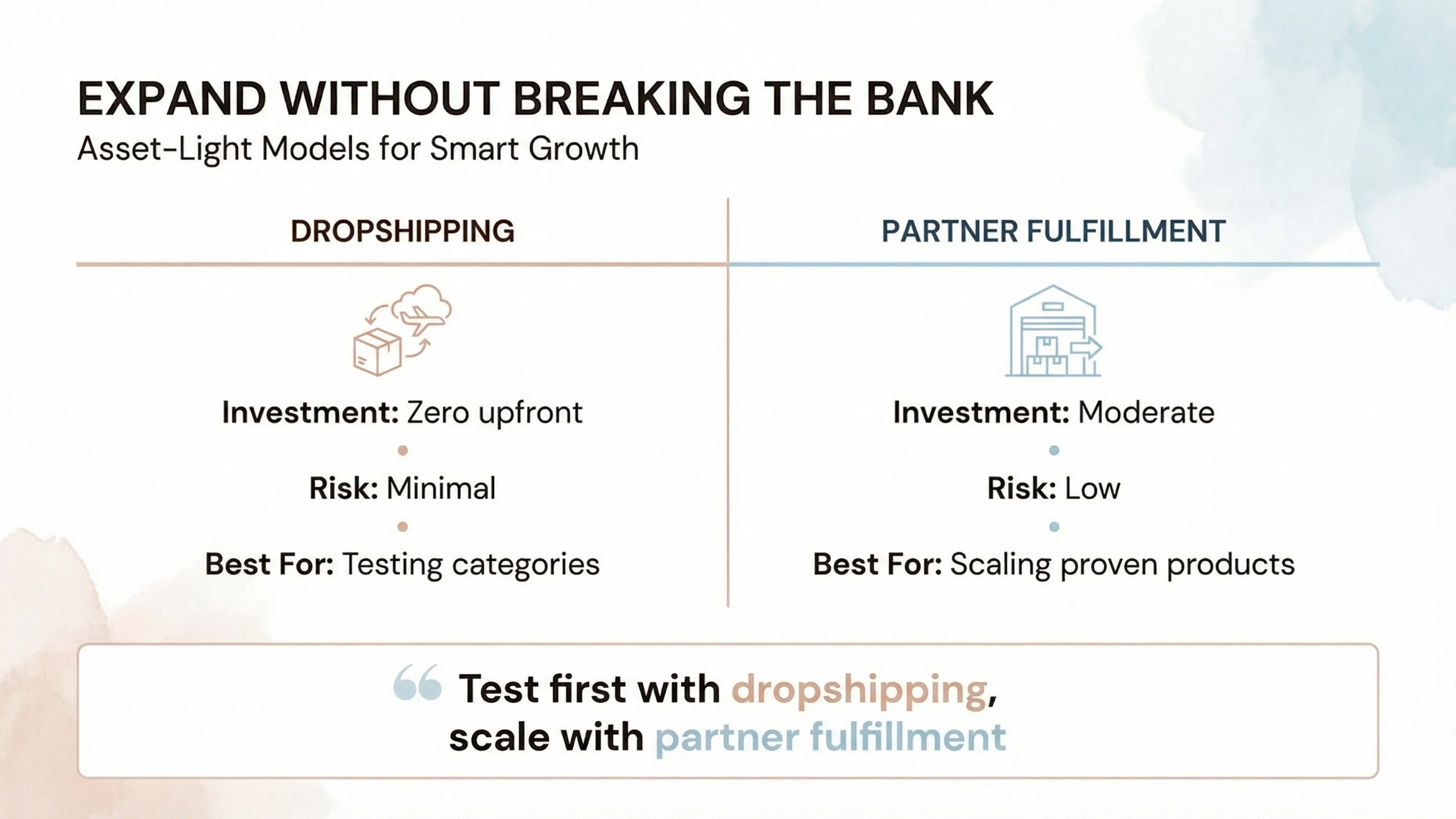
One of the most popular asset-light models is dropshipping. With dropshipping, you don’t have to purchase any inventory upfront. Instead, you partner with a supplier who will ship the products directly to your customers on your behalf. This is a great way to test new products and categories without taking on any inventory risk. However, it’s important to choose your dropshipping partners carefully. You need to make sure that they are reliable and that their products are high-quality. You also need to be mindful of branding and returns, as these can be more challenging to manage with a dropshipping model.
Another asset-light model is partner fulfillment. With partner fulfillment, you purchase the inventory, but you store it at a third-party logistics (3PL) provider. The 3PL will then pick, pack, and ship the orders to your customers on your behalf. This is a great option if you want to have more control over your inventory and branding but don’t want to have to deal with the hassle of fulfillment. It’s also a great way to scale your business, as you can easily add new products and categories without having to worry about running out of space in your own warehouse.
At Branvas, we specialize in helping apparel founders make the leap from a single-category store to a full-fledged lifestyle brand. We believe that the key to building a successful eCommerce business is to create a strong brand identity and to offer a curated selection of products that your customers will love. That’s why we offer a wide range of private-label accessories that you can use to expand your product offerings and to build a more profitable business.
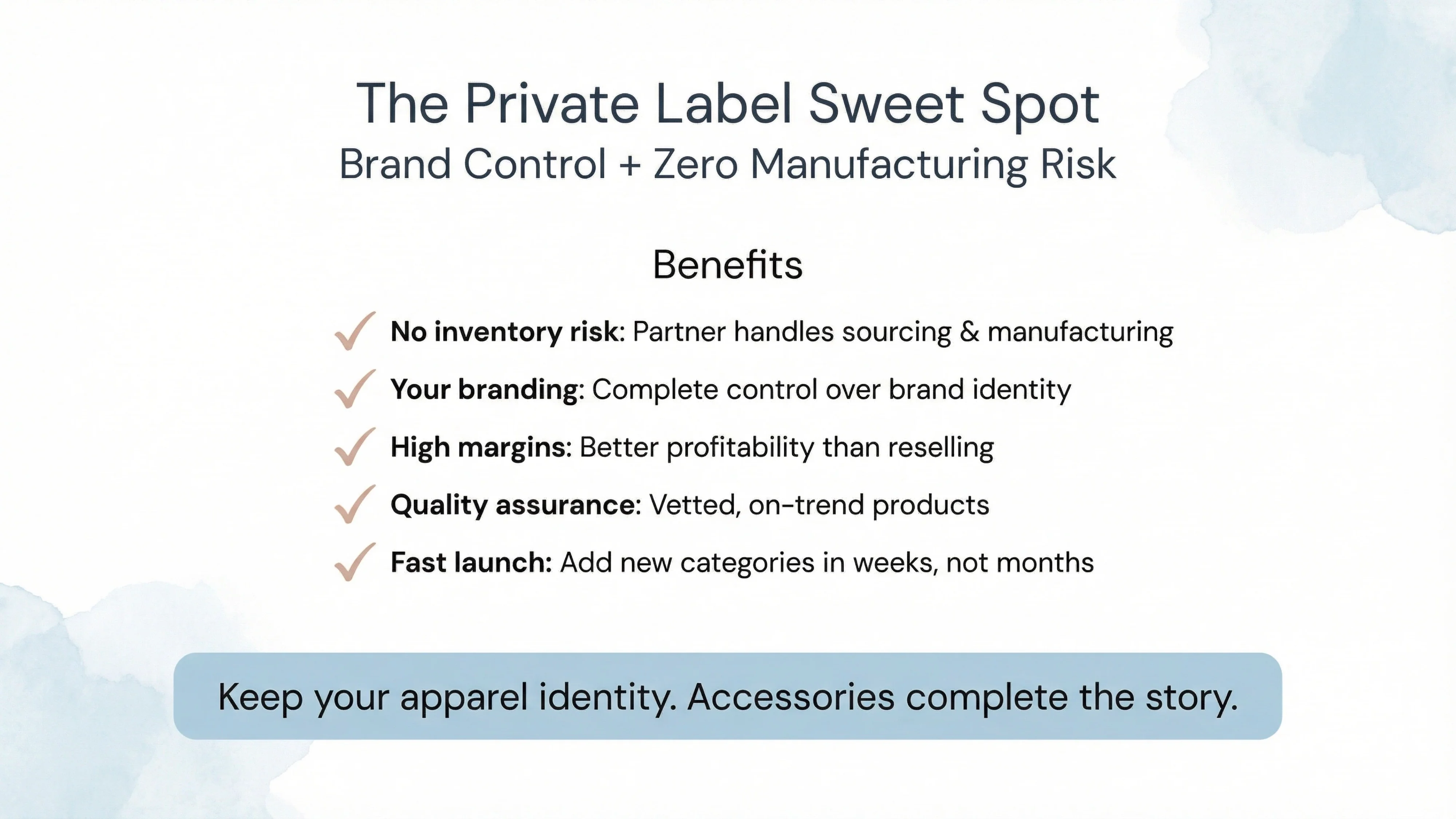
“Turn your niche apparel store into a ‘Lifestyle Brand’ using Branvas private labeling.”
Private labeling is the perfect way to add accessories to your store without taking on any inventory risk. We handle all of the sourcing, manufacturing, and branding for you, so you can focus on what you do best: building your brand and connecting with your customers. By adding jewelry from Branvas to your store, you can instantly increase your AOV and perceived brand value. Our jewelry is high-quality and on-trend, and it’s the perfect complement to any apparel brand.
You keep the apparel identity; accessories complete the story. With Branvas, you can easily add a new revenue stream to your business and build a brand that your customers will love for years to come. If you want to test accessories without holding inventory, Branvas can help. We offer a wide range of private-label jewelry that is perfect for any apparel brand, and we make it easy to get started.
Transitioning from an apparel-only store to a lifestyle brand is a journey, not a sprint. This 30/60/90-day roadmap provides a structured approach to help you expand your product offerings and build a more profitable business.
Your first 30 days are all about taking the first step. Choose one adjacent category to add to your store, preferably a “Completer” like jewelry. Select a small, curated collection of 10–30 SKUs and set up a checkout cross-sell to promote your new products. This will allow you to test the waters and start generating incremental revenue right away.
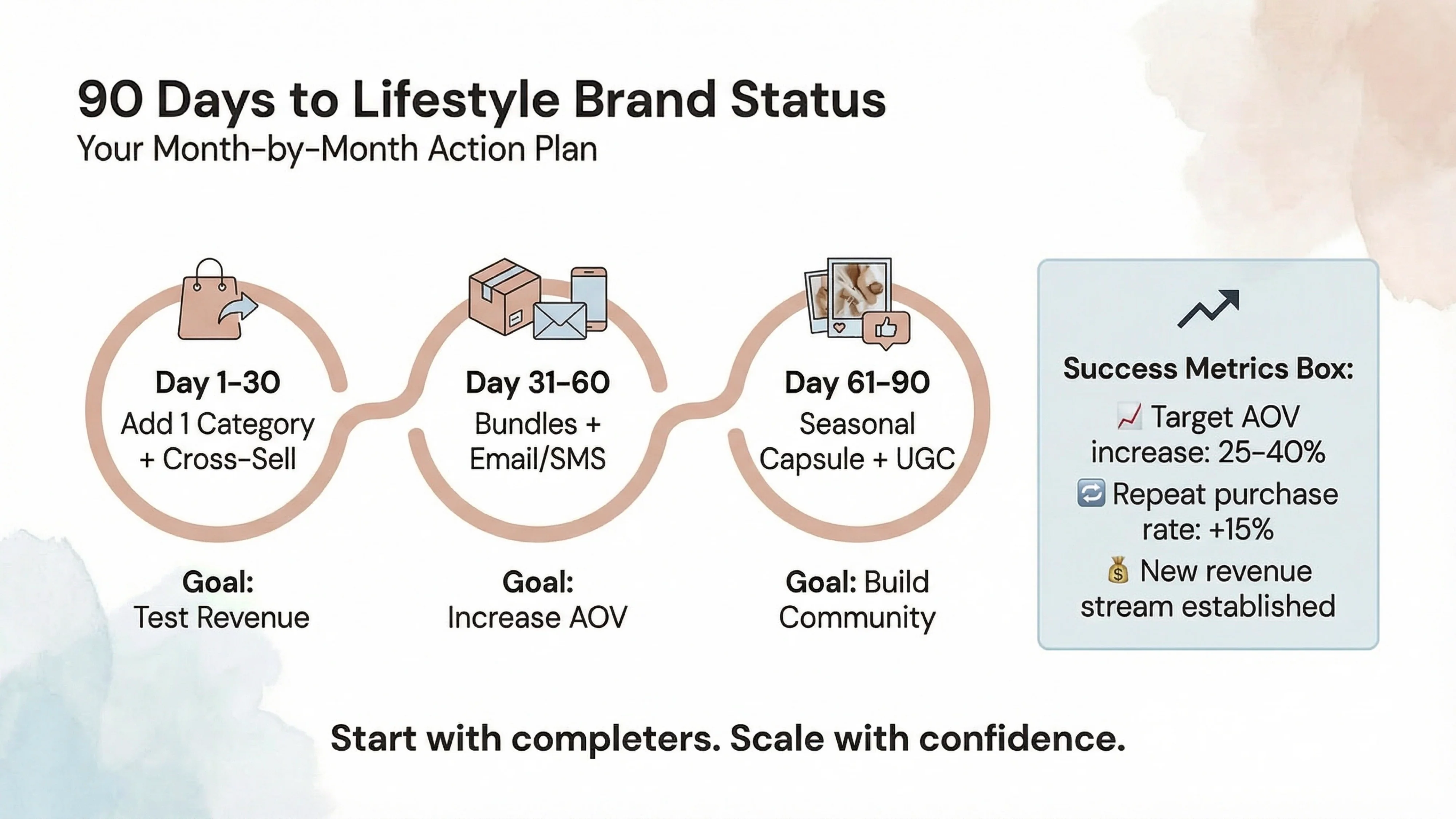
In your second month, it’s time to get more sophisticated with your marketing. Create occasion-based bundles that combine your core apparel items with your new accessories. This will not only increase your AOV but also show your customers how to style your products together. You should also set up email and SMS campaigns to promote your new products to your existing customers.
By day 90, you should have a good understanding of what resonates with your customers. Now it’s time to start planning your first seasonal capsule drop. This will create a sense of urgency and excitement, and it will give you a great opportunity to tell a story around your new products. You should also start encouraging your customers to share photos of themselves wearing your products on social media. This user-generated content (UGC) is a powerful form of social proof, and it will help you to build a strong community around your brand.
While a niche store allows for a stronger brand identity and more targeted marketing, a general store offers the flexibility to test a wider range of products. However, the most successful model in 2026 and beyond is the lifestyle brand, which combines a focused identity with complementary, adjacent product categories to increase AOV and customer loyalty.
A lifestyle brand is a brand that has a strong identity and a curated selection of products that appeal to a specific customer demographic. It’s a brand that understands its customers’ world and is committed to serving them in a more holistic way. It’s not just about selling products; it’s about building a community and creating an emotional connection with your customers.
The key is to be strategic and intentional. Start by adding “Completers,” which are accessories that directly complement your core apparel category. Use a “capsule drop” strategy to introduce new products in small, curated collections. And create occasion-based bundles to show your customers how your products can be styled together.
Accessories increase profitability in several ways. They have a higher margin than apparel, and they have a lower return rate. They also increase AOV by encouraging customers to purchase multiple items in a single transaction. And they are less susceptible to seasonality, which can help to stabilize your revenue throughout the year.
There are a number of asset-light models that you can use to add jewelry to your store without holding any inventory. The most popular model is dropshipping, where you partner with a supplier who will ship the products directly to your customers on your behalf. Another option is private labeling, where you partner with a company like Branvas to create your own line of branded jewelry.
[1] “Average Order Value (AOV): Formula, Benchmarks and 7 Ways to Increase It (2026),” Shopify, September 18, 2025, https://www.shopify.com/il/blog/average-order-value.
[2] “The State of Fashion 2026: When the rules change,” McKinsey & Company, November 17, 2025, https://www.mckinsey.com/industries/retail/our-insights/state-of-fashion.
[3] “Why the Shine Isn’t Fading on Jewellery Sales,” The Business of Fashion, December 10, 2025, https://www.businessoffashion.com/articles/luxury/the-state-of-fashion-2026-report-jewellery-category-sales/.
[4] “Top digital marketing trends and predictions for 2026,” Think with Google, December 2025, https://www.thinkwithgoogle.com/intl/en-emea/consumer-insights/consumer-trends/digital-marketing-trends-2026/.
[5] “Start Shopify Dropshipping for Beginners: The 2026 Blueprint,” Doba, January 23, 2026, https://www.doba.com/blog/dropshipping-platforms/shopify-dropshipping/start-shopify-dropshipping-for-beginners-the-2026-blueprint-39221?srsltid=AfmBOoqXm9-S6QwiwzrFzHfskeOgQmYfY_mtRD374RKggaWh_VKLXRj2.