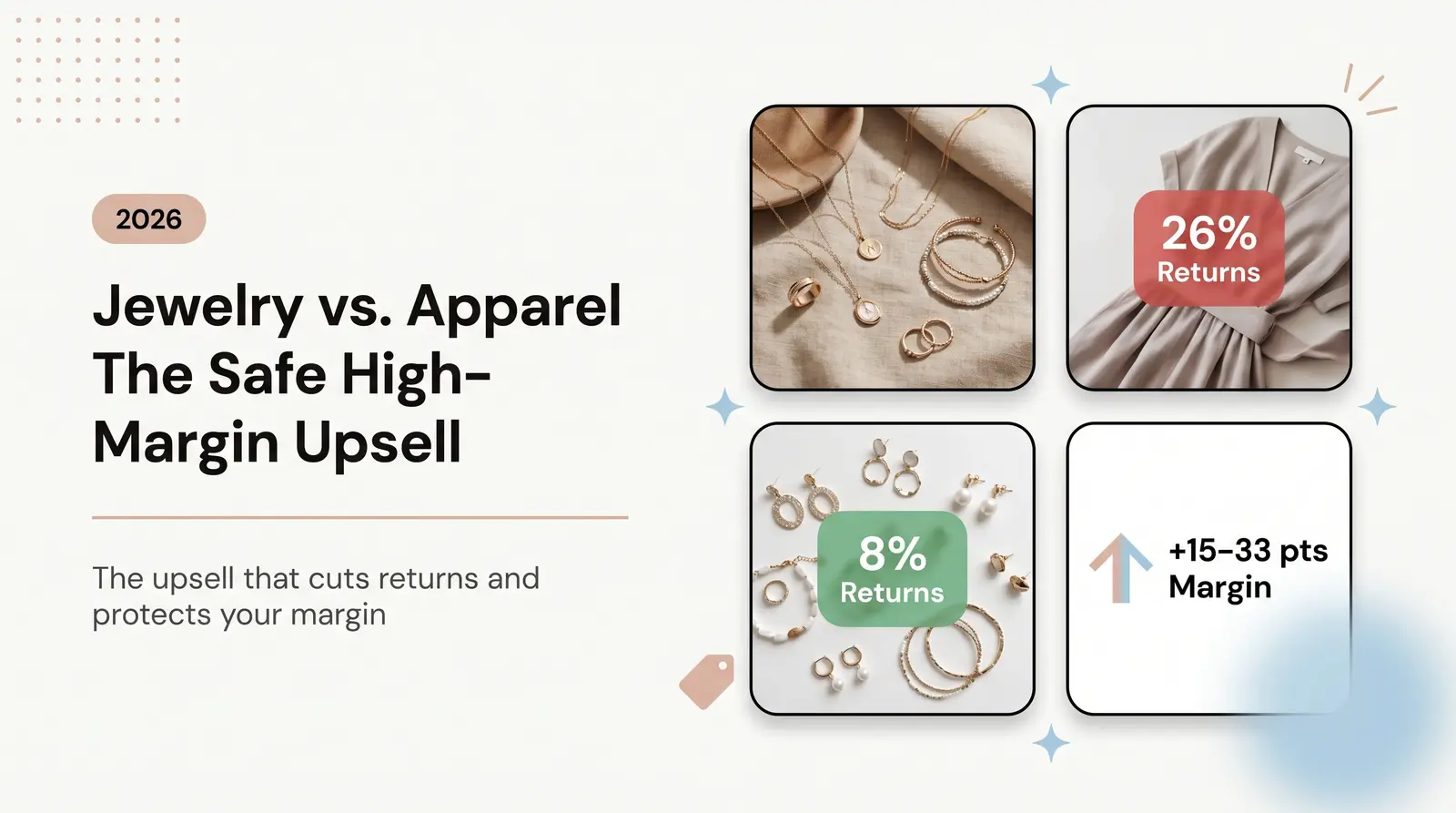



Adding low-return jewelry to your store structurally improves blended margins by offsetting the high return rates and hidden costs of apparel SKUs.
Published:
March 15, 2026
Author:
Yi Cui
Jewelry doesn't just add revenue. It can stabilize margins. For fashion and apparel store owners, this isn't a clever line. It's a fundamental business insight. While you're focused on selling beautiful clothing, a silent tax is being levied on your revenue. The average return rate for online apparel hovers between 24% and 28% [1] [2], and each of those returns costs far more than just the refund. Processing a single returned item can cost anywhere from $10 to over $20, excluding the lost margin on the product itself [3]. By the end of this article, you will understand how to use accessories as a structural margin lever to combat this erosion, not just as a simple upsell tactic.
The true cost of a return goes far beyond the initial refund. It includes reverse logistics (shipping the item back), inspection, repackaging, and restocking labor. It also includes the wasted customer acquisition cost for a sale that was ultimately unwound.
There's another number most operators don't track: roughly 30% of returned items cannot be resold at full price due to damage, signs of wear, or a missed selling window [4]. That forces costly markdowns or liquidation, which directly erodes your gross margin even further.
This is what we call return-driven margin erosion: the gap between the gross margin you see at checkout and the effective margin you actually keep after the full return cycle plays out. We often see founders at Branvas who are shocked when they map their actual contribution margin after returns. Numbers that looked healthy at checkout collapse fast.
Add return fraud on top of that. The National Retail Federation reported that 15.1% of all retail returns in 2024 were fraudulent, costing retailers $103.8 billion [2]. For apparel, this problem is especially acute, since clothing is the most commonly wardrobed and bracketed category.

Contribution margin is the revenue left over after subtracting Cost of Goods Sold (COGS) and variable costs. It's the money that contributes to covering your fixed costs and, eventually, generating profit. But for a fashion business, this metric is dangerously incomplete.
At Branvas, we advise founders to use a framework we call Return-Adjusted Contribution Margin (RACM). This metric gives a brutally honest view of how much real profit a SKU generates after accounting for the full impact of returns.
The formula is:
RACM = (Revenue x (1 - Return Rate)) - COGS - Variable Costs - Return Processing Cost
Let's compare two SKUs side by side.
Apparel SKU RACM Calculation:
Jewelry SKU RACM Calculation:
The apparel SKU is losing $1.66 per unit sold. The jewelry SKU is generating $17.83 in real profit per unit sold. Despite a lower selling price, the jewelry SKU wins by a wide margin. That's the structural advantage of a low-return category.
(Variable cost estimates are illustrative. Your actual figures will vary based on your shipping carrier, payment processor, and fulfillment model.)

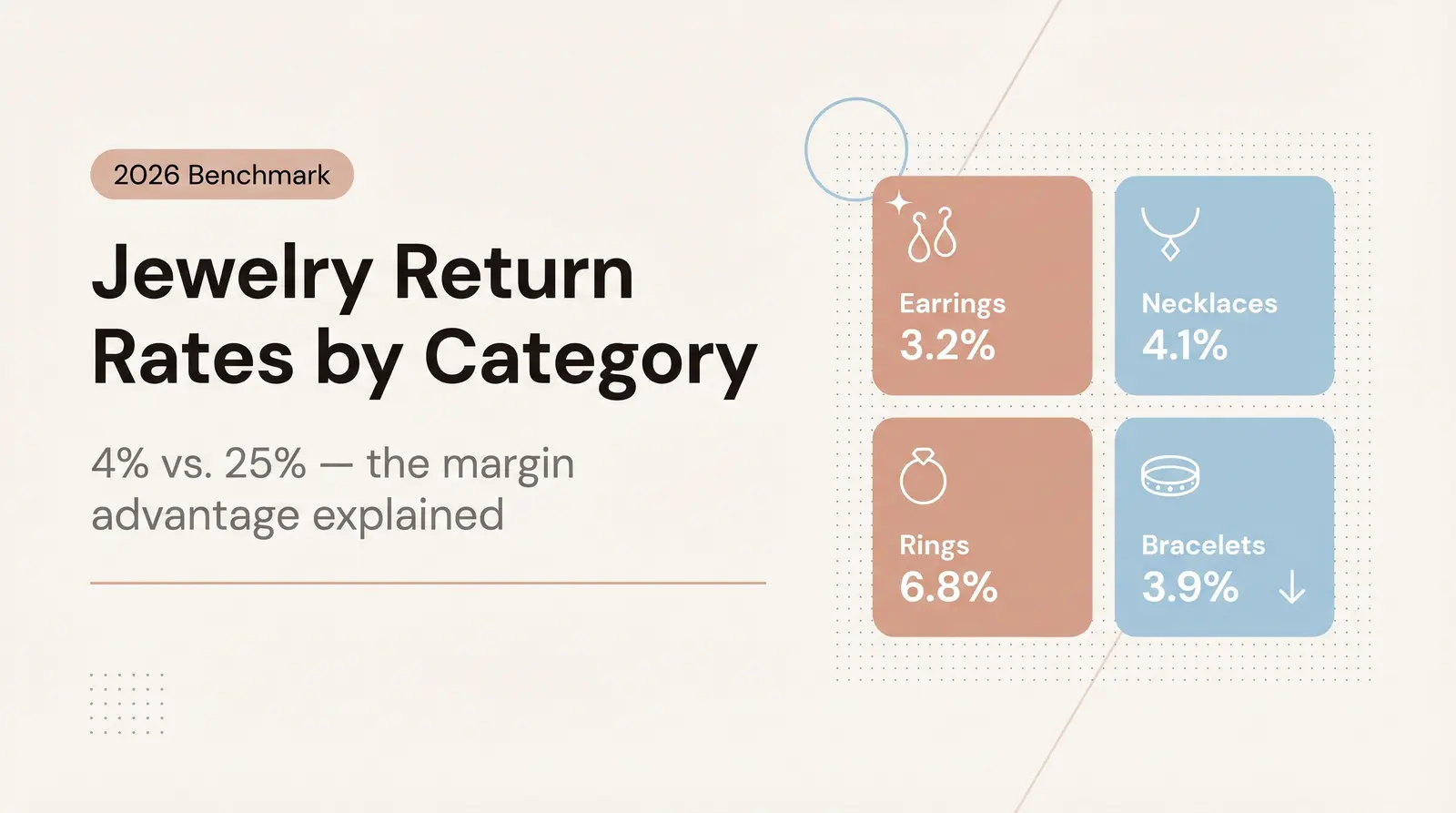
The dramatic difference in RACM comes down to one core driver: accessories and jewelry return rates are structurally lower than apparel. While online apparel return rates average 24-28% [1] [2], jewelry returns typically fall in the 4-8% range and accessories in the 7-13% range [5] [6].
The reasons are rooted in the nature of the product, not in customer behavior.
Fit is not a factor. The single biggest driver of apparel returns is poor fit, cited in over 50% of returns [7]. Jewelry is largely one-size-fits-all. That entire category of returns simply doesn't exist.
Sizing is minimal. For items like rings or bracelets, sizing is far simpler and less variable than clothing. A customer who orders a size 7 ring has far more certainty than one ordering a size 8 dress.
Gifting drives purchase intent. Jewelry is frequently purchased as a gift or for a special occasion. This creates a higher emotional attachment to the item and a lower likelihood of return. The purchase decision is more deliberate.
Price points reduce buyer's remorse. At accessible price points, typically under $75, there is less financial incentive for a customer to go through the hassle of initiating a return. The friction of the process outweighs the recovery.
Most merchants assume returns are a customer behavior problem to be solved with better sizing charts. The more durable fix is category mix. Adding low-return SKUs is a structural hedge, not a workaround. This shifts the focus from fixing individual customer issues to strengthening the financial foundation of the entire store. That's a fundamentally different, and more powerful, approach to ecommerce profitability.

Blended margin is the average contribution margin across all categories in your store, weighted by their share of revenue. When you only sell apparel, your blended margin is fully exposed to high return rates. Introduce a low-return category like accessories, and you change the math at the store level.
To illustrate this, we use the Branvas Blended Margin Matrix, a simple model for understanding how adding accessories shifts your blended RACM.
| Scenario | Apparel Revenue Mix | Accessories Revenue Mix | Blended Return Rate (est.) | Blended RACM (est.) |
|---|---|---|---|---|
| Apparel-Only Store | 100% | 0% | ~26% | Low |
| Apparel-Dominant | 80% | 20% | ~22% | Moderate |
| Balanced Mix | 60% | 40% | ~19% | Higher |
| Accessories-Forward | 40% | 60% | ~15% | Highest |
Estimated blended return rates are calculated as weighted averages, based on a ~26% rate for apparel and an ~8% rate for accessories, derived from industry benchmark data [1] [5]. These are estimates. Your actual figures depend on your specific product mix, AOV, COGS, and logistics costs.
Use Branvas's Profit Calculator at branvas.com/profit-calculator to model your specific store.
In our experience at Branvas, sellers who shift even 20% of their revenue mix toward accessories see a measurable improvement in their effective margin within the first 90 days.

Adding an accessories line isn't about randomly stocking shiny objects. It's a strategic move that requires a clear process.
Step 1: Audit your current return rate by category. Pull a report from your Shopify, WooCommerce, or order management system. Break it down by product category. You need to know your baseline before you can improve it.
Step 2: Calculate your current RACM. Use the formula above for your top-selling apparel items. This will reveal which SKUs are actually profitable and which ones are quietly destroying your margins.
Step 3: Identify complementary accessory styles. Look for pieces that align with your existing brand aesthetic. If you sell bohemian dresses, delicate gold-plated necklaces and natural stone bracelets fit naturally. Random SKUs that don't match your brand voice will hurt repeat purchase rates, not help them.
Step 4: Source private-label accessories with consistent quality. If you're sourcing accessories for the first time, platforms like Branvas (branvas.com/how-it-works) handle private-label sourcing, custom branding, and blind fulfillment, so you can test accessories without warehouse overhead.
Step 5: Launch with a tight SKU count. Start with 3-5 hero pieces. Measure their RACM after 60-90 days. Expand based on what the data tells you, not what looks good on a mood board.
Step 6: Bundle accessories with high-return apparel SKUs. A $45 necklace bundled with a $95 dress increases perceived value and gives the customer a stronger emotional connection to the overall purchase. That connection reduces the likelihood of returning the apparel item.

Not all products are created equal when it comes to return risk. We developed the Branvas Returns-Proof SKU Scorecard to help sellers identify products with the highest potential for profitability.
Rate each potential product on the following criteria:
| Criterion | Points |
|---|---|
| Fit-independent (does not require body-specific sizing) | 3 pts |
| Sub-$75 price point (reduces buyer's remorse) | 2 pts |
| Gift-purchase eligible (expands use case) | 2 pts |
| Complementary to existing catalog (brand coherence) | 2 pts |
| Material/quality consistency achievable at scale | 3 pts |
| Total possible | 12 pts |
SKUs scoring 9 or higher are high-priority additions to your catalog. Most jewelry and accessories score 10-12 on this rubric. Most fashion apparel scores 4-7.

Industry benchmark data consistently shows that jewelry and accessories have significantly lower return rates than apparel. Jewelry typically falls in the 4-8% return rate range, while accessories broadly sit around 7-13% [5] [6]. Compare that to the 24-28% average for online apparel [1] [2], and the structural advantage becomes clear. The gap is not marginal. It's the difference between a profitable category and one that erodes margins.
High return rates erode profit through multiple simultaneous channels. You lose the revenue from the refund. You pay for reverse logistics. You pay for inspection and restocking labor. You often lose the original outbound shipping cost. And if the item can't be resold at full price, you take a markdown or liquidation loss on top of all of that. The result is that a product with a 40% gross margin can easily generate negative contribution margin once returns are factored in, as the worked example in this article demonstrates.
Yes, through blended return rate mechanics. Your store's overall return rate is a weighted average across all categories. By shifting a portion of your revenue from high-return apparel to low-return accessories, you lower that weighted average. This directly improves your blended Return-Adjusted Contribution Margin (RACM) and overall ecommerce profitability, without requiring you to overhaul your apparel catalog or change your return policy.
Items that are not size-dependent and carry strong gifting appeal tend to have the lowest return rates. Necklaces and earrings are typically the safest bets. Many bracelet styles also perform well. Rings carry slightly more return risk due to sizing, but even they return at a fraction of the rate of apparel. The key is to prioritize styles that are easy to photograph, clearly described, and fit a wide range of customers without requiring a specific body measurement.
Platforms like Branvas operate on a Brand-as-a-Service model, which means you can launch a private-label jewelry line without holding any inventory. Branvas handles product sourcing, custom branding, packaging, and blind fulfillment directly to your customers. You test the market, measure your RACM, and scale what works, without the financial risk of upfront inventory investment or the operational complexity of managing a warehouse.
High return rates are not just a cost of doing business in fashion ecommerce. They are a direct, measurable threat to your profitability. The conventional response, better sizing guides, stricter return policies, and improved product photography, addresses symptoms. The structural solution is category mix.
By incorporating low-return, high-margin accessories into your store, you create a financial hedge that stabilizes your blended margins and compounds over time. The RACM framework and the Blended Margin Matrix are tools you can apply today. Run the numbers on your own catalog. The results will likely surprise you.
If you're ready to add a private-label jewelry or accessories line to your store, without inventory risk, Branvas makes it straightforward. Explore the catalog, build your brand, and start improving your blended margins: Launch your accessories brand at Branvas
The stores that win in fashion ecommerce won't just sell better products. They'll sell smarter category mixes.
[1] The True Cost of Apparel Returns: Alarming Return Rates Require Loss-Minimization Solutions. Coresight Research (2023). https://coresight.com/research/the-true-cost-of-apparel-returns-alarming-return-rates-require-loss-minimization-solutions/
[2] Average Retail Return Rate (2026 Data): eCommerce vs In-Store. Capital One Shopping (January 2026). https://capitaloneshopping.com/research/average-retail-return-rate/
[3] What Are Average Return Rates for Ecommerce? Red Stag Fulfillment. https://redstagfulfillment.com/average-return-rates-for-ecommerce/
[4] What Really Happens To Our Online Shopping Returns? Baptist World Aid (April 2024). https://baptistworldaid.org.au/2024/04/03/what-really-happens-to-our-online-shopping-returns/
[5] The Ecommerce Returns Benchmark Report 2023. Loop Returns (2023). https://info.loopreturns.com/hubfs/The%20Ecommerce%20Returns%20Benchmark%20Report%20-%20Loop%202023.pdf
[6] Most Returned Online Purchases by Category in the U.S. 2025. Statista (2025). https://www.statista.com/forecasts/997235/most-returned-online-purchases-by-category-in-the-us/
[7] Most Common Return Reasons in Ecommerce by Vertical (2026 Data and Trends). Loop Returns (February 2026). https://www.loopreturns.com/blog/items-returned-most-often-ecommerce/
[8] NRF and Happy Returns: 2024 Consumer Returns in the Retail Industry. National Retail Federation (December 2024). https://nrf.com/research/2024-consumer-returns-retail-industry
[META DESCRIPTION SUGGESTION]
High apparel returns eating your profit? Learn how adding low-return accessories like jewelry can structurally improve your ecommerce margins and reduce your blended return rate.