


Women’s apparel stores can increase average order value by adding jewelry using smart category picks, merchandising strategies, and inventory-free fulfillment models.
Published:
March 7, 2026
Author:
Yi Cui
Add jewelry to a women's apparel catalog the smart way: category picks, merchandising, and ops without tying up cash in inventory.
Women's apparel stores are sitting on one of the most underused revenue levers in retail: accessories. Jewelry is a natural complement to clothing, and adding even a small selection can lift average order value, increase basket size, and give customers a reason to come back more often. This guide covers which jewelry categories to add, how to price and merchandise them, and how to do it without committing to inventory you're not sure will sell.
The strategic case is straightforward. Jewelry is a high-margin, low-weight, easy-to-ship category that fits naturally into the shopping context your customers are already in. When someone is buying a dress or a blouse, they're already thinking about how they'll wear it. A well-placed jewelry suggestion at that moment is not an interruption. It's a service.
Average order value is the most immediate benefit. The average AOV for clothing ecommerce stores is around $109 [1]. A store operating at that baseline that successfully attaches a $28-$45 jewelry piece on 15-20% of orders could see AOV increase by roughly 4-8% over time. That's a conservative, illustrative estimate based on typical accessory attach rates, not a guarantee, but it reflects the kind of directional lift that makes the category worth testing.
Beyond the first order, jewelry creates repeat purchase triggers that apparel alone often doesn't. A customer who buys a necklace to match a top she bought last month has a reason to return. Accessories are also gifted frequently, which opens your store to purchase occasions, like birthdays and holidays, that a pure apparel catalog might miss.
Industry data shows that cross-selling strategies contribute between 10-30% of ecommerce revenues for stores that implement them effectively [2]. Accessories specifically carry a median ecommerce conversion rate of 7.4% across fashion verticals [3], which is exceptionally high compared to other categories. Fashion and apparel brands also see approximately 25-26% repeat customer rates [4], and adding a complementary category like jewelry gives you more touchpoints to bring customers back without increasing acquisition costs.

The categories that work best for apparel stores are versatile, accessible in price, and easy to style alongside clothing in photos and displays. Here are seven that consistently perform well in this context.
Layered Necklaces: $22-$55
Layered necklaces work with everything from casual tees to occasion tops, making them easy to cross-sell across your entire catalog. The key is to photograph them on models wearing your clothing, not as standalone shots. A delicate two-layer gold chain on a V-neck blouse product page lifts the add-to-cart rate on both items.
Stacking Rings: $14-$38 per ring, or $32-$65 as a set
Stacking rings are a natural gifting item and a strong impulse buy at lower price points. Adjustable styles eliminate sizing complexity, which is the main barrier to selling rings online. Merchandise these near your casual and boho apparel lines.
Statement Earrings: $18-$48
Statement earrings sell well alongside occasion wear, going-out tops, and workwear. Oversized hoops and sculptural drops perform in spring and summer; pearl and gemstone styles carry through fall and holiday. Display them on mannequins styled with your apparel hero pieces to show the full look.
Dainty Gold and Silver Chains: $18-$42
Simple chains are the most universally wearable jewelry category. They layer well, suit almost any occasion, and appeal to a wide age range. These are your safest entry-point SKUs. They also photograph well alongside minimalist and neutral apparel, which is a common aesthetic for contemporary women's boutiques.
Charm Bracelets and Chain Bracelets: $24-$58
Bracelets have strong gifting appeal. Charm bracelets in particular invite personalization and repeat purchase: a customer who buys one charm is likely to return for another. Merchandise these near gift-friendly apparel items like robes, loungewear, or occasion dresses, especially during peak seasons.
Anklets: $14-$32
Anklets are a seasonal category with strong spring and summer performance. They pair naturally with sandals, midi skirts, and resort wear, making them a smart add-on for any store with a warm-weather apparel line. They work well as impulse adds at checkout or in post-purchase upsell flows.
Ear Cuffs and Ear Climbers: $16-$40
Ear cuffs are trend-forward and require no piercing, which broadens their appeal. Pair them with your more fashion-forward pieces and use them in editorial-style photography. They're not your highest-volume SKU, but they add credibility to your assortment and attract a customer who's actively following trends.

Getting the right jewelry into your catalog is only half the job. How you present it, price it, and connect it to your apparel determines whether it actually sells.
Online, the most effective placement is directly on your apparel product pages, not buried in a separate jewelry category. A "Complete the Look" section at the bottom of a dress page, showing two or three jewelry options styled with that specific garment, outperforms a standalone jewelry page almost every time. In our experience at Branvas, women's apparel store owners who merchandise jewelry alongside outfit photos tend to see stronger add-to-cart rates than those listing jewelry as a standalone category.
For in-store or pop-up contexts, place jewelry near the register and on mannequins dressed in your apparel. Flat-lay photography is particularly effective online: a styled flat lay showing a top, earrings, and a necklace gives the customer a complete visual and makes the jewelry feel like a natural part of the purchase.
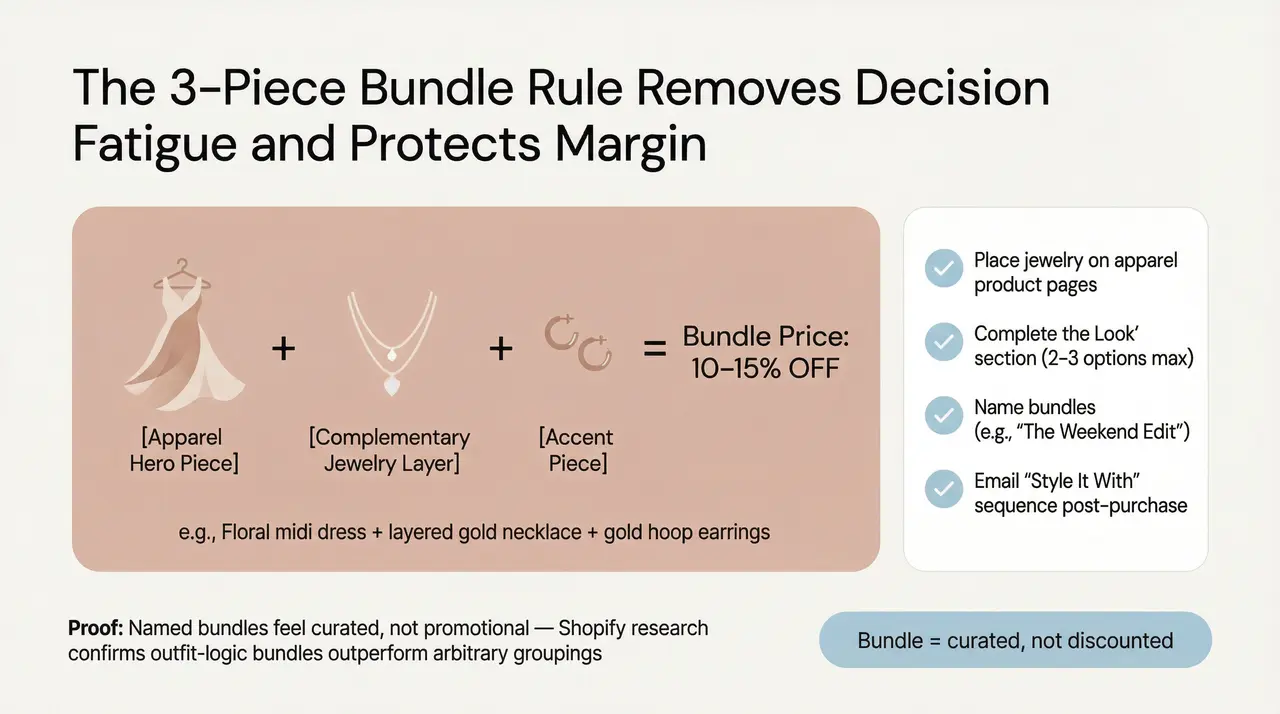
The most reliable bundling framework for apparel stores adding jewelry is The 3-Piece Bundle Rule:
[Apparel hero piece] + [Complementary jewelry layer] + [Accent piece] = bundle price at 10-15% below the individual sum
In practice: a floral midi dress + a layered gold necklace + a pair of gold hoop earrings, bundled at 10-15% less than buying all three separately. The discount is modest enough to protect your margin but meaningful enough to create perceived value.
The bundle works because it removes decision fatigue. The customer doesn't have to figure out what jewelry goes with the dress. You've already done that for them. Shopify's research on fashion bundling confirms that strong-performing bundles are built around natural outfit logic, such as "complete the look" combinations, rather than arbitrary product groupings [5].
Present bundles as named collections, like "The Weekend Edit" or "The Office-to-Evening Set," rather than a list of items. Named bundles feel curated, not promotional.
Use a cross-sell widget or "Frequently Bought Together" section to surface jewelry on apparel pages. Keep the selection tight: two or three options per apparel item is enough. More than that creates choice paralysis.
Email is an underused channel for jewelry cross-sells. A "Style It With" sequence, triggered after a customer buys an apparel item, showing two or three jewelry pieces that pair with their purchase, is a low-effort way to drive a second transaction. Keep it visual-first and short.
For paid social, styled flat lays and outfit videos that show the full look, including jewelry, tend to outperform product-only shots. The jewelry adds visual interest and signals a complete, shoppable aesthetic.
The biggest hesitation apparel store owners have about adding jewelry is inventory risk. You've already got cash tied up in clothing. Adding a new category means more SKUs, more storage, and more markdowns if things don't sell. That's a real concern, and it's why the fulfillment model matters as much as the products you pick.
On-demand dropshipping lets you list jewelry without holding any stock. When a customer orders, the supplier ships directly to them. Margins are thinner than wholesale, but there's no inventory commitment and no markdown risk. This is the right model for testing demand before committing.
Private-label dropshipping takes the same inventory-free model and adds custom branding: your packaging, your label, your brand experience, shipped directly to the customer without you touching the product. This makes the most sense for established apparel stores that want jewelry to feel like a natural extension of their brand.
Wholesale with small MOQs is worth considering once you've validated demand. Many fashion jewelry suppliers offer minimums of 50-100 units per style, keeping upfront cost manageable. The trade-off is that you're holding inventory, so you need reasonable confidence in the SKUs before committing.
If you want to skip the supplier search, Branvas's private-label fulfillment model is built for exactly this: no inventory commitment required. See how it works.

The goal of a starter assortment is not to cover every customer. It's to cover the basics, test demand across a few categories and price points, and minimize markdown risk. This 10-SKU plan is designed for a women's apparel store launching jewelry for the first time. It balances minimalist and statement styles, spans three price tiers, and includes strong gifting options.
The selection logic: lead with universally wearable pieces, include one or two trend-forward items to signal that your store is current, and make sure at least two or three SKUs have obvious gifting appeal.
| SKU | Category | Retail Price Range | Why It Earns Its Spot |
|---|---|---|---|
| 1. Delicate gold layered necklace (2-chain set) | Layered necklaces | $28-$38 | Universally wearable, high cross-sell potential with any top or dress |
| 2. Dainty silver pendant necklace | Dainty chains | $22-$32 | Entry-level price point, easy impulse add, broad appeal |
| 3. Gold hoop earrings (medium, 30mm) | Statement earrings | $18-$28 | Classic style with consistent demand, pairs with almost any outfit |
| 4. Pearl drop earrings | Statement earrings | $22-$35 | Strong gifting item, works for occasions and everyday wear |
| 5. Adjustable stacking ring set (3-pack) | Stacking rings | $32-$45 | One-size-fits-most eliminates sizing risk, strong gifting appeal |
| 6. Sculptural ear cuff (single) | Ear cuffs | $16-$26 | Trend-forward, no piercing required, attracts fashion-forward customer |
| 7. Gold chain bracelet | Chain bracelets | $24-$36 | Versatile, giftable, pairs well with casual and occasion apparel |
| 8. Charm bracelet (initial or symbol charm) | Charm bracelets | $32-$48 | High gifting appeal, invites repeat purchase for additional charms |
| 9. Delicate anklet (gold or silver) | Anklets | $16-$26 | Seasonal performer, natural cross-sell with resort and warm-weather apparel |
| 10. Oversized statement earrings (resin or sculptural) | Statement earrings | $24-$38 | Visual anchor for your jewelry section, drives editorial photography |
This assortment gives you coverage across five categories, three price tiers (under $30, $30-$40, and $40+), and a mix of everyday and occasion styles. Track which categories get the most add-to-cart activity in the first 60-90 days, then use that data to decide where to expand.
Ready to build your starter jewelry assortment without holding inventory? Browse the Branvas catalog or estimate your margins before you commit to a single SKU.

Fashion jewelry typically carries gross margins of 50-70% at retail when sourced through wholesale or private-label dropship programs [6]. The exact margin depends on your sourcing model and price point. Running your numbers through a margin calculator before committing to a supplier is worth the 10 minutes.
Layered necklaces, dainty chains, and statement earrings are the most consistent performers in apparel store contexts because they're easy to style in outfit photos and appeal to a broad customer base. Stacking rings and charm bracelets tend to perform well as gifting items, particularly around holidays. The best category for your store depends on your apparel aesthetic and your customer's price sensitivity.
Not necessarily. Several platforms handle jewelry sourcing, branding, and fulfillment in one place, so you don't need to manage a separate supplier relationship. If you already have a wholesale apparel supplier, it's worth asking whether they carry accessories. The key requirement is that your supplier can ship directly to your customer, ideally with your branding on the packaging.
The most effective approach is a "Complete the Look" or "Style It With" section at the bottom of your apparel product pages, showing two or three jewelry pieces styled with that specific garment. Keep the selection tight and make sure the jewelry is photographed on a model wearing your clothing. A cross-sell widget or Shopify app can automate this placement once you've set up the product associations.
Yes. On-demand dropshipping and private-label dropshipping models let you list and sell jewelry without holding any stock. The supplier fulfills each order as it comes in, shipping directly to your customer. This is the lowest-risk way to test whether jewelry resonates with your audience before committing to a wholesale order.