



Compare gifted, paid, and affiliate influencer deal structures using a profit matrix, worked examples, and ROI formulas to choose the most profitable campaign type.
Published:
October 5, 2026
Author:
Yi Cui
Same creator. Three deal structures. The calculator that shows which one actually nets you more profit.
In our experience at Branvas, the brands that struggle most with influencer ROI are the ones that choose a deal structure based on what feels safe rather than what the numbers support. Whether you are an established ecommerce seller or an influencer launching a private-label jewelry line, the decision between gifting products, paying a flat fee, or offering an affiliate commission determines whether a campaign drives profitable growth or drains your margins.
This guide provides a structured, numbers-based framework to evaluate gifted, paid, and affiliate influencer deals. We will break down the true costs, model a realistic campaign, and introduce a proprietary decision matrix to help you maximize your return on investment.
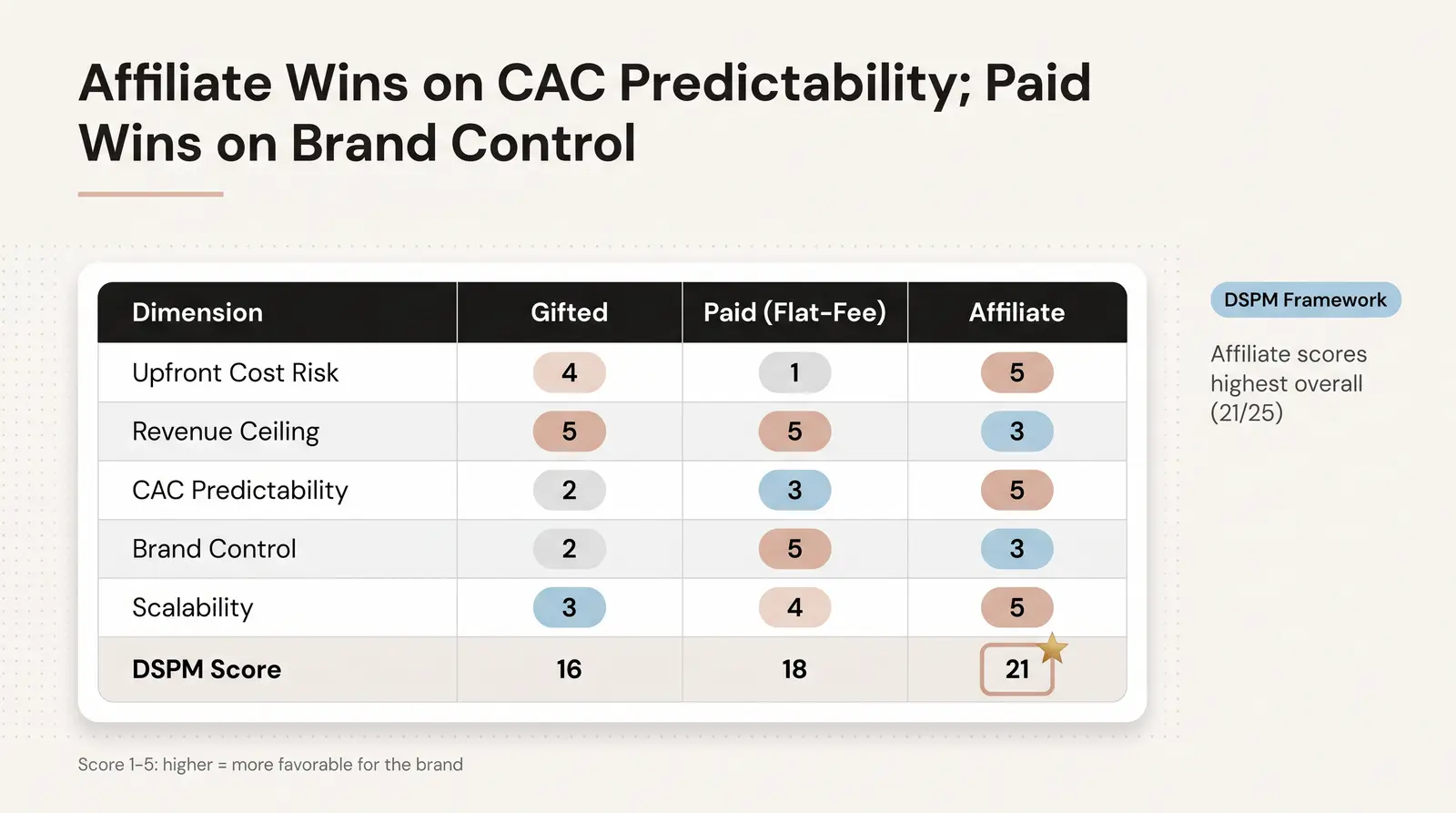
At Branvas, when we help a new brand set up their first influencer program, we always run the Deal Structure Profit Matrix before committing to any deal type. The DSPM is a decision model that scores each of the three deal types across five critical dimensions on a scale of 1 to 5 (where 5 is the most favorable outcome for the brand).
| Dimension | Gifted Campaign | Paid (Flat-Fee) | Affiliate (Commission) |
|---|---|---|---|
| Upfront Cost Risk (Cash out before results) | 4 | 1 | 5 |
| Revenue Ceiling (Max potential if viral) | 5 | 5 | 3 |
| CAC Predictability (Reliability of cost per customer) | 2 | 3 | 5 |
| Brand Control (Creative direction, messaging) | 2 | 5 | 3 |
| Scalability (Ease of replicating across creators) | 3 | 4 | 5 |
| Total DSPM Score | 16 | 18 | 21 |
Scoring Logic:
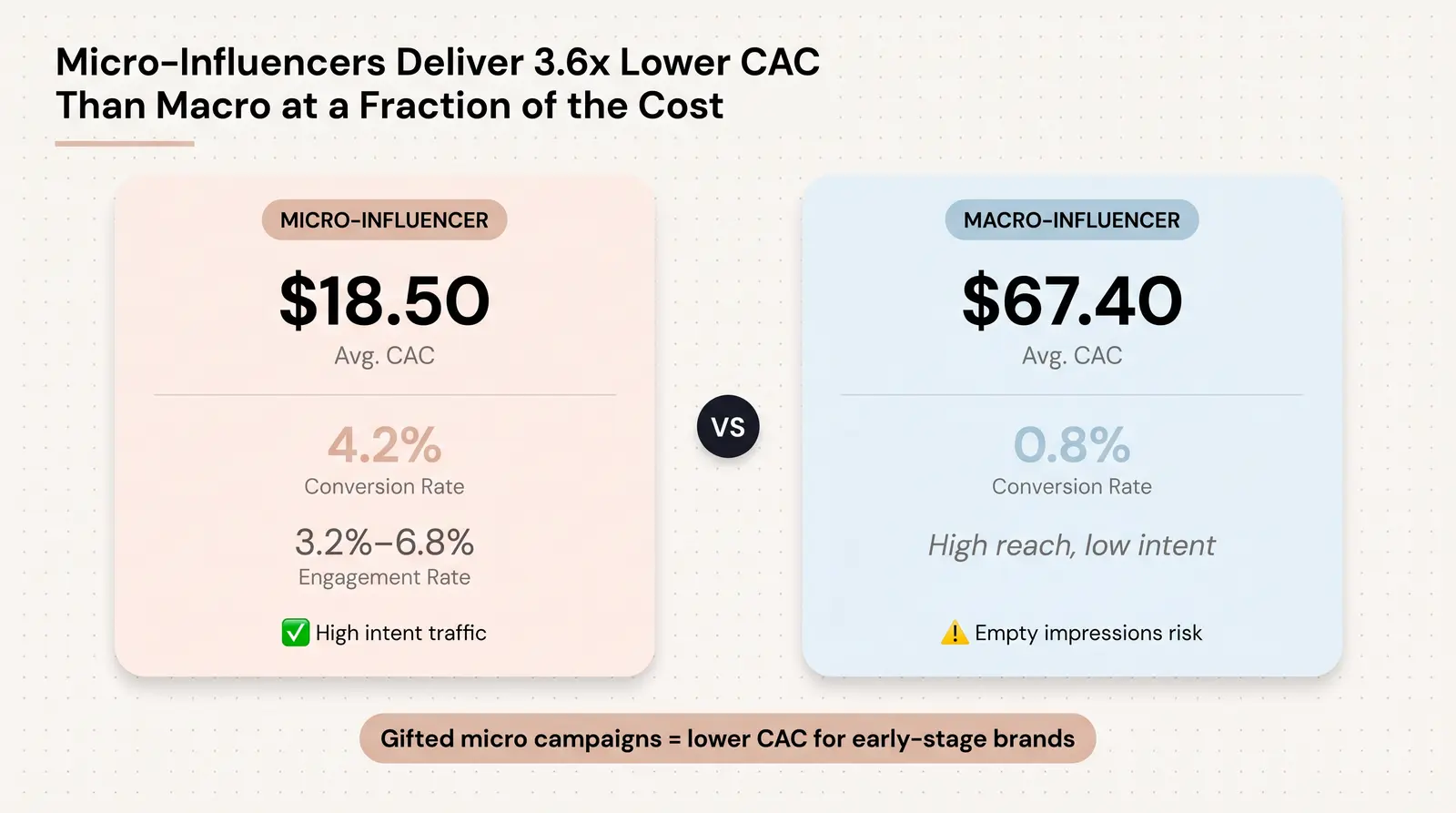
Gifted campaigns are often dismissed as low-ROI by brands chasing scale—but for early-stage product launches, a gifted micro-influencer campaign frequently delivers a lower Customer Acquisition Cost (CAC) than a paid macro campaign. The creator's authentic excitement translates to higher conversion rates, not just empty impressions.
Data supports this shift. Nano-influencers (1K-10K followers) average a $18.50 CAC and a 4.2% conversion rate, while macro-influencers (1M+ followers) average a $67.40 CAC and a mere 0.8% conversion rate [1]. We often see founders—especially in jewelry and accessories—underestimate how much gifted product cost erodes margin when they're also absorbing shipping, packaging, and a follow-up sequence. However, when targeted correctly, the high engagement rates of micro-influencers (often between 3.2% and 6.8%) drive intent-rich traffic that converts efficiently.
To compare these structures objectively, you need to calculate the projected revenue, costs, and net contribution margin for each scenario. Below is the framework to model your next campaign.
Before running the numbers, gather the following metrics for your target creator and your store:
| Input Metric | Example Value |
|---|---|
| Creator Followers | 80,000 |
| Engagement Rate (%) | 4.2% |
| Estimated Reach per Post | 15,000 views |
| Post Click-Through Rate (CTR) | 1.5% |
| Sitewide Conversion Rate (%) | 1.5% |
| Average Order Value (AOV) | $180 |
| Product COGS | $45 |
| Gifted Product Cost (COGS + Shipping) | $55 |
| Flat-Fee Amount | $1,200 |
| Affiliate Commission Rate | 15% |
Note: The 1.5% sitewide conversion rate and $180 AOV are based on 2026 benchmarks for the jewelry and accessories ecommerce sector [2].
Use these formulas to project the outcomes:
Let's apply the formulas to our mid-tier creator profile (80,000 followers, 15,000 reach, 1.5% CTR, 1.5% store conversion rate).
Traffic & Sales Projection:
Side-by-Side Comparison:
| Metric | Gifted | Paid (Flat-Fee) | Affiliate (15%) |
|---|---|---|---|
| Projected Revenue | $607.50 | $607.50 | $607.50 |
| Total COGS | $151.88 | $151.88 | $151.88 |
| Deal Cost | $55.00 | $1,255.00 | $146.13 |
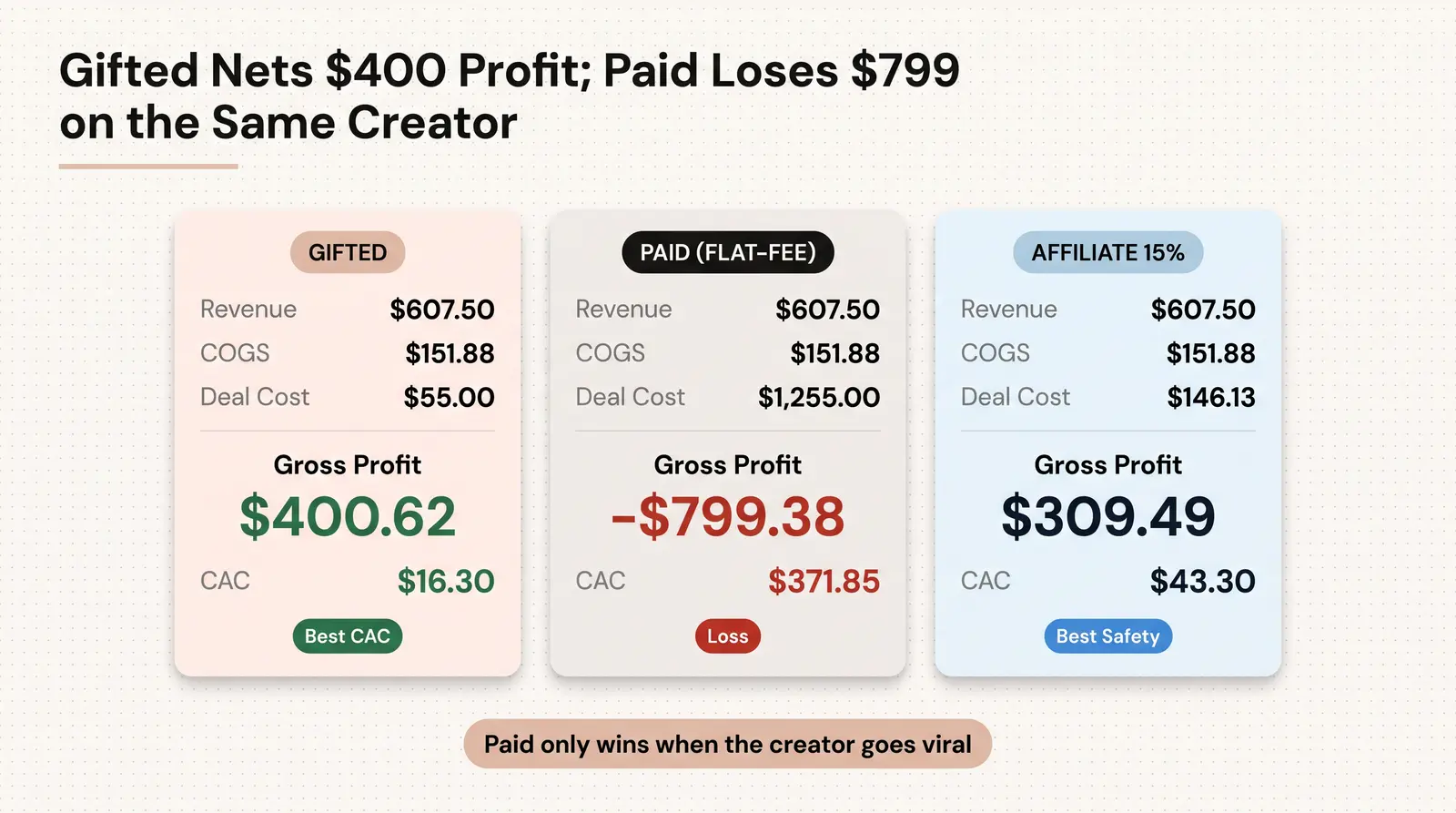
| Gross Profit | $400.62 | -$799.38 (Loss) | $309.49 |
| Projected CAC | $16.30 | $371.85 | $43.30 |
In this baseline scenario, the Paid (Flat-Fee) structure results in a significant loss. The creator's reach and the store's conversion rate simply do not generate enough sales to cover a $1,200 flat fee.
The Gifted structure yields the highest gross profit and lowest CAC ($16.30), making it highly attractive. However, this assumes the creator actually posts the content and drives the average CTR—which is never guaranteed without a contract.
The Affiliate structure offers a strong middle ground. It guarantees that you only pay the $91.13 commission if the sales actually materialize, alongside the initial $55 product seeding cost. The $43.30 CAC is highly sustainable for a $180 AOV product.
When the Answer Flips: If this creator suddenly goes viral and reaches 150,000 people (yielding 33.75 orders and $6,075 in revenue), the Paid structure becomes wildly profitable. The flat fee remains $1,200, dropping the CAC to $37.18. Meanwhile, the Affiliate cost would scale up to $966 in commissions. This illustrates why the DSPM scores Paid campaigns highest for "Revenue Ceiling" and Affiliate campaigns highest for "CAC Predictability."
If you're launching a jewelry or accessories brand and want to model your influencer program before you spend a dollar, Branvas's Profit Calculator lets you stress-test your numbers in minutes.
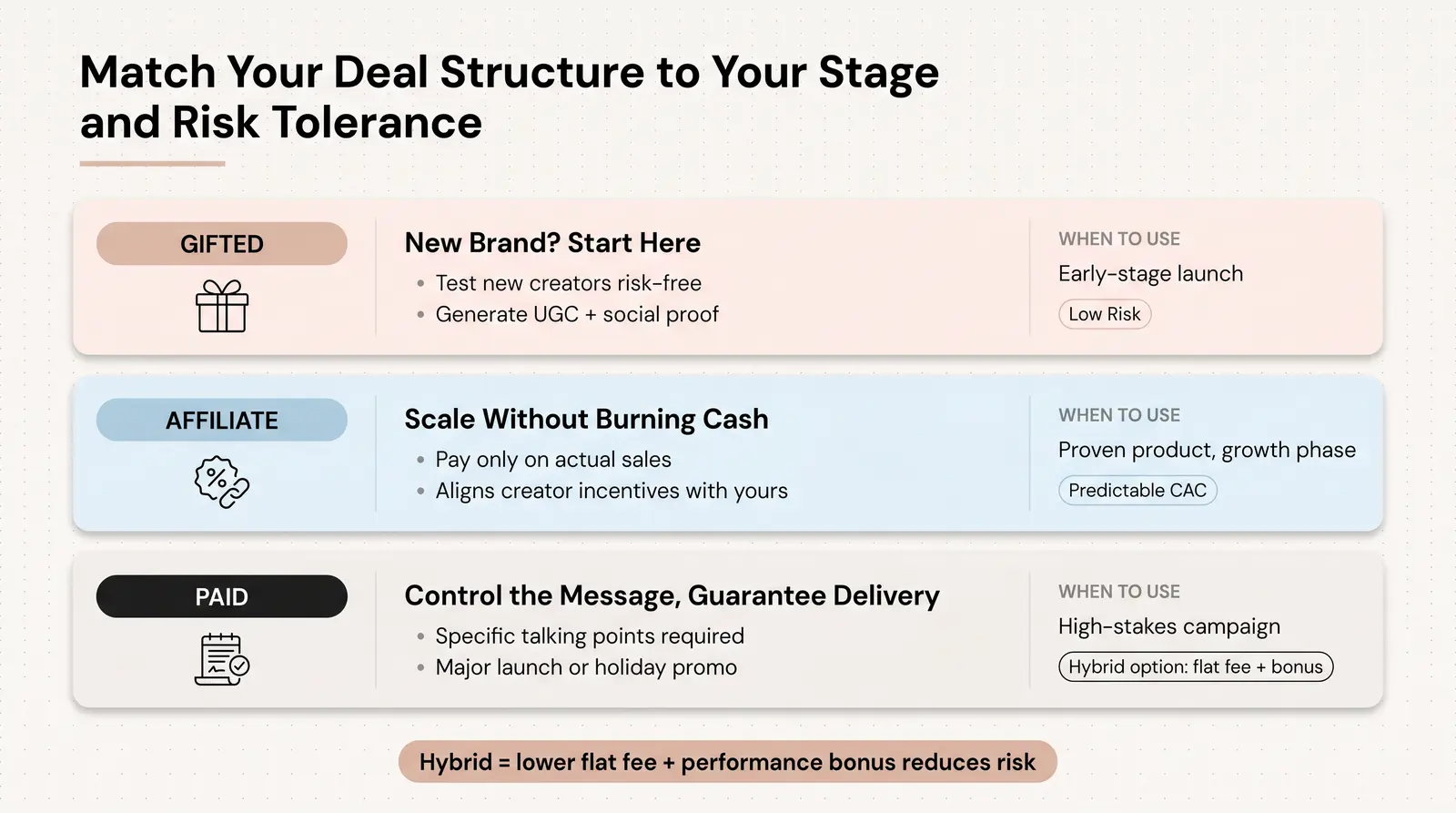
Choosing the right structure depends on your immediate business goals and risk tolerance.
When managing fulfillment, custom packaging, and blind shipping for these campaigns, operations can quickly become a bottleneck. See how Branvas works → to streamline your private-label jewelry logistics so you can focus on creator relationships.
A strong influencer marketing ROI typically ranges from $4 to $6 for every dollar spent. A 2025 benchmark study indicates an average return of $5.20 to $6.50 per $1 invested, with top-performing campaigns exceeding a 10:1 ratio [3]. For ecommerce brands, focusing on a sustainable LTV:CAC ratio is often more actionable than a blended ROI multiple.
The fundamental formula is: (Total Revenue - Total Campaign Costs) / Total Campaign Costs × 100. However, accurate ROI calculation requires proper attribution. Brands should use unique discount codes, UTM parameters, and affiliate links to track direct conversions, while also factoring in the cost of goods sold (COGS) and product seeding expenses [4].
Neither is universally better; they serve different purposes. Gifted campaigns are highly cost-effective for generating user-generated content (UGC) and testing new micro-influencers, but they lack guaranteed deliverables. Paid campaigns provide guaranteed reach, timeline control, and messaging alignment, making them essential for coordinated product launches [5].
For direct-to-consumer (DTC) ecommerce, standard affiliate commission rates range from 10% to 15% on new-customer orders. High-margin industries like digital products may offer up to 30%, while lower-margin physical goods, including some jewelry and electronics, often sit between 8% and 12% or utilize flat bounties (e.g., $10-$15 per sale) [6].
Tracking differs by platform behavior. Instagram often drives conversions through direct link clicks in Stories (where swipe-up/link click rates average 1% to 5%). TikTok drives heavy awareness but relies more on dedicated promo codes, as users rarely leave the app via bio links. Brands must use platform-specific codes and post-purchase surveys ("How did you hear about us?") to capture the full impact of TikTok campaigns [1].
Ready to launch your own branded jewelry line and build an influencer program around it? See how Branvas works →