

A material-by-material guide rating every common cleaning method as safe, caution, or never for gold-plated, vermeil, sterling, stainless, pearl, and moissanite jewelry.
Published:
November 9, 2026
Author:
Yi Cui
The safest way to clean jewelry at home is usually a soft cloth, lukewarm water, a small amount of mild soap, and thorough drying. That answer changes when the piece has thin plating, a pearl, a coated or treated stone, a loose setting, or a decorative finish. When you are unsure, clean the most vulnerable part of the piece, not the toughest one. Warm water and mild soap are a sound baseline for many gems, but not a license to soak or scrub every material. 1
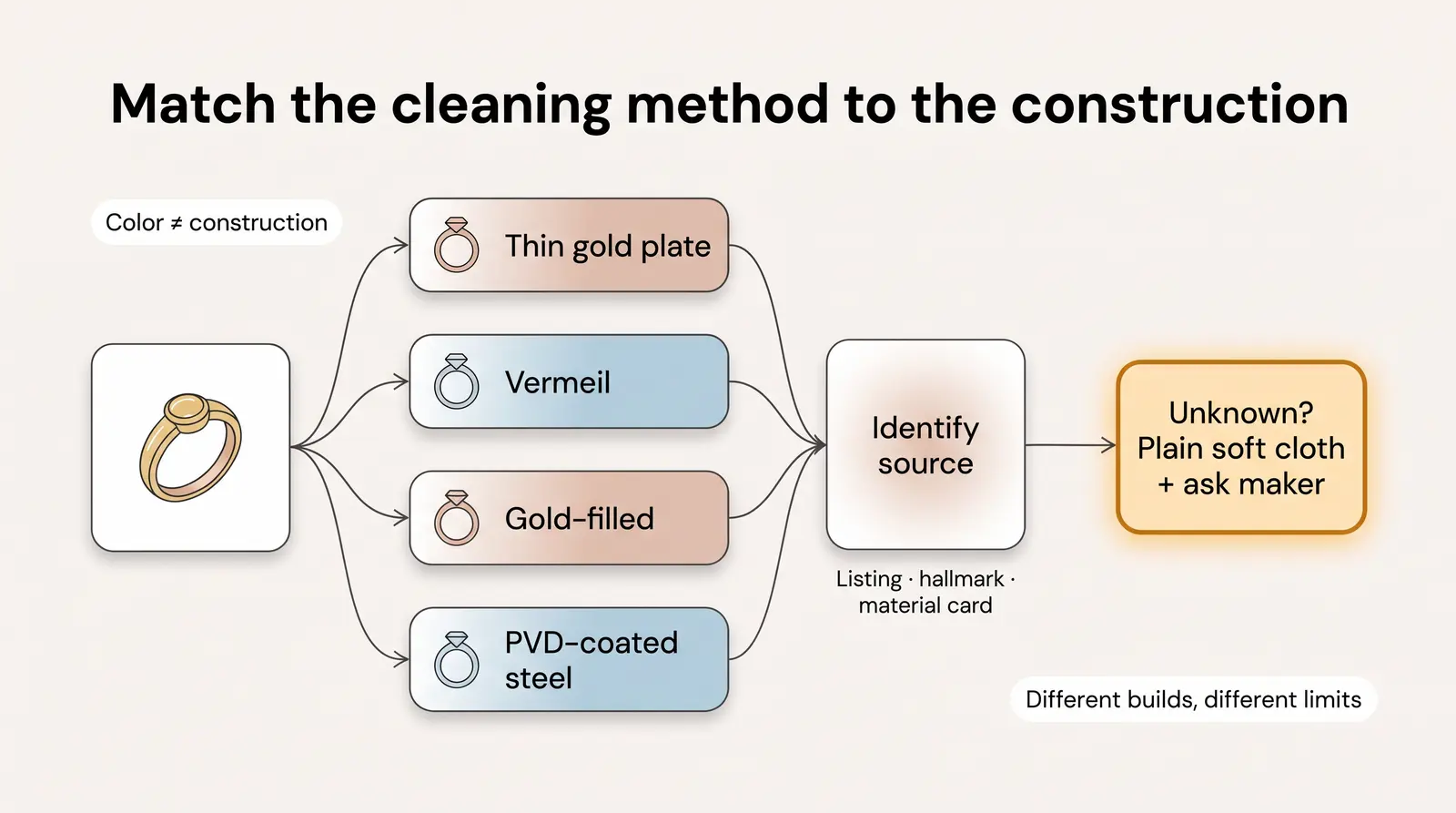
A gold-colored ring may be thin gold plate, gold vermeil over sterling silver, gold-filled, or a PVD-coated stainless-steel piece. Those are different constructions with different care limits.
The FTC describes vermeil as gold-plated sterling silver. It also explains that gold plating eventually wears with use and that wear depends partly on plating thickness. Gold-filled pieces use a mechanically applied gold layer, rather than ordinary electroplate. 2
If you do not know what you own, check the product listing, material card, hallmark, or seller. If the construction is still uncertain, use only a plain soft cloth and ask the maker or a jeweler before trying a cleaner.
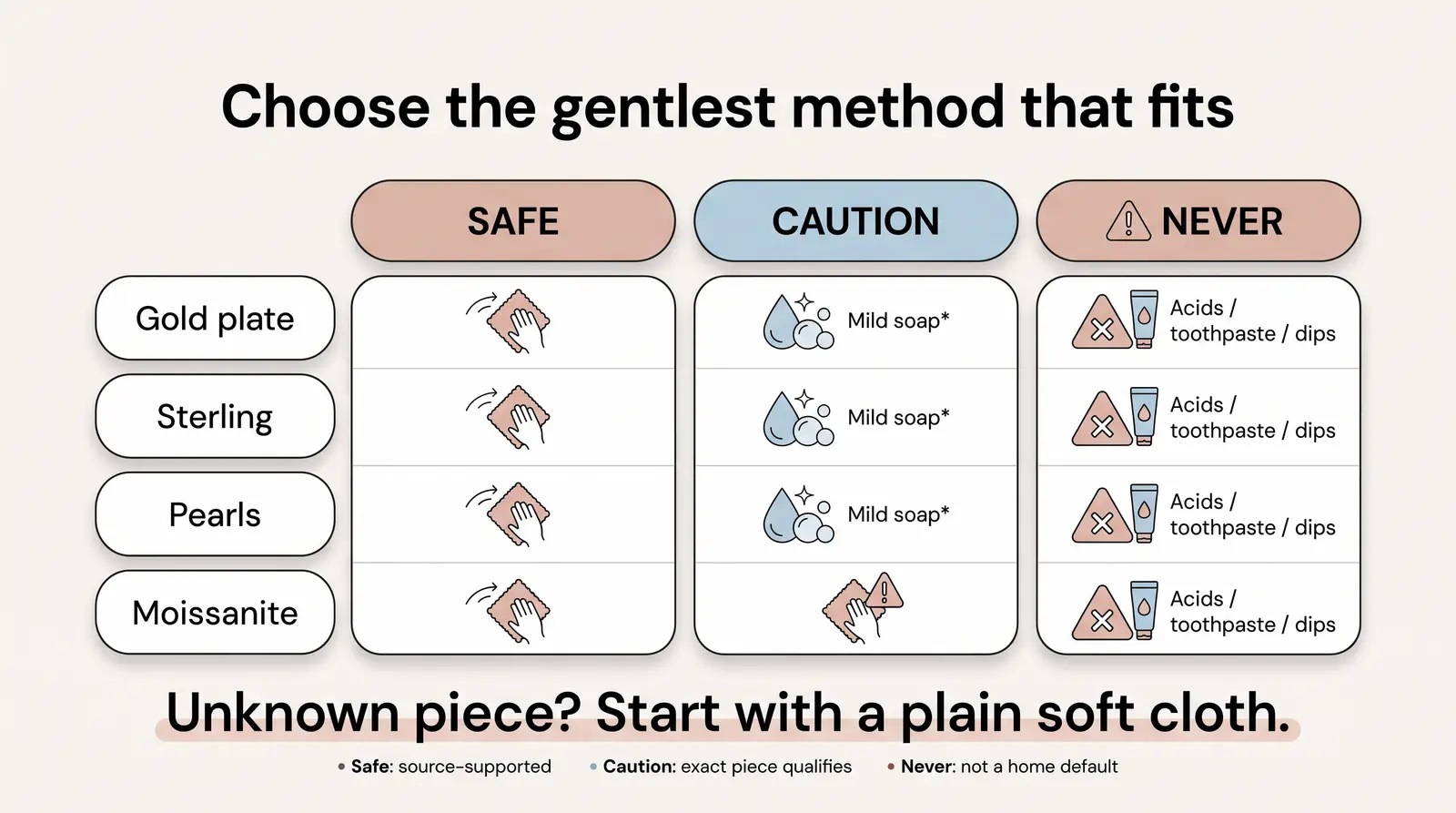
These ratings are for a typical at-home routine, not a promise about every piece. Safe means a source supports the method within the stated limits. Caution means the method can be reasonable only when the exact construction allows it. Never means do not use it as a default home method. It may still be appropriate if the manufacturer or a qualified jeweler approves it for the exact assembled piece.
A plain soft cloth is different from a treated polishing cloth. Treated silver cloths are mildly abrasive, even though they are gentler than liquid or paste polishes. 5
| Material | Mild soap + lukewarm water | Plain soft cloth | Baking-soda paste | Toothpaste | Vinegar, lemon, or other acids | Ultrasonic cleaner | Commercial silver dip | Treated polishing cloth |
|---|---|---|---|---|---|---|---|---|
| Gold-plated, thin electroplate | Caution: Branvas recommends a small amount of mild soap, gentle rinsing, and immediate drying; plating still wears over time. 2 7 | Safe: Use a soft, lint-free cloth with little pressure. 7 | Never: No direct support for plated jewelry. Abrasion risk is a material-based inference. | Never: Branvas specifically says not to use toothpaste on plated jewelry. 7 | Never: No direct material-specific support. Avoid acids as a conservative inference for a thin, worn-prone finish. | Never: Branvas says not to use an ultrasonic on plated jewelry. 7 | Never: A silver dip is not a cleaner for gold plate, and CCI warns dips can harm mixed materials. 5 | Never: A treated silver cloth may abrade a thin finish. This is a precaution based on plated-surface abrasion evidence. 5 |
| Vermeil, gold over sterling silver | Caution: Treat the gold surface as plating. Use a brief, gentle clean only when the maker permits it. 2 7 | Caution: A dry soft cloth is the least aggressive option. This is a conservative application of plated-finish guidance. 7 | Never: No source supports an abrasive paste on a gold-plated surface. | Never: Do not use it as a default. Branvas warns against toothpaste on plated finishes. 7 | Never: No direct support for acids on vermeil. This is a conservative surface-protection recommendation. | Never: Branvas advises against ultrasonic cleaning for plated finishes. 7 | Never: Do not treat the gold surface as bare sterling. Dips can over-clean and damage plated or mixed pieces. 5 | Never: Silver-polishing cloths are for light tarnish on silver, not a gold surface. 5 |
| Gold-filled | Caution: FTC terminology describes construction, not a cleaning recipe. Use this only if stones and settings permit it. 2 | Caution: A plain soft cloth is a low-abrasion routine option. This is a conservative inference, not gold-filled-specific testing. | Caution: No direct support. Avoid unless the maker approves the exact piece. | Never: No authoritative source reviewed endorses it as a general jewelry cleaner. | Never: No direct support for acid cleaning. This is a conservative inference. | Caution: The setting, stones, and treatments decide. GIA's exclusions still apply. 4 | Never: It is not a silver-cleaning surface. | Caution: Use only a maker-approved cloth. Do not assume a silver cloth is suitable. |
| PVD-coated stainless steel | Caution: Branvas advises mild soap, lukewarm water, thorough drying, and a microfiber wipe. The coating still needs finish-specific care. 8 | Safe: Soft microfiber or another plain soft cloth is appropriate for routine wiping. 8 | Never: No direct support. Abrasive wear on a coating is a material-based inference. | Never: No direct support. Avoid abrasive DIY cleaning on a decorative coating. | Never: Branvas advises against harsh chemical cleaners; acid avoidance is a conservative extension. 8 | Never: Branvas advises against ultrasonic cleaning for PVD jewelry. 8 | Never: CCI notes acids in dips can damage stainless steel and organic materials. 5 | Never: Branvas advises against abrasive polishing cloths on PVD. 8 |
| Solid stainless steel | Caution: Gentle soap and water is a practical default when there are no vulnerable stones, coatings, or glued parts. This is a conservative inference. | Caution: A plain soft cloth is a low-abrasion option for an uncoated, stone-free piece. This is a conservative inference. | Caution: No direct source supports a paste for jewelry-grade stainless. | Never: Not a supported default cleaner. | Never: CCI notes acids in dips can damage stainless steel. Do not use acid hacks. 5 | Caution: Stainless alone is not the whole piece. Check gems, settings, and treatments first. 4 | Never: Silver dip is not a stainless cleaner, and its acids can harm stainless. 5 | Caution: Use only a cloth specified for the piece, not a silver-tarnish cloth by default. |
| Solid sterling silver | Safe: CCI supports washing suitable silver with detergent and water, then rinsing and drying, provided nonmetal parts stay dry. 5 | Safe: A plain soft cloth removes surface grime with minimal abrasion. 5 | Caution: CCI does not endorse generic baking-soda paste. Its conservation methods are not a universal jewelry recipe. 5 | Never: No authoritative source reviewed supports toothpaste for sterling care. | Never: CCI's acid warnings and dip limits do not support vinegar or lemon as a home default. 5 | Caution: Only if the exact piece has no excluded stones, treatments, or loose settings. 4 | Caution: CCI says dips can over-clean or pit silver. Reserve them for appropriate bare solid silver only, with careful scope. 5 | Caution: CCI supports a silver cloth for light tarnish, but notes that it is abrasive. Use light pressure. 5 |
| Silver-plated or plated sterling | Caution: Use only a gentle, brief clean and keep nonmetal parts dry. Thin plated surfaces require restraint. 5 | Caution: A plain soft cloth is the low-abrasion choice. This is a conservative inference for a plated surface. | Never: Abrasive removal can wear the plated surface. 5 | Never: No supported use, and abrasives are a poor fit for plating. | Never: No supported use. | Never: Do not assume the plated surface or any set stones can tolerate vibration. 4 | Never: CCI says any tarnish-removal method may seriously damage silver-plated objects. 5 | Never: CCI warns abrasion can remove thin silver plating. 5 |
| Pearls | Caution: GIA permits occasional warm, soapy-water cleaning. Use a very soft tool or cloth, then dry fully. 3 | Safe: Wipe with a very soft, clean cloth after wear. 3 | Never: No support, and pearl is soft and easily abraded. 3 | Never: No support for this abrasive method. | Never: GIA says acids can damage pearls. 3 | Never: GIA says pearls should never go in an ultrasonic or steam cleaner. 3 | Never: Keep metal-cleaning chemicals off pearl nacre and stringing. 3 5 | Never: A treated polishing cloth is not for nacre. Use a very soft plain cloth instead. 3 |
| Moissanite, with its setting metal | Safe: Mild soap, warm water, and a soft brush or cloth are supported by manufacturer guidance when the setting allows it. 12 | Safe: Use a plain lint-free cloth after drying. 12 | Never: No direct support for a universal paste on the complete piece. | Never: No direct support. Avoid abrasive DIY cleaners on the setting. | Never: No direct support for acids on the complete piece. | Caution: One manufacturer permits it for sturdy metals and hard gems, but its guidance conflicts elsewhere. GIA's treatment and setting warnings control when uncertain. 4 12 | Never: A dip is not a stone-and-setting cleaner. | Caution: Keep any stone-specific cloth off the setting unless its maker says otherwise. 12 |
| Other porous, coated, filled, heat-sensitive, or unknown gems | Caution: Use a gentle solution only after identifying treatment and setting. 1 4 | Caution: A plain soft cloth is the safer starting point. This is a conservative choice for an unknown surface. | Never: No universal support for an abrasive paste. | Never: No universal support. | Never: Do not use as a default when treatment or porosity is unknown. | Never: GIA excludes many treated, coated, filled, heat-sensitive, and organic materials. 4 | Never: Not a universal gem or mixed-material cleaner. | Never: Do not use an abrasive treated cloth on an unknown surface. |
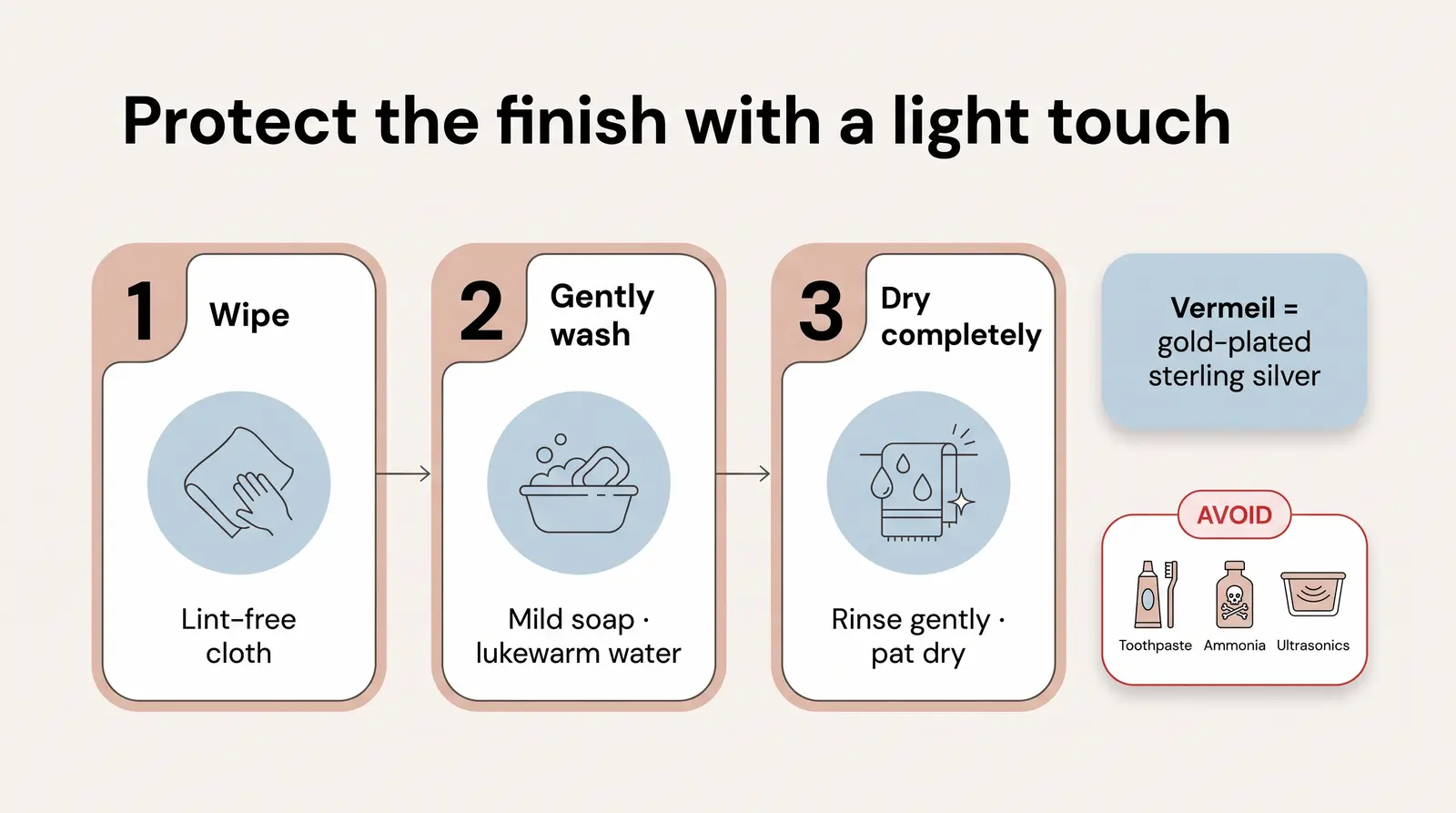
Gold-plated jewelry and vermeil need a light touch. The valuable part of the cleaning decision is the surface layer, not whether the piece looks like solid gold.
Branvas gives this same mild-soap, soft-cloth, and prompt-drying approach for gold-plated pieces. It also says to avoid toothpaste, ammonia-based cleaners, and ultrasonics. 7
Vermeil deserves the same surface-first logic. It is gold-plated sterling silver, so a method that makes sense for bare sterling can be wrong for the gold layer. If the gold has worn through and silver is showing, do not try to solve that with a silver dip on the whole piece. Ask the maker or a jeweler how to address the exposed area.
For a useful comparison of finish types and tradeoffs, see Branvas's PVD, gold-filled, and vermeil durability guide. Its material comparisons are helpful context, but the care advice in this article stays with the more conservative, source-supported approach.
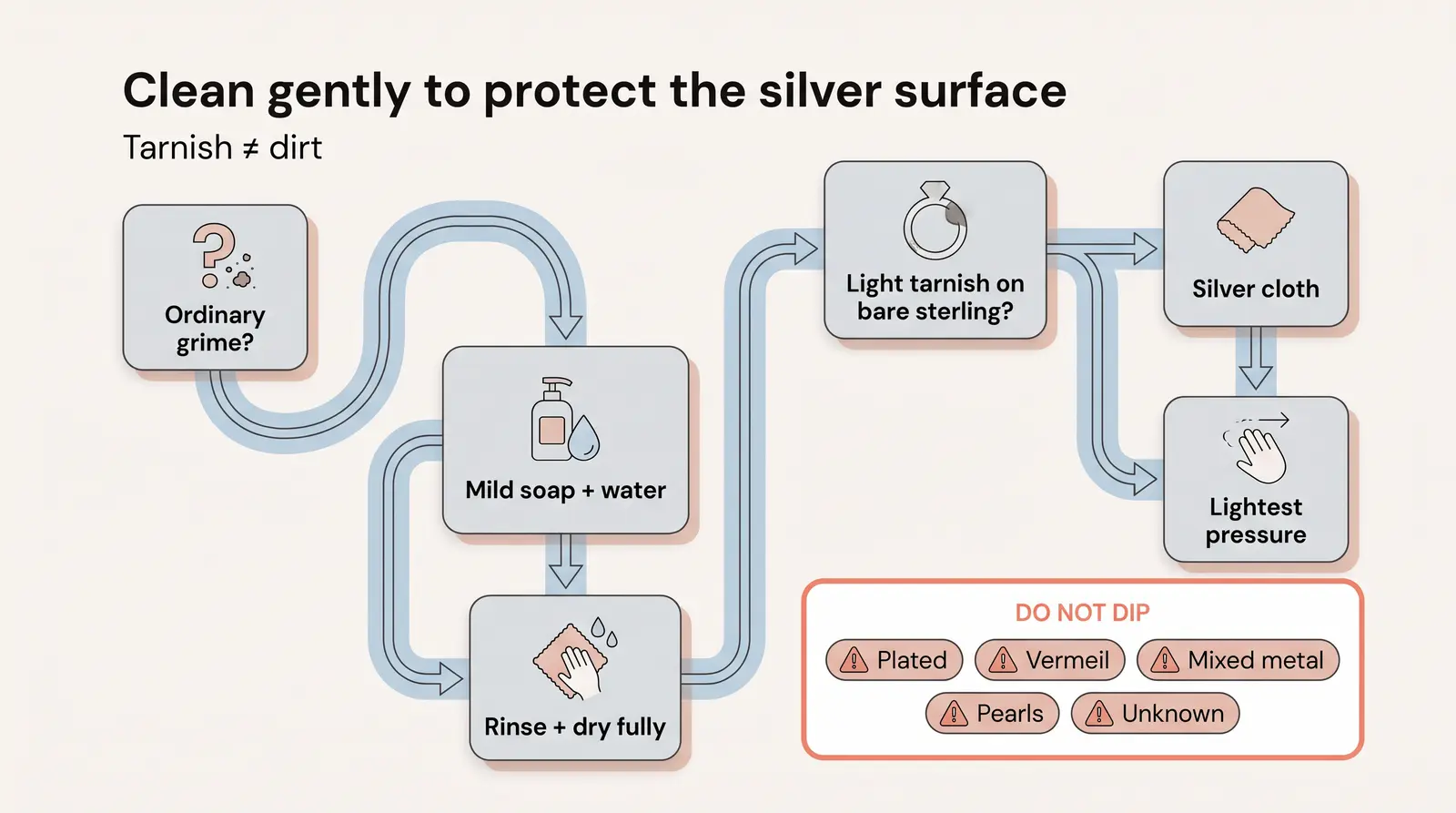
Sterling silver is 92.5% pure silver. Tarnish is not the same thing as dirt. It is mainly silver sulfide formed when silver reacts with sulfur-containing compounds in the environment. 2 5
For ordinary grime, wash only a suitable solid-silver piece with mild soap and water, rinse it, and dry it fully. Keep pearls, porous stones, glued components, and other nonmetal parts out of the water unless their care instructions allow it. 5
For light tarnish on bare sterling, a silver polishing cloth can help. Use the lightest pressure that works. CCI notes that polishing cloths are abrasive, although gentler than liquid, paste, or foam polishes. 5
Do not use a silver dip on plated sterling, vermeil, mixed-metal jewelry, pearl jewelry, or a piece with uncertain construction. CCI warns that dips can over-clean, pit silver, and damage other materials. It also warns that tarnish-removal methods can seriously damage silver-plated objects. 5
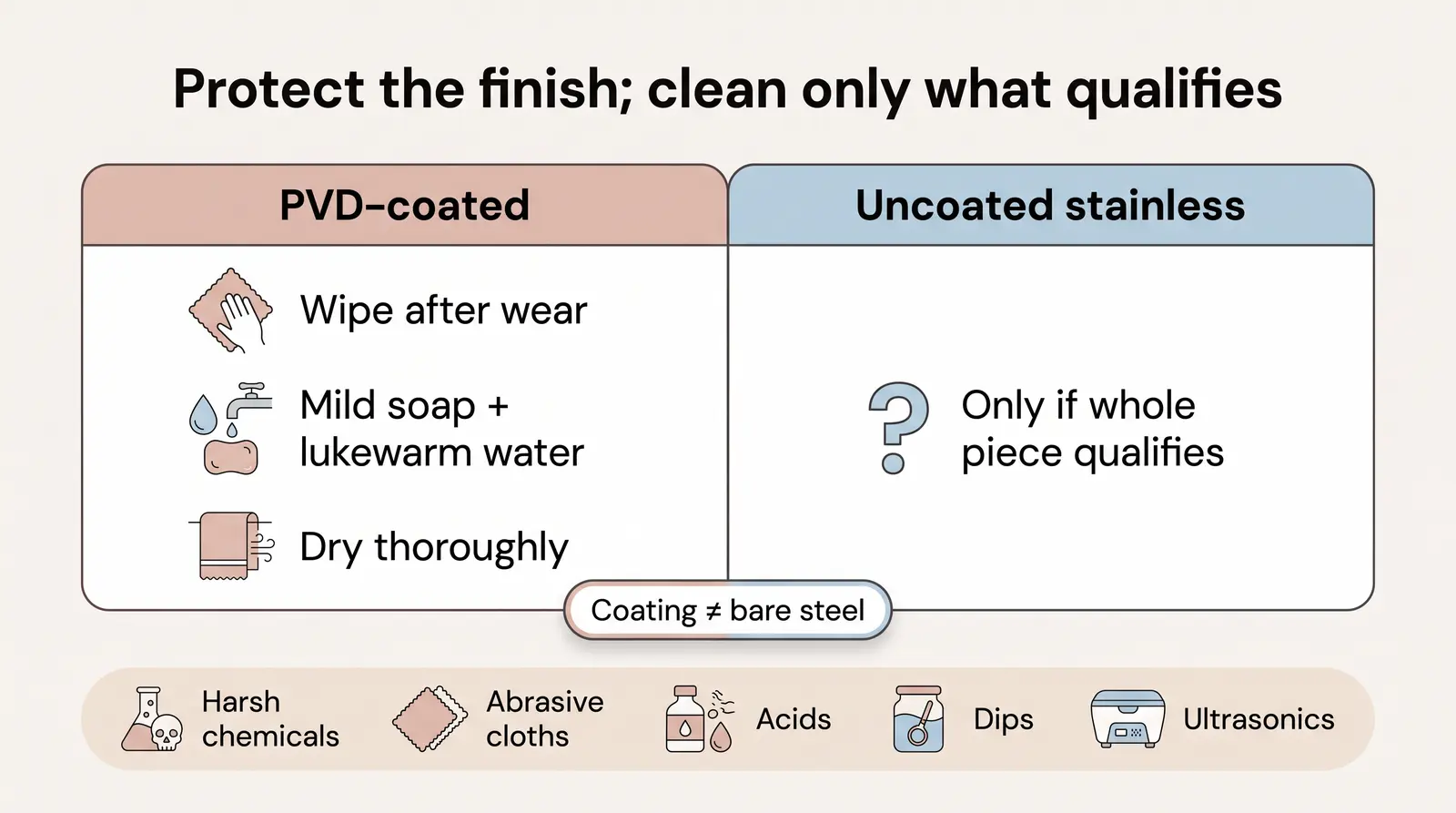
Plain stainless steel and PVD-coated stainless are not the same care category. PVD is a decorative coating, so clean it as a finish, not as bare steel.
For PVD jewelry, wipe after wear with a soft microfiber cloth. For deeper cleaning, Branvas recommends mild soap, lukewarm water, thorough drying, and avoiding harsh chemical cleaners, abrasive polishing cloths, and ultrasonic cleaners. 8
For uncoated stainless-steel jewelry, a soft cloth and gentle soap-and-water clean is a practical conservative default when the entire piece has no vulnerable gems, coatings, or adhesives. Do not assume that a stainless-steel base makes every version of the piece safe for acids, dips, or an ultrasonic cleaner.
If you sell stainless pieces, Branvas's PVD coating jewelry guide gives additional brand-specific positioning. Check each SKU before repeating a water-safe or coating claim. Branvas's catalog, for example, distinguishes certain water-safe stainless styles from other materials and says pearl, turquoise, and shell pieces should stay dry. 9
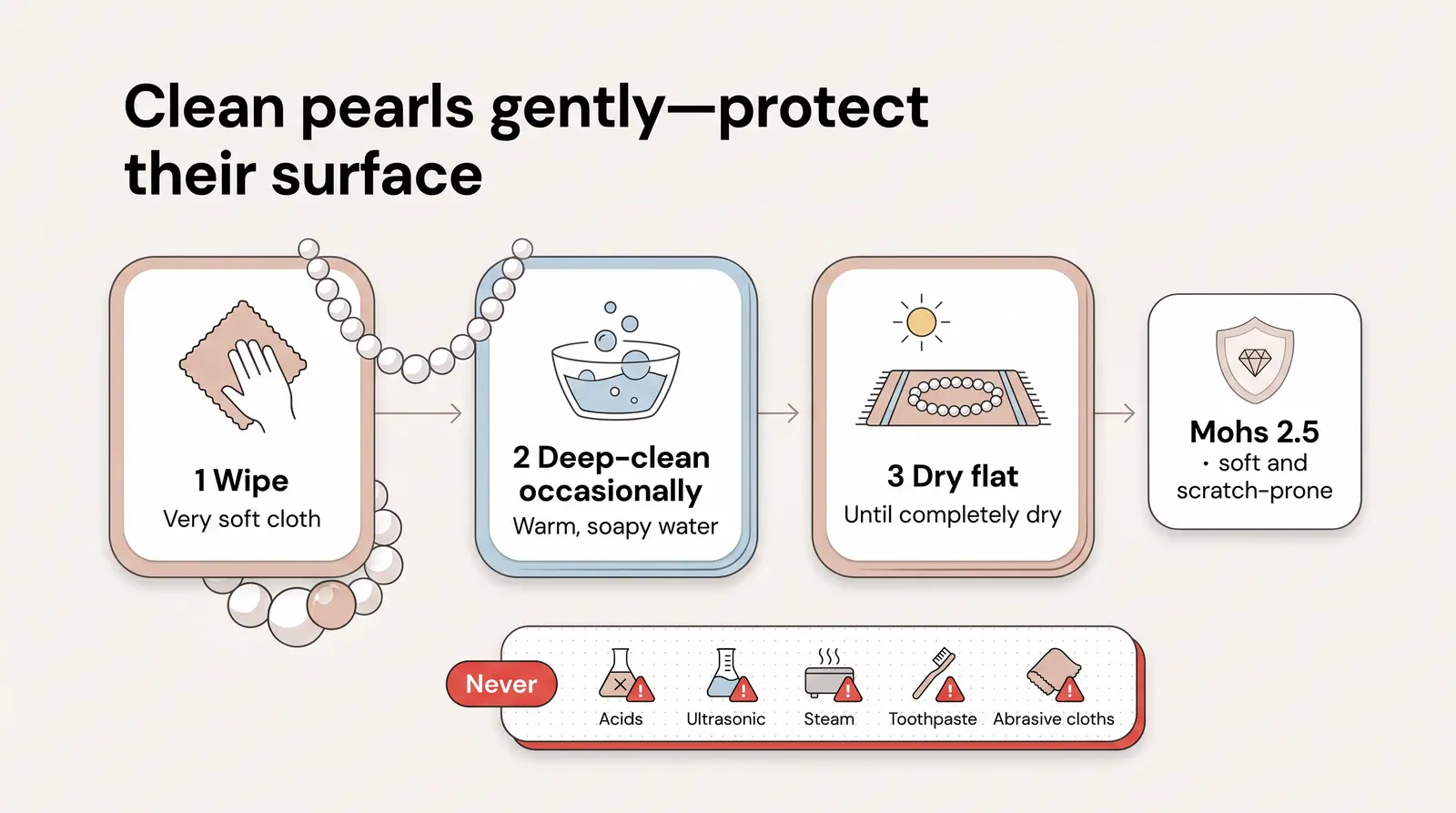
Pearls are the clear exception to the "scrub it clean" approach. GIA ranks pearl at 2.5 on the Mohs scale and says it is very soft and easily scratched or abraded. It also warns that chemicals and all acids can damage pearls. 3
After wearing pearls, wipe them with a very soft, clean cloth. For occasional deeper cleaning, use warm, soapy water with a very soft clean brush or cloth. If the piece is strung, dry it flat and do not wear it until it is completely dry because wet silk can stretch and attract dirt. 1 3
Never use an ultrasonic or steam cleaner on pearls. Keep perfume, hairspray, household cleaner, vinegar, lemon, toothpaste, baking-soda paste, silver dip, and abrasive polishing cloths away from them. 3
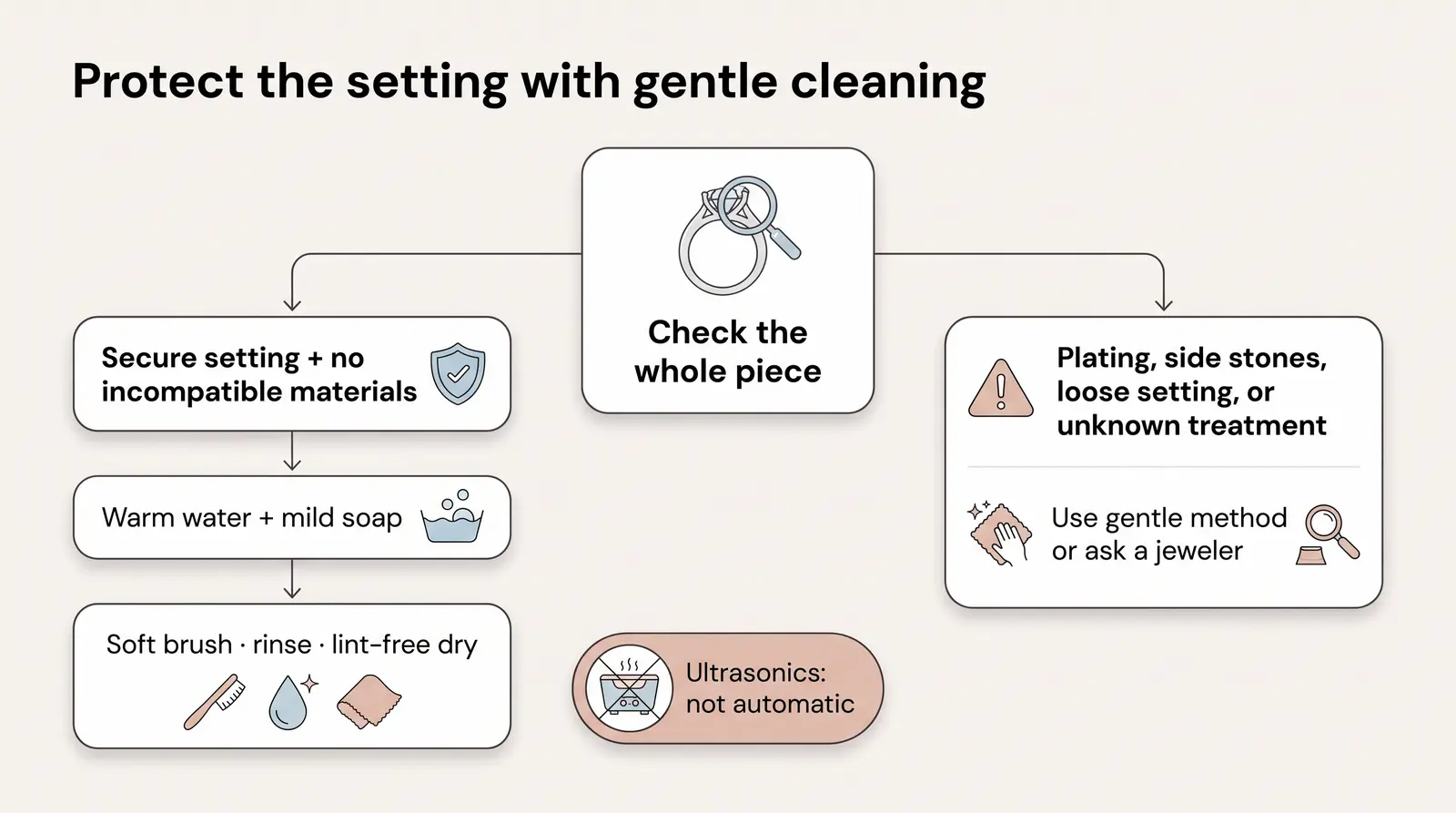
Moissanite is durable, but the stone is only one part of the jewelry. Prongs, solder, a plated setting, side stones, and any treatment are part of the cleaning decision.
For a ring with a secure setting and no incompatible materials, use warm water, mild soap, a soft toothbrush or cloth, rinse carefully, and dry with a lint-free cloth. Manufacturer guidance from Charles & Colvard supports that routine and recommends checking prongs. 12
Do not use an ultrasonic cleaner just because the center stone is moissanite. Manufacturer guidance on moissanite ultrasonics is not consistent, and GIA warns that ultrasonic vibration can loosen stones or damage settings. It also excludes organic, coated, filled, treated, and heat-sensitive gems. When any part of the piece is uncertain, use the soap-and-water method or ask a jeweler. 4 12
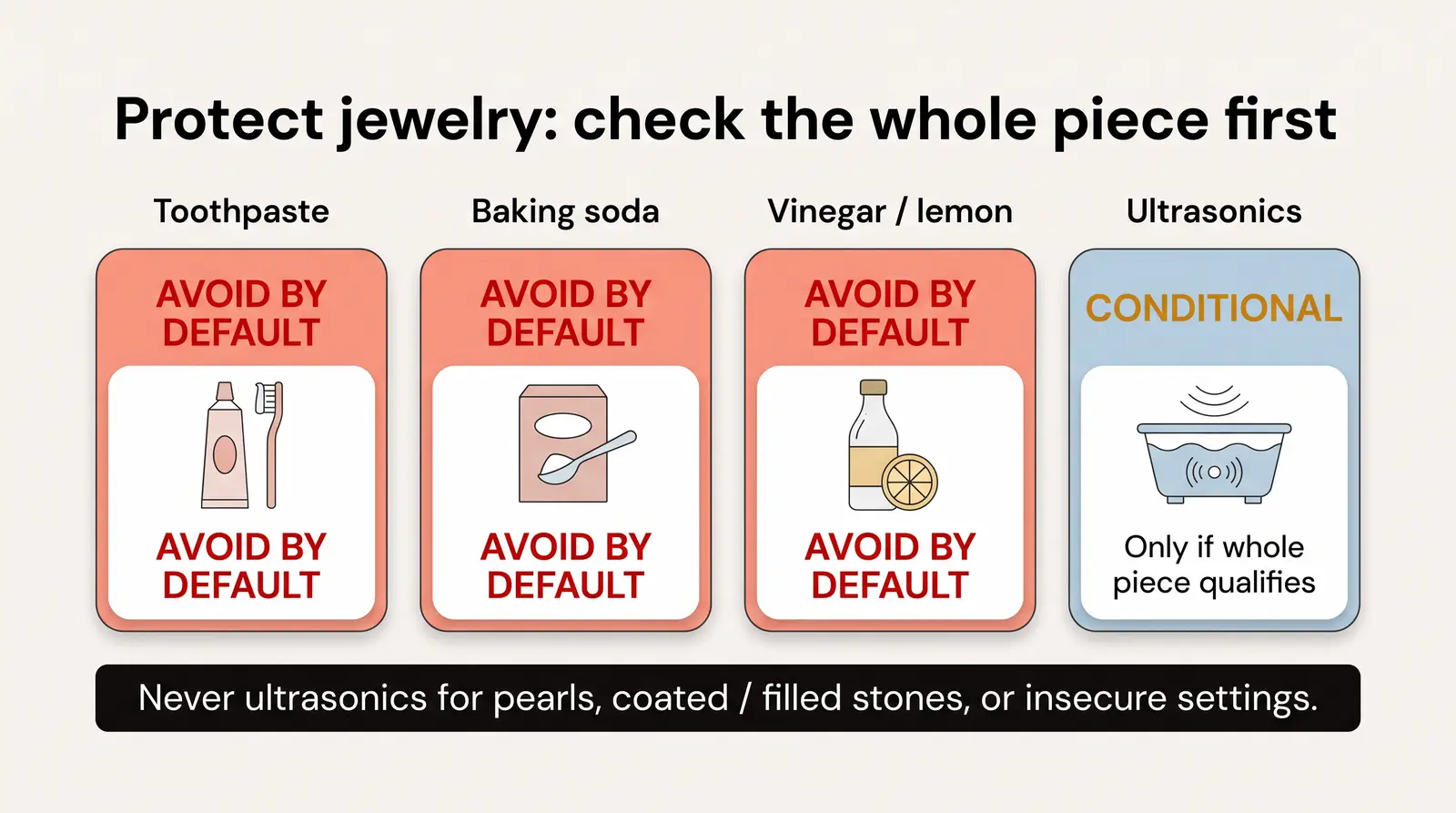
These methods are not interchangeable, even when a search result calls them a "jewelry hack."
Toothpaste: Do not use it as a default cleaner. Branvas specifically warns against it for gold-plated jewelry. Toothpaste formulas vary, and using an abrasive product on thin plating, polished surfaces, pearls, or a stone setting is an avoidable risk. 7
Baking-soda paste: Do not treat it as a universal silver or jewelry solution. The conservation guidance reviewed here does not endorse generic baking-soda paste for all jewelry. CCI's controlled silver-cleaning options are narrower than an internet recipe, and it repeatedly stresses the risk of abrasive removal. 5
Vinegar or lemon: Do not use acids as a general jewelry cleaner. GIA says all acids can damage pearls. CCI also notes that acids in silver dips can damage stainless steel and organic materials. What happens to a particular alloy, finish, solder, or stone depends on the construction, so the safest general answer is to avoid acid hacks unless the manufacturer gives specific instructions. 3 5
Ultrasonic cleaners: They are useful only when the entire piece qualifies. GIA says not to use them on pearls and other organic materials, fracture-filled gems, coated or impregnated stones, several heat-sensitive gems, or insecure settings. Check stones before and after cleaning. 4
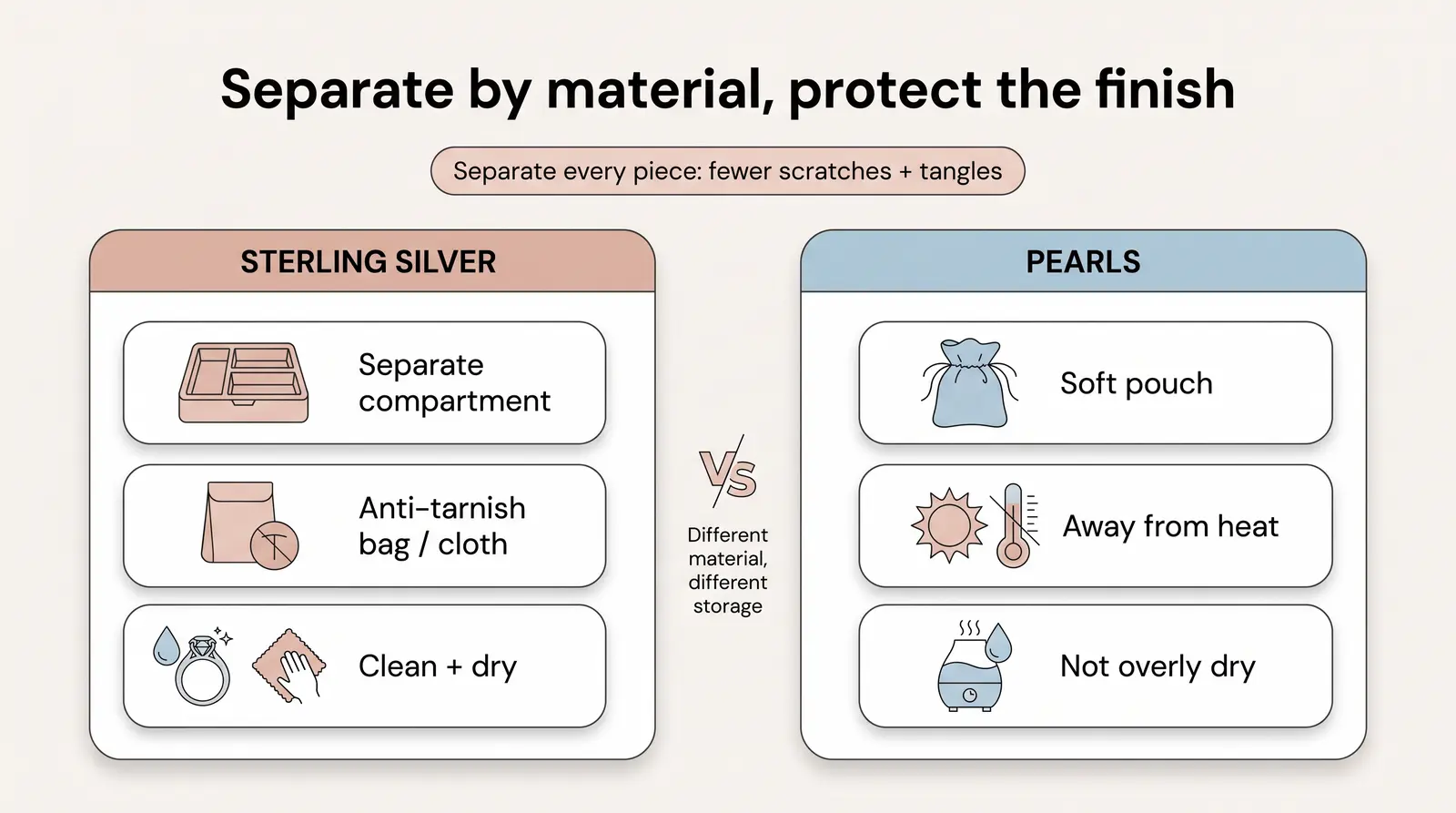
Storage cannot make plating permanent, but it can reduce preventable tarnish, scratches, and tangles.
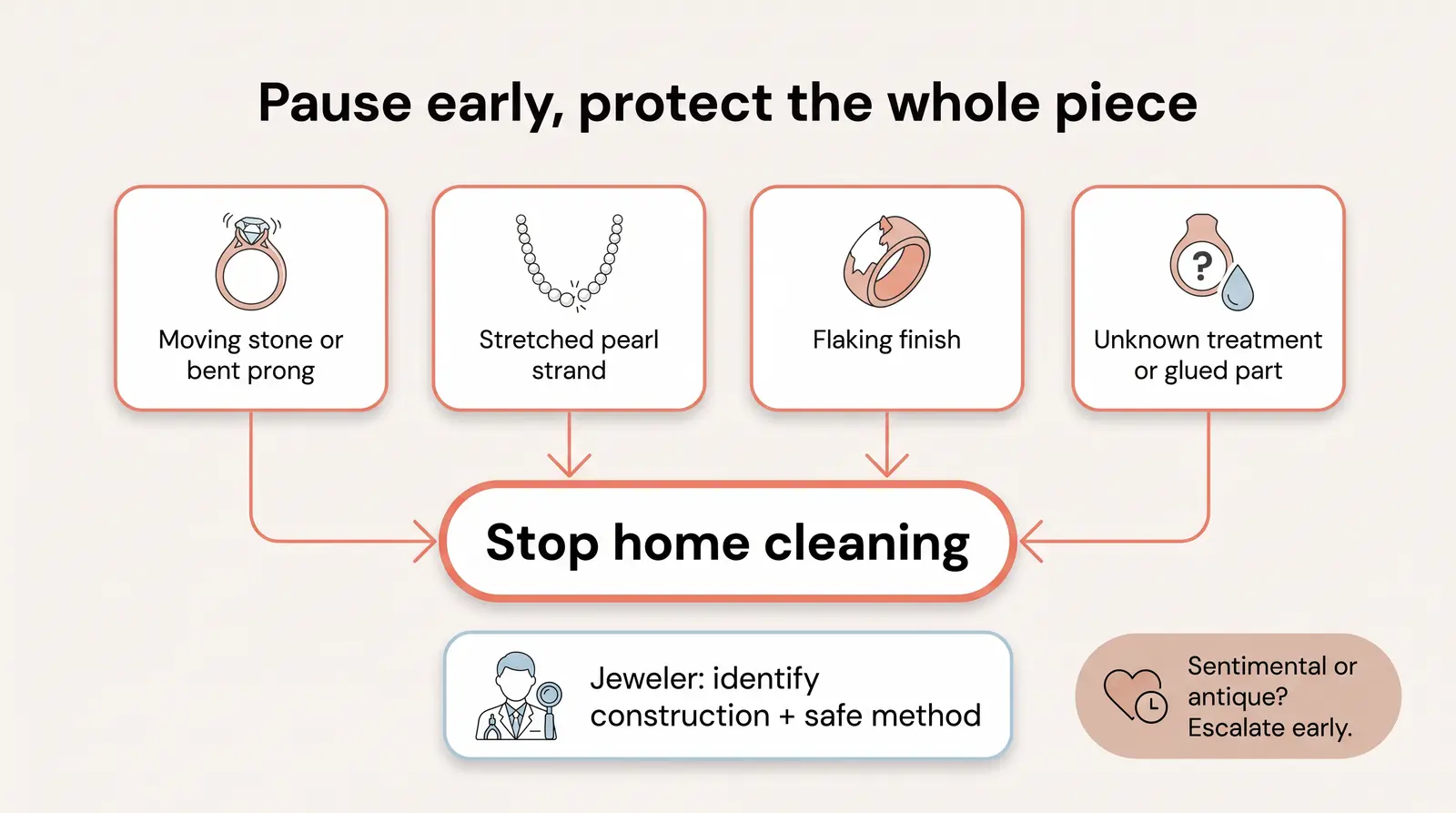
Stop if a stone moves in its setting, a prong is bent, a pearl strand is stretched, a finish is flaking, or the piece has an unknown treatment, a glued component, or sentimental value that makes an experiment too costly.
The same applies to antique, oxidized, hollow, or mixed-material jewelry. A professional can identify the construction and use a method that is appropriate for the entire piece.
The following is original copy for a small packaging insert. It is not a claim that a downloadable Branvas care card currently exists.
Keep your jewelry looking its best
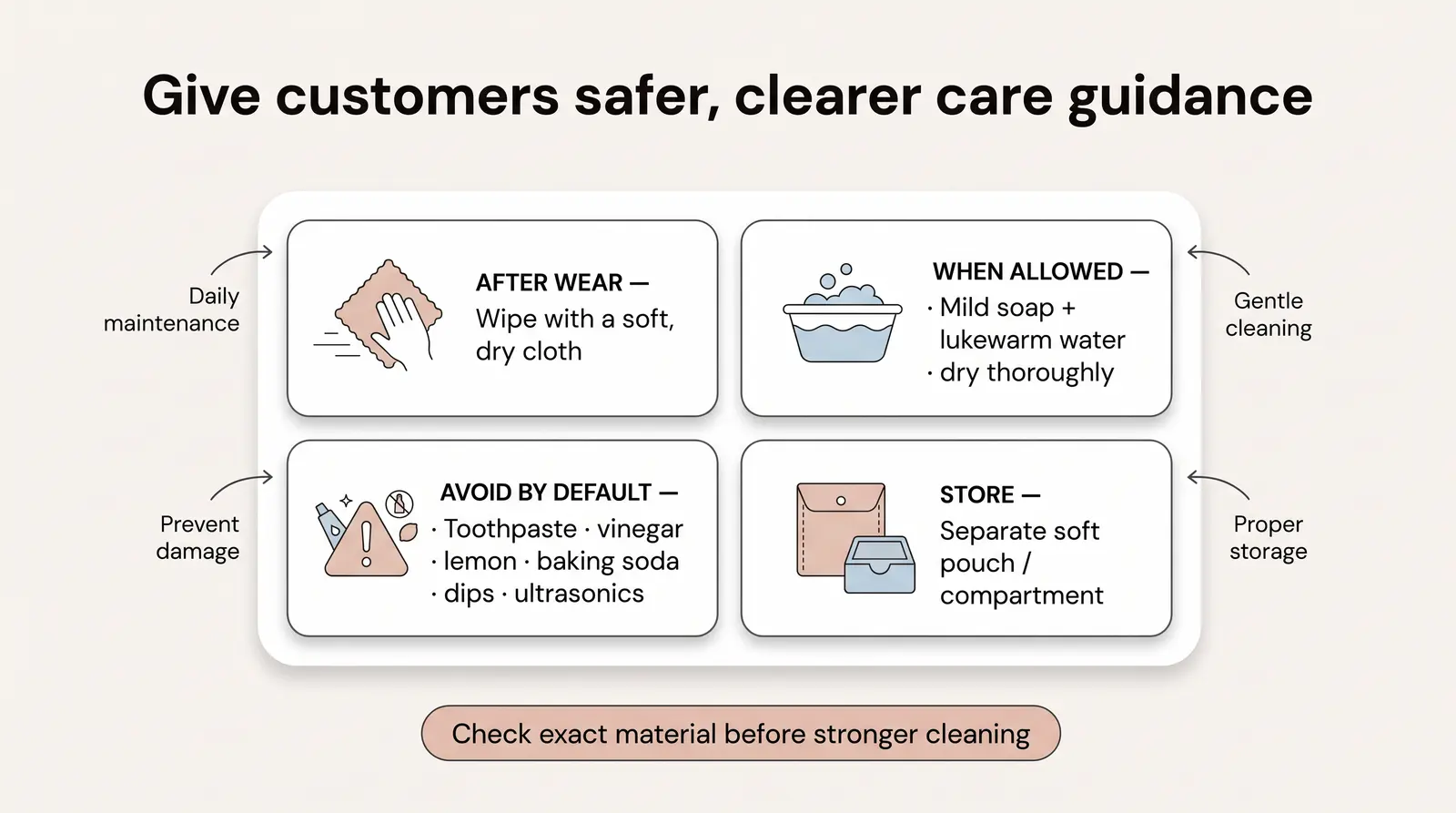
Wipe your piece with a soft, dry cloth after wear. When your material allows it, use lukewarm water and a small amount of mild soap, then dry thoroughly.
Avoid perfume, lotion, household cleaners, pools, hot tubs, and rough surfaces. Do not use toothpaste, vinegar, lemon, baking soda paste, silver dip, or an ultrasonic cleaner unless the care instructions for your exact piece say it is safe.
Store each piece separately in a soft pouch or compartment. Use an anti-tarnish bag or cloth for sterling silver. Keep pearls away from heat, acids, and very dry storage.
Need help? Check the material listed on your product page or contact us before trying a stronger cleaner.
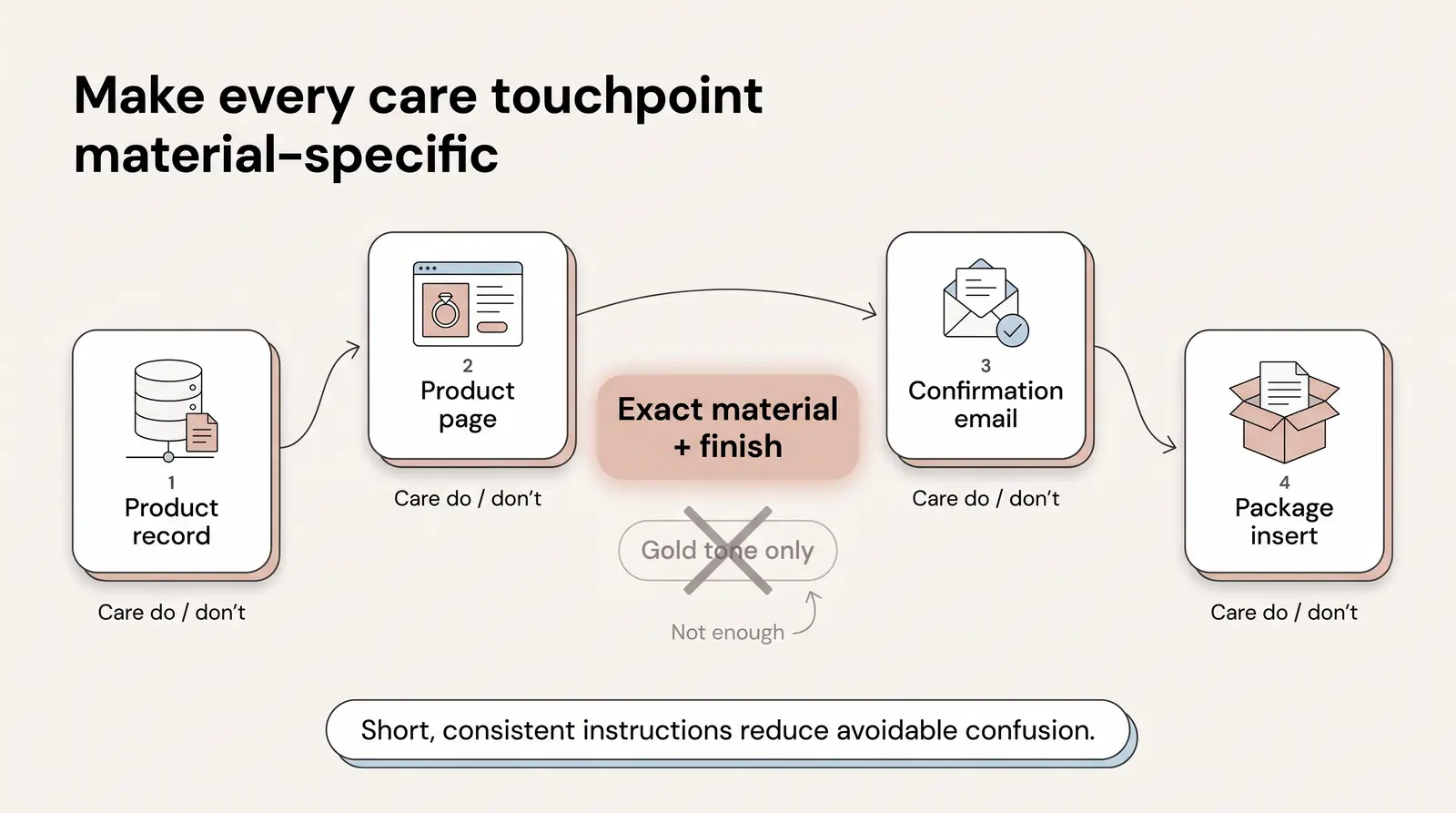
Consumer care comes first. For a brand owner, the practical next step is to carry the exact material and finish from the product record into the product page, confirmation email, and package insert. "Gold tone" is not enough to decide care. A customer needs to know whether the item is plated brass, vermeil, gold-filled, PVD-coated stainless, sterling, or a mixed-material piece.
Clear instructions cannot guarantee fewer care-related questions or returns, but they can reasonably reduce avoidable confusion by telling buyers which common hacks not to try. The strongest version is material-specific, short, and consistent across every customer touchpoint.
Branvas's pricing page lists a Branded package insert on its VIP plan. The page does not describe it as a care card or specify its editable content, so confirm eligibility and format before promising a particular insert to customers. 10
If branded fulfillment is part of your model, see how Branvas works for its stated sourcing, quality-check, packaging, and fulfillment process. 11
Do not use vinegar as a default cleaner for gold-plated jewelry. There is no direct source support in the research for using household acid on thin plating, and the conservative option is a soft cloth or the maker-approved mild-soap method. 7
No. Branvas explicitly advises against toothpaste for plated jewelry. Use a soft lint-free cloth instead, and use mild soap and lukewarm water only when the maker permits it. 7
For a suitable bare sterling piece, start with a gentle wash and thorough drying. For light tarnish, use a silver polishing cloth with light pressure. Avoid dips and strong methods when the piece is plated, hollow, antique, pearl-set, or made with mixed materials. 5
Not as an automatic rule. One manufacturer permits ultrasonic cleaning for sturdy metal and hard-gem pieces, while other manufacturer guidance is more conservative. GIA's setting and treatment cautions still apply. If the ring has plating, side stones, a loose setting, or unknown treatment, use mild soap and water instead. 4 12
Separate pieces in soft pouches or compartments. Use an anti-tarnish bag or cloth for sterling silver and keep it clean and dry. Do not apply the same very-dry storage logic to pearls, which should be protected from heat, rough objects, and excessively dry conditions. 1 3 5
Title and hook revised for accuracy. The original title's "Tested Methods" language and the proposed hook about testing 12 plating types, photographing damage, and finding that half of methods strip plating were not supported by documented, attributable Branvas material reviewed for this article. The H1 therefore uses a source-led "Safe / Caution / Never" framing. The publishable copy makes no claim that Branvas, the author, or any other party performed these tests or captured macro photos.
New-article scope, not a replacement. Branvas has related material articles, including PVD vs. gold-filled vs. vermeil durability, gold-plated jewelry care, and PVD coating jewelry. None was found to deliver the same all-material, method-by-method decision matrix. This article should therefore be published as a distinct care hub and link to those narrower material pages rather than duplicate their durability discussion.
Care-card asset status. Official Branvas pages verify a VIP "Branded package insert" feature, but they do not verify a downloadable PDF care card or state that the insert is a care instruction card. The on-page template above is original copy for brands to adapt. Producing a co-brandable PDF is a separate production task, and the team should confirm VIP eligibility, customization limits, and fulfillment use before describing it as an available feature.
Recommendation for a future, real test feature. If Branvas wants to publish macro photos and test findings later, use a documented protocol rather than a broad claim. Select comparable samples with recorded substrate, finish, plating or coating specification, stone type, and starting condition. Apply one cleaning method per sample plus an untreated control, with fixed solution concentration, contact time, rubbing pressure or stroke count, and rinsing/drying steps. Photograph each sample before and after under the same magnification and lighting. Record visible finish change, color change, stone or setting condition, and, where possible, coating-thickness or surface measurements. Publish sample count, controls, limitations, and results by material. Do not use the current article to imply those results exist.
Coverage limitation. Representative organic results were reviewed for practical US-English intent, but no reproducible Google rank, localization, device capture, or SERP-feature export was recorded. The article's decisions are based on opened source pages and cited material guidance, not on a claim about search position.