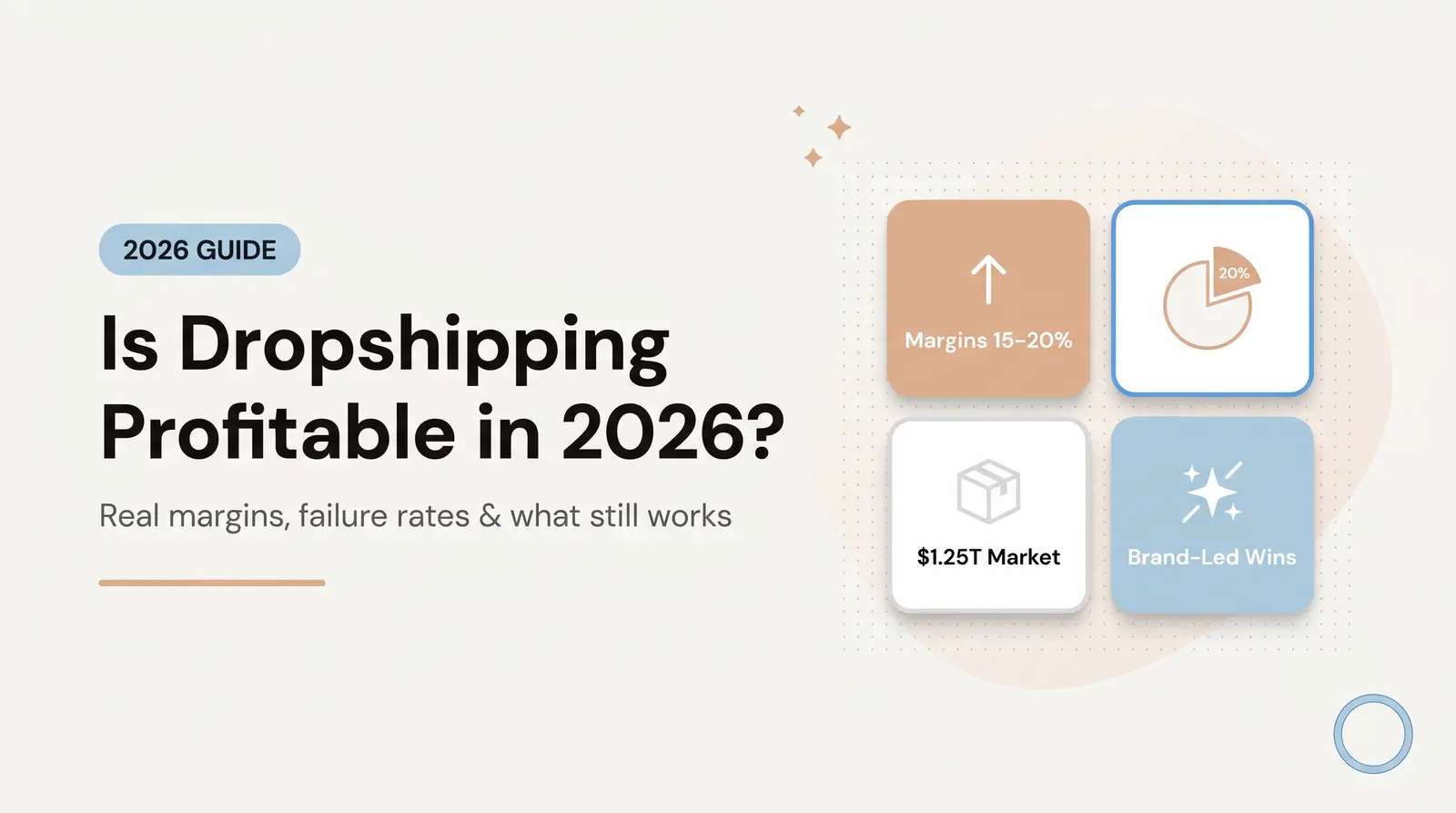



This step-by-step guide teaches how to start dropshipping in 2026 using private-label branding, organic video launches, and proven niche selection strategies for profitability.
Published:
October 12, 2026
Author:
Yi Cui
The internet has 10,000 "how to start dropshipping" guides and maybe 50 of them have been updated since 2023. Here's the version that reflects what actually works in 2026 — including the niches that are saturated and the ones quietly winning.
Let's address the reality of the market right now. The global dropshipping industry reached $365.7 billion in 2024 and is projected to hit $476.1 billion by the end of 2026 [1]. Yet, despite this massive growth, the failure rate for new dropshipping stores remains stubbornly high at 80% to 90% [1]. The reason is simple: the playbook has changed. The days of throwing up a generic Shopify store, importing cheap products from AliExpress, and running low-budget Meta ads are over. Customer acquisition costs have surged, and consumers demand real brands, fast shipping, and high-quality products.
If you want to be among the 10% to 20% of dropshippers who achieve profitability in their first year [1], you need a strategy built for 2026. This guide will walk you through the exact steps to launch a sustainable, brand-first dropshipping business, from selecting a viable niche to scaling your first winning product.
Niche selection is the single highest leverage point in your entire business. If you choose a saturated market, you will bleed capital trying to outbid established competitors. If you choose a market with no demand, you will hear crickets. What makes a niche "dropship-viable" in 2026 is not just whether it is trending on TikTok, but whether it offers enough margin to absorb rising advertising costs while maintaining high perceived value.
Many beginners gravitate toward what feels familiar, which leads them straight into oversaturated markets. In 2026, you should actively avoid niches like phone cases, general fitness gear, generic print-on-demand t-shirts, and basic home decor. These categories are dominated by massive retailers and Amazon Prime, leaving no room for a new dropshipper to compete on price or shipping speed.
Instead, look for niches that are quietly winning. These include pet wellness, functional wellness for women over 35, hobby-specific gear, and the undisputed leader for new sellers: jewelry and accessories.
Jewelry consistently outperforms other dropshipping categories for several structural reasons. First, it hits the perfect Average Order Value (AOV) sweet spot of $30 to $120. This provides enough gross margin to acquire customers profitably. Second, jewelry is an emotional purchase. Customers are not comparing specs; they are buying a feeling, a gift, or a piece of identity. This allows you to charge premium prices for products that cost relatively little to source.
Furthermore, jewelry boasts near-zero return rates. While apparel dropshippers battle return rates of 30% to 40% due to sizing issues, jewelry return rates hover below 10% [2]. It is also evergreen, meaning you aren't constantly chasing fleeting trends, and its low shipping weight keeps fulfillment costs minimal. Finally, jewelry integrates perfectly with the influencer gifting culture that drives organic social media growth.
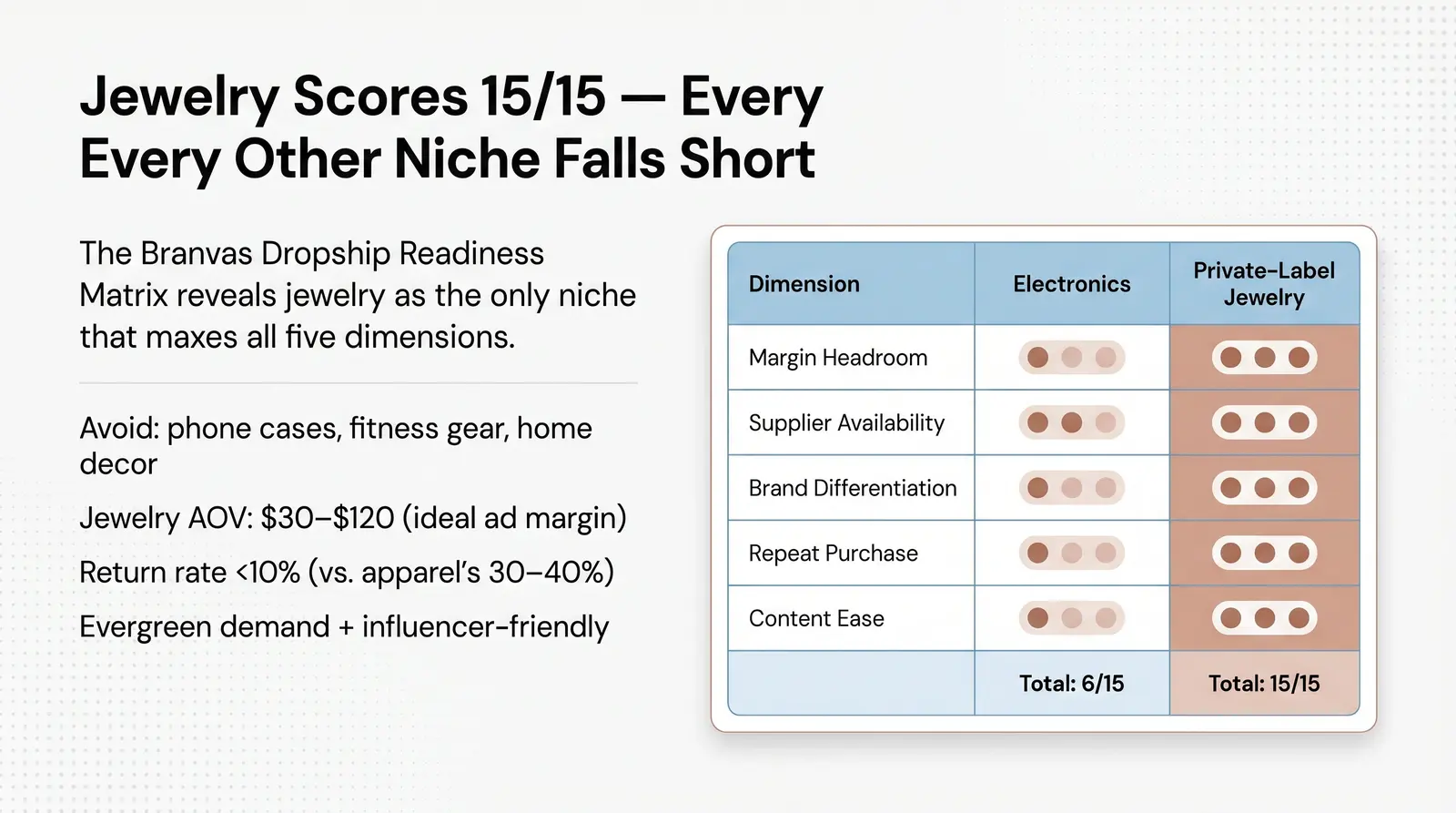
To help you evaluate potential niches objectively, we developed the Branvas Dropship Readiness Matrix. Score any niche from 1 (Poor) to 3 (Excellent) across these five dimensions. A total score below 10 means you should keep looking.
| Dimension | Why It Matters | General Electronics Accessories | Private-Label Jewelry |
|---|---|---|---|
| Margin Headroom | Can you mark it up 3x-5x to cover ad costs? | 1 (Price-shopped heavily) | 3 (High perceived value) |
| Supplier Availability | Are there reliable, fast-shipping suppliers? | 2 (Many, but quality varies) | 3 (Excellent private-label options) |
| Brand Differentiation | Can you make it look like a premium brand? | 1 (Hard to brand a generic cable) | 3 (Packaging and curation win) |
| Repeat Purchase Probability | Will they buy again without ads? | 1 (Rarely need two of the same) | 3 (High gifting and collection potential) |
| Content/Social Proof Ease | Is it easy to make organic video content? | 1 (Boring to film) | 3 (Highly visual, unboxing friendly) |
| Total Score | 6 / 15 (Avoid) | 15 / 15 (Launch) |
If you are ready to explore the highest-scoring niche, discover how Branvas helps aspiring entrepreneurs launch jewelry brands with zero inventory.
Once you have a niche, you must decide how you will source and fulfill your products. In 2026, there are three primary dropshipping models, and choosing the wrong one will cap your growth before you even launch.
The first is commodity dropshipping, the traditional model where you source generic products from platforms like AliExpress. While the startup costs are low, the margins are thin, shipping times are often atrocious, and you build zero brand equity because a thousand other stores are selling the exact same item.
The second is print-on-demand (POD), where you apply custom designs to white-label products like mugs or apparel. This solves the branding issue but limits you to a very specific catalog of products, and the base costs are often high, squeezing your margins.
The third, and most effective model for 2026, is private-label / Brand-as-a-Service. In this model, you partner with a supplier who not only fulfills the product but also applies your branding to the packaging and the product itself. You operate like a true brand owner, not a reseller.
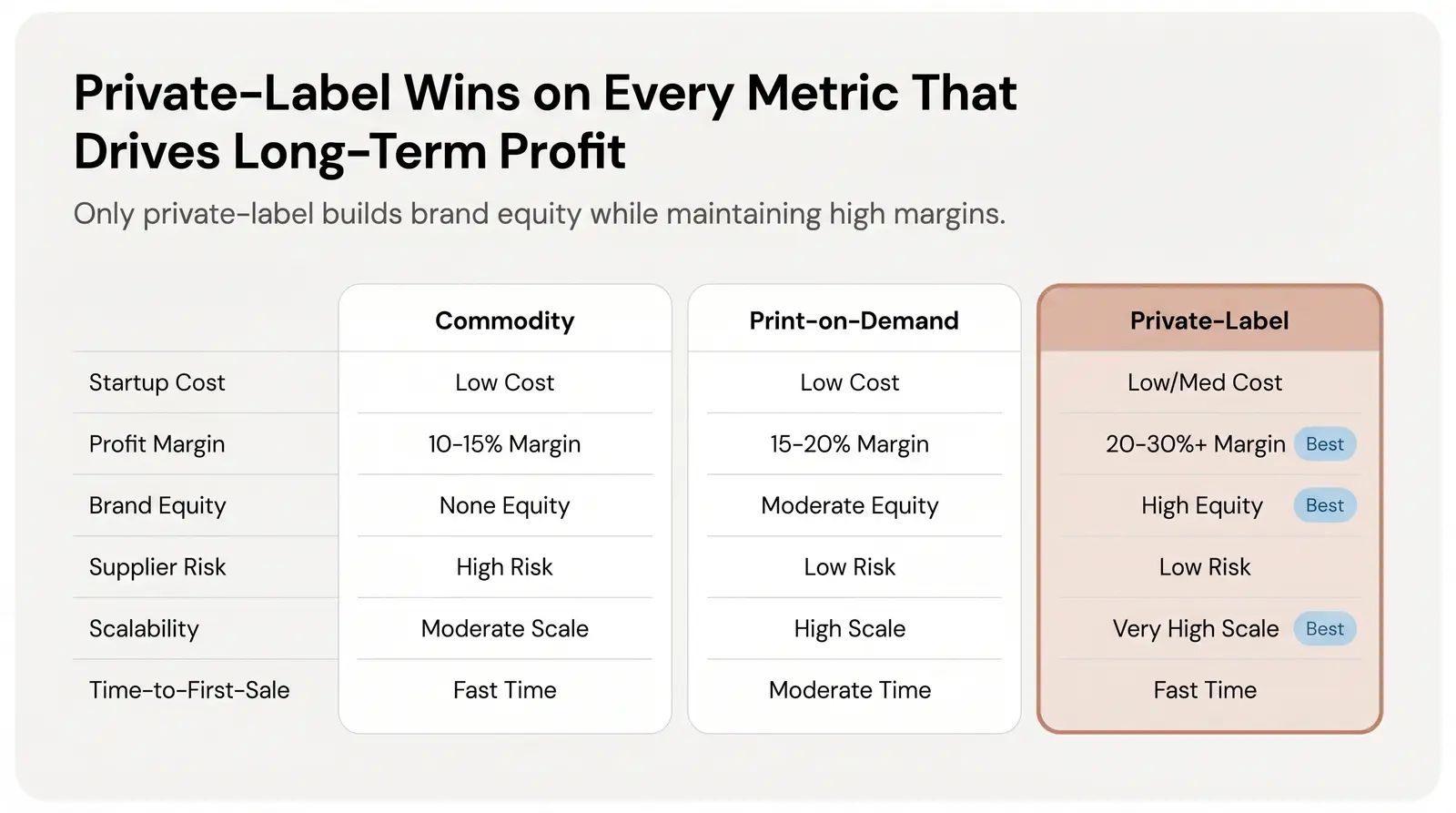
| Business Model | Startup Cost | Profit Margin | Brand Equity | Supplier Risk | Scalability | Time-to-First-Sale |
|---|---|---|---|---|---|---|
| Commodity Dropshipping | Very Low | Low (10-15%) | None | High (Quality/Shipping) | Moderate | Fast |
| Print-on-Demand | Low | Medium (15-20%) | Moderate | Low | High | Moderate |
| Private-Label / Brand-as-a-Service | Low to Medium | High (20-30%+) | High | Low (Vetted Partners) | Very High | Fast |
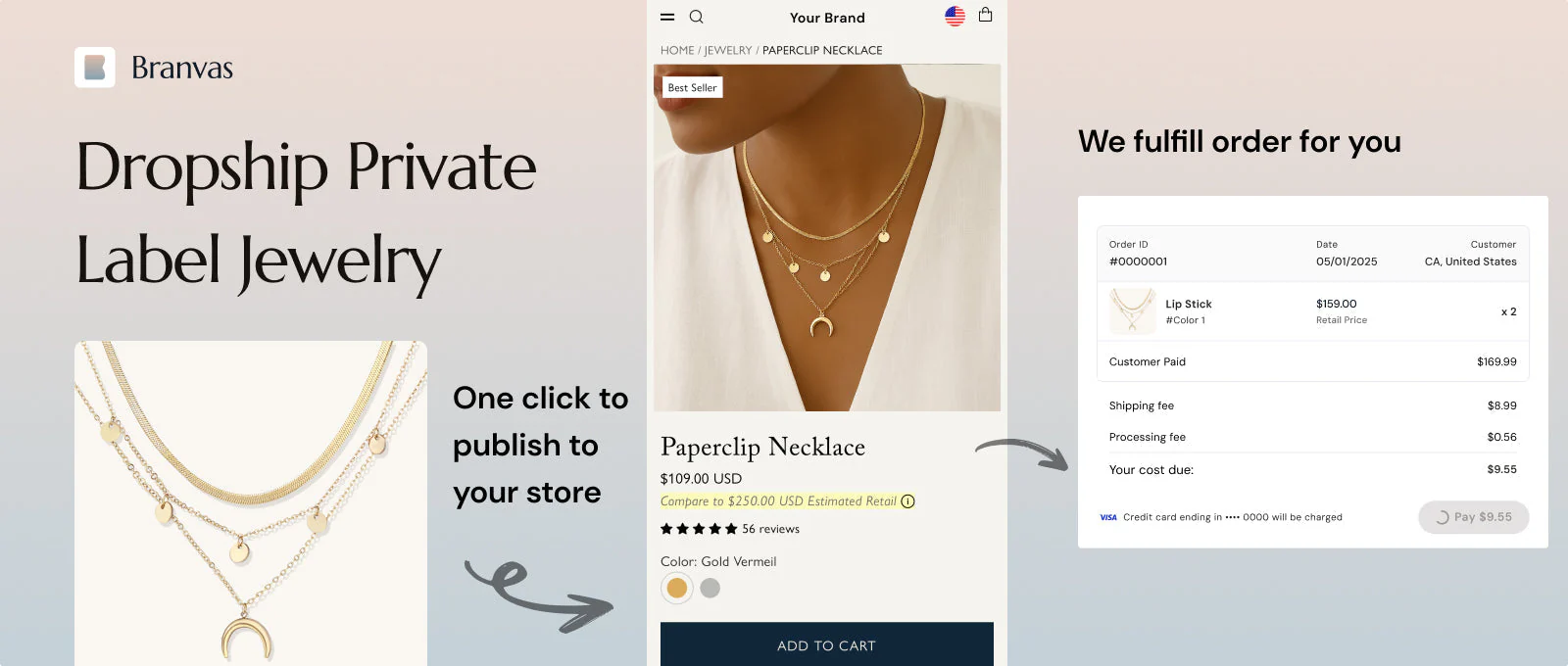
Private-label wins because it builds long-term brand equity. When a customer receives a beautifully packaged necklace with your logo on the box, they remember your brand, not the factory that made it. However, managing a factory yourself requires massive capital and minimum order quantities (MOQs). This is where Brand-as-a-Service comes in. Services like Branvas handle the sourcing, branding, packaging, and blind fulfillment — so you operate like a brand owner, not a reseller.
See how the Brand-as-a-Service model works in practice.
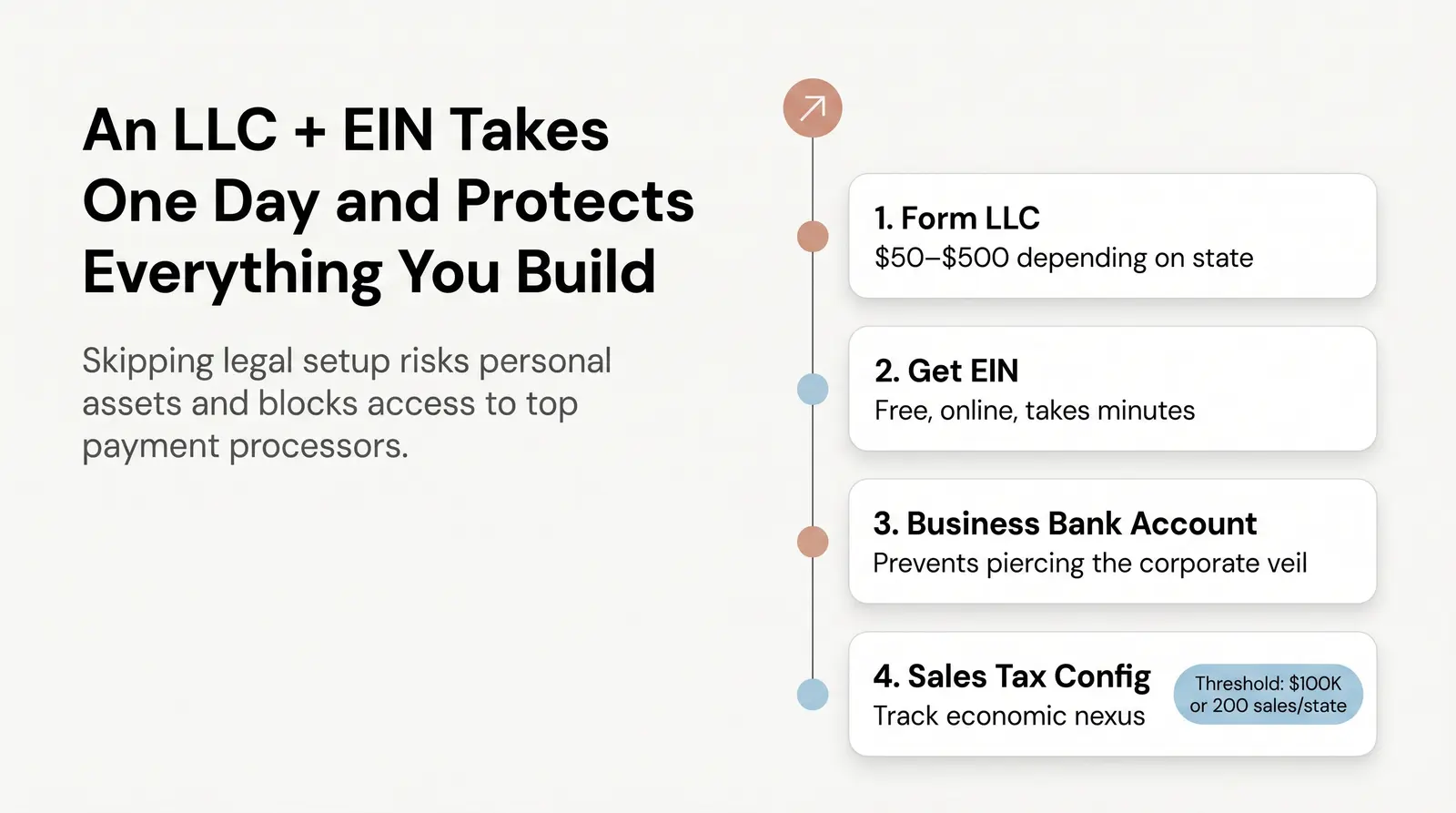
We often see new sellers skip the legal structure step entirely. That's a mistake that costs real money later. While you can technically start dropshipping as a sole proprietor, operating without a formal business entity exposes your personal assets to liability and makes it difficult to secure the best payment processors.
For most ecommerce entrepreneurs in the US, forming a Limited Liability Company (LLC) is the smartest first step. An LLC separates your personal assets from your business liabilities. The cost to form an LLC varies by state, typically ranging from $50 to $500 [3]. Once your LLC is formed, you must obtain an Employer Identification Number (EIN) from the IRS, which is free and can be done online in minutes.
With your LLC and EIN, you can open a dedicated business bank account. Mixing personal and business finances is a bookkeeping nightmare and can pierce the corporate veil of your LLC. Furthermore, platforms like Shopify, Stripe, and PayPal increasingly require formal business documentation to process payments without holds or reserves.
You must also understand sales tax nexus. In 2026, economic nexus laws mean that if you sell enough products into a specific state, you must collect and remit sales tax there, even if you have no physical presence. The threshold is typically $100,000 in sales or 200 transactions per year in a given state [4]. While you won't hit this on day one, you need your store configured to track it.
Note: This is not legal or financial advice. Always consult a CPA or attorney to ensure your business is structured correctly for your specific situation.
Your storefront is your only salesperson. If it looks untrustworthy, slow, or confusing, you will pay for traffic that never converts. When choosing an ecommerce platform in 2026, the debate usually comes down to Shopify versus WooCommerce.
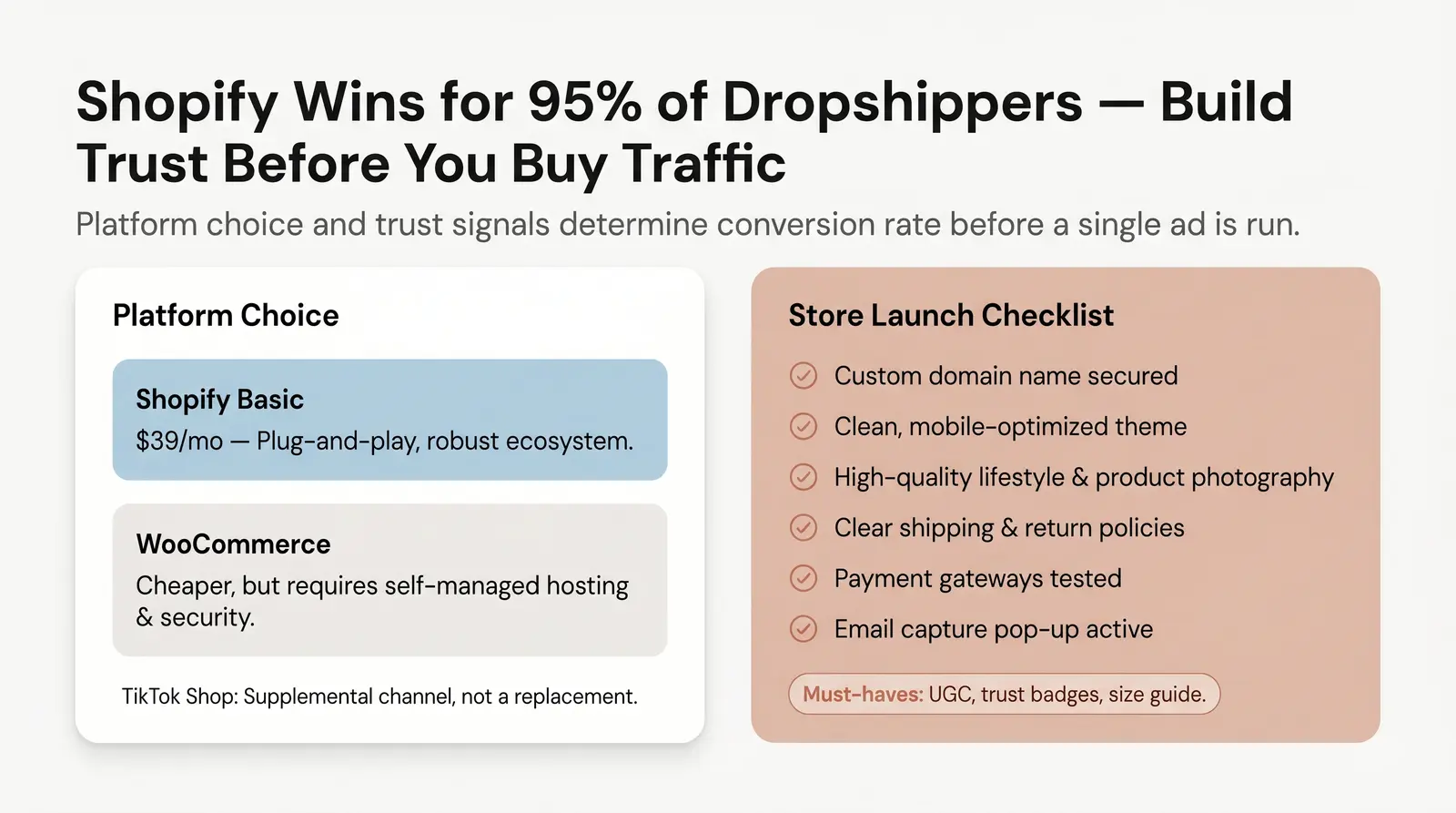
For 95% of dropshippers, Shopify is the clear winner. It is plug-and-play, hosts the most robust ecosystem of dropshipping apps, and handles security and hosting automatically. The Basic plan costs $39 per month (or $29 if paid annually) [5], which is a negligible expense for a reliable foundation. WooCommerce is cheaper long-term but requires you to manage your own WordPress hosting, security updates, and plugin conflicts — time better spent marketing your products. You should also consider TikTok Shop, but treat it as a supplemental sales channel integrated with your Shopify store, not a replacement for your own domain.
A high-converting product page in 2026 requires more than just a title and a price. Consumers are skeptical. Your product pages must feature prominent trust signals, such as secure checkout badges and clear return policies. User-Generated Content (UGC) is mandatory; show real people using or wearing your product. If you are selling jewelry, a visual size and fit guide is essential to reduce purchase hesitation. Finally, prioritize lifestyle imagery over sterile white-background photos. Customers need to visualize how the product fits into their life.
Store Launch Checklist:
Once your store is built, you need products that match your brand's aesthetic. Explore the Branvas catalog to curate your initial collection.
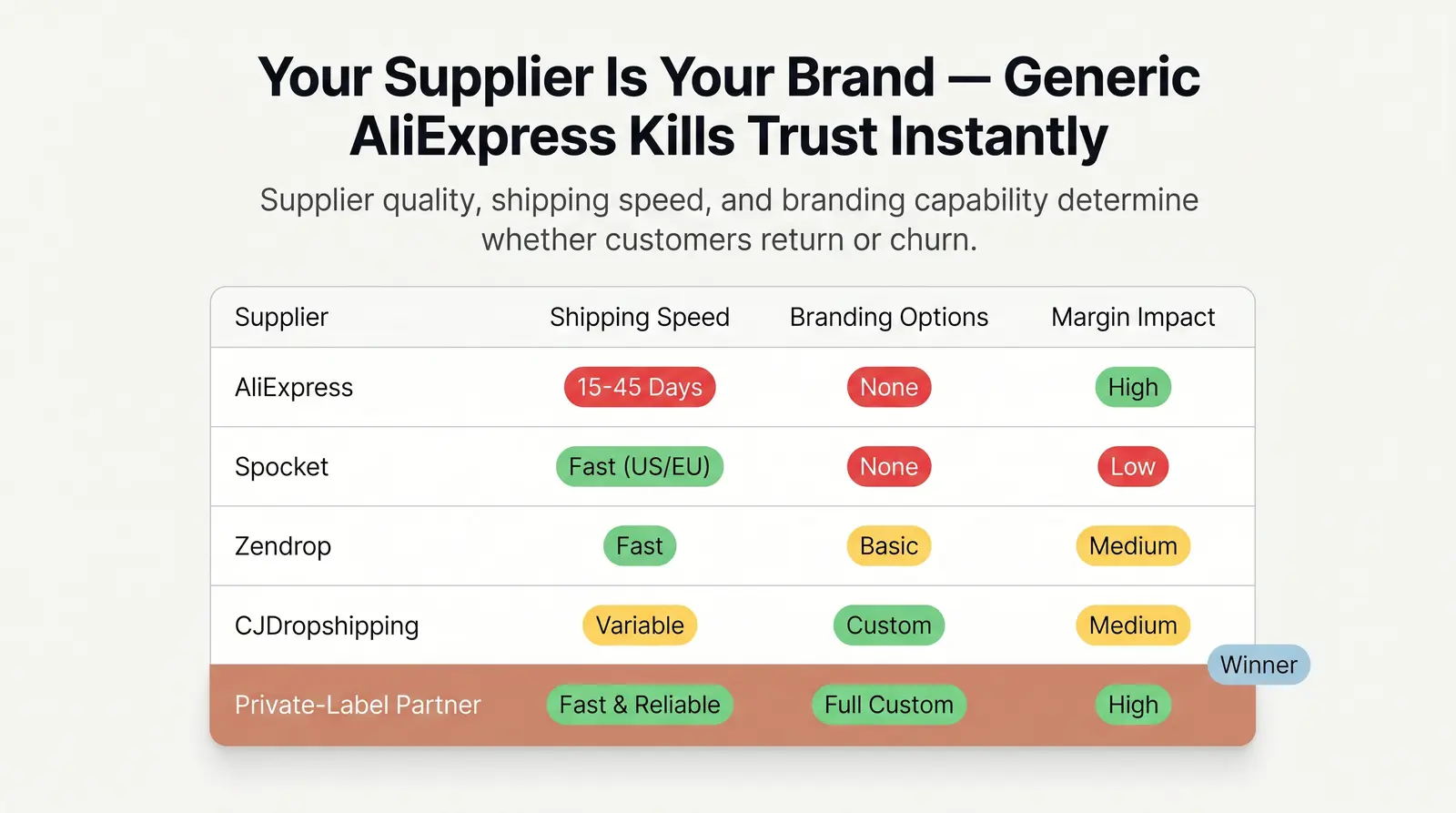
Your supplier is your silent partner. If they fail, your brand takes the blame. When evaluating dropshipping suppliers, you must look beyond the wholesale price. You need to assess their shipping times, their ability to perform blind shipping (no invoices or Chinese characters on the package), their communication responsiveness, and whether they offer custom branding options.
The landscape of supplier platforms has evolved significantly. AliExpress remains the largest catalog, but its 15-to-45-day shipping times and inconsistent quality make it a liability for serious brands. Spocket offers faster shipping from US and EU suppliers, but the product costs are higher, squeezing margins. Zendrop provides faster fulfillment and some branding features, but with a smaller catalog. CJDropshipping offers custom packaging, but quality control can be hit or miss.
For jewelry specifically, generic AliExpress suppliers fail because they offer no branding, slow shipping, and high rates of tarnishing or breakage. This destroys customer trust immediately. This is why a private-label partner like Branvas solves the core problem for jewelry brands. Branvas provides high-quality, curated jewelry with your brand's logo on the packaging, shipped quickly and reliably. You get the margins of private label without the inventory risk.
If you're launching a jewelry brand, explore Branvas's catalog to see what's possible with private-label from day one.
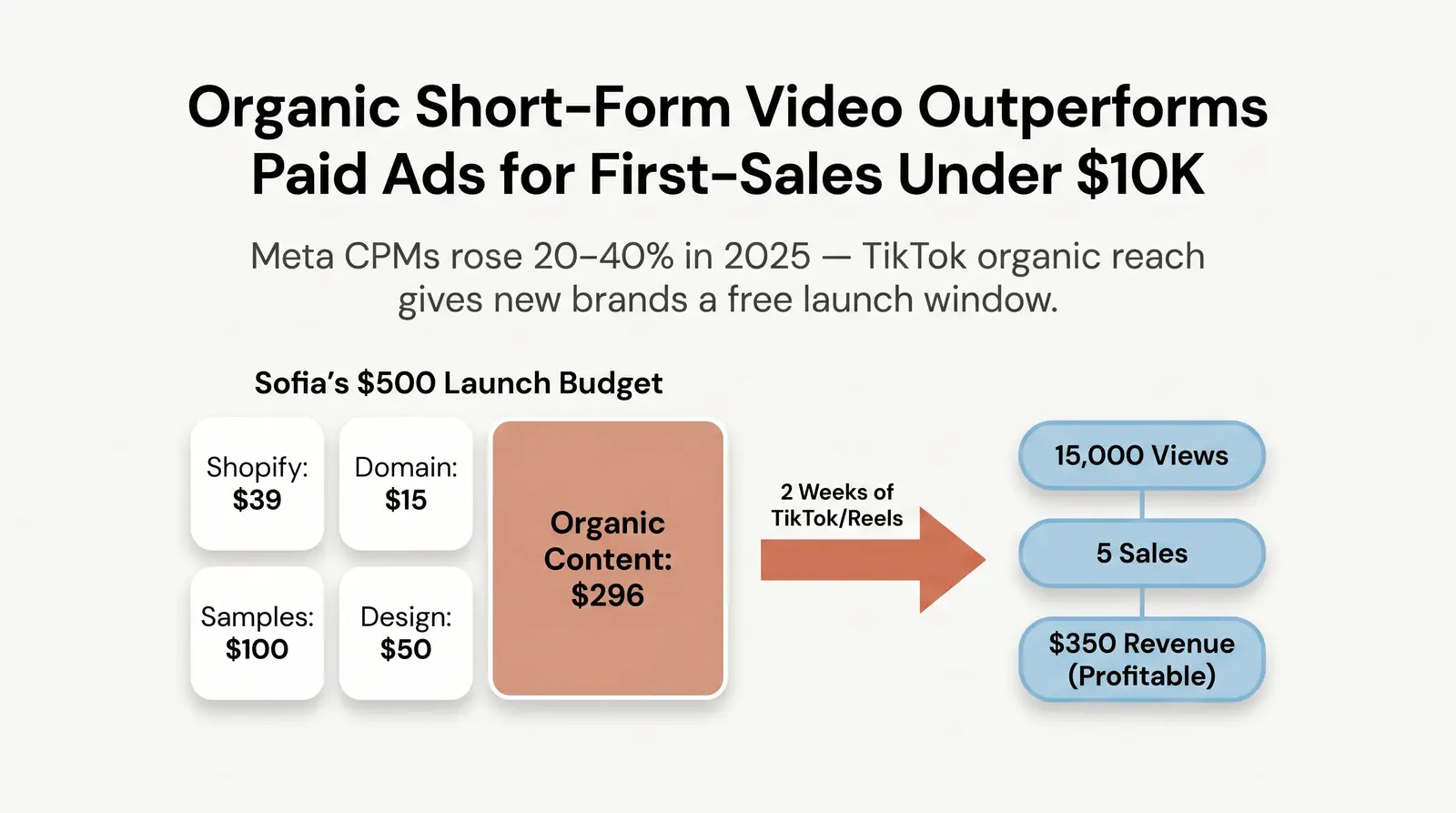
Most beginners are told to validate their products with paid ads first. They load up a Meta (Facebook/Instagram) campaign, spend $500, get zero sales, and declare dropshipping dead. Here is the contrarian truth for 2026: the highest-converting first-sales channel for physical product brands under a $10K budget is organic short-form video, not Meta ads.
Why? Because Meta CPMs (Cost Per Mille, or the cost for 1,000 impressions) have inflated massively. In 2025, Meta CPMs rose by over 20% across the board, with some industries seeing spikes of nearly 40% [6]. It is simply too expensive to test unproven products on cold audiences with paid ads.
Conversely, TikTok's algorithm still rewards new accounts with an organic reach boost during their first two to four weeks. More importantly, product-market fit signals from organic saves, shares, and comments are far more reliable than Return on Ad Spend (ROAS) on a $50 test budget. In our experience at Branvas, the founders who succeed fastest aren't the ones who spent the most on ads — they're the ones who picked a niche they could talk about on camera.
Your organic launch strategy should focus on four types of videos: unboxing experiences, "this is what I sell" walkthroughs, behind-the-scenes brand building (packing orders, designing the store), and customer reactions. Post one to three times a day consistently. Only graduate to paid ads once you have proof of organic traction — typically after your first three to five organic orders.
Let's look at a realistic example. Sofia, 26, has no prior ecommerce experience but wants to start a side hustle. She allocates a strict $500 budget.
She chooses the jewelry niche because of its high margins and low return rates. She signs up for Shopify ($39) and buys a domain ($15). Instead of gambling on AliExpress, she partners with Branvas for private-label fulfillment. She orders $100 worth of samples to her house so she can film content. She spends $50 on basic packaging design assets from a freelancer.
With her remaining $296, she does not buy ads. Instead, she spends two weeks filming organic TikToks and Instagram Reels using her samples. She posts videos showing how the jewelry catches the light, how she styles it, and the story behind her new brand. In week three, a video about her waterproof gold-plated rings gets 15,000 views. She makes her first 5 sales, generating $350 in revenue with a $105 cost of goods. She is profitable, she has validated her product, and she still has her ad budget in the bank to scale what is already working.
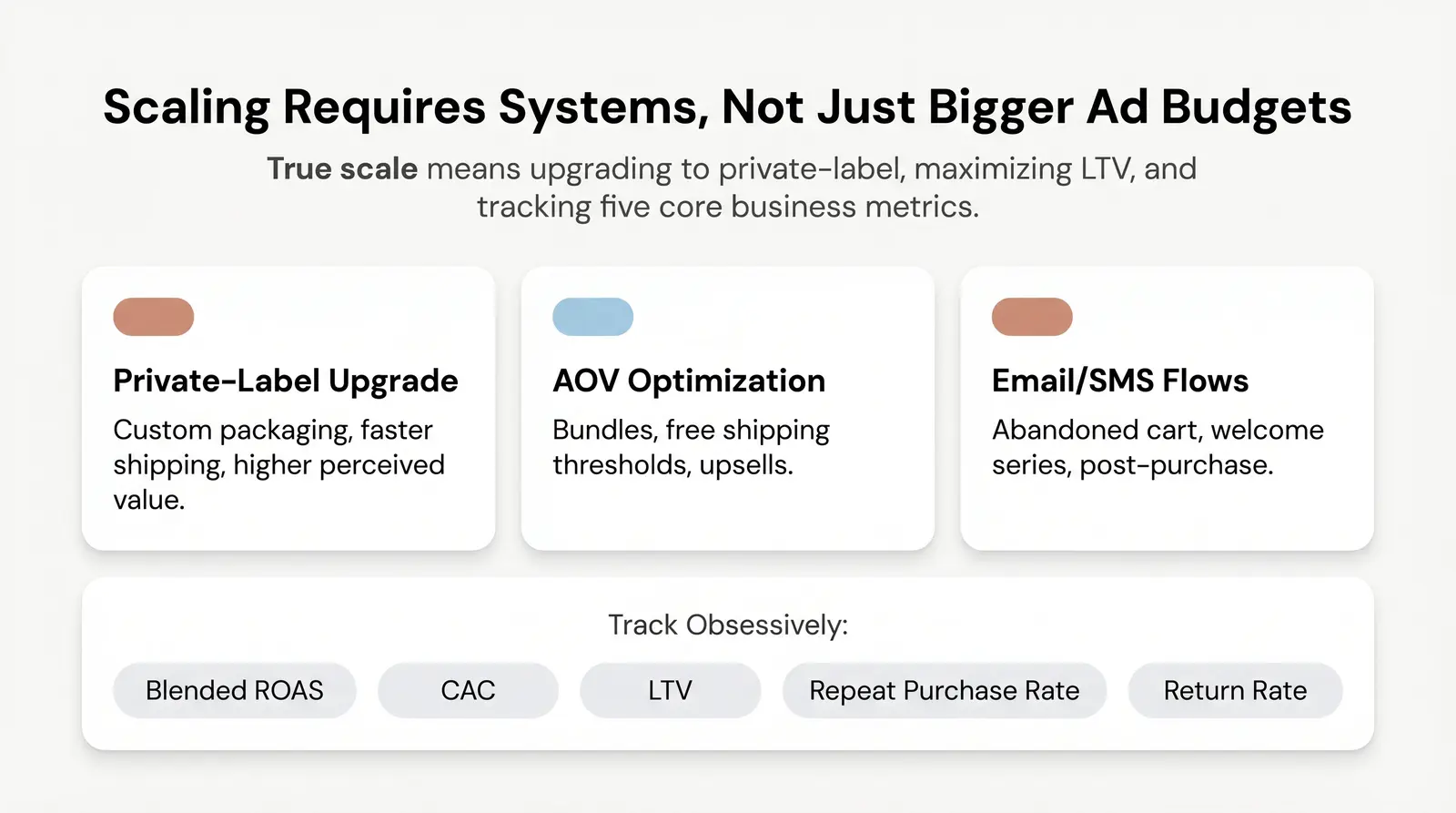
Scaling does not just mean increasing your daily ad budget. True scaling is about building a resilient business system. As your order volume increases, the cracks in your foundation will show. You must ensure your supplier can handle 50 orders a day as reliably as they handled five.
Scaling also means maximizing the value of the customers you already have. You should focus heavily on AOV optimization by offering bundles, "frequently bought together" recommendations, and free shipping thresholds. Implement robust email and SMS flows for abandoned carts, welcome series, and post-purchase follow-ups. Introduce a loyalty program to drive repeat purchases.
If you started with commodity dropshipping to test the waters, scaling is the exact moment you must upgrade to a private-label model. You cannot build a seven-figure brand shipping generic products in ePacket envelopes. You need custom packaging, faster shipping, and higher perceived value to justify the rising Customer Acquisition Costs (CAC).
As you scale, track your metrics obsessively. Your Blended ROAS, CAC, Customer Lifetime Value (LTV), repeat purchase rate, and return rate are the vital signs of your business. Use the Branvas Profit Calculator to ensure your margins remain healthy as your ad spend grows.
Ready to launch a jewelry brand that scales? See how Branvas works — from your first order to your thousandth.
Q: How much money do I need to start dropshipping in 2026?
A: You can launch a professional dropshipping store for under $500. This covers your Shopify subscription, a custom domain, sample products for content creation, and basic legal setup. By leveraging organic short-form video instead of paid ads for your initial launch, you can keep your startup costs incredibly lean.
Q: Is dropshipping still profitable in 2026?
A: Yes, but the margins have shifted. While commodity dropshipping yields thin 10% to 15% net margins, private-label dropshipping in high-ticket niches like jewelry can generate 20% to 30% net margins. Profitability in 2026 requires building a brand, optimizing your average order value, and securing reliable suppliers.
Q: What is the best niche for dropshipping beginners?
A: Jewelry and accessories is the optimal niche for beginners. It offers high perceived value, excellent profit margins, low shipping costs, and return rates under 10%. At Branvas, we've helped launch dozens of jewelry brands — and the single biggest predictor of early success is niche specificity, not product quality.
Q: Do I need an LLC to start a dropshipping business?
A: While not legally required on day one, forming an LLC is highly recommended. It protects your personal assets from business liabilities and makes it significantly easier to open business bank accounts and secure reliable payment processors like Stripe and Shopify Payments.
Q: How long does it take to make your first sale dropshipping?
A: If you follow a consistent organic content strategy, you can realistically expect your first sale within two to four weeks of launching your store. Relying on SEO takes months, while paid ads can generate sales in days but require a larger budget and carry higher risk for beginners.