



Convert gold and silver spot prices into per-piece metal content cost by karat using the MCC formula, then build a pricing strategy around metal volatility.
Published:
September 30, 2026
Author:
Yi Cui
Gold set repeated records through 2025 and 2026, yet too many jewelry sellers are still repricing on instinct instead of math. This guide turns a spot quote into a per-piece metal-content number so you can see what is actually moving your margin.
For founders building their first collection, Branvas's resources for aspiring entrepreneurs can help turn that sourcing decision into a launch plan.
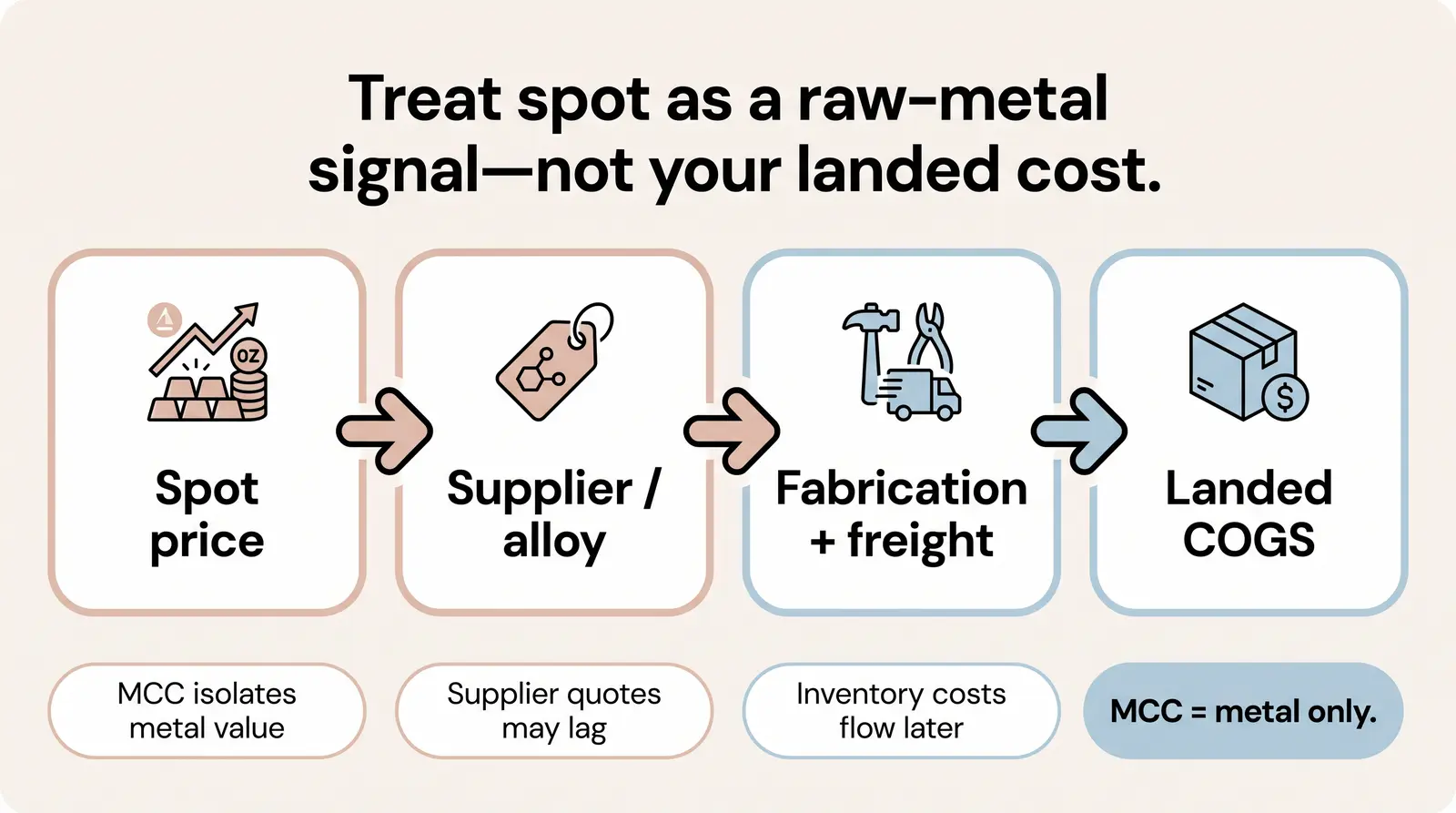
Spot is the wholesale reference price for a troy ounce of unallocated metal. It changes continuously and is quoted before the work of turning metal into a sellable item. It is a floor for raw metal value, not a ceiling for your landed cost.1 2
The commercial chain is straightforward: spot price becomes a refinery or supplier price, then an alloy cost by karat, then fabrication, casting loss, labor, finishing, stones, findings, quality control, freight, duties, packaging, wholesale margin, and retail margin. A supplier may also use a dated fixing, a hedge, average-cost inventory, or a contract price rather than the quote visible on your phone.
At Branvas, one of the most common misconceptions we see from new brand founders is treating spot price as their actual metal cost. It is not. The useful working number is Metal Content Cost, or MCC: the dollar value of the precious metal physically attributable to a piece at a stated spot price. MCC is an input to total COGS, not total COGS itself.
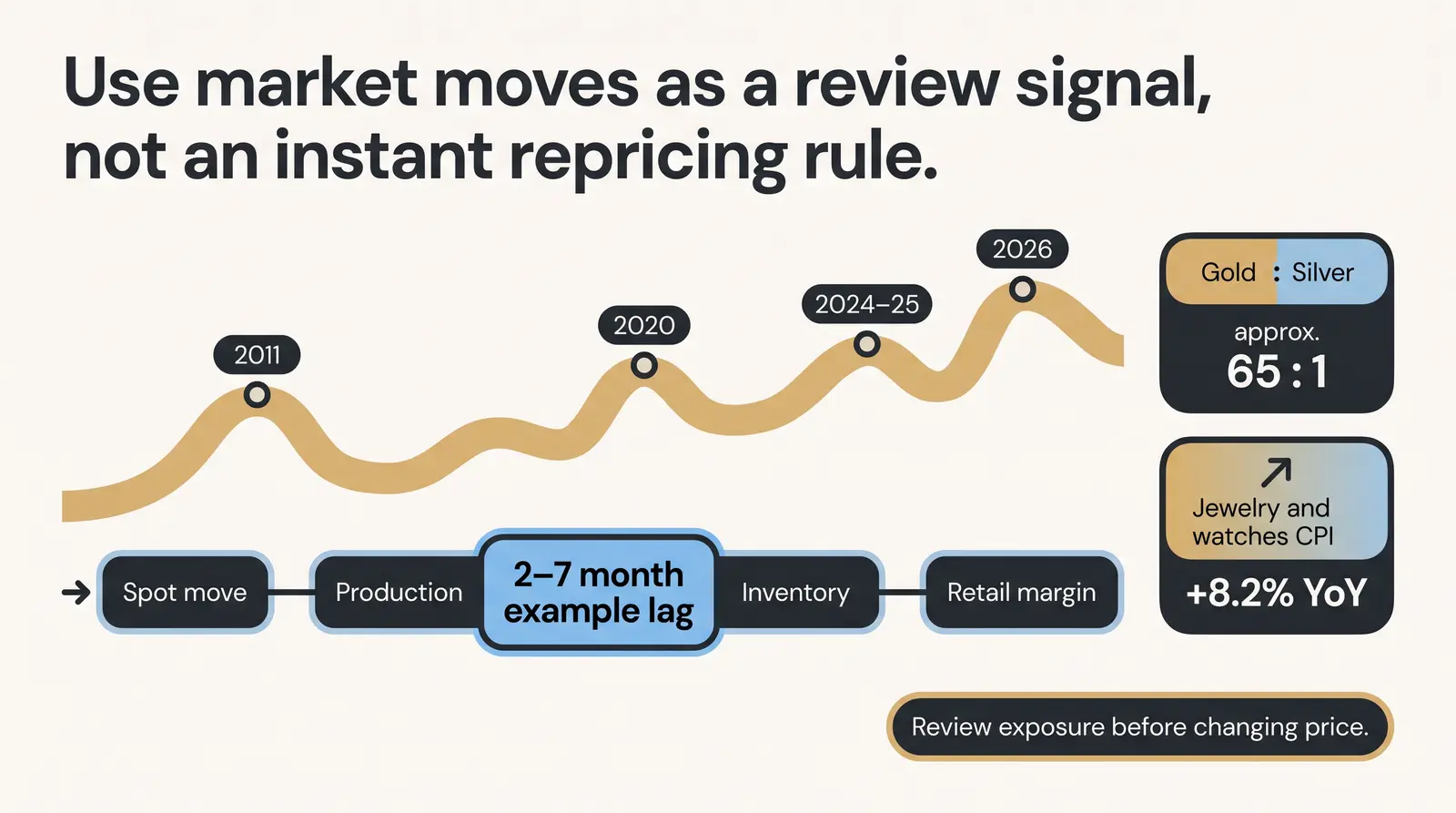
A practical implication follows: a same-day gold move can matter enormously to a solid 18K collection and barely move a PVD collection. It can also take months to show up in a retailer's gross margin. Pandora disclosed a usual two-to-seven-month production-to-cost-of-sales lag and a longer, hedge-related spot-silver-to-EBIT margin lag in 2024. Signet likewise describes average-cost inventory as a reason merchandise-cost changes take time to flow through margin.8 9
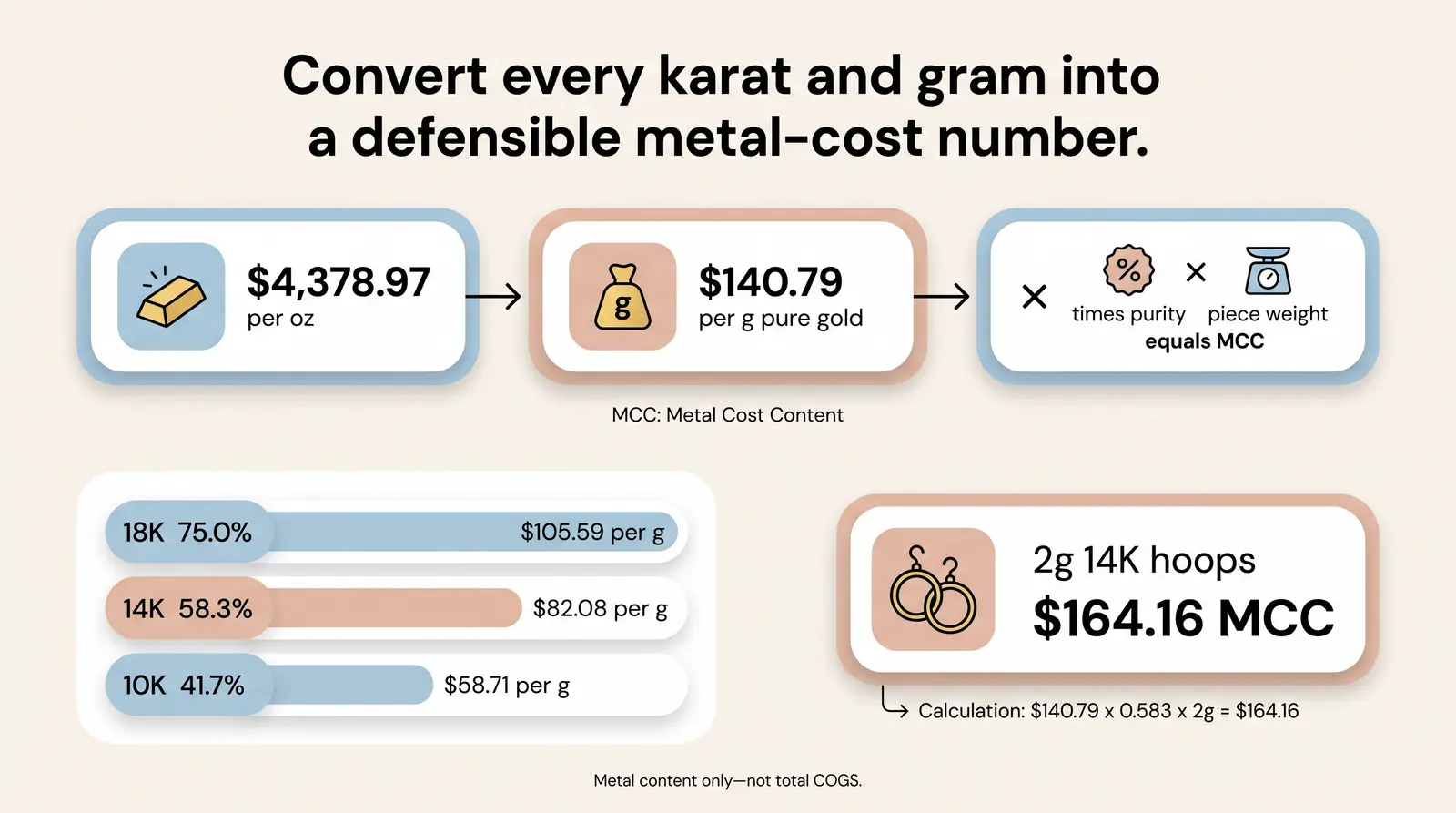
The table below uses an illustrative spot snapshot captured 18 September 2026 at 11:41 GMT: gold at $4,378.97/troy oz and silver at $67.03/troy oz. That converts to $140.79/g of pure gold and $2.155/g of pure silver, using 31.1034768g per troy ounce. The live widget should replace these figures on its update cycle.1
| Metal Type | Gold/Silver Purity | Grams of Pure Metal per 1g of Alloy | Metal Content Cost per Gram at the Example Spot Price | Notes |
|---|---|---|---|---|
| 24K Gold | 99.9% | 0.999g | $140.65 | Pure gold; uncommon for durable everyday jewelry |
| 18K Gold | 75.0% | 0.750g | $105.59 | Fine-jewelry standard |
| 14K Gold | 58.3% | 0.583g | $82.08 | Common U.S. fine-jewelry alloy |
| 10K Gold | 41.7% | 0.417g | $58.71 | A lower-gold karat alloy |
| Gold-Filled | About 5% by metal weight | About 0.050g | $7.04 | At least 1/20 by metal weight for the FTC gold-filled example, mechanically bonded |
| Gold Vermeil | Not defined as a weight percentage | About 0.001-0.005g* | $0.14-$0.70* | Sterling-silver base; FTC vermeil guidance calls for 10K+ gold and 2.5 microns of fine-gold equivalent on significant surfaces |
| Gold-Plated | Not defined as a universal weight percentage | About 0.0001-0.0005g* | $0.01-$0.07* | Illustrative thin-deposit allocation only; actual mass depends on area, thickness, density, and alloy |
| PVD Coating | Not a gold-content claim | Varies, often no elemental gold | $0.00 when no gold is used | PVD is a deposition method, not a standardized jewelry gold thickness |
| 925 Sterling Silver | 92.5% Ag | 0.925g Ag per 1g | $1.99 | Derived from silver spot price |
*The coating rows are illustrative metal allocations per gram of finished item, not legal standards or universal manufacturing values. Coating mass must be calculated from the item’s actual surface area, thickness, coating density, and gold fraction. This matters: a 1-micron fine-gold coating over a large hoop has more gold than the small allocations in this comparison table.
Gold content by karat is nominally karat divided by 24: 18K is 18/24, or 75.0%; 14K is 14/24, or 58.3%; and 10K is 10/24, or 41.7%. The FTC requires accurate karat disclosure for gold alloys. Its Guides define sterling as at least 925/1,000 silver, and provide specific conditions for terms such as vermeil and gold-filled.3 4 5
The Branvas MCC Formula™ (Metal Content Cost)
MCC per piece = (Spot Price per troy oz ÷ 31.1035) × Purity Factor × Piece Weight in gramsFor plated products, replace
Purity Factor × Piece Weightwith the measured or specified fine-gold-equivalent deposit mass. That prevents a coating estimate from being mistaken for the metal content of a solid piece.
Here is the math, step by step, using the same illustrative snapshot.
1. A 2g gold hoop earring pair in 14K
$4,378.97 ÷ 31.1035 = $140.79/g of pure gold
$140.79 × 0.583 = $82.08/g of 14K gold content
$82.08 × 2g = $164.16 MCC
A plausible $350 direct-to-consumer retail benchmark puts the gold-content value at 46.9% of retail. That is not a gross-margin calculation. The remaining price must still cover non-gold alloy, fabrication, finishing, fulfillment, acquisition costs, overhead, returns, and profit.
2. A 5g gold chain in 18K
$4,378.97 ÷ 31.1035 = $140.79/g of pure gold
$140.79 × 0.750 = $105.59/g of 18K gold content
$105.59 × 5g = $527.95 MCC
Against an illustrative $1,200 retail benchmark, MCC is 44.0% of retail. The percentage is lower than 100% because retail includes more than gold, but it is still large enough that a supplier price review should not wait for an annual planning cycle.
3. A 3g sterling silver ring in 925
$67.03 ÷ 31.1035 = $2.155/g of pure silver
$2.155 × 0.925 = $1.99/g of 925 silver content
$1.99 × 3g = $5.98 MCC
Against an illustrative $75 retail benchmark, silver content is 8.0% of retail. The alloy, casting, polishing, plating if used, and fulfillment can outweigh the silver spot exposure for this type of product.
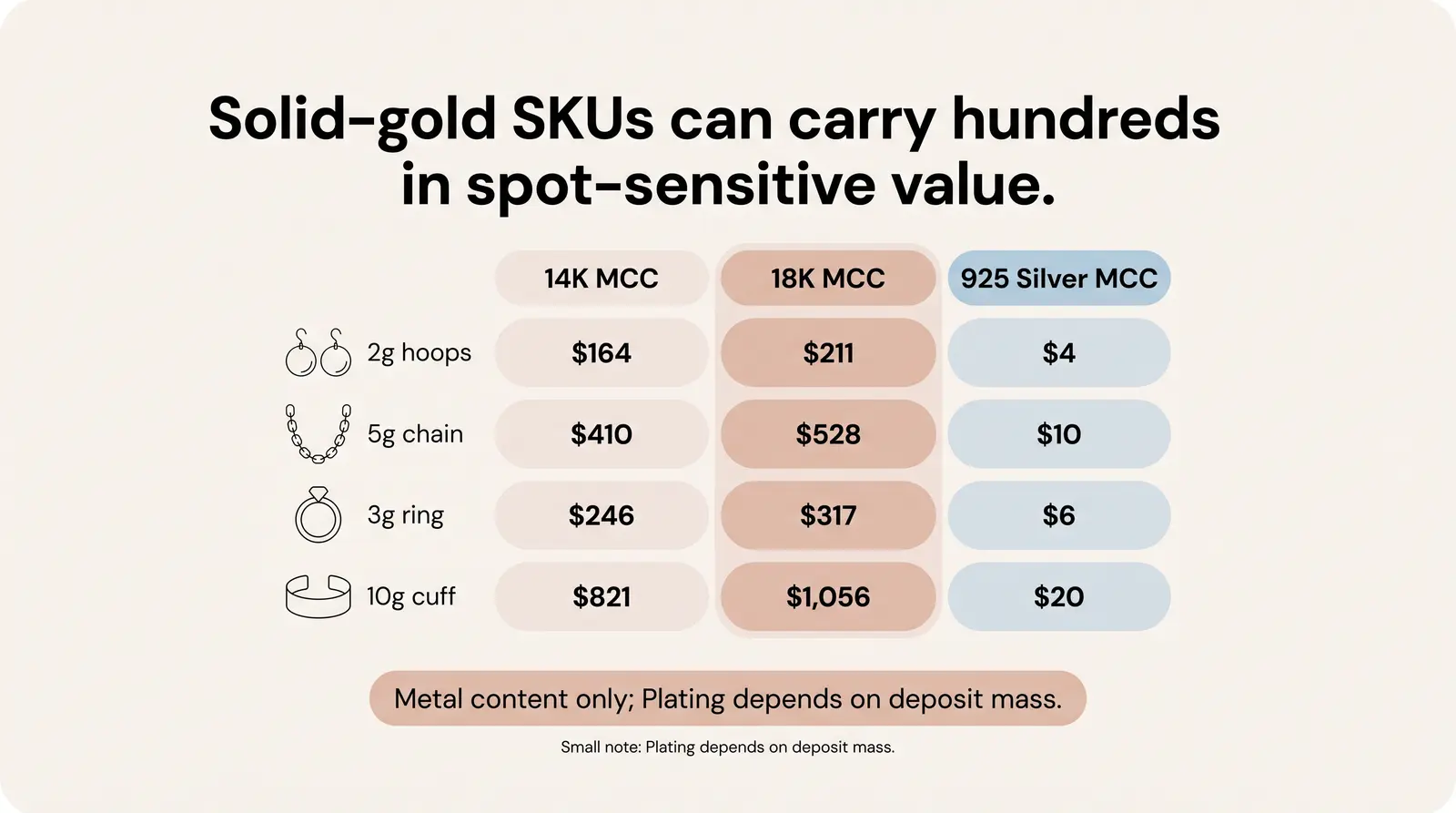
This is metal content cost only, not total COGS. The solid-metal columns apply the MCC Formula directly. The gold-plated column uses deliberately small illustrative fine-gold-equivalent deposits of 0.1mg, 0.3mg, 0.2mg, 0.5mg, and 0.1mg, respectively. It is useful for showing the arithmetic, but it is not a substitute for a supplier coating specification.
| Item | Approx. Weight | 14K Gold MCC | 18K Gold MCC | 925 Silver MCC | Gold-Plated MCC* |
|---|---|---|---|---|---|
| Small hoop earring pair | 2g | $164.16 | $211.18 | $3.99 | $0.01 |
| Medium chain necklace | 5g | $410.39 | $527.95 | $9.97 | $0.04 |
| Solitaire ring | 3g | $246.24 | $316.77 | $5.98 | $0.03 |
| Chunky cuff bracelet | 10g | $820.79 | $1,055.90 | $19.93 | $0.07 |
| Pendant, small | 1.5g | $123.12 | $158.39 | $2.99 | $0.01 |
*Gold-plated values use the stated illustrative deposit masses, not the finished-item weights. They will be higher for a thicker deposit or a larger surface area. Labor, findings, packaging, freight, duties, and margin are excluded from every column.
The operational point is simple. One solid-gold collection can carry hundreds of dollars of spot-sensitive value per SKU. A sterling collection often carries single-digit metal value at these weights. Coated products can carry very little or meaningfully more, depending on the deposited mass. Ask for the thickness, surface coverage, coating chemistry, and test method before assigning a plated MCC.
See the live chart above. The long view shows why jewelry planning needs a process instead of a once-a-year estimate. Gold rallied in the 2008 financial crisis, reached its prior-era high around the 2011 precious-metals peak, then spent much of 2018 and early 2019 below those highs before rallying again. The COVID-19 shock drove a new 2020 peak. Gold recovered through 2022 and 2023, when the LBMA afternoon benchmark reached $2,069.40/oz on 27 December 2023, then set repeated records in 2024 and 2025. Reuters recorded a spot high of $5,594.82/oz on 29 January 2026 before the 18 September 2026 snapshot used in this article.1 2
Silver often moves in the same broad direction but not in the same proportion. The illustrative snapshot produces a gold-to-silver ratio of about 65:1, calculated as $4,378.97 divided by $67.03. A higher ratio means gold is expensive relative to silver; a lower ratio means silver has caught up. It is a relative-value signal, not a rule that a silver ring should be priced at a fixed fraction of a gold ring. Manufacturing, weight, design, and customer perception still control the final price.
Retail pricing lags spot because the shelf price is not a live metal quote. The U.S. BLS jewelry-and-watches CPI was 229.740 in August 2026, versus 212.244 a year earlier, an 8.2% increase. That is a useful retail-price indicator, but it combines jewelry and watches and does not measure pure gold jewelry alone.6 There is no credible universal number of months that all brands take to reprice. Public company disclosures instead show different inventory, production, and hedging mechanics. Pandora’s disclosed two-to-seven-month production-to-cost-of-sales lag is a useful example, not an industry law.8
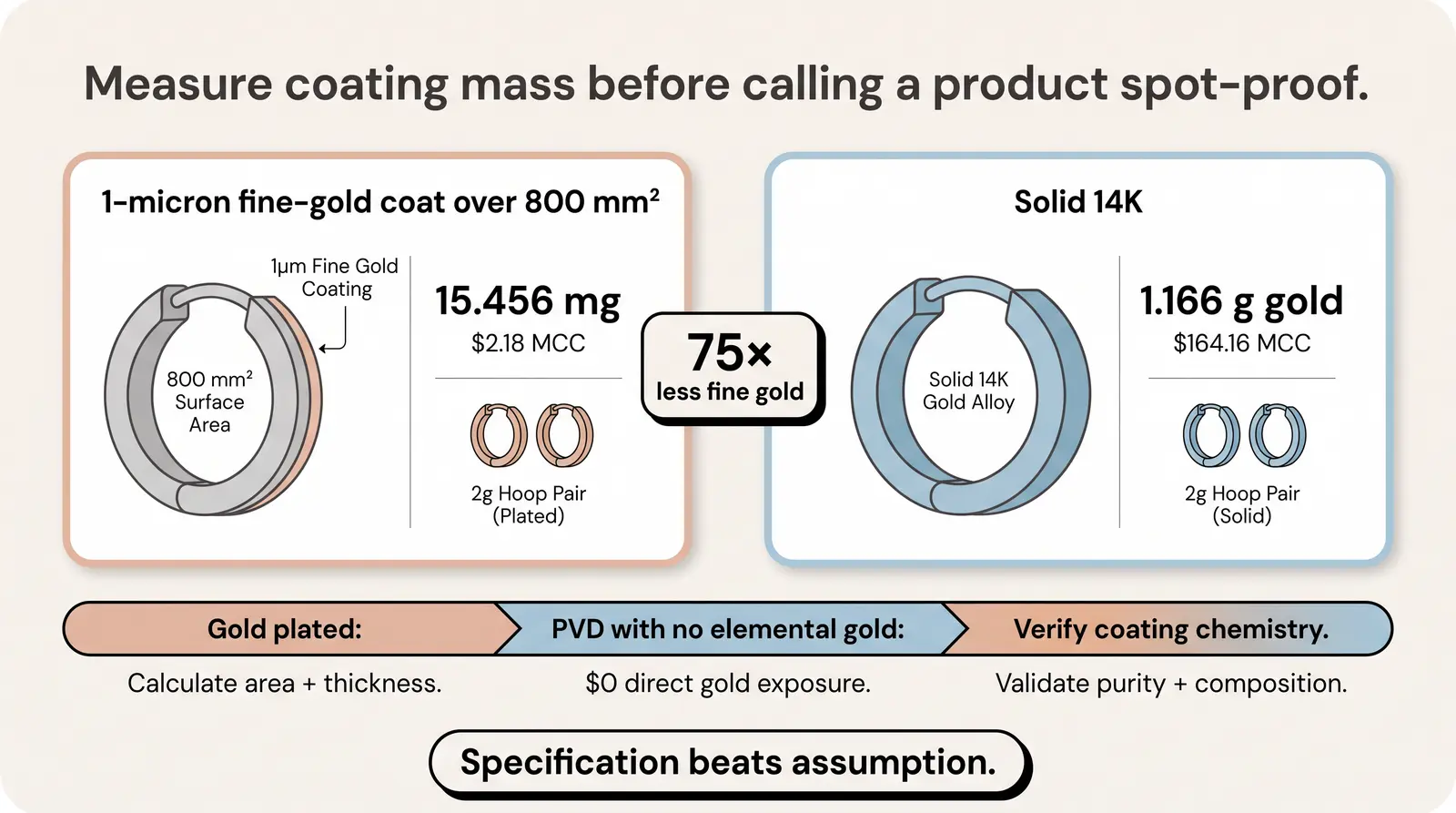
Non-Obvious Insight: Gold headlines can become a psychological pricing trigger, but a universal claim that a plated earring gains less than $0.01 of cost when gold rises from $2,000 to $3,000/oz is not mathematically reliable. For a full 1-micron fine-gold coat over 800mm², the direct increase is about $0.50. For a light flash deposit it can be only a few cents, and for a PVD system with no elemental gold it can be zero. The honest insight is that plated and PVD products are usually much less exposed than solid gold, not that every coating has no exposure.
The direct cost insulation is real when a product has a small gold-equivalent deposit relative to a solid-gold alternative. It needs to be quantified rather than assumed.
Take the requested example of a 2g hoop pair with roughly 800mm² of coated surface area, modeled as a uniform 1-micron layer of fine gold. Convert 800mm² to 8.00cm². Convert 1 micron to 0.0001cm. The volume is therefore:
8.00cm² × 0.0001cm = 0.000800cm³
Using fine gold’s density of 19.32g/cm³, the gold mass is:
0.000800cm³ × 19.32g/cm³ = 0.015456g = 15.456mg
At $140.79/g, its metal content is:
0.015456g × $140.79 = $2.18
Now compare that with the 2g solid 14K hoop pair above. Its gold content is 2g × 58.3%, or 1.166g, with an MCC of $164.16. The modeled plated hoop uses about 75 times less fine gold by mass. If gold rises from $2,000 to $3,000/oz, the 1-micron model’s direct gold-cost increase is about $0.50, while the solid 14K pair’s gold-content increase is about $37.49.
That result also shows why generic percentage claims are risky. Gold-plated is not defined by a universal percentage of a finished item. The FTC’s example for an electrolytic gold deposit uses a 0.175-micron fine-gold-equivalent minimum, while its Heavy Gold Electroplate example uses 2.5 microns. Vermeil requires a sterling-silver base and 2.5 microns of fine-gold equivalent on significant surfaces. The actual item geometry and coating specification decide the mass.4 5
PVD, or physical vapor deposition, is a vacuum deposition process. It is not a jewelry karat category or a standardized promise of a particular gold thickness. Decorative PVD systems can be thin films made from compounds such as titanium nitride and can contain no elemental gold. When that is the coating chemistry, gold spot has no direct metal-content effect. When a supplier calls a finish “gold PVD,” ask what material is actually deposited and request the coating specification.10
At Branvas, most of our catalog is built around plated, vermeil, and 925 silver precisely because those choices can give brand founders greater margin stability when gold is making headlines. The insulation is a COGS advantage, not permission to overstate the construction. Brand perception can still move with gold news, so precise product descriptions matter.
Explore Branvas's catalog of margin-stable jewelry styles →
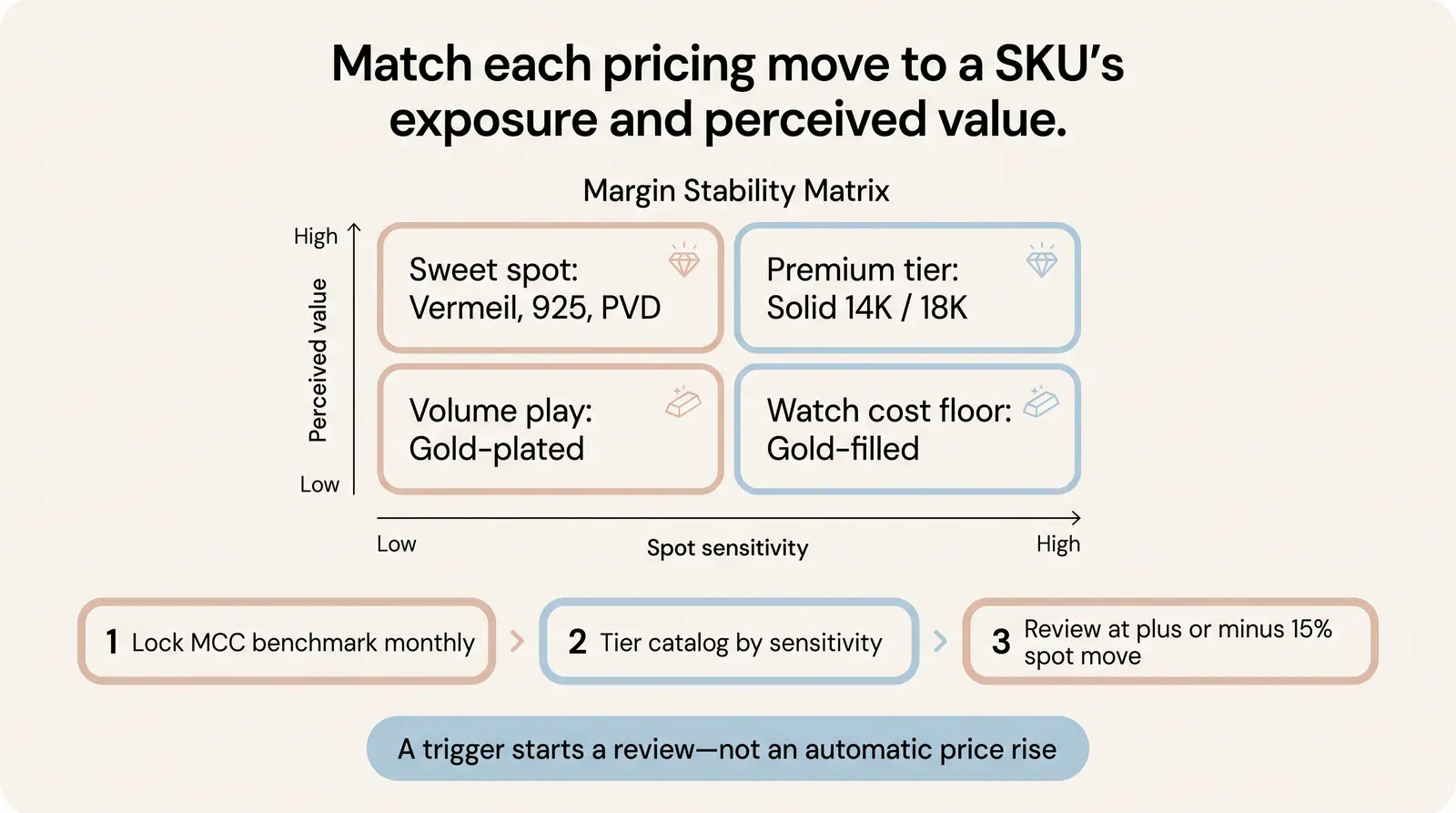
The right response is not to treat every SKU alike. The Branvas Margin Stability Matrix™ makes metal sensitivity visible alongside perceived value.
| Low Spot Price Sensitivity | High Spot Price Sensitivity | |
|---|---|---|
| High Perceived Value | Gold Vermeil, 925 Silver, PVD. Sweet Spot | Solid 14K/18K Gold. Premium Tier, manage with hedging or MOQ pricing |
| Lower Perceived Value | Basic Gold-Plated. Volume play, strong margins | Gold-Filled, if spot spikes. Watch your cost floor |
High perceived value and low sensitivity: Vermeil, 925 silver, and well-specified PVD can support a premium story without putting a full solid-gold weight on every invoice. The constraint is product truth. State the base metal, coating method, and care expectations accurately.
High perceived value and high sensitivity: Solid 14K and 18K deserve a premium tier, a tighter quote-validity window, and an explicit price-review process. If your supplier offers hedged or fixed-period pricing, compare its premium with the cost of an unprotected move. For small brands, minimum-order and quote-expiry terms are often more practical than direct commodity hedging.
Lower perceived value and low sensitivity: Basic plated product can be a volume engine if the finish specification is repeatable. Its key risks are quality consistency, warranty claims, and customer expectations, not usually a one-day spot move.
Lower perceived value and higher sensitivity: Gold-filled contains substantially more gold than a light plated finish. At a 1/20 metal-weight construction, its MCC can move quickly enough to require quote checks, while its perceived premium depends on education and durable construction.
In our experience working with jewelry founders, the matrix works best when it becomes a sourcing routine rather than a one-time positioning exercise. Use it to decide which pieces lead paid acquisition, which are premium upsells, and which need short supplier quote windows.
Lock your COGS benchmarks using the MCC Formula. Revisit the benchmark monthly, and use the supplier’s actual quote and fabrication premium alongside it. An annual spot-price assumption is not enough for solid-gold inventory.
Tier your catalog by metal sensitivity. Lead volume SKUs with plated, PVD, and silver designs when the economics fit. Position solid gold as a premium upsell with a price that can withstand a plausible metal move.
Build price-review triggers. A sensible starting trigger is a plus or minus 15% move in the relevant spot benchmark from the approved cost sheet. A trigger starts a review. It does not automatically require a retail price increase.
Communicate transparently, or do not use the metal story. Explain a price change in material-cost terms when the item is solid or high-karat enough for the statement to be meaningful. Do not imply that a non-gold PVD finish has become expensive because of gold spot headlines.
At Branvas, we tell founders to separate a supplier quote, MCC, landed COGS, and retail price in the same spreadsheet. That makes a pricing decision auditable instead of intuitive.
Ready to build a jewelry brand with margin-stable sourcing built in? See how Branvas works →
Q: How does the gold spot price affect the cost of my jewelry?
A: It affects the raw-gold portion of the item, not the whole cost of the item. Convert the spot quote from troy ounces to grams, multiply by the karat purity, then multiply by the item’s precious-metal weight. At the illustrative $4,378.97/oz snapshot, 14K gold has about $82.08 of gold content per gram. A 2g 14K piece therefore has about $164.16 of gold content before alloy, casting, labor, findings, shipping, packaging, and margin. Suppliers may use a different fixing date or fabrication premium, so confirm the quote basis.1
Q: How much gold is actually in gold-plated jewelry?
A: There is no single percentage because the answer depends on surface area, coating thickness, deposit composition, and coverage. A uniform 1-micron layer of fine gold over 800mm² contains about 15.456mg of gold. A much lighter flash can contain only fractions of a milligram. In U.S. FTC guidance, a qualifying electrolytic gold-plate example uses 0.175 microns of fine-gold equivalent, while Heavy Gold Electroplate uses 2.5 microns. Ask for the actual specification rather than relying on the word “plated.”5
Q: What is the price per gram of 925 sterling silver today?
A: At the illustrative 18 September 2026 silver spot snapshot of $67.03 per troy ounce, pure silver is about $2.155 per gram. Sterling is 92.5% silver, so the silver-content value of 925 is about $1.99 per gram. That is not necessarily your purchase price per gram. Your cost can include alloy, casting and polishing, supplier margin, freight, duties, and any coating. Recheck the live spot widget before using the figure in a supplier negotiation.1 4
Q: Will jewelry prices go up in 2026?
A: Some have already risen, but no universal increase is inevitable. The BLS jewelry-and-watches CPI was 8.2% higher in August 2026 than in August 2025. That category includes watches and does not isolate every jewelry material. Brands can respond to volatile metal costs through design changes, lower weights or karats, supplier terms, inventory, hedging, narrower margins, or retail price changes. The strongest case for a review is solid high-karat inventory with a large MCC, not a headline alone.6 7 9
Q: Is gold-filled jewelry worth the extra cost over gold-plated?
A: It can be, when the intended durability and customer promise justify it. The FTC gold-filled example requires an at-least-10K gold alloy mechanically bonded to significant surfaces and at least 1/20 of the article’s metal weight. That is materially more gold than a light electroplated layer, so it can offer a different construction and cost profile. It also carries more direct gold-price exposure. Compare the supplier’s actual metal-weight specification, finish warranty, base metal, and total landed cost rather than treating every “gold-filled” or “plated” claim as interchangeable.5


