



This FTC compliance checklist helps jewelry sellers legally audit material claims, hypoallergenic labels, sustainability marketing, and influencer disclosures to avoid enforcement actions.
Published:
September 13, 2026
Author:
Yi Cui
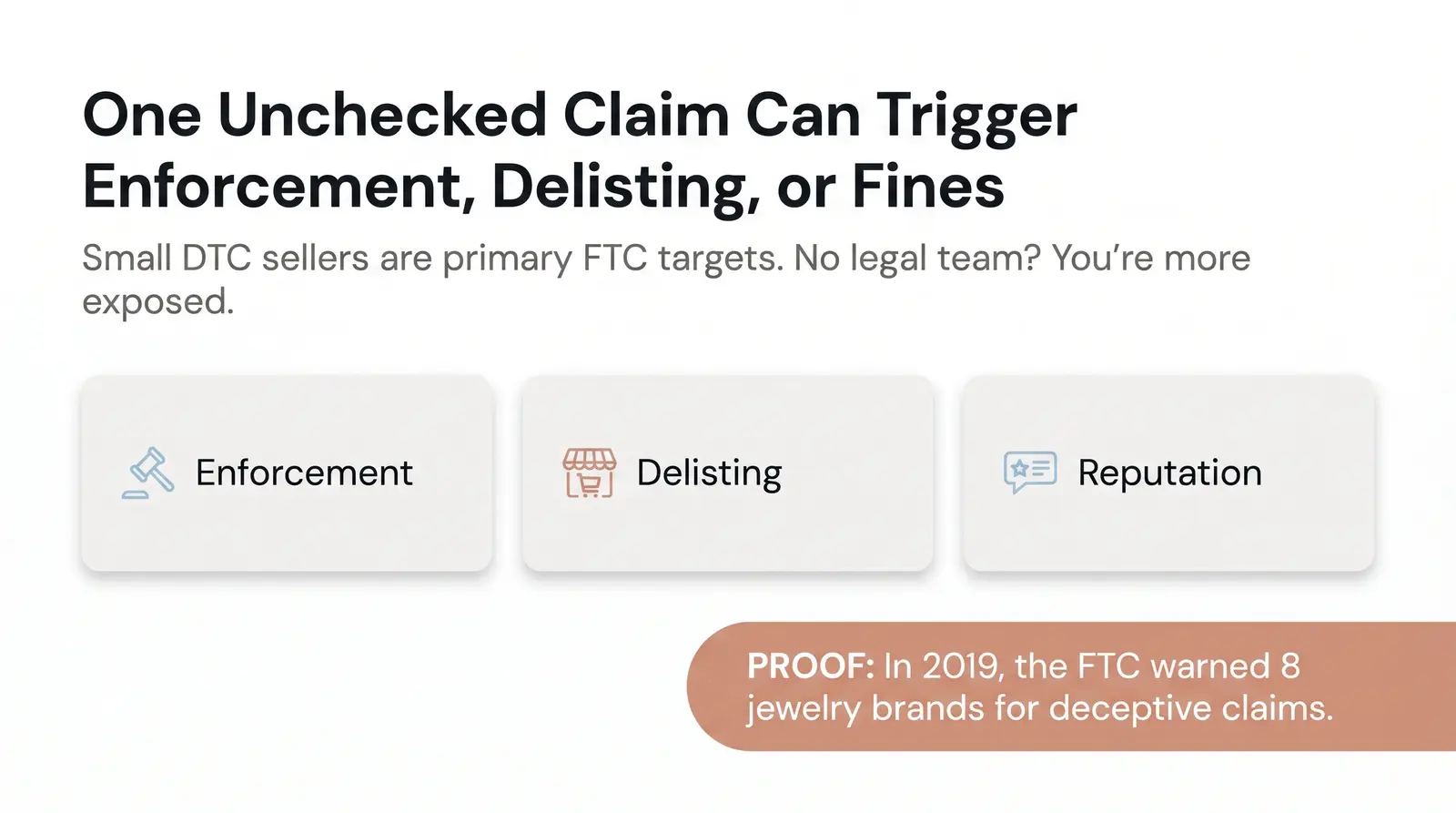
Protect your brand from legal pitfalls. The Federal Trade Commission (FTC) takes truth in advertising seriously, and the jewelry industry is no exception. For jewelry sellers, ecommerce entrepreneurs, and influencer-brand founders, making inaccurate or unsubstantiated claims about materials, allergens, or sustainability can lead to severe consequences. These risks include formal FTC enforcement actions, consumer complaints, marketplace delisting on platforms like Amazon or Etsy, and irreversible reputational damage.
Most jewelry sellers assume FTC compliance is only for big brands with dedicated legal teams—but the FTC has historically targeted small direct-to-consumer (DTC) and ecommerce sellers precisely because they lack legal counsel and often make easily disprovable claims. For example, in April 2019, the FTC sent warning letters to eight jewelry marketers regarding deceptive online advertising of simulated or laboratory-created diamonds, as well as unsubstantiated "eco-friendly" claims [1]. The FTC made it clear that failure to follow the Guides for the Jewelry, Precious Metals, and Pewter Industries could result in enforcement actions and civil penalties.
In our experience at Branvas, many new jewelry founders are surprised to learn that a single unchecked claim—like "nickel-free" on a product page—can trigger a formal complaint or marketplace removal. Ensuring your product listings, packaging, and marketing copy are legally defensible under FTC guidelines is not just about avoiding fines; it is about building a foundation of trust with your customers.
The legal baseline for selling jewelry in the United States is established by the FTC's Guides for the Jewelry, Precious Metals, and Pewter Industries (16 CFR Part 23), which were last comprehensively revised in 2018 [2]. These guides dictate exactly how sellers must describe their products to avoid deceiving consumers.
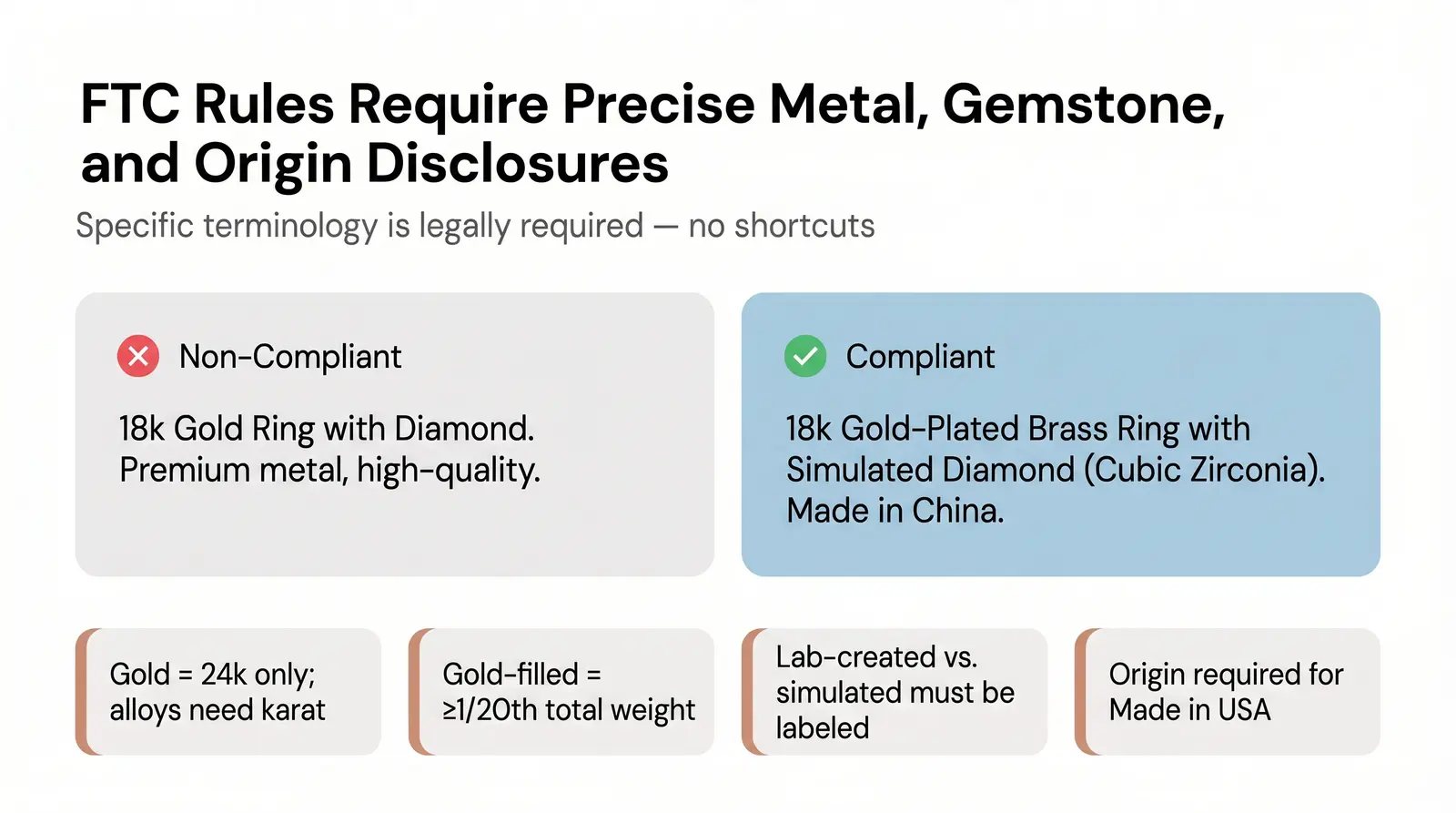
When it comes to metal content claims, the rules are highly specific. You cannot legally call an item "gold" unless it is composed entirely of 24-karat gold. For gold alloys, the karat fineness must be disclosed accurately and conspicuously (e.g., "14k gold"). For plated, filled, or bonded metals, the FTC requires sellers to disclose the base metal and the nature of the coating. For instance, "gold plated" requires a surface plating of gold alloy of reasonable durability, while "gold filled" requires the plating to constitute at least 1/20th of the total metal weight of the article [2].
Gemstone labeling also requires strict adherence to the guides. Sellers must clearly distinguish between natural, laboratory-created, and simulated stones. The 2019 FTC warning letters specifically cautioned marketers against using the name of any precious stone, including diamonds, to describe a simulated or lab-created stone without a clear and conspicuous disclosure immediately preceding the name [1]. Additionally, country of origin requirements mandate that sellers disclose where the product was manufactured, particularly if making "Made in USA" claims, which require the product to be "all or virtually all" made in the United States.
Worked Example: Non-Compliant vs. Compliant Listing Copy
The term "hypoallergenic" is widely used in the jewelry industry, but it is a legal trap for many sellers. According to the U.S. Food and Drug Administration (FDA), there are no federal standards or definitions that govern the use of the term "hypoallergenic" [3]. However, under Section 5 of the FTC Act, any objective claim made in advertising must be substantiated. This means that if you claim a piece of jewelry is "hypoallergenic," you must possess competent and reliable evidence that the product is less likely to cause allergic reactions for most people compared to competing products.
It is crucial to understand the difference between "hypoallergenic," "nickel-free," and "safe for sensitive skin." "Hypoallergenic" implies a lower risk of allergic reaction but does not guarantee the absence of allergens. "Nickel-free" is an absolute claim that the product contains zero nickel, which is the most common cause of metal allergies. "Safe for sensitive skin" is a broader, softer claim, but it still requires qualification and substantiation to avoid being deemed deceptive. For international sellers, the European Union's REACH regulation (Annex XVII, Entry 27) provides a strict credibility benchmark, restricting nickel release in jewelry intended for direct and prolonged skin contact to 0.5 μg/cm²/week [4].
"Nickel-free" is not self-verifying. Without third-party lab testing (e.g., XRF analysis or ICP-MS), the claim is legally vulnerable even if your supplier told you it was nickel-free. The FTC requires marketers to have a reasonable basis for their claims, and relying solely on a supplier's unverified statement does not meet this standard.
We often see founders struggle with this at Branvas—a supplier says "nickel-free" verbally or in a spec sheet, but without documented testing, that claim can't safely appear in your marketing.

Environmental marketing claims are governed by the FTC's Guides for the Use of Environmental Marketing Claims, commonly known as the Green Guides [5]. First issued in 1992 and last updated in 2012, the Green Guides are currently undergoing a comprehensive review process that began in late 2022 and remains pending as of early 2026 [6].
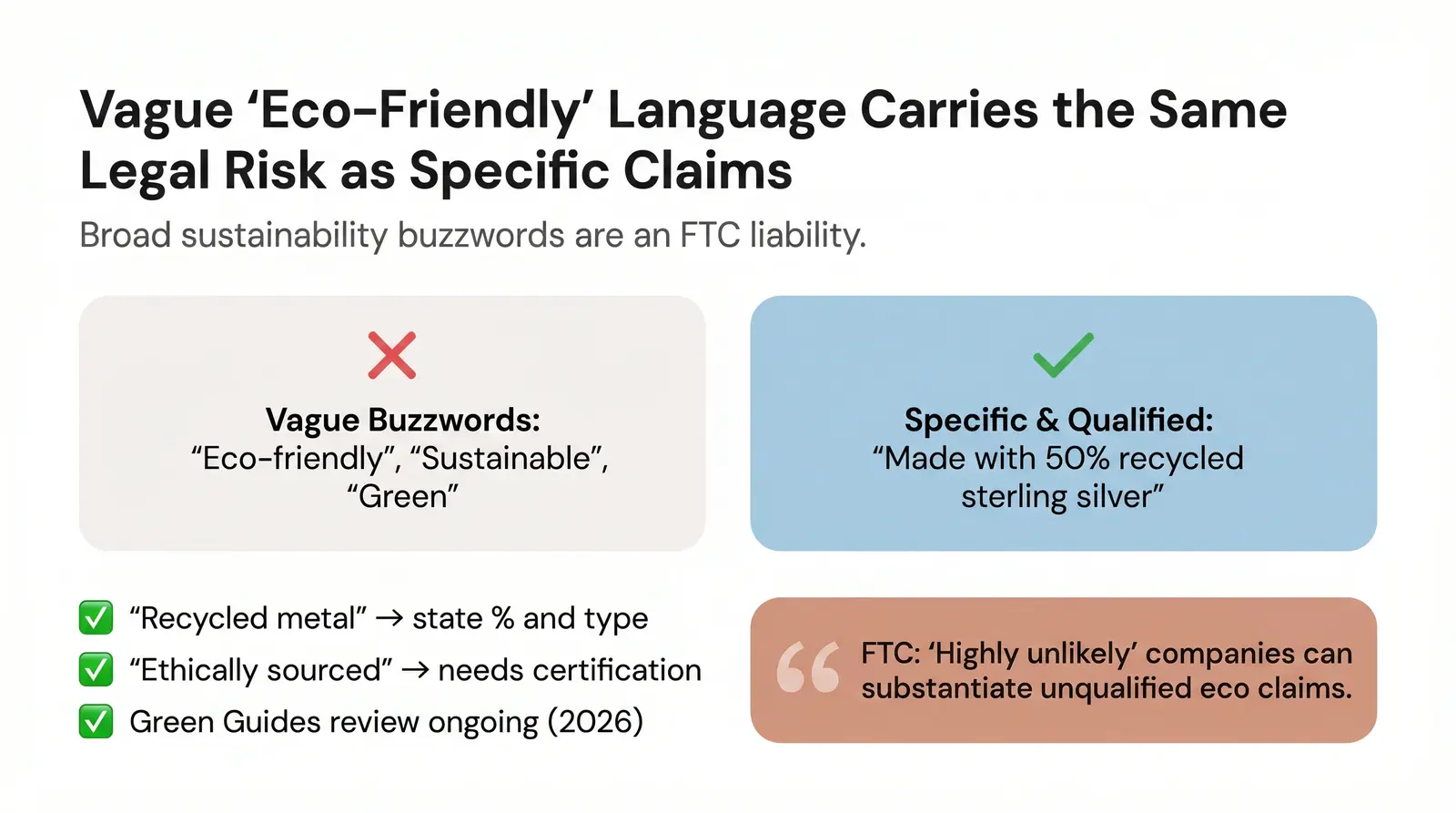
The Green Guides require that all environmental claims be truthful, not misleading, and supported by a reasonable basis, which often means competent and reliable scientific evidence. When making "recycled metal" claims, sellers must state the specific percentage and type of recycled content used. "Ethically sourced" claims should reference a specific, recognized certification or third-party audit rather than relying on the seller's own undefined standards.
Vague sustainability language like "eco-conscious" or "planet-friendly" on jewelry packaging is not safer than specific claims—the FTC treats broad implied claims as equally liable if they create a false net impression. In its 2019 warning letters to jewelry marketers, the FTC explicitly stated that it is "highly unlikely" that companies can substantiate all reasonable interpretations of unqualified claims such as "eco-friendly," "eco-conscious," or "sustainable" [1]. Sellers must qualify these claims adequately to avoid deception.
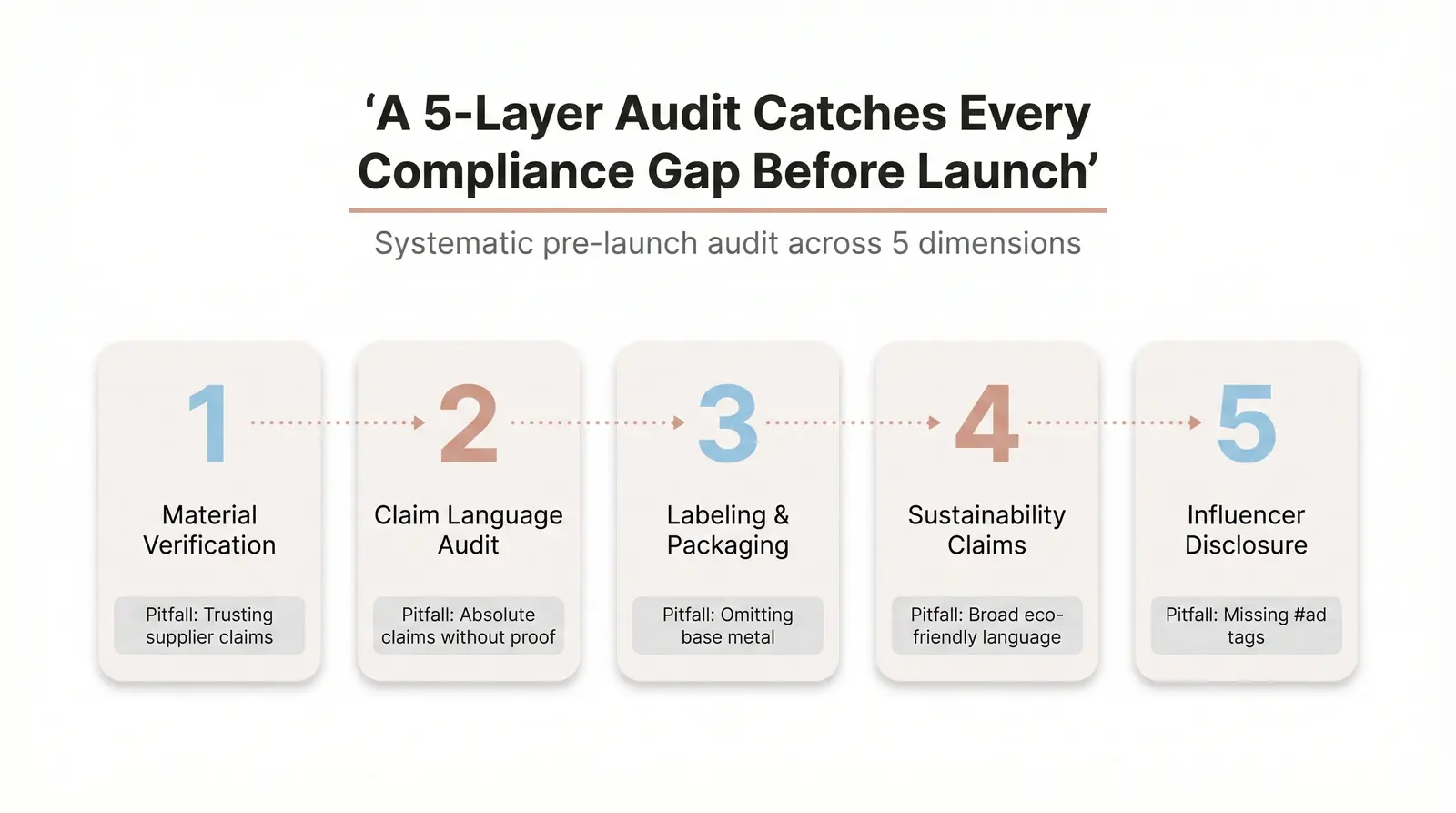
To help private-label jewelry founders audit their claims before launch, we developed the Branvas Compliance Clarity Framework™. This 5-layer audit system ensures that every aspect of your product presentation is legally sound and builds consumer trust.
Layer 1 — Material Verification
Before making any material claims, you must verify the actual composition of your jewelry. This involves obtaining third-party lab testing or verifiable documentation from your manufacturer. Trusting supplier claims without independent verification is a primary cause of compliance failures.
Layer 2 — Claim Language Audit
Review all product descriptions, social media posts, and advertising copy to ensure they meet FTC substantiation standards. Avoid using absolute claims like "100% nickel-free" or "hypoallergenic" unless you possess the specific lab proof required to defend them.
Layer 3 — Labeling & Packaging Review
Ensure that all required disclosures are present, legible, and conspicuous on your packaging and product inserts. This includes accurately identifying the base metal when a plating is present and ensuring that karat fineness marks are correct.
Layer 4 — Sustainability & Environmental Claims Check
Audit any environmental marketing language against the FTC Green Guides. Ensure that claims like "recycled" or "eco-friendly" are specific, qualified, and supported by reliable data or certifications, rather than relying on broad, unsubstantiated buzzwords.
Layer 5 — Endorsement & Influencer Disclosure Review
Review all influencer partnerships and brand founder posts for proper disclosures. The FTC's updated Endorsement Guides (2023) require clear and conspicuous disclosures (e.g., #ad or #sponsored) for any material connection, including gifted products. This layer is especially important for influencer-founded jewelry brands, as founders must disclose their commercial relationship to the brand if it is not already obvious to the audience [7].
| Layer | Focus Area | Key Question | Common Pitfall |
|---|---|---|---|
| 1 | Material Verification | Can you prove what the product is made of? | Trusting supplier claims without documentation |
| 2 | Claim Language Audit | Does your copy meet FTC substantiation standards? | Using absolute claims ("100% nickel-free") without lab proof |
| 3 | Labeling & Packaging Review | Are all required disclosures present and legible? | Omitting plating depth or base metal identity |
| 4 | Sustainability Claims Check | Are eco claims specific, qualified, and substantiated? | Broad "eco-friendly" language without supporting data |
| 5 | Endorsement & Influencer Disclosure | Are paid/gifted relationships clearly disclosed? | No #ad or #sponsored on influencer posts for the brand |
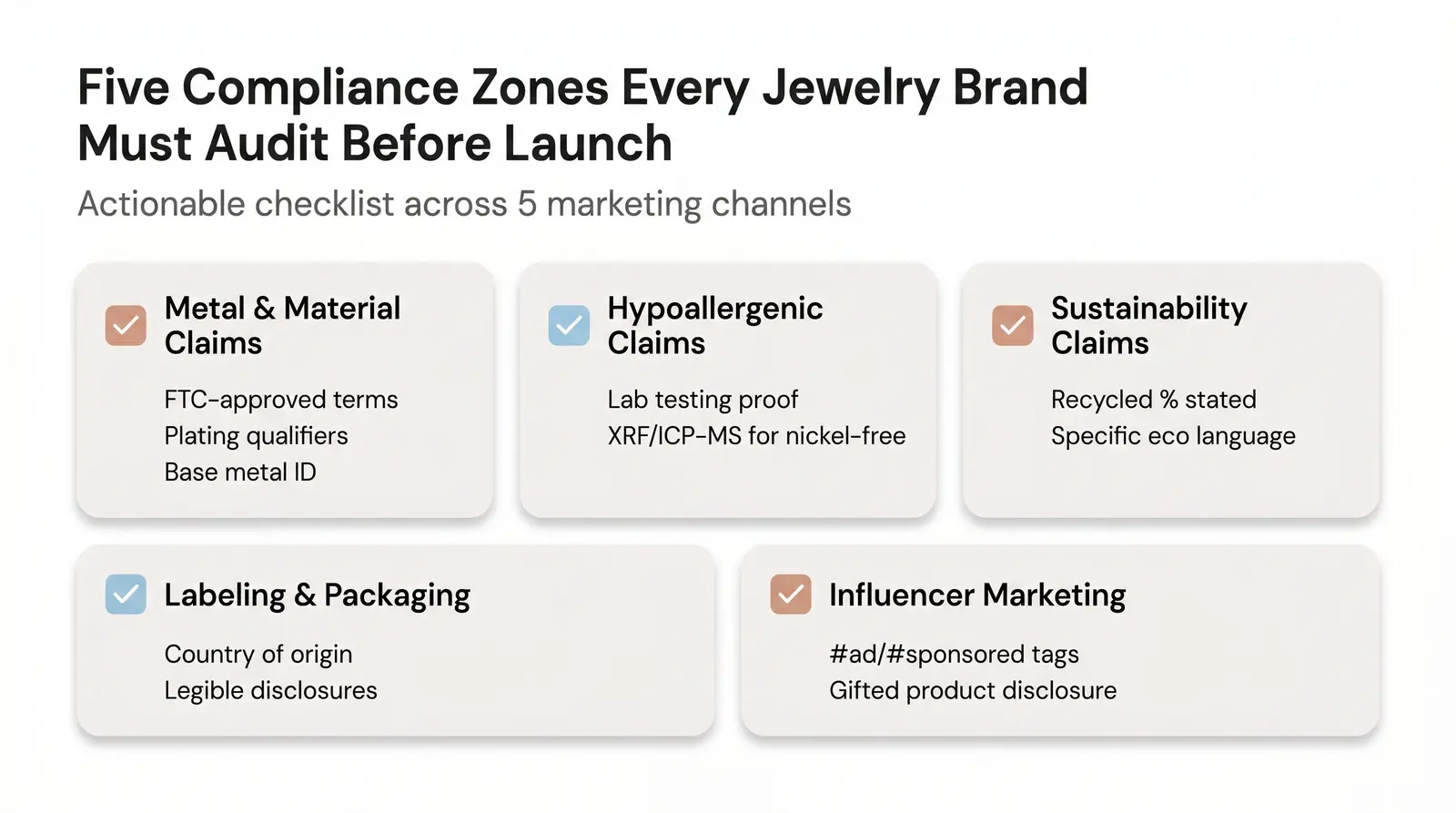
Use this actionable checklist to audit your jewelry brand's compliance across all marketing channels.
Material & Metal Claims
Hypoallergenic & Allergen Claims
Sustainability & Environmental Claims
Labeling & Packaging
Endorsements & Influencer Marketing
Navigating FTC compliance, material verification, and ethical sourcing can be overwhelming for new brand founders. Branvas was built to solve exactly these sourcing and compliance headaches. When you partner with Branvas, you get access to tested, documented materials and packaging that's designed to support clean, compliant claims from day one.
Our private-label Brand-as-a-Service (BaaS) model handles the heavy lifting: product sourcing, branding, packaging, and fulfillment, including blind shipping directly to your customers. This allows you to focus on marketing and community building, knowing that your product claims are backed by verified data.
Learn how it works at Branvas.com/how-it-works.
If you're building a jewelry brand and want to start with a compliance-ready foundation, explore Branvas's catalog or see pricing.
What are the FTC's jewelry labeling requirements for gold and silver?
The FTC requires that the term "gold" only be used for 24-karat solid gold. For gold alloys, the karat fineness must be disclosed (e.g., "14k gold"). If a product is plated, the base metal and the fact that it is plated must be clearly stated (e.g., "gold-plated brass"). Silver products must meet specific purity standards; for example, "sterling silver" must be at least 92.5% pure silver.
Can I call my jewelry "hypoallergenic" without testing?
While there is no specific federal definition for "hypoallergenic," the FTC requires that all objective advertising claims be substantiated. This means you must have competent and reliable evidence that your jewelry is less likely to cause allergic reactions than competing products. Using the term without any testing or documentation leaves your brand vulnerable to enforcement actions for deceptive marketing.
What does "nickel-free" legally require under FTC guidelines?
A "nickel-free" claim is an absolute assertion that the product contains zero nickel. To legally make this claim, you must possess third-party laboratory testing, such as XRF (X-ray fluorescence) or ICP-MS analysis, proving the absence of nickel. Relying solely on a supplier's verbal assurance or an unverified specification sheet is not considered adequate substantiation by the FTC.
What sustainability claims can I make about my jewelry without violating the FTC Green Guides?
You can make sustainability claims as long as they are specific, qualified, and substantiated by reliable evidence. For example, instead of using broad terms like "eco-friendly," state exactly what makes the product sustainable, such as "made with 50% recycled sterling silver." The FTC warns that unqualified, general environmental benefit claims are highly likely to be deceptive.
Do influencer-founded jewelry brands have additional FTC disclosure obligations?
Yes. Under the FTC's 2023 Endorsement Guides, influencers who promote their own brands must clearly and conspicuously disclose their commercial relationship to the brand if it is not already obvious to their audience. Additionally, any influencers or creators who receive gifted products from your brand must disclose that material connection (e.g., using #ad or #gifted), even if no monetary payment was exchanged.