


This 90-day playbook sequences acquisition channels by ROI to help bootstrapped ecommerce founders get their first 100 customers using organic outreach before paid ads.
Published:
October 2, 2026
Author:
Yi Cui
Most new store advice is either too vague ("run ads!") or too expensive to execute. This is the 90-day operational playbook for bootstrapped and unfunded founders, sequenced by channel ROI so you spend time and money where it returns fastest at the zero-audience stage.
We've structured this around real CAC benchmarks, multi-store patterns, and a framework that prioritizes human trust over algorithmic spend — because that's what actually works when you're starting from scratch.
If you're launching a Shopify store, a dropshipping brand, or a private-label product line, the first 100 customers represent something specific: proof. Proof that your product solves a real problem, that your messaging connects, and that your operations can handle real orders. This playbook is designed to get you there as efficiently as possible.
Acquiring your first 100 customers is fundamentally different from scaling from 1,000 to 10,000. Standard marketing advice fails new stores because it assumes a foundation that doesn't yet exist.
No pixel data. No social proof. No email list. No domain authority.
When a brand lacks these trust signals, conversion rates suffer. According to Littledata benchmarks, the average Shopify store converts at 1.4% to 1.8%, with top-performing stores exceeding 3.2% [1]. For a brand-new store with zero reviews, hitting even that 1.4% average is an uphill battle.
The biggest mistake is starting with paid ads. Most guides lead with Meta or Google, but for stores with no creative testing history and no pixel data, paid CAC in month one routinely exceeds $80 to $120+. The channels that actually work first are the ones that leverage human trust and manual outreach, not algorithms. Meta's optimization engine requires historical purchase data to find buyers efficiently. Without it, you're paying a premium for the platform to learn who your customer is [2].
We've worked with hundreds of new brand founders at Branvas, and the pattern is consistent: the stores that hit 100 customers fastest almost never did it primarily through paid ads in the first 60 days. They relied on high-effort, low-cost channels to build the initial data and revenue needed to fund scalable acquisition later.
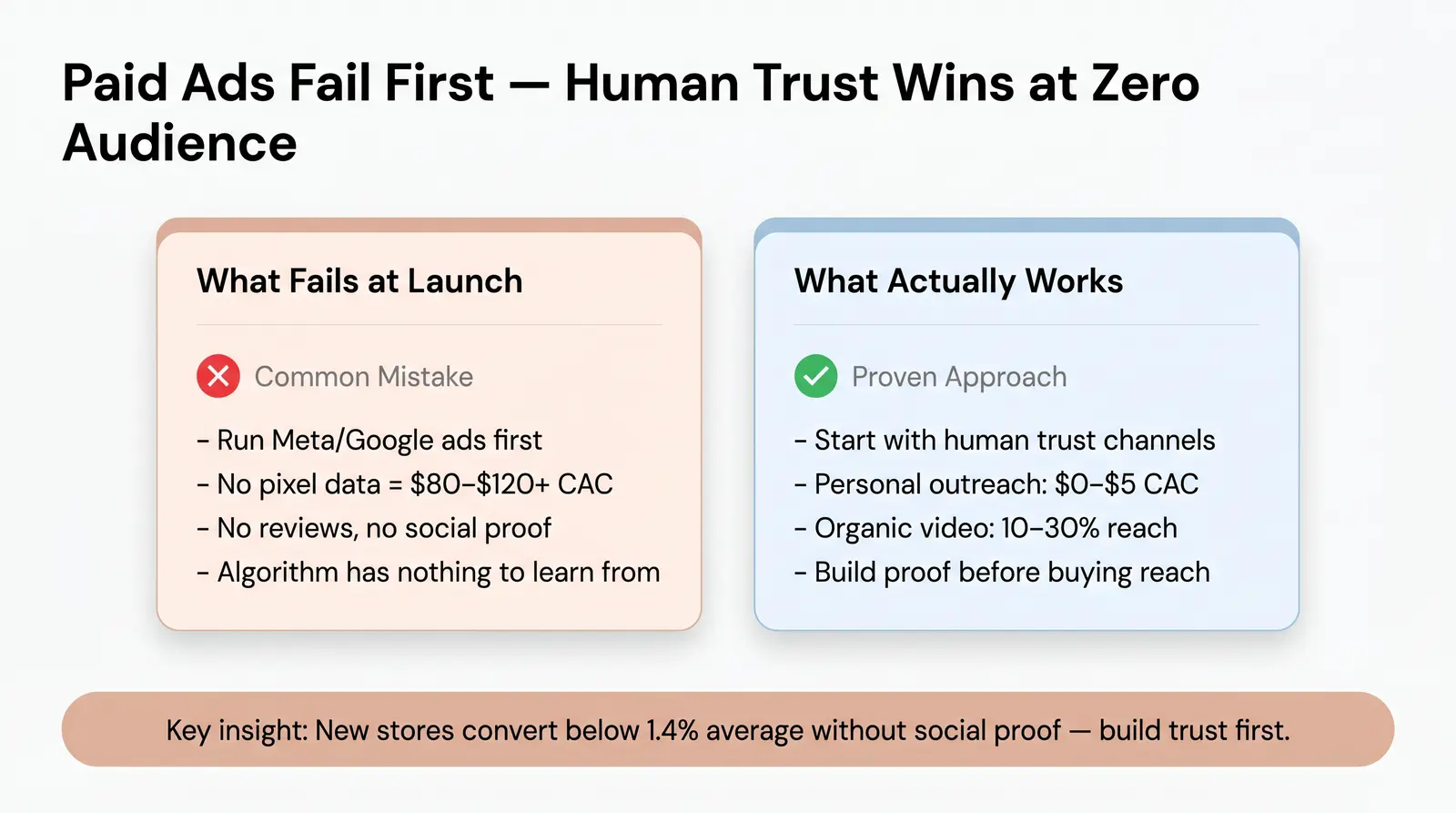
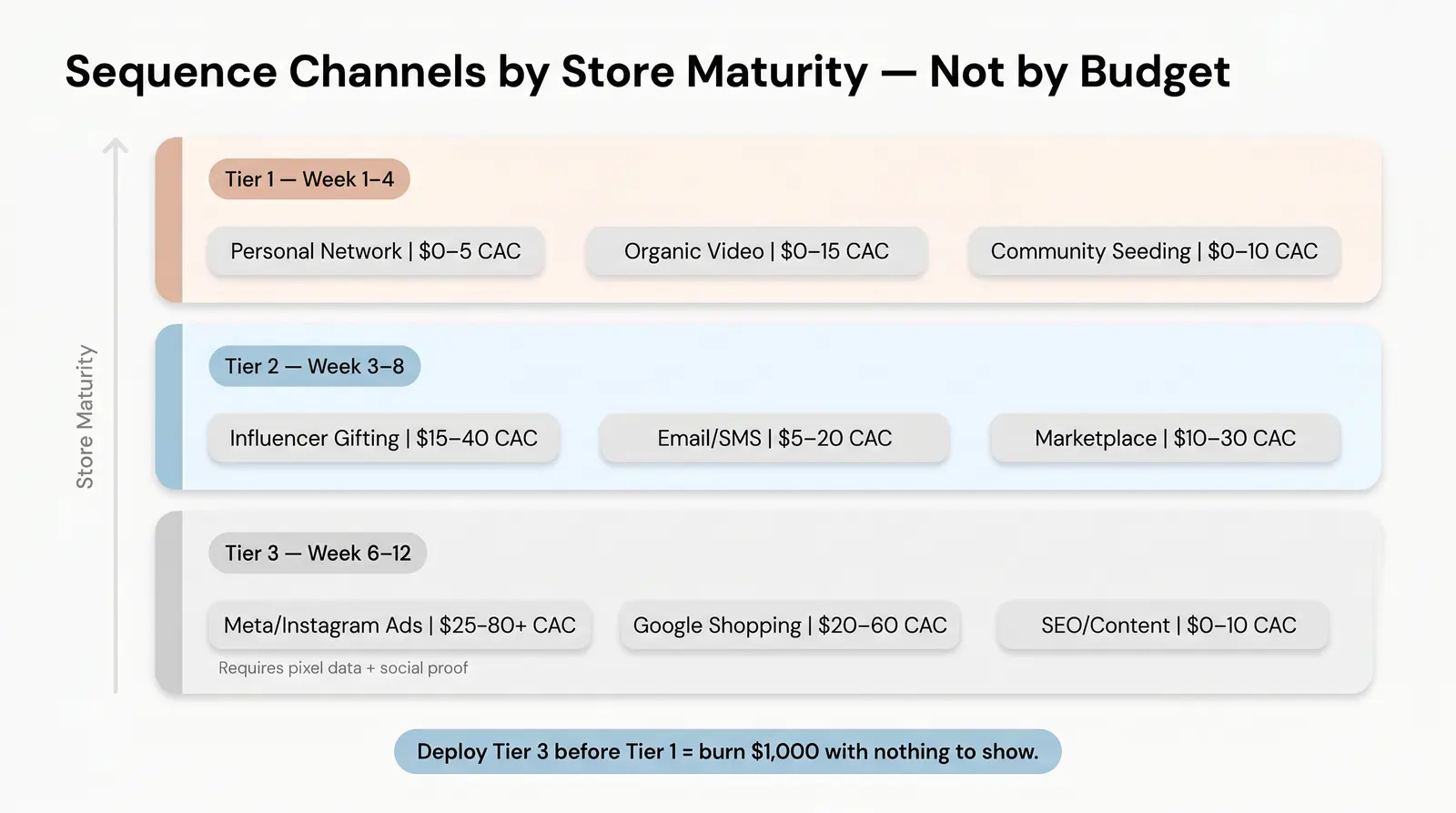
To navigate the zero-audience phase, we developed the "First 100 Stack" — Branvas's channel-sequencing model for new ecommerce stores. This framework organizes acquisition channels into three tiers based on when each channel is effective relative to store maturity and available capital.
The logic is simple: some channels work with zero data and zero audience. Others require proof before they perform. Knowing which is which saves you thousands of dollars and weeks of frustration.
| Tier | Channel | Best Starting Week | Estimated CAC (New Store) | Capital Required | Scales Without Traction? |
|---|---|---|---|---|---|
| 1 — Launch Fuel | Personal network + direct outreach | Week 1–2 | $0–$5 | None | No — but essential for first 10 |
| 1 — Launch Fuel | Organic short-form video (TikTok/Reels) | Week 1–4 | $0–$15 | None | Yes (with consistency) |
| 1 — Launch Fuel | Community seeding (Reddit, Facebook Groups, niche forums) | Week 1–3 | $0–$10 | None | Limited |
| 2 — Traction Amplifiers | Influencer gifting (micro, 5K–50K followers) | Week 3–6 | $15–$40 (product cost) | Low ($200–$500) | Yes |
| 2 — Traction Amplifiers | Email/SMS list building + launch sequence | Week 2 onwards | $5–$20 | Low | Yes |
| 2 — Traction Amplifiers | Marketplace listings (Etsy, Amazon) | Week 4–8 | $10–$30 | Low–Medium | Yes |
| 3 — Scale Engines | Meta/Instagram paid ads | Week 6–10 (after creative testing) | $25–$80+ | Medium ($500+/mo) | Yes — but needs data first |
| 3 — Scale Engines | Google Shopping | Week 6–12 | $20–$60 | Medium | Yes — but needs search volume |
| 3 — Scale Engines | SEO/content | Week 1 (set up) / results Week 12+ | $0–$10 (organic) | Low | Yes — long runway |
CAC ranges are estimates derived from industry benchmarks across multiple sources [3] [4] [5]. Individual results will vary based on product category, price point, and execution quality.
Tier 1 channels require zero budget and zero prior data. They use human relationships and algorithmic discovery. TikTok organic reach can still hit 10% to 30% compared to Instagram's 2% to 5% [6], which means a brand-new account with zero followers can still reach thousands of potential buyers if the content is strong. This is the single most important advantage new ecommerce founders have that most guides ignore. Tier 2 channels amplify early traction cheaply by leveraging micro-influencers and capturing intent through email. Tier 3 channels require data, creative assets, or search volume that only exists after some traction. Sequencing matters. Deploying Tier 3 tactics before Tier 1 foundations are built is how founders burn their first $1,000 with nothing to show for it.
The CAC ranges in the table above are estimates triangulated from multiple industry sources and should be treated as benchmarks, not guarantees. Your actual CAC will depend on product category, price point, creative quality, and execution consistency. Jewelry brands tend to see higher average CACs ($91 according to First Page Sage's analysis of 80+ ecommerce clients) than food and beverage brands ($53) [4]. Use these figures as a planning baseline, not a ceiling.
For ecommerce founders looking to explore the full range of channels available, Branvas's ecommerce solutions page covers the operational side of building a brand that can support multi-channel acquisition from day one.
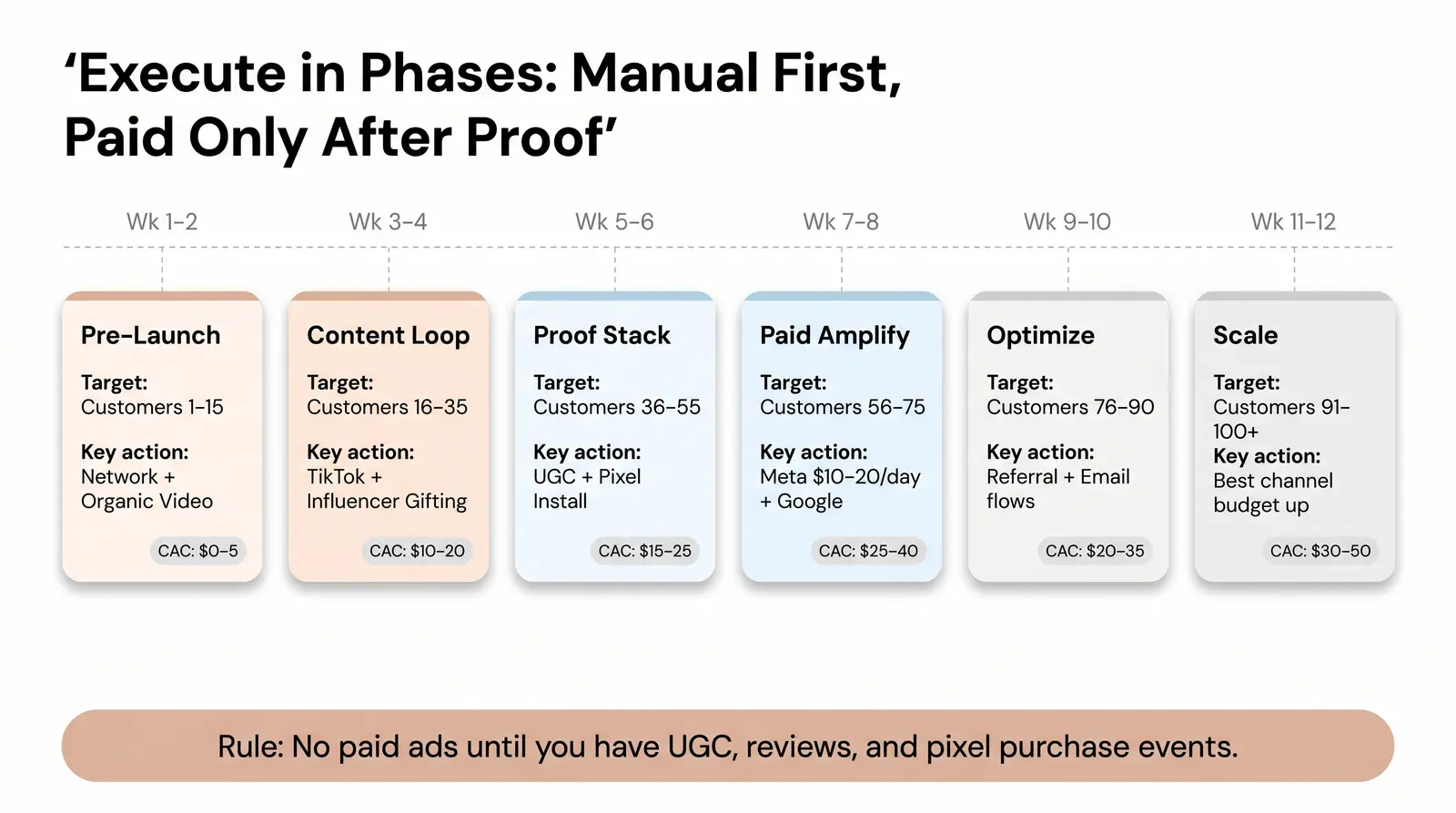
Executing the First 100 Stack requires discipline and a willingness to do things that don't scale at first. Here is the week-by-week breakdown.
Week 1–2: Pre-Launch Activation (Target: Customers 1–15)
The focus here is entirely manual. Reach out to your personal network via direct messages, seed social proof by asking early adopters for honest feedback, and post your first organic video content. Set up pre-launch email capture on your store and introduce yourself in two to three relevant online communities. Do not run paid ads. Do not obsess over SEO rankings. Expected channel CAC: $0 to $5. Time investment: 15 to 20 hours per week.
For your personal outreach, be specific. A message that says "I just launched a jewelry brand and I'd love your honest feedback — here's 20% off your first order" converts far better than a generic announcement post. Your first 10 to 15 customers are not a marketing exercise. They are a product validation exercise. Treat them that way.
For organic video, the goal in weeks one and two is not virality. It's learning. Post every day, test different hooks and formats, and pay attention to which videos get the most watch time. The algorithm rewards completion rate above all else [6]. A 15-second video that 80% of viewers watch to the end will outperform a 60-second video that most people skip.
What not to do: Spending money on ads before you have a single review or piece of UGC is the most common first-month mistake. You need proof before you pay for reach.
Week 3–4: First Content Loop (Target: Customers 16–35)
Double down on short-form video. Aim for one to three TikTok or Reels posts per day, testing different hooks, formats, and angles. Begin your first influencer gifting outreach, targeting nano and micro-influencers (5,000 to 50,000 followers) who accept product-only compensation [7]. Launch your email welcome sequence — welcome emails generate open rates of 68.6% compared to 19.7% for standard campaigns [8]. Post in three to five relevant communities. Expected channel CAC: $10 to $20. Time investment: 15 hours per week.
Week 5–6: Proof Stacking (Target: Customers 36–55)
Collect user-generated content from your first customers. Install the Meta pixel now, but do not spend yet. Post customer content and testimonials across your channels. Initiate a second wave of influencer gifting with a focus on creators whose first posts performed well. Expected channel CAC: $15 to $25. Time investment: 10 to 15 hours per week.
Week 7–8: Paid Amplification (Target: Customers 56–75)
Launch your first small paid test: $10 to $20 per day on Meta using the UGC creative you collected in previous weeks. Set up Google Shopping for high-intent search capture. Leverage any organic content that already performed well by turning it into a paid ad. This is when the pixel data you've been building starts to pay off. Expected channel CAC: $25 to $40. Time investment: 10 hours per week.
For your first Meta campaign, use retargeting before prospecting. Target website visitors and video viewers first, since these audiences already have some familiarity with your brand. Cold prospecting with no data and no social proof is where CAC spikes. Start narrow, prove the economics, then expand.
Week 9–10: Optimize and Referral (Target: Customers 76–90)
Launch a post-purchase referral program to turn your existing customer base into an acquisition channel. Optimize your email flows based on open and click data. Double down on what's working and cut what isn't. Expected channel CAC: $20 to $35. Time investment: 10 hours per week.
Week 11–12: Scale What Works (Target: Customers 91–100+)
Increase budget on your best-performing paid channel. Begin investing in long-term SEO content. Build an affiliate or ambassador pipeline for sustained influencer marketing. Expected channel CAC: $30 to $50. Time investment: 10 hours per week.
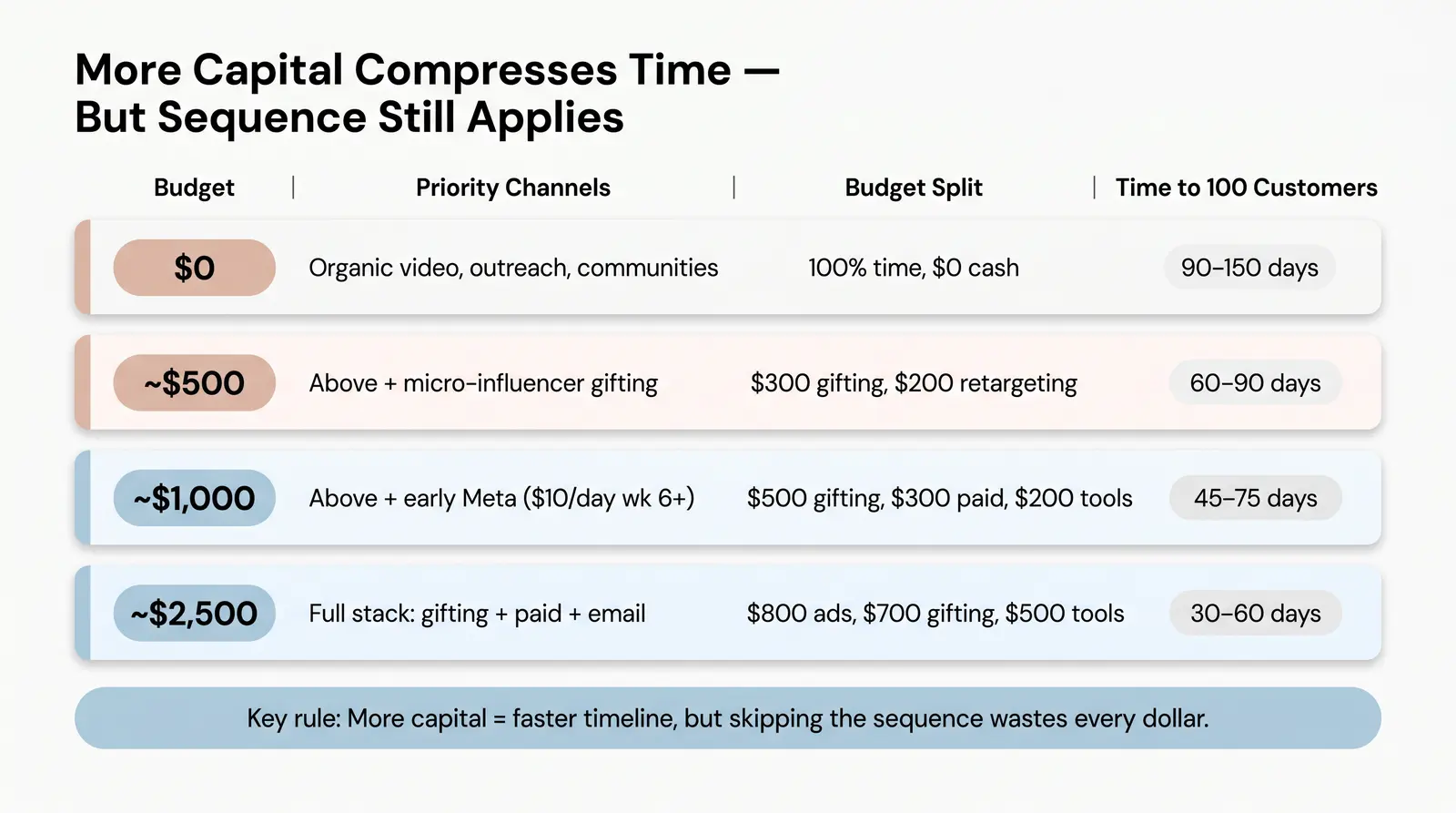
Time and money are interchangeable in early ecommerce. More capital compresses timelines but doesn't replace the need for proof and trust signals. Here is how to allocate resources based on your starting budget.
| Starting Capital | Priority Channels | Suggested Budget Split | Expected Time to 100 Customers |
|---|---|---|---|
| $0 (time-rich) | Organic video, network outreach, community seeding | 100% time, $0 cash | 90–150 days |
| ~$500 | Above + influencer gifting (3–5 micro influencers) | $300 product gifting, $200 held for retargeting | 60–90 days |
| ~$1,000 | Above + early paid Meta ($10/day) after week 6 | $500 gifting, $300 paid, $200 email tools | 45–75 days |
| ~$2,500 | Full stack: gifting + paid Meta/Google + email platform | $800 paid ads, $700 gifting, $500 tools/creative, $500 reserve | 30–60 days |
If you have zero capital, you must trade time for attention. If you have $2,500, you can accelerate the timeline by funding product seeding and testing paid ads earlier, but you still need to follow the sequence to avoid wasting budget on unproven creative.
Before you allocate any budget, it's worth modeling your unit economics. The Branvas profit calculator helps you estimate margins by channel so you can make informed decisions about where each dollar goes.
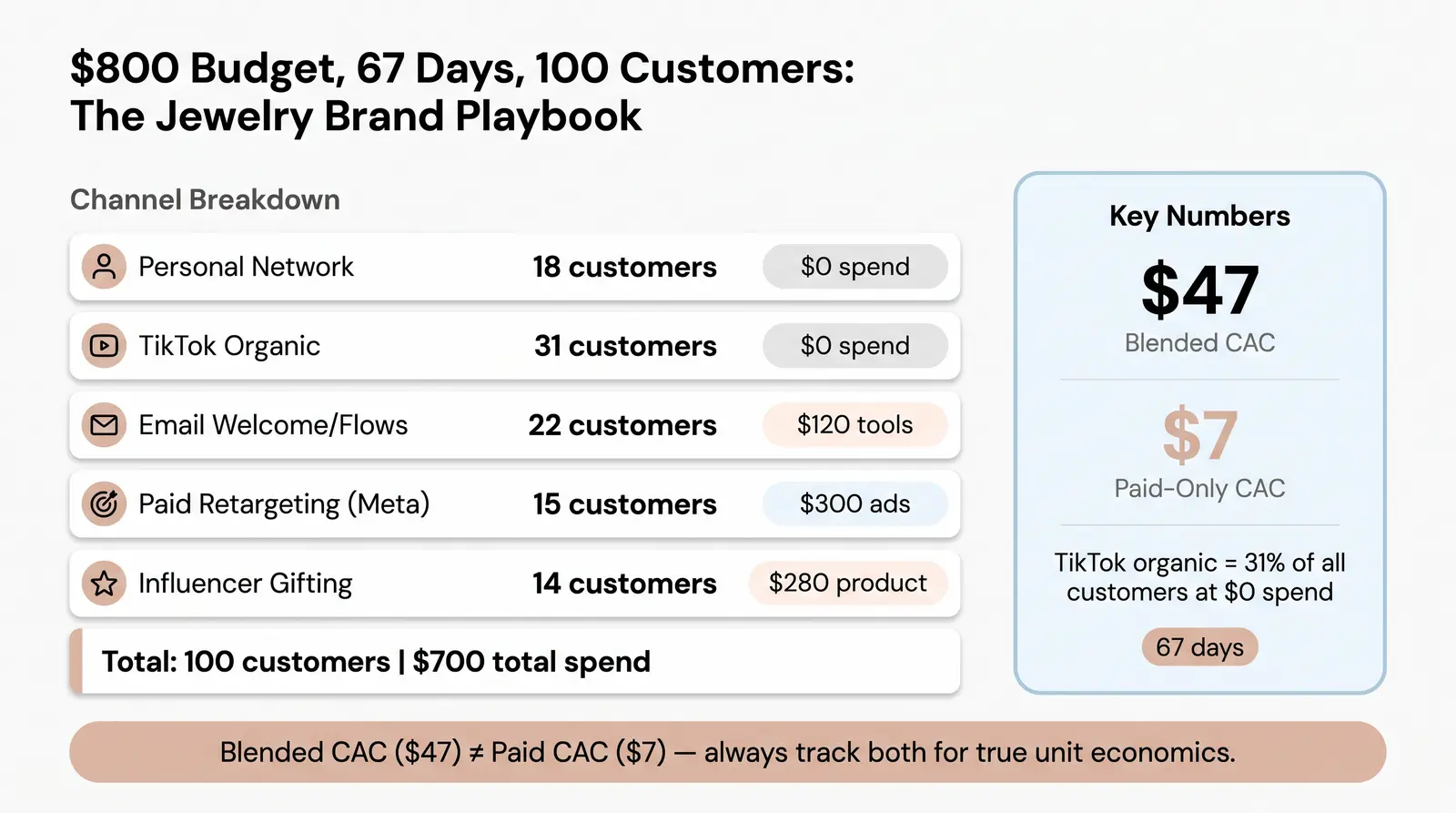
The following is a representative composite example based on patterns we see among Branvas founders. It is not a named case study, but it reflects real acquisition dynamics from private-label brands in the jewelry and accessories category.
A new private-label jewelry brand launched with $800 in capital using the First 100 Stack framework. In weeks one and two, the founder focused entirely on personal outreach and organic TikTok, securing 18 customers from friends, family, and extended network connections. The store had no reviews and no pixel data at this point.
By week three, a single TikTok video demonstrating the product's durability went semi-viral, driving 22 orders over five days. That one piece of content became the turning point. It generated social proof, seeded the pixel with purchase events, and gave the founder UGC to repurpose.
In week four, the founder invested $280 in product costs to seed four micro-influencers, which yielded 14 customers over the following three weeks. The brand's welcome email sequence captured traffic that didn't buy immediately, eventually converting 22 customers. By week seven, the founder deployed $300 in Meta retargeting ads aimed at website visitors and cart abandoners, acquiring 15 more customers.
| Channel | Customers Acquired | Estimated Spend |
|---|---|---|
| Personal Network | 18 | $0 |
| TikTok Organic | 31 | $0 |
| Email Welcome/Flows | 22 | $120 (tools) |
| Paid Retargeting (Meta) | 15 | $300 |
| Influencer Gifting | 14 | $280 (product cost) |
| Total | 100 | $700 |
The blended CAC at 100 customers was $7 per customer counting only paid media spend, or $47 when factoring in software tools and product costs. That $47 figure is the number that matters for unit economics planning.
If you're launching a jewelry or accessories brand and want the product side handled — sourcing, packaging, and fulfillment — so you can focus entirely on customer acquisition, Branvas's private-label Brand-as-a-Service is built exactly for this stage. You can also browse the Branvas catalog to see the range of private-label products available for launch.
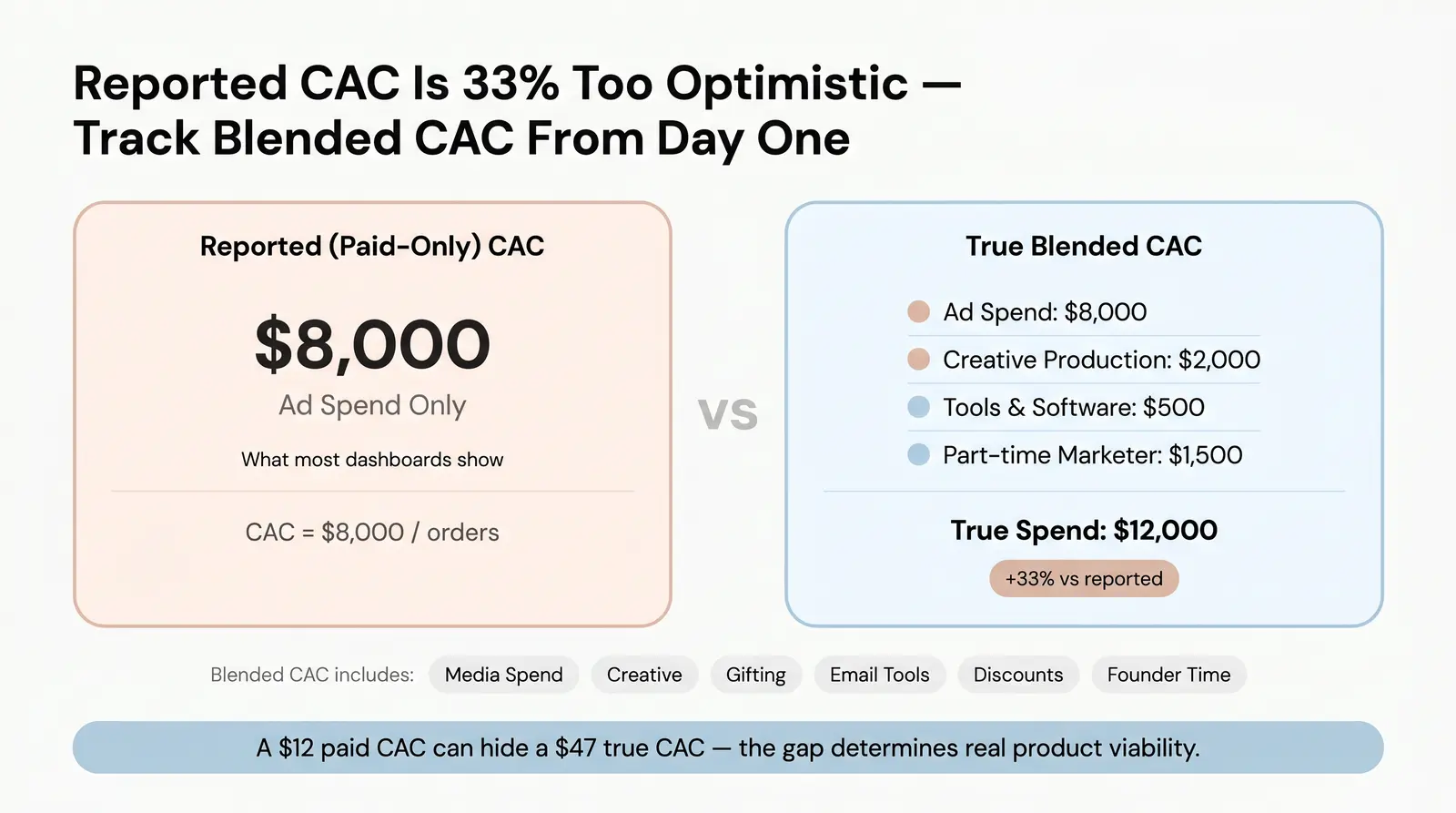
The real CAC for a new store isn't just ad spend. It includes founder time, creative production, tool subscriptions, and failed tests. Most CAC benchmarks only count media spend, which creates a dangerous illusion.
Consider a brand spending $8,000 per month on ads, $2,000 on creative production, $500 on tools, and $1,500 on a part-time marketer. Their true acquisition spend is $12,000, not $8,000. The CAC calculated off $8,000 is 33% too optimistic [9]. That gap compounds over time and can make a fundamentally unprofitable product look viable until it isn't.
At Branvas, we encourage every founder we work with to build a blended CAC tracker from day one — because the difference between a $12 "paid CAC" and a $47 true blended CAC can determine whether a product is actually viable at scale. Track both. Always.
The components of true blended CAC for a new ecommerce store include: media spend, creative production costs, influencer gifting (product cost plus shipping), email platform fees, attribution tools, first-purchase discount codes, and the prorated time of anyone whose role touches acquisition.
Here's a practical illustration. A founder spending $300 on Meta retargeting, $280 on influencer gifting (product cost), $120 on email tools, and 40 hours of personal time (valued conservatively at $25/hour) has a true acquisition cost of $1,700 for 100 customers, not $700. That's a $17 blended CAC, which is still excellent for a jewelry brand. But it's a very different number than the $7 paid-only figure. Both numbers are useful. Only one tells you the full story.
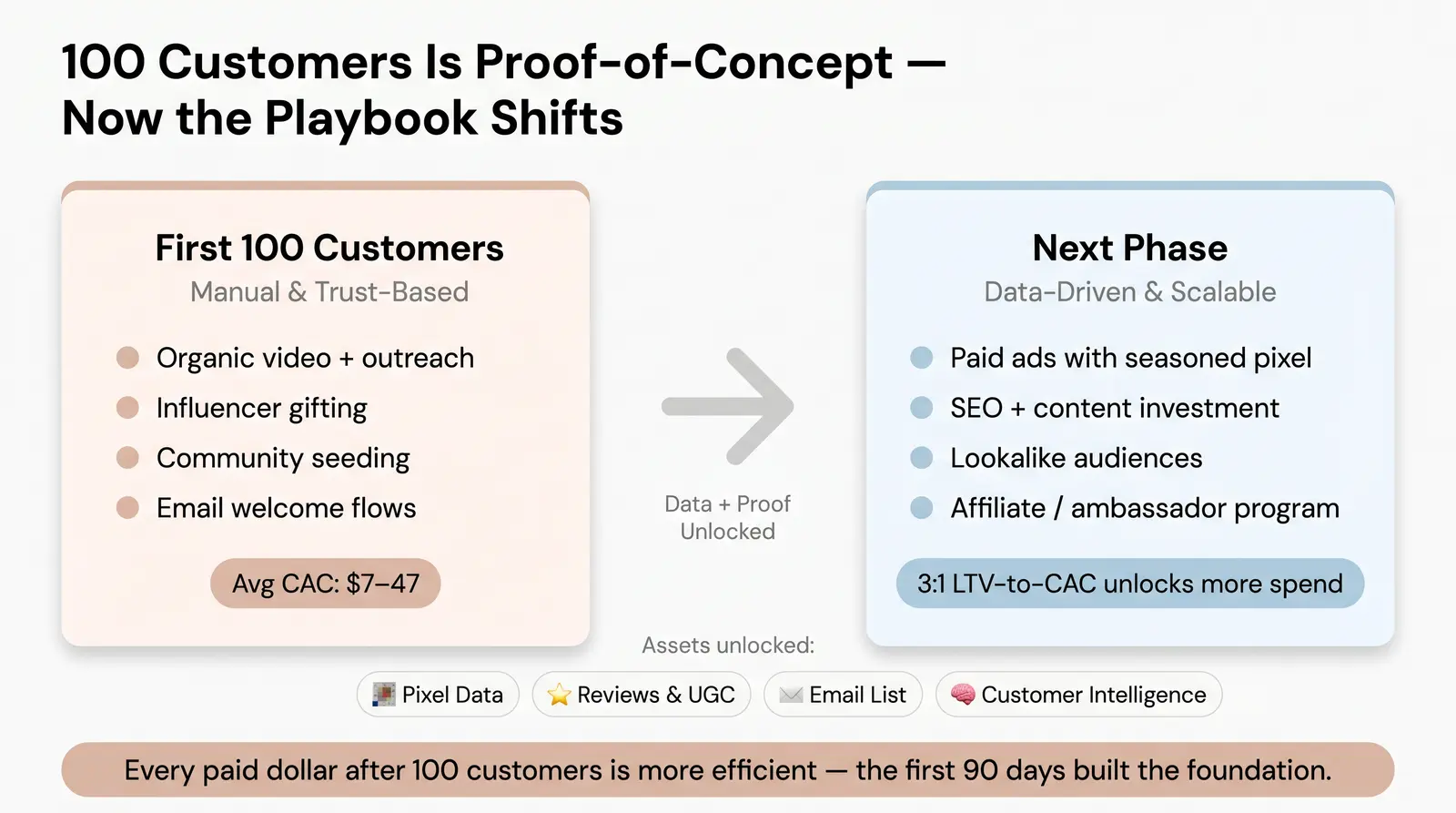
Reaching 100 customers is a proof-of-concept milestone, not an arrival. It means your product has real demand, your messaging resonates, and your operations can fulfill orders. That's significant. But the acquisition playbook shifts significantly once you have data, social proof, and a seasoned pixel.
After 100 customers, the focus moves toward retention, lifetime value (LTV), brand equity, and referral loops. You now have the data to scale paid channels efficiently, the customer base to generate consistent reviews and UGC, and the purchase history to build lookalike audiences that actually convert.
The economics also change. A store with 100 customers and a 3:1 LTV-to-CAC ratio can afford to spend more on acquisition than a store with no data and no retention system. That's the compounding advantage of doing the first 100 right.
The acquisition playbook for the next phase looks different: more paid, more SEO, more affiliate. But all of it depends on the foundation you built in the first 90 days. The pixel data, the reviews, the UGC, the email list — these are the assets that make every subsequent dollar of acquisition spend more efficient. One more thing worth noting: 100 customers is also when you start to understand your actual customer. Who they are, what language they use to describe the problem your product solves, and what made them buy. That intelligence is worth more than any ad campaign you could run in month one.
Ready to launch your brand? Branvas handles product sourcing, private-label branding, packaging, and blind fulfillment — so you can execute this playbook without the operational overhead. See how it works or explore pricing.
For a bootstrapped store relying on organic channels, it typically takes 90 to 150 days to acquire the first 100 customers. Stores starting with $1,000 to $2,500 in capital can compress this timeline to 30 to 75 days by accelerating influencer seeding and early paid retargeting. The primary driver of speed is consistency in content creation and manual outreach, not budget. Founders who post organic video content daily and actively engage communities tend to hit their first 30 customers significantly faster than those who wait for paid ads to do the work.
Personal network outreach and organic short-form video (TikTok, Instagram Reels) are the most cost-effective channels, typically resulting in a $0 to $15 CAC. These channels require zero media spend and rely entirely on algorithmic discovery and human relationships. Community seeding in relevant subreddits or Facebook groups is also highly effective for zero-audience stores, particularly for niche products where engaged communities already exist. The key is to add genuine value to those communities before promoting your product.
No. Running paid ads before acquiring initial customers is a common and expensive mistake. Ad platforms like Meta require historical pixel data to optimize targeting effectively. Without social proof, reviews, or pixel data, conversion rates are extremely low, resulting in a CAC that routinely exceeds $80 to $120+ in the first month. The better approach is to build your first 10 to 20 customers through organic channels, collect reviews and UGC, and then use that content as your paid ad creative once the pixel has some purchase history to work with.
Depending on your strategy, expect to spend between $0 (if relying entirely on organic content and time) and $2,500. A balanced approach using influencer gifting, email tools, and strategic retargeting usually requires $500 to $1,000. It is crucial to track blended CAC, which includes tool subscriptions, product gifting costs, and creative production, rather than just ad spend. Many founders are surprised to find their true blended CAC is three to five times higher than their reported paid CAC.
Yes, significantly. Private-label products build trust faster because they signal exclusivity, quality control, and brand commitment. Generic dropshipping forces you to compete purely on price against hundreds of sellers offering identical products, which compresses margins to 20% to 30% and makes it nearly impossible to build the social proof needed for organic acquisition [10]. Branded products also support better storytelling on TikTok and in influencer content, which is the foundation of the First 100 Stack. Private-label margins of 40% to 60% also give you more room to fund gifting and early paid tests.