


Build a layered trust architecture using six signal categories—legitimacy, security, social proof, policy clarity, brand identity, and authority—to convert first-time visitors into buyers.
Published:
July 29, 2026
Author:
Yi Cui
Most new store owners obsess over design, ads, and product photos—but buyers leave because they don't trust the store, not because the layout is wrong. Unknown stores lose buyers on credibility, not design. The reality is that the gap between a 0.5% and a 3% conversion rate almost always comes down to one thing: trust architecture. In our experience working with new brand founders at Branvas, missing trust signals cost stores their most qualified traffic. This guide provides a full inventory of buildable trust signals, organized by effort and impact, plus a framework for prioritizing them from day one.
Online shopping is inherently risky for a first-time buyer. They face a combination of risk aversion, fear of fraud, uncertainty about product quality, and post-purchase anxiety regarding shipping and returns. When a customer lands on a new store, they are silently evaluating whether it is safe to hand over their credit card details. According to the Baymard Institute, 19% of users abandon checkouts because they do not trust the site with their payment information [1]. Furthermore, a lack of trust is not just a security issue; it is a brand issue.
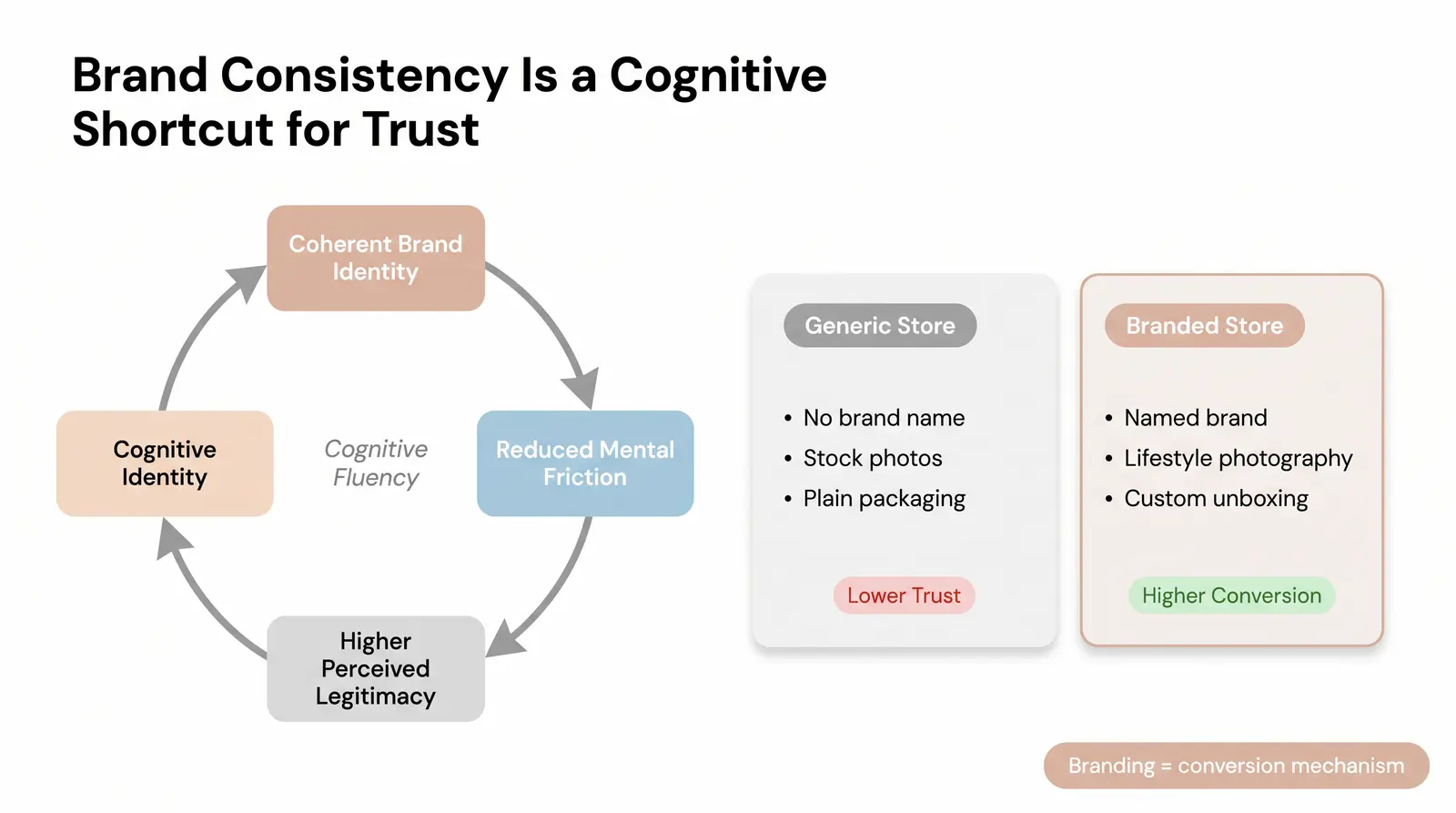
The problem isn't that your store looks bad—it's that it looks like every other Shopify store. Generic stores using default themes, no-name packaging, and stock photos register as low-credibility even when the products are excellent. Brand distinctiveness is a trust signal. Cognitive fluency research shows that familiar-feeling, coherent aesthetics reduce mental friction and increase perceived legitimacy [2]. When a store lacks a distinct identity, it triggers a subconscious warning that the business might be a fly-by-night operation.

Trust is not one thing—it's a stack of signals, each addressing a different buyer fear. Missing any layer creates a "trust gap" that no amount of ad spend can bridge. We call this The Trust Stack™ by Branvas, a tiered model that categorizes trust signals by layer, from foundational to brand-level. This is the exact model we use when auditing new brand launches.
| Trust Layer | What It Addresses | Example Signals | Difficulty to Build (1–5) | Impact on Conversion (1–5) |
|---|---|---|---|---|
| Layer 1: Legitimacy | "Is this a real business?" | Domain email, About page, phone/chat, business address | 1 | 4 |
| Layer 2: Security | "Will my payment info be safe?" | SSL badge, recognized payment icons (Visa, PayPal, Shop Pay), security seals | 1 | 4 |
| Layer 3: Social Proof | "Have others bought this and been happy?" | Reviews, UGC, star ratings, order counts | 3 | 5 |
| Layer 4: Policy Clarity | "What happens if something goes wrong?" | Clear return/refund policy, shipping timeline, FAQ | 1 | 3 |
| Layer 5: Brand Identity | "Do I feel good buying from this brand?" | Logo, packaging, brand story, consistent visual identity, named collections | 3 | 5 |
| Layer 6: Authority & Endorsement | "Do people I trust, trust them?" | Press mentions, influencer features, certifications, partnerships | 4 | 4 |
Layer 1: Legitimacy. Before anything else, a buyer needs to know a real human runs the store. A professional domain email ([email protected] instead of [email protected]), a physical business address, and accessible contact information instantly validate your existence.
Layer 2: Security. Security goes beyond an SSL certificate. It involves displaying recognizable payment processors like PayPal, Shop Pay, or Visa. Familiar payment methods borrow trust from established financial institutions, reassuring buyers that their transactions are protected [3].
Layer 3: Social Proof. This is the most powerful conversion driver but the hardest to get initially. Authentic customer reviews, user-generated content (UGC), and visible star ratings validate the product's quality and the store's reliability.
Layer 4: Policy Clarity. Vague shipping times and hidden return policies destroy trust. A clear, easily accessible 30-day return policy and specific delivery dates answer the "what if" questions that cause checkout abandonment.
Layer 5: Brand Identity. A cohesive brand tells a story. From the logo to the unboxing experience, a strong identity signals investment and permanence. It shows you care about the customer experience beyond the transaction.
Layer 6: Authority & Endorsement. Third-party validation from influencers, press, or industry certifications acts as a powerful trust shortcut, leveraging the credibility of established entities to boost your own.

Layer 3 (social proof) is the hardest to build first. New stores must over-invest in Layers 1, 2, 4, and 5 to compensate for the lack of reviews. You cannot rely on past customers to vouch for you, so your infrastructure must do the heavy lifting.
Worked Example — Sofia's Jewelry Store (Day 1): Sofia launched a jewelry brand last month with zero reviews. Here's exactly how she stacked trust signals without any social proof: She set up a custom domain email and integrated PayPal and Shop Pay at checkout (Layers 1 & 2). She wrote a handwritten About story detailing her passion for ethically sourced gems and implemented a crystal-clear 30-day return policy (Layers 1 & 4). Most importantly, she invested in a branded unboxing experience and launched with a named collection, "The Aura Edit" (Layer 5). By stacking these signals, her conversion rate improved from ~0.4% in week 1 to ~2.1% by week 4, all before her first review was even published.
We often see founders skip Layer 5 entirely—treating branding as a "later" problem. But for jewelry especially, the unboxing experience and brand name are doing active trust work at the moment of purchase decision.
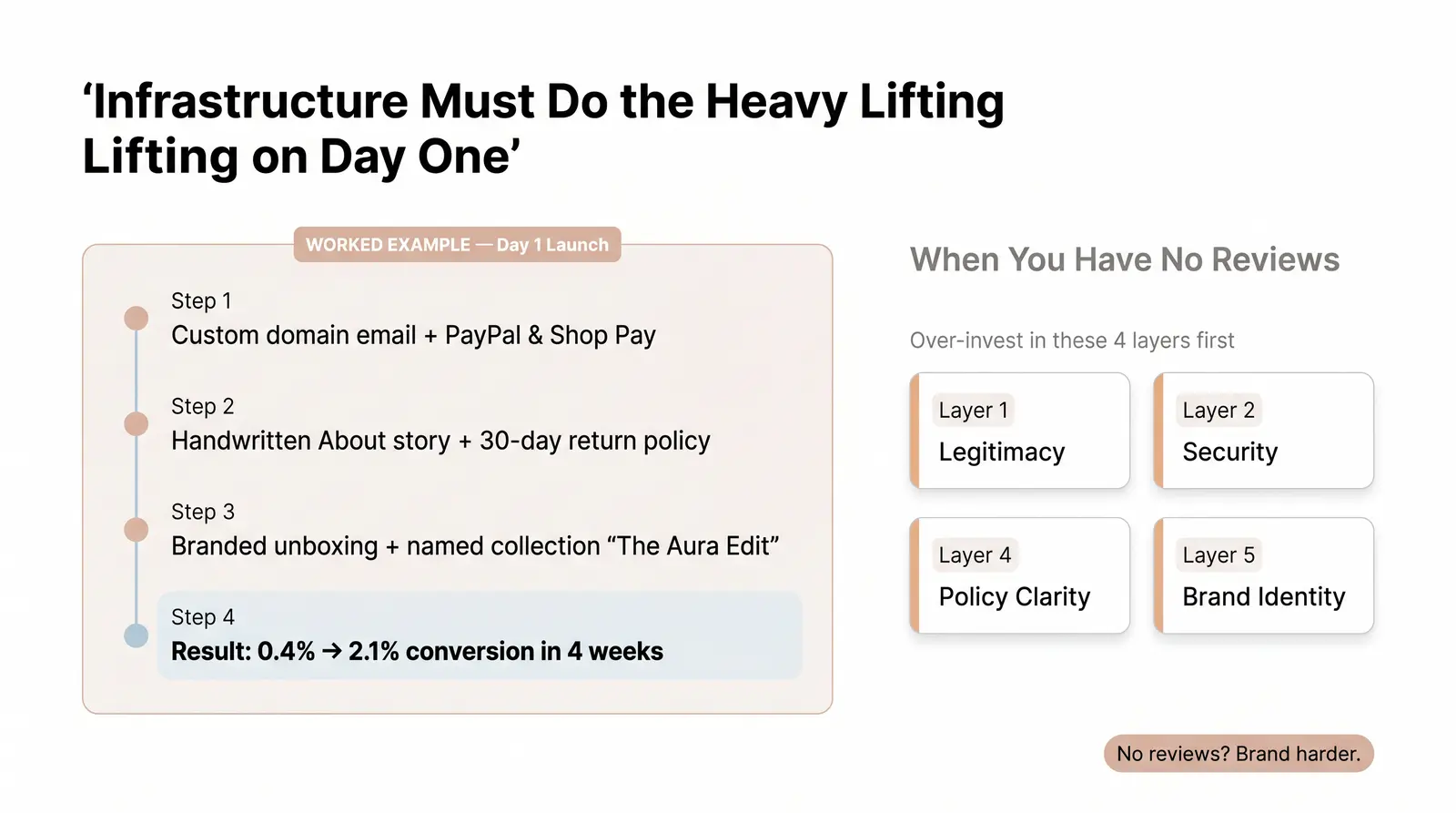
Stores with a named brand, custom packaging, and consistent identity convert measurably better than white-label or unbranded storefronts—even with identical products. This is driven by the cognitive fluency effect: familiar-feeling, coherent brand aesthetics reduce friction and increase perceived legitimacy [2].
A brand name is a trust shortcut. When buyers see a named brand—even one they've never heard of—their brain processes it as more legitimate than a nameless product listing. The brand signals that someone stands behind the product and takes responsibility for its quality. Research shows that consumers are willing to pay a premium for branded products because they associate the brand with higher quality and reduced risk [4].
This is exactly why Branvas-powered brands are set up with private-label branding from day one—not as a luxury, but as a conversion mechanism. Explore how it works →
Not all trust badges are created equal. The difference between trust badges that work and generic noise is recognition. Recognizable third-party logos like PayPal, Visa, Mastercard, Shop Pay, and Google Reviews carry implicit trust because customers know these companies handle fraud protection at scale [3]. Conversely, generic "Secure Checkout" badges or obscure security seals mean nothing and can even look suspicious.
The highest-converting trust badge placements are near the point of friction: the cart page, the checkout flow, and near the "Add to Cart" button on the product page. However, over-badging can backfire. A checkout page cluttered with 12 unknown security seals reads as desperate and untrustworthy. Less, placed better, is more.

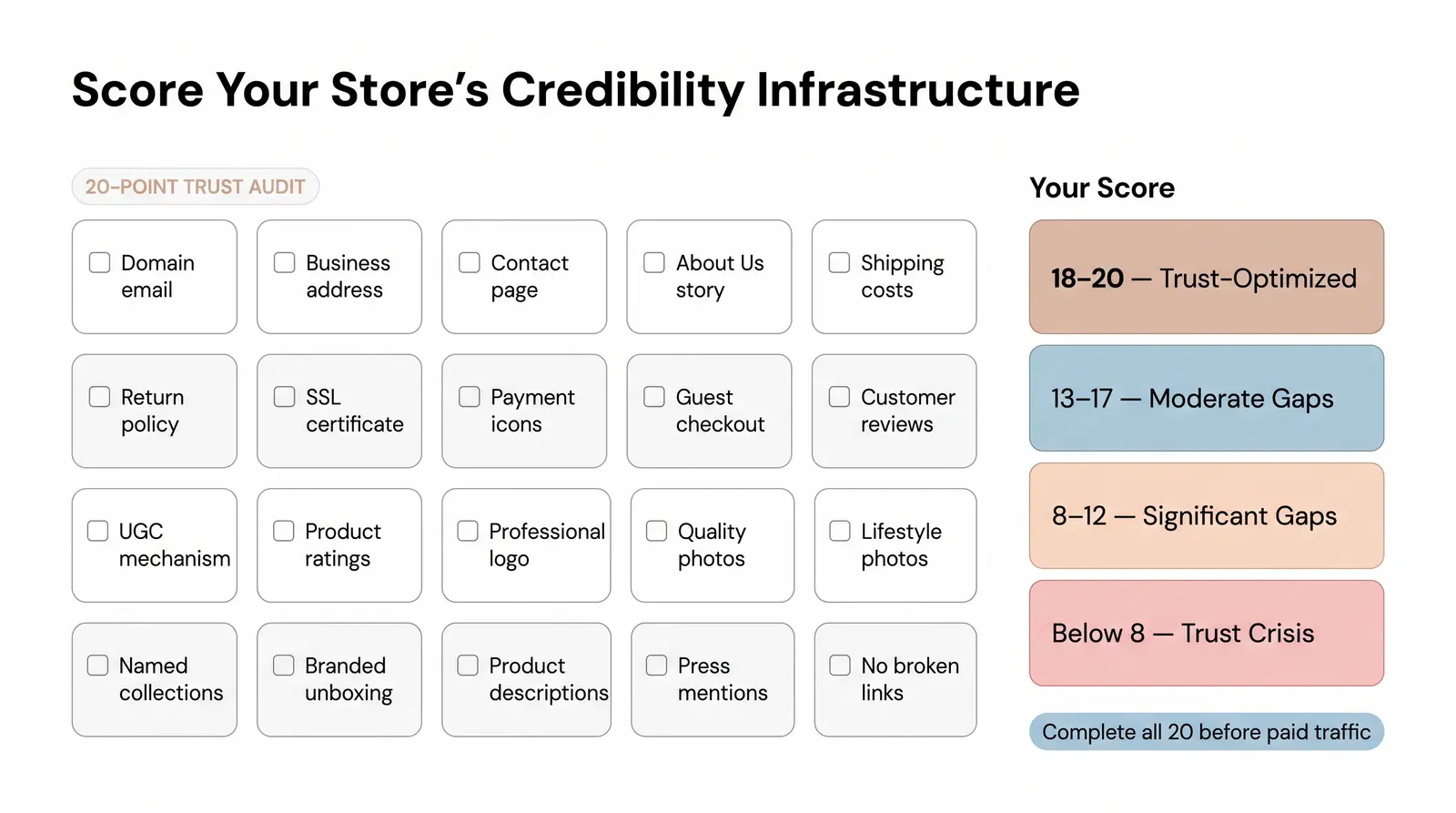
When we audit a new store, we look for specific trust markers. Use the Branvas Trust Audit to score your store's credibility infrastructure.
Scoring:
When we onboard new brand partners, we walk through this audit in the first week. Stores that complete all 20 checkpoints before running paid traffic consistently outperform those that don't.
Branvas addresses Layers 1, 4, and 5 structurally so you don't have to piece them together yourself. Custom branding, packaging, and blind fulfillment mean the brand experience is coherent from your store directly to the customer's doorstep.
Private-label packaging eliminates the "mystery Alibaba box" unboxing that destroys repeat purchase trust. Furthermore, blind shipping means the Branvas name never appears on the package—only your brand does. This seamless experience ensures that the trust you build online is validated when the product arrives.
Ready to launch a brand that converts from day one? Start with Branvas →

Q: What are the most important trust signals for a new ecommerce store?
A: The most critical foundational signals are clear contact information, recognizable payment methods (like PayPal or Shop Pay), and a transparent return policy. These address immediate anxieties about legitimacy, security, and post-purchase support before you have reviews to rely on.
Q: How do I build trust on my online store with no reviews?
A: Compensate by over-investing in brand identity and transparency. Use high-quality lifestyle photography, write a compelling founder story, offer a generous return policy, and ensure your site design is cohesive and professional to project legitimacy.
Q: Do trust badges actually increase conversions?
A: Yes, but only if they are recognizable. Badges from known entities like PayPal, Visa, or Norton provide a sense of security, whereas generic or cluttered badges can actually increase suspicion and lower conversion rates.
Q: Why do branded stores convert better than generic ones?
A: Branded stores benefit from cognitive fluency; a consistent, professional identity feels familiar and safe to the brain. A distinct brand name acts as a shortcut for trust, signaling that a real company stands behind the product's quality.
Q: How long does it take to build customer trust for a new online store?
A: While structural trust (policies, branding, secure checkout) can be built on day one, relational trust (reviews, repeat purchases) takes time. However, a fully optimized "Trust Stack" can lift conversion rates within the first few weeks of launching traffic.