


Diagnose why shoppers browse without buying using the CART-CHECK framework, then fix trust gaps on Shopify product pages to boost add-to-cart rates.
Published:
July 6, 2026
Author:
Yi Cui
When shoppers browse but do not add to cart, the issue is often confidence, not traffic.
You’ve done the hard work. You’ve sourced beautiful products, set up your Shopify store, and poured money into TikTok and Instagram ads. The dashboard shows hundreds of daily visitors, but the add-to-cart rate is a flatline zero. It’s a frustrating scenario that leaves many new ecommerce founders asking the same question: Why is nobody buying?
The instinct is usually to blame the marketing. Founders assume they are targeting the wrong audience, the ad creative is stale, or the pricing is too high. But if visitors are clicking your ads and spending time on your product pages, the traffic isn’t the problem. The problem is a lack of trust and clarity. In categories like jewelry—where products are tactile, high-consideration, and difficult to verify through a screen—every ounce of friction or doubt costs you a sale.
This article will help you stop guessing. We’ll break down exactly why interested shoppers abandon your store, introduce a diagnostic framework to audit your product pages, and give you a practical checklist to close the trust gaps that are silently killing your conversions.
Browse paralysis happens when a visitor has genuine purchase intent but is stopped by uncertainty. They want the product, but they aren’t confident enough in the store, the item, or the transaction process to pull the trigger.
Recent data from the Baymard Institute shows that while 42% of cart abandonments are from users who are "just browsing," the remaining majority abandon due to friction points that can be resolved. When we look at users who abandon purchases, 19% do so because they don't trust the site with their credit card information, and 18% leave due to a too long or complicated checkout process [1].
Most store owners assume no add-to-cart means they have the wrong audience or bad ads. In reality, research shows the majority of non-converting visitors had genuine purchase intent—they were stopped by friction, doubt, or missing information. According to Forter’s 2024 Trust Premium Report, shoppers are willing to spend 51% more with retailers they trust compared to those they don't [2]. When trust is absent, hesitation takes over.
In our experience at Branvas, we often see new jewelry store founders obsess over ad creative while leaving gaping holes in their product pages—holes that silently kill conversions. They worry about the top of the funnel while the bottom of the funnel is leaking trust.

To help sellers identify these leaks, we developed the CART-CHECK™ framework—a 9-point diagnostic model Branvas uses to audit product pages for trust and clarity gaps before launch.
Here is how you can audit your own product pages using the 9 dimensions of CART-CHECK™:
C — Credibility Signals
Does your page show that other people trust you? This includes customer reviews, trust badges, and a clear brand story. In jewelry, a lack of reviews makes a new store look risky. Adding even a few authentic reviews can lift conversions significantly.
A — Accuracy of Product Information
Are all the necessary details present? For jewelry, this means explicitly stating the materials (e.g., solid gold vs. gold-plated), dimensions, weight, and care instructions. Ambiguity about what a piece is made of will instantly stop a sale.
R — Risk Reversal
Do you make it safe for the customer to buy? This involves clear return policies, guarantees, and money-back promises. A jewelry buyer needs to know they can return a piece if it doesn't fit or look right in person.
T — Transaction Confidence
Is the checkout process visibly secure? Displaying payment security icons, SSL certificates, and recognized payment methods (like Apple Pay or PayPal) reassures buyers. If a customer doesn't recognize your payment gateway, they won't enter their card details.
C — Clarity of the Offer
Is it 100% clear what the shopper is buying, in what variant, and at what price? Variant selectors for ring sizes or necklace lengths must be intuitive. If a shopper isn't sure which size they selected, they won't add it to their cart.
H — Human Presence
Does the brand feel human? This means real photos of the product being worn, a founder story, or social proof with real faces. Jewelry needs to be seen on a person to understand how it drapes and catches the light.
E — Engagement Signals
Are there signs of an active community? Recent reviews, active social proof, or authentic "X people viewing this" notifications show that the store is alive. Stagnant pages feel abandoned and untrustworthy.
C — Channel Fit
Does the page match the expectation set by the traffic source? If an influencer promoted a specific necklace on TikTok, the landing page should immediately highlight that exact necklace and match the casual, authentic tone of the video.
K — Kinesthetic Substitutes
Can the user "feel" the product? For tactile products like jewelry, you need close-up texture shots, videos, size-on-body photos, and clear material callouts to substitute for the physical experience of holding the item.

Let's look at a realistic worked example of a fictional Shopify jewelry store, "Luna & Gilt"—a new store selling dainty gold-filled necklaces—going through the CART-CHECK™ audit.
| CART-CHECK Dimension | What Luna & Gilt Had | The Gap | The Fix |
|---|---|---|---|
| Credibility Signals | No reviews, just a 5-star rating with no text. | Looks fake or manipulated; no actual customer voice. | Add a review app to collect and display detailed text reviews with photos. |
| Accuracy of Product Info | "Beautiful gold necklace." | No mention of metal type, plating thickness, or chain length. | Update description to specify "14k gold-filled, 18-inch chain, hypoallergenic." |
| Risk Reversal | A link to a dense, legalistic return policy in the footer. | Hard to find and intimidating to read. | Add a simple "30-Day Easy Returns" icon and brief summary near the Add to Cart button. |
| Transaction Confidence | Basic Shopify checkout without trust badges. | Missing visual cues that the payment is secure. | Add recognized payment icons (Visa, Mastercard, PayPal, Shop Pay) under the ATC button. |
| Clarity of the Offer | Dropdown menu for chain length with no size guide. | Shoppers don't know where an 18" vs 20" chain falls on the chest. | Add a visual chain length guide showing where different lengths sit on a model. |
| Human Presence | Only stock photos of the necklace on a white background. | No sense of scale, style, or human connection. | Add lifestyle photos of a model wearing the necklace in natural lighting. |
| Engagement Signals | No indication of recent sales or activity. | The store feels empty, like walking into a deserted boutique. | Enable a subtle, authentic notification showing recent purchases or active viewers. |
| Channel Fit | TikTok ad sent users to the homepage instead of the product. | High friction; users have to search for the item they saw. | Route ads directly to the specific product page with messaging that matches the ad. |
| Kinesthetic Substitutes | One low-resolution image. | Shoppers can't see the clasp quality or chain texture. | Add a macro close-up shot, a short video showing the necklace moving, and detail shots. |
Once these gaps are closed, the same traffic converts at a measurably higher rate. By answering the customer's unspoken questions and removing friction, Luna & Gilt transforms a leaky product page into a high-converting asset.

Based on conversion research, here are the five highest-impact trust signals for Shopify product pages, ranked by importance:
High-Quality, In-Scale Imagery and Video
Why it works: Baymard Institute research shows that 42% of users try to ascertain the size of a product from images, and 37% of sites fail to provide "in scale" images [3]. Video and lifestyle photos act as kinesthetic substitutes, reducing the perceived risk of buying a physical product online.
Implementation Tip: For a jewelry store, always include a photo of the piece being worn by a model, a macro shot of the details (like the clasp or setting), and a short video showing how the metal catches the light.
Authentic Customer Reviews with Photos
Why it works: Reviews are the ultimate social proof. Data indicates that products with reviews convert significantly higher than those without, and 93% of consumers say online reviews influenced their purchase decisions [4].
Implementation Tip: Use a review app that allows customers to upload photos of themselves wearing your jewelry. A slightly imperfect customer photo builds more trust than a polished studio shot.
Clear, Visible Return Policies (Risk Reversal)
Why it works: Knowing they can return an item reduces the cognitive load and fear of making a mistake. It shifts the risk from the buyer to the seller.
Implementation Tip: Don't hide your return policy in the footer. Place a short, clear statement (e.g., "Free 30-Day Returns") right near the Add to Cart button.
Recognized Payment and Security Badges
Why it works: 19% of cart abandonments happen because users don't trust the site with their credit card information [1]. Familiar logos (PayPal, Shop Pay, Norton Secured) act as mental shortcuts for safety.
Implementation Tip: Add a row of accepted payment method icons directly below your checkout buttons.
Detailed, Accurate Product Specifications
Why it works: Ambiguity breeds hesitation. If a customer has to guess what a product is made of, they will leave.
Implementation Tip: For jewelry, use a bulleted list to clearly state the metal type, gemstone details, dimensions, and hypoallergenic status.
Branvas sellers get access to branded packaging and product imagery assets—see how the Branvas catalog supports launch-ready product pages with built-in credibility.

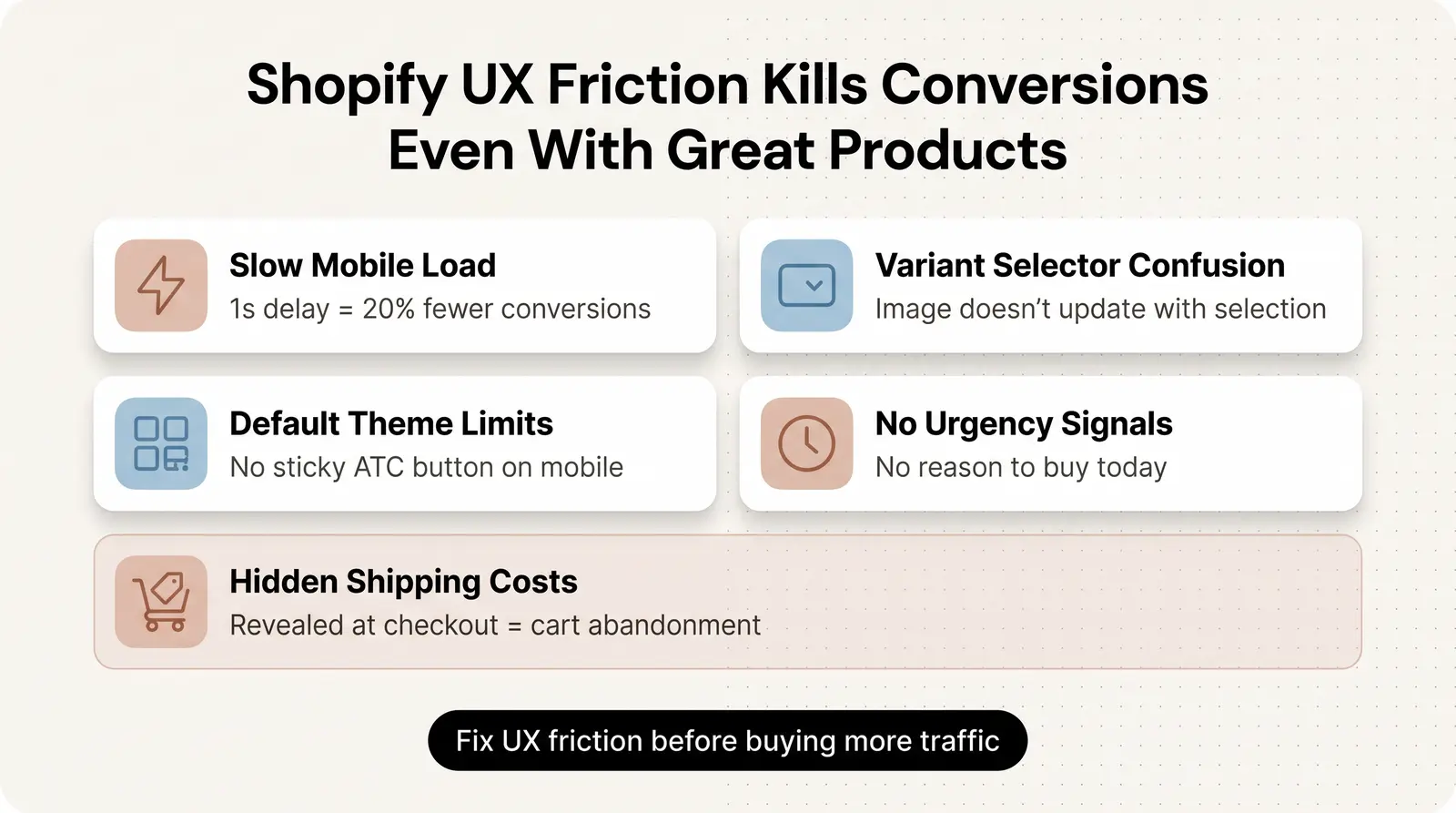
Even with great trust signals, technical and UX friction on Shopify can kill your conversion rate. Here are the common culprits:
We've seen stores using premium Shopify themes lose sales simply because the 'Add to Cart' button wasn't visible without scrolling on mobile—a 30-minute fix that changes everything.
Before you spend another dollar on ads, audit your product pages against this checklist:
Product Page Fundamentals
Social Proof & Credibility
Transaction & Risk Signals
Mobile & Speed

Most new jewelry store founders don't have trust gaps because they're lazy—they have them because they're doing everything solo. When you are managing product sourcing, photography, copywriting, inventory, and fulfillment all by yourself, there's simply no bandwidth left for optimization.
Branvas removes the operational burden. We provide private-label products with professional branding and packaging ready to go, so founders can focus entirely on their storefront, marketing, and customer experience from the start.
Our approach means sellers launch with credibility signals already built in. With Branvas, you get high-quality product consistency, branded packaging, and reliable blind fulfillment that makes your brand look established and trustworthy, even on day one. You don't have to worry about taking macro shots of clasps or writing accurate material specs—we provide the assets and information you need to build a high-converting page.
Curious how Branvas works? Explore how it works and see why hundreds of sellers launch with us instead of figuring it out alone.

Why are people visiting my Shopify store but not adding to cart?
If you have traffic but no add-to-cart events, you likely have a trust or clarity gap. Visitors may be interested in the product, but friction points—such as unclear sizing, missing material details, lack of reviews, or hidden shipping costs—cause them to hesitate and leave. It is a confidence problem, not a traffic problem.
What are the most important trust signals for a new ecommerce store?
The most critical trust signals include authentic customer reviews (especially with photos), clear and generous return policies, recognized payment security badges, and high-quality lifestyle imagery that shows the product in scale. For a new store, these elements substitute for established brand reputation.
How do I know if my product page has trust gaps?
You can identify trust gaps by auditing your page using the CART-CHECK™ framework. Look for missing credibility signals, vague product information, hidden return policies, or a lack of human presence in your imagery. High bounce rates and long time-on-page with zero conversions are strong indicators of trust gaps.
Does social proof really matter if I'm a brand new store with no reviews yet?
Yes, social proof is essential. If you don't have customer reviews yet, you can build trust through other forms of social proof, such as founder stories, behind-the-scenes content showing your process, user-generated content from friends or micro-influencers, and clear guarantees. You must actively work to get those first few reviews to break the ice.
What's the fastest way to improve add-to-cart rate on Shopify without changing my product or price?
The fastest improvements come from removing friction and adding clarity. Ensure your Add to Cart button is highly visible (use a sticky button on mobile), state your shipping and return policies clearly near the buy button, add payment trust badges, and ensure your product descriptions explicitly answer common customer questions (like sizing and materials).
When you see a dashboard full of visitors but an empty shopping cart, it’s easy to panic and assume your products or prices are wrong. But remember the core insight: traffic is not your problem—trust is. Your visitors are interested; they just need reassurance.
Fixing trust gaps is cheaper and faster than buying more traffic. By auditing your store with the CART-CHECK™ framework, addressing missing information, and implementing the 25-point checklist, you can transform hesitant browsers into confident buyers.
If you're building a jewelry or accessories brand and want to start with the credibility signals already in place, Branvas was built for exactly that. Start your brand with Branvas →