



The TRACE diagnostic framework helps ecommerce founders identify whether low sales stem from traffic volume, audience mismatch, weak trust signals, unclear product pages, or a broken offer.
Published:
June 22, 2026
Author:
Yi Cui
You launch your Shopify store, set up your product pages, and turn on the Facebook ads. The dashboard shows clicks. The traffic is flowing. But the sales dashboard remains stubbornly at zero. The instinct for almost every new founder is identical: "I need more traffic," or "The product is wrong." So they pour more money into ads, or they rip down the site to start over.
But most new store owners misdiagnose their problem and fix the wrong thing first. They spend money on ads when the real problem is trust, or obsess over product pages when no one is even arriving. The reality is that an ecommerce funnel breaks in predictable ways. If you can identify exactly where the break is happening, you can stop burning cash and start fixing the root cause.
In this guide, we will break down the five root causes of an underperforming ecommerce store and introduce a simple diagnostic framework to help you identify whether you have a traffic problem, a trust problem, or something else entirely.
Throwing money at ads before diagnosing the real problem is one of the most common—and expensive—mistakes in ecommerce. The average global ecommerce conversion rate sits around 1.9% to 2%, with Shopify stores typically achieving between 2.5% and 3% [1]. If your store is converting at 0.2%, doubling your ad spend will just double your losses.
More traffic is almost never the first fix, because traffic amplifies whatever is already broken. If your store looks untrustworthy, driving more people to it just means more people will leave without buying. Paid traffic is a multiplier, not a foundation.
At Branvas, we work with new brand founders regularly, and the pattern is almost always the same: the instinct is to run more ads. But more traffic into a leaking funnel just leaks faster.

Before you can fix your store, you need to understand the five core reasons why ecommerce stores fail to convert.
Not Enough Traffic
You simply have too few sessions to convert meaningfully. If you only get 100 visitors a month, a 2% conversion rate means two sales. You need a minimum viable traffic volume—usually around 1,000 sessions a month—just to test if your conversion rate is healthy.
Wrong Traffic / Audience Mismatch
The traffic exists, but it is irrelevant. You might be ranking for the wrong keywords, targeting the wrong audience on social media, or driving traffic from a channel that does not match your product. If you sell high-end jewelry but your ads target bargain hunters, your conversion rate will be zero.
Weak Trust Signals
The store looks untrustworthy. It is missing reviews, has no clear return policy, lacks a brand story, or uses generic stock photos. According to the Baymard Institute, 25% of shoppers abandon checkout because they do not trust the site with their financial information [2].
Unclear or Unconvincing Product Pages
The benefits are not communicated, the images are poor quality, there is no size or fit information, or the calls to action are confusing. Up to 62% of leading ecommerce sites have "mediocre" or worse product page UX [3].
Broken or Mismatched Offer
The price is too high for the perceived value, the product does not solve a real pain point, or the positioning is wrong. Even with perfect traffic and a beautiful site, a bad offer will not sell.

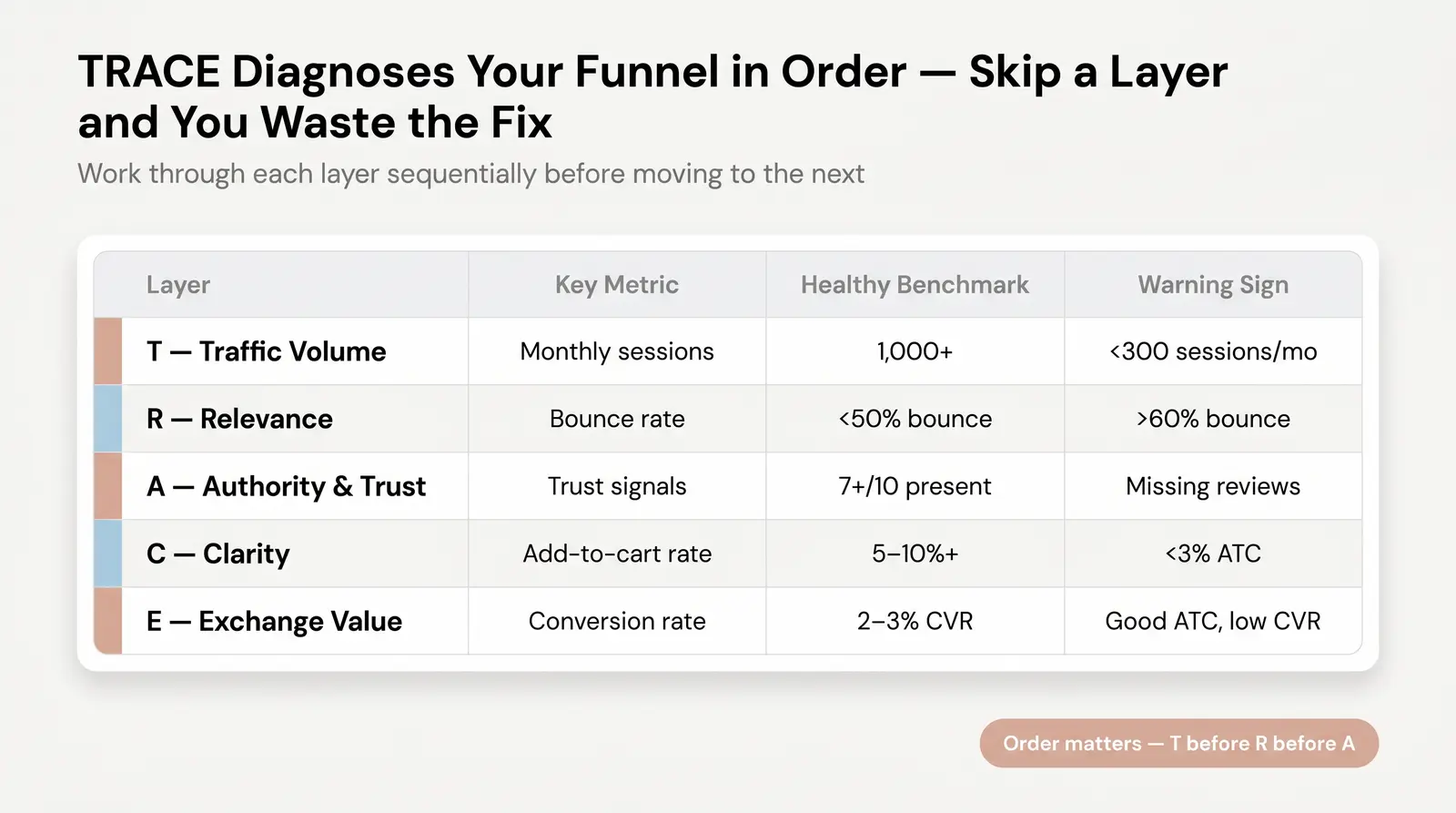
To stop guessing and start fixing, we use the TRACE Framework. It stands for Traffic Volume, Relevance, Authority & Trust, Clarity, and Exchange Value.
TRACE is designed to be worked through in order, because each layer depends on the one before it. If you fail at Traffic Volume, you cannot diagnose Relevance. If you fail at Relevance, fixing Authority & Trust is premature.
| TRACE Layer | Key Metric to Check | Healthy Benchmark | Warning Sign | First Action |
|---|---|---|---|---|
| Traffic Volume | Monthly sessions | 1,000+ to test CVR | <300 sessions/mo | Focus on SEO or organic content first |
| Relevance | Bounce rate / session duration | <50% bounce, >1:30 avg | >60% bounce + low pages/session | Audit traffic sources and targeting |
| Authority & Trust | Trust signal checklist score | 7+/10 signals present | Missing reviews, policy pages | Add social proof, return policy, brand story |
| Clarity | Add-to-cart rate | 5–10%+ | <3% ATC despite relevant traffic | Rewrite product pages, improve images |
| Exchange Value | Conversion rate + abandoned cart % | 2–3% CVR | Good ATC but low CVR (<1%) | Test pricing, bundles, guarantees |
Note: Benchmarks vary by industry. For example, fashion stores typically see bounce rates between 40% and 60%, while the average add-to-cart rate globally is around 6.2% to 7.5% [4] [5].
Let's look at a realistic scenario.
Example: "Luna & Co." — A new jewelry brand on Shopify, 3 months old, running $500/month in Facebook ads.
Luna & Co. is getting traffic, but no sales. Let's walk through the TRACE framework:
The diagnosis stops here. The trust and clarity layers are irrelevant until the relevance issue is fixed. Luna & Co. needs to fix their ad targeting before they spend a single minute improving product pages or adding reviews. If they skip Relevance and go straight to fixing Authority (e.g., buying a new theme or adding trust badges), they will waste effort and see no improvement in results, because the people arriving never intended to buy in the first place.

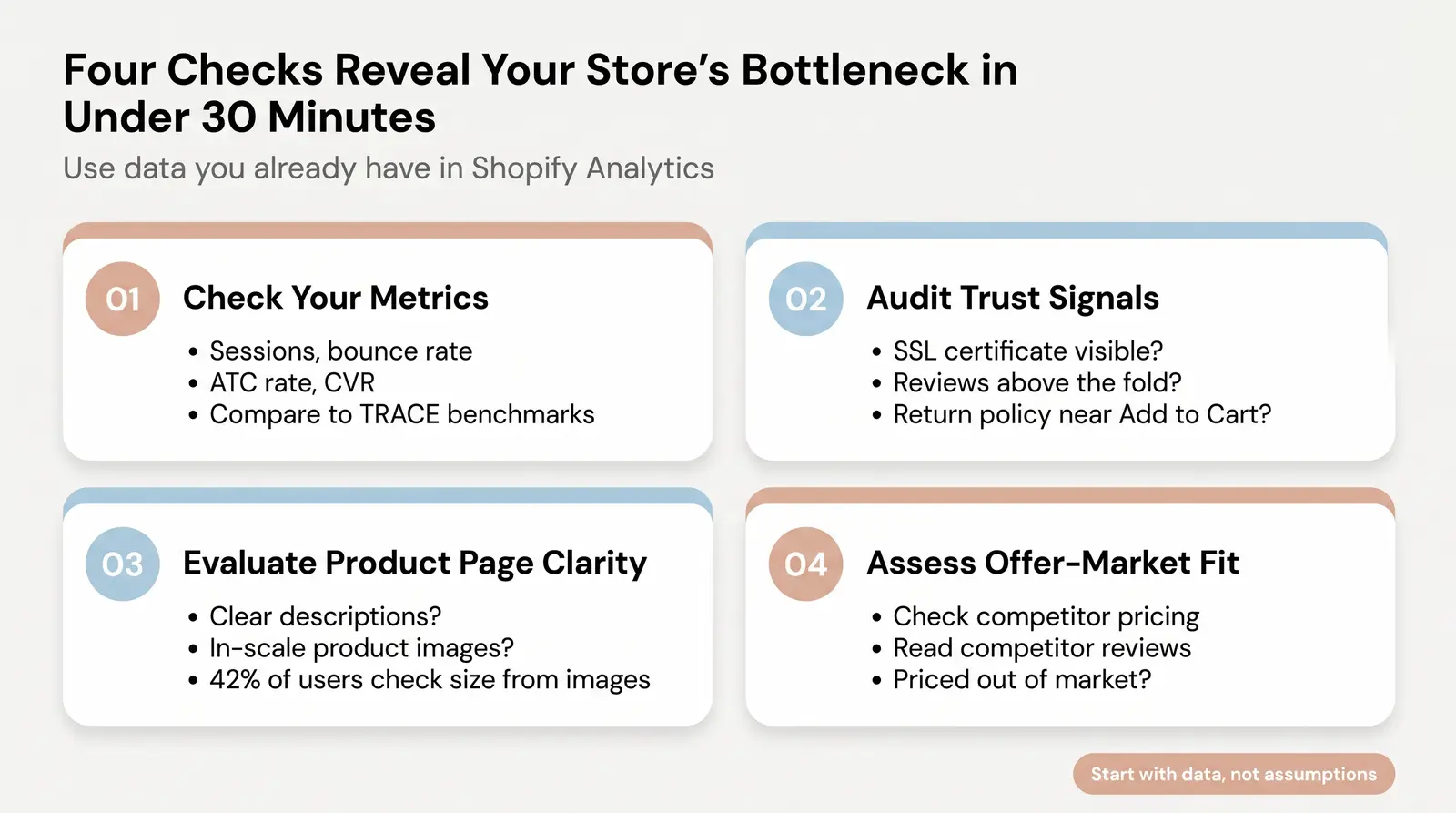
You can diagnose your own store using data you already have. Here is a practical checklist:
1. Check Your Metrics
Open Shopify Analytics. Look at your sessions, bounce rate, add-to-cart (ATC) rate, and conversion rate (CVR). Compare them to the TRACE benchmarks.
2. Audit Trust Signals
Does your site have an SSL certificate? Are reviews visible above the fold on product pages? Is your return policy clearly linked in the footer and near the Add to Cart button? Do you have a compelling brand story and real product photos?
3. Evaluate Product Page Clarity
Are your product descriptions clear? Do you have "in scale" images showing the product's size? (Baymard found that 42% of users try to ascertain the size of a product from images, yet 37% of sites don't provide "in scale" images [3]).
4. Assess Offer-Market Fit
Look at competitor pricing. Are you priced out of the market? Read competitor reviews to see what customers actually value.
If you're launching or auditing a private-label jewelry or accessories brand and want a store setup that already passes the TRACE trust and clarity layers from day one, explore how Branvas works — the platform is built so founders don't start from zero on credibility.
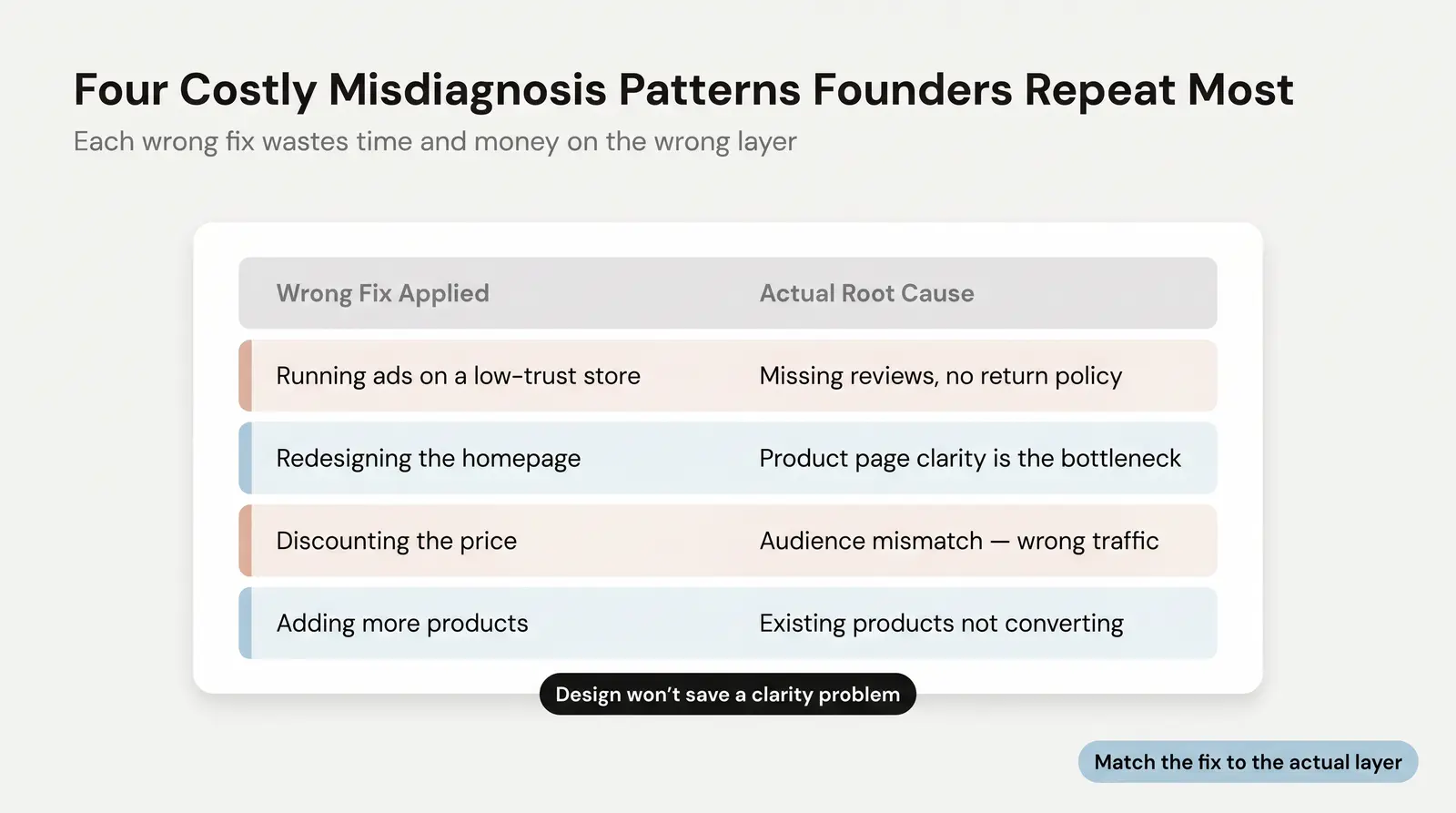
When founders misdiagnose their store's problems, they waste time and money. Here are the most common patterns:
Running ads on a low-trust store
If your store lacks reviews, a clear return policy, and secure payment badges, paying for traffic is burning money. Buyers will arrive, feel suspicious, and leave.
Redesigning the homepage when the product page is the problem
Many founders obsess over their homepage design. But if visitors are landing on product pages and not adding to cart, the homepage is not the bottleneck.
Discounting when the real issue is audience mismatch
If you are driving the wrong people to your store, lowering the price will not make them buy. People who have no interest in your product will not buy it at any price.
Adding more products when the existing ones aren't converting
More inventory does not fix a broken funnel. If your first ten products aren't selling, adding fifty more will just spread your limited traffic thinner.
We've seen founders at Branvas completely overhaul their visual branding — new logo, new color palette, new packaging — only to realize the core issue was that they were driving cold Instagram traffic to a product page with two sentences of copy and one photo. Design won't save a clarity problem.
How do you know when it is time to scale your ads? Use this simple threshold model:
Paid traffic is a multiplier, not a foundation. Fix the foundation first.

How do I know if my Shopify store has a traffic problem or a conversion problem?
Look at your sessions. If you have fewer than 1,000 sessions a month, you have a traffic volume problem. If you have over 1,000 sessions but a conversion rate below 1%, you have a conversion problem related to relevance, trust, or clarity.
What is a good conversion rate for a Shopify store?
The average Shopify conversion rate is generally between 2.5% and 3%. However, this varies by industry and traffic source. A rate above 3.2% puts you in the top tier of stores.
Why is my ecommerce store getting traffic but no sales?
High traffic with no sales usually indicates an audience mismatch or weak trust signals. You may be driving clicks with clickbait ads, or visitors may be abandoning the site because they do not trust it with their payment information.
How do I audit my Shopify store for free?
Start with Shopify Analytics to check your bounce rate and add-to-cart rate. Then, manually review your product pages for clear images, visible reviews, and an easy-to-find return policy. Use the TRACE framework to identify the specific bottleneck.
What are the most important trust signals for a new ecommerce store?
The most critical trust signals are authentic customer reviews placed above the fold, a clear and visible return policy, secure payment badges near the checkout, and high-quality, non-stock product imagery.
The TRACE framework—Traffic Volume, Relevance, Authority & Trust, Clarity, and Exchange Value—gives you a structured way to identify exactly why your store is not making sales. Diagnosis before action saves time and money. Fixing the right layer of the funnel is a skill, and most stores that fail do so not because the product is bad, but because they never identified the real bottleneck.
If you're building a jewelry or accessories brand and want to start with a product, fulfillment, and brand foundation that's designed to convert — not just look good — see how Branvas can help. You can also run your numbers with the Branvas Profit Calculator before you commit to anything.


