


This ecommerce niche finder quiz evaluates your budget, interests, and risk tolerance to recommend the most profitable product category for your online store.
Published:
October 8, 2026
Author:
Yi Cui
Take this free quiz to find your ecommerce niche and stop guessing what products will actually sell. If you are tired of endless research and want a clear, data-backed recommendation on where to launch your brand, you are in the right place. This interactive tool evaluates your budget, interests, and risk tolerance to pinpoint the exact market you should enter today.
Choosing the right niche is the highest-leverage early decision you will make as an ecommerce entrepreneur. US ecommerce sales grew 8.7% in 2024 to nearly $1.2 trillion, comprising 16.2% of total retail sales [1]. That growth is real, but so is the competition. A well-defined niche lets you bypass broad, saturated markets and speak directly to a specific group of buyers with underserved needs and a higher willingness to pay.
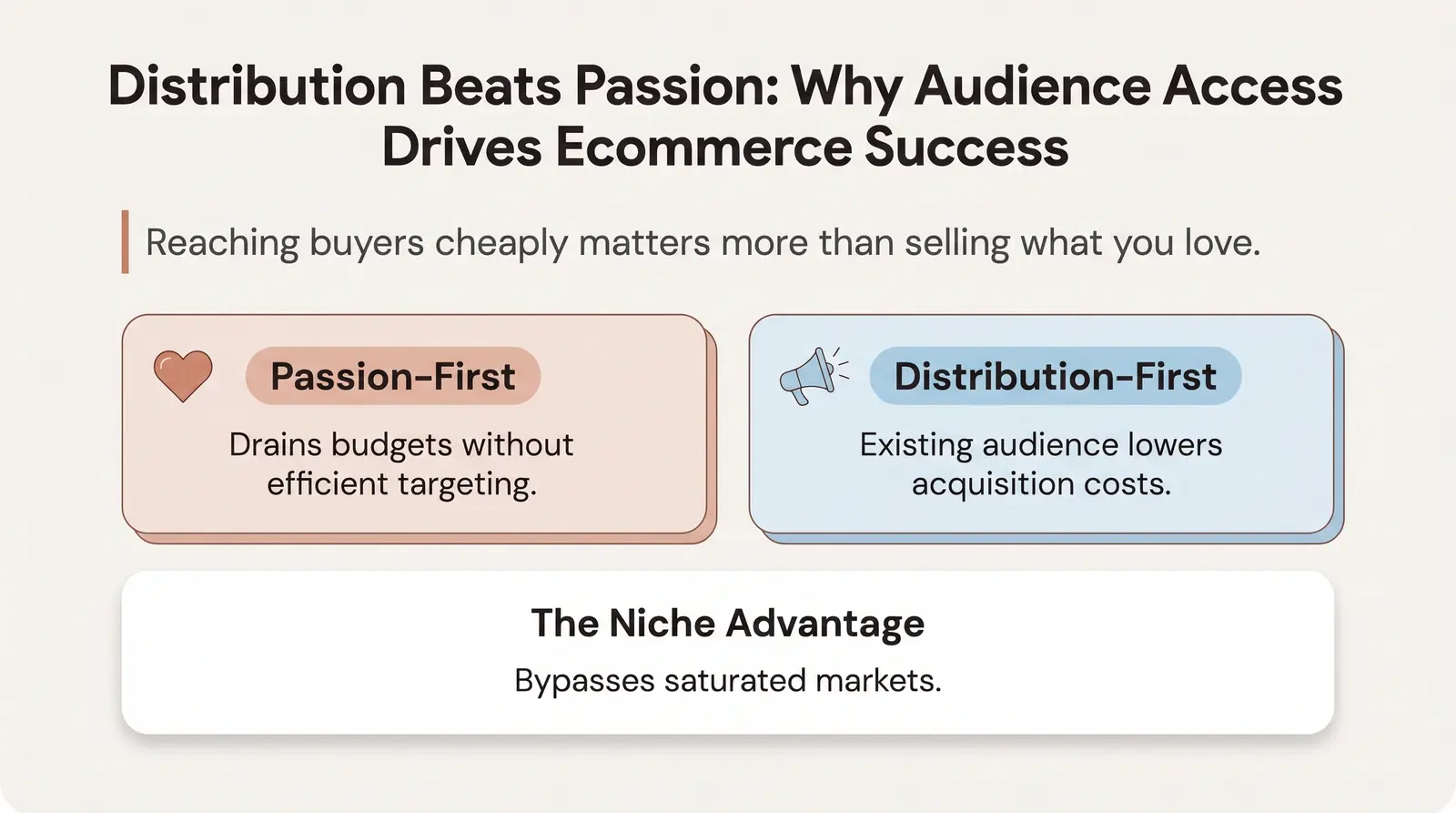
Here is the contrarian truth most people don't want to hear: passion for a niche matters far less than your ability to reach that niche's audience cheaply. While many gurus advise founders to "sell what they love," the reality is that customer acquisition costs will drain your budget long before your passion pays off if you cannot efficiently target your buyers. The founders who thrive are the ones who ask "where do I already have an audience or distribution advantage?" before they ask "what do I love?"
At Branvas, we've onboarded hundreds of first-time brand founders, and the ones who struggle most aren't the ones with small budgets — they're the ones who chose a niche based on what they liked rather than where they already had distribution. A founder with 8,000 Instagram followers in the fitness space who launches a fitness accessories brand will almost always outperform a founder with zero audience who launches a "passion project" in a category they have no reach in.
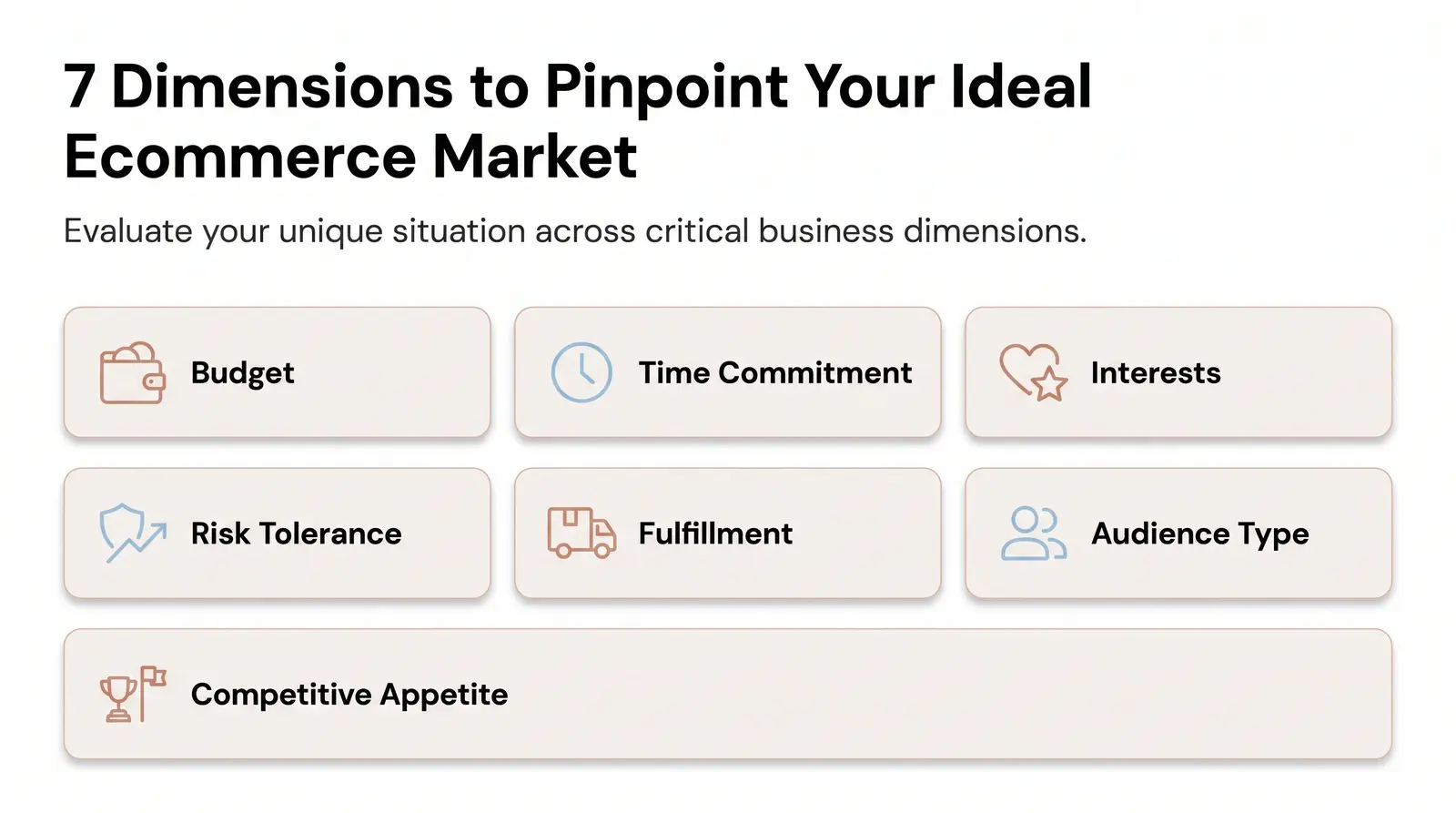
This 8-question decision-tree quiz is designed to cut through the noise and deliver a personalized niche recommendation. Instead of generic advice, the quiz evaluates your unique situation across seven critical dimensions.
| Dimension | What It Measures |
|---|---|
| Budget | Your realistic upfront investment capacity |
| Interests/Passions | The product categories you naturally gravitate toward |
| Time Commitment | How many hours per week you can dedicate |
| Risk Tolerance | Your comfort with inventory, debt, and uncertainty |
| Fulfillment Preference | Whether you want hands-off or hands-on logistics |
| Target Audience Type | The type of buyer you are best positioned to reach |
| Competitive Appetite | Your willingness to fight for market share vs. find a quieter lane |
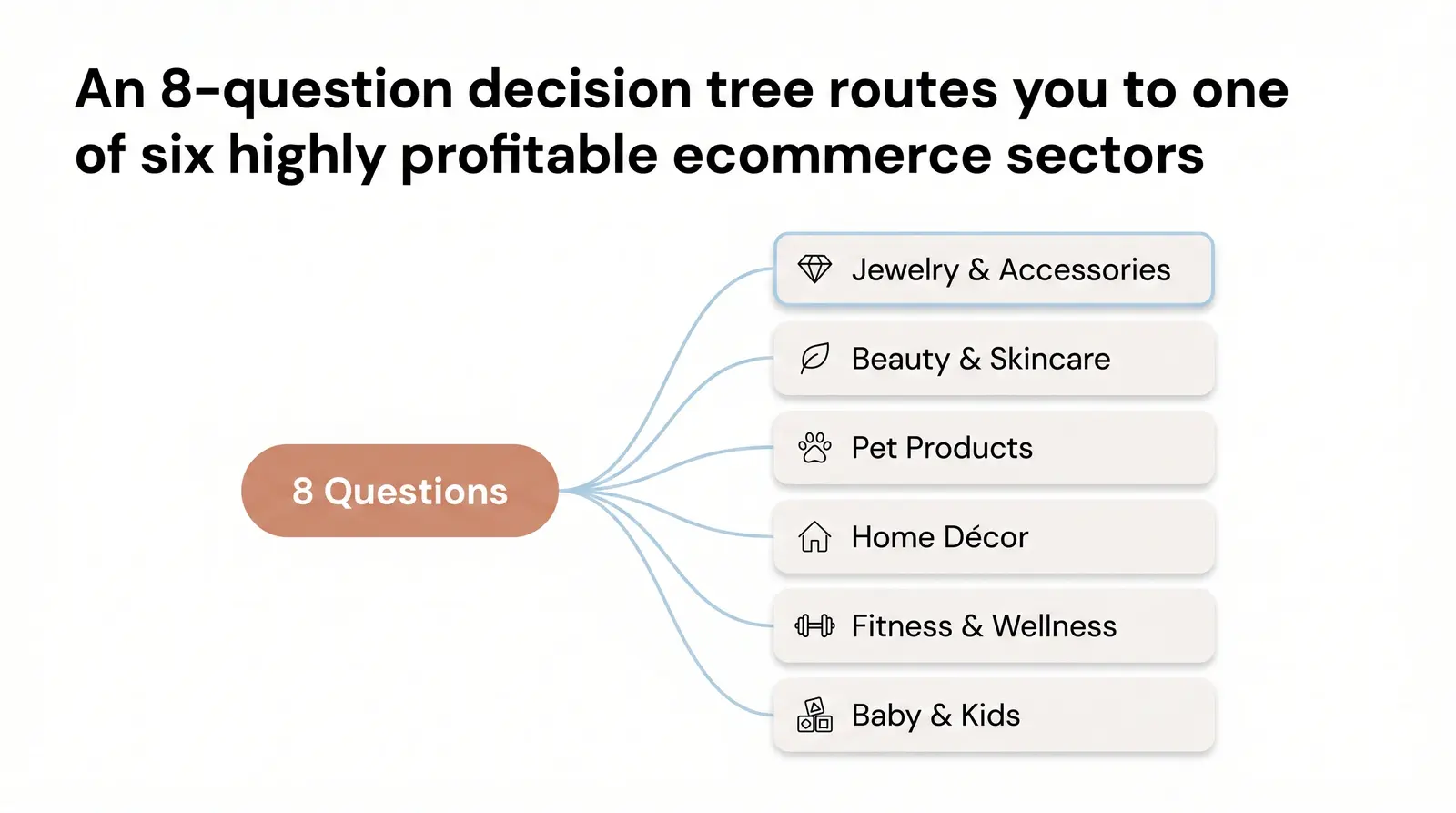
By answering honestly, you will be routed to one of six highly profitable ecommerce sectors tailored to your strengths. If you run a blog or resource site for entrepreneurs, this quiz is also available as an embeddable widget to help your audience find their path. Contact Branvas for embed access by visiting our How It Works page.
Question 1: What is your realistic starting budget for launching this business?
Question 2: How much time can you dedicate to running this business each week?
Question 3: What type of products naturally catch your eye when you shop online?
Question 4: How do you feel about managing physical inventory and shipping?
Question 5: Which target audience sounds most appealing to market to?
Question 6: What is your tolerance for product returns and sizing issues?
Question 7: How do you prefer to compete in the market?
Question 8: What is your primary financial goal for the first 12 months?
Tally your answers to see which path aligns best with your profile. Whichever letter appears most frequently across your answers points to your recommended niche.
1. Jewelry & Accessories
(Mostly A's — especially on Q1, Q2, Q4, Q5, Q6, Q7)
The global jewelry market is expected to reach $578.45 billion by 2033, growing at a CAGR of 5.5% [2]. Online jewelry sales alone are growing at 13.8% annually. This niche offers exceptional margins, lightweight shipping, and minimal return rates. It is ideal for founders who want to focus on branding and marketing rather than logistics.
Estimated Startup Cost: $300 to $1,000. Recommended Model: Private Label / Blind Dropshipping. Best For: Brand-builders, influencers, and aesthetic-driven marketers who want a fast path to their first sale.
If your results point to jewelry, you're in luck — this is one of the fastest niches to launch with a private-label model. Branvas makes it possible to go from zero to a branded jewelry line in weeks, with no inventory risk. Explore how it works →
2. Beauty & Skincare
(Mostly B's — especially on Q2, Q3, Q4, Q5, Q8)
The global beauty and personal care market is projected to generate nearly $698 billion in revenue in 2026 [3]. This niche thrives on repeat purchases and customer loyalty, making it highly lucrative once you acquire a buyer. The challenge is that regulatory requirements for cosmetics vary by country, so sourcing from certified manufacturers is non-negotiable.
Estimated Startup Cost: $1,000 to $3,000. Recommended Model: Private Label. Best For: Content creators and founders passionate about wellness and self-care.
3. Pet Products
(Mostly C's on Q2, Q5, Q7 — B's on Q8)
The US pet industry reached $158 billion in 2025 [4]. Pet owners are notoriously willing to spend on their animals, and the emotional connection they feel to their pets translates into exceptionally high engagement rates on social media. The downside is that many pet product categories are commoditized, so differentiation through branding and niche targeting (e.g., "products for senior dogs") is essential.
Estimated Startup Cost: $500 to $2,000. Recommended Model: Dropshipping / Wholesale. Best For: Community builders and social media marketers.
4. Home Décor & Lifestyle
(Mostly C's on Q1, Q3, Q4 — A's on Q6)
The US home decor market generated over $237 billion in 2024 and is on a steady growth trajectory. While items can be bulkier and harder to ship, the high average order values make up for the logistical challenges. This niche performs exceptionally well on Pinterest and TikTok, where visual inspiration drives purchase intent.
Estimated Startup Cost: $1,500 to $5,000. Recommended Model: Dropshipping / Custom Manufacturing. Best For: Pinterest and Instagram marketers with a strong eye for interior design.
5. Fitness & Wellness
(Mostly C's on Q1 — B's on Q3, Q5, Q7)
The global wellness economy hit a record $6.8 trillion in 2024, growing 7.9% year-over-year [5]. From at-home equipment to recovery tools, this niche caters to highly motivated buyers. The challenge is that large, heavy equipment is expensive to ship. Focus on accessories, apparel, and recovery products for the best unit economics.
Estimated Startup Cost: $2,000 to $5,000. Recommended Model: Dropshipping / White Label. Best For: Fitness professionals, coaches, and health enthusiasts.
6. Baby & Kids
(Mostly C's on Q3, Q5, Q8 — B's on Q7)
The global baby products market is projected to reach $579.52 billion by 2033, growing at a CAGR of 6.4% [6]. Parents prioritize safety, quality, and utility, creating a market that is resilient to economic downturns. This niche requires strict attention to safety certifications, but rewards founders who earn parental trust with exceptional repeat purchase rates.
Estimated Startup Cost: $1,000 to $3,000. Recommended Model: Private Label / Wholesale. Best For: Parent-influencers and founders focused on safety and utility.
To further validate your quiz result, we recommend running your chosen niche through The Branvas Niche-Fit Score™. This is the proprietary scoring model we use internally to evaluate niche viability for new brand founders before they invest a single dollar.
The framework evaluates niches across five dimensions, each scored from 1 (Poor) to 5 (Excellent). The dimensions are Margin Potential (the gap between COGS and perceived retail value), Audience Accessibility (how cheaply you can target the ideal buyer via ads or organic content), Fulfillment Simplicity (the ease of storing, packing, and shipping), Trend Momentum (the current and projected market growth rate), and Repeat Purchase Rate (the likelihood of a customer returning within 12 months).
| Niche Category | Margin Potential | Audience Accessibility | Fulfillment Simplicity | Trend Momentum | Repeat Purchase Rate | Total Score |
|---|---|---|---|---|---|---|
| Jewelry & Accessories | 5 | 4 | 5 | 4 | 4 | 22 / 25 |
| Beauty & Skincare | 4 | 3 | 4 | 4 | 5 | 20 / 25 |
| Pet Products | 3 | 5 | 3 | 4 | 4 | 19 / 25 |
| Home Décor | 4 | 4 | 2 | 3 | 2 | 15 / 25 |
| Fitness Equipment | 3 | 3 | 1 | 4 | 1 | 12 / 25 |
Interpretation Guide: A score of 20 to 25 means the niche is launch-ready. Proceed to sourcing and branding immediately. A score of 15 to 19 indicates a viable niche with caveats, requiring a specific marketing angle or operational workaround. A score below 15 signals high risk, and you will need significant capital or a large existing audience to succeed.
Worked Example: Jewelry & Accessories (Score: 22/25)
Jewelry earns a perfect 5 in Margin Potential because the perceived value of a well-branded necklace or bracelet far exceeds its manufacturing cost. A piece that costs $4 to produce can retail for $35 to $65 with the right packaging and brand story. It also scores a 5 in Fulfillment Simplicity because items are tiny, lightweight, and rarely break in transit, making blind-ship fulfillment seamless. Audience Accessibility scores a 4 rather than a 5 because the jewelry category is competitive on paid social, but the highly visual nature of the product makes organic content creation straightforward. Trend Momentum scores a 4, reflecting the steady 5.5% CAGR of the global jewelry market [2]. Repeat Purchase Rate scores a 4 because customers who love a brand's jewelry return for gifts, seasonal pieces, and new collections.
In our experience at Branvas, niches that score above 20 on this framework tend to reach their first 100 orders faster — often within the first 60 days of launch.

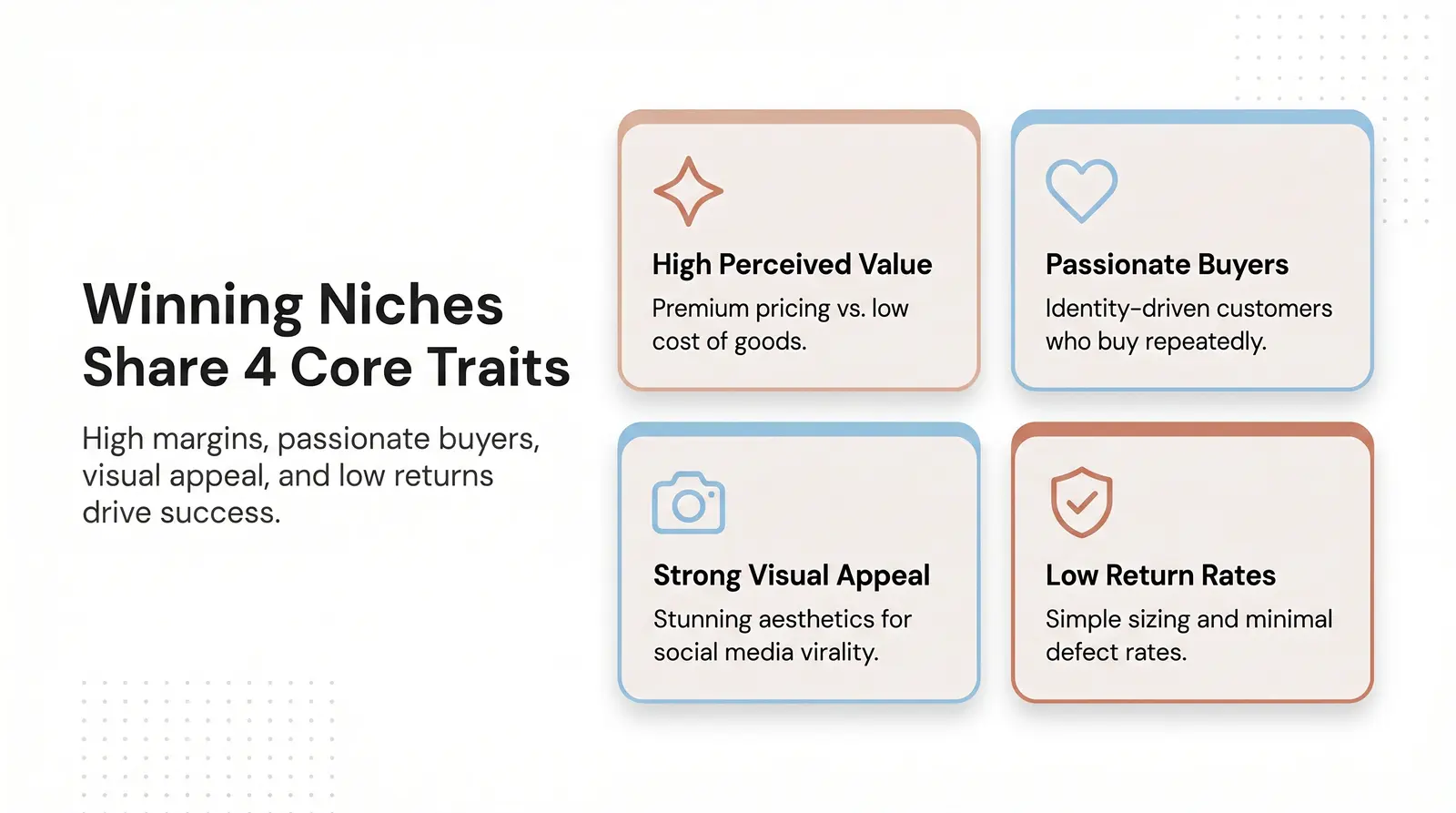
After analyzing the fastest-growing sectors, several distinct characteristics emerge among the winning niches. The global dropshipping market is projected to grow at a 22.0% CAGR through 2030, reaching $1.25 trillion [7]. But raw market size does not guarantee success. The stores that win share four traits.
First, they boast a high perceived value relative to their cost of goods sold. Consumers willingly pay a premium for products that feel exclusive, personalized, or beautifully packaged, regardless of the base material cost. This is why private-label brands routinely achieve 60% to 80% gross margins in categories like jewelry and beauty.
Second, winning niches attract passionate, identity-driven buyers. Whether it is a dog owner, a skincare enthusiast, or a jewelry collector, the buyer views the purchase as an extension of who they are. This emotional investment drives word-of-mouth, social sharing, and repeat purchases without additional ad spend.
Third, the best niches feature strong visual appeal. In an era dominated by short-form video on TikTok and Instagram Reels, products must look stunning on camera to drive organic virality. Jewelry, beauty, and home decor all photograph exceptionally well, which is why they dominate influencer content.
Fourth, they maintain low return rates. Categories with complex sizing or high defect rates erode profit margins fast. This is one reason jewelry consistently ranks among the highest-margin, lowest-return-rate categories in private label — browse the Branvas catalog to see what's available.
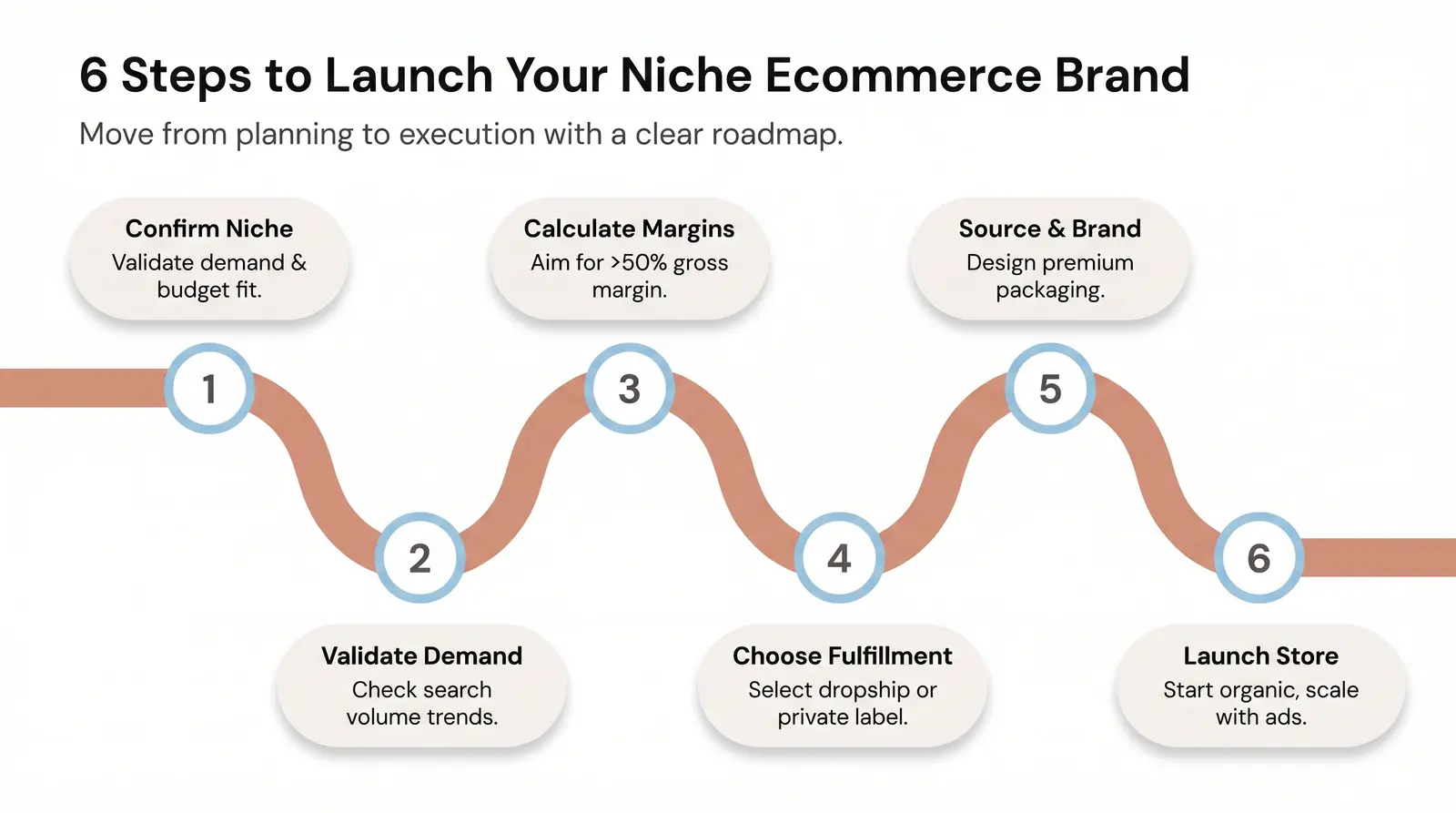
Now that you have identified your ideal ecommerce niche, it is time to move from planning to execution. These six steps take you from quiz result to live store.
Step 1: Confirm Your Niche. Review your quiz result and run it through the Branvas Niche-Fit Score™ to ensure it aligns with your budget and goals. If two niches score similarly, choose the one where you already have an audience or content advantage.
Step 2: Validate Demand. Use Google Trends and keyword research to confirm that people are actively searching for products in your chosen category. Look for consistent search volume over 12 months, not just a seasonal spike.
Step 3: Calculate Your Margins. Before committing, run your niche's margins through the Branvas Profit Calculator to see what your unit economics look like at different price points. Aim for a minimum 50% gross margin before ad spend.
Step 4: Choose a Fulfillment Model. Decide whether you will hold inventory, use a traditional dropshipper, or partner with a private-label service. For most first-time founders, a blind-ship private-label model eliminates the biggest operational risks.
Step 5: Source Products and Brand. Select high-quality items and design packaging that elevates the perceived value of your brand. Your unboxing experience is your first physical touchpoint with the customer — make it count.
Step 6: Build Your Store and Launch. Set up your Shopify store, integrate your fulfillment partner, and launch your first marketing campaign. Start with organic content before scaling with paid ads.
If your niche is jewelry or accessories, Branvas is purpose-built for this moment. You get private-label products, custom branding and packaging, and blind-ship fulfillment — without carrying inventory. Start your brand with Branvas →
Q: What is the most profitable niche for ecommerce in 2025?
A: While profitability varies by execution, jewelry, beauty, and pet products consistently rank at the top based on margin potential, repeat purchase rates, and low operational complexity. Jewelry stands out in particular because it combines the highest gross margins in the private-label space with the lowest return rates of any wearable category. Online jewelry sales are growing at 13.8% annually [2], and the barrier to entry with a private-label model is lower than almost any other physical product category.
Q: How do I know if a niche is too competitive?
A: A niche is rarely "too competitive" if you have a unique angle. The real signal to watch is cost per click (CPC) on advertising platforms relative to your average order value. If your CPC is $2 and your average order value is $40 with a 50% margin, you need a 10% conversion rate to break even on ads — which is nearly impossible. That is when you need to either niche down further (e.g., from "skincare" to "vegan skincare for athletes") or shift to organic-first marketing strategies.
Q: Can I start an ecommerce business with less than $500?
A: Yes. Models like print-on-demand and blind dropshipping require zero upfront inventory costs. With a Brand-as-a-Service platform, you can launch a fully branded store using only your budget for a domain name, website hosting, and initial marketing tests. Jewelry is one of the most accessible niches at this budget level because products are inexpensive to sample, lightweight to ship, and easy to photograph with a smartphone.
Q: Is jewelry a good niche for dropshipping or private label?
A: Jewelry is arguably the best niche for private label specifically. It is lightweight, inexpensive to ship globally, and easy to customize with branded packaging and custom tags. Unlike apparel, it does not suffer from complex sizing issues, which keeps return rates extremely low and preserves your profit margins. The perceived value gap between cost and retail price is also among the widest of any product category, giving you room to build a premium brand without premium manufacturing costs.
Q: What's the difference between dropshipping and private-label for niche products?
A: Traditional dropshipping involves selling generic, unbranded products shipped directly from a supplier, often with long shipping times and zero brand differentiation. Private label means placing your own brand name, logo, and custom packaging on the products, allowing you to charge a premium and build a recognizable long-term brand asset. The key difference is that dropshipping builds the supplier's brand equity while private label builds yours. For founders serious about creating a real business rather than a temporary arbitrage play, private label is the superior model.