


Compare dropshipping and print-on-demand across margins, branding, scalability, and niche fit to choose the fulfillment model that maximizes your profitability.
Published:
September 30, 2026
Author:
Yi Cui
POD and dropshipping are often pitched as the same thing. They're not — and the wrong choice locks you into a business model that will cap your margin for years.
While print-on-demand (POD) is technically a subset of dropshipping, the two terms have diverged in practice to represent entirely different business models. Both allow you to sell products without holding inventory, but the mechanics of how those products are created, branded, and priced are fundamentally different. Choosing the wrong model for your specific niche means capped margins, weak branding, and limited catalog control. For ecommerce sellers, aspiring entrepreneurs, and content creators, understanding this distinction is the difference between building a scalable brand and running a low-margin side hustle.
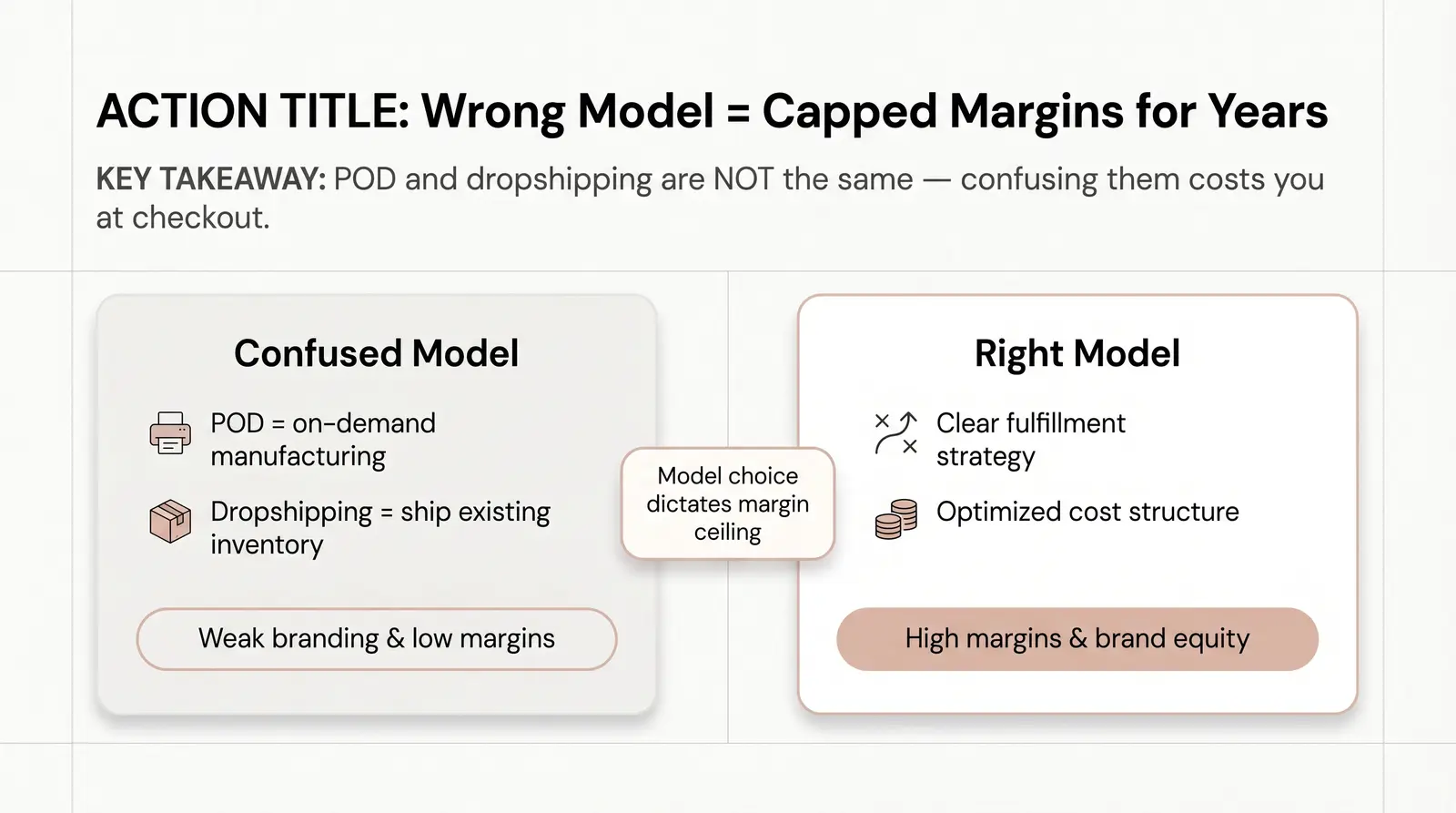
In our experience at Branvas, we see a lot of sellers conflate these two models — and the confusion tends to cost them at checkout.
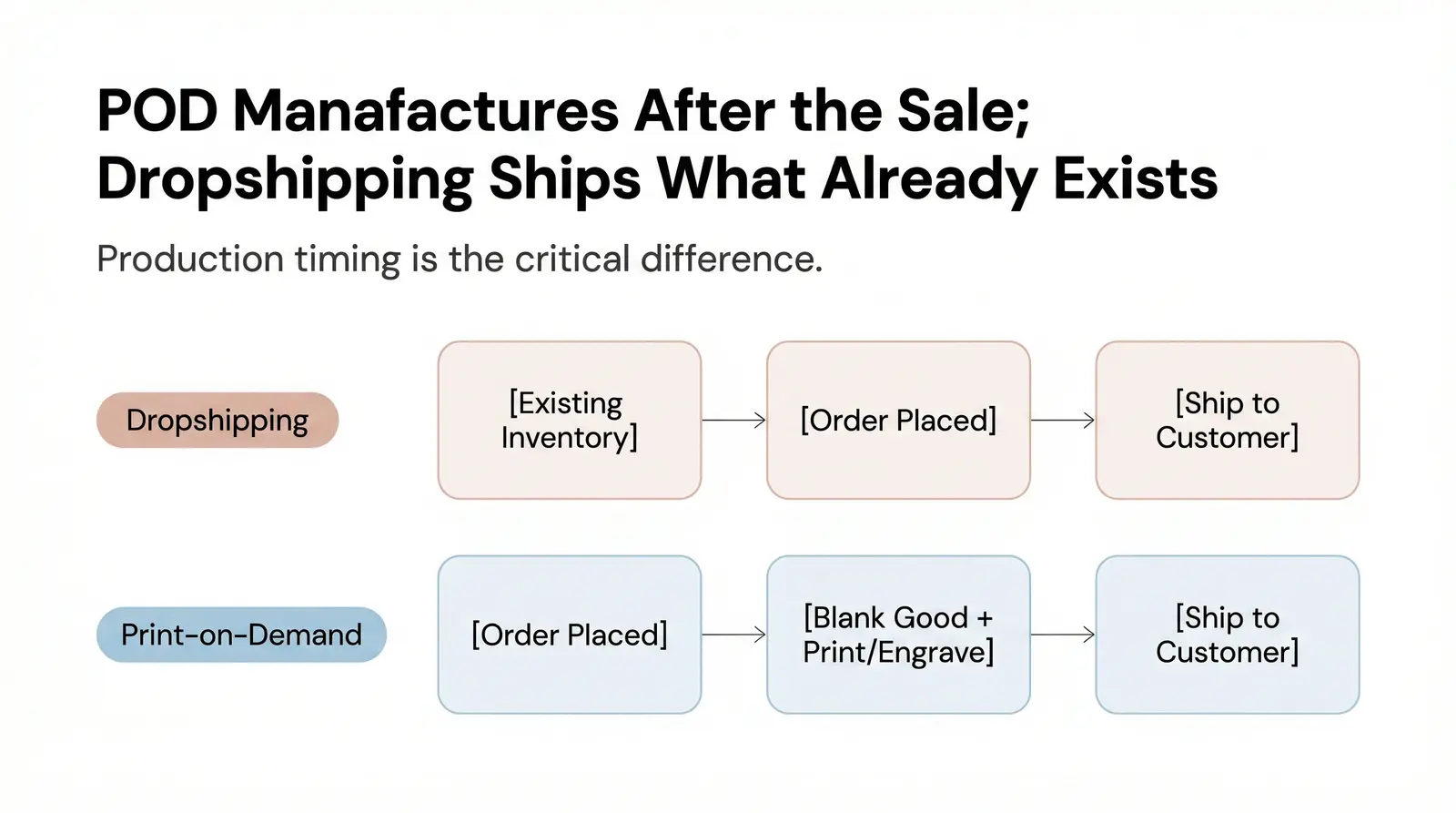
General dropshipping is a fulfillment method where a seller markets a product, a third-party supplier fulfills the order, and the seller never touches the inventory. The key characteristic of traditional dropshipping is that it ships from an existing inventory of ready-made products. You are essentially acting as a marketing layer for products that have already been manufactured.
Print-on-demand operates differently. POD is an on-demand manufacturing model triggered by an order. You start with blank goods (like t-shirts, mugs, or jewelry bases), apply a custom print or engraving, and the product is created at the time of order. Common platforms in this space include Printful, Printify, and ShineOn. The critical distinction is production timing: POD produces the product after the sale, while traditional dropshipping ships a product that already exists.
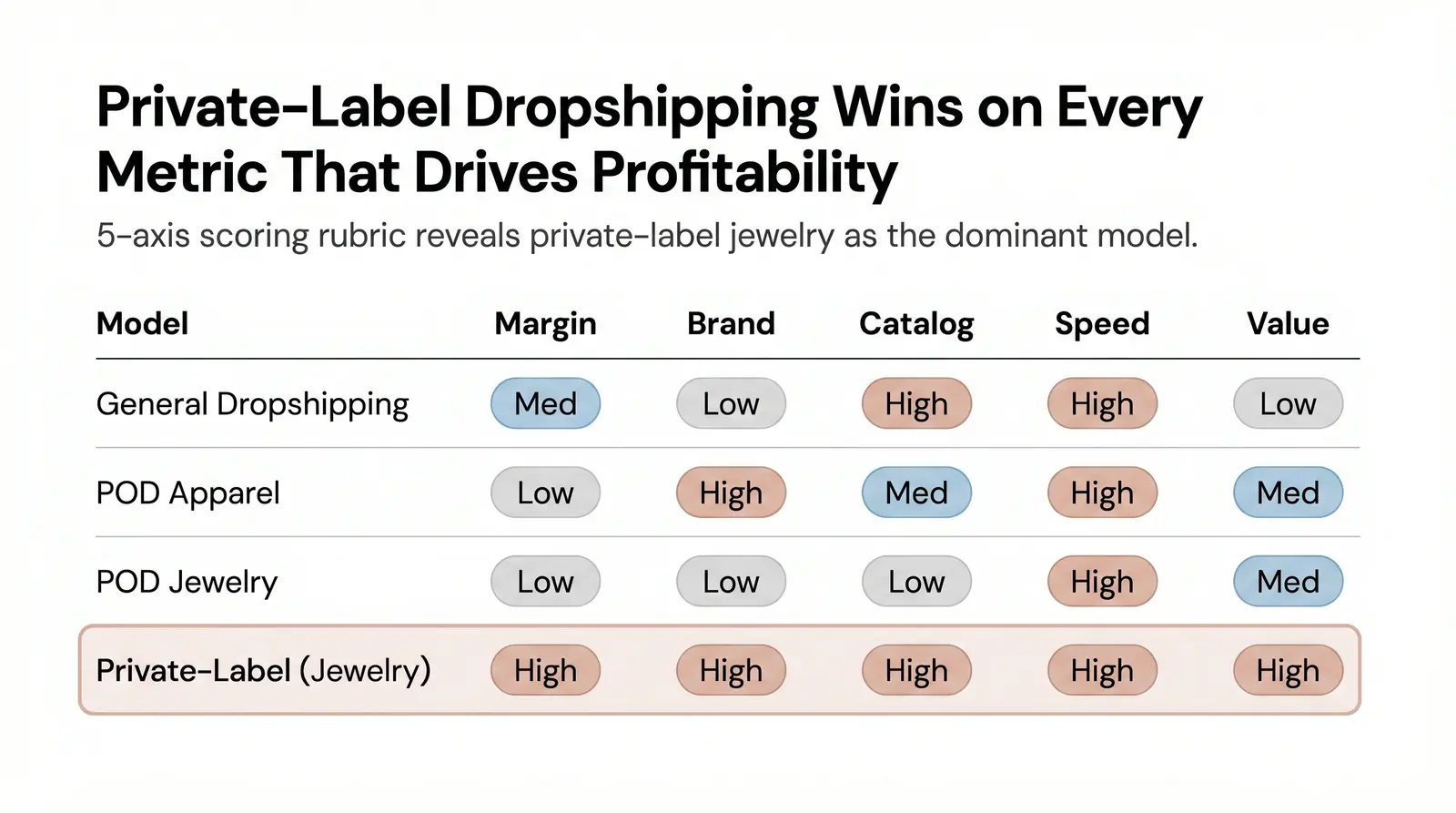
To help sellers evaluate these models objectively, we developed The Branvas Model Clarity Framework. This is a 5-axis scoring rubric that evaluates any fulfillment model across the metrics that actually drive profitability and brand equity.
Use this table to assess which model aligns with your business goals. If your priority is speed-to-market with zero upfront design work, your choice will look very different than if your goal is maximizing perceived value and margin floor.
| Fulfillment Model | Margin Floor | Brand Control | Catalog Depth | Speed-to-Market | Perceived Product Value |
|---|---|---|---|---|---|
| General Dropshipping | Medium | Low | High | High | Low |
| Print-on-Demand (Apparel) | Low | High | Medium | High | Medium |
| Print-on-Demand (Jewelry/Accessories) | Low | Low | Low | High | Medium |
| Private-Label Dropshipping (Jewelry) | High | High | High | High | High |
The financial reality of these models becomes clear when you look at the cost of goods sold (COGS) and realistic retail prices.
For POD apparel, margins are notoriously tight. A standard Printful t-shirt has a base cost of roughly $12 to $15. If you sell that shirt for $30 to $35, you are looking at a gross margin of around 50% to 55% [1]. However, this high per-unit cost floor leaves very little room for customer acquisition costs (CAC) or discounts.
ShineOn, a popular POD platform for jewelry, operates on a different structure. Their base costs for stainless steel pieces typically start around $11.77, with 18k gold-plated items starting at $17.77 [2]. While sellers can set their own retail prices (often suggested between $49.99 and $79.99), the fixed base cost limits profitability as you scale.
General dropshipping margins are highly variable by category and supplier, but a healthy dropshipping business typically targets a 65% to 70% gross margin [3].
Private-label jewelry dropshipping offers a significantly different economic profile. Because you are sourcing finished goods rather than paying for one-off manufacturing, the base costs are lower, and the perceived value is higher due to branded packaging.
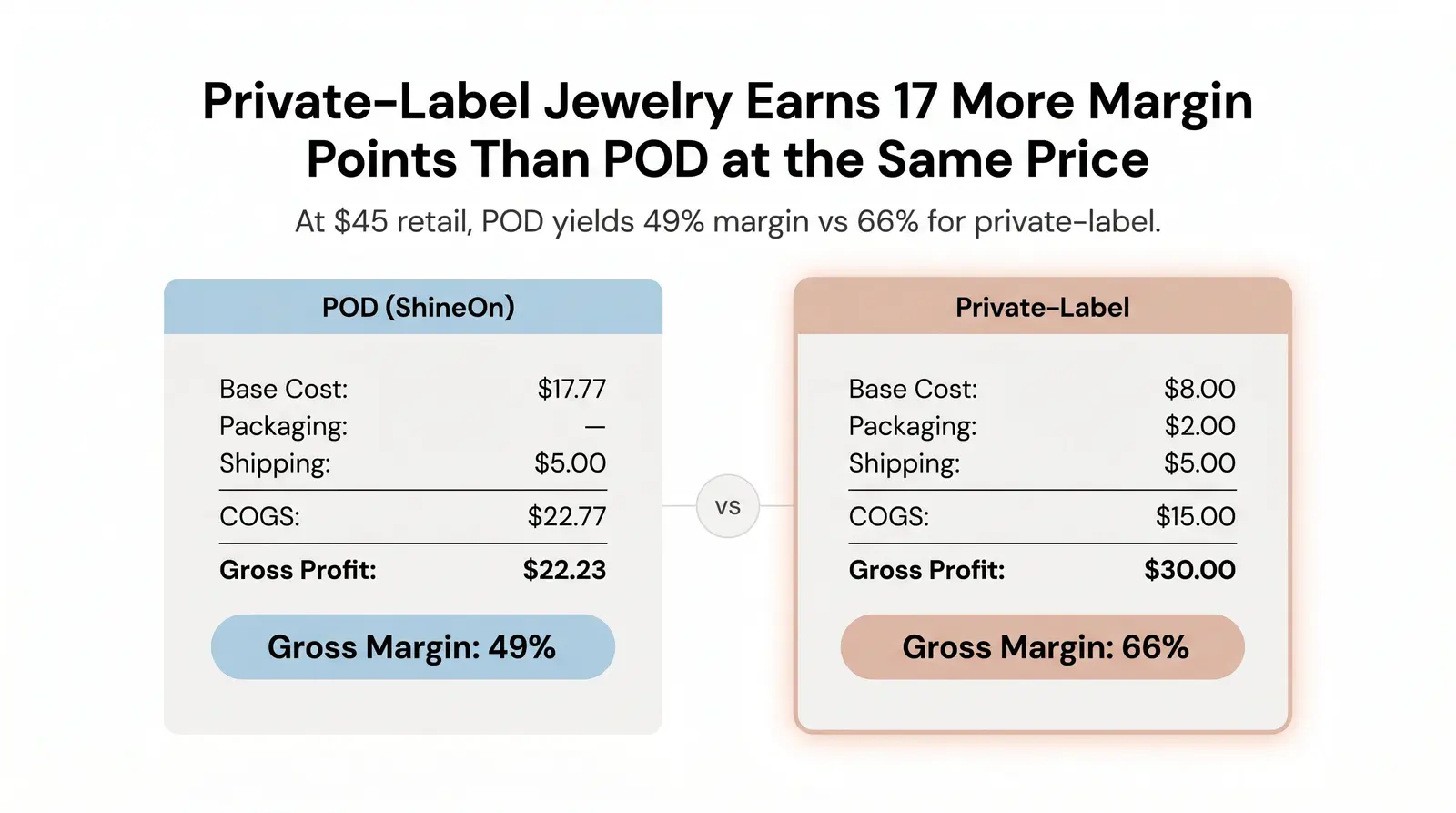
Let's look at a worked example for a gold-plated necklace sold at a $45 retail price point:
With a ShineOn-style POD model, your base cost might be $17.77. Add $5 for shipping, and your total COGS is $22.77. Your gross profit is $22.23, yielding a 49% gross margin.
With a Branvas-style private-label dropshipping model, the base cost for a similar gold-plated necklace might be $8.00. Add $2 for custom branded packaging and $5 for shipping, bringing your total COGS to $15.00. Your gross profit is $30.00, yielding a 66% gross margin.
The margin gap between POD jewelry and private-label jewelry dropshipping widens significantly as order volume scales, because POD pricing is largely fixed per unit while private-label models often have tiered pricing.
The biggest hidden cost of POD is the "white-label trap." Most POD products ship in generic packaging, meaning brand recall is exceptionally low. The customer remembers the platform they bought it on, not the brand that sold it.
There is an exception for POD apparel: the product is the brand. Because the custom print is the core value proposition, POD works exceptionally well for streetwear and graphic apparel.
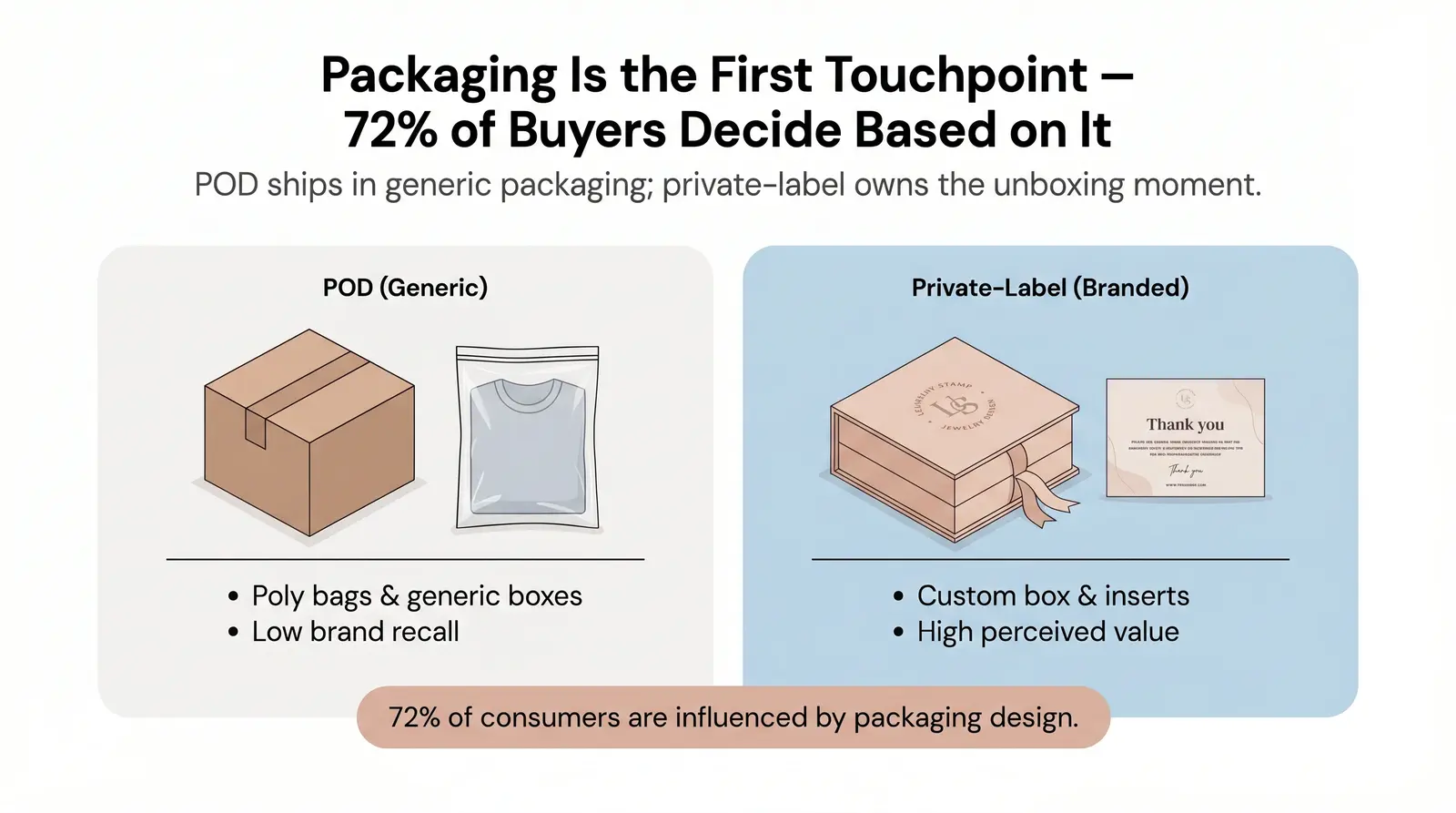
For jewelry, however, perceived value is heavily influenced by packaging, presentation, and the brand story. POD jewelry often arrives in poly bags or minimal, generic boxes. Private-label dropshipping, like the Branvas model, allows for custom boxes, branded inserts, and logo stamping.
Counterintuitively, adding branding to a lower-cost jewelry piece often increases perceived value more than upgrading the piece itself. Packaging is the first physical touchpoint — it shapes the entire unboxing experience and review sentiment. Consumer psychology research indicates that 72% of American consumers state their purchase decisions are influenced by a product's packaging design [4]. Premium packaging elevates the emotional significance of gifting and justifies higher price points.
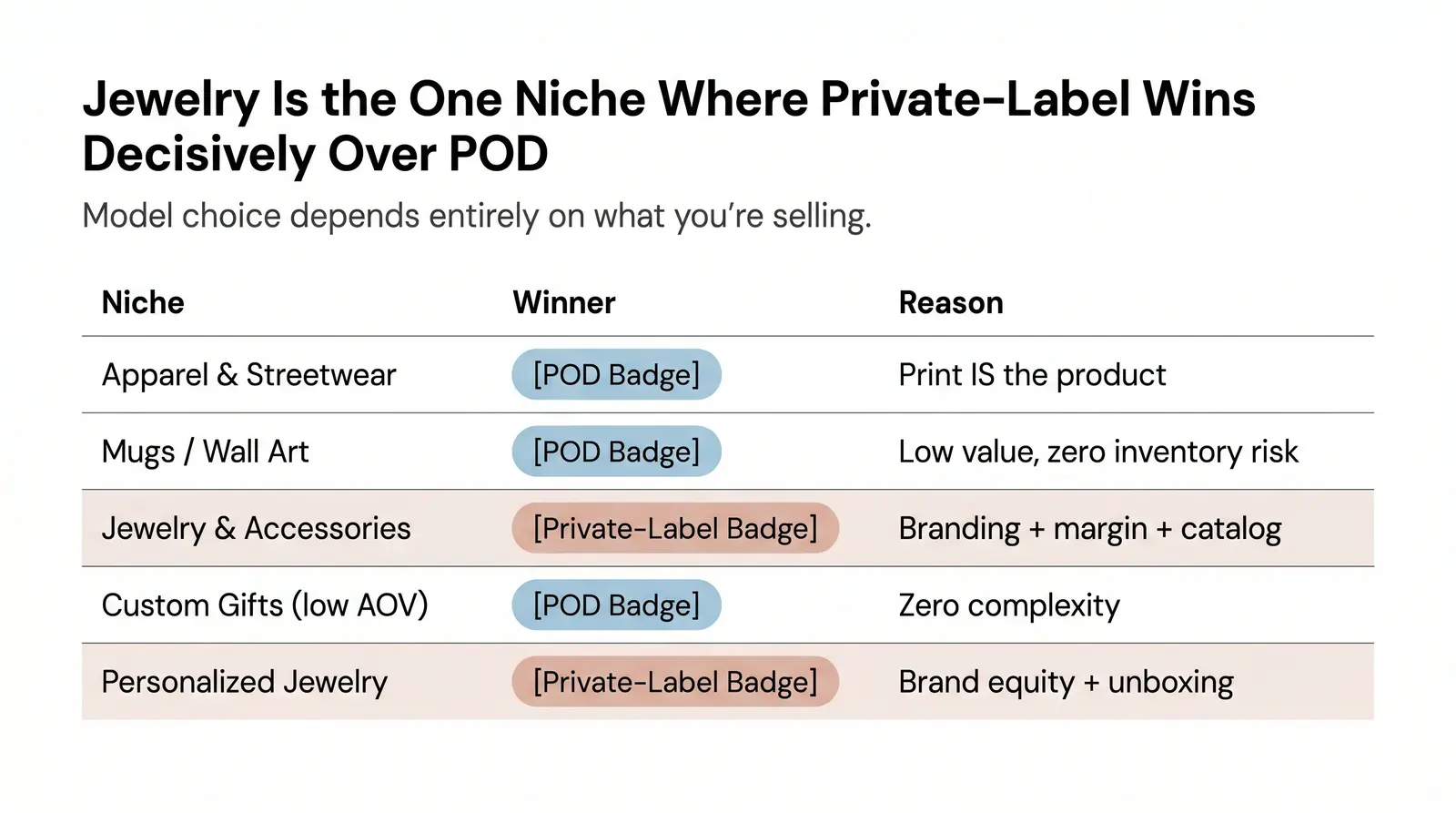
Choosing the right model depends entirely on what you are selling.
Apparel & Streetwear → POD Usually Wins
Custom prints are the product, making POD economics logical. ShineOn is not the right platform here, as they specialize in jewelry and accessories. Printful and Printify dominate this space. POD enables limited drops, culture-driven design, and zero inventory risk, which is perfect for streetwear brands.
Mugs, Posters, Wall Art, Home Goods → POD Usually Wins
These are generally low perceived-value items where margins are thin regardless of the fulfillment model. POD removes inventory risk entirely, making it ideal for content creators monetizing an audience with branded merchandise.
Jewelry & Accessories → Private-Label Dropshipping Wins Decisively
This is where the models diverge sharply. ShineOn POD jewelry has significant limitations: fixed base costs, limited catalog customization, generic fulfillment, and branding that is mostly digital (like engravings) rather than a physical brand experience.
Private-label jewelry dropshipping offers distinct advantages: full catalog breadth, real physical branding (custom packaging, inserts, logos), better margins at scale, higher perceived value, and the ability to build a real brand asset.
We built Branvas specifically because we kept seeing jewelry sellers hit a ceiling on ShineOn or Etsy POD — the model works until it doesn't, and the margin never compounds the way a real brand does.
If you're currently selling jewelry through a POD platform and feeling the margin squeeze, it might be worth exploring how a private-label model works — Branvas's How It Works page walks through the exact steps.
Custom Gifts & Personalization Niche → Nuanced
POD wins for low average order value (AOV) items like mugs, cards, and photo prints. For personalized jewelry, such as name necklaces or birthstone pieces, private-label wins if you want to build brand equity, while POD wins if you want zero operational complexity.
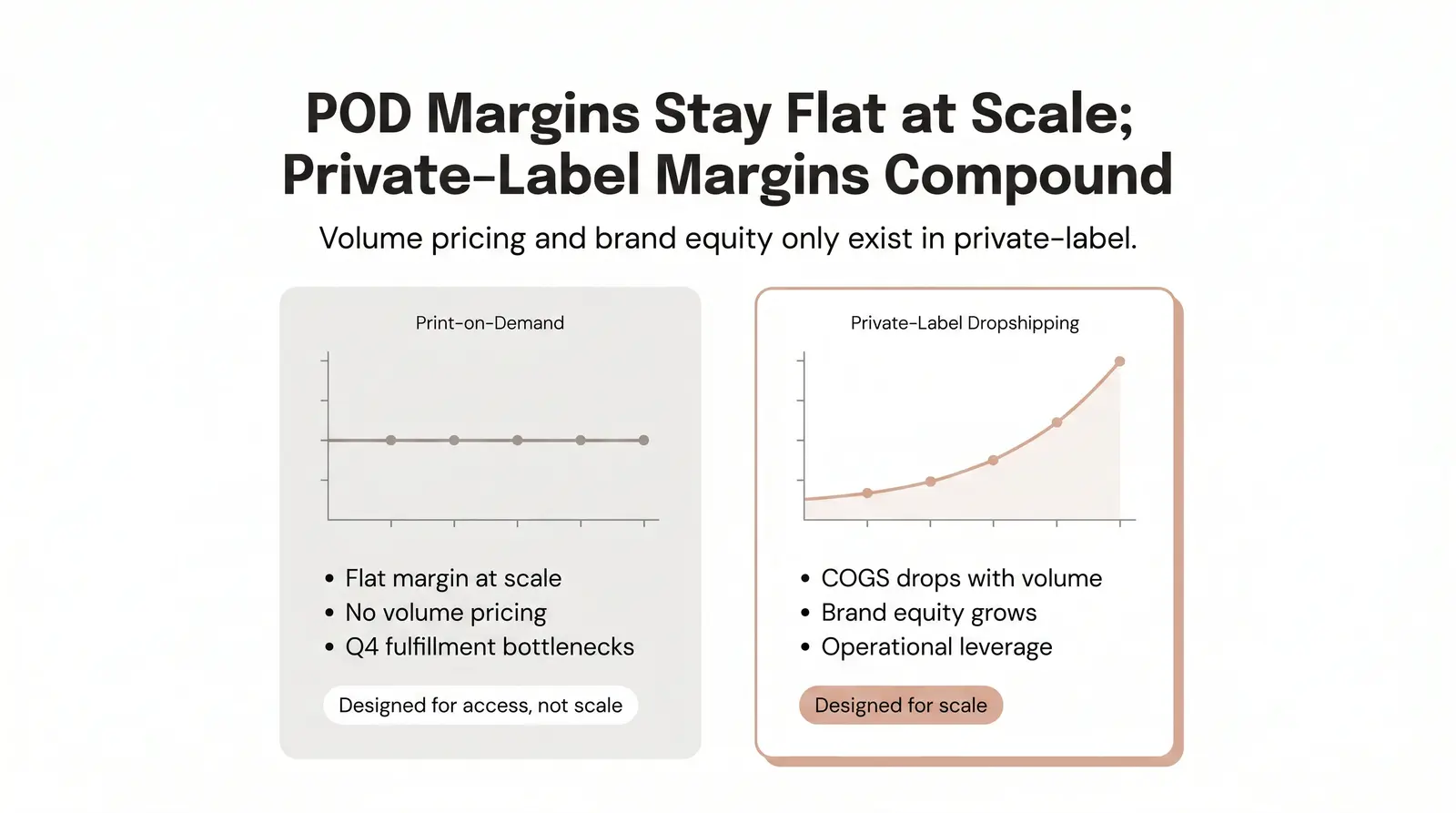
Scalability exposes the structural flaws in some fulfillment models. With POD, your margin stays roughly flat as you scale because there is rarely volume pricing on most platforms. Fulfillment speed is entirely dependent on the POD provider's capacity, which can bottleneck during Q4.
With private-label dropshipping, as your volume grows, your COGS typically decreases. You deepen fulfillment relationships, and your brand equity compounds. Both models keep you asset-light, but private-label gives you more operational levers to pull.
Scalability in ecommerce isn't just about fulfillment speed — it's about whether your margin structure improves as you grow. POD models are designed for access, not scale.
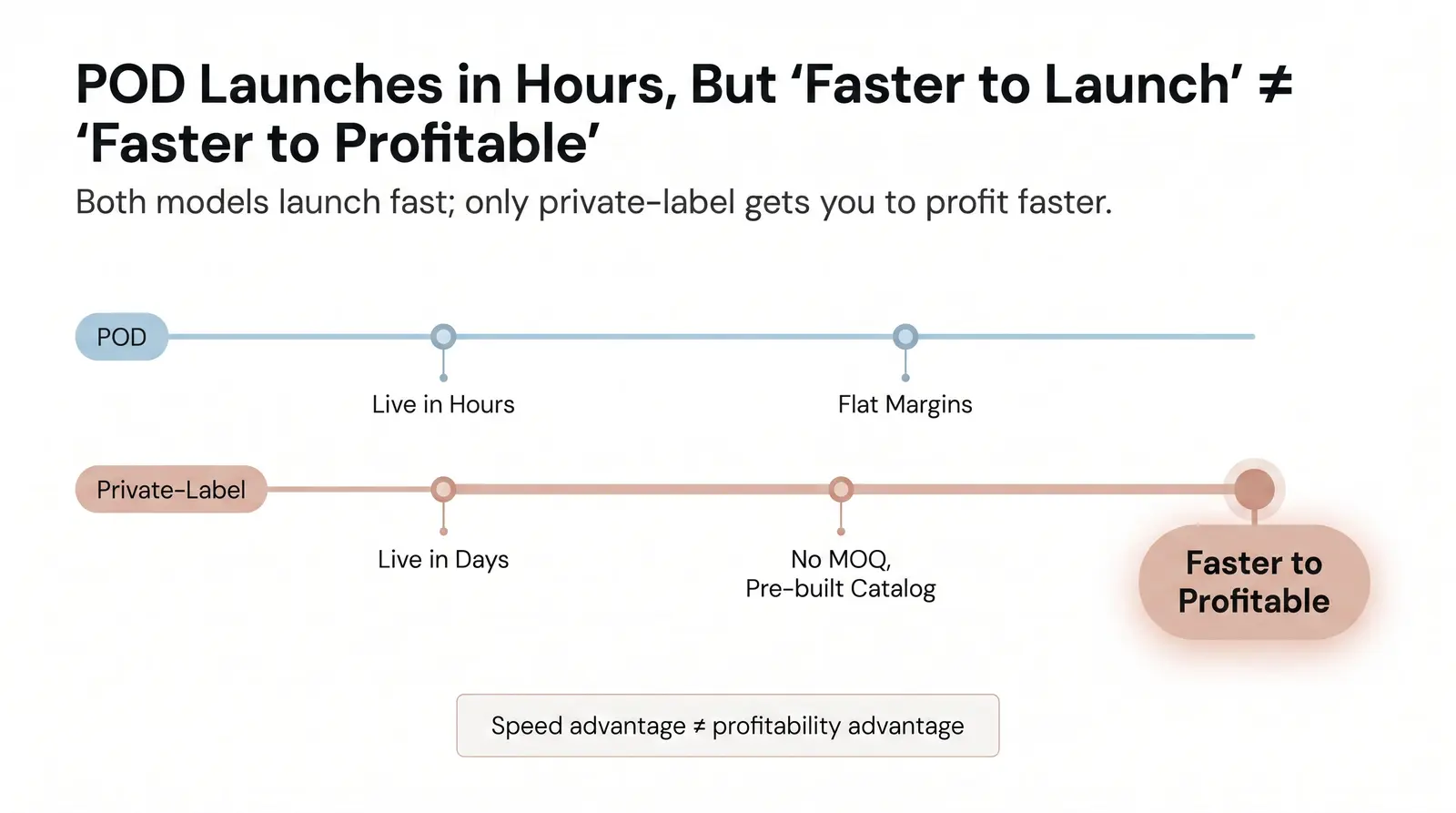
POD wins on raw launch speed. You can pick a platform, upload a design, connect a store, and be live in hours.
Private-label dropshipping with Branvas is also incredibly fast. There are no minimum order quantities (MOQs), you have access to a pre-built catalog, and brand setup is handled for you. This process typically takes days, not weeks.
The honest take is this: if you have zero budget, zero designs, and zero brand concept, POD is faster. But "faster to launch" does not equal "faster to profitable."
If you're ready to explore private-label jewelry without the usual complexity, see Branvas's full catalog and pricing — no minimums required.
1. Is print-on-demand the same as dropshipping?
No. While both models allow you to sell without holding inventory, print-on-demand involves manufacturing the product after the order is placed (applying a design to a blank item). Traditional dropshipping involves shipping an already manufactured product directly from a supplier to the customer.
2. Which model has better profit margins — dropshipping or print-on-demand?
Dropshipping generally offers better profit margins, especially as you scale. POD has a high fixed base cost per unit because you are paying for one-off manufacturing, which caps your gross margin. Private-label dropshipping allows for lower base costs and higher perceived value, leading to wider margins.
3. Is ShineOn a dropshipping or print-on-demand platform?
ShineOn is primarily a print-on-demand platform specializing in personalized jewelry and accessories. Sellers customize message cards or engravings, and ShineOn produces and ships the item when an order is placed.
4. Can I build a real brand with print-on-demand?
Yes, but it is much easier in apparel than in other categories. For t-shirts and streetwear, the custom print is the brand. For categories like jewelry, the lack of custom physical packaging in most POD models makes it difficult to build strong brand recall and perceived value.
5. What is the best model for selling jewelry online?
For most sellers, private-label dropshipping is the superior model for jewelry. It offers significantly better margins, full control over the unboxing experience (custom boxes and inserts), and a much wider catalog of trending styles compared to the limited base products offered by POD platforms.