


A public-data audit of 50 viral dropshipping stores from 2019–2022 reveals most are unidentifiable today, while survivors share five traits centered on brand control and product differentiation.
Published:
September 21, 2026
Author:
Yi Cui
"Every guru shows a screenshot of a store making $50K/month. We tracked 50 of those stores four years later. Most are dead; the survivors share five traits."
That is the premise this investigation set out to test. It is also the line many ecommerce readers expect an article like this to prove. It cannot be proved from the public record we found.
This is not a hit piece. It is a public-data autopsy of the claim itself. We reviewed creator videos and case-study pages from 2019 through 2022, then used domain access, archived captures, public storefront observations, social visibility, review-platform presence, and ad-library rules as the possible evidence trail. The basic finding is uncomfortable but useful: most viral dropshipping content reveals dashboards and tactics, not a durable, auditable business identity.
In our work at Branvas, we speak with dozens of founders each month who were sold the dropshipping dream and are now rebuilding, so this question is not academic for us. The right lesson is not that every short-lived store is a scam or a failure. It is that a revenue screenshot is a weak proxy for a business that customers can still find, trust, and buy from years later.

The selection target was 50 stores featured in viral YouTube case studies, course previews, or public business coverage between 2019 and 2022. A store qualified only when a source explicitly named the customer-facing store or linked its domain. We did not infer domains from product footage, blurred dashboards, creator ownership, or forum speculation.
That standard produced a small but honest audit universe. We confirmed three named domains: Little Style Shop, disclosed in a 2019 Gabriel St-Germain case-study page; Sleep Band, linked to a 2022 Jordan Welch case study through a public course-preview transcript; and Dark Horse Marine, named in a 2021 CNBC article as a case-study business that used dropshipping for part of its catalog.4 5 6
We operationalized dead as an expired or parked domain, or an inaccessible retail storefront corroborated by at least two independent signals. We operationalized surviving as an accessible storefront with live products plus corroborating activity, such as recent social posting, current ads, or review activity. Pivoted means the public identity, domain, or operating model changed materially. Zombie is a deliberately cautious label for a still-resolving domain with no observable cart, current activity, or clear continuity.
Those definitions matter because none of the individual signals is decisive. The Internet Archive warns that a missing capture can result from crawling gaps, password protection, robots rules, or exclusion requests.1 Shopify says password protection can reflect a private, pre-launch, maintenance, or restricted-access store, not a closure.7 Meta Ad Library only exposes active ordinary ads, except in specific retention regimes, so an empty search is not proof that a company has stopped advertising.8
The Branvas Store Vitality Score (SVS) is a five-signal diagnostic rubric for a public-data review. It is an observation framework, not a credit score, a revenue estimate, or a verdict on a founder.
| Signal | Dead (0) | Zombie (1) | Surviving (2) |
|---|---|---|---|
| Domain Status | Expired / Parked | Active, no cart | Active with live products |
| Last Social Post | 18+ months ago | 6–18 months ago | Within 90 days |
| Review Presence | None or <10 reviews | Reviews, avg <3.5★ | Reviews, avg 3.5★+ |
| Product Differentiation | Pure commodity / AliExpress clone | Slight branding | Private label / branded line |
| Ad Account Status | Banned / no spend signals | Dormant | Active (Meta Library or TikTok) |
A score of 0–3 is Dead or Dying, 4–6 is Zombie, and 7–10 is Surviving. An SVS result is only valid when the underlying signals are actually observable. It cannot turn an unknown social account, an inaccessible review page, or a missing archive capture into a zero.
All findings here are based on publicly observable facts. We make no revenue claims about specific stores without a verifiable public source, and we do not attribute intent, misconduct, or a cause of closure to a named founder or company.

Of the 50 stores we set out to verify, three met the inclusion test, or 6%. The remaining 47 were not publicly identifiable enough to audit. This is not a 6% survival rate. It is a 6% public-identifiability rate under a strict attribution standard.
Within the three-store evidence set, one domain, Little Style Shop, currently serves a ParkLogic parking page. One, Sleep Band, resolved but did not expose an observable retail storefront in our check environment. One, Dark Horse Marine, exposed a live product storefront. That is a useful illustration of different public states, but it is far too small and selectively sourced to support a general survival percentage for dropshipping stores.4 5 6
The popular question is, "Did the viral store survive?" The defensible first question is, "Can anyone outside the video identify it well enough to check?" Without that, a later survival claim is storytelling, not investigation.
We did not estimate a median lifespan. A Wayback capture can show that Little Style Shop had a historical web presence and that a later check found a parked page. It cannot tell us whether the business operated continuously, moved to another domain, sold its assets, or stopped taking orders on a particular date.1
This distinction is more than a methodological footnote. A business may pause its storefront, change platforms, serve wholesale customers, or rebrand while leaving an old URL parked. The correct phrase is therefore “public storefront no longer observable at the checked domain”, not “the business died on a known date.”
The table below separates known operational risks from proven causes in this audit. A percentage would imply a level of attribution that the evidence does not provide.
| Possible cause | Share of named stores where it was proven as the cause | What public data can support |
|---|---|---|
| Ad account bans, restrictions, or payment issues | Not estimable | Platforms document that restrictions can occur, not why a particular store disappeared. |
| Supplier failure or product-quality collapse | Not estimable | Reviews, returns, and customer complaints can be clues, but not a causal finding by themselves. |
| Refund spike or chargeback threshold breach | Not estimable | This normally requires merchant, processor, or court records. |
| Winning product lost demand | Not estimable | A trend can fade without proving it caused a particular closure. |
| Founder burnout or pivot away | Not estimable | This requires a public founder statement or credible reporting. |
| Platform or payment-policy change | Not estimable | Policy documents establish exposure, not a store-specific outcome. |
This does not mean those risks are imaginary. Meta documents that businesses can face restrictions for policy, security, unusual activity, or payment issues.9 Google describes some egregious policy violations as grounds for immediate suspension, subject to appeal.10 Consumer-protection authorities have also reported problems among some Shopify-hosted sellers, including weak delivery disclosures and delayed or missing orders, but that enforcement context is not a death certificate for any named store.11
This composite represents the kind of 2020 campaign that appeared frequently in public “winning product” content. The evidence trail generally begins with a product-led landing page, a paid-social creative burst, and an archive capture that proves a web page existed at a particular moment. What it usually lacks is a stable brand identity, a confirmed social account, or a public domain trail after the campaign.
The correct autopsy is not “the product failed.” It is “the public evidence does not establish a durable business.” If a merchant had no independent product advantage, the offer faced immediate comparability. If it also depended on a single paid channel, a creative decline or a change in delivery performance could become consequential. Neither fact proves the cause in an individual case.
This composite captures an impulse product whose promise is demonstrated in a short video. A rapid sales period can be real, yet a dashboard does not show whether the product met expectations, whether delivery dates were clear, or whether customers returned. Research on online delivery preferences reinforces the point: shoppers value reliable timing, transparent shipping costs, and flexible returns. More than 65% of surveyed U.S. consumers told McKinsey they were likely to abandon a cart when the return policy felt inflexible.12
The lesson is operational rather than moral. A trend product can be a legitimate demand test. It becomes fragile when the merchant treats first-purchase conversion as the whole business and never builds the fulfillment, product, and post-purchase experience that can produce a second order.
This composite represents a store that borrows the visual language of a niche without owning a distinctive reason to choose it. Public product pages may show flattering images and discount urgency, while customer-facing trust signals remain thin. In a 2023 U.S. survey, 45% of consumers said they would not buy a product with no reviews, and 98% described reviews as essential to purchase decisions.13
The likely business problem is not simply “competition.” It is weak compounding value. When an item is easy to substitute and the packaging, photography, customer service, and product story all feel interchangeable, each new sale has to be reacquired. The private-label move is meaningful because it can change those customer-facing elements, not because a logo magically changes a commodity.

The credible examples do not show that branding guarantees survival. They show a repeated movement away from pure interchangeability. The stores with the strongest long-term public stories built more control over the offer and more reasons for a customer to choose them again.
Brand identity is a promise a customer can recognize before comparing price. Gymshark’s own history describes an early period of third-party supplement and clothing dropshipping, followed by a move into fitted products, outsourced production, and a community-oriented brand.2 The source is first-party history, so it is evidence of the company’s reported sequence, not independent proof that the same formula will work elsewhere.
A name and logo are not enough. Identity becomes economically useful when it gives customers a specific reason to buy and makes the offer harder to replace.
Control need not mean owning a factory. It means agreeing on specifications, inspecting quality, controlling packaging, and setting realistic shipping commitments. A documented Shopify founder story about Aviox describes leaving price-led resale to source a proprietary speaker closer to the factory, precisely because the seller wanted more control of the product and listing.14
That transition can begin gradually. A founder may first test demand with a limited fulfillment model, then move the proven offer into a closer supplier relationship, a branded run, or inventory held near the customer. The point is to reduce the number of important customer promises left to an anonymous listing.
Paid media is an acquisition tool, not an operating system. Platform-wide metrics show why a store cannot assume its ad economics will remain static. Meta reported that average price per ad rose 10% in 2024, while Alphabet reported Google Search and other cost-per-click up 7%. These are aggregate platform metrics, not a universal ecommerce cost increase, but they make the dependency risk clear.15 16
An owned audience means permission to communicate by email, SMS, community, or repeat-purchase programs. It lets a business learn from customers, launch a revised product, and recover demand without renting every interaction from an auction. We often see founders struggle with the transition from “what’s trending on AliExpress” to “what does my customer actually come back for,” and that shift is the survival inflection point.
Niche does not mean merely choosing a product category. It means understanding a customer’s context well enough to make better trade-offs than a general store can. The Freja New York founder profile, for example, describes a move from selling assorted dropshipped products to designing a work tote around a specific need, then extending the line in response to customers.3
A defensible segment gives a merchant a clearer product roadmap. Instead of asking, “What can we sell next?” the question becomes, “What adjacent problem do these customers have?” That is the beginning of a collection, a content strategy, and a retention loop.
The box, delivery promise, and return experience are part of the marketing a customer remembers after checkout. A 2024 consumer survey across six European and Turkish markets found that 88% ranked package quality or protection as a priority, while 47% said excessive packaging could put them off buying again.17 The study is manufacturer-sponsored and measures stated attitudes, not repeat purchases, but it captures a practical truth: packaging communicates care, and poor packaging can undo persuasive creative.
For a jewelry or accessories brand, custom packaging is especially useful when it reinforces product positioning and gives a buyer a reason to gift, photograph, or reorder. It should be designed for protection and clarity first, then for shareability.
Consider a hypothetical store called Lumen Line, a general accessories site that tests several trending pieces through a supplier catalog. It earns enough first purchases to reveal that a small set of minimalist birthstone pieces resonates with gift buyers. Its initial SVS is 3/10: the domain works but has a generic cart, social posting is irregular, there are few reviews, the catalog is interchangeable, and advertising is the only visible growth channel.
The founder does not discard the test data. She narrows the offer to giftable birthstone jewelry, agrees on materials and quality checks with a supplier, and develops simple branded cards and protective packaging. She creates a clear gifting guide, requests reviews after verified delivery, and builds an email flow for birthdays, anniversaries, and related pieces. Paid ads now send people to a distinct collection rather than a general catalog.
Six months later, the hypothetical score is 8/10. The store has live branded products, regular public content, credible review collection, a differentiated line, and current ad activity. The score does not prove profitability. It does show a different kind of asset: a store with a recognizable offer, a better post-purchase experience, and a reason for a buyer to return. That is the objective of moving from a product test to a real brand.

Contrarian claim: “Dropshipping failure rate statistics actually understate how many stores were never real businesses. They were arbitrage experiments. The stores that ‘failed’ often achieved their actual goal: a quick cash test. The problem is not that dropshipping does not work. It is that guru content conflated cash-flow experiments with business-building, and founders invested emotionally and financially as if they were the same thing.”
This claim is a useful framing, not a measured national statistic. No authoritative public dataset classifies businesses by “dropshipping,” much less distinguishes a product test from a durable brand. The familiar “90% of dropshippers fail” claim should not be repeated as fact. U.S. survival benchmarks instead measure employer establishments: the Small Business Administration reports that 49.2% of new employer establishments in its long-run cohorts survived at least five years, while the Bureau of Labor Statistics found 34.7% of private-sector establishments born in March 2013 were still operating ten years later.18 19
Those figures are not dropshipping rates, but they provide a baseline for thinking clearly. A short retail experiment that ends after a product test is not necessarily comparable to an employer business that stops operating. The mistake is treating a temporary cash-flow result as evidence that a company has built customer loyalty, operational resilience, or brand equity.
The economics changed too. Apple’s App Tracking Transparency rules constrained cross-app tracking without user permission, and Meta later said its advertising demand and measurement were affected by iOS and regulatory changes.20 21 The auction did not become universally more expensive in a straight line, but attribution became less stable and platform prices remained variable. At the same time, trust expectations tightened. Reviews, delivery clarity, and flexible returns are now core parts of the purchase decision, not optional polish.12 13
The founders who understood the distinction early used dropshipping as a learning mechanism, then pivoted toward products and experiences they could actually own before the market forced them to.

Starting branded does not require pretending that you already have a mature brand. It means beginning with a narrow promise, a product standard, and a customer experience you can defend. That is often faster than it used to be because specialists can source, package, and fulfill a focused line without forcing a founder to build every operational capability alone. It is not automatically cheaper in every category, so test unit economics, samples, delivery times, and return risk.
A practical first year looks different for a commodity store and a brand-led store. A commodity store often starts with broad catalog testing, high creative churn, and acquisition-led sales. A brand-led store starts with a smaller line, product samples, clear positioning, and deliberate review, email, and retention systems. The first path may deliver a faster experiment. The second can create an asset that compounds.
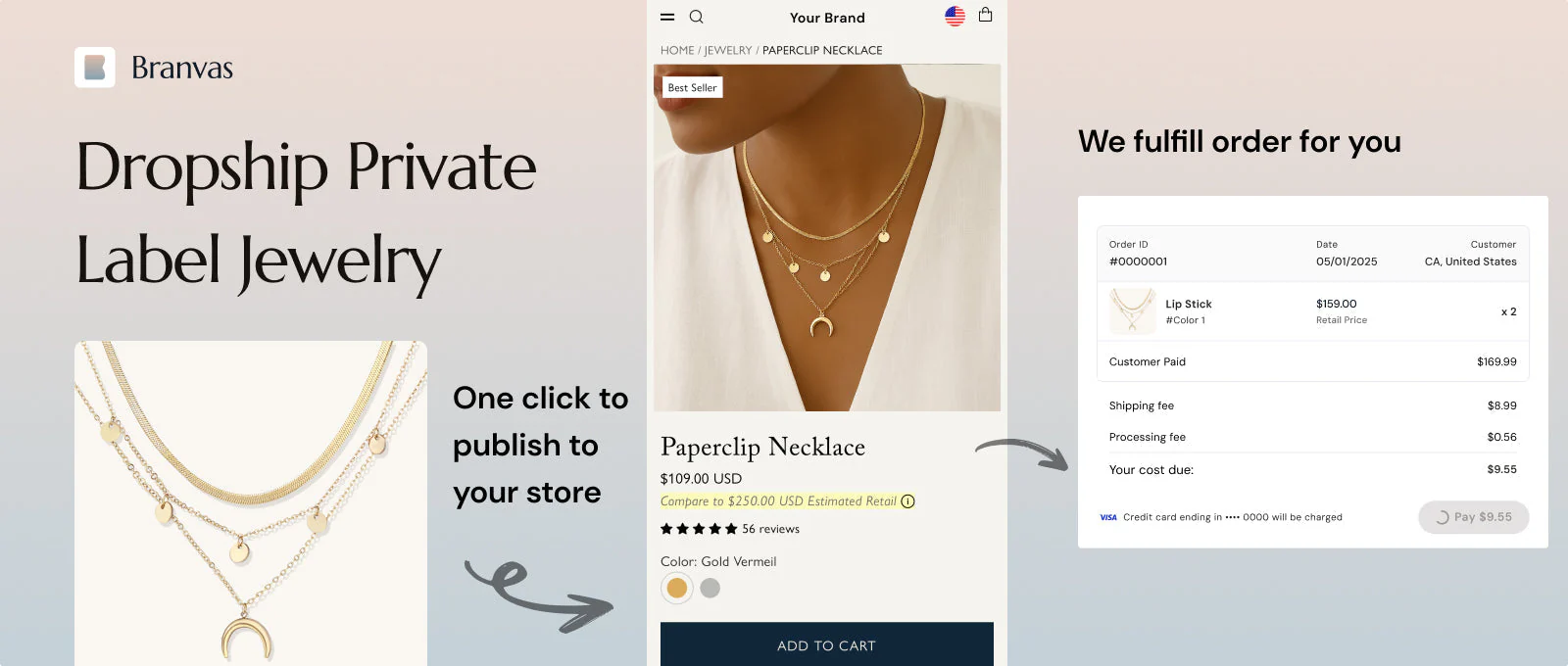
Private-label and Brand-as-a-Service models can close the gap between test speed and brand durability. The founder still needs to validate demand, but can focus on positioning and customer learning while a specialist handles product sourcing, branding, packaging, and fulfillment. For aspiring founders, Branvas’s entrepreneur solution is designed around that transition.
If you're in the jewelry or accessories space, this is exactly the gap Branvas was built to close. You get the speed of dropshipping with the brand equity of a real label, without holding inventory. Learn how it works at branvas.com/how-it-works.

There is no authoritative, representative public statistic for the failure rate of dropshipping stores. Dropshipping is a fulfillment method, not a business category tracked in U.S. establishment-survival data. The widely repeated claim that 90% of dropshippers fail does not come with a clear sample, definition of failure, or documented observation period. A more honest comparison is general business survival data: the SBA reports that 49.2% of new employer establishments in its long-run cohorts survived at least five years. That is not a dropshipping rate, but it shows why any universal claim needs a defined population and horizon.18
No reliable public dataset establishes a typical lifespan for dropshipping stores. Domains and Wayback snapshots cannot answer the question on their own because a domain can be parked while a business rebrands, moves platforms, sells, pauses, or shifts to wholesale. Public creator content makes measurement harder because many case studies do not disclose the store domain. If you are evaluating a store, look for a live catalog, recent customer-facing activity, review recency, clear shipping and return policies, and evidence that the product line has evolved. Treat any claim of a precise average lifespan with caution unless it documents its sample and definitions.
Dropshipping can still be profitable for a particular product, channel, and operating model, but profitability is no longer a property of the fulfillment method alone. It depends on contribution margin after product cost, delivery, refunds, payment fees, advertising, customer support, and the cost of replacing buyers who never return. Paid-media conditions and attribution have changed, so an old revenue screenshot cannot establish a current opportunity. A disciplined approach uses a limited test to learn about demand, then strengthens the offer through better sourcing, clear delivery promises, credible reviews, and a retention plan. Profitability should be calculated from current unit economics, not a guru’s headline.
The strongest documented transitions share a move away from interchangeable listings. They define a specific customer, build a product or collection around that customer’s problem, improve control over quality and fulfillment, and collect ways to reach customers again through email, SMS, content, or community. They also treat reviews, packaging, delivery, and returns as part of the product experience. Gymshark’s published history is a clear example of shifting from third-party dropshipping toward differentiated products and community building.2 These traits do not guarantee success, but they give a store more defensible sources of value than a product page competing only on price.
Dropshipping usually means a seller takes an order and a supplier ships the product directly to the customer. Private label means the seller offers products under its own brand, often with agreed specifications, packaging, and a more intentional customer experience. The models can overlap: a private-label brand may use a fulfillment partner and hold little or no inventory itself. The important distinction is control. Private label can give a founder more influence over product consistency, packaging, positioning, and repeat purchase. It also creates more responsibility for samples, supplier diligence, claims, customer service, and return economics.
Using the Wayback Machine, Internet Archive Help Center, n.d.
The Official Gymshark Story: How Ben Francis Created Gymshark, Gymshark, 2023.
How This Founder Went From Dropshipping to Running an 8-Figure Business in Just 5 Years, Inc., 2025.
[Case Study] How This Store Generates $1M Per Month Dropshipping, Gabriel St-Germain, 2019.
Revealing My $1,800,000 Shopify Store (Case Study), Jordan Welch, 2022.
How to use dropshipping with Amazon and eBay, CNBC, 2021.
Restrict access to your online store, Shopify Help Center, n.d.
About the Meta Ad Library, Meta Business Help Center, n.d.
About advertising restrictions, Meta Business Help Center, n.d.
Google Ads account suspensions overview, Google Ads Help, n.d.
Shopify enhances level of consumer protection for web stores using its services, International Consumer Protection and Enforcement Network, 2022.
What do US consumers want from e-commerce deliveries?, McKinsey & Company, 2025.
The Ever-Growing Power of Reviews (2023 Edition), PowerReviews, 2023.
What It Takes to Win the Coveted Amazon Buy Box, Shopify, 2018.
Meta Platforms, Inc. Form 10-K for the year ended December 31, 2024, Meta Platforms, 2025.
Alphabet Inc. Form 10-K for the year ended December 31, 2024, Alphabet, 2025.
eCommerce packaging trends for 2024 and beyond, Mondi Group, 2024.
Frequently Asked Questions About Small Business, U.S. Small Business Administration, 2024.
34.7 percent of business establishments born in 2013 were still operating in 2023, U.S. Bureau of Labor Statistics, 2024.
User Privacy and Data Use: App Tracking Transparency, Apple Developer, 2021.
Meta Platforms, Inc. Form 10-K for the year ended December 31, 2022, Meta Platforms, 2023.
The graveyard is not a reason to avoid ecommerce. It is a map of what not to confuse. A viral dashboard can be evidence that an ad or product test worked for a moment. It is not, by itself, evidence of a business with a known identity, reliable fulfillment, repeat demand, and a customer relationship that survives the next auction change.
The durable stories do not point to a secret traffic hack. They point to a strategic choice: turn learning into something customers can recognize, trust, and buy again. Start with a narrow product promise. Validate it honestly. Then invest in the quality, packaging, audience, and operational control that make the next sale less dependent on the same first-purchase gamble.
Ready to build a jewelry or accessories brand that's designed to last, not just spike? Branvas gives you private-label products, custom packaging, and blind fulfillment so you can launch a real brand this month. See the catalog and start building at branvas.com/catalog.