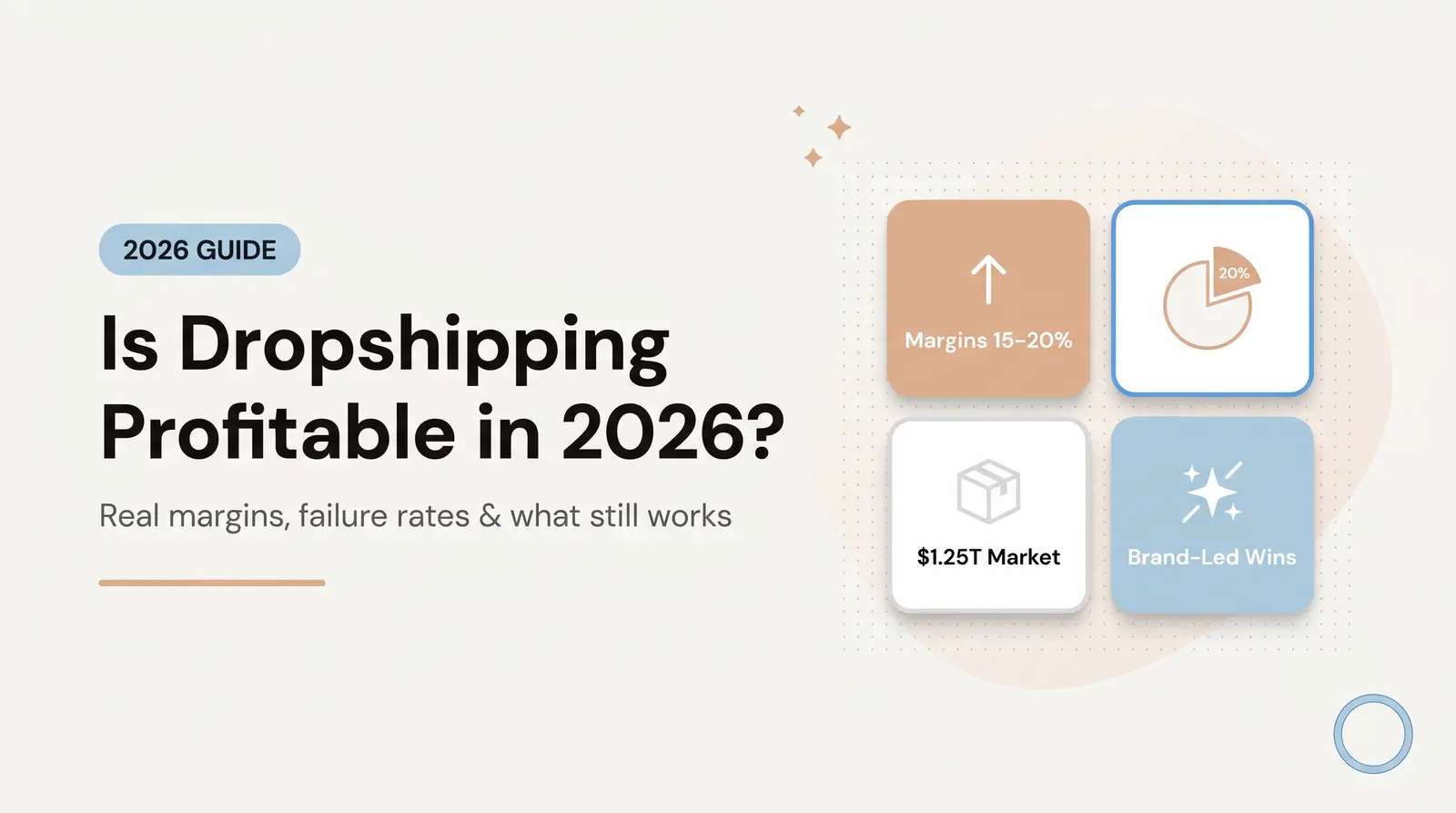



Use this free dropshipping margin calculator to uncover your true net profit per order, break-even ROAS, and hidden costs before scaling ad spend.
Published:
October 6, 2026
Author:
Yi Cui
Use this free margin calculator from Branvas to finally see the real numbers behind your ecommerce store. If you are running paid traffic to a dropshipping product without knowing your exact break-even point, you are flying blind.
Most dropshipping "profit margin" content focuses entirely on the spread between your product cost and your selling price. It is easy to look at a $10 necklace selling for $49 and assume you have an incredible 80% margin. However, the single biggest hidden margin killer is not your ad spend—it is platform payment processing compounding on top of transaction fees. If you are using a third-party payment gateway on a basic Shopify plan, you could be losing nearly 5% of your gross revenue before you even pay for the product or the ad click [1].
In our experience at Branvas, the founders who struggle most aren't spending too much on ads—they've never actually calculated their true margin per order before going live. They scale their ad spend based on a false sense of profitability, only to realize at the end of the month that their net margin is hovering near zero. To build a sustainable brand, you need a calculation framework that accounts for every single cost.

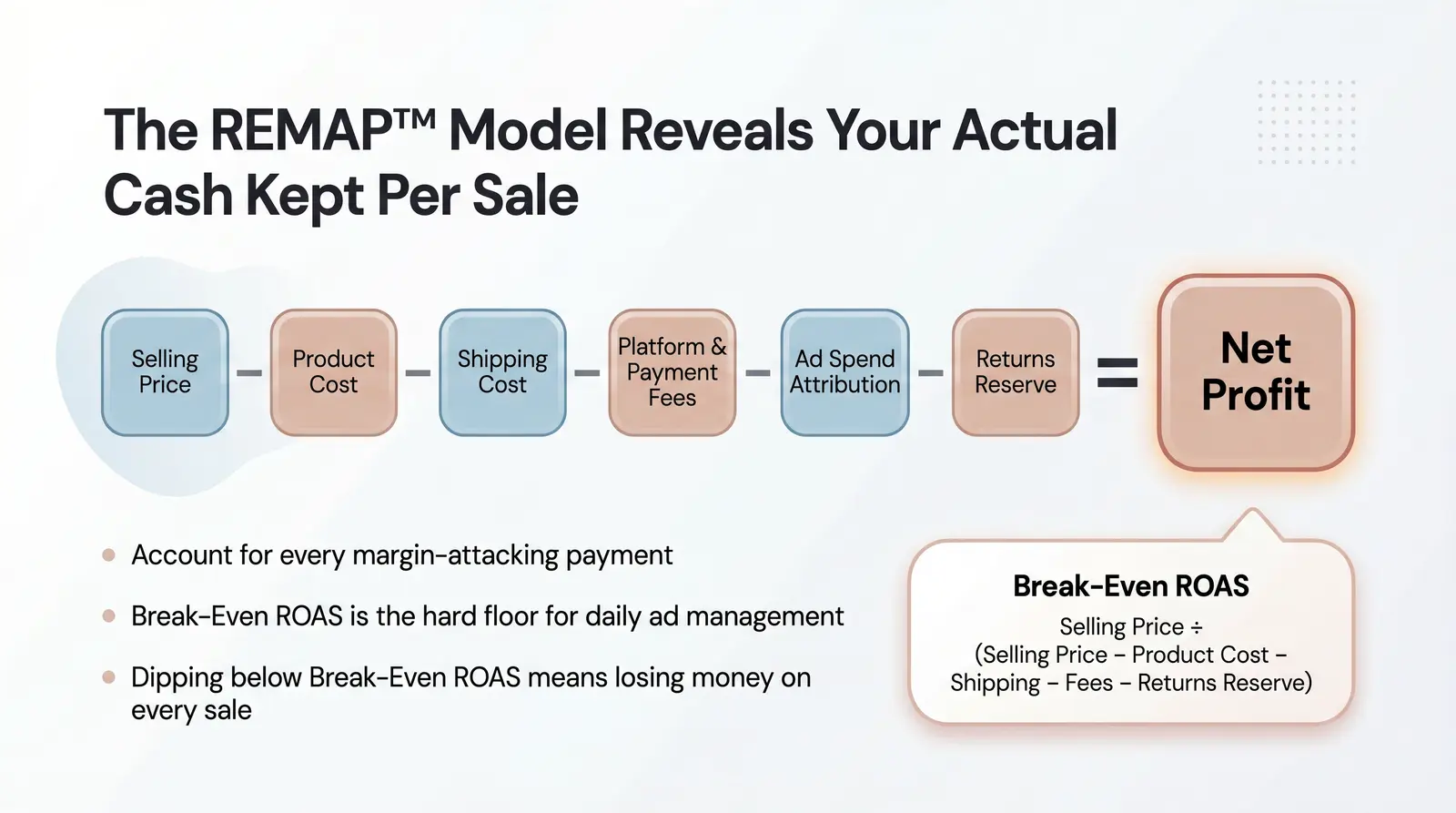
To get an accurate picture of your profitability, we use a proprietary framework called The REMAP™ Margin Model (Revenue minus Every Margin-Attacking Payment). This model is structured to strip away the illusion of gross markup and reveal the actual cash you keep from every sale.
The REMAP™ formula:
Net Profit = Selling Price − Product Cost − Shipping Cost − Platform & Payment Fees − Ad Spend Attribution − Returns Reserve
Here is a breakdown of each variable in the formula:
Margin % formula:
Gross Margin % = (Net Profit ÷ Selling Price) × 100
Break-Even ROAS formula:
Break-Even ROAS = Selling Price ÷ (Selling Price − Product Cost − Shipping − Fees − Returns Reserve)
Break-Even Return on Ad Spend (ROAS) is far more actionable than margin percentage alone for paid traffic dropshippers. Your margin percentage tells you how much you keep after the fact, but your Break-Even ROAS gives you a hard floor for your daily ad management. If your Meta or TikTok ads dip below this ROAS number, you are actively losing money on every sale [2].
You can use this step-by-step fill-in calculator walkthrough manually or plug the variables into your own spreadsheet. By inputting your specific costs, you will instantly see whether your product is viable for paid acquisition.
Input Table:
| Input Variable | Your Number | Example |
|---|---|---|
| Selling Price | $ ___ | $49.00 |
| Product Cost (COGS) | $ ___ | $8.50 |
| Shipping Cost | $ ___ | $4.20 |
| Platform Fee % | ___ % | 2.9% + $0.30 |
| Monthly Ad Spend | $ ___ | $1,200 |
| Monthly Orders | ___ | 80 |
| Returns Reserve % | ___ % | 3% |
Output Table:
| Output Metric | Formula | Example Result |
|---|---|---|
| Ad Spend Per Order | Ad Spend ÷ Orders | $15.00 |
| Platform Fee ($$) | (Selling Price × fee%) + fixed | $1.72 |
| Returns Reserve ($$) | Selling Price × reserve% | $1.47 |
| Net Profit Per Order | See REMAP™ formula | $18.11 |
| Gross Margin % | Net Profit ÷ Selling Price | 36.96% |
| Break-Even ROAS | Formula above | 2.70× |
Want this as a ready-to-use Google Sheet? Download the Branvas Dropshipping Margin Calculator →

Let us walk through a full worked example using a realistic private-label jewelry product scenario. Imagine you are selling a minimalist necklace via a Shopify store and driving traffic primarily through Meta ads.
If you only look at the "naive" margin—subtracting your $8.50 product cost from your $49.00 selling price—your margin looks incredible at 82%. This is the trap that catches most beginners.
However, when we apply the true REMAP™ margin after all costs, the picture changes. You must deduct the $4.20 shipping cost, the $1.72 in Shopify payment fees, the $1.47 returns reserve, and the $15.00 it costs to acquire that customer via Facebook ads. Your actual net profit per order is $18.11, leaving you with a true REMAP™ margin of 36.96%.
This product is absolutely viable, but only above a 2.70× ROAS floor. If your ad performance drops and your ROAS falls from 3× to 2×, your customer acquisition cost spikes to $24.50. Suddenly, your net profit shrinks to just $8.61 per order, compressing your margin to 17.5%.
We often see sellers excited about an 80% markup discover they're actually running at 20% net — or less — once platform fees and ad attribution are factored in.

Your choice of supplier dramatically impacts your final dropshipping profit margin. A lower upfront product cost does not automatically translate to a higher net margin if it comes with slow shipping and high return rates.
| Supplier Type | Product Cost | Shipping | Lead Time | Est. Return Rate | Net Margin (REMAP™) |
|---|---|---|---|---|---|
| AliExpress (standard) | $6.00 | $5.50 | 15–30 days | 6–8% | ~28% |
| CJ Dropshipping | $7.50 | $3.80 | 7–15 days | 4–5% | ~31% |
| Spocket (US supplier) | $12.00 | $2.50 | 3–7 days | 2–3% | ~27% |
| Branvas (private-label) | $8.50 | $4.20 | 5–10 days | 1–2% | ~37% |
While AliExpress offers the lowest raw product cost, the 15 to 30-day shipping times inevitably lead to higher customer frustration, disputes, and a return rate that can easily hit 8%. This erodes your margin significantly on the back end. Conversely, US-based suppliers via Spocket offer fast shipping, but the high wholesale cost leaves very little room for ad spend [3].
Branvas provides the optimal balance. The lower return rate—driven by strict quality control and premium branded packaging—compounds positively on your margin over volume. You pay a fair price for the product, but you keep more of the revenue because you are not refunding angry customers.
See how Branvas pricing works for your niche → branvas.com/pricing

Understanding what constitutes a good dropshipping profit margin requires looking at industry benchmarks. According to recent data, the average net profit margin for a successful dropshipping store falls between 15% and 25% [4].
| Margin Tier | Net Margin % | What It Means |
|---|---|---|
| Danger Zone | < 10% | One bad ad day wipes profit |
| Break-Even | 10–18% | Surviving, not scaling |
| Healthy | 20–35% | Sustainable with optimization |
| Strong | 35–50% | Scalable with room for testing |
| Exceptional | > 50% | Private-label / brand moat |
It is crucial to understand the contrarian insight of volume versus margin: a 20% margin at high volume beats a 50% margin at low volume. If you sell 1,000 units a month at a 20% margin on a $50 product, your net profit is $10,000. If you sell 100 units a month at a 50% margin on the same product, your net profit is only $2,500. Do not paralyze your growth by chasing an unrealistic margin percentage if it chokes your conversion rate.

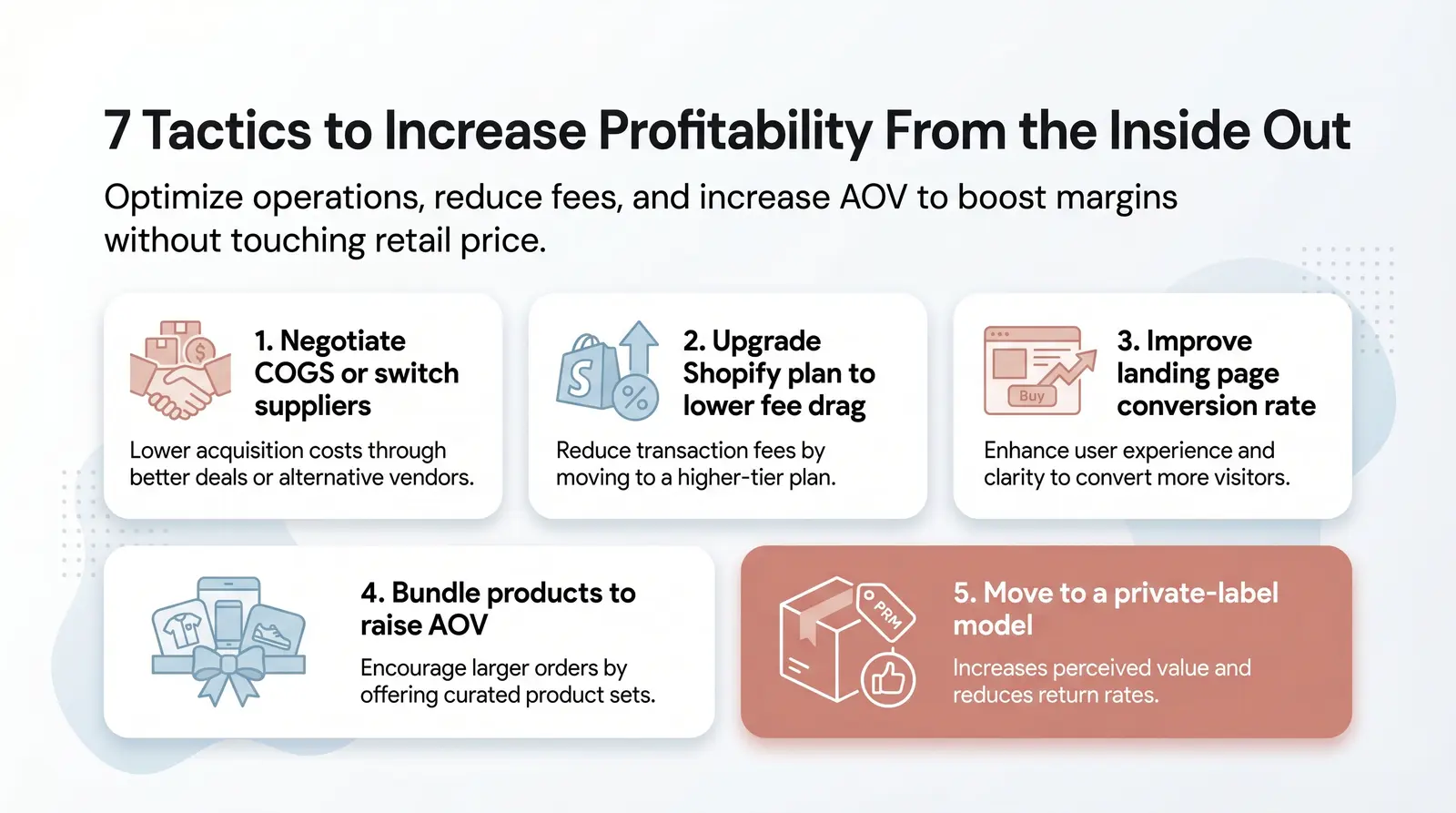
You do not always have to raise your retail prices to improve your dropshipping profit margin. Here are seven actionable tactics to increase your profitability from the inside out.
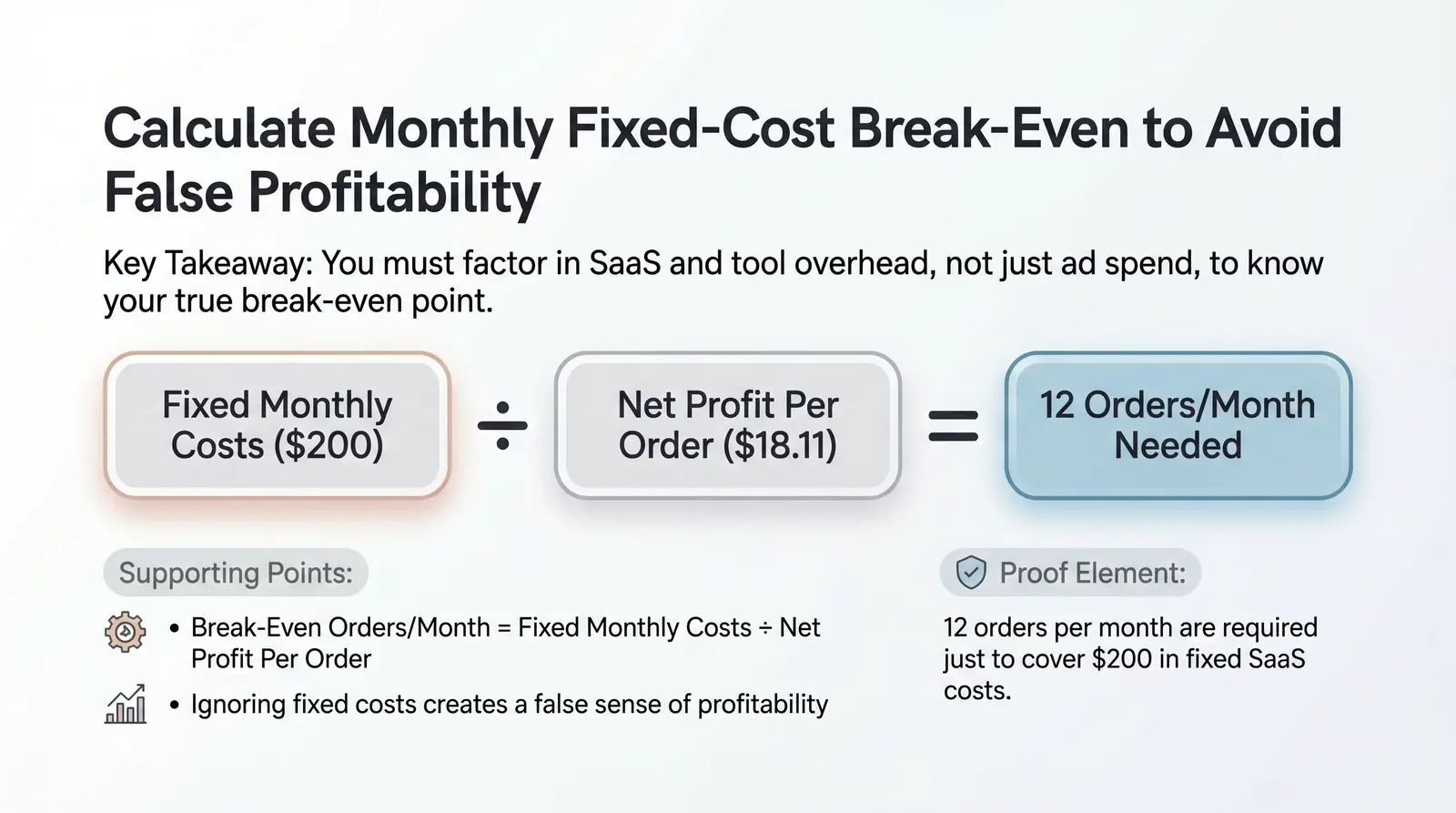
A proper dropshipping break-even analysis must be calculated in two dimensions. The first is your per-order break-even, which dictates your ROAS floor for advertising. The second is your monthly fixed-cost break-even, which tells you exactly how many orders you need to process just to keep the lights on.
Break-Even Orders/Month = Fixed Monthly Costs ÷ Net Profit Per Order
For example, if you spend $200 per month on your Shopify subscription and essential apps, and your net profit per order is $18.11, you must divide $200 by $18.11. This means you need a minimum of 12 orders per month just to cover your fixed costs before your variable ad spend generates any real wealth.
Most dropshippers calculate break-even on ad spend alone and completely ignore their fixed SaaS and tool overhead. This creates a false sense of profitability in the early months of a business. You must factor in every subscription to know your true dropshipping break even point.
Ready to launch a private-label jewelry brand with real margins? See how Branvas works → branvas.com/how-it-works
A good net profit margin for dropshipping typically falls between 15% and 25% after all expenses are deducted. While gross margins can look as high as 70%, your true take-home pay is much lower once you account for advertising, platform fees, and shipping costs.
To calculate your dropshipping profit margin, subtract your product cost, shipping fees, platform payment processing fees, ad spend per order, and a returns reserve from your selling price. Divide that net profit by your selling price and multiply by 100 to get your margin percentage.
A comprehensive dropshipping margin calculator must include the cost of goods sold (COGS), shipping costs, payment gateway fees (like Shopify Payments or PayPal), marketplace transaction fees, and your customer acquisition cost from advertising.
Break-even ROAS is the exact return on ad spend you need to maintain to cover all of your product and operational costs without losing money. If your ad campaigns dip below this specific multiplier, you are paying more to acquire a customer than you make in profit.
Yes, dropshipping is still highly profitable in 2025, but the model has shifted away from generic products toward branded, private-label operations. Sellers who focus on high-quality suppliers, fast shipping, and accurate margin tracking continue to build highly lucrative businesses.