


The de minimis repeal ended duty-free imports, hitting low-AOV ecommerce hardest. Sellers must rebuild pricing around landed cost, DDP shipping, and higher average order values.
Published:
September 18, 2026
Author:
Yi Cui
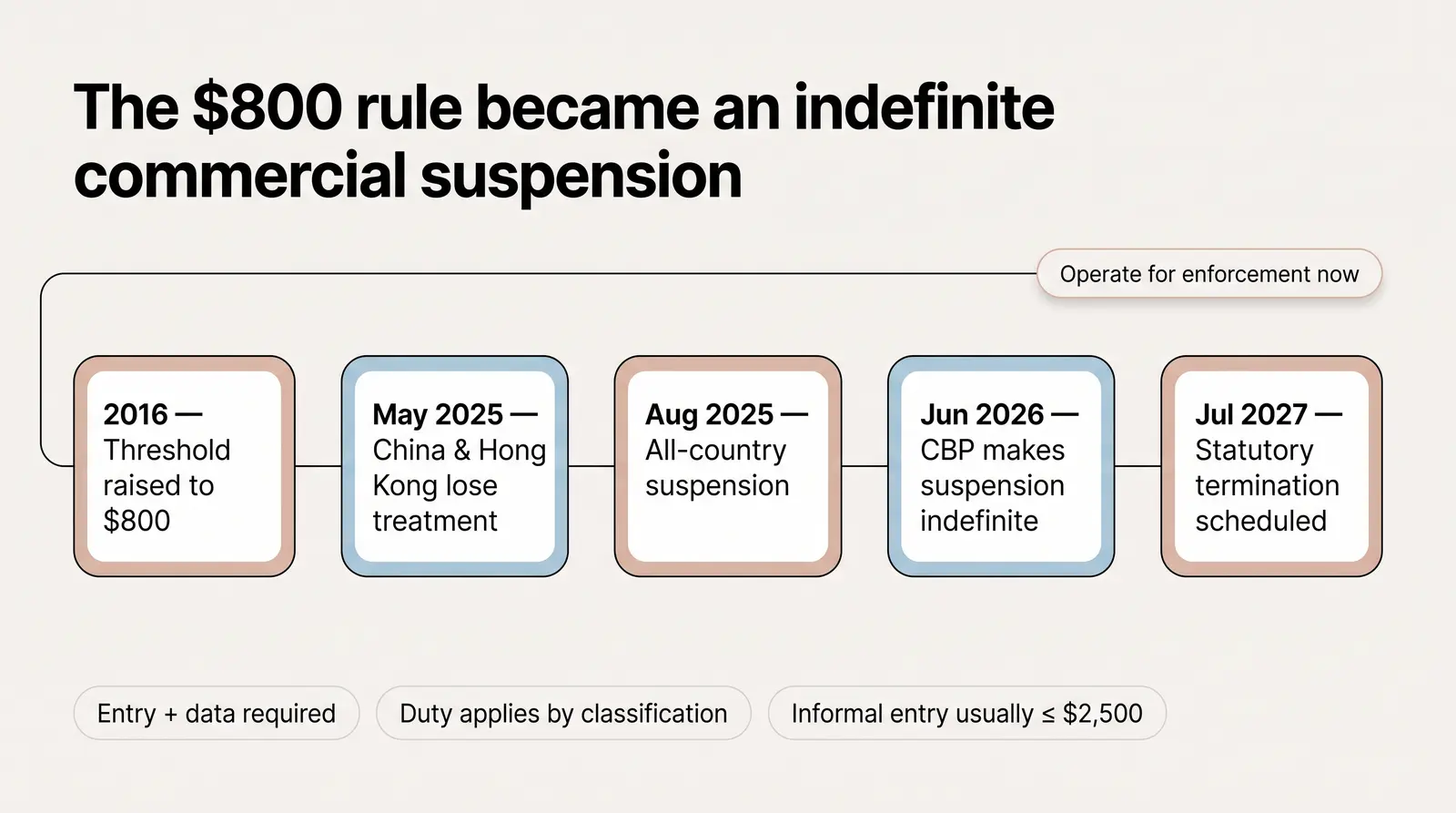
Section 321 is the U.S. low-value import provision. The Trade Facilitation and Trade Enforcement Act increased the administrative threshold from $200 to $800 in 2016, which helped direct-to-consumer imports scale quickly.4 The change in 2025 was not one event. It was two distinct policy stages, followed by regulations that made the commercial suspension indefinite.
| Date | What changed | Why it matters for sellers |
|---|---|---|
| February 24, 2016 | The Trade Facilitation and Trade Enforcement Act raised the Section 321 administrative threshold to $800. | Small direct shipments could generally enter without duty under the commercial de minimis provision. |
| May 2, 2025 | Covered products of China and Hong Kong lost duty-free Section 321 treatment. Non-postal parcels required an appropriate ACE entry and applicable duties. | This was the first major break for China-direct platforms and dropshippers. It was not yet a global repeal.1 |
| May 14 to August 28, 2025 | A temporary China/Hong Kong postal regime used 54% ad valorem duty or $100 per postal item. | These widely reported figures were historical, postal-specific interim rules. They are not a current universal China tariff.5 |
| August 29, 2025 | Executive Order 14324 suspended de minimis treatment for covered goods from all countries, regardless of value, origin, transportation mode, or entry method. | The exemption stopped being a viable general business assumption for cross-border ecommerce.2 |
| February 24, 2026 | The all-country suspension continued after the earlier IEEPA tariff framework changed. | The removal of a particular emergency tariff did not restore de minimis.6 |
| June 24, 2026 | CBP regulations indefinitely suspended the $800 administrative exemption for non-postal and postal merchandise. | For ordinary commercial imports, the current rule is an indefinite suspension, not merely a short-term executive-order experiment.3 |
| July 24, 2026 | A new postal informal-entry process took effect for eligible mail. | Postal shipments now need detailed origin, classification, value, and duty data, plus a bond before release in eligible cases.3 |
| July 1, 2027 | Congress scheduled statutory termination of the commercial Section 321 provision. | The legal framework may change again, but sellers should operate on the suspension already in force.11 |
CBP enforcement is now entry-plus-data: classification, origin, declared value, an appropriate entry, and payment of applicable charges. Informal entry is generally available for eligible shipments through $2,500; formal entry is generally required above it and for specified categories. A China-origin product may face ordinary HTS, Section 301, and product-specific duties, depending on its 10-digit classification, origin, valuation, and entry date.12 13
Global sellers are moving in the same direction. The EU replaced covered low-value distance-sale duty relief with a temporary €3 charge per tariff-item category from July 2026, while Great Britain has announced reform of its £135 relief by March 2029 at the latest.14 15
In our experience at Branvas, where we process cross-border fulfillment for hundreds of independent jewelry and accessories brands, the de minimis repeal did not hit all price points equally.
We use the Parcel Cost Impact Model (PCIM) to show why. PCIM is a planning framework, not a customs quote. It separates merchandise duty from entry and carrier handling costs so founders can see which charges scale with value and which do not.
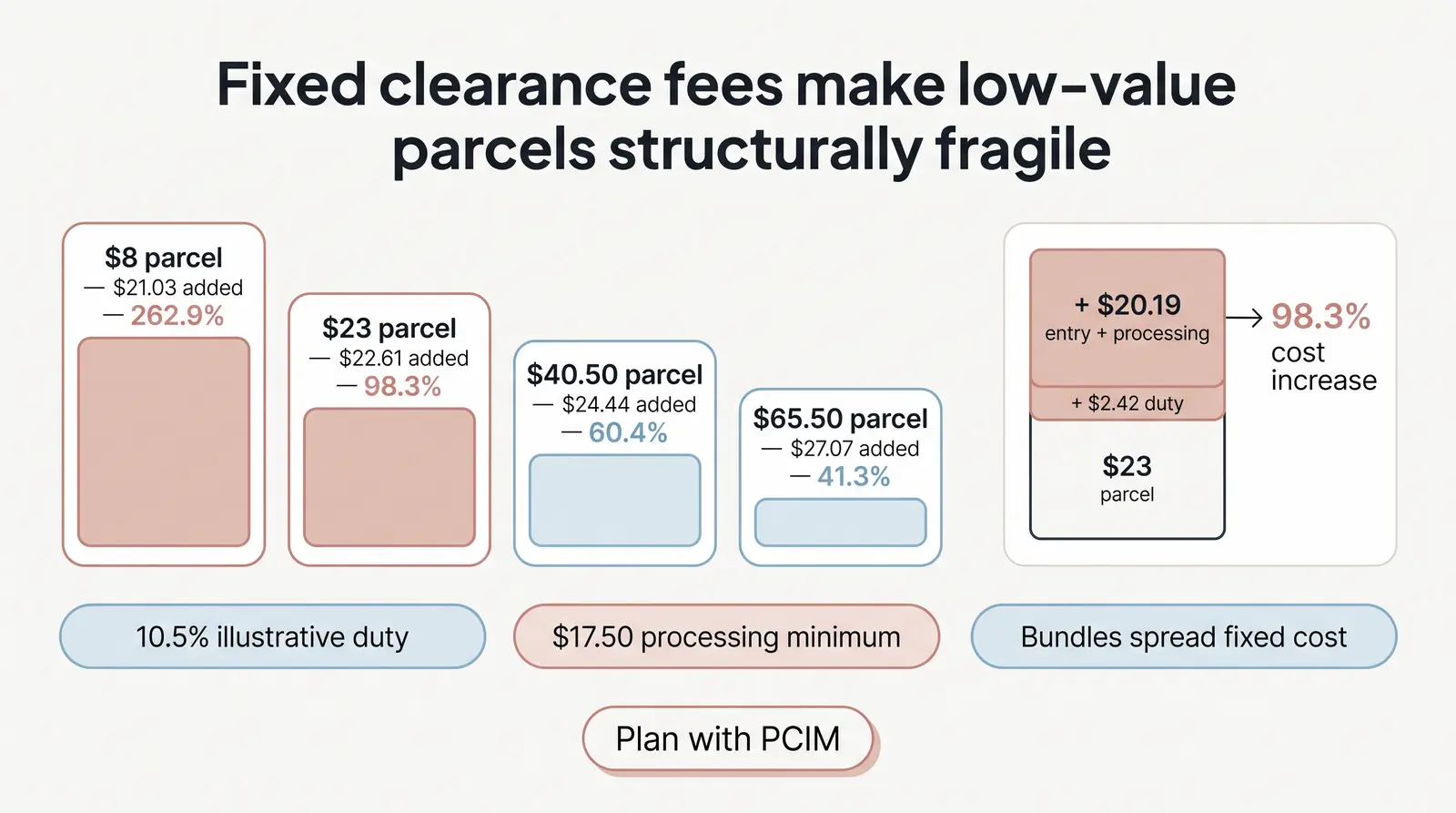
The table uses midpoint values and an illustrative 10.5% merchandise-duty assumption: 3% ordinary HTS plus 7.5% Section 301. It also assumes an eligible informal entry with CBP's $2.69 lowest listed fee and a $17.50 courier duty-advance minimum published by UPS and DHL for applicable services.13 16 17 Real rates and fees can differ materially.
| Parcel Declared Value | Estimated Duty Rate (%) | Estimated Duty ($) | Typical Brokerage/Clearance Fee ($) | Total Added Cost ($) | % Cost Increase on Parcel Value | Seller Margin Impact |
|---|---|---|---|---|---|---|
| $1–$15, midpoint $8 | 10.5% | $0.84 | $20.19 | $21.03 | 262.9% | Severe |
| $16–$30, midpoint $23 | 10.5% | $2.42 | $20.19 | $22.61 | 98.3% | Severe |
| $31–$50, midpoint $40.50 | 10.5% | $4.25 | $20.19 | $24.44 | 60.4% | High |
| $51–$80, midpoint $65.50 | 10.5% | $6.88 | $20.19 | $27.07 | 41.3% | High |
The fee column combines the illustrative $2.69 entry fee and $17.50 duty-processing minimum. It is not a universal broker price, but it shows why a low-ticket direct parcel can fail even when the duty rate looks manageable.
Consider a $28 customer order for a sterling-silver ring set. Before the de minimis exemption ended, assume the seller's unit cost was $10.50, branded packaging was $1.50, and cross-border fulfillment freight was $4.00. The delivered operating cost was $16.00. At a $28 retail price, the gross margin was $12.00, or 42.9%.
For a post-de minimis courier shipment under the PCIM assumptions, the same order adds $2.94 of duty on the $28 declared value, $2.69 of entry charge, and a $17.50 carrier processing minimum. The cost stack becomes $39.13.
| Cost line | Pre-de minimis | Post-de minimis illustrative courier shipment |
|---|---|---|
| Product cost | $10.50 | $10.50 |
| Branded packaging | $1.50 | $1.50 |
| Cross-border freight | $4.00 | $4.00 |
| Applicable estimated duty | $0.00 | $2.94 |
| Entry charge | $0.00 | $2.69 |
| Carrier duty-processing minimum | $0.00 | $17.50 |
| Total cost | $16.00 | $39.13 |
To maintain a 40% gross margin, the seller would need a retail price of approximately $65.22, before any marketing, payment, return, or domestic delivery expense. That does not mean every $28 order now needs to cost $65.22. A consolidated DDP lane may reduce the per-parcel fixed charge. It does show why direct, individually cleared low-AOV parcels are fragile.
We often see founders struggle with the assumption that they can simply absorb these costs. The math doesn't work at low AOVs.
Contrary to the common narrative that de minimis repeal will devastate all small sellers, it has disproportionately harmed ultra-low-AOV dropshippers while creating a structural advantage for sellers with branded products priced above $45. The reason is arithmetic, not sentiment. A fixed $17.50 processing charge consumes 39% of a $45 item but 175% of a $10 item before any duty. A brand with bundles, repeat purchase potential, and a domestic or prepaid-duty fulfillment route has more room to absorb or disclose the cost. CBP's own data show the scale of the channel that was disrupted: low-value shipments exceeded 1.36 billion in FY2024, while CBP later reported more than $1 billion collected on over 246 million low-cost shipments from May through December 2025.10 11
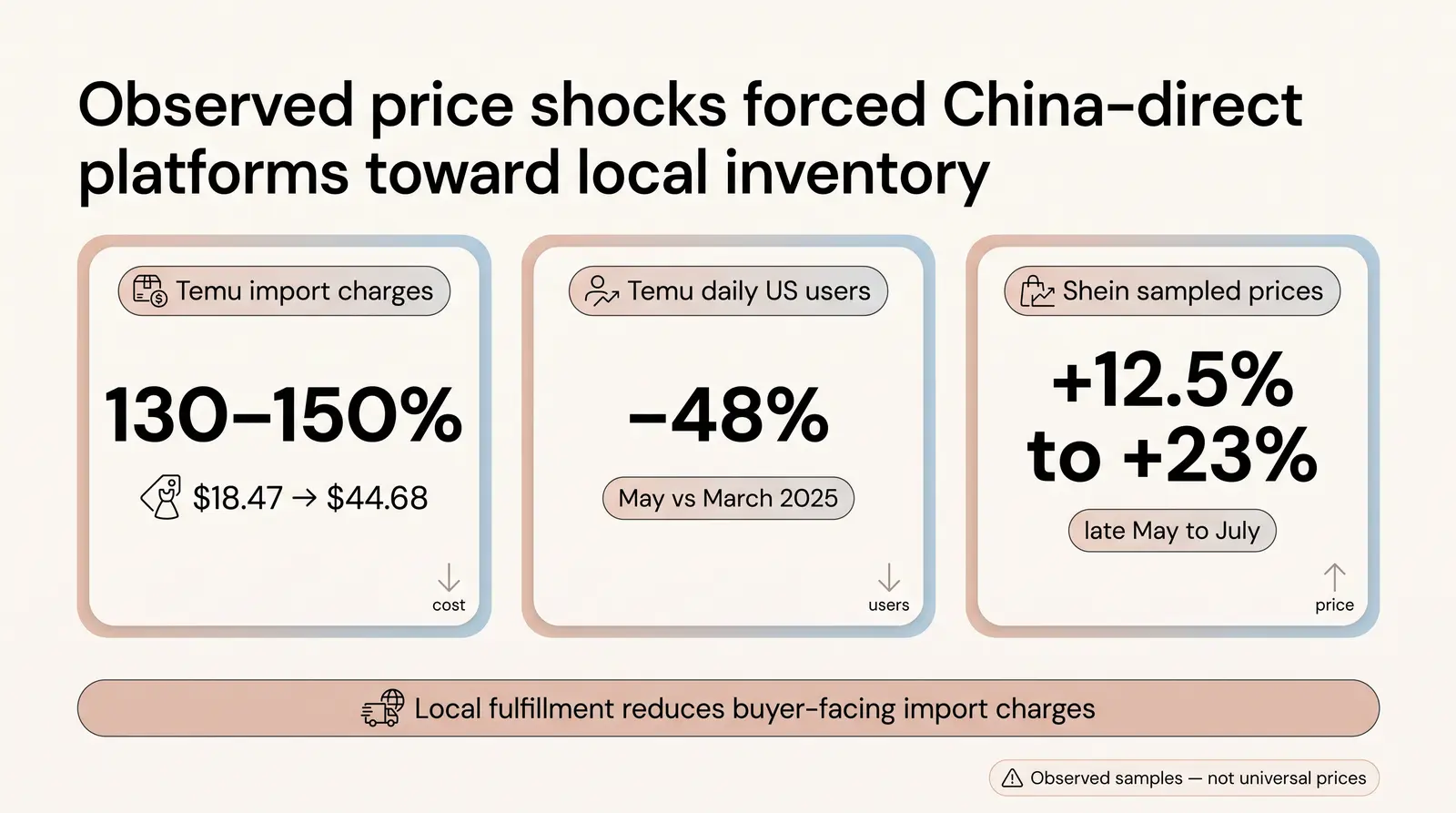
The clearest price evidence comes from Temu and Shein. In late April 2025, CNBC observed Temu China-direct listings with import charges of roughly 130% to 150%. In one example, an $18.47 dress showed a $26.21 import charge, taking the customer's total to $44.68.7
Temu then changed the model. On May 2, CNBC found China-direct items labeled out of stock while U.S.-warehouse listings were promoted as having no import charges or added delivery charges. Reuters later reported that Temu's daily U.S. users fell 48% in May versus March, based on Sensor Tower data, alongside a shift toward locally fulfilled inventory.8 9
Shein offers the strongest published price-tracking sample. Reuters tracked nearly 200 U.S.-site items from an April 24 baseline. Its 70-item low-cost apparel sample was 12.5% higher by the end of May. A 100-item sample of higher-priced women's garments was 23% higher on average by July 22. The ten largest movers in one basket rose from $31 to $69, a 123% increase.9
Shein later told investors it had begun passing on the majority of additional tariff costs through higher U.S. prices. That does not make every Shein item 23% more expensive, because promotions, inventory location, assortment, and product category all matter. It does establish a directional consumer price shock, not merely a hypothetical customs cost.18
AliExpress was exposed because it also relied heavily on China-direct low-value trade. Public reporting supports that exposure, but a defensible U.S.-wide AliExpress price index or fee schedule was not available in the sources reviewed. The correct conclusion is narrower: AliExpress faced the same loss of the de minimis pathway, but its post-change U.S. price impact should not be assigned a made-up percentage.19
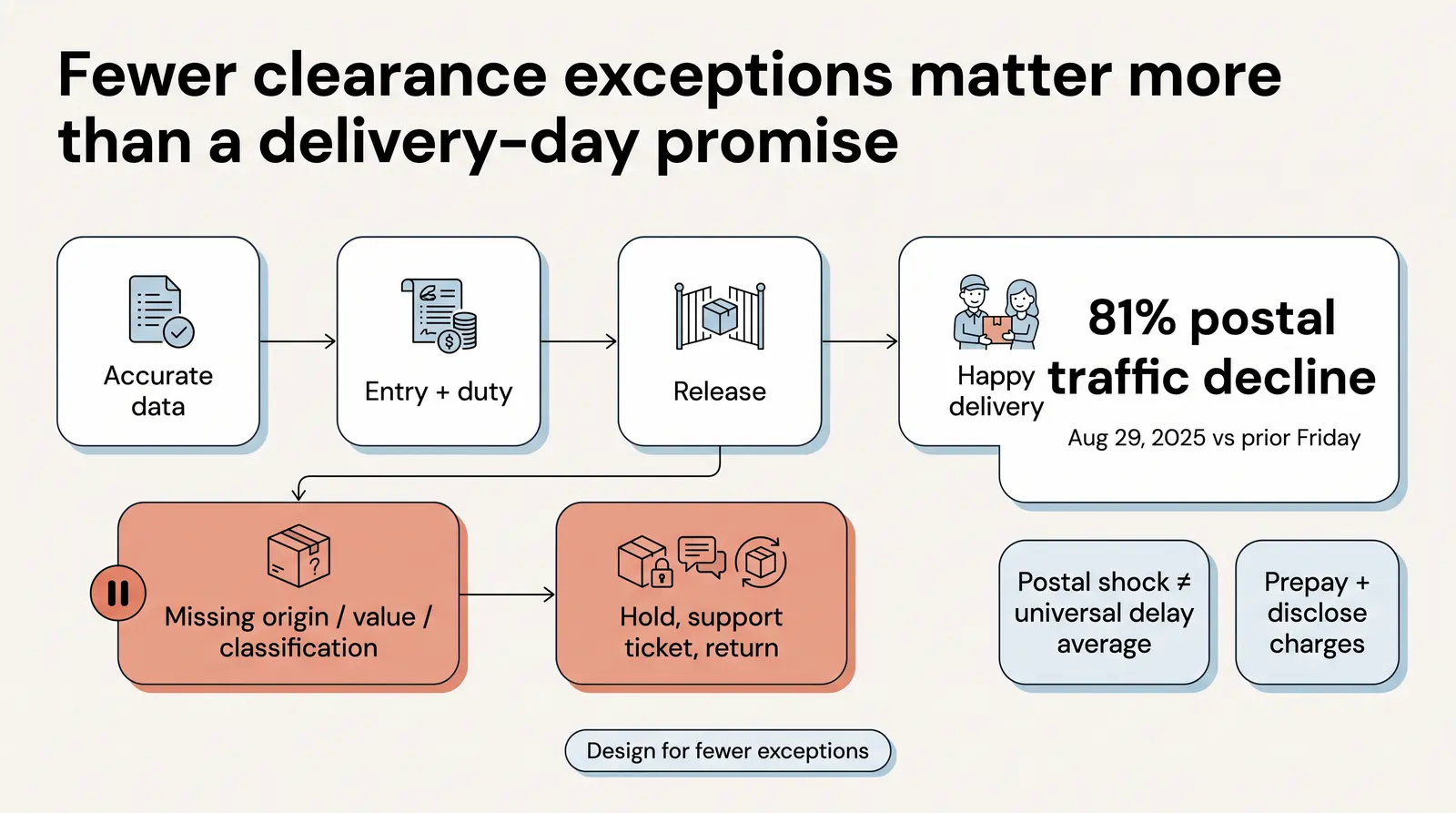
The most measurable disruption was not a universal delivery-time average. It was an immediate postal shock. The Universal Postal Union recorded an 81% decline in postal traffic to the United States on August 29, 2025 compared with the prior Friday, and confirmed service suspensions from 88 postal operators.20
That figure needs context. CBP says mail represented only 5% of de minimis shipments, while general cargo and express carriers handled the other 95%. CBP described commercial-carrier adaptation as having minimal interruption. Both facts can be true: postal networks experienced a severe transition, while the broader carrier market did not produce a published, system-wide delay statistic.10 20
The operational risk is simple. A parcel cannot clear until the correct data, entry, duties, and where required bond are in place. CBP's mail rule says an eligible shipment will not be released from custody until entry and the required bond are transmitted. Incomplete classification, origin, or value information can therefore turn a low-cost shipment into a hold, a customer-service ticket, or a return.3 12
There is no authoritative national refusal or abandonment rate. That absence matters. Do not treat anecdotal return stories as a market-wide percentage. What has been documented is the mechanism: NBC News reported disputed surprise-duty bills, return-to-sender requests, and buyers refusing parcels to avoid charges. One buyer's corrected bill still resulted in a return shipment and additional cost.21
For sellers, the practical target is not a promised delivery-day improvement. It is fewer exceptions. Accurate classification, prepayment, proactive tracking, and clear checkout disclosure reduce the odds that a buyer sees a charge for the first time at the door.
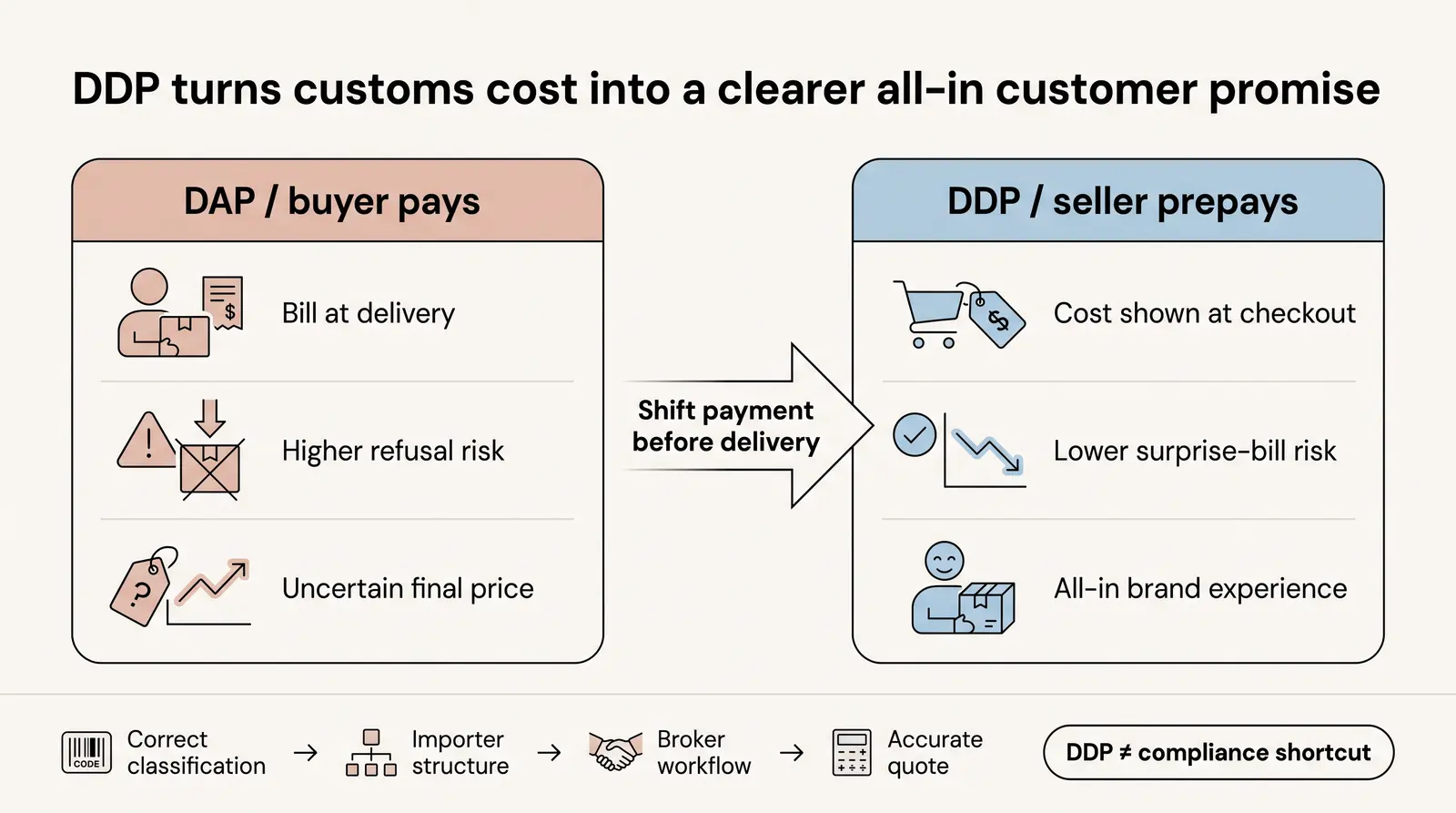
Delivered Duty Paid, or DDP, means the seller arranges and pays carriage, export, transit, import clearance, duties, and taxes to the named destination. The buyer normally unloads. DDP can produce a more predictable buyer experience, but it does not erase customs compliance. The business still needs a lawful importer-of-record structure, correct classification and valuation, broker authorization where needed, and product-compliance controls.22 23
The useful comparison is technically DDP versus Delivered at Place, or DAP. "DDU" is legacy shipping language removed from ICC Incoterms in 2010, although carriers still use it to describe receiver-paid duty and tax arrangements.24
| Dimension | DDU / DAP, buyer pays import charges | DDP, seller prepays import charges |
|---|---|---|
| Buyer experience | Buyer may receive a bill at delivery or before release. | Total cost can be presented at checkout. |
| Refusal risk | Higher if the buyer did not expect a duty or carrier charge. | Lower surprise-bill risk, but seller still bears collection and pricing risk. |
| Compliance complexity | Buyer-side payment does not remove the need for accurate entry data. | Seller must arrange a robust importer, broker, tax, and carrier workflow. |
| Cost predictability | Less predictable for the buyer. | More predictable for the buyer when rates are quoted accurately. |
| Brand perception | Can feel like a cross-border transaction with an uncertain final price. | Supports a more local, all-in brand experience. |
DDP was not a magic shield from the de minimis exemption ending. It was a better commercial operating system for a world where duty exists. Sellers that had already bulk-imported into U.S. inventory or used prepaid-duty routes could embed cost at checkout instead of forcing a buyer to become the customs payer.
In our experience at Branvas, DDP works best for products with enough gross margin to price the landed cost honestly, a stable product catalog, and consistent shipment data. No credible public statistic establishes a universal small-seller DDP adoption rate, so claims of a specific adoption surge should be treated as operational observation, not market measurement.
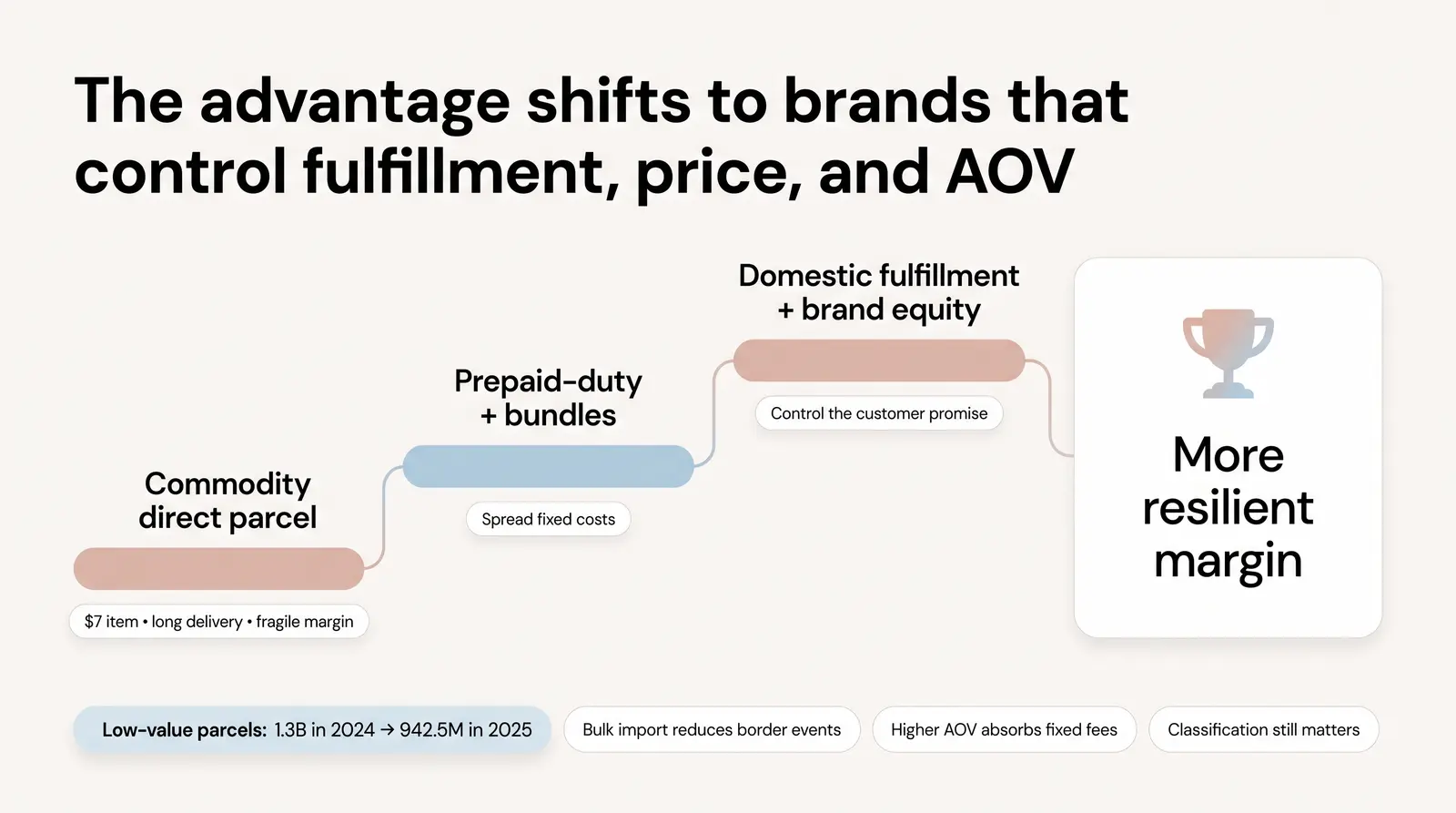
The end of de minimis raised the operational floor for ecommerce. A seller can no longer reliably win with a $7 item, a long international delivery promise, and the assumption that customs stays invisible. Domestic fulfillment replaces many individual border events with fewer bulk-import decisions. Branded fulfillment and higher AOV help spread fixed clearance costs across more margin.
The policy therefore rewards brand equity over price arbitrage, though it does not make every branded seller protected. A weak margin, incorrect classification, or poorly designed DDP program can still lose money. The relative advantage has moved toward sellers who control presentation, pricing, and fulfillment.
The market evidence points in the same direction. Temu shifted U.S. activity toward local fulfillment. Shein raised prices to pass through part of added cost. CBP estimates reported by CRS show low-value parcels fell from 1.3 billion valued at $64.6 billion in 2024 to 942.5 million valued at $48.1 billion in 2025, although tariffs, rerouting, and broader business changes prevent a clean single-cause reading.8 11
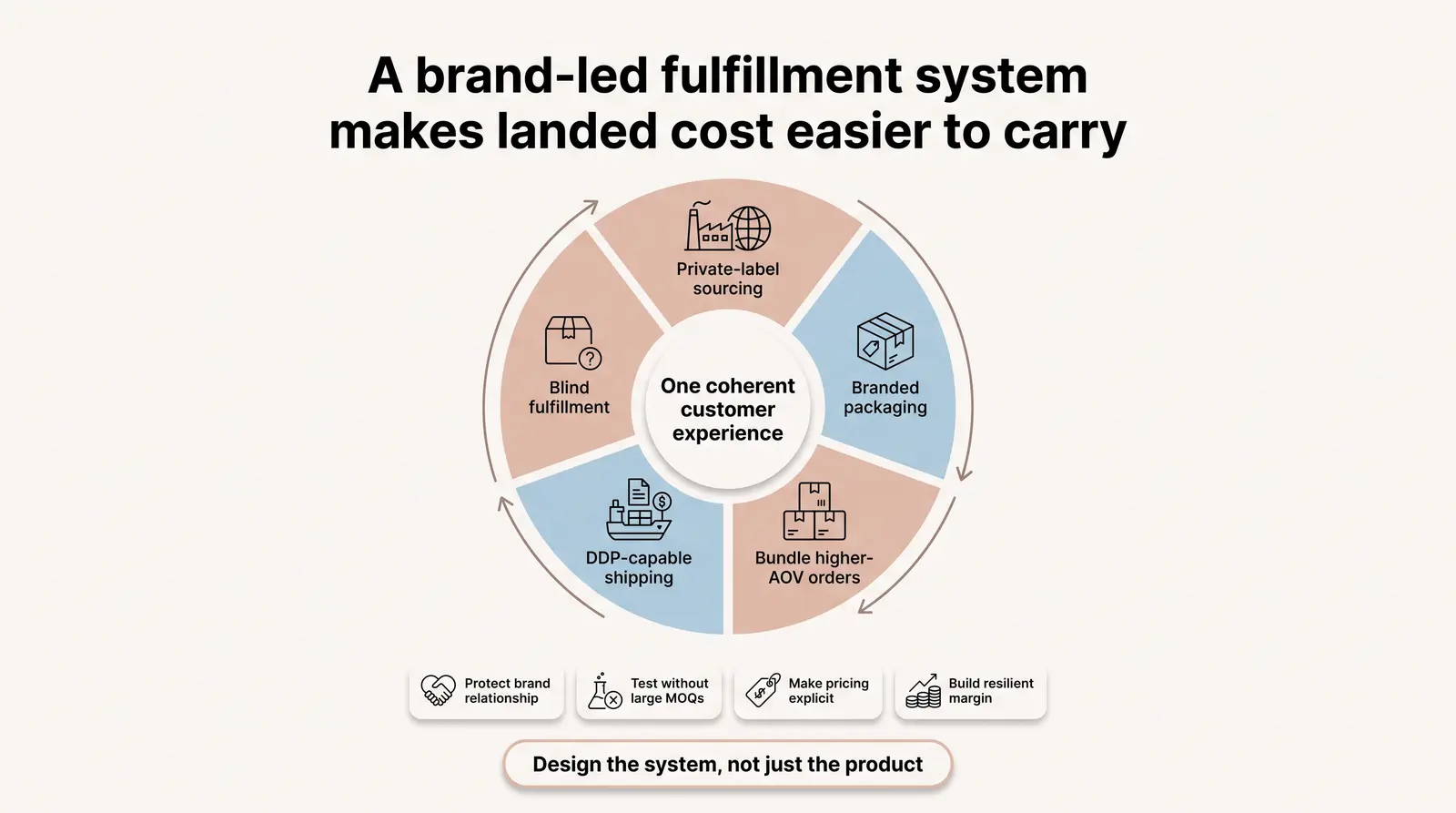
For jewelry and accessories sellers, the post-de minimis era makes the fulfillment design as important as the product design. Branvas combines private-label sourcing, branded packaging, blind fulfillment, and DDP-capable shipping so the end customer sees a coherent brand rather than a fragmented overseas transaction.
The objective is not to hide customs costs. It is to design a catalog and delivery experience that can carry them. Branded packaging can support a higher AOV. Bundles can spread fixed cross-border costs across multiple items. DDP can make the checkout promise clearer. Blind fulfillment protects the seller's relationship with the customer, and no minimum orders allow smaller brands to test a more resilient model without committing to a large inventory position.
If you're rethinking your sourcing and fulfillment model, Branvas's how-it-works page walks through exactly how the private-label model works, from product selection to doorstep delivery.
For sellers operating an ecommerce shop or boutique, Branvas's ecommerce and boutique store owner solution explains how that model can fit a brand-led assortment.
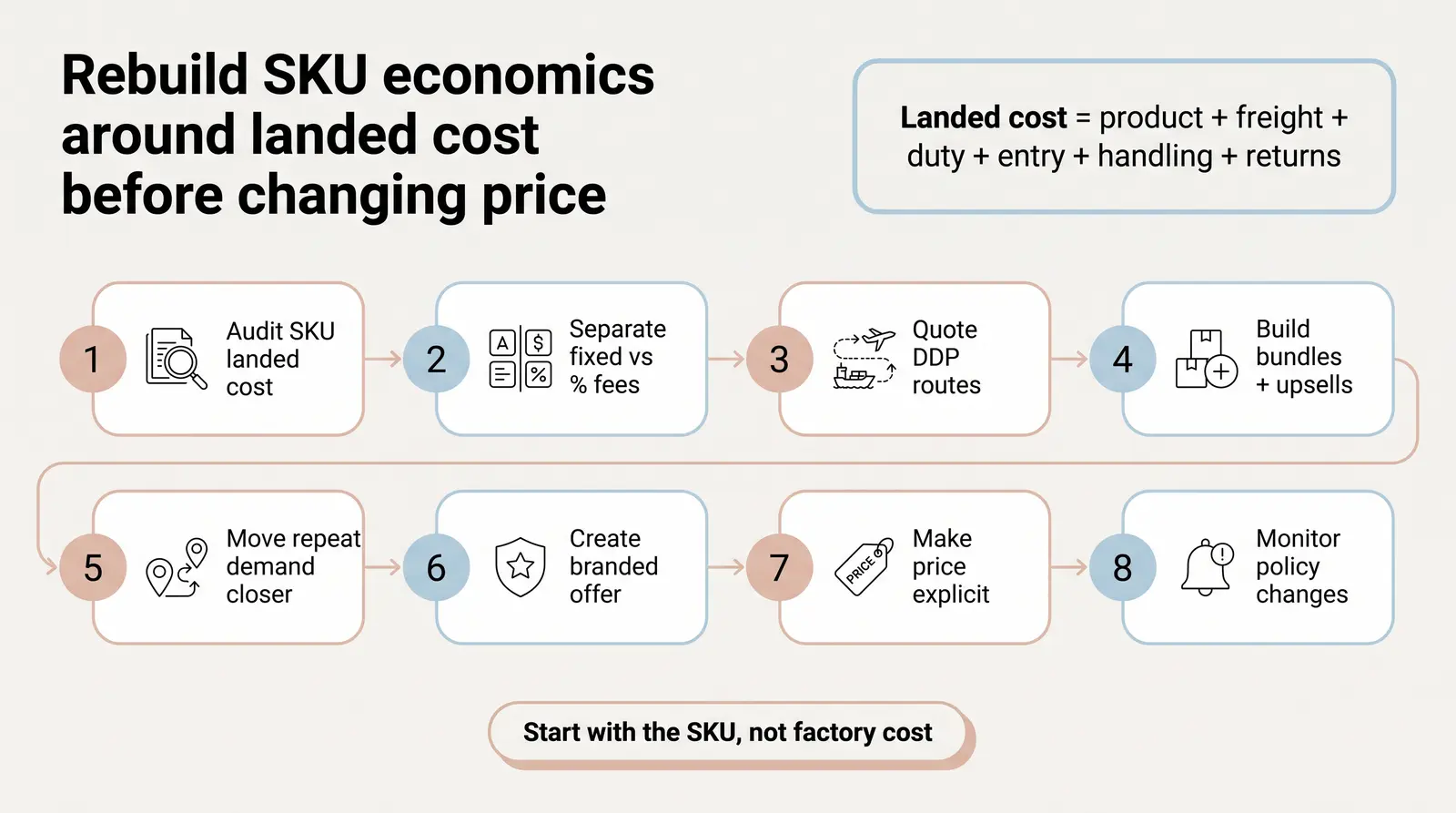
Audit landed cost at SKU level. Record factory cost, international freight, classification, origin, applicable duties, entry charges, broker or carrier fees, packaging, domestic delivery, returns, and payment fees. Use the live HTSUS and a qualified customs adviser for a production classification, not a generic China tariff percentage.12 13
Separate fixed costs from percentage costs. A 10% duty scales with item value. A carrier advancement minimum does not. This makes the $15 parcel and the $60 bundle fundamentally different businesses.
Evaluate DDP routes before changing retail price. Request all-in quotes by lane, carrier, and service. Confirm who acts as importer of record, who pays duty, what happens if a recipient refuses delivery, and whether the quoted price includes advancement, bond, storage, and return fees. Compare the result with your existing price model and Branvas pricing.
Increase AOV deliberately. Build gift sets, multi-item bundles, add-on packaging, warranties, and thoughtful upsells. The goal is not an arbitrary price increase. It is to make each customer order economically capable of carrying its fulfillment costs.
Move repeatable demand closer to the customer. For proven SKUs, compare direct parcel shipping with bulk import into domestic fulfillment or a suitable bonded-warehouse strategy. The right choice depends on cash flow, forecast accuracy, storage, and classification risk.
Turn commodity items into a branded offer. Private label, differentiated packaging, content, and a clear customer promise create margin that a race-to-the-bottom listing cannot. This is where a jewelry or accessories seller can often build a defensible price point.
Make customer pricing explicit. If the buyer pays import charges, disclose that before checkout. If you use DDP, state that duties and taxes are prepaid where applicable. Clear language can reduce disputes and refusal risk.
Monitor the policy, not just headlines. The commercial suspension is indefinite under current CBP rules, and the statutory change is scheduled for July 2027. Recheck CBP, the Federal Register, tariff schedules, and carrier notices before publishing a new duty promise or quote.3 11
Ready to build a brand that's structurally protected from tariff volatility? Branvas handles sourcing, branding, and DDP fulfillment for jewelry and accessories sellers. Explore the Branvas model → or check the profit calculator to see your margins under the new cost structure.
No, not for ordinary commercial low-value imports. The China and Hong Kong exemption ended on May 2, 2025, and the suspension expanded to covered imports from all countries on August 29, 2025. In June 2026, CBP indefinitely suspended the $800 administrative exemption for postal and non-postal commercial merchandise. Separate rules remain for qualifying gifts and certain traveler articles, but an ecommerce package should not be priced as duty-free simply because it is worth less than $800.1 2 3
There is no single China parcel tariff. The answer depends on the product's 10-digit HTSUS classification, customs value, country of origin, entry date, and whether Section 301, Section 232, antidumping, countervailing, quota, or other measures apply. Add carrier, broker, and entry charges to calculate true landed cost. A carrier's duty-advance fee can be more material than a low duty rate on a low-value parcel. Confirm the classification and current rates before quoting a buyer.12 13 16
Temu showed China-direct import charges of roughly 130% to 150% on some listings in late April 2025, then moved U.S. activity toward local inventory and fulfillment. Reuters found Shein's sampled low-cost apparel prices 12.5% above an April baseline by late May 2025, while a sample of higher-priced women's garments was 23% higher by July 22. These are observed samples, not a universal price increase for every item.7 8 9
DDP means Delivered Duty Paid. The seller arranges and pays the applicable transportation, import clearance, duties, and taxes to the named destination, allowing the buyer to see a clearer all-in price. It does not eliminate customs costs or compliance obligations. The seller still needs correct product classification, valuation, importer-of-record arrangements, and carrier or broker processes. DDP reduces surprise-bill risk for the buyer when it is priced and executed accurately.22 23
Yes, but the business model must change. Ultra-low-AOV, individually cleared parcels face the highest percentage impact from entry and carrier fees. Profitability is more plausible when the seller has enough margin, can use a prepaid-duty or consolidated route, raises AOV through bundles, and offers a differentiated product rather than a commodity listing. For repeatable demand, compare direct shipping with domestic inventory or a bonded strategy. The decision should be based on SKU-level landed cost, not factory price alone.