


This guide covers jewelry import duties, tariffs, DDP shipping, IOSS compliance, and restricted materials across 10 global markets to help brands ship internationally without costly mistakes.
Published:
April 21, 2026
Author:
Yi Cui
The global online jewelry market is projected to reach $85.7 billion in 2026 [1], and cross-border ecommerce is driving much of that growth. For founders launching jewelry brands, the opportunity is real. The problem is that the path to international customers runs directly through a tariff minefield that most sellers are completely unprepared for.
Customs fees, import duties, compliance failures, and seized shipments are not rare edge cases. They are the predictable outcome of shipping jewelry internationally without a proper understanding of how each market works. A single shipment held at UK customs, a batch of EU orders returned due to missing IOSS registration, or a Brazilian shipment hit with a 60% effective tax burden can wipe out weeks of profit in a single event.
This guide is the definitive, market-by-market reference for jewelry international shipping in 2026. It covers DDP shipping mechanics, IOSS compliance for EU-bound orders, duty thresholds and rates for the top 10 global jewelry markets, carrier strategy, restricted materials, and the most common mistakes that get shipments seized. Whether you are sourcing through a platform like Branvas or running your own supply chain, this manual gives you the information you need to sell globally without expensive surprises.
Most product categories trigger a straightforward customs process. Jewelry does not. Several characteristics combine to make it one of the most scrutinized categories in international trade.
First, jewelry carries a high declared value per gram. A 20-gram sterling silver necklace worth $150 is flagged very differently by customs algorithms than a 500-gram consumer electronics item worth the same amount. The value density invites scrutiny, and customs authorities in most markets have specific protocols for high-value small parcels.
Second, the HS code structure for jewelry is genuinely complex. Chapter 71 of the Harmonized System covers natural pearls, precious stones, precious metals, and imitation jewelry across dozens of sub-headings. Misclassifying a gold-plated silver piece as base metal jewelry, or confusing HS 7113 (precious metal jewelry) with HS 7117 (imitation jewelry), can result in either overpaying duties or triggering a fraud investigation for underpayment.
Third, jewelry is a category with a documented history of customs fraud. The US Department of Justice announced "trade and customs fraud, including tariff evasion" as a top white-collar enforcement priority in May 2025 [2]. An Indonesian jewelry manufacturer was criminally charged in November 2025 specifically for undervaluing commercial shipments. A US company paid $1 million in penalties for evading customs duties on gold jewelry imports.
At Branvas, we regularly hear from founders who were told by overseas manufacturers to mark packages as "gifts" or undervalue commercial shipments. This advice is not a gray area. It is customs fraud, and it can result in seizure, fines, import bans, and in serious cases, criminal prosecution.
Fourth, jewelry involves materials that are actively restricted or prohibited in multiple markets. Ivory, tortoiseshell, coral, and certain shells are regulated under CITES. Gold, tin, tungsten, and tantalum sourced from conflict-affected regions trigger Dodd-Frank and OECD due diligence obligations. The EU's nickel directive limits nickel release in skin-contact metals. Hallmarking requirements vary by market. These restrictions are not theoretical. Shipments containing non-compliant materials are seized at border.
Understanding these dynamics is the starting point for any serious global jewelry fulfillment strategy.

The GATE Framework is Branvas's four-pillar system for compliant, profitable cross-border jewelry fulfillment. It is designed to give jewelry brand founders a structured approach to international expansion that accounts for the unique challenges of the category.
| Pillar | Name | Core Principle |
|---|---|---|
| G | Geo-Specific Duty Mapping | Know your destination market's duty rate, de minimis threshold, and restricted materials list before you list a product for sale. |
| A | Accurate HS Classification | Use the correct HS code (7113.xx for precious metal jewelry) to avoid misdeclaration penalties and clearance delays. |
| T | Tax Collection Method | Choose between DAP (buyer pays duties on arrival) and DDP (seller pre-collects) based on market norms, order values, and customer expectations. |
| E | End-to-End Compliance | Carrier selection, commercial invoice accuracy, IOSS and VAT registration, restricted materials screening, and a returns management strategy. |
G: Geo-Specific Duty Mapping means doing the research before you open a market, not after your first shipment is held. Every market in this guide has a different duty rate, a different de minimis threshold, and a different set of materials restrictions. Mapping these before you list a product prevents the scenario where you launch into a market and discover the landed cost makes your pricing uncompetitive.
A: Accurate HS Classification is non-negotiable. The difference between HS 7113.11 (silver jewelry) and HS 7117.19 (imitation jewelry of base metal) can be a duty rate difference of several percentage points, and the wrong classification in either direction creates problems. Sellers sourcing from third-party manufacturers should verify the HS classification independently, not rely solely on the supplier's documentation.
T: Tax Collection Method is a strategic decision. DAP (Delivered At Place, formerly DDU) is simpler to set up but creates a poor customer experience in markets where the buyer receives an unexpected duty bill at the door. DDP (Delivered Duty Paid) requires more logistics infrastructure but delivers a seamless experience. The right choice depends on the market, the average order value, and your logistics setup.
E: End-to-End Compliance is where most sellers fall short. Compliance is not just about getting the HS code right. It encompasses accurate commercial invoices, IOSS registration for EU sales, VAT registration where required, restricted materials screening for every product in your catalog, and a clear strategy for handling duty-paid returns.

The table below provides a reference-level overview of each market. Per-market narratives follow with additional context and practical seller guidance.
| Market | De Minimis Threshold | Jewelry Import Duty Rate | VAT/GST | DDP Available | Key Compliance Notes |
|---|---|---|---|---|---|
| USA | $0 (Suspended Aug 2025) | 5% - 8% + 10% Baseline | State Sales Tax | Yes | Formal entry required over $2,500. Baseline 10% tariff on all imports. |
| UK | £135 (Ending by 2029) | 2% - 4% | 20% VAT | Yes | EORI required. Seller collects VAT at checkout for orders under £135. |
| EU | €0 (Effectively) | 2.5% - 4% | 17% - 27% | Yes | €3 flat fee per item under €150 from July 2026. IOSS registration required. |
| Canada | CAD $20 | 0% - 6.5% | 5% - 15% (GST + PST) | Yes | CUSMA/USMCA benefits for US/MX origin goods. Very low de minimis. |
| Australia | AUD $1,000 | 0% - 5% | 10% GST | Yes | GST applies to all imports regardless of value since 2018. |
| UAE | AED 0 | 5% | 5% VAT | Yes | Investment gold VAT exempt. DMCC hallmarking standards apply. |
| Japan | JPY 10,000 (~$66) | 0% - 5.4% | 10% Consumption Tax | Yes | Threshold revision under review. Low duty rates on precious metals. |
| Singapore | SGD $400 (~$295) | 0% | 9% GST | Yes | Essentially duty-free. Investment precious metals GST exempt. |
| Mexico | USD $50 | 10% - 20% | 16% IVA | Yes | Courier shipments from non-FTA countries face 33.5% global rate. |
| Brazil | BRL 0 | 10% - 18% | 17% - 20% ICMS | Yes | Highly complex cascading tax structure. Total burden can exceed 60%. |
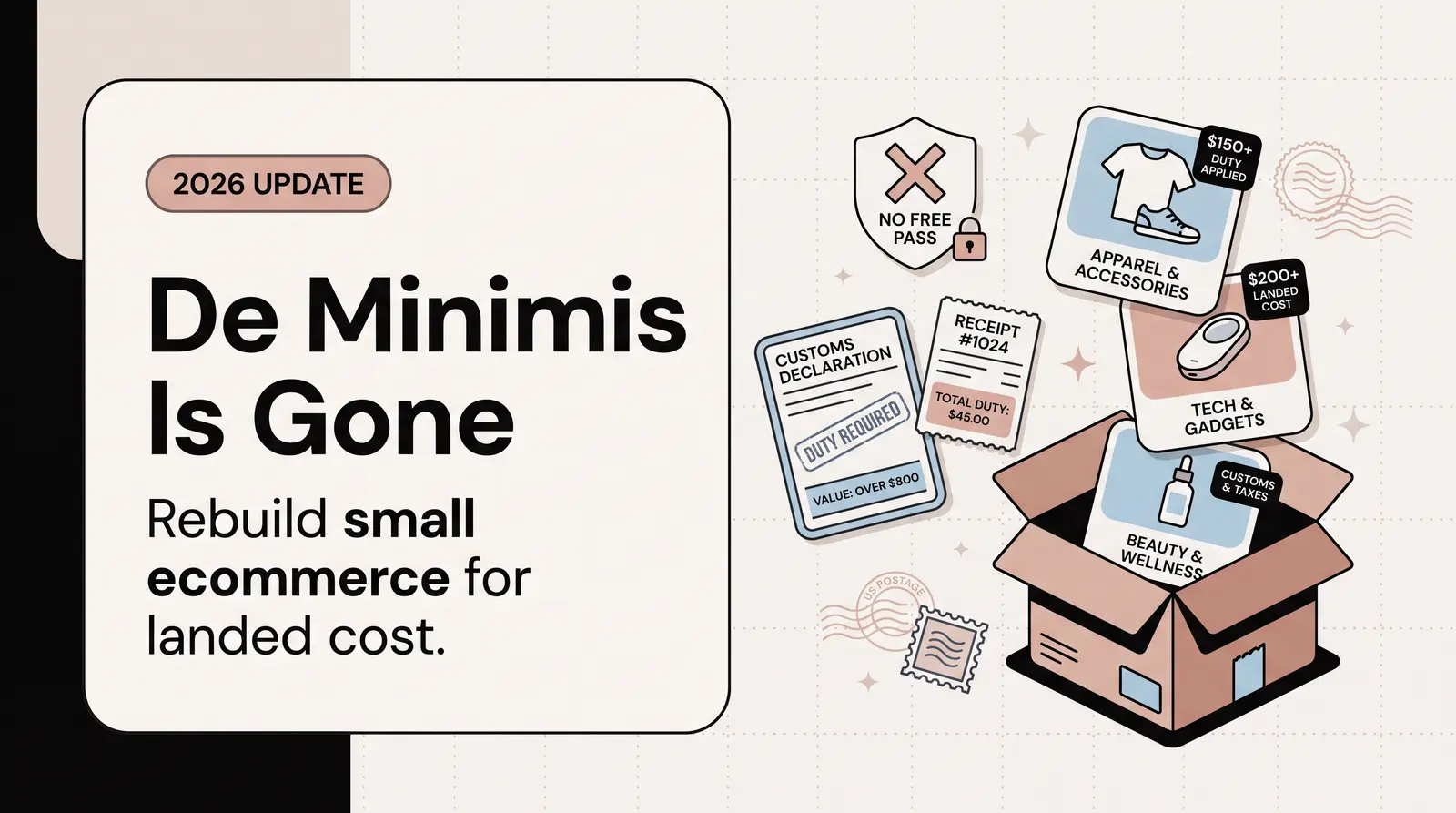
The US market underwent a fundamental change on August 29, 2025, when the $800 de minimis threshold was suspended by executive order [3]. All jewelry shipments to US customers are now subject to duties, regardless of value. The base duty rates for jewelry under HTS Chapter 71 range from approximately 5% to 8% depending on material and construction, with a 10% baseline tariff applying on top. Silver jewelry (7113.11) typically carries a 6.3% specific duty, while gold and other precious metal jewelry (7113.19) ranges from 5% to 7%.
For commercial imports valued at $2,500 or more, formal entry is required, including a customs bond [4]. Sellers should work with a licensed customs broker for high-value shipments. DDP is strongly recommended to prevent customer-facing surprises. Ensure your commercial invoices accurately reflect the true transaction value, as CBP scrutiny has intensified significantly since 2025.
Practical advice: Price your US listings to include the full landed cost, including the baseline tariff. Sellers who built their US pricing around the old de minimis exemption are now operating at a loss on every order.
The UK maintains a £135 de minimis threshold for customs duties, but this does not mean shipments under £135 are tax-free [5]. For orders at or below £135, sellers must collect 20% VAT at the point of sale and remit it to HMRC. Above £135, standard customs duties apply alongside import VAT. The UK's jewelry duty rate for silver jewelry (7113.11) is 2%, confirmed by the UK Integrated Online Tariff. Gold and other precious metal jewelry rates are similarly low.
The UK Autumn Budget 2025 announced plans to remove the £135 customs duty relief by 2029, aligning the UK more closely with the EU's approach. Sellers need an EORI number for commercial imports. The UK Hallmarking Act 1973 requires precious metal articles above certain weights to be hallmarked before sale. Ensure your commodity codes are accurate for C88/E2 import entries.
Practical advice: Register for UK VAT if your annual UK sales exceed the registration threshold. For smaller volumes, use a marketplace facilitator or a fulfillment partner that handles UK VAT compliance.
The EU is implementing the most significant customs reform in decades. The existing IOSS framework (introduced July 2021) covers consignments under €150, allowing sellers to collect VAT at checkout and remit via a single monthly return. Standard import duties for jewelry range from 2.5% to 4%, and VAT rates vary by member state from 17% (Luxembourg) to 27% (Hungary).
Starting July 1, 2026, a €3 flat customs duty per item will apply to goods below €150 for IOSS-registered sellers [5]. This is per item, not per parcel. A three-item order ships together but each item attracts a separate €3 charge. The EU is also developing a permanent Customs Data Hub by 2028 that will enable full tariff-based duty calculations on all imports regardless of value.
Practical advice: Register for IOSS before your first EU sale. Ensure your IOSS number appears on all shipping labels and customs declarations. Price your EU products to absorb the €3 per-item charge from July 2026.
Canada's CAD $20 de minimis threshold is one of the lowest among major ecommerce markets, meaning virtually all jewelry imports are subject to taxes [6]. The federal GST is 5%, but provincial taxes push the total to 12-15% depending on the destination province. Jewelry originating from the United States or Mexico may benefit from 0% import duties under the Canada-United States-Mexico Agreement (CUSMA/USMCA). From other origins, duty rates typically range from 0% to 6.5% depending on material.
DDP is highly recommended for Canada. Canadian consumers are accustomed to receiving packages without unexpected fees, and a duty bill at the door creates a poor experience that leads to package refusals. Work with a carrier that has strong Canadian customs clearance capabilities.
Practical advice: If you are shipping from the US, ensure your products qualify for CUSMA preferential treatment by meeting the rules of origin requirements. This can eliminate import duties entirely.
Australia offers a relatively generous AUD $1,000 de minimis threshold for customs duties, and most jewelry categories face a 0% import duty rate [7]. However, a 10% GST applies to all imported goods regardless of value, following the 2018 reform that extended GST to low-value imports. Non-resident sellers with annual Australian turnover exceeding AUD $75,000 must register for and collect GST.
DHL Express and FedEx offer strong Australian coverage with DDP options. The market is relatively straightforward compared to Brazil or Mexico, but accurate valuation and GST compliance are essential.
Practical advice: If your annual Australian sales are approaching AUD $75,000, register for GST proactively. Failing to collect GST when required creates a liability that the Australian Tax Office will pursue.
The UAE has no de minimis threshold. All imports are subject to a 5% customs duty based on the CIF (cost, insurance, freight) value, plus a 5% VAT [8]. Finished jewelry is treated as a consumer product and attracts both charges. An exception exists for investment gold (99%+ purity bars and coins), which is VAT exempt.
The UAE is a significant jewelry market, particularly for gold. Sellers must comply with local hallmarking standards, including those set by the Dubai Multi Commodities Centre (DMCC). The market rewards quality and authenticity, so accurate material declarations are both a legal requirement and a commercial necessity.
Practical advice: For gold jewelry, ensure your products meet UAE purity standards and are appropriately hallmarked. Misrepresenting gold purity is a serious compliance issue in this market.
Japan currently exempts goods valued under JPY 10,000 (approximately $66 USD) from both customs duty and the 10% consumption tax [9]. Above this threshold, consumption tax applies, and specific duty rates vary by jewelry type. Precious metal jewelry (gold, silver, platinum) generally faces 0% import duty in Japan, making it one of the more favorable markets for fine jewelry.
However, Japan's government announced in January 2026 that it is reviewing the de minimis threshold due to a tenfold increase in low-value ecommerce imports. Sellers should monitor this development closely, as a threshold revision could significantly change the economics of selling into Japan.
Practical advice: Japan is a premium market that values quality and presentation. Invest in branded packaging and accurate product descriptions. DHL Express and FedEx have strong Japanese delivery networks with reliable DDP options.
Singapore provides GST relief for postal and air imports valued up to SGD $400 [10]. Above this threshold, a 9% GST applies to the full CIF value. Jewelry faces 0% customs duty, making Singapore essentially a duty-free market. Investment precious metals meeting specific criteria are exempt from GST entirely.
Singapore's customs process is efficient and transparent. The primary compliance requirement is accurate valuation and proper documentation. The market is small but affluent, with strong demand for quality jewelry.
Practical advice: Singapore is an excellent test market for Asian expansion due to its straightforward customs environment, English-speaking population, and strong logistics infrastructure.
Mexico's customs landscape became more complex in 2026. The de minimis threshold is USD $50 for goods originating from USMCA partner countries (US and Canada), with goods in this range exempt from import duties but still subject to 16% IVA [11]. Goods valued between $50 and $117 face a 17% duty rate. For courier shipments from non-FTA countries, the global rate increased from 19% to 33.5% in 2026.
Jewelry import duties from non-FTA countries typically range from 10% to 20% depending on material. Mexico's 2026 tariff increases primarily targeted sectors like cosmetics, textiles, and apparel, but sellers should verify specific jewelry classifications with a Mexican customs broker.
Practical advice: If you are shipping from the US, leverage USMCA benefits to minimize duties. Ensure your carrier has strong Mexican customs clearance capabilities, as documentation requirements have become more stringent in 2026.
Brazil is the most complex and expensive market in this guide. There is no de minimis threshold, and the tax structure is cascading, meaning each tax is calculated on a base that includes the previous taxes [12]. The Import Tax (II) for jewelry ranges from 10% to 18%. On top of this, sellers face IPI (0-30%), PIS/COFINS (11.75% combined), ICMS state tax (17-20%), and SISCOMEX administrative fees. The total effective tax burden can easily exceed 60% of the CIF value.
Brazil's tax reform is underway, with new CBS and IBS taxes being tested in 2026 before replacing the current structure by 2033. This creates additional complexity for sellers trying to model their Brazilian landed costs.
Practical advice: Brazil requires a dedicated logistics partner with deep local knowledge. The market is significant, but the compliance burden is high. Consider whether the market size justifies the operational complexity before launching.

Delivered Duty Paid (DDP) is an Incoterms 2020 rule under which the seller assumes full responsibility for delivering goods to the buyer's named destination, including all transportation costs, export and import duties, taxes, and customs clearance. It represents the maximum obligation for the seller and the minimum obligation for the buyer.
The core advantage of DDP is customer experience. When a buyer in the UK or Germany orders a piece of jewelry, they want to receive it without any additional charges. Under DAP (Delivered At Place, the alternative), the carrier contacts the buyer before delivery to collect import duties and a handling fee. This creates friction, delays, and in many cases, refused deliveries. The seller then faces the cost of return shipping and potentially losing the sale entirely.
The disadvantages of DDP are real. The seller must accurately calculate and pre-pay duties in each destination market, which requires either sophisticated tax calculation software or a logistics partner with that capability. DDP also means the seller bears the risk of duty rate changes between order placement and customs clearance. For markets like Brazil, where the tax burden is exceptionally high, DDP pricing requires careful margin analysis.
Worked Example: $95 Sterling Silver Necklace, US-Based 3PL to UK Customer
Under DAP: The customer pays $95 at checkout plus shipping. The package arrives in the UK and Royal Mail contacts the customer to collect 20% VAT ($19) plus a £8 carrier handling fee before delivery. The customer is surprised, frustrated, and may refuse the package. The seller loses the sale and pays return shipping.
Under DDP: The seller prices the necklace at $95 and adds a transparent "duties and taxes included" line at checkout, collecting an additional $27 (20% VAT plus a small DDP processing fee). The customer pays $122 total and receives the package without any further contact. The seller's net margin is slightly reduced by the DDP processing fee (typically $3-5 for this value), but the conversion rate is higher and the customer experience is seamless.
The math: On a $95 item, DDP adds approximately $4-6 in processing costs. The alternative is a 15-20% refused delivery rate under DAP, each of which costs $15-25 in return shipping. For most jewelry sellers, DDP is the economically superior choice.
Carriers and Platforms Supporting DDP for Jewelry Ecommerce
DHL Express offers DDP as a standard service option with strong coverage across all 10 markets in this guide. FedEx International Priority supports DDP with a dedicated jewelry shipping program. UPS provides DDP for commercial shipments. On the platform side, Shopify Markets supports duty collection at checkout, enabling sellers to implement DDP without custom logistics infrastructure. For sellers using a fulfillment partner like Branvas, DDP capability is built into the fulfillment model.

The Import One-Stop Shop (IOSS) was introduced by the EU on July 1, 2021, as part of a broader VAT reform for ecommerce. It applies to distance sales of goods imported from outside the EU with a consignment value not exceeding €150. The system allows sellers to register for VAT in a single EU member state, collect VAT from EU buyers at the point of sale based on the destination country's rate, and remit all collected VAT via a single monthly return.
For jewelry sellers, IOSS is not optional if you want to provide a competitive customer experience. Without IOSS registration, your carrier must collect VAT from the customer before delivery, along with a handling fee that typically ranges from €5 to €15 per parcel. This creates exactly the kind of friction that leads to refused packages and negative reviews.
How IOSS Registration Works
Non-EU sellers can register for IOSS directly if they are based in a country with a mutual assistance agreement with the EU, or through an EU-based intermediary (fiscal representative) in most other cases. Registration is done through the tax authority of the chosen EU member state. Once registered, you receive an IOSS VAT identification number that must appear on all customs declarations for eligible shipments.
VAT Rate Variation by EU Member State
VAT rates for jewelry vary across the EU. Germany charges 19%, France 20%, Italy 22%, Spain 21%, and Hungary 27%. When a customer in Germany orders a €120 necklace, you collect 19% VAT (€22.80) at checkout. When a customer in Hungary orders the same item, you collect 27% VAT (€32.40). Your IOSS registration must account for these varying rates.
The 2026 Changes
Starting July 1, 2026, the EU is implementing a €3 flat customs duty per item on goods below €150 for IOSS-registered sellers. This is a significant change. A customer ordering three jewelry items in a single parcel will trigger three separate €3 charges. Sellers must factor this into their EU pricing strategy. For items priced below €20, the €3 duty represents a meaningful percentage of the sale price.
Common IOSS Mistakes
Using a supplier's IOSS number is one of the most common and dangerous errors. Each IOSS number is registered to a specific legal entity and can only be used for that entity's sales. Using another entity's IOSS number is fraud. Failing to register before your first EU sale means your initial shipments will be held at customs or delivered with unexpected charges. Declaring incorrect invoice values to stay below the €150 threshold is customs fraud.
If you're launching a jewelry brand and selling into the EU, Branvas's fulfillment infrastructure is already set up for IOSS-compliant shipping. Learn how our fulfillment works at branvas.com/how-it-works.

Post-Brexit, the UK operates under its own customs framework, separate from the EU. The UK Global Tariff (Chapter 71) governs jewelry imports. The standard third-country duty rate for silver jewelry (7113.11) is 2%, as confirmed by the UK Integrated Online Tariff. Gold and other precious metal jewelry rates are similarly low.
The £135 threshold is the central compliance point. For shipments valued at £135 or less, sellers must collect 20% VAT at the point of sale and remit it to HMRC. This applies to all B2C sales from non-UK sellers to UK consumers. For shipments above £135, standard import VAT and customs duties are collected at the border.
EORI Numbers and Documentation
Any business importing goods commercially into the UK requires an Economic Operators Registration and Identification (EORI) number. This is a unique identifier used on all customs declarations. Without an EORI, shipments cannot be formally cleared through UK customs. Applications are processed by HMRC and typically take a few days.
Accurate commodity codes are essential for completing C88/E2 import entries. The UK Trade Tariff service provides a searchable database of all commodity codes and their associated duty rates.
2025-2026 Changes
The UK Autumn Budget 2025 announced the government's intention to remove the £135 customs duty relief for low-value imports, with implementation targeted for 2029. This will align the UK more closely with the EU's approach and will require sellers to account for customs duties on all UK-bound shipments, regardless of value. HMRC has confirmed it will maintain tariff-free imports until December 31, 2026, to give businesses time to prepare.
Practical Guidance
Register for UK VAT if your annual UK sales exceed the registration threshold. Use a carrier with strong UK customs clearance capabilities. Ensure all commercial invoices include accurate material descriptions, country of origin, and true transaction values. The UK Hallmarking Act 1973 requires precious metal articles above specific weights to be hallmarked before sale in the UK.

Material compliance is one of the most overlooked aspects of jewelry international shipping. The following checklist covers the key restrictions that apply across the top 10 markets.

The fulfillment model you choose has a direct impact on your cost structure, customer experience, and compliance posture. There are four primary models for global e-commerce fulfillment of jewelry.
Ship-from-Origin (Direct): You ship each order directly from your warehouse or supplier to the end customer. This is the simplest model to set up but the most expensive per shipment and the most complex from a compliance perspective, as you are managing customs declarations for every individual order.
Regional 3PL Warehousing: You pre-position inventory in regional warehouses (e.g., a UK warehouse for European customers, a US warehouse for North American customers). This reduces cross-border complexity and shipping costs but requires significant upfront inventory investment and adds warehouse management overhead.
Marketplace Fulfillment (Amazon FBA Globally): Amazon's fulfillment network can handle cross-border logistics, but jewelry faces specific restrictions on Amazon, including category approval requirements and limitations on high-value items. Fees can also be significant relative to jewelry's margins.
Brand-as-a-Service Fulfillment (Branvas): A BaaS model like Branvas handles sourcing, branding, packaging, and fulfillment as an integrated service. For jewelry brands, this means blind shipping with branded packaging, pre-negotiated carrier rates, and compliance infrastructure built in. This is particularly valuable for founders who want to focus on brand building and customer acquisition rather than logistics operations.
Carrier Comparison for Jewelry
| Carrier | Speed | Tracking | Insurance Limit | DDP Support | Best For |
|---|---|---|---|---|---|
| DHL Express | 1-3 days | Excellent | Up to $50,000+ | Yes | Premium, time-sensitive shipments |
| FedEx International Priority | 1-3 days | Excellent | Up to $50,000+ | Yes | High-value commercial shipments |
| UPS Worldwide Express | 1-3 days | Excellent | Standard limits | Yes | Commercial shipments, B2B |
| Royal Mail International | 5-10 days | Basic | Limited | No | Low-value, non-urgent shipments |
| Regional Postal Networks | 7-21 days | Minimal | Very limited | No | Lowest cost, highest risk |
Insurance Considerations
Standard carrier liability for lost or damaged jewelry is typically limited to a fraction of the declared value. For high-value pieces, separate parcel insurance or marine cargo insurance is essential. Ensure your declared value on customs documents matches your insured value. Discrepancies create problems both at customs and when filing insurance claims.
At Branvas, we've built our fulfillment model specifically around jewelry's unique logistics challenges: blind shipping, branded packaging, and pre-negotiated carrier rates are all part of what we provide. You can explore our full product catalog at branvas.com/catalog and review pricing at branvas.com/pricing.
Ready to launch your jewelry brand without the logistics headache? Explore Branvas's Brand-as-a-Service platform at branvas.com/how-it-works. We handle sourcing, branding, and global fulfillment so you don't have to.

1. Undervaluing commercial shipments or marking as "gift"
This is the most common and most dangerous mistake in jewelry international shipping. Customs authorities in every major market have algorithms specifically designed to identify undervalued high-density shipments. The penalties range from seizure and fines to criminal prosecution. In 2023, a US company paid $1 million in penalties for evading customs duties on gold jewelry. Always declare the true commercial value on every shipment.
2. Using the wrong HS code
Misclassifying jewelry under the wrong HS code is a compliance failure with real consequences. Using HS 7117 (imitation jewelry) for a piece that should be classified under HS 7113 (precious metal jewelry) to access a lower duty rate is fraud. Using the wrong code in the other direction means overpaying duties unnecessarily. Invest time in accurate classification or work with a customs broker.
3. Missing or incorrect commercial invoice details
A commercial invoice for a jewelry shipment must include the accurate description of goods, material composition (e.g., 925 sterling silver), country of origin, quantity, unit value, total value, and the seller's and buyer's details. Missing any of these elements can result in clearance delays or rejection at customs. Carriers will often hold shipments pending corrected documentation.
4. Shipping CITES-restricted materials without permits
Ivory, tortoiseshell, coral, and certain shells are actively screened at borders. Shipments containing these materials without valid CITES documentation are seized immediately. The seller faces potential criminal charges in addition to losing the goods. Screen every product in your catalog against CITES Appendices I, II, and III before listing.
5. Ignoring IOSS registration before selling to EU
Launching EU sales without IOSS registration means your customers receive unexpected VAT demands and carrier handling fees before their packages are delivered. Many will refuse delivery. You then face return shipping costs and the loss of the sale. Register for IOSS before your first EU shipment, not after.
6. Not accounting for import duties in pricing and margins
If you are offering DDP shipping, the import duties are your cost. If you have not modeled these costs into your pricing, you are effectively subsidizing your customers' import taxes. This is a common error for sellers expanding into new markets without doing the duty mapping first. Use the GATE Framework's first pillar to map duties before you set prices.
7. Using consumer postal services for high-value commercial shipments
Royal Mail, USPS, and similar postal services are designed for personal correspondence and low-value consumer goods. They lack the tracking granularity, insurance coverage, DDP capability, and customs clearance expertise required for commercial jewelry shipments. A $500 necklace sent via standard postal service has minimal recourse if it is lost or seized.
8. No returns strategy for duty-paid shipments
International returns for jewelry are complex. If you shipped DDP and the customer returns the item, reclaiming the paid duties requires a formal duty drawback claim in most markets. Without a returns strategy, you absorb the duty cost on every return. Build your returns policy and logistics process before you launch, not after your first return request.

Import duties on jewelry vary significantly by destination country and material type. The US applies a 10% baseline tariff plus specific rates of 5-8% depending on the HS code. The UK charges 2-4% for precious metal jewelry above the £135 threshold. The EU applies 2.5-4% plus VAT. Australia charges 0% duty but 10% GST. Japan charges 0% on most precious metal jewelry. Always verify the specific rate for your HS code and destination country with the official customs authority or a licensed customs broker before launching into a new market.
Yes, if you want to provide a seamless customer experience for orders valued at €150 or less. Without IOSS registration, your carrier must collect VAT from the customer before delivery, along with a handling fee. This creates friction, delays, and refused packages. IOSS registration allows you to collect VAT at checkout and remit it centrally, eliminating the border collection step. Note that from July 2026, a €3 flat customs duty per item will also apply to IOSS-registered sellers on goods below €150.
Delivered Duty Paid (DDP) is an Incoterms 2020 rule where the seller bears all costs, including import duties, taxes, and customs clearance, delivering goods to the buyer's door. For jewelry ecommerce, DDP is generally the right choice for most markets. It eliminates customer-facing surprise charges, reduces refused deliveries, and creates a premium unboxing experience. The trade-off is that you must accurately calculate and price in the duty costs for each market. DHL Express, FedEx International Priority, and UPS all support DDP for jewelry shipments.
Accurate documentation is the foundation. Always declare the true commercial value, use the correct HS code, provide a complete commercial invoice with material descriptions and country of origin, and never mark commercial shipments as gifts. Screen your product catalog for CITES-restricted materials and obtain the necessary permits before shipping. Register for IOSS before selling to EU customers. Work with a carrier that has strong customs clearance expertise in your target markets.
The cheapest option is regional postal networks, but cheapest is rarely the right choice for jewelry. Postal services offer limited tracking, minimal insurance, no DDP capability, and slow delivery times. A better approach for small brands is to use a fulfillment partner with pre-negotiated express carrier rates, which can bring DHL or FedEx costs down to levels competitive with postal services while maintaining full tracking, insurance, and DDP support. Platforms like Branvas are specifically designed to give small jewelry brands access to enterprise-level logistics infrastructure.
[1] Online Jewelry Market Size in 2026, and Future Forecasts. IceCartel, 2026.
[2] Customs and tariff enforcement and the increased risk of criminal prosecutions. DLA Piper, February 2026.
[3] Suspending Duty-Free De Minimis Treatment for All Countries. The White House, July 2025.
[4] What are the requirements for importing diamonds, jewelry, and other gemstones?. U.S. Customs and Border Protection, November 2025.
[5] E-commerce: 150 EUR customs duty exemption threshold to be removed as of 2026. European Commission, November 2025.
[6] Customs Tariff 2026. Canada Border Services Agency, January 2026.
[7] GST on low value imported goods. Australian Taxation Office, September 2025.
[8] Clearing the customs and paying customs duty. The Official Portal of the UAE Government, April 2026.
[9] Outline of Tariff and Duty Rates System. Japan Customs.
[10] Consumers Importing Goods into Singapore. Inland Revenue Authority of Singapore, January 2026.
[11] Mexico: 2026 Trade and Customs Updates. Alvarez and Marsal, January 2026.
[12] Brazil Import Duties 2026: Full Cost Breakdown and Tax Reform. Novatrade, February 2026.