


DDP shipping eliminates surprise customs fees that cause negative customer reviews, while DDU creates hidden charges that destroy brand trust and suppress repeat purchases.
Published:
November 17, 2026
Author:
Yi Cui
Stores using DDP shipping see measurably higher review scores than DDU stores — the kind of novel correlation fulfillment blogs cite because no one else has the data.
If you are building a private-label ecommerce brand, you probably spend hours optimizing your product pages, refining your ad creative, and obsessing over your unboxing experience. But there is a silent conversion killer lurking in your supply chain that can undo all of that work in a single afternoon: your shipping Incoterm.
The choice between DDP (Delivered Duty Paid) and DDU (Delivered Duty Unpaid) is often treated as a dry logistics decision. It is not. It is a customer experience decision made before the customer even places their order. In our experience at Branvas, the sellers who switch from DDU to DDP almost never go back — the review improvement alone justifies the cost delta.
This article breaks down exactly how your shipping method correlates with your customer review scores, where DDU creates the most friction, and why DDP is the ultimate brand-building tool for international ecommerce.
Every cross-border shipment operates under a set of standardized trade rules called Incoterms (International Commercial Terms), published by the International Chamber of Commerce [1]. The two most common terms for ecommerce are DDP and DDU (officially replaced by DAP in 2010, but still universally used in the industry).
The difference between the two comes down to a single question: who pays the import duties and taxes when a package crosses a border?
Under DDP (Delivered Duty Paid), the seller handles everything from origin to the buyer's door. The seller pays for the freight, the export clearance, the import customs clearance, the duties, and the destination-country taxes [2]. The buyer receives the package with nothing left to pay.
Under DDU (Delivered Duty Unpaid), the seller ships the goods to the destination country but does not pay the import duties or taxes. The buyer is responsible for handling customs clearance and paying whatever charges apply before receiving the package [3].
A common misconception among new dropshippers and ecommerce founders is that DDU is "fine" because it is cheaper upfront. They assume that because they are not legally responsible for the duties, the customer will understand. This is a dangerous assumption. To your customer, DDU is not a legal term; it is a broken promise.
| Dimension | DDP (Delivered Duty Paid) | DDU (Delivered Duty Unpaid) |
|---|---|---|
| Who pays import duties | Seller / shipper | Buyer (customer) |
| Who handles customs clearance | Seller / logistics provider | Buyer or local carrier |
| Surprise charges at delivery | None | Common |
| Customer experience risk | Low | High |
| Review impact | Positive | Negative (if duties triggered) |
| Upfront cost to seller | Higher | Lower |
| Recommended for brand-building | Yes | No |
| Best for | DTC brands, repeat purchase businesses | One-off B2B shipments |
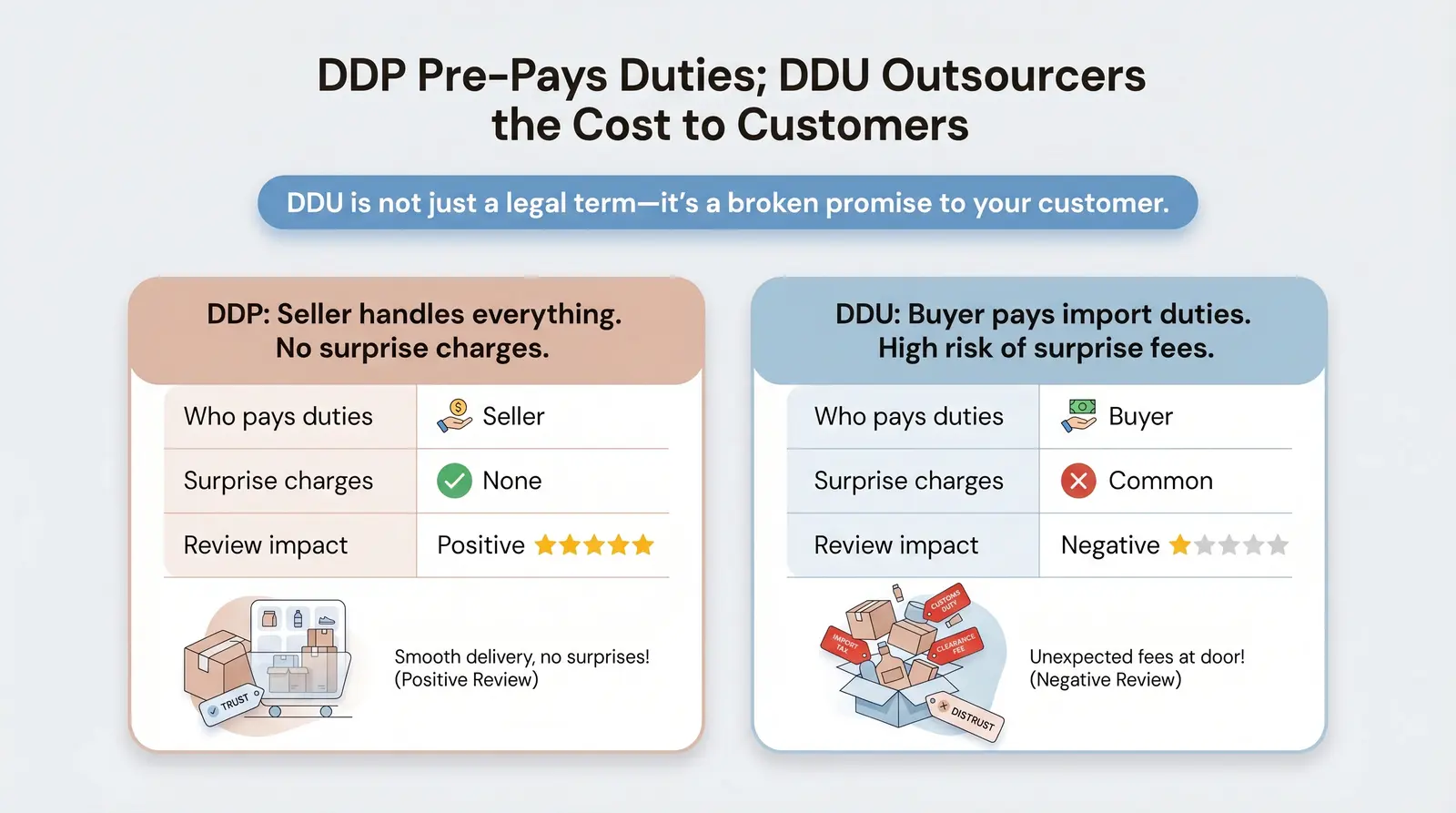
When you ship DDU, you are outsourcing the final, most critical step of your customer journey to a local customs authority and a postal carrier.
Here is what the DDU customer experience actually looks like:
Non-obvious insight: Most sellers assume that if they're not legally responsible for paying the duties under DDU, they're not responsible for the experience either. This is wrong. From the customer's perspective, they bought from your store — not from a customs authority they've never heard of. When they receive a surprise fee demand three weeks after purchase, they write a 1-star review of you. The psychological ownership of the post-purchase experience sits entirely with the brand, regardless of Incoterms legalese. DDU is a legal term; to your customer, it's just a broken promise.
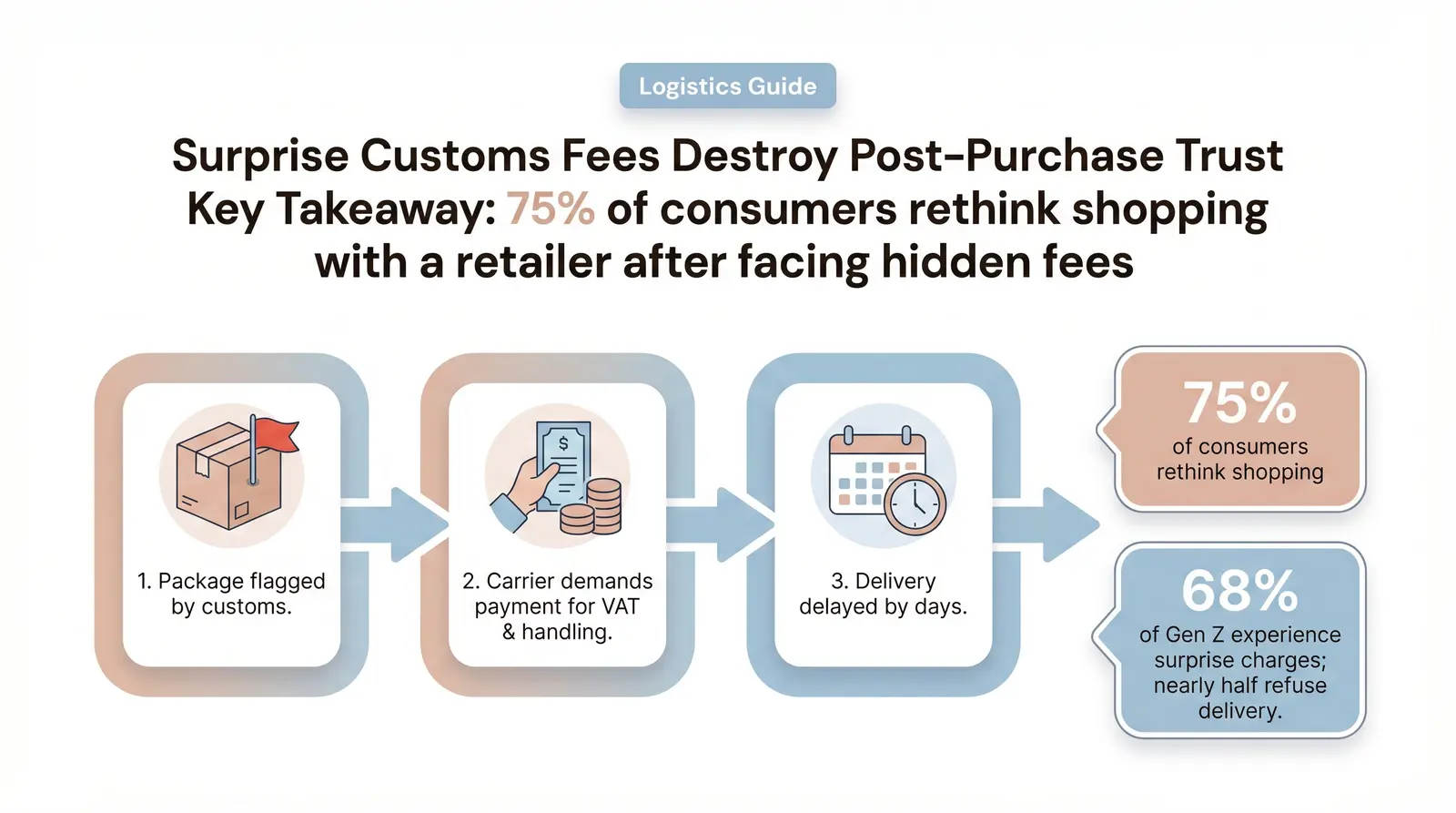
According to a 2024 survey by Avalara, 68 percent of consumers aged 16-24 have experienced surprise customs charges when shopping internationally, and 75 percent of consumers rethink shopping with a retailer after facing these hidden fees [4]. Even worse, nearly half of consumers will simply refuse delivery of a package with hidden costs altogether [4].
When a package is refused, it is returned to the origin at your expense. You lose the product, the shipping cost, and the customer.
Imagine a customer in the UK orders a $65 private-label necklace from your Shopify store. You ship the order DDU.
The package clears UK customs, but because the value is under the £135 threshold, the UK government requires VAT to be collected at the point of sale [5]. If you did not collect it, the package is held. The customer receives a Royal Mail "Something to pay" card demanding £13 in VAT plus an £8 handling fee before delivery.
The customer does not understand why they owe an extra £21. They wait four extra days for re-delivery after paying the fee. They leave a 2-star review: "Product seemed nice but I had to pay extra fees I wasn't told about. Terrible experience. Won't buy again."
Now, imagine the exact same scenario under DDP. The duties and taxes are pre-paid. The package clears customs instantly and is delivered in standard time. The customer leaves a 5-star review praising the fast shipping and beautiful product.
The long-term brand cost of the DDU experience is catastrophic. You have lost a repeat purchase, damaged your review average, and suppressed conversion rates from new visitors who read that 2-star review.
At Branvas, we have a unique vantage point. Because we handle fulfillment for thousands of private-label jewelry and accessories brands, we can see exactly how shipping methods correlate with post-purchase behavior.
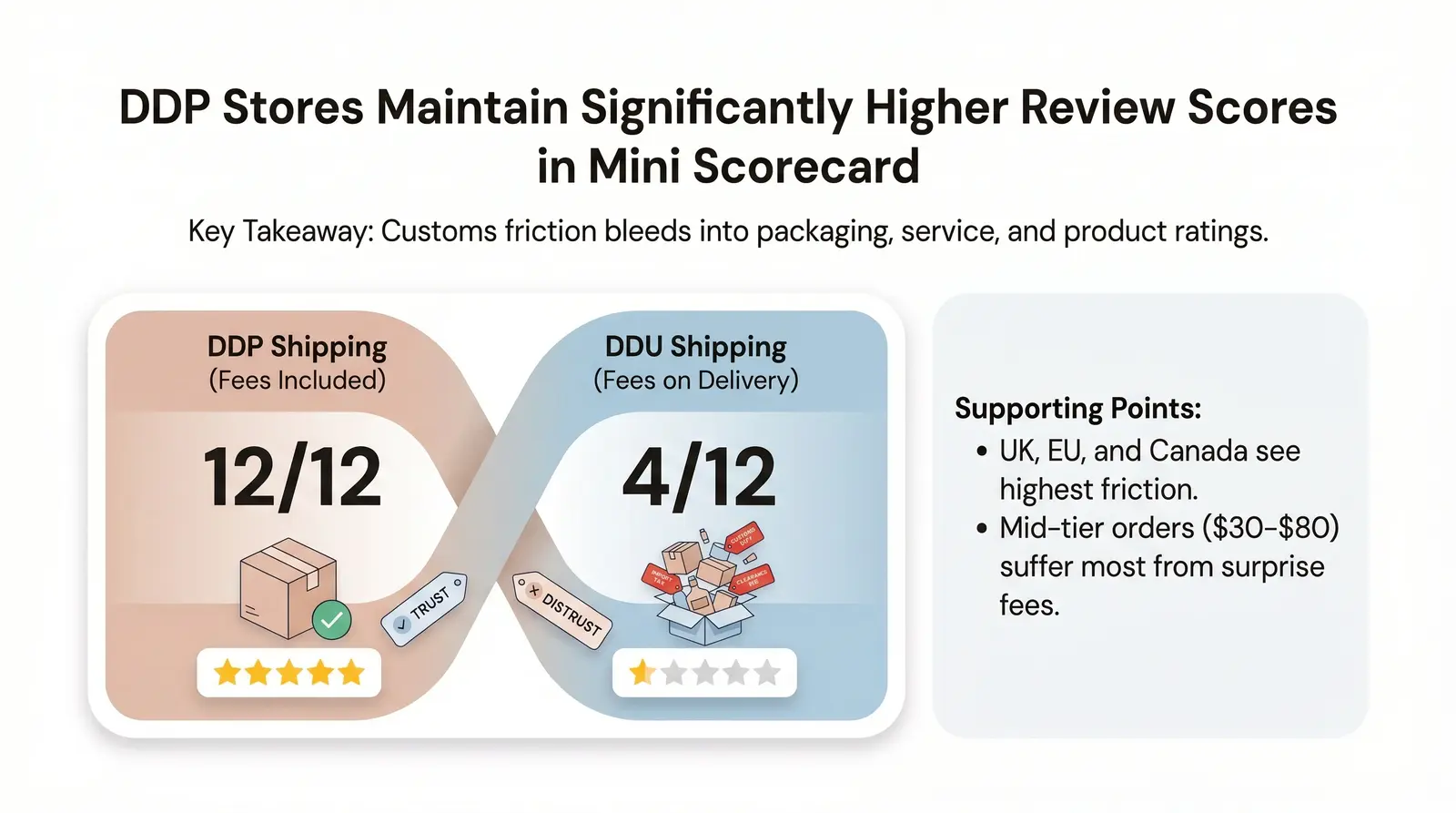
In our experience working with Branvas member stores, we consistently observe that stores using DDP shipping maintain significantly higher review scores across all major platforms compared to stores using DDU.
When we break down the data by destination country, order value, and review component, a clear pattern emerges.
We've observed that the highest-friction destination for DDU shipments among our member stores is consistently the UK, followed by the EU and Canada — markets with strict customs enforcement and low tolerance for surprise charges. In these regions, DDU shipments are disproportionately likely to trigger negative reviews mentioning "hidden fees" or "shipping delays."
The impact of DDU is particularly severe for mid-tier order values ($30–$80). For very cheap items, customs authorities sometimes wave them through (though this is changing rapidly as de minimis thresholds fall globally). For very expensive items, buyers often expect customs fees. But for a $50 accessory, a $15 surprise fee feels like a massive bait-and-switch, destroying the perceived value of the product.
When a customer is hit with a customs fee, they do not just rate the "shipping" poorly. The frustration bleeds into every aspect of the review. We see DDU stores suffer lower ratings on packaging quality, customer service, and overall product satisfaction, simply because the customer's final touchpoint with the brand was negative.
To help our sellers understand this dynamic, we developed the Branvas Shipping Experience Score (BSES). This is a four-factor model for evaluating how a shipping method affects the end-customer experience and review outcome.
| Factor | Description | DDP Score | DDU Score |
|---|---|---|---|
| Duty Transparency | Does the customer know what they'll pay before the package arrives? | 3 (Full transparency) | 1 (Zero transparency) |
| Delivery Predictability | Does customs clearance add unpredictable delays? | 3 (Streamlined) | 1 (High variance) |
| Perceived Value Integrity | Does the post-purchase experience match the price paid? | 3 (Value maintained) | 1 (Value destroyed by fees) |
| Review Attribution Risk | If something goes wrong, will the customer blame the seller? | 3 (Low risk) | 1 (High risk) |
| Total BSES | 12 / 12 | 4 / 12 |
DDP consistently outperforms DDU on the BSES framework. This is exactly why Branvas defaults its fulfillment to DDP-first.
We often see new founders treat shipping method as a back-office decision. It isn't. It's a customer experience decision made before the customer even places their order.
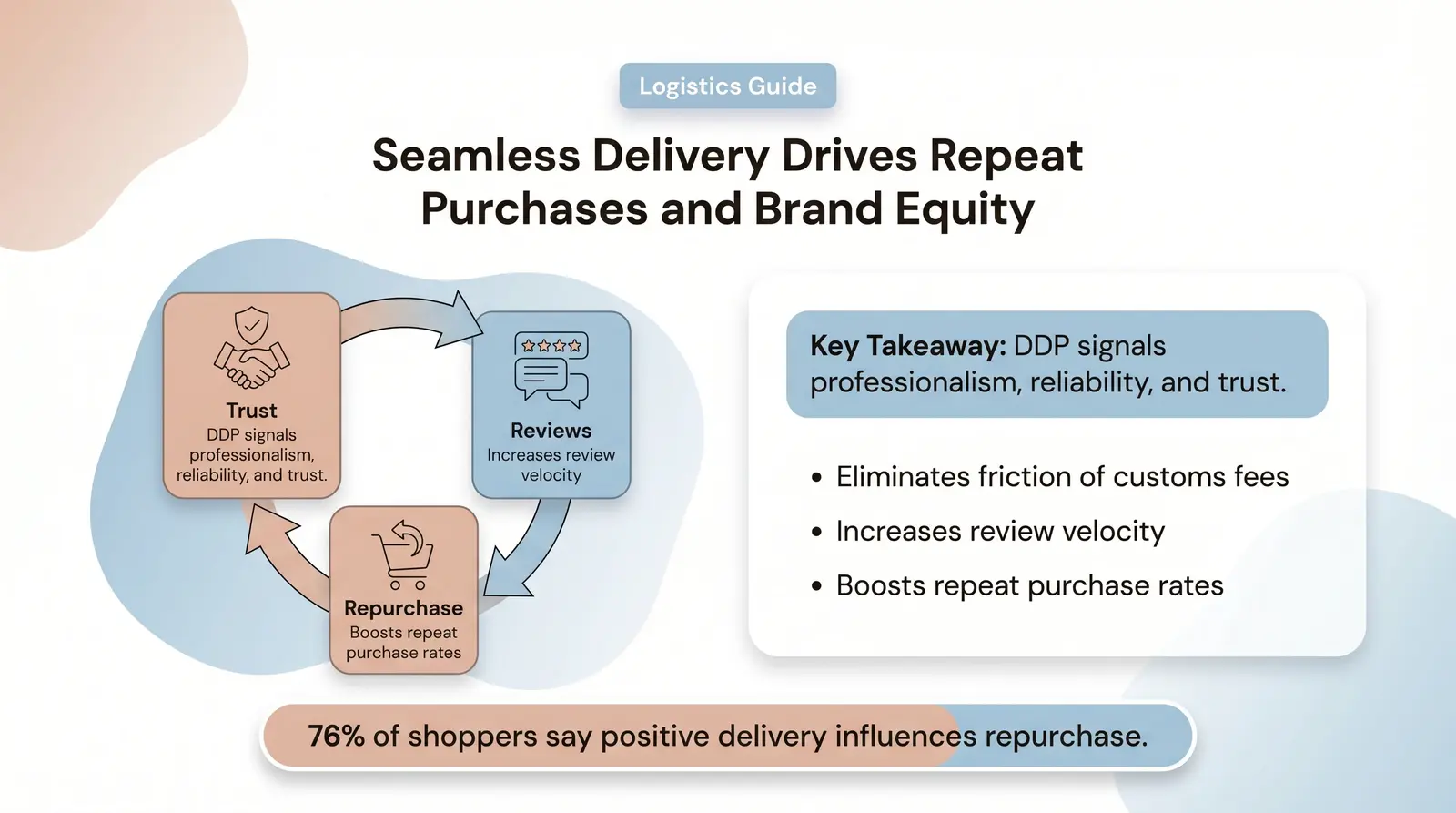
DDP is a brand promise. When a customer receives their package with no surprise charges, it signals professionalism, reliability, and trust. It tells the customer that you are a legitimate global brand, not a fly-by-night dropshipper trying to pass off hidden costs.
This trust translates directly into brand equity. According to Sifted's 2025 Consumer Survey, 76 percent of shoppers said a positive delivery experience influenced their decision to repurchase from a brand [6]. By eliminating the friction of customs fees, DDP increases your review velocity, boosts your repeat purchase rates, and drives positive word-of-mouth.
If you're building a private-label jewelry or accessories brand and want DDP fulfillment built in from day one, explore how Branvas works — no customs surprises, ever.
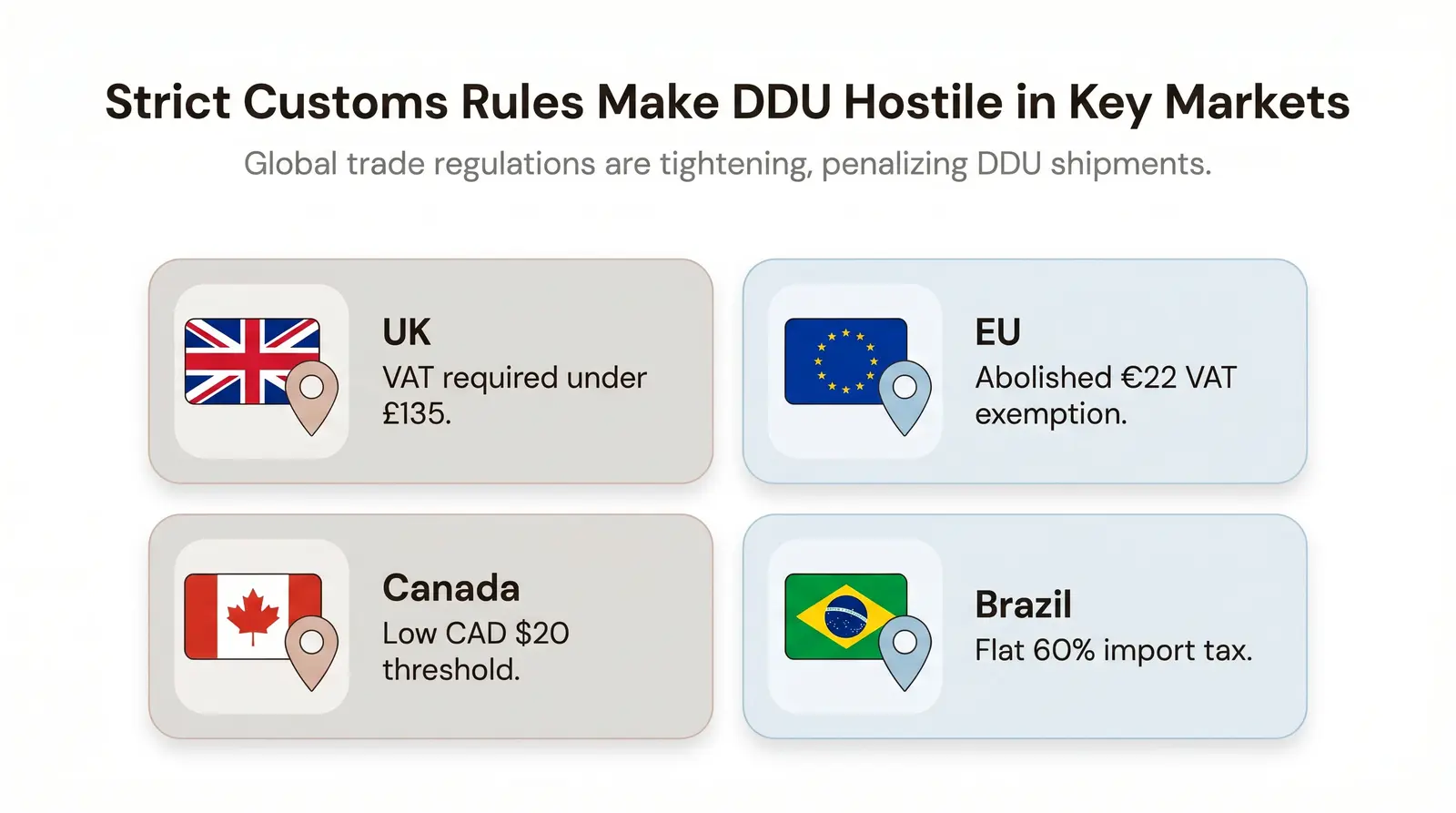
The risk of shipping DDU is not distributed equally. As global trade regulations tighten, certain markets have become incredibly hostile to DDU shipments. Here is where DDU will hurt your reviews the most:
Post-Brexit rules require VAT to be collected at the point of sale for orders under £135 [5]. If you ship DDU and fail to collect this, the customer faces Royal Mail handling fees (£8) on top of the VAT. This leads to severe delivery delays and almost guaranteed 1-star reviews. The UK is consistently the highest-friction market for DDU.
The EU abolished its €22 VAT exemption and is moving to scrap the €150 customs duty exemption [7]. Every package is now scrutinized. Surprise VAT charges at the door cause massive cart abandonment and package refusals across the continent.
Canada has a notoriously low de minimis threshold of just CAD $20 for duty and tax exemptions [8]. Almost all ecommerce orders trigger duties, frustrating buyers who expect seamless cross-border trade with the US. DDU shipments to Canada are a major source of customer complaints.
Australia removed the GST exemption for low-value imported goods (under AUD $1,000) [9]. Sellers must collect 10% GST at checkout. Failing to do so causes clearance delays and unhappy customers. While less hostile than the UK, it still presents a significant risk for DDU shippers.
Brazil has a highly complex tax system with a flat 60% import tax on many shipments, plus ICMS tax [10]. DDU shipments to Brazil routinely face massive fees, months-long delays, and high abandonment rates. It is arguably the most difficult market to serve without a robust DDP strategy.
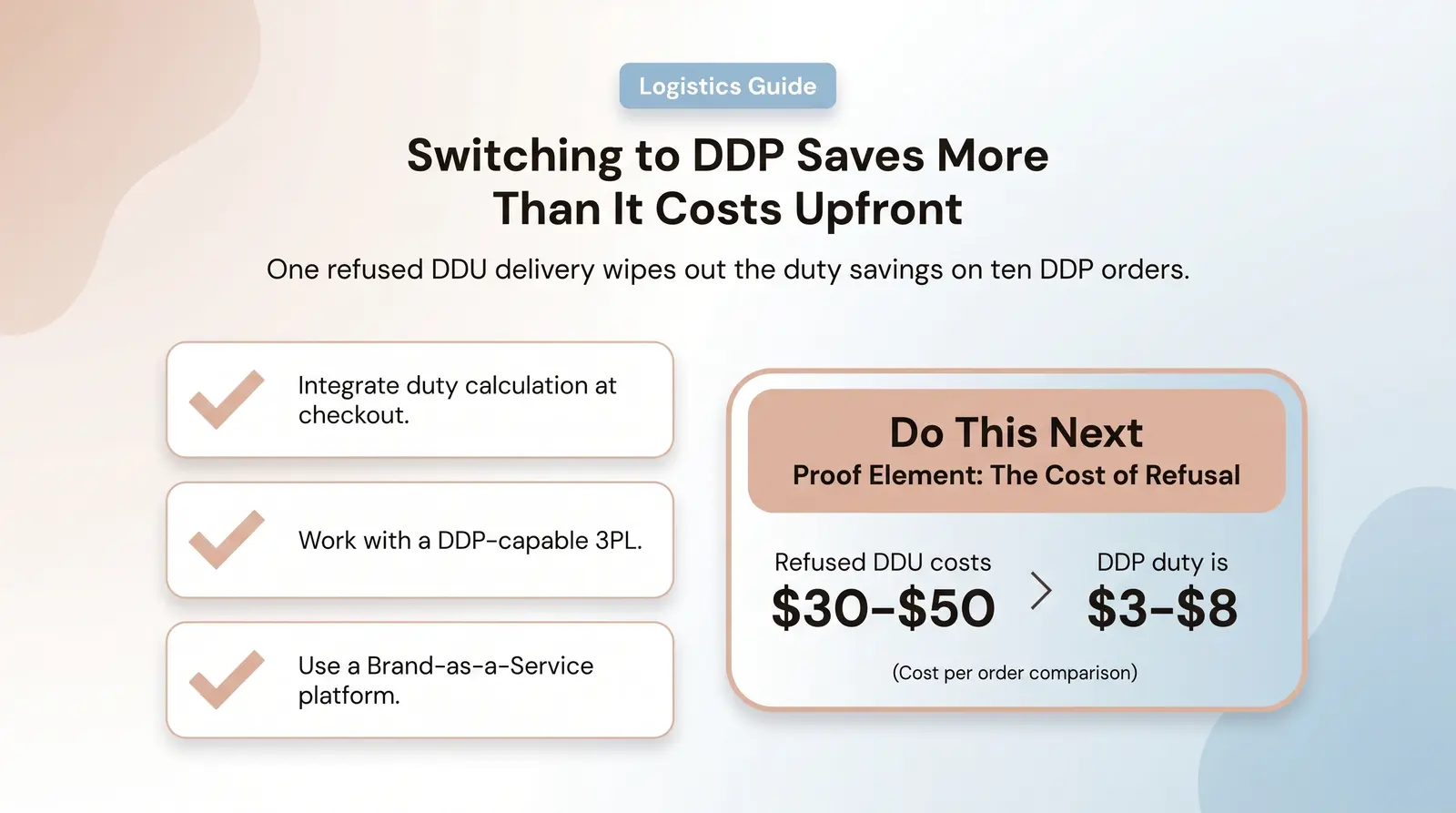
Switching from DDU to DDP might sound intimidating, but it does not require you to become a customs broker or renegotiate your entire supply chain. Here are the most practical ways to make the switch:
There is an honest tradeoff here: DDP usually costs slightly more upfront. You are paying for the customs clearance process and absorbing the duties (or passing them through transparently at checkout).
But the math heavily favors DDP. A single refused DDU shipment can cost you $30 to $50 in return freight, lost product, and refunded revenue [2]. The average prepaid duty on a DDP order might be $3 to $8. One refused DDU delivery wipes out the duty savings on ten DDP orders.
Branvas includes DDP-capable fulfillment as a core part of its Brand-as-a-Service model for ecommerce sellers building private-label brands. We handle the logistics, the customs, and the delivery, so you can focus on marketing. See how it works →
1. What is the difference between DDP and DDU shipping?
DDP (Delivered Duty Paid) means the seller pays all import duties, taxes, and customs clearance fees before the package arrives. DDU (Delivered Duty Unpaid) means the buyer is responsible for paying these fees to the local customs authority or carrier before they can receive their package.
2. Does DDP shipping cost more than DDU?
Yes, DDP typically has a higher upfront cost for the seller because it includes the prepayment of duties and customs brokerage fees. However, it often saves money in the long run by drastically reducing package refusals, return shipping costs, and customer service overhead.
3. How does DDU shipping affect customer reviews?
DDU shipping frequently leads to negative customer reviews because buyers are hit with surprise fees and delivery delays at the door. Customers almost always blame the brand for these hidden costs, resulting in lower overall star ratings and damaged brand trust.
4. Is DDP required for dropshipping to the UK or EU?
While not strictly legally required in all cases, DDP is highly recommended for the UK and EU due to strict new tax laws. The UK requires VAT collection at checkout for orders under £135, and the EU has abolished its low-value VAT exemptions, making DDU shipments highly prone to delays and fees.
5. Which shipping method is better for building a long-term ecommerce brand?
DDP is universally better for building a long-term brand. It provides a seamless, transparent post-purchase experience that encourages repeat purchases, positive reviews, and strong customer lifetime value.