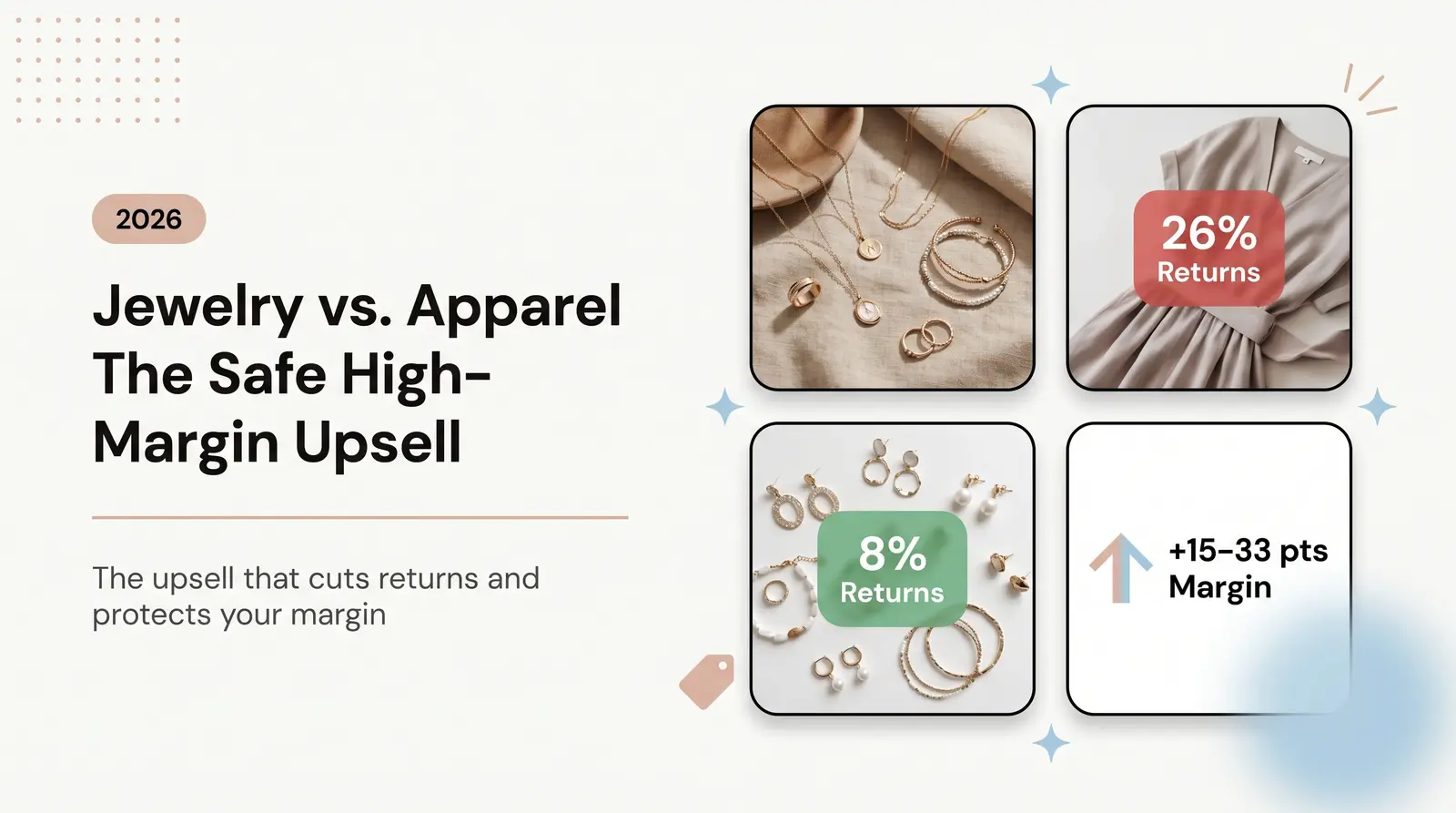



Adding a jewelry category to your clothing boutique boosts AOV, improves margins, and drives repeat purchases without holding inventory through on-demand fulfillment.
Published:
April 18, 2026
Author:
Yi Cui
The easiest upsell your clothing store is missing. You have spent years curating the perfect apparel collections, building a loyal customer base, and designing a shopping experience your customers love. But if you are only selling clothing, you are leaving money on the table at every single checkout. The fix is simpler, faster, and lower-risk than you probably think.
Average Order Value (AOV) is the average amount a customer spends per transaction. It is calculated by dividing total revenue by total number of orders. For a clothing boutique with fixed overhead, a capped local audience, and rising ad costs, AOV is the highest-leverage metric you have. The fastest way to increase boutique AOV is not a new ad campaign or a new platform. It is a smarter product mix. You can double your revenue without doubling your traffic. You just need each customer to spend a little more.
Here is what the data shows. Fashion and apparel ecommerce stores average an AOV of roughly $85 to $105 [1]. Stores that carry jewelry and accessories as a complementary category consistently push their AOV above the $120 mark [1]. That gap is not accidental. It reflects a simple truth: when customers can complete the look in one cart, they do.
Most boutique owners think they need more customers to grow revenue. That is the wrong instinct. The faster path is getting existing buyers to spend more per transaction. Acquiring a new customer costs up to five times more than selling to an existing one [2]. When you pour budget into ads and social media to drive new traffic, you are paying a premium for growth that is already sitting in your checkout flow.
We often see boutique owners obsessing over ad spend and follower counts when the fastest revenue lever is sitting right in their product mix.
The math is unforgiving. If your boutique does 100 orders a month at a $65 AOV, you are generating $6,500 in monthly revenue. If you can increase that AOV by just $15 through a jewelry add-on, you add $1,500 per month, or $18,000 per year, without a single new customer. No new ad campaign. No new platform. No new audience to build.

Not every product category makes sense as a boutique add-on. Jewelry does, and the reasons go beyond the obvious.
Natural pairing. Customers already mentally "complete the look" when they shop for clothing. They are thinking about how the dress pairs with earrings, how the blouse works with a layered necklace, how the outfit needs a finishing piece. Jewelry for boutique stores is not a stretch. It is the logical next step in the customer's own thought process. You are not convincing them to want something new; you are simply making it easy to get what they already want.
High margin, low footprint. Jewelry carries some of the strongest margins in all of retail. Independent jewelry businesses typically operate at gross margins of 42% to 75% [3], compared to the 40% to 55% range common in apparel. Small SKUs, lightweight shipping, and minimal storage requirements mean jewelry adds revenue without adding operational complexity. A rack of 10 necklaces takes up less space than one folded sweater.
Impulse-buy price points. Most boutique jewelry sells in the $18 to $75 range. This is the sweet spot for add-on purchases: high enough to move your AOV meaningfully, low enough that customers do not need to think twice. A $32 pair of earrings is not a considered purchase for someone who just added a $75 dress to their cart. It is a yes.
Repeat purchase behavior. Accessories drive return visits. Customers who buy a necklace from your boutique come back to find matching pieces, to buy gifts, or to refresh their collection each season. The clothing store accessories category is not just an AOV play. It is a retention play.
Table 1: AOV Impact Scenarios: Clothing Boutique With vs. Without Jewelry Add-On
| Scenario | Attach Rate | Avg. Jewelry Item Price | New AOV | Monthly Revenue | Annual Revenue Lift |
|---|---|---|---|---|---|
| Scenario A: No Jewelry | 0% | $0 | $65.00 | $6,500 | $0 |
| Scenario B: Moderate Upsell | 30% | $28 | $73.40 | $7,340 | $10,080 |
| Scenario C: Strong Upsell | 50% | $38 | $84.00 | $8,400 | $22,800 |
Based on a baseline of 100 orders/month at a $65 AOV. Annual Revenue Lift reflects the incremental gain over Scenario A.
The numbers in Scenario C are not aggressive. A 50% jewelry attach rate is achievable when the product is well-curated, priced correctly, and presented as a natural complement to the clothing. Use Branvas's profit calculator to model your own store's potential lift based on your actual order volume and AOV.

Let us be honest about the real objection. Boutique owners have been burned by dead inventory. You bought into a trend, ordered a minimum quantity, and watched half of it sit on the rack for six months. Jewelry feels even riskier because styles change fast, sizes do not apply the same way, and a piece that looks great in a photo can feel cheap in person.
Research shows that 20% to 30% of inventory in most retail businesses becomes dead stock each year [4]. For a small boutique, that is not just a financial hit. It is a cash flow crisis. Dead inventory locks up capital that could be going toward your next clothing buy, your marketing, or your operations.
The fear of inventory risk is the single biggest reason boutique owners delay adding jewelry, but it is also the most solvable problem on the list.
Here is the reframe: the inventory risk model you are imagining is the old model. Modern private-label and on-demand fulfillment have changed the equation entirely. Blind dropship fulfillment means a partner holds the inventory and ships directly to your customer under your brand name. You list the product, you collect the sale, and you pay the supplier only after the customer has already paid you. You never touch the product. You never carry the risk.
In our experience at Branvas, boutique owners who make the switch to on-demand jewelry fulfillment describe it as one of the lowest-stress product decisions they have ever made.

You do not need to become a jewelry sourcing expert, build supplier relationships in overseas markets, or invest in photography equipment. The entire launch process can be completed in days.
The Branvas "Zero-Risk Jewelry Launch" Framework (a 4-step system for clothing boutiques)
Worked Example: The Coastal Chic Boutique (illustrative)
A hypothetical women's clothing boutique ("Coastal Chic") selling beachy resort wear at an average of $72 AOV decides to add 8 jewelry SKUs via Branvas: layered necklaces, shell earrings, and stackable rings priced $22 to $45. Within 60 days, 40% of orders include at least one jewelry item. Average jewelry add-on: $31. New AOV: $84.40. On 120 monthly orders, that is a $1,488/month revenue increase, or $17,856 annualized, with zero inventory held.

Whether you choose Branvas or evaluate other options, the criteria for a quality jewelry partner are the same. Use this as your decision checklist.
Blind shipping capability. Your brand should appear on every package, not your supplier's. Customers should never know a third party is involved. This protects your brand equity and your customer relationships.
No or low minimum order quantities. You should be able to start with a handful of SKUs and scale up based on what actually sells. Any partner requiring large upfront commitments is putting the inventory risk back on you.
Private-label and custom branding options. Custom packaging, branded inserts, and logo-stamped materials are what separate a professional jewelry launch from a generic dropship operation. Your customers will notice the difference.
Integration with major ecommerce platforms. Shopify, WooCommerce, and similar platforms should be natively supported. Manual order processing is a time drain that eliminates the efficiency benefit of the model.
Product quality and return policy. Request samples before listing. A clear return or exchange policy protects both you and your customer if a piece does not meet expectations.
Trend refresh cadence. The jewelry market moves seasonally. Your partner should be updating their catalog regularly so you can swap in new styles without starting from scratch.
If you're evaluating partners, Branvas's How It Works page walks through exactly how boutique owners go from zero to a fully branded jewelry category, without the typical headaches.

The honest answer is: mostly yes, but not identically for everyone.
Boutiques with a very niche, non-accessory-adjacent aesthetic may see lower attach rates. A store focused exclusively on technical activewear or workwear suiting may find that jewelry does not naturally fit the customer's mindset at checkout. That does not mean accessories are off the table. It means you need to think carefully about which accessories make sense. A sleek, minimal cuff or a simple chain might work even for a professional workwear boutique.
Price point alignment matters more than most owners realize. A luxury boutique selling $400 dresses should not be pairing them with $12 fast-fashion jewelry. The price gap signals a mismatch in quality and brand positioning that can actually undermine customer trust. Match your jewelry price points to your clothing price points, and your customers will treat the accessories as a natural part of the experience.
The safest and smartest approach is to start small. Launch with 8 to 12 carefully selected SKUs that reflect your brand's aesthetic. Run them for 60 to 90 days, track attach rates and which styles convert, and then scale the winners. You are not committing to a full accessories department on day one. You are running a low-risk test that pays for itself.

1. How many jewelry SKUs should a clothing boutique start with?
Start with 8 to 12 SKUs. This is enough variety to give customers real choices without overwhelming your site or your own curation bandwidth. Focus on a few core categories: earrings, necklaces, and one or two stackable or layering options. After 60 to 90 days, you will have clear data on which styles your customers prefer, and you can expand from there with confidence.
2. Can I sell jewelry in my boutique without holding inventory?
Yes. By partnering with a private-label dropship provider like Branvas, you list products on your site and they are fulfilled on-demand. The partner handles storage, picking, packing, and blind shipping directly to your customer. You pay for the product only after the customer pays you, which means your cash flow is protected and your inventory risk is essentially zero.
3. How does adding clothing store accessories affect my boutique's brand identity?
Done correctly, accessories strengthen your brand identity. They signal that your boutique is a complete lifestyle destination, not just a place to buy individual pieces. The key is custom branding: your logo on the packaging, your brand colors, your aesthetic in the product selection. When a customer receives a branded jewelry piece from your boutique, it reinforces your store as the place they go to complete their look.
4. What margin can boutique owners expect on private-label jewelry?
Jewelry is one of the highest-margin categories in retail. Boutique owners working with private-label fulfillment partners typically see gross margins of 40% to 75%, depending on their pricing strategy and the perceived value of their brand [3]. At the lower end of boutique jewelry price points ($22 to $45), a 50% margin is very achievable. Visit Branvas's pricing page for a direct look at the cost structure.
5. How do I integrate a jewelry category into my existing Shopify boutique store?
The integration is straightforward. Connect your Shopify store to your fulfillment partner's app or platform, import the selected SKUs with their provided product imagery and descriptions, and create a new "Jewelry" or "Accessories" collection in your store navigation. Most modern fulfillment platforms handle inventory syncing and order routing automatically, so there is no manual processing involved once the initial setup is complete.
Jewelry is not a distraction from your clothing brand. It is the most natural, margin-friendly, and risk-free revenue extension available to boutique owners right now. Your customers are already thinking about it when they shop your clothing. The only question is whether they are buying it from you or someone else.
With on-demand fulfillment, you can increase your AOV, delight your customers with a complete brand experience, and add a meaningful revenue line without tying up a single dollar in dead stock.
Ready to add a branded jewelry category to your boutique, without the inventory risk? Explore Branvas for Boutique Owners