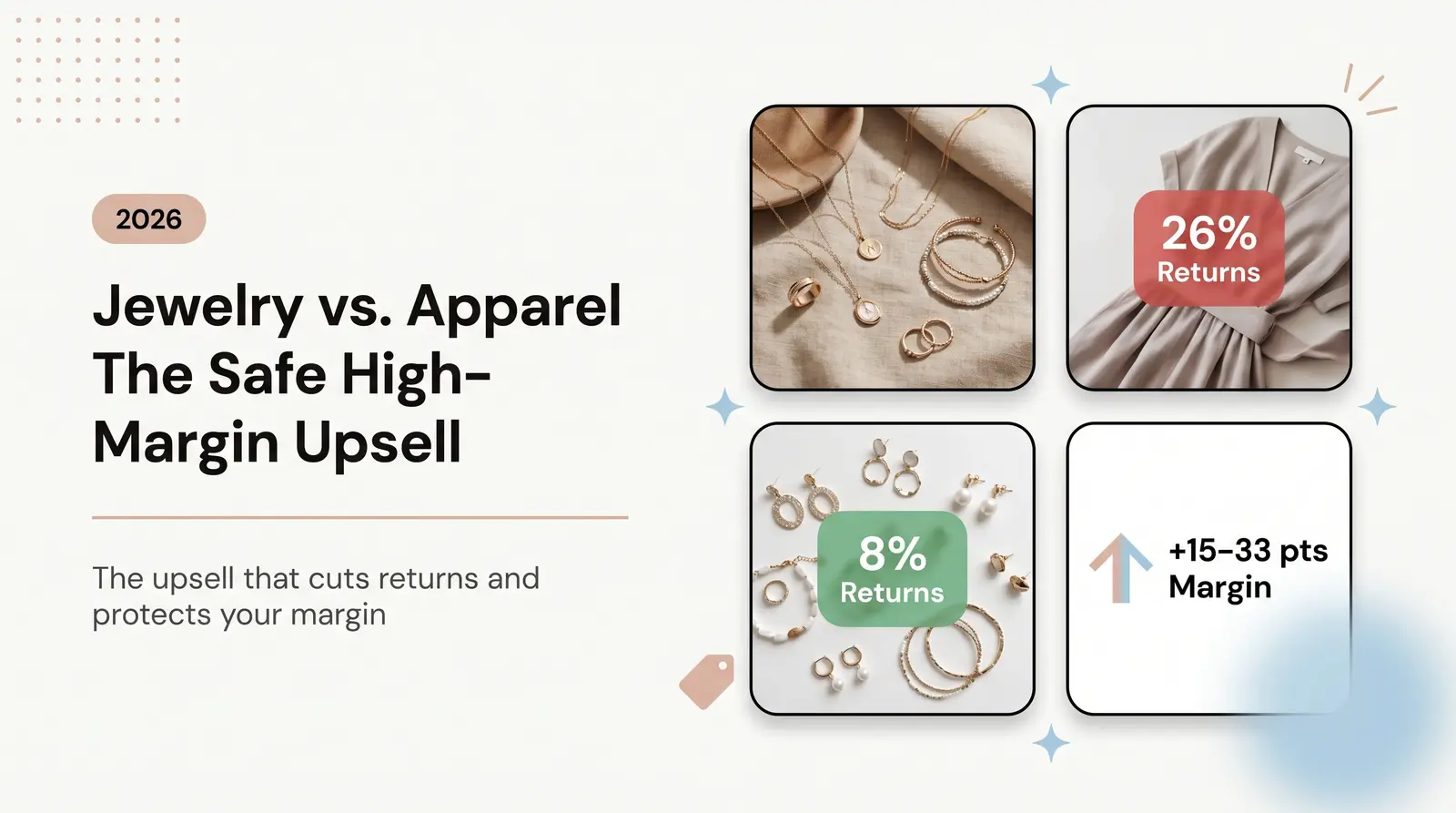



Jewelry’s structurally low 8% return rate and 60-80% gross margins make it the highest-leverage category addition for boosting blended ecommerce profitability.
Published:
April 21, 2026
Author:
Yi Cui
The hidden data point that makes jewelry the safest high-margin upsell for boutiques isn't its conversion rate. It's the structural absence of returns.
For ecommerce store owners, returns are not just a logistics cost. They are a margin-destruction mechanism that compounds across reverse shipping fees, restocking labor, customer acquisition cost write-offs, and potential product markdowns. When a customer returns a $50 item, you don't just lose the sale. You absorb the outbound shipping you already paid, the return label, the processing time, and the write-off if the item comes back damaged.
In our experience at Branvas, the first thing new boutique owners are shocked by isn't their COGS. It's how much their return rate quietly erodes every margin calculation they made.
Most operators focus on top-line revenue and front-end conversion, ignoring the back-end bleed. But category mix is a strategic lever, and the data overwhelmingly favors jewelry as a structural stabilizer for ecommerce profitability. This article will prove it.

The ecommerce returns landscape has reached a scale that most merchants underestimate. According to the National Retail Federation, an estimated 19.3% of online sales will be returned in 2025, with total retail returns projected to reach $849.9 billion [1]. Online retail returns average 24.5%, roughly triple the in-store rate of 8.72% [3].
That headline number, however, masks a massive disparity between product categories. Apparel and footwear consistently suffer the highest return rates, driven primarily by sizing and fit issues. Jewelry and accessories, by contrast, maintain return rates that are a fraction of the industry average [2] [4].
The compounding cost of a single return makes this disparity even more damaging. Factoring in reverse logistics, processing labor, restocking, and potential markdowns, the true all-in cost of one return can range from $10 to $65 per item. Only 48% of returned items are resold at full price; the rest are discounted, liquidated, or written off entirely [6].
E-commerce Return Rate Benchmarks by Category
| Product Category | Avg. Return Rate | Primary Return Reason | Relative Margin Risk |
|---|---|---|---|
| Apparel/Fashion | 25% (range: 18-31%) | Sizing/fit | High |
| Footwear | 20% (range: 15-27%) | Sizing/fit | High |
| Jewelry/Accessories | 8% (range: 5-10%) | Style preference / gifting | Low |
| Electronics | 11% (range: 5-15%) | Defect/expectations | Medium-High |
| Home Goods | 19% (range: 8-23%) | Sizing/decor mismatch | Medium |
(Data compiled from NRF, Loop Returns, Eightx, and ReturnZap industry benchmarks [1] [2] [5] [6].)
Apparel returns are overwhelmingly about fit, with Loop Returns data showing that 56% of apparel returns cite fit or size as the primary reason [2]. Footwear is even more sensitive, with 61% of returns tied to fit issues. Jewelry and accessories, by contrast, see style or preference as the dominant return reason, at 33-38% of returns, and even that driver is far less common than fit-driven returns in softlines [2].

The low return rate of jewelry is not a coincidence. It is built into the nature of the product, and understanding why matters for any merchant thinking about category strategy.
No sizing problem. The single biggest driver of apparel and footwear returns is poor fit, cited in over 50% of returns across those categories [2]. Jewelry is largely one-size-fits-all. Necklaces, earrings, and bracelets require no fit decision. That entire category of returns simply does not exist.
Emotional and gifting purchase behavior. Jewelry is disproportionately bought as a gift or self-reward. Buyers are psychologically pre-committed to the item before it arrives. The purchase decision is more deliberate, and the emotional attachment is higher.
Price-to-perceived-value ratio. Jewelry holds its perceived value even after unboxing in a way a misfit blouse does not. A $45 necklace that looks exactly like the product photo creates no cognitive dissonance. A dress that fits differently than expected creates immediate return intent.
Impulse-to-keep psychology. Once worn or gifted, the return threshold rises sharply. The friction of initiating a return outweighs the recovery value, especially at accessible price points under $75.
Here is the contrarian insight most merchants miss: most operators assume their high return rate is a fulfillment problem. It isn't. It's a category problem. Optimizing your return portal won't fix a 25% apparel return rate. Reconsidering your product mix will.
We often see founders spend thousands on return automation software when the more powerful move is simply adding a low-return-rate category to their catalog.

To understand the true financial impact of category mix, we use the Branvas Category Blending Matrix, a decision model for ecommerce operators to evaluate how adding a low-return, high-margin product category affects their store's blended net margin.
The framework relies on four inputs:
A Shopify boutique sells 80% apparel and 20% accessories. Apparel gross margin = 55%, return rate = 25%. Accessories/jewelry gross margin = 68%, return rate = 8%. Using the Branvas Category Blending Matrix:
Apparel effective margin after returns:
Jewelry effective margin after returns:
Blended Margin Index before jewelry expansion (80/20 mix):
BMI = (0.80 x 47.5%) + (0.20 x 65.6%) = 38.0% + 13.1% = 51.1%
If store shifts mix to 60/40 apparel/jewelry:
New BMI = (0.60 x 47.5%) + (0.40 x 65.6%) = 28.5% + 26.2% = 54.7%
Insight: The shift to 40% jewelry increases blended net margin by approximately 3.6 percentage points, with zero change to traffic, conversion rate, or CAC. (Numbers are illustrative and based on industry benchmark data. Your actual figures will vary based on your specific COGS, shipping carrier, and fulfillment model.)
This is the power of category blending. You don't need to acquire more customers. You need to sell them something that doesn't come back.

Tactical return-reduction tools have their place. For apparel merchants, the following steps can help reduce returns within the category:
These are real improvements. But they are second-order levers. They reduce returns within a category; they cannot bridge the structural divide between categories. A well-executed sizing chart might reduce your apparel return rate from 28% to 22%. That is meaningful. But it still leaves you at 22%, compared to 8% for jewelry.
For Shopify merchants looking for the highest-leverage move, adding jewelry and accessories as a low-return, high-margin SKU category is the structural fix. It diversifies your return risk and stabilizes your cash flow at the store level, not just the SKU level.
If you're curious how your margins could look with a private-label jewelry line added to your store, Branvas's Profit Calculator lets you model it in under 2 minutes.

Understanding the margin benchmarks for jewelry is essential for evaluating the category as a business decision.
A healthy gross margin for direct-to-consumer jewelry typically ranges from 60% to 80% [7]. This is significantly higher than the apparel gross margin benchmark of 45-55%, and the gap widens further once return rates are factored in.
The margin profile varies by sourcing model:
Private-label jewelry is the highest-margin model because you are not competing on price with identical products. You are selling a branded experience. And return rates for branded, packaged jewelry are even lower than the category average, because the unboxing and gifting premium increases perceived value and reduces buyer's remorse.
Branvas makes it possible to launch your own private-label jewelry brand in days, not months, with no inventory risk. See how it works. You can also browse Branvas's jewelry catalog to see what's available for private-label branding and start building your high-margin product line today.

The argument is simple: returns are a category problem, and jewelry is the structural solution. By blending high-margin, low-return accessories into your product mix, you can increase your store's overall profitability without acquiring a single new customer, running a new ad, or redesigning your storefront.
Three types of merchants should act on this data now.
The apparel boutique owner bleeding margin to returns: Category diversification is your highest-ROI move. You don't need to abandon apparel. You need to offset it. Learn more at branvas.com/solutions/ecommerce-and-boutique-store-owners.
The Shopify generalist looking for a high-margin product line: Jewelry is the data-backed answer. Low return rates, high gross margins, and strong gifting demand make it the most defensible category for a new product line.
The influencer or creator considering launching a product: Jewelry is the safest first SKU category by return rate and margin profile. The barrier to entry is low, the margin is high, and the return risk is minimal. Explore your options at branvas.com/solutions/influencers-creators and branvas.com/solutions/aspiring-entrepreneurs.

1. What is the average return rate for jewelry sold online?
The average return rate for ecommerce jewelry purchases is approximately 8%, with a typical range of 5% to 10% [4]. This is significantly lower than the overall ecommerce average of 19-20% and a fraction of the 25%+ return rate common in apparel. The low rate is structural, driven by the absence of fit-related returns and the high proportion of gift and self-reward purchases.
2. Why do apparel return rates stay so high despite better technology?
Despite advancements like AR try-ons, detailed sizing charts, and customer fit reviews, apparel return rates remain high because fit is deeply subjective and varies across brands, fabrics, and body types. Consumer behavior also plays a role: "bracketing," the practice of buying multiple sizes with the intent to return what doesn't fit, is reported by roughly 63% of shoppers and is especially common among younger demographics [3]. Technology can reduce returns at the margin, but it cannot eliminate the fundamental uncertainty of buying clothing online.
3. How do e-commerce returns affect net profit margins on Shopify stores?
Returns erode net profit margins through multiple channels: reverse logistics costs, processing and restocking labor, and the write-off of damaged or unsellable goods. Research shows that only 48% of returned items are resold at full price, meaning more than half of returns result in a markdown or liquidation loss [6]. A 25% return rate can reduce a product's effective contribution margin by 30% to 50%, turning seemingly profitable sales into net losses once all return-related costs are accounted for.
4. Is private-label jewelry more profitable than reselling other brands' jewelry?
Yes, private-label jewelry is generally more profitable. By building your own brand, you can command higher retail prices and capture gross margins of 60% to 80%, compared to the 40-55% margins typical of reselling commodity or white-label products [7]. Private-label also provides pricing power and brand equity that resale cannot replicate. Over time, the compounding effect of higher margins and lower return rates creates a significantly stronger financial foundation.
5. How can a boutique owner add jewelry to their Shopify store without holding inventory?
Boutique owners can use Brand-as-a-Service (BaaS) platforms like Branvas to launch a private-label jewelry line with no upfront inventory. These platforms handle product sourcing, branding, custom packaging, and blind shipping directly to the end customer. The merchant sets their own retail price, captures the margin, and never touches the product. It is the lowest-risk way to add a high-margin, low-return category to an existing store.
[1] 2025 Retail Returns Landscape — National Retail Federation, 2025
[2] Most Common Return Reasons in Ecommerce by Vertical (2026 Data and Trends) — Loop Returns, 2026
[3] Average Retail Return Rate (2026 Data) — Capital One Shopping, 2026
[4] Return Policy Strategies for Jewelry Brands in 2025 — Loop Returns, 2025
[5] Shopify Return Rate Benchmarking — ReturnZap, 2024
[6] Average eCommerce Return Rate by Category (2026 Data) — Eightx, 2026
[7] Jewelry Profit Margin Calculator: See Your Earnings — Branvas, 2026