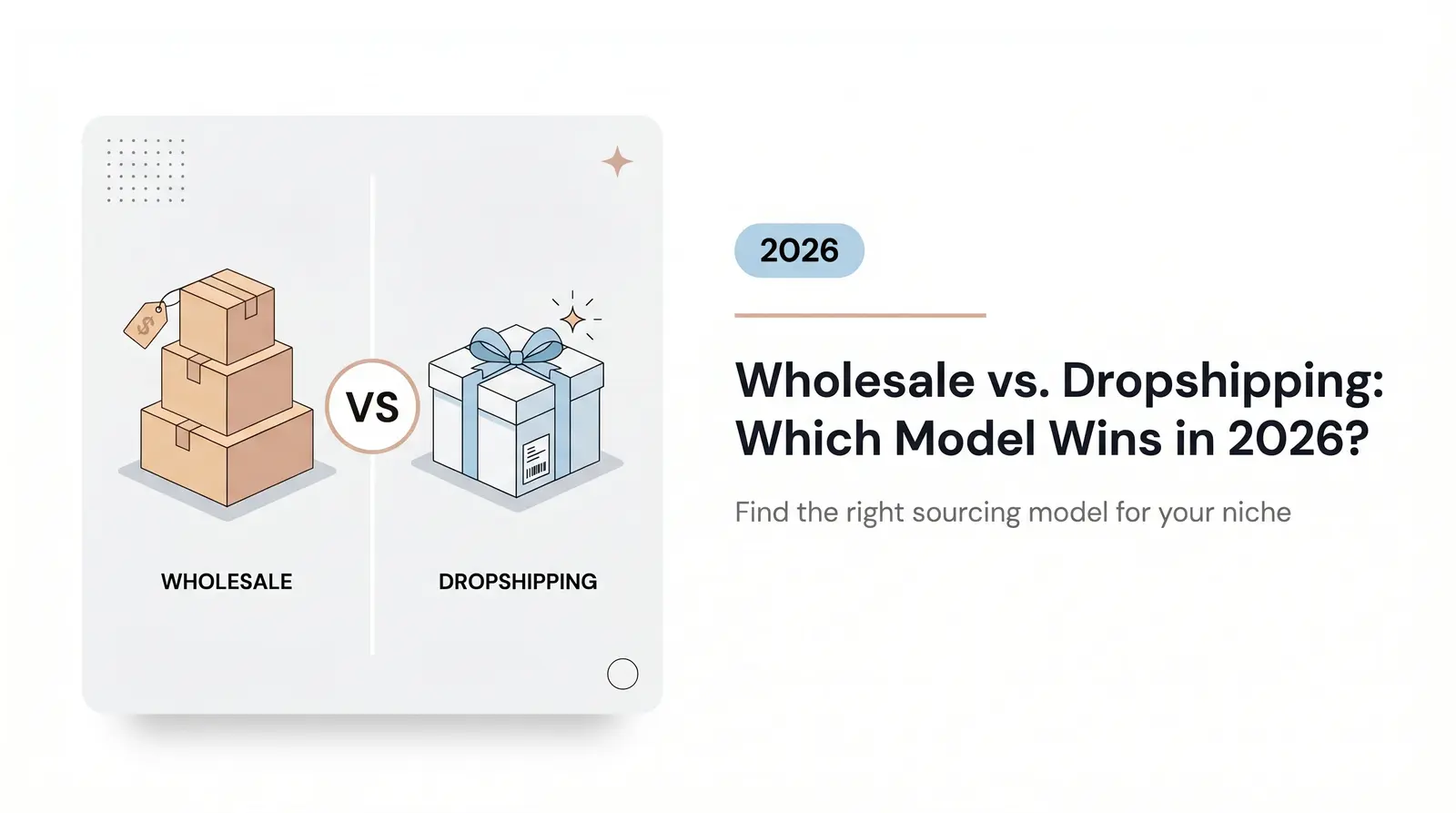



Wholesale jewelry inventory carries five hidden costs—storage, dead stock, insurance, capital opportunity cost, and labor—that dropshipping eliminates, often resulting in better effective margins.
Published:
April 10, 2026
Author:
Yi Cui
Inventory is a silent cash trap. Imagine a jewelry seller who just bought $8,000 in wholesale inventory. They negotiated a great per-unit price, the stock arrived, and they felt like a real brand founder. But six months later, they discover that the real cost of that inventory was closer to $11,500 once carrying costs were factored in. Their cash is tied up, their margins are shrinking, and they are stuck paying to store products that haven't sold yet.
This is the reality for thousands of ecommerce entrepreneurs. Wholesale inventory has five hidden costs most sellers never calculate. While buying in bulk seems cheaper on paper, the financial leaks it creates can quietly suffocate a growing business.
The dropshipping model, particularly when paired with a fulfillment partner, is structurally designed to eliminate each one of these costs. Understanding the true price of holding stock is the first step toward making a smarter decision about how to build your brand.
When founders compare dropshipping vs wholesale, they almost always focus on the per-unit cost. It is true that buying 500 necklaces wholesale gives you a lower cost per piece than dropshipping them one by one. But this comparison is dangerously incomplete.
The missing metric is Total Inventory Cost (TIC). TIC measures not just the purchase price of the goods, but the full cost of owning, storing, and managing physical stock over time. When you calculate TIC correctly, the per-unit cost advantage of wholesale often disappears entirely. In many cases, it actually inverts. Many sellers who think they are saving money by buying wholesale are actually operating at a worse effective margin than dropshippers.
Here is the non-obvious insight most sellers miss: the wholesale model front-loads your costs, while the dropshipping model spreads them out and eliminates several entirely. A seller who buys $5,000 in inventory on Day 1 is immediately exposed to storage fees, dead stock risk, insurance premiums, and tied-up capital. A dropshipping seller pays none of those costs until a customer actually buys.
In our experience at Branvas, most founders we talk to have never calculated their real inventory carrying cost. When we walk them through it, there's usually a moment of genuine shock.

To understand where your money is actually going, you need a system. The Branvas TIC Framework™ (Total Inventory Cost Framework) is a five-category model for calculating the true cost of holding wholesale inventory.
Each of these five categories represents a specific financial leak that drains cash from your business. Together, they explain why jewelry inventory costs are almost always higher than founders expect.
| # | Hidden Cost Category | Typical Cost Range | Often Overlooked? |
|---|---|---|---|
| 1 | Storage & Warehousing | $6.00–$12.00 per sq ft per year | Yes |
| 2 | Dead Stock & Write-Offs | 15–30% of inventory value | Yes |
| 3 | Inventory Insurance | $350–$900 annually | Yes |
| 4 | Capital Opportunity Cost | 20–30% annually | Yes |
| 5 | Operational Labor & Admin | $16.95–$25.00 per hour, often untracked | Yes |

Every square foot of space your inventory occupies costs money. Whether you are renting a commercial warehouse, using a third-party logistics provider (3PL), or even upgrading to a larger apartment to store boxes, you are paying for space. In 2025, the national average U.S. warehouse lease rate reached $9.12 per square foot annually, with coastal markets exceeding $12.00 [1]. That does not include operating expenses (NNN charges), which add another $1 to $3 per square foot on top of the base rent.
For a small jewelry brand holding even a modest amount of stock, this adds up fast. A 100 square foot storage unit in a mid-tier market could easily cost $75 to $100 per month, and that is before you factor in climate control for delicate pieces.
Dropshipping eliminates this cost entirely. Your fulfillment partner holds the inventory in their own facility. You pay exactly $0 for storage space, and you only pay for the product when a customer actually buys it.
Not everything you buy will sell. Trends shift, seasons pass, and certain styles simply flop. This unsold merchandise becomes dead stock, and it is one of the most expensive problems in the jewelry and accessories business.
Fashion retailers write down inventory by 15% to 25% on average at year-end due to style obsolescence and seasonal changes [2]. That means if you buy $10,000 of jewelry wholesale, you should realistically expect to lose up to $2,500 of that value because some pieces will not move. For a small brand, that is not a rounding error. That is a significant hit to your profitability.
With dropshipping, dead stock risk is zero. You never buy inventory upfront, so you never get stuck holding products that do not sell. If a specific necklace style is not connecting with your audience, you simply remove it from your store and replace it with something that does.
If you hold physical products, you need to insure them against theft, fire, and damage. For small businesses, this typically means purchasing an inland marine insurance policy or a business owner's policy (BOP). Small businesses pay an average of $350 annually for inland marine insurance, while jewelry-specific policies average around $902 per year [3]. Some policies for higher-value stock can run significantly more.
This is a fixed annual cost that exists regardless of whether your products are selling. You pay it whether your inventory is moving fast or sitting in a corner collecting dust.
When you use a dropshipping model, the supplier carries the insurance burden for the inventory they hold. You do not need to insure products you do not own, which removes this fixed expense from your balance sheet entirely.
This is the most expensive and least understood hidden cost in the jewelry inventory costs conversation. When you spend $5,000 on wholesale inventory, that is $5,000 you cannot spend on marketing, website improvements, or influencer partnerships.
Industry benchmarks show that inventory carrying costs typically account for 20% to 30% of a company's total inventory value each year [4]. This figure captures the full cost of capital being locked in boxes rather than actively growing your business. If your cost of capital is 25% annually, then $5,000 in inventory is costing you $1,250 per year just in opportunity cost, before you add a single other expense.
Dropshipping keeps your capital liquid. Instead of tying up thousands of dollars in stock, you can deploy that money into paid ads or product development, generating immediate returns rather than waiting months to recoup your inventory investment.
Managing inventory takes time, and time is money. You have to receive shipments, count units, organize storage, pick orders, pack boxes, print labels, and handle returns. If you hire someone to do this, warehouse labor costs average $16.95 to $20.00 per hour nationally, with coastal markets reaching $22 to $25 per hour [5]. If you do it yourself, you are spending hours on administrative overhead instead of focusing on sales and brand growth.
For a solo founder managing a small jewelry brand, this hidden cost is particularly painful. Ten hours per month of inventory management at $20 per hour is $200 per month, or $2,400 per year, that never appears on any product cost sheet.
A dropshipping partner handles all operational labor. They pick, pack, and ship orders on your behalf. Your time is freed up to focus entirely on marketing and customer experience, which is where your real leverage is.

Here is a realistic scenario. A jewelry brand founder places a $5,000 wholesale order for 200 units of earrings and necklaces. On paper, the cost is $25 per unit. Here is what happens over a 6-month period when we apply the Branvas TIC Framework™.
| Cost Category | 6-Month Expense |
|---|---|
| Base inventory cost | $5,000 |
| Storage cost (6 months at $50/month) | $300 |
| Dead stock risk allocation (20% of order) | $1,000 |
| Insurance (6 months of annual policy) | $200 |
| Capital opportunity cost (6 months at 25% annual rate) | $625 |
| Labor and admin (10 hours/month at $20/hr) | $1,200 |
| Total True Cost | $8,325 |
| Effective cost per unit (200 units) | $41.62 vs. apparent $25.00 |
The apparent cost was $25 per unit. The effective cost, once you apply the TIC Framework, is $41.62 per unit. That is a 66% increase in your real cost basis, which completely changes the margin math.
If you were selling those earrings at $60 each, you thought you had a $35 gross margin. You actually have an $18.38 margin once TIC is applied. That is a very different business.
A dropshipping model sidesteps all five of these costs. You pay $0 for storage, carry $0 in dead stock risk, pay $0 for insurance on held inventory, have $0 in tied-up capital, and spend dramatically less time on administrative overhead. The per-unit cost is higher with dropshipping, but the effective margin is often better once you run the full numbers.

Wholesale is not inherently bad. It is just often the wrong choice for new or growing brands. Wholesale genuinely wins when you have high-velocity SKUs with predictable demand, an established customer base, and the infrastructure to handle fulfillment efficiently. Large brands with negotiated warehousing rates and existing 3PL relationships can absolutely make wholesale work in their favor. But until you reach that scale, the hidden costs usually outweigh the per-unit savings.

Branvas's Brand-as-a-Service model is structurally designed to remove every category in the TIC Framework™. Branvas handles product sourcing, private-label branding, packaging, and fulfillment, including blind shipping, so founders can launch a jewelry brand without holding a single piece of inventory.
There is no upfront inventory to buy, which means zero capital opportunity cost. You get private-label branding without needing a warehouse. Because Branvas fulfills on demand, your dead stock risk is completely eliminated. You never pay for a product that does not sell.
This is not just a cash flow advantage. It is a structural advantage. You can test new styles, launch new collections, and respond to trends without the fear of getting stuck with inventory that no longer fits your audience.
If you're evaluating whether to invest in wholesale inventory or launch with a fulfillment-first model, Branvas's How It Works page is a good place to start, no pitch, just the model explained clearly. Founders who want to see product options before committing can browse the Branvas catalog.

Q: What is the average inventory carrying cost as a percentage of inventory value?
A: Industry benchmarks consistently show that inventory carrying costs account for 20% to 30% of a company's total inventory value annually [4]. This percentage includes storage, insurance, labor, dead stock risk, and the opportunity cost of tied-up capital. For high-fashion and accessories categories, the percentage can push toward the higher end of that range due to trend sensitivity and seasonal obsolescence.
Q: Is dropshipping always cheaper than wholesale for jewelry?
A: On a strict per-unit basis, wholesale is usually cheaper. However, when you factor in Total Inventory Cost (TIC), which includes storage, insurance, dead stock, and capital opportunity cost, dropshipping often results in a better effective profit margin, especially for new or growing brands. The key is to calculate the full cost of holding inventory, not just the purchase price.
Q: What happens to dead stock in a wholesale jewelry business?
A: Dead stock represents unsold inventory that ties up cash and takes up storage space. In the fashion and jewelry industry, retailers typically write off 15% to 25% of their inventory value at year-end due to changing trends and seasonal obsolescence [2]. Brands are often forced to discount heavily or liquidate at a loss, which destroys the margin advantage they thought they had when buying wholesale.
Q: How does dropshipping eliminate storage costs?
A: In a dropshipping model, your fulfillment partner holds the physical inventory in their own warehouse. You only pay for the product when a customer makes a purchase. This means you never pay rent for commercial storage space, never sign a warehouse lease, and never deal with the logistics of receiving and organizing stock.
Q: What is the difference between dropshipping and private-label dropshipping?
A: Standard dropshipping typically involves shipping generic, unbranded products directly from overseas suppliers, which can result in long shipping times, inconsistent quality, and no brand differentiation. Private-label dropshipping, like the model offered by Branvas, allows you to sell high-quality products with your own custom branding and packaging, fulfilled on demand. This gives you the cash flow benefits of dropshipping with the brand equity of a real product line.
Wholesale has a seductive per-unit cost advantage that collapses under the weight of five hidden costs most sellers never track. When you account for storage, dead stock, insurance, capital opportunity cost, and labor, the math changes dramatically.
Inventory really is a silent cash trap, but it is one that is entirely optional in today's ecommerce environment. You no longer need to tie up thousands of dollars in boxes just to start a jewelry brand. The tools exist to build something real, with real branding, without the financial exposure that wholesale inventory creates.
Ready to launch a jewelry brand without the inventory risk? Explore Branvas's private-label Brand-as-a-Service model and see how founders are building profitable brands without touching a single box of stock.