


Compare wholesale and dropshipping jewelry models with real profit margin breakdowns to choose the best path for building a defensible, scalable jewelry brand.
Published:
April 17, 2026
Author:
Yi Cui
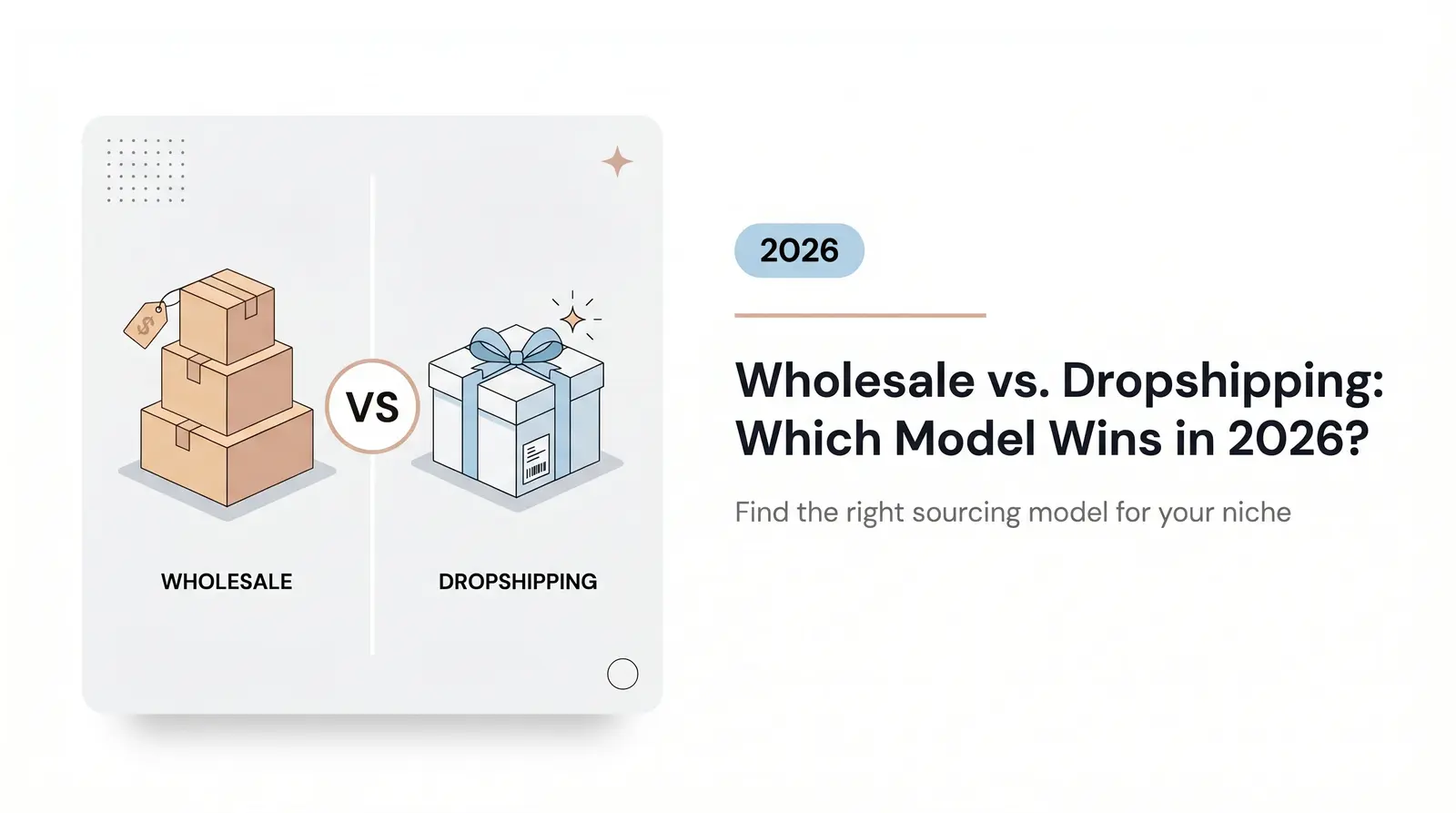
The ultimate battle for your business model. For jewelry sellers, choosing between wholesale and dropshipping isn't just a logistical decision. It's a choice that dictates your profit margins, your daily operations, and ultimately, whether you build a defensible brand or just another fleeting storefront.
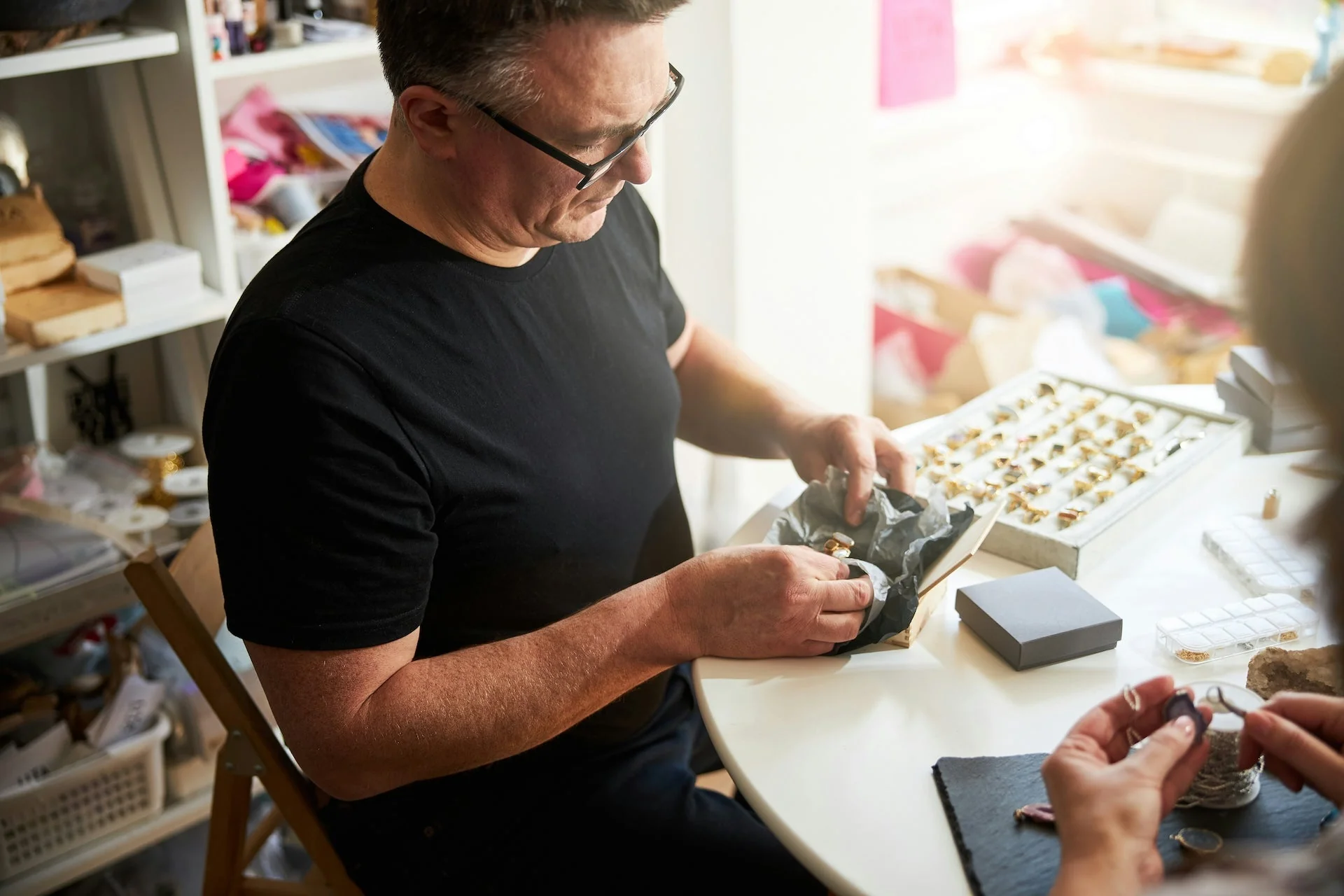
Wholesale jewelry sourcing is the traditional path. You purchase inventory in bulk, tie up upfront capital, and take physical ownership of the products. You control the quality, the packaging, and the shipping speed, but you also carry the risk of unsold inventory.
Dropshipping jewelry offers a lower barrier to entry. You hold no inventory. When a customer places an order, your supplier ships the product directly to them on your behalf. It requires minimal upfront capital, but you sacrifice control over fulfillment, packaging, and often, product quality.
Most guides frame this as a margin debate. In reality, the deeper issue is brand control, and that's where most dropshippers quietly lose.
The choice between these models affects your brand identity, customer experience, and long-term defensibility in a market projected to reach $578.45 billion by 2033 [1].

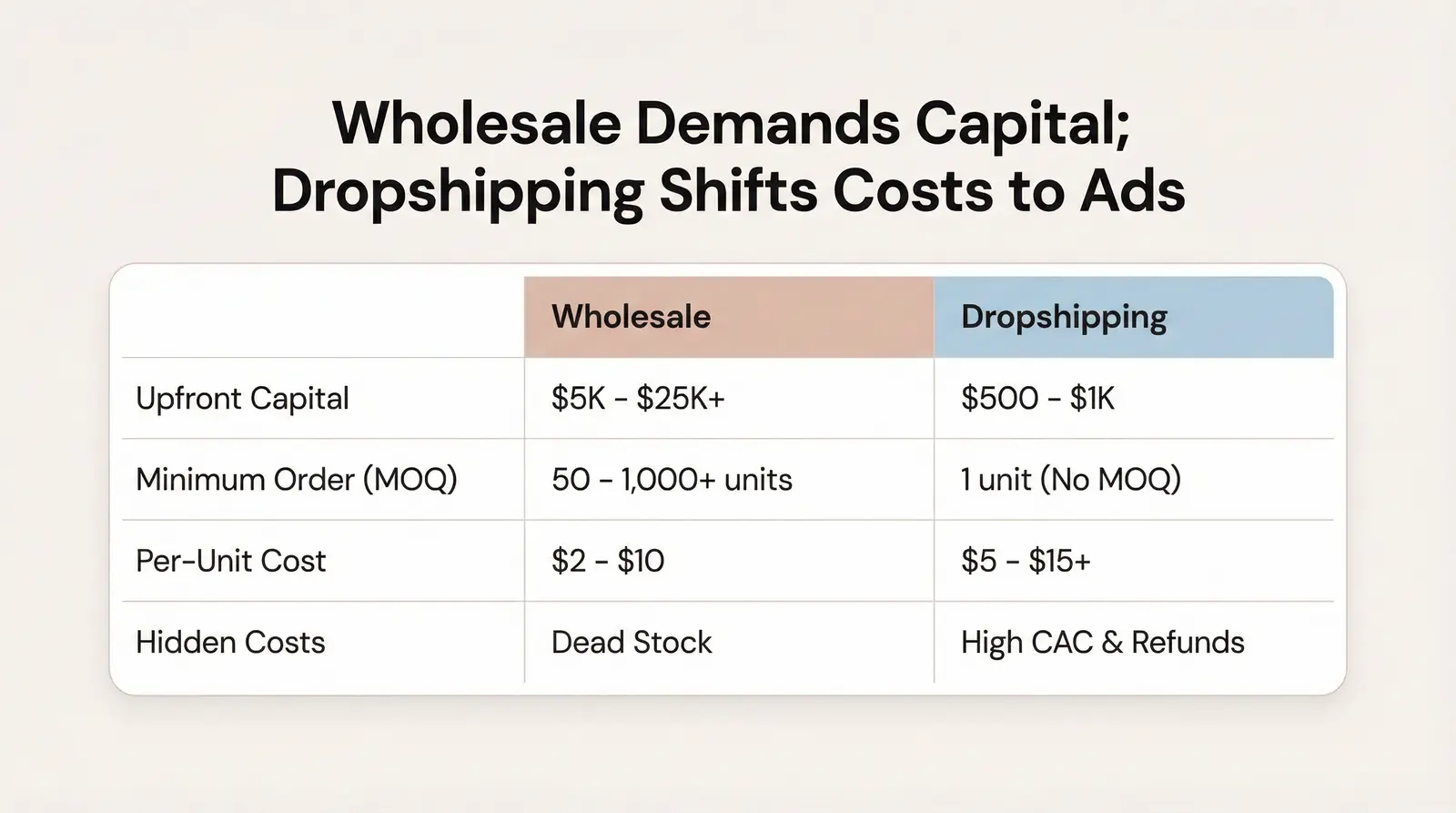
The financial reality of starting a jewelry business varies wildly depending on your chosen model. Wholesale requires significant capital to meet Minimum Order Quantities (MOQs) and secure storage. Dropshipping shifts those costs toward marketing and platform fees instead.
| Cost Factor | Wholesale Jewelry | Dropshipping Jewelry |
|---|---|---|
| Minimum Order Quantity | 50 to 1,000+ units per style | 1 unit (no MOQ) |
| Average Upfront Capital Needed | $5,000 to $25,000+ | $500 to $1,000 |
| Inventory Storage Costs | High (warehouse or office space) | $0 |
| Per-Unit Cost (avg. fashion jewelry) | $2.00 to $10.00 | $5.00 to $15.00+ |
| Branding/Packaging Control | Full control | Minimal to none |
| Time to First Sale | 4 to 8 weeks (sourcing and shipping) | 1 to 3 days |
Hidden costs often catch new sellers off guard. In wholesale, the hidden cost is dead stock: inventory that doesn't sell and ties up your cash flow. In dropshipping, the hidden costs are high customer acquisition costs (CAC) and elevated refund rates caused by long shipping times and inconsistent product quality.
On paper, dropshipping jewelry looks incredibly lucrative, often boasting gross margins of 50% to 80%. But the reality of net margins tells a different story.
Dropshipping margins face severe compression from platform fees, rising ad spend, supplier price hikes, and returns. Most jewelry dropshippers end up with net margins between 10% and 25% [2].
Wholesale, conversely, offers real margin expansion opportunities. By purchasing in bulk, you secure lower per-unit costs. You can also implement private labeling and product bundling to increase perceived value and average order value (AOV), pushing net margins closer to 30% or higher.
Let's run the numbers. A seller moves 100 units per month of a $30 retail-price bracelet.
Dropshipping Model:
| Line Item | Amount |
|---|---|
| Revenue (100 units x $30) | $3,000 |
| COGS: Product + Supplier Shipping ($12/unit) | -$1,200 |
| Platform/Payment Fees (3%) | -$90 |
| Ad Spend (CAC of $12/unit) | -$1,200 |
| Returns/Refunds (5% rate) | -$150 |
| Net Profit | $360 (12% margin) |
Wholesale Model:
| Line Item | Amount |
|---|---|
| Revenue (100 units x $30) | $3,000 |
| COGS: Bulk Product Cost ($4/unit) | -$400 |
| Inbound Shipping + Packaging ($2/unit) | -$200 |
| Platform/Payment Fees (3%) | -$90 |
| Ad Spend (CAC of $12/unit) | -$1,200 |
| Storage/Fulfillment Labor (est.) | -$200 |
| Returns/Refunds (2% rate, better QC) | -$60 |
| Net Profit | $850 (28.3% margin) |
In our experience at Branvas, sellers who start with dropshipping often hit a margin ceiling around 15 to 20% once ad costs are factored in, and that's when they start looking for a better model.

The operational complexity of dropshipping doesn't decrease as you scale. It often increases, because you're managing more supplier relationships with less leverage.
When you rely on generic dropshipping, you face compounding operational risks: sudden supplier stockouts, inconsistent product quality, and long shipping times that damage customer trust. You have zero control over the unboxing experience, which is critical in jewelry.
Traditional wholesale carries its own burdens. You must manage physical inventory, conduct your own quality control, handle returns directly, and ensure fast fulfillment. The cash-flow burden of purchasing inventory upfront can stifle growth if products don't move as quickly as anticipated.
The non-obvious truth is this: most sellers assume dropshipping gets easier at scale. It doesn't. Every new supplier you add is another relationship to manage, another quality variable to monitor, and another potential point of failure that shows up in your reviews.

In the jewelry market, brand control is a long-term competitive moat. Jewelry is an emotional purchase, heavily reliant on repeat buyers and gifting occasions.
A generic dropshipping model, shipping products in unbranded envelopes from overseas, destroys the perceived value of the item. It guarantees the customer won't return, and it makes it nearly impossible to charge a premium.
Contrast this with branded wholesale or private-label jewelry. When a customer receives a beautifully packaged piece with custom inserts and consistent quality, they aren't just buying a product. They are buying into a brand. That emotional connection drives the lifetime value (LTV) that makes ad spend profitable over time.
This is exactly the gap Branvas was built to close, giving sellers the low-inventory flexibility of dropshipping with the brand control of a private-label wholesale operation. Learn how Branvas works

You don't have to choose between the cash-flow risks of wholesale and the brand-diluting reality of dropshipping. The Branded Fulfillment Framework (BFF) is a proprietary Branvas model that combines the best of both worlds.
Step 1: Source Smart. Access a curated jewelry catalog with no large MOQ requirements. See our product catalog
Step 2: Brand It Yours. Apply custom packaging, labels, and brand identity directly at the product level.
Step 3: Sell Anywhere. Integrate seamlessly with your ecommerce store. Branvas fulfills and blind-ships every order in your brand's name.
Step 4: Scale Without Storage. Operate with no warehouse and no inventory risk, while maintaining full margin and brand ownership.
This model eliminates the primary failure points of both traditional paths. You avoid the margin compression and poor customer experience of dropshipping, while bypassing the heavy capital requirements and storage logistics of wholesale.
Whether you are an influencer monetizing an audience or an ecommerce operator scaling a store, the BFF model provides a scalable foundation built on brand ownership from day one.
At Branvas, we've seen sellers go from zero to a fully branded jewelry line in under two weeks, without touching a single piece of inventory.

Use our proprietary Jewelry Business Model Selector to find your best fit:
| Your Situation | Best Fit Model |
|---|---|
| You have $500 to $1,000 startup budget | Dropshipping (to test concepts) |
| You have $5,000+ and want full margin control | Wholesale |
| You're an influencer with an existing audience | Branvas Private-Label |
| You want to test products before committing | Dropshipping or Branvas |
| You want a long-term defensible brand | Wholesale or Branvas |
| You want hands-off fulfillment with your branding | Branvas Private-Label |

Q: What are typical profit margins for dropshipping jewelry?
A: While gross margins can look high at 50 to 80%, the reality of net margins is much lower. After factoring in product costs, shipping, platform fees, and advertising spend, most jewelry dropshippers see net margins between 10% and 25%. The lower end of that range is common for sellers relying heavily on paid social ads.
Q: How much do I need to start a wholesale jewelry business?
A: Starting a traditional wholesale jewelry business typically requires between $5,000 and $25,000. This capital covers supplier Minimum Order Quantities (MOQs), storage space, and investments in custom branding and packaging. Lower-MOQ suppliers can reduce this barrier, but expect to invest at least $2,000 to $5,000 to get started properly.
Q: Can I dropship jewelry with my own branding?
A: Traditional dropshipping from platforms like AliExpress rarely allows for custom branding. However, using a Brand-as-a-Service platform like Branvas allows you to blind-ship products with your own custom packaging and inserts, giving the appearance of a fully branded operation without holding inventory.
Q: Is wholesale or dropshipping better for scaling a jewelry brand?
A: Wholesale is generally better for scaling a defensible brand because it offers higher net margins and complete control over the customer experience. Dropshipping often breaks down at scale due to supplier inconsistencies and margin compression from rising ad costs. The best long-term path combines the flexibility of dropshipping with the brand control of wholesale.
Q: What is private-label jewelry and how does it compare to dropshipping?
A: Private-label jewelry involves sourcing existing product designs and applying your own branding and packaging to them. Unlike standard dropshipping, private labeling allows you to build brand equity, charge premium prices, and retain customers. The result is significantly higher profit margins and stronger customer lifetime value compared to generic dropshipping.
The debate between wholesale and dropshipping jewelry often misses the point entirely.
The real question isn't "wholesale or dropshipping." It's "how do I build a brand, not just a store."
Dropshipping offers a fast, low-risk entry but severely limits your ability to scale profitably and control the customer experience. Wholesale provides the margins and brand control necessary for long-term success but requires significant upfront capital and operational overhead.
By understanding the true costs, margin realities, and operational complexities of each model, you can make an informed decision that aligns with your budget and goals. But remember: you no longer have to settle for the extremes.
Ready to launch your jewelry brand without the inventory risk or the margin squeeze? Start with Branvas today