


Compare wholesale and dropshipping across apparel, home goods, beauty, and jewelry using a 5-dimension sourcing scorecard to find the best model for your capital and niche.
Published:
June 14, 2026
Author:
Yi Cui
Wholesale feels like the "real" way to start an ecommerce business, until you're sitting on $15K of unsold inventory. Here's when each model wins, across niches.
Choosing between wholesale and dropshipping is the most consequential sourcing decision a new founder makes. It dictates your cash flow, your risk profile, and how quickly you can validate a product. This guide breaks down the real differences between the two models, introduces a proprietary framework for evaluating them, and delivers a rigorous, niche-by-niche comparison covering apparel, home goods, beauty, and jewelry. By the end, you will know exactly which model aligns with your capital, your category, and your growth goals.
The standard definition is simple: wholesale means buying products in bulk upfront, while dropshipping means a supplier ships individual orders directly to your customer. That surface-level distinction misses the structural realities of running an ecommerce business in 2026.
The true difference lies in who owns the inventory risk. When you buy wholesale, you are locking up working capital in physical goods before a single customer has validated demand. If the product fails to sell, you absorb the loss. With dropshipping, the supplier holds the inventory risk, freeing your capital for customer acquisition and brand building. According to recent financial data, 82% of small business failures cite cash flow problems as the primary cause, and the average small business carries only 27 days of cash reserves [1]. Wholesale's biggest hidden cost is not inventory itself. It is the opportunity cost of capital locked in unsold stock.
The two models also diverge on brand control and customer data ownership. Traditional wholesale gives you physical control over every item and the unboxing experience. Dropshipping, historically, meant sacrificing that control for capital efficiency.
Here is the contrarian insight most articles miss: dropshipping has a reputation problem it does not fully deserve. The problem is not the model. It is the commodity product selection and zero brand differentiation that plagued early dropshippers. Private-label dropshipping resolves this entirely. By partnering with a supplier who applies your branding to the product and packaging before shipping, you retain the capital efficiency of dropshipping while building a distinct, defensible brand. In fact, 66% of consumers now say private label products are as good as, or even better than, national brand alternatives [2].

To make an objective decision, you need to evaluate both models across the constraints that actually break new businesses. We use The Branvas Sourcing Scorecard to help founders map their resources against the realities of each model.
| Dimension | Wholesale | Dropshipping |
|---|---|---|
| Capital Required | High ($5K to $25K+) | Low (under $1K) |
| Cash Flow Risk | High (Inventory lock-up) | Low (Pay as you sell) |
| Brand Control | High (Full physical control) | Medium to High (With private-label) |
| Scalability | Medium (Constrained by capital) | High (Unconstrained by inventory) |
| Speed to First Sale | Low (8 to 14 weeks) | High (1 to 2 weeks) |
If you score 3 or more dimensions as critical constraints for your business stage, dropshipping is likely your starting model. Here is how that plays out across the most common ecommerce niches.

Winner: Wholesale (for established sellers with demand validation)
Wholesale can work for proven SKUs, but sizing complexity and return rates punish dropshipping. Dropshipping apparel is high-risk for new brands.
The apparel category is notoriously difficult. Sizing inconsistency is the leading cause of fashion returns, accounting for up to 53% of apparel returns [3]. When you dropship clothing, you have no ability to physically verify sizing consistency across production batches, leading to high return rates that quickly erode margins. For new brands without a validated fit profile, wholesale allows for strict quality control before the product reaches the customer. The rule here is simple: never dropship apparel you have not personally sampled and sized.
Winner: Wholesale (with print-on-demand as a hybrid exception)
Shipping weight and fragility make dropshipping expensive and risky in this category. Wholesale wins, but it requires significant storage infrastructure.
Home decor and furniture involve bulky, heavy, or fragile items. Billable shipping weight for these products can consume more than 30% of estimated margins [4]. Dropshipping fragile items from overseas introduces high damage rates and expensive return logistics. Wholesale allows you to import via freight, inspect for damage, and use specialized domestic carriers for final delivery. For lighter, flat items like wall art or printed textiles, print-on-demand offers a viable hybrid model that avoids inventory risk without the fragility problem.
Winner: Wholesale (white-label, compliance-first)
Regulatory complexity makes dropshipping treacherous for new sellers. This is a medium-difficulty category even with wholesale.
The beauty industry is heavily regulated. In the US, the Modernization of Cosmetics Regulation Act (MoCRA) imposes strict requirements on labeling, ingredient disclosure, and facility registration. Recent data shows that 48% of imported cosmetics companies fail FDA compliance [5]. Dropshipping skincare directly from overseas suppliers exposes the seller to significant legal and safety risk if ingredients are mislabeled or formulations are unverified. Wholesale sourcing of compliant, white-label products from vetted domestic labs is the only secure path for new beauty founders.
Winner: Dropshipping, decisively.
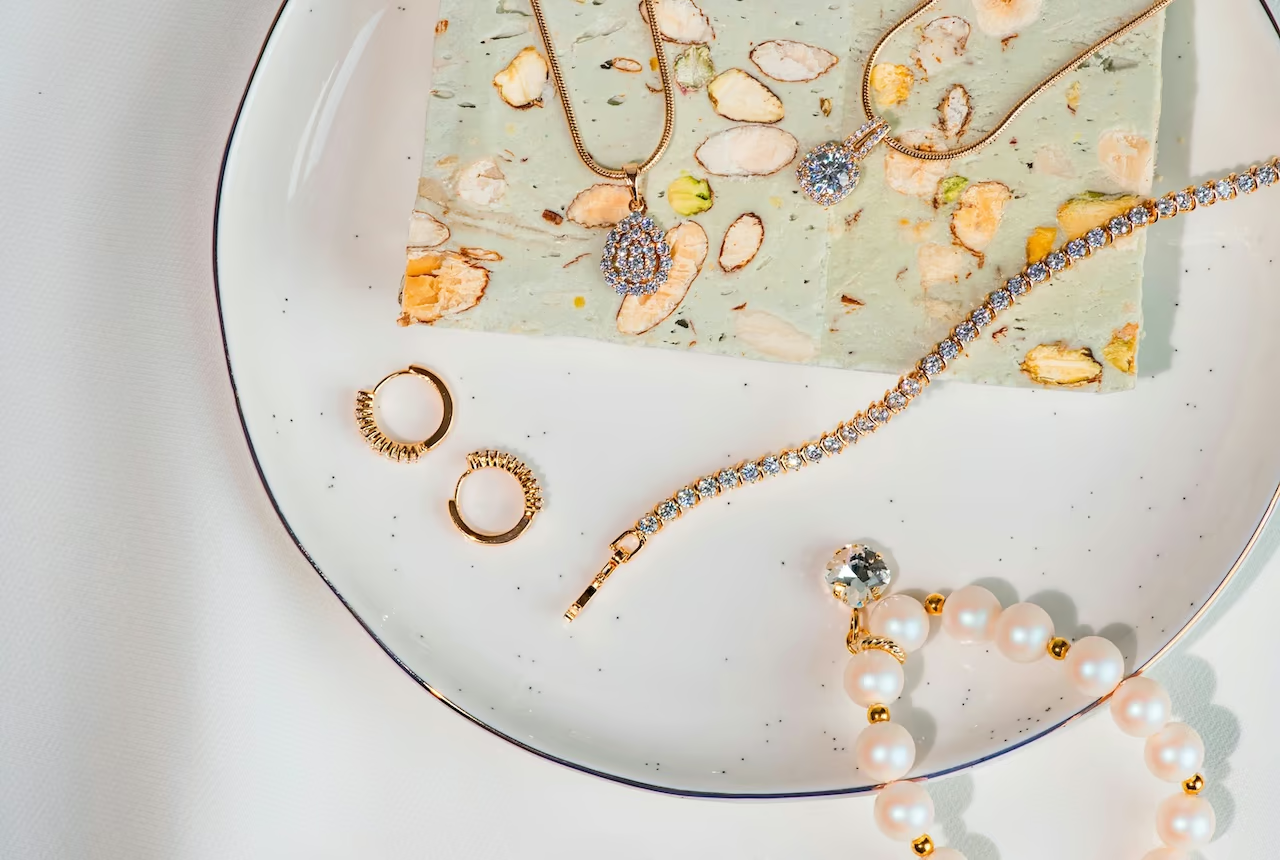
Jewelry is the ideal category for the dropshipping model, and the reasons compound on each other.
Package sizes are small, resulting in negligible shipping costs and fast transit times. Unlike apparel, there are no complex sizing issues (rings being the only minor exception, easily managed with a size guide), which keeps return rates exceptionally low. Jewelry benefits from evergreen demand and high perceived value relative to actual product cost, yielding strong gross margins.
In our experience working with early-stage jewelry founders at Branvas, the combination of small package size, high perceived value, and zero sizing friction makes jewelry the single most forgiving category for a first-time dropshipper.
Moissanite is the standout sub-niche right now. The global moissanite jewelry market was valued at $2.8 billion in 2025 and is projected to reach $6.1 billion by 2034, growing at a 9.1% CAGR [6]. Retail margins on moissanite jewelry range from 60% to 75%, driven by low material costs and high consumer perceived value [7]. Consumers evaluate moissanite by how it looks and what they can afford, not by a commodity price chart, which gives sellers strong pricing power.
Earrings are the highest-volume, lowest-risk SKU category for new jewelry brands. They require no sizing, they are frequent impulse purchases, and they photograph beautifully for social content. For any founder launching a jewelry brand, earrings are the logical starting point.
The ability to build a fully branded experience without holding inventory makes private-label dropshipping the undisputed winner for jewelry. For influencers and creators building a personal brand, this is especially powerful. See how Branvas supports creators and influencers with private-label jewelry built around their audience.

Consider Maya, a lifestyle influencer with 42K Instagram followers who wants to monetize her audience by launching a jewelry line. She has strong aesthetic taste but limited capital.
Option A: Wholesale from a China Supplier
Maya decides to source wholesale earrings via Alibaba. She faces a Minimum Order Quantity (MOQ) of 200 units per style. To launch a cohesive collection of 10 styles, she must purchase 2,000 units. At $4 per unit, her initial inventory cost is $8,000. Add custom packaging design and production ($600), freight shipping ($400), and domestic storage for the first three months ($300), and her total upfront capital outlay approaches $9,300 to $10,000. It takes 12 weeks to receive samples, finalize production, and clear customs. If three of her 10 styles fail to sell, she is sitting on roughly $2,400 in dead stock with no clear path to liquidation.
Option B: Private-Label Dropshipping via Branvas
Maya chooses private-label dropshipping through Branvas. Her inventory cost is $0. She selects 15 styles from the Branvas catalog, uploads her brand assets, and Branvas handles branded packaging and blind fulfillment directly to her followers. She launches her store in two weeks. When a customer orders a $45 moissanite necklace, Maya pays the $12 base cost and keeps the $33 gross profit. She tests new SKUs without financial risk and doubles down on what sells.
The math is straightforward:
| Factor | Wholesale (Option A) | Branvas Dropshipping (Option B) |
|---|---|---|
| Upfront capital required | $9,300 to $10,000 | $0 |
| Time to first sale | 8 to 14 weeks | 1 to 2 weeks |
| Dead stock risk | High ($2,400+ per failed style) | None |
| SKU testing flexibility | Low (locked to MOQ) | High (add/remove anytime) |
| Brand packaging | Custom (but delayed) | Included, blind-shipped |
We consistently see new sellers underestimate the working capital drag of wholesale MOQs. Maya launches in two weeks with Branvas versus 8 to 14 weeks sourcing, sampling, and importing wholesale. That time difference alone is worth thousands in opportunity cost.
Curious how the Branvas model works? Explore our How It Works page to see the full private-label process. You can also explore the Branvas Academy for resources on building a jewelry brand from scratch.

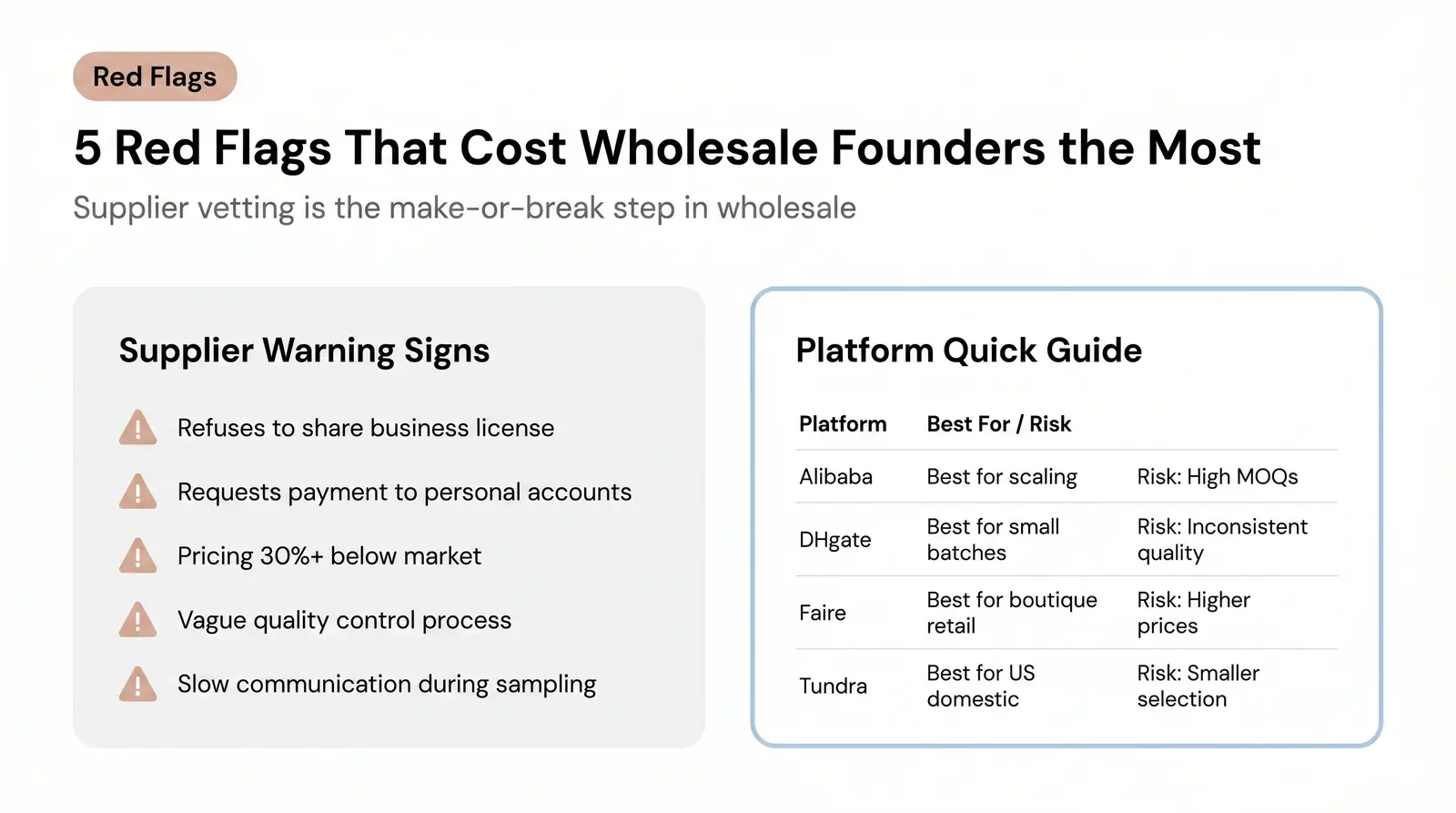
If your capital and category dictate a wholesale approach, you need to navigate a complex landscape of suppliers and platforms. Here is a concise breakdown of the most commonly used options.
Alibaba is the largest global B2B directory, founded in 1999. It is best for scaling established brands that need factory-direct pricing and custom production. The key risk is high MOQs and the time required to vet overseas factories properly.
DHgate is a China-based marketplace with lower MOQs and no minimum order value, making it useful for testing small batches. The key risk is inconsistent quality and a higher prevalence of counterfeit or mislabeled goods.
Faire is a curated marketplace of independent brands, primarily US and European. It is best for boutique retail sourcing with buyer-friendly return policies on first orders. The key risk is higher price points compared to direct factory sourcing.
Tundra is a zero-commission wholesale platform with free shipping options, focused on US and Canada buyers. It is best for domestic sourcing without the fees that other platforms charge. The key risk is a smaller supplier selection than global platforms.
RangeMe is a product discovery platform connecting brands with retail buyers. It is best for getting an established brand into major retail chains, not for sourcing products to sell. The key risk is expensive premium membership with mixed results for small sellers.
When sourcing wholesale moissanite jewelry specifically, verify the supplier's grading standards (D-E-F color, VS1-VS2 clarity are industry benchmarks), request certification documents, confirm production lead times, and ask for references from other retail buyers. MOQs for moissanite pieces typically start at 10 to 50 units per style, making it more accessible than many other jewelry categories.
Before committing capital to any wholesale supplier, run them through this checklist. These are the five red flags we have seen cost founders the most.
Use this matrix to align your current situation with the optimal sourcing model.
| Your Situation | Recommended Model |
|---|---|
| Under $2,000 starting capital | Dropshipping |
| Proven demand, ready to scale | Wholesale or hybrid |
| Building a personal brand (creator or influencer) | Private-label dropshipping |
| Selling jewelry or accessories | Dropshipping (private-label) |
| Apparel with 3 or more validated SKUs | Wholesale |
| Testing a new product idea | Dropshipping |
| B2B or retail buyers as customers | Wholesale |
The matrix reveals a clear pattern. Dropshipping is the tool for discovery, testing, and capital preservation. Wholesale is the tool for maximizing margins on proven winners. For categories with low logistical friction, like jewelry, the dropshipping advantage extends well beyond the startup phase.
If the matrix points you toward private-label dropshipping for jewelry, Branvas was built exactly for this. See our catalog or get started today. No inventory required. You can also use our profit calculator to model your margins before you launch.

Yes, dropshipping remains highly profitable when executed with the right niche and brand strategy. The global dropshipping market is projected to reach $590 billion in 2026, growing at over 20% annually [8]. The sellers who struggle are those relying on generic, commodity products with no brand differentiation. Sellers who use private-label dropshipping to build distinct brands consistently achieve net margins between 15% and 35%. The model is not the problem. The product selection and brand strategy are.
Minimum Order Quantities for jewelry wholesale vary significantly by supplier, material, and customization level. Basic fashion jewelry on platforms like Alibaba typically requires 50 to 500 units per style. Custom designs, engraving, or precious metal settings may have lower unit MOQs but higher total dollar commitments. For moissanite jewelry specifically, MOQs tend to start at 10 to 50 pieces per style, making it one of the more accessible wholesale categories.
The most reliable starting points are Alibaba (filter for Verified Suppliers), Global Sources, and direct trade show sourcing from events like the Hong Kong Jewellery and Gem Fair. However, a list of suppliers is far less valuable than a rigorous vetting process. Always request samples, verify business licenses, and use secure escrow payment methods before committing to a production run. For founders who want to skip this process entirely, private-label dropshipping through a platform like Branvas removes the supplier vetting burden completely.
Wholesale moissanite jewelry is an exceptional niche for sellers who have the capital and operational capacity for inventory. The market is growing at a 9.1% CAGR, driven by consumer demand for ethical, brilliant, and affordable alternatives to mined diamonds [6]. Retail margins of 60% to 75% are among the highest in the jewelry category [7]. However, for new founders without capital, private-label dropshipping of moissanite jewelry delivers the same margin opportunity without the inventory risk.
You can absolutely build a real brand using dropshipping, provided you use a private-label model. The "generic dropshipping" stigma comes from sellers who ship unbranded products in plain poly bags with no customer experience. Private-label dropshipping is fundamentally different. Partners like Branvas apply your custom branding to the product packaging and ship directly to your customer under your brand name, with no supplier branding visible. The customer experience is indistinguishable from a brand that holds its own inventory.