


Learn how to find and vet reliable China wholesale suppliers, calculate true landed costs, avoid common scams, and explore private-label dropshipping as a faster alternative for jewelry brands.
Published:
September 25, 2026
Author:
Yi Cui
Sourcing from China is either the smartest move you'll make or a multi-thousand-dollar education in what not to do. The difference is almost entirely in what you know before you start.
The appeal of sourcing from China is undeniable. For decades, it has been the engine room of global ecommerce, offering unmatched manufacturing scale, rapid prototyping, and price points that make healthy retail margins possible. Whether you are looking for a china wholesale suppliers list to launch a new brand or seeking to optimize an existing supply chain, the sheer variety of factories and trading companies available is staggering. The country manufactures everything from fashion accessories to industrial equipment, and for many product categories, there is simply no comparable alternative.
However, the reality of international procurement is far more complex than most online guides suggest. Behind the glossy platform interfaces lie significant operational hurdles: MOQ traps, inconsistent quality control, payment security risks, and logistics surprises that can obliterate your profit margins before you make your first sale. Sourcing from China requires a strategic approach to vetting partners, calculating true landed costs, and understanding the regulatory environment. This guide will walk you through exactly how to find and vet reliable suppliers, manage the logistics of importing, and ultimately explore a smarter alternative for specific niches, especially jewelry, that eliminates these headaches entirely.
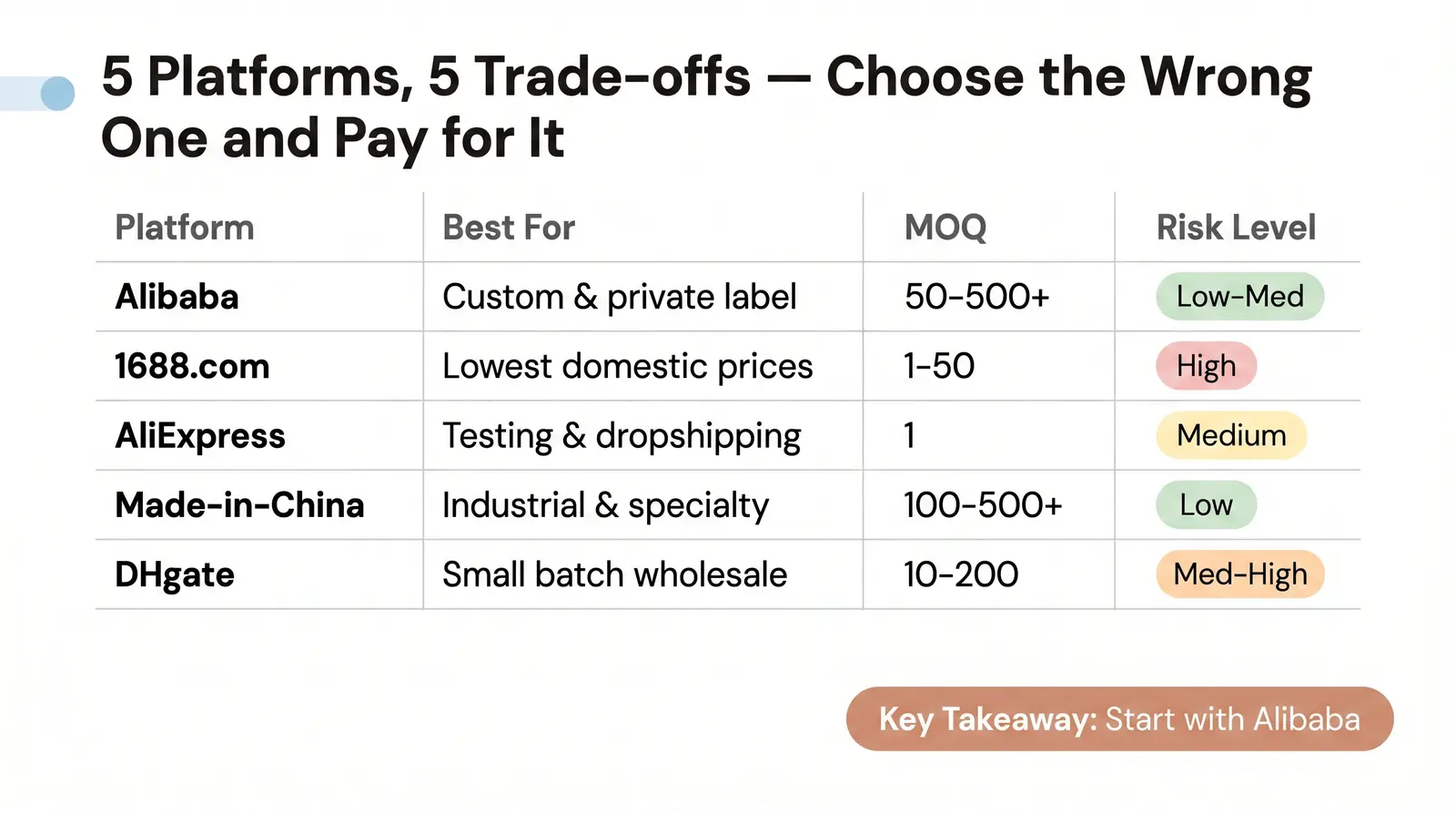
When searching for a china wholesale suppliers list, most founders begin their journey on one of the major B2B marketplaces. Each platform serves a distinct purpose and carries its own set of risks and rewards. Understanding which platform fits your use case is the first decision you will make, and it matters more than most people realize.
Alibaba remains the undisputed giant of global B2B sourcing, connecting millions of international buyers with Chinese manufacturers and trading companies. The platform's primary advantage is its Trade Assurance program, which acts as an escrow service protecting buyers against shipping delays and quality discrepancies. [1] Launched in 2015, Trade Assurance insures your payment against missed shipment deadlines or a failure to meet established quality requirements. Qualifying suppliers are assigned a coverage limit, and if a dispute arises, Alibaba steps in as mediator and will pay out a refund if the supplier is found at fault.
There are important caveats. Trade Assurance coverage limits vary by supplier, meaning a $10,000 order may only be covered up to $7,500 if that is the supplier's assigned limit. More critically, the program does not establish its own quality standards. It only enforces the terms you have already written into the contract. Vague phrases like "high quality" are nearly impossible to enforce, so buyers must specify measurable quality criteria in writing before placing any order. [1]
Pro tip: Always opt for pre-shipment coverage rather than post-delivery coverage. This allows you to withhold final payment until a third-party inspection confirms the goods meet your specifications.
Operated by the Alibaba Group, 1688.com is the domestic wholesale marketplace for the Chinese market. Because it caters to local buyers, prices are often significantly lower than on Alibaba, as they do not include export markups or the overhead of English-speaking sales staff. A product that costs $4.00 per unit on Alibaba may be listed at $2.50 on 1688 from the same factory.
The catch is that the platform is entirely in Chinese, and suppliers typically do not hold export licenses or accept international payment methods. Accessing 1688 requires a sourcing agent or a specialized payment setup, making it best suited for experienced buyers who have established logistics networks in China. We have seen founders try to navigate 1688 directly and end up with miscommunicated specs, wrong shipments, and no recourse.
Pro tip: Use a trusted Yiwu or 1688 sourcing agent to access this platform. The savings on unit cost typically more than offset the agent's commission.
AliExpress is the retail and low-MOQ arm of the Alibaba ecosystem, designed for consumers and dropshippers rather than serious brand builders. While it is an excellent platform for ordering single units to test product viability before committing to a bulk order, the margins are generally too thin for sustainable resale at scale. Not all products on AliExpress carry the same level of buyer protection as Alibaba's Trade Assurance, and shipping times via standard postal services can be unpredictable, ranging from 2 weeks to 2 months.
Pro tip: Use AliExpress exclusively for product validation. Order 3 to 5 units, test them thoroughly, and then move to Alibaba or a direct factory relationship for your actual production run.
Often overlooked by Western ecommerce sellers, Made-in-China.com is a robust B2B directory that excels in industrial, hardware, and specialty manufacturing categories. The platform features an "Assessed Supplier" program, where third-party auditing firms verify the supplier's financial and operational status. While it may not have the sheer volume of consumer goods found on Alibaba, it is a highly reliable platform for founders sourcing technical or heavy-duty products.
Pro tip: If your product falls into a specialty industrial or hardware category, Made-in-China.com is worth exploring before defaulting to Alibaba. The supplier pool is smaller but often more specialized.
DHgate occupies the middle ground between the bulk requirements of Alibaba and the retail focus of AliExpress. It is particularly popular for small batch orders, allowing buyers to purchase 10 to 200 units at wholesale prices. However, the barrier to entry for sellers on DHgate is lower than on Alibaba, which historically correlates with a higher risk of encountering counterfeit goods or unreliable vendors. [2] Buyer protection exists, but the platform requires rigorous due diligence before committing to any purchase.
Pro tip: On DHgate, filter strictly by seller rating and transaction history. Only work with sellers who have completed at least 500 transactions with a rating above 97%.
| Platform | Best For | Typical MOQ | Payment Protection | Risk Level | Verdict |
|---|---|---|---|---|---|
| Alibaba | Custom manufacturing and private label | 50 to 500+ units | High (Trade Assurance) | Low-Medium | The industry standard for serious brand builders. |
| 1688.com | Lowest prices and domestic sourcing | 1 to 50 units | Low (for foreigners) | High | Excellent margins, but requires a sourcing agent. |
| AliExpress | Product testing and dropshipping | 1 unit | Medium | Medium | Good for testing, poor for scaling a brand. |
| Made-in-China | Industrial and specialty goods | 100 to 500+ units | High (Secure Trading) | Low | Underused for non-consumer categories. |
| DHgate | Small batch wholesale | 10 to 200 units | Medium (Buyer Protection) | Medium-High | Useful for small orders, but requires strict vetting. |
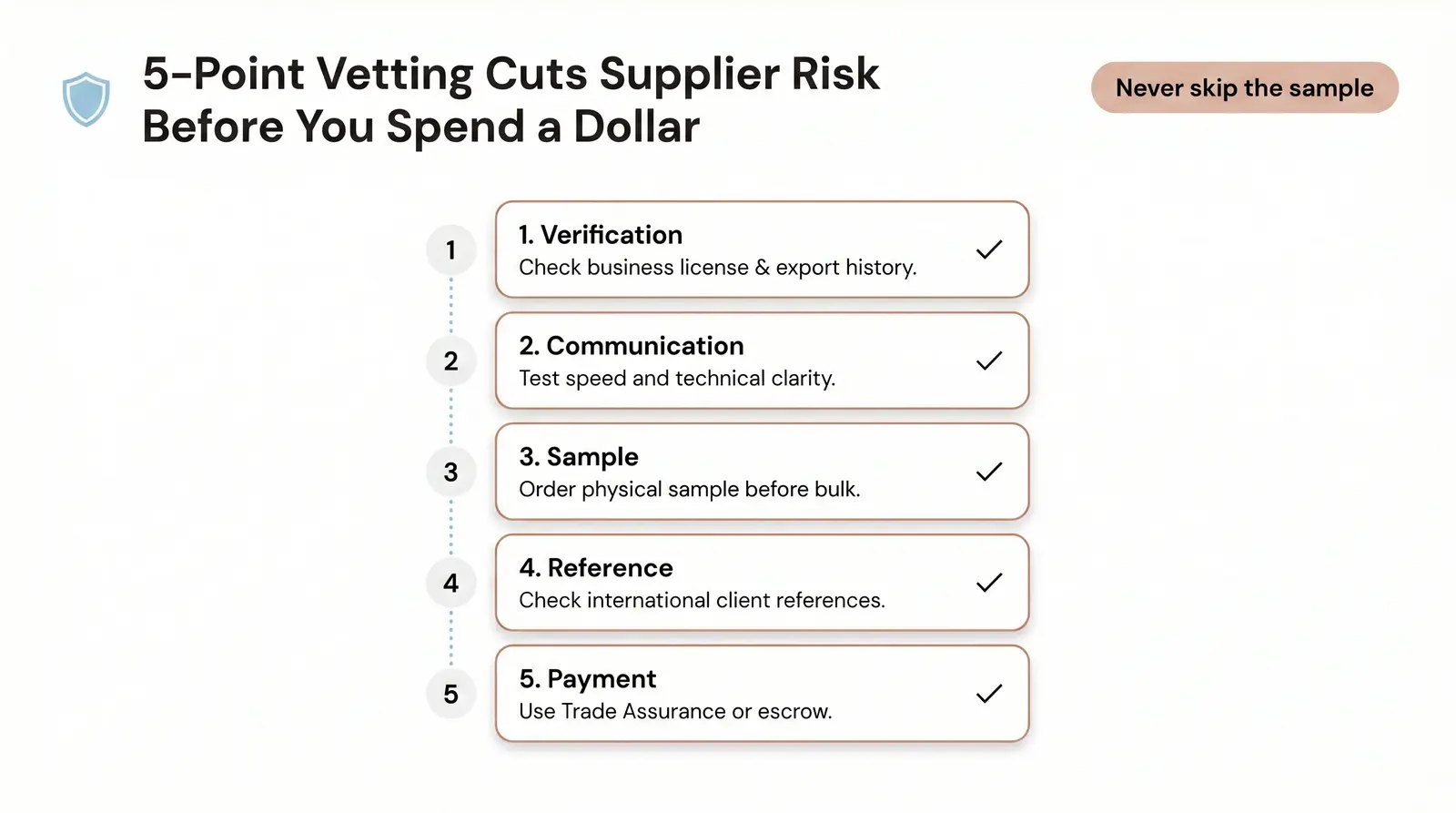
Finding a supplier is easy. Finding a reliable manufacturing partner is the real challenge. In our experience at Branvas, the suppliers who fail these five checks almost always cause problems downstream, whether that is a delayed shipment, a batch of off-spec goods, or a communication blackout mid-production. We call this The Branvas 5-Point Supplier Vetting Framework, and it is the same process we apply when evaluating every new manufacturing partner.
1. Verification Layer. Begin by checking the supplier's official status. Look for the Verified Supplier badge on Alibaba and request a copy of their business license. A legitimate manufacturer should have a clear track record, multiple years in business, and a verifiable export history to your target market. For deeper verification, you can search the supplier's Chinese company name on China's State Administration for Market Regulation (SAMR) database to confirm their legal registration status.
2. Communication Quality Test. The speed and clarity of a supplier's communication are leading indicators of their operational competence. Send a detailed product brief and ask specific technical questions: What alloy is used in this bracelet? What is the plating thickness? Can you share a recent factory audit report? A reliable partner will provide detailed, specific answers and readily share factory photos or videos. A supplier who responds only with generic sales pitches and pushes you to place an order quickly is a warning sign.
3. Sample-First Rule. Never commit to a full production run without first ordering and paying for a physical sample. Evaluate the sample not just for aesthetic appeal, but for material quality, packaging durability, and strict adherence to your provided specifications. Document every detail of the approved sample in writing, as this becomes the quality benchmark for your production order.
4. Reference Check. Request references from other international clients, particularly those in your region. While suppliers will only provide favorable contacts, the willingness to share references is a positive signal. Additionally, search for the supplier's company name outside the B2B platform to uncover independent reviews or warnings on forums like Reddit's r/ecommerce or specialized sourcing communities.
5. Payment Protection Stack. Establish secure payment terms before discussing price. Acceptable methods include T/T (wire transfer) tied to a platform escrow service like Alibaba Trade Assurance, or PayPal for initial sample orders under $500. Immediate red flags include demands for full upfront payment via Western Union, MoneyGram, or direct wire transfers to personal bank accounts. Any supplier who refuses Trade Assurance and insists on a direct wire transfer is not a partner worth trusting.
Minimum Order Quantities (MOQs) are the primary barrier to entry for new ecommerce brands. While a supplier might list an MOQ of 1,000 units, these figures are often negotiable, especially if you are willing to pay a slight premium per unit for a smaller initial run. Many factories will accept 200 to 300 units for a first order if you demonstrate seriousness and agree to a slightly higher per-unit price.
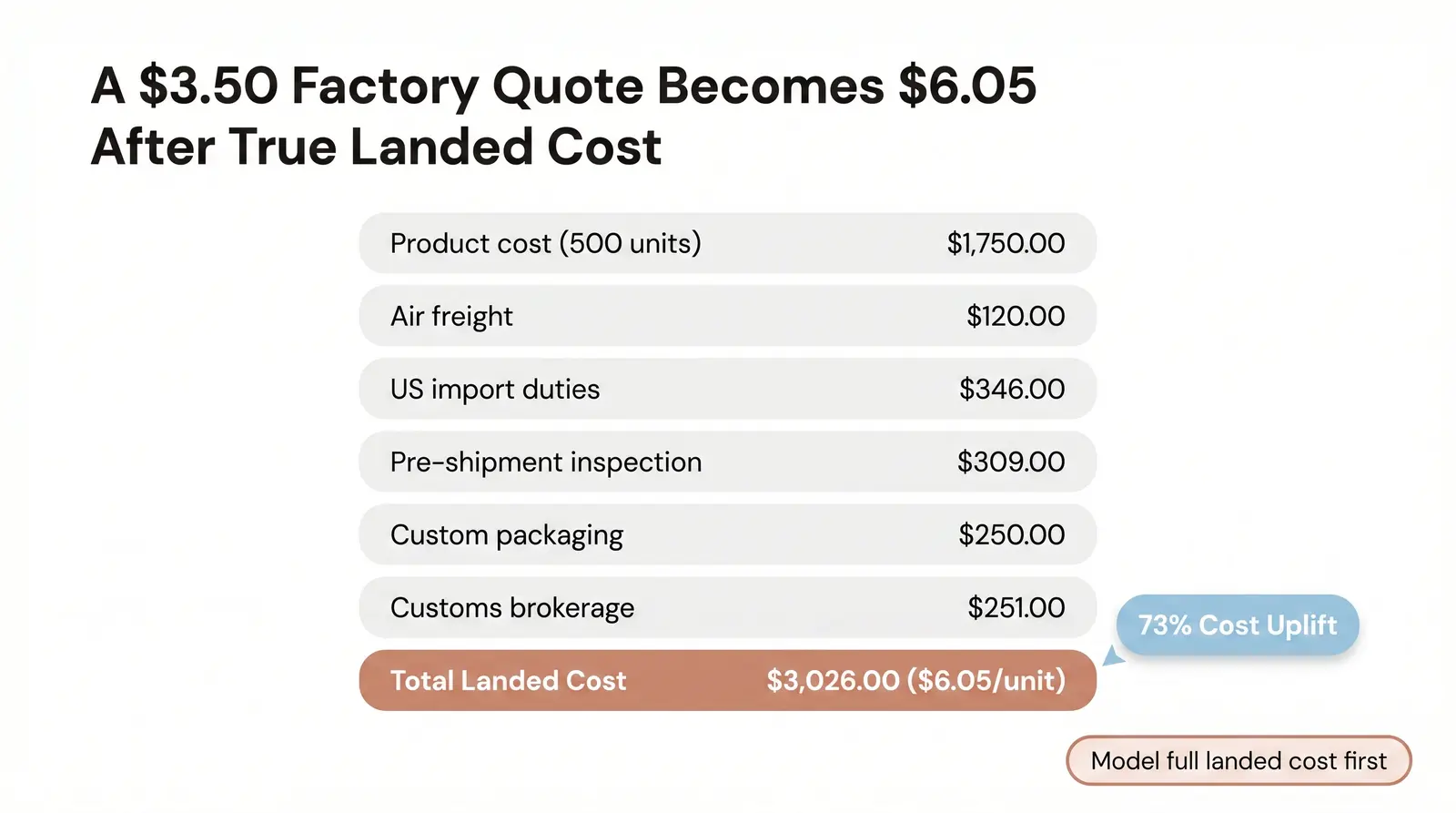
However, the unit cost quoted by the factory is only a fraction of what you will actually pay. The true landed cost formula must account for the unit price, freight charges, import duties, quality inspection fees, packaging, and payment processing costs. Failing to calculate this accurately is one of the most common and costly mistakes new importers make.
Consider this worked example. A founder orders 500 units of a custom bracelet at a quoted factory price of $3.50 per unit, totaling $1,750 in product cost. Here is what the full landed cost actually looks like:
| Cost Component | Amount |
|---|---|
| Product cost (500 units at $3.50) | $1,750.00 |
| Air freight (approx. 15kg at $8/kg) | $120.00 |
| US import duties (11% base + 7.5% Section 301 = 18.5% on CIF value) [3] | $346.00 |
| Pre-shipment inspection (QIMA standard rate) [4] | $309.00 |
| Custom branded packaging ($0.50/unit) | $250.00 |
| Customs brokerage and payment fees | $251.00 |
| Total Landed Cost | $3,026.00 |
| True cost per unit | $6.05 |
The true per-unit cost is $6.05, a full 73% higher than the factory quote of $3.50. If you were planning to retail this bracelet at $14.99 with a $3.50 cost in mind, your actual margin just dropped from 77% to 60%. That is still a workable margin, but the math changes dramatically if you add returns, marketing costs, and platform fees.
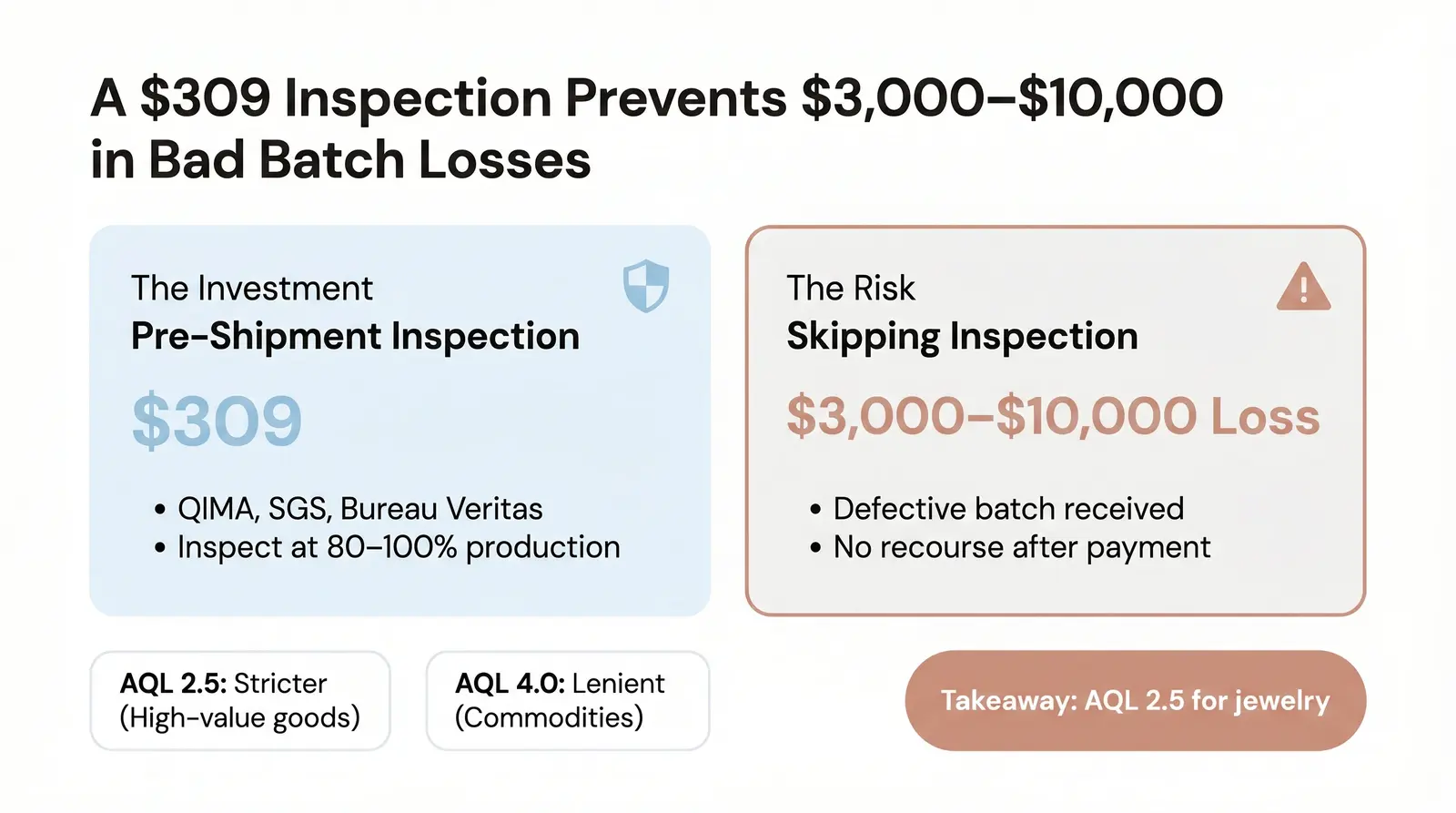
Quality control is not an area where you can afford to cut corners. A pre-shipment inspection, conducted when 80% to 100% of your goods are manufactured and packed, is the industry standard for protecting your investment.
Reputable third-party inspection companies, including QIMA, SGS, and Bureau Veritas, deploy inspectors to the factory floor to verify product quality, quantity, and packaging against your specifications. QIMA, for example, charges approximately $309 per man-day all-inclusive, with same-day report delivery and 48-hour deployment. [4] SGS and Bureau Veritas typically run $300 to $600 per man-day at the premium end of the market. These inspectors use the Acceptable Quality Limit (AQL) standard, based on ISO 2859-1, to determine pass/fail rates. An AQL 2.5 standard is stricter and allows fewer defects per sample, making it appropriate for higher-value consumer goods like jewelry. An AQL 4.0 standard is more lenient and is typically used for lower-value commodity items.
Most first-time importers skip inspection to save $200 to $400 and then spend $3,000 to $10,000 fixing or discarding a bad batch. The inspection is the cheapest insurance you will ever buy. Beyond the financial protection, there is a behavioral dimension: a factory that knows a third-party inspector is coming is inherently more likely to prioritize your order's quality over other production runs.
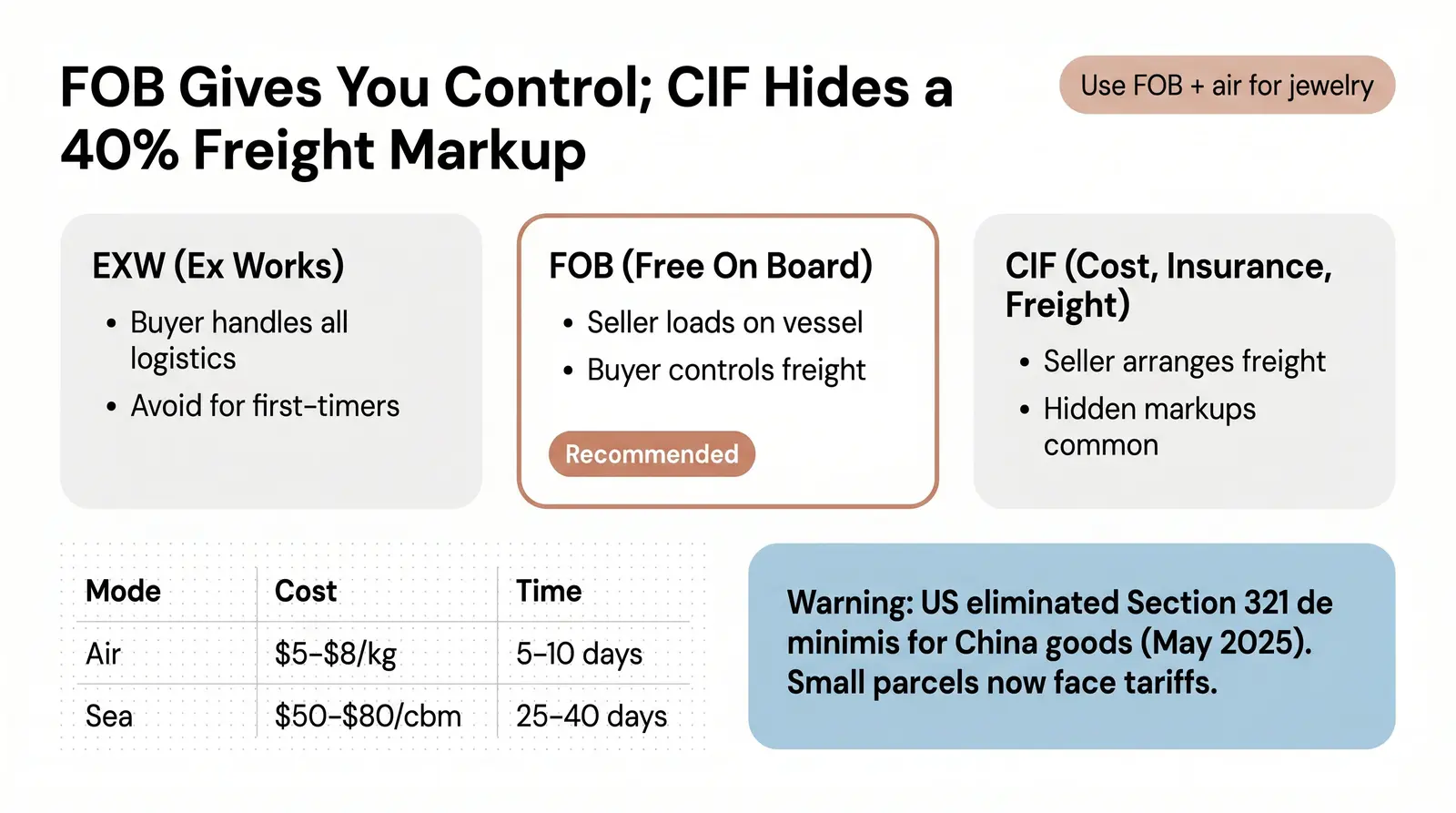
Understanding international shipping terms, known as Incoterms, is critical to managing your logistics costs and risk exposure. [5] The three most common terms for China imports are EXW, FOB, and CIF.
EXW (Ex Works) places all responsibility on the buyer from the moment the goods leave the factory floor. This includes arranging Chinese export customs clearance and inland transportation to the port, which is highly complex for buyers without a local presence in China. EXW is generally not recommended for first-time importers.
FOB (Free On Board) is the recommended term for most small ecommerce brands. The seller is responsible for the goods until they are loaded onto the shipping vessel at the designated Chinese port. From that point, the buyer takes over risk and cost. FOB gives you control over your freight forwarder choice, which means you can shop for competitive rates and avoid the inflated shipping costs that suppliers often bundle into CIF quotes.
CIF (Cost, Insurance, and Freight) means the seller arranges and pays for freight and insurance to your destination port. While it sounds convenient, buyers often end up paying inflated shipping rates and lose control over the logistics process. We have seen founders accept CIF quotes only to discover their supplier was charging 40% above market freight rates.
When choosing between sea freight and air freight, the tradeoff is straightforward: sea freight runs approximately $50 to $80 per cubic meter for LCL (less than container load) shipments and takes 25 to 40 days. Air freight costs $5 to $8 per kilogram and delivers in 5 to 10 days. For small, high-value items like jewelry, air freight is often the right choice despite the higher cost.
Most ecommerce founders don't realize that their supplier's quoted "shipping cost" is almost never the full cost. Duties, drayage, last-mile delivery, and brokerage fees can add 15% to 40% on top of the freight quote. A critical regulatory change has made this even more important: the U.S. eliminated the Section 321 de minimis exemption for China-origin goods in May 2025, meaning that even small parcels are now subject to tariffs and customs scrutiny. [6] This change significantly impacts ecommerce businesses that previously relied on duty-free low-value shipments.
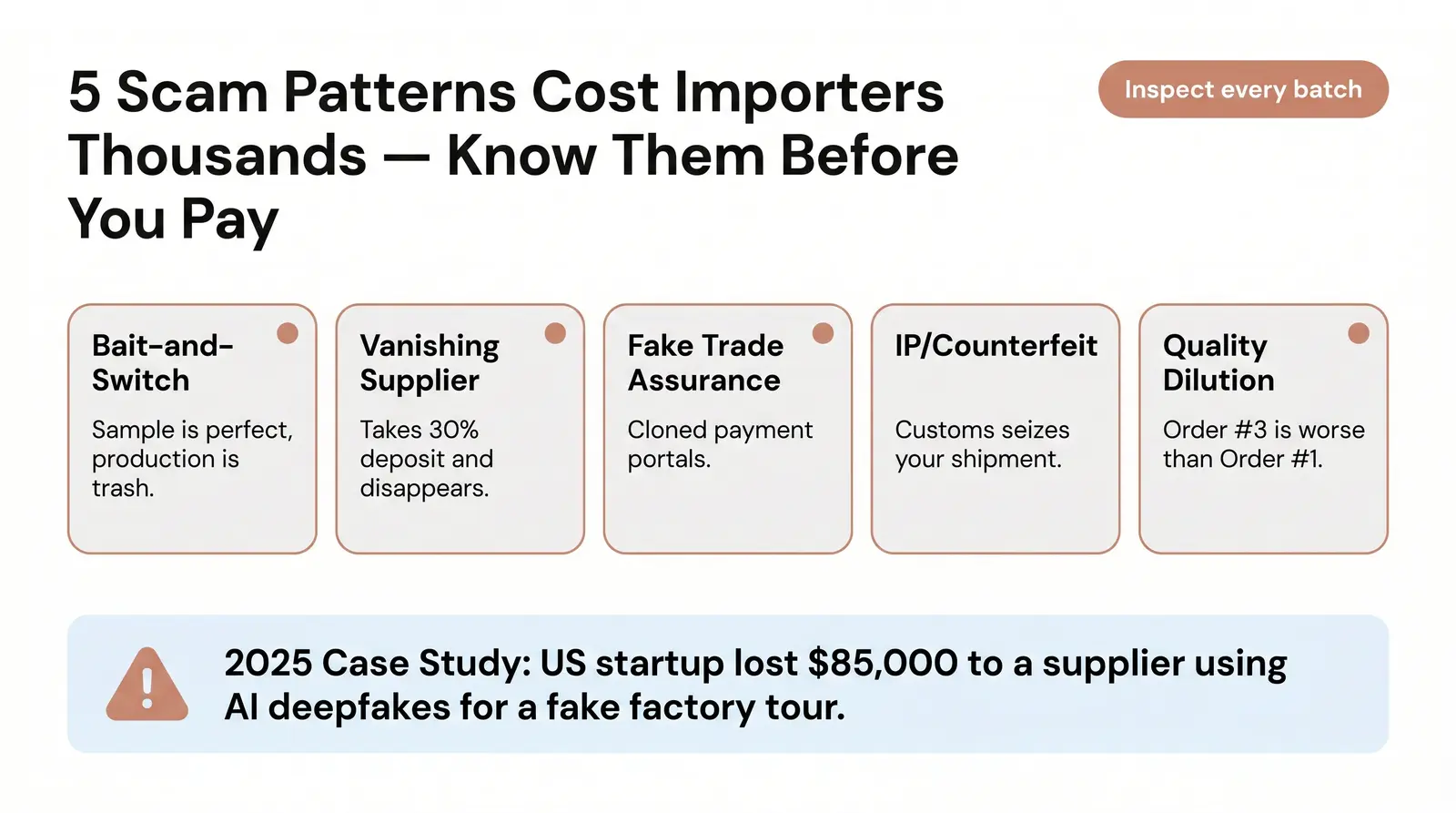
Even with a rigorous vetting process, the landscape of China sourcing is fraught with sophisticated scams. Fraudsters continuously evolve their tactics, and in 2025, they have moved beyond simple ghost companies to complex schemes involving AI deepfakes and forged documentation. [7] Here are five documented scam patterns every importer needs to know.
1. The Bait-and-Switch. A supplier sends a high-quality sample that meets all your specifications. The production run, however, is manufactured with inferior materials or poor craftsmanship. This is the most common scam in the industry and is often difficult to detect until the goods arrive. How to protect yourself: Never skip the pre-shipment inspection. Ensure your purchase contract explicitly states that production goods must match the approved sample in all material respects, and withhold final payment until the inspection report confirms compliance.
2. The Vanishing Supplier. After receiving a 30% or 50% upfront deposit, the supplier ceases all communication. The factory may have never existed, or it was a fraudulent trading company using stolen identity documents. A documented case study from sourcing researchers involved a US startup that lost $85,000 to a supplier who used AI-generated deepfakes during a video call to simulate a factory tour. [7] How to protect yourself: Verify the supplier's business license through official Chinese government channels and use only secure payment methods tied to platform escrow services.
3. Fake Trade Assurance. Scammers create counterfeit platform badges or direct you to a cloned website that mimics Alibaba's Trade Assurance portal. Payments made outside the official platform have no protection. How to protect yourself: Always initiate communication and payments directly through the official B2B platform's messaging and payment systems. Never click on external links provided by the supplier for payment processing.
4. IP and Counterfeit Risks. You unknowingly import goods that infringe on existing patents or trademarks, leading to customs seizures and potential legal action in your home country. Counterfeit goods are routinely intercepted at US ports of entry, and the importer bears the legal liability. How to protect yourself: Conduct thorough patent and trademark searches before sourcing any product. If a supplier offers branded goods at a steep discount, they are almost certainly counterfeit.
5. Quality Dilution. The first few orders are perfect, but subsequent production runs gradually decline in quality as the factory attempts to increase its margins by substituting cheaper components or reducing plating thickness. How to protect yourself: Maintain consistent quality control standards across every order. Do not assume that a successful first batch guarantees future quality. Continue to mandate pre-shipment inspections for every production run.
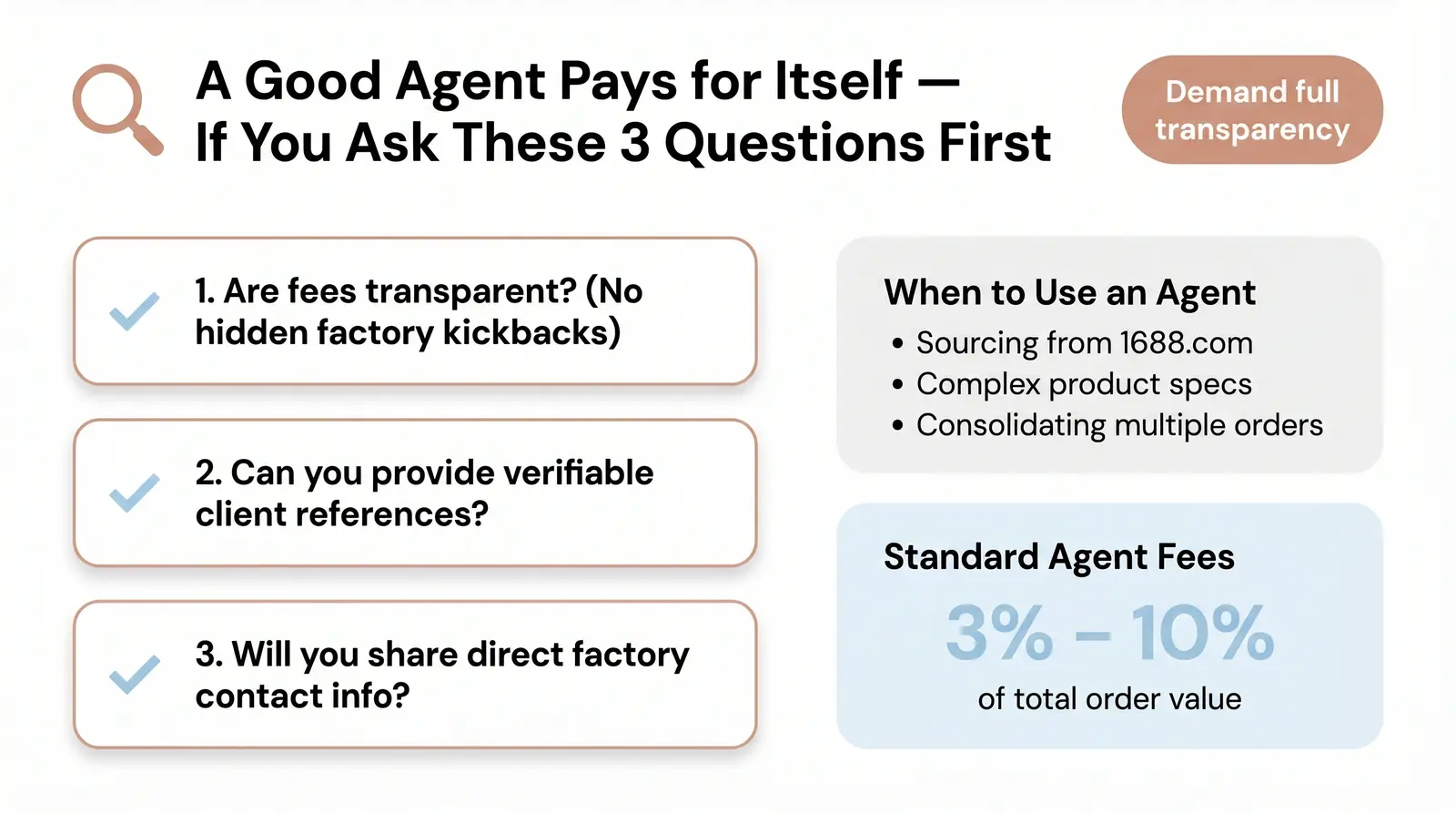
For many founders, the complexities of negotiating with factories, managing quality control, and coordinating logistics are overwhelming. This is where a sourcing agent becomes invaluable. A good agent acts as your representative on the ground in China, handling factory sourcing, price negotiation, QC liaison, and shipment consolidation.
Sourcing agents typically charge a commission between 3% and 10% of the total order value, though some operate on flat fees or monthly retainers. [8] They are particularly useful when sourcing from domestic platforms like 1688.com, managing complex product specifications, or consolidating multiple small orders from different factories into a single shipment.
However, the industry is not without risk. The most common issue is the hidden kickback, where an agent receives a commission from both the buyer and the factory, creating a conflict of interest that inflates your unit cost. When evaluating a sourcing agent, ask these three questions before signing any agreement:
A sourcing agent who hesitates on any of these three questions is not the right partner.
Everything above is real, necessary information—if you are building a brand that requires custom manufacturing at scale. But for a specific category of sellers, especially those in fashion, accessories, and jewelry, there is a model that eliminates most of this complexity entirely.
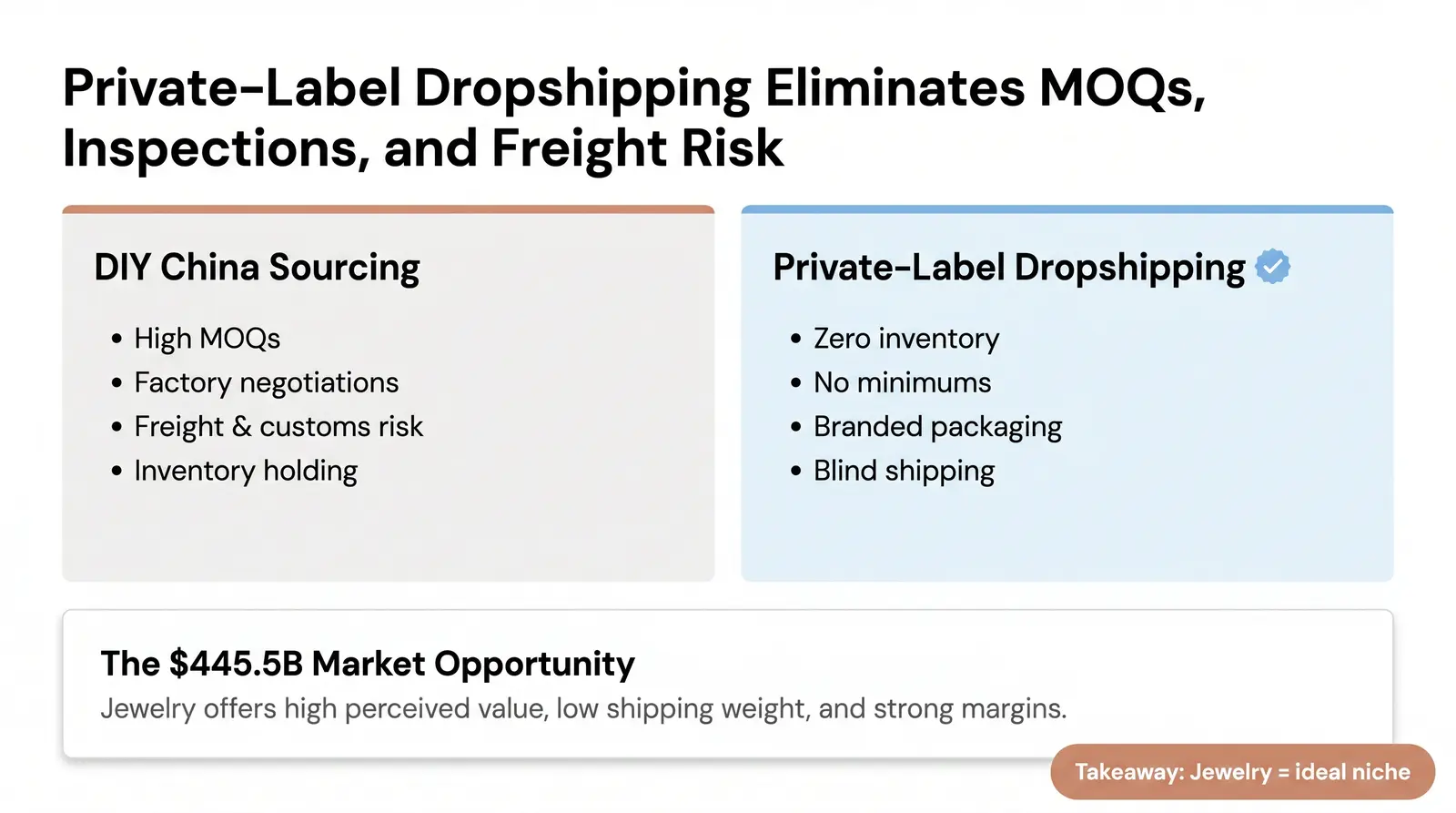
Private-label dropshipping is rapidly transforming how ecommerce brands launch and scale. Instead of navigating MOQs, pre-shipment inspections, freight forwarders, and customs brokers, founders partner with a platform that handles the entire supply chain. The global dropshipping market is valued at $445.5 billion in 2025 and is projected to reach $1,253 billion by 2030, driven by the demand for low-risk, high-margin business models. [9]
While dropshipping apparel can be challenging due to sizing complexity and high return rates, and electronics carry significant IP and customs risk, jewelry is the ideal niche for this model. Jewelry offers high perceived value relative to its weight and shipping cost, strong repeat purchase potential, excellent margins on branded product, and it is inherently influencer-friendly. A $30 bracelet with your brand's name and packaging on it commands a fundamentally different customer relationship than an unbranded piece from a wholesale marketplace.
Consider the contrast directly. DIY China sourcing requires you to manage MOQs, factory negotiations, pre-shipment inspections, freight forwarding, customs clearance, and warehousing before you make a single sale. Private-label dropshipping eliminates all of that. No inventory, no minimums, branded packaging, and blind shipping directly to your customer.
This is exactly the problem Branvas was built to solve. With established manufacturing relationships in Thailand, China, and Italy, Branvas handles sourcing, quality control, branding, packaging, and blind fulfillment, so you can launch a real jewelry brand without placing a single factory order. Whether you are an aspiring entrepreneur building your first brand or an influencer or creator looking to monetize your audience with a product line, the model is built for speed and simplicity.
If you are in the early stages of figuring out your sourcing model, it is worth spending 5 minutes with our how-it-works page before committing to an MOQ.
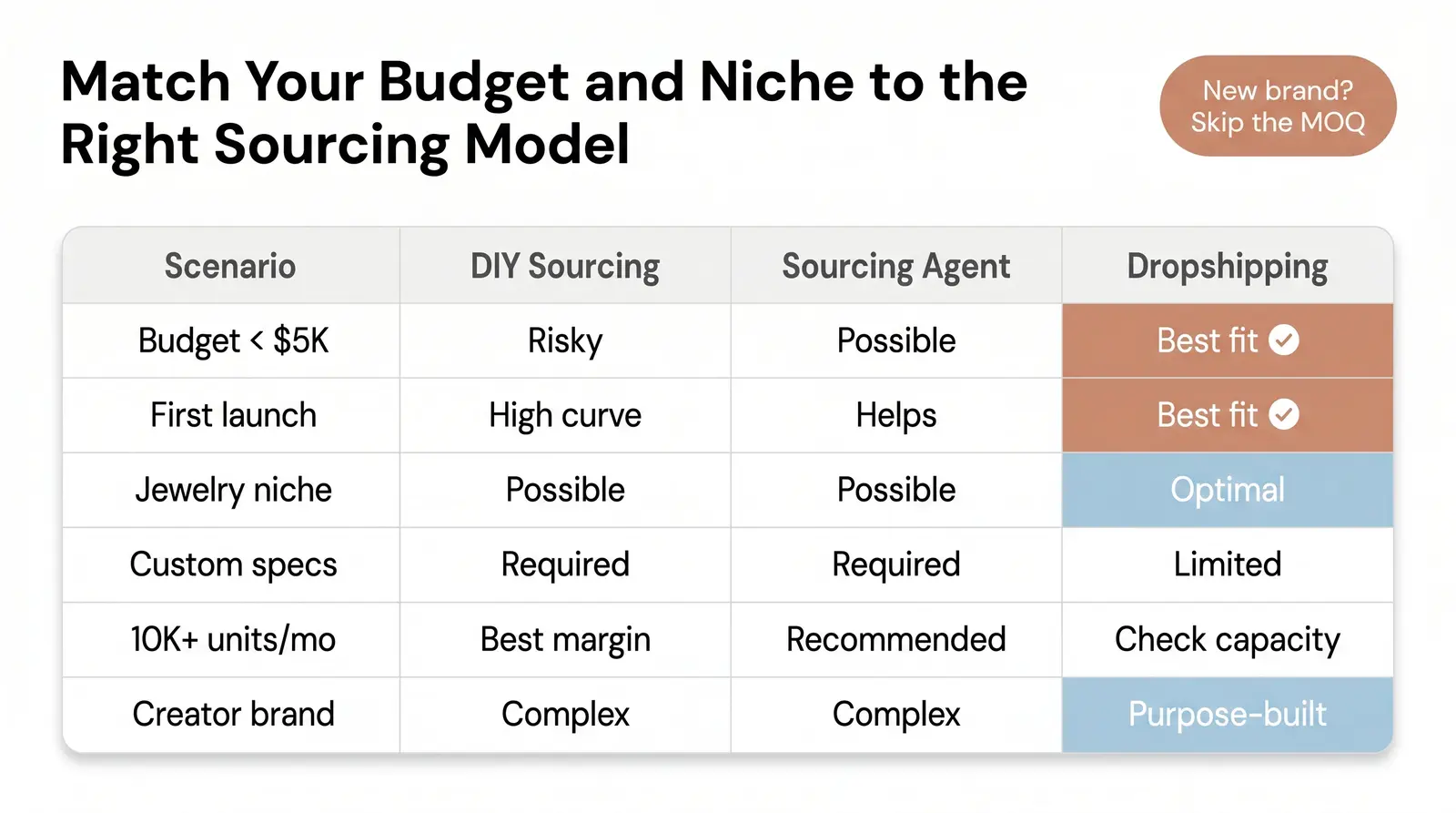
Choosing the right sourcing model depends entirely on your budget, experience level, and product category. Use this matrix to determine the best path for your brand:
| Scenario | DIY China Sourcing | Sourcing Agent | Private-Label Dropshipping (e.g., Branvas) |
|---|---|---|---|
| Budget under $5,000 | Risky | Possible | Best fit |
| First product launch | High learning curve | Helps | Best fit |
| Jewelry and accessories niche | Possible | Possible | Optimal |
| Need custom specs or patents | Required | Required | Limited |
| Selling 10,000+ units per month | Best margin | Recommended | Check capacity |
| Influencer or creator brand | Complex | Complex | Purpose-built |
For first-time founders or those with limited capital, the DIY route is fraught with expensive lessons that compound quickly. Conversely, if you are scaling a highly customized product to tens of thousands of units per month, direct factory relationships or a dedicated sourcing agent will yield the best long-term margins. For the vast majority of new jewelry and accessory brands, the private-label dropshipping model offers the fastest, safest path to market. If you want to understand the cost comparison in detail, the Branvas pricing page lays it out clearly.
Alibaba is generally the best starting point for international buyers due to its massive supplier directory and Trade Assurance buyer protection. For industrial or specialty goods, Made-in-China.com is a strong alternative with rigorous supplier verification. If you are looking for the lowest possible unit prices and are comfortable working with a sourcing agent, 1688.com offers factory-direct pricing without the export markup. The right platform depends on your product category, order volume, and risk tolerance.
Alibaba is a B2B platform designed for bulk wholesale orders and custom manufacturing, typically requiring Minimum Order Quantities starting at 50 to 500 units. AliExpress is a B2C retail platform where you can buy single units, making it useful for product testing or dropshipping, but the margins are usually too thin for building a scalable brand. Alibaba also offers Trade Assurance, a robust escrow and dispute resolution system, while AliExpress buyer protection is less comprehensive for commercial buyers.
Verify the supplier's business license through official channels, insist on ordering a physical sample before bulk production, and use secure payment methods like Alibaba Trade Assurance. Never pay via Western Union or direct wire transfer to a personal account. Most importantly, never skip a third-party pre-shipment inspection. The $300 inspection fee is the single most effective defense against receiving a batch of substandard goods.
MOQs vary significantly by product category and factory, typically ranging from 50 to over 1,000 units for custom manufactured goods. However, stated MOQs are often negotiable. Factories may accept a smaller initial order if you are willing to pay a slightly higher per-unit price to cover their setup costs. For jewelry and accessories, initial MOQs of 100 to 300 units are common for custom designs.
Yes, in several specific scenarios: when sourcing from domestic platforms like 1688.com, when managing complex product specifications that require on-the-ground oversight, or when consolidating orders from multiple factories into a single shipment. A good agent charges 3% to 10% commission but can save you significantly more by negotiating better factory prices and preventing costly quality mistakes. The key is vetting the agent as rigorously as you would vet a supplier.
Sourcing products from China is a viable and highly profitable strategy, but it is operationally heavy. The platforms are powerful, the factories are capable, and the price advantages are real. However, the learning curve is steep, and the cost of a single mistake, whether it is a botched quality inspection, misunderstood shipping terms, or a sophisticated scam, can cripple a new business before it gains any momentum.
The decision ultimately comes down to a fork in the road. You can go deep on DIY sourcing, investing the time and capital to build a robust supply chain, or you can choose the right partner for your niche and eliminate the friction entirely. For founders in the jewelry and accessories space, the private-label dropshipping model wins clearly. It removes the inventory risk, the MOQ traps, and the logistical complexity, allowing you to focus entirely on building your brand and serving your customers.
We have seen founders spend six months and $15,000 navigating the DIY China sourcing process, only to end up with a warehouse full of product that does not move. We have also seen founders launch a jewelry brand in under 30 days with zero inventory risk. The difference is choosing the right model for your niche from the start.
Ready to launch a jewelry brand without the sourcing headache? See how Branvas works — or explore the product catalog to see what is ready to brand and ship today.