


This guide ranks side hustles by scalability using a 3-tier framework, revealing why private-label jewelry offers the highest margins and brand-building potential for aspiring entrepreneurs.
Published:
July 9, 2026
Author:
Yi Cui
Search for "side hustle ideas" and the internet will flood you with lists recommending DoorDash, selling on eBay, or freelance tutoring. These are valid ways to make a quick buck, but almost none of them scale past a single income ceiling. They are fundamentally flawed for anyone looking to build long-term wealth.
The key distinction you need to understand is time-bound income versus leverage-based income. Time-bound side hustles require you to actively work to earn. If you stop driving or tutoring, the money stops. Leverage-based income means your revenue can grow without a proportional increase in your time input.
Most people optimizing for the "highest hourly rate" in a side hustle are thinking about it wrong. The better variable is the revenue ceiling—the maximum you can earn even if you work 24/7. A $50-per-hour freelance gig has a hard ceiling; a branded product store does not. In fact, a 2026 survey found that while 47% of Americans have a side hustle, those relying on traditional gig work often plateau quickly, whereas those building leverage-based models see compounding returns [1].

At Branvas, we use a proprietary decision tool to evaluate side hustles before recommending paths to founders. We call it the Branvas Scalability Matrix™. It ranks opportunities based on their true growth potential.
| Side Hustle | Time Ceiling | Revenue Ceiling | Startup Cost | Brand-Building Potential | Scalability Tier |
|---|---|---|---|---|---|
| Gig Economy (Delivery/Rideshare) | High (Hours worked = pay) | Low ($2k-$4k/mo max) | Low | None | Tier 1 |
| Freelancing (Writing/Design) | High | Medium ($5k-$10k/mo) | Low | Low | Tier 1 |
| Reselling/Flipping | High | Medium | Low-Medium | Low | Tier 1 |
| Tutoring/Coaching | High | Medium | Low | Low | Tier 1 |
| Social Media Management | Medium | Medium | Low | Low | Tier 2 |
| Affiliate Marketing | Low | High | Low | Medium | Tier 2 |
| Content Creation/YouTube | Medium | High | Low | High | Tier 2 |
| Print-on-Demand | Low | Medium-High | Low | Medium | Tier 2 |
| Digital Products/Courses | Low | High | Low-Medium | High | Tier 3 |
| Private-Label Jewelry/Accessories | Low | Very High | Low-Medium | Very High | Tier 3 |
The matrix makes it clear: to build a real business, you must move from Tier 1 (trading time for money) to Tier 3 (building assets and brand equity).
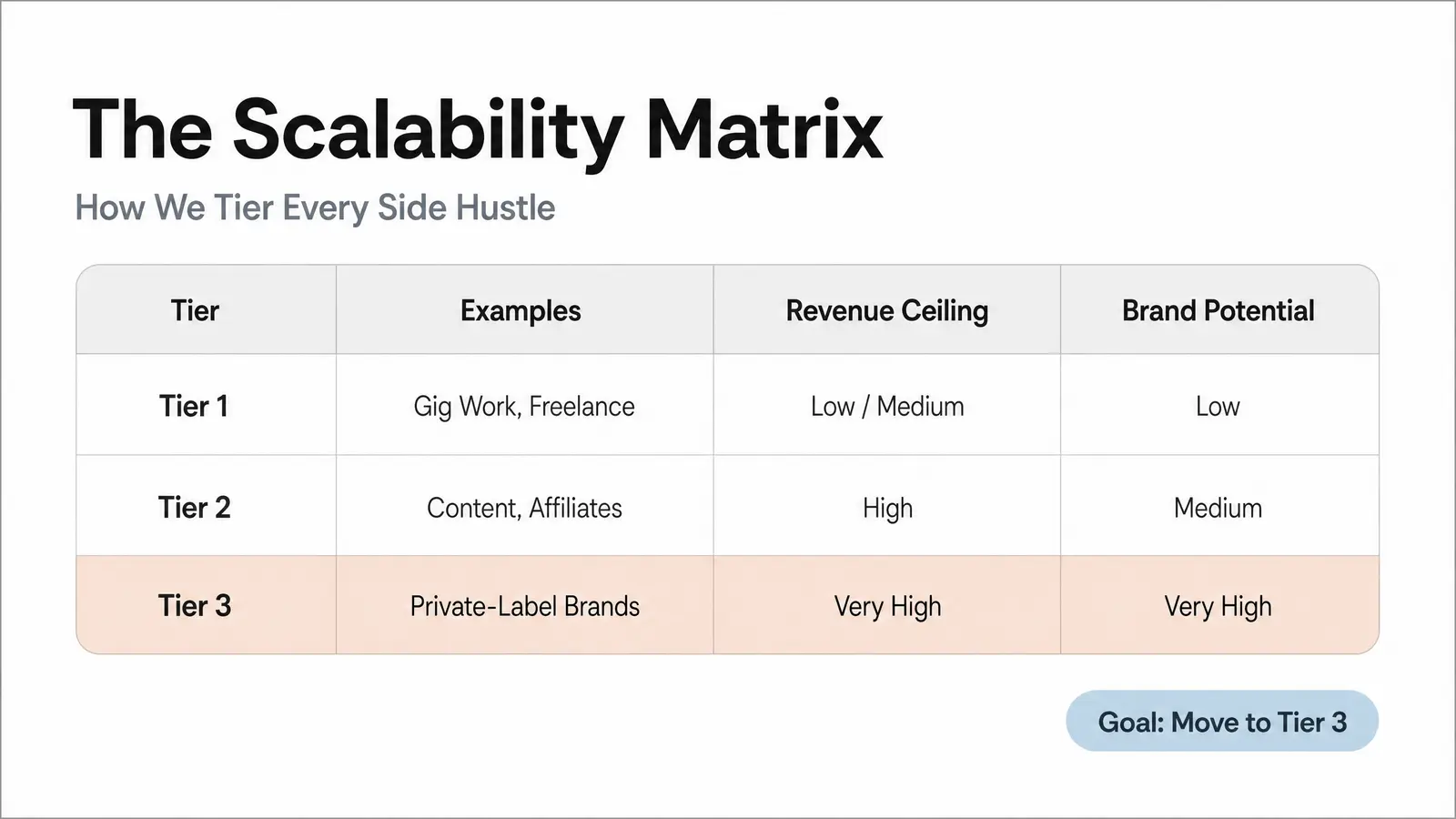
Tier 1 side hustles include the gig economy, tutoring, freelance services, and reselling. These are the most common entry points into the side hustle world. They are legitimate ways to earn, and they often require zero upfront capital.
However, they cap out. You only have 24 hours in a day. If you charge $50 an hour for freelance design, your absolute maximum earning potential is strictly tied to your waking hours. In our experience at Branvas, we often see founders who started in freelance or gig work—it built discipline and capital, but they hit a ceiling fast and needed leverage. They realize that no matter how hard they hustle, they are still just an employee with a different title.

Tier 2 side hustles offer more leverage. This category includes social media management, affiliate marketing, content creation, coaching, and print-on-demand. These models are better because you can build an audience and automate some of the revenue generation.
The problem is that you are still largely the bottleneck. Your face, your content, or your direct involvement drives the sales. Consider a content creator who built a 50,000-follower account and earns $2,000 a month in affiliate income. They have plateaued because they have no owned product or brand equity. If the algorithm changes or they stop posting, the income dries up. They are scaling, but they are scaling their own labor rather than a standalone asset.

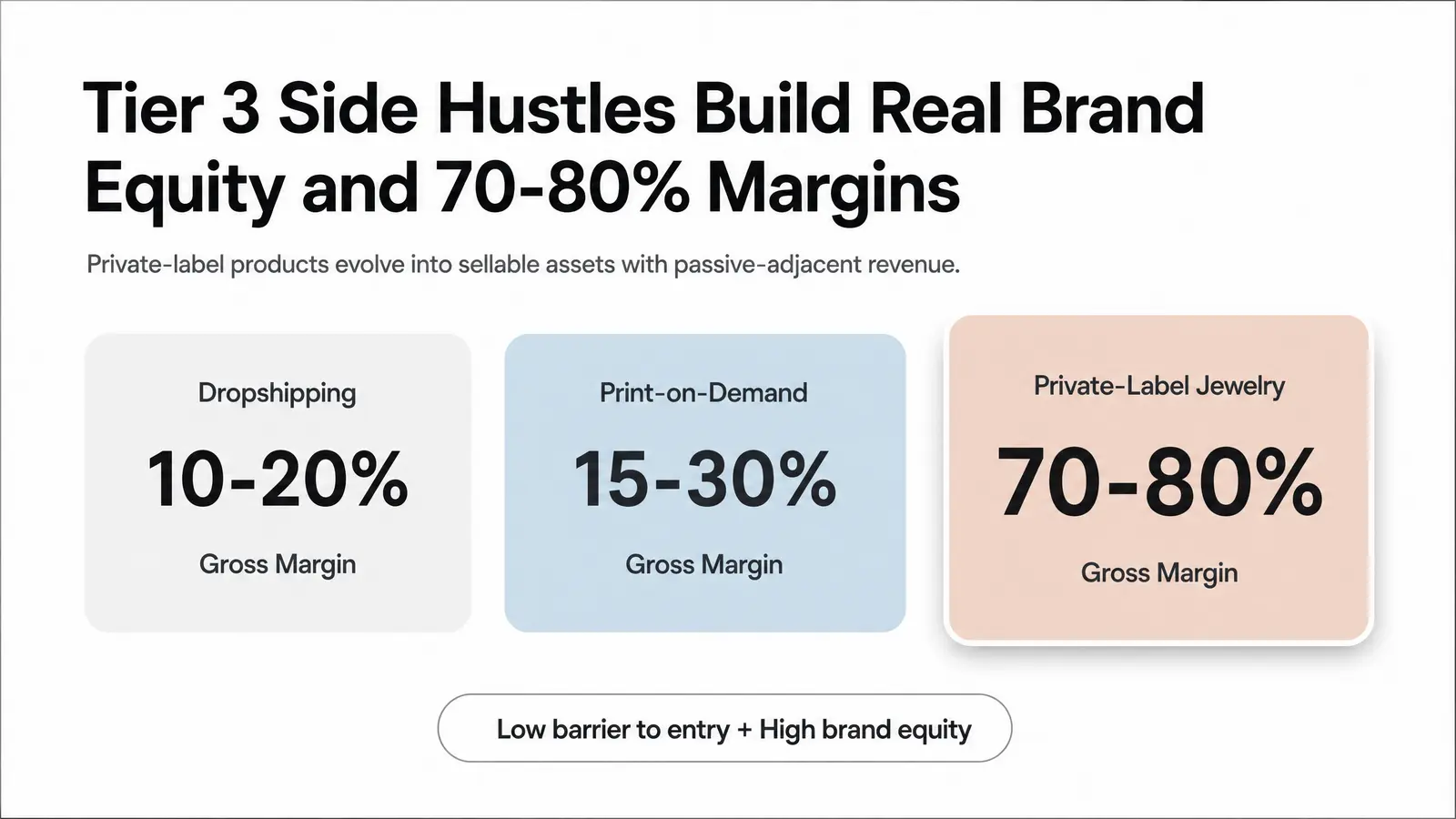
Tier 3 side hustles are the ones that evolve into real businesses. These include private-label physical products, branded e-commerce stores, SaaS, and digital product businesses with distribution. What makes these different is brand equity, repeat customers, sellable asset value, and passive-adjacent revenue.
Private-label jewelry and accessories stand out as the most accessible Tier 3 option for non-technical founders, especially creators and influencers. The margin proof is undeniable. A piece of jewelry sourced at $8 to $12 can be branded and sold for $45 to $75. When fulfillment is handled by a third party, you are looking at a 70–80% gross margin potential. Compare that to dropshipping commodities, which often yield 10–20% margins, or print-on-demand at 15–30% [2] [3].
Jewelry is often overlooked because people assume it requires goldsmithing skills or a massive upfront inventory buy. In reality, the barrier is lower than people think—especially with a Brand-as-a-Service model. At Branvas, we've worked with creators who launched their first jewelry collection with no prior product experience and were shipping orders within weeks.
If you're wondering whether a jewelry brand is realistic for your situation, Branvas's How It Works page walks through the full process—sourcing, branding, and fulfillment—in plain language.
Building a Tier 3 side hustle isn't magic. It requires a system. We call this the Branvas Brand Progression Framework, a 5-stage model to take you from idea to scale.
Take Maya, a 28-year-old nurse with 12,000 Instagram followers. She launched a dainty gold jewelry brand in six weeks. She hit $4,200 in her first month and crossed $8,000 a month by month four simply by adding a second collection. She followed the progression and built an asset.

Creators and influencers with an existing audience have the fastest path to scale. They already have distribution and trust, meaning their customer acquisition cost is near zero. E-commerce sellers who understand how to move product but are tired of low-margin dropshipping are also perfectly positioned to pivot into high-margin private-label goods.
Even aspiring entrepreneurs starting from zero can succeed. The runway is slightly longer, but building a brand from scratch is a totally viable path if you focus on a specific niche.

Three common failure modes stop side hustles from growing. First is a lack of differentiation. If you compete solely on price with no brand identity, you will lose to larger competitors. Second is the time-scaling trap. Founders try to grow by adding more hours instead of building leverage or systems.
Third, and most importantly, is picking the wrong vehicle. If you choose a side hustle with a structural ceiling, you will always wonder why it won't grow. The biggest predictor of side hustle success isn't the idea—it's whether the model has leverage built into it from day one. Picking the right vehicle matters more than execution, at least early on.
Ready to turn your side hustle into a real brand? See how Branvas works — from your first product to your first 100 orders.

What side hustle has the highest income potential in 2026?
Private-label physical products, specifically in high-margin categories like jewelry and accessories, offer the highest income potential. Unlike freelancing or gig work, branded e-commerce scales without requiring a proportional increase in your time, allowing for uncapped revenue growth.
Can a side hustle really become a full-time business?
Yes, but only if you choose a scalable model. Time-bound side hustles rarely replace a full-time salary without burnout. However, building a branded e-commerce store or digital product business creates equity and leverage, making the transition to full-time highly achievable.
What are the best side hustles for people with limited time?
The best options for limited time are those that separate fulfillment from sales. Brand-as-a-Service models, where platforms like Branvas handle sourcing, packaging, and shipping, allow you to focus purely on marketing and brand building.
Is selling jewelry a good side hustle?
Selling jewelry is an exceptional side hustle due to its high gross margins (often 70–80%), low shipping costs, and strong brand-building potential. It is highly scalable and doesn't require massive upfront inventory if you partner with the right supplier.
How do I start a private-label product side hustle with no experience?
Start by validating an audience or niche. Then, partner with a Brand-as-a-Service platform that manages the complex parts—sourcing, branding, and fulfillment. This allows you to launch quickly and focus on selling rather than logistics.