


This article compares POD vs private label jewelry models, revealing how sellers can nearly double gross profit by switching to branded private-label fulfillment without holding inventory.
Published:
August 24, 2026
Author:
Yi Cui
Upgrade your quality, upgrade your profit.
For many ecommerce sellers, print-on-demand is the gateway drug to entrepreneurship. It offers a frictionless entry point with zero inventory risk, allowing anyone to launch a brand from their laptop. You upload a design, connect a store, and let a third-party facility handle the rest. It feels like magic until you look closely at your profit and loss statement.
The reality of scaling a print-on-demand business often involves a frustrating plateau. While revenue might grow, the actual cash retained in the business remains stubbornly low. You outsource the risk, but you also outsource the margin and the brand equity.
As sellers mature, the conversation inevitably shifts from "how do I get my first sale?" to "how do I actually build a profitable, sellable asset?" This is where the evaluation of POD vs private label becomes critical. Understanding the structural differences in margin, fulfillment, and customer experience is the key to unlocking the next stage of growth.
Print-on-demand operates on a simple premise: products are only manufactured after a customer places an order. For apparel and basic accessories, platforms like Printful, Printify, and Gelato have built massive infrastructures to support this model. The global print-on-demand market was valued at roughly $10 billion in 2024, driven by the sheer accessibility it offers to creators and side-hustlers [1].
The strengths of this model are undeniable. You face zero inventory risk, require minimal startup capital, and can test hundreds of designs without financial penalty. If a t-shirt design flops, you simply delete the listing. This flexibility makes it an incredible sandbox for validating ideas and finding an audience.
However, the core problem with print-on-demand lies in what you are actually selling. You are marketing commodity products with thin margins and zero brand differentiation. When a customer receives a POD item, it typically arrives in a generic poly mailer. The unboxing experience is entirely forgettable, and the packaging is something you do not control. You are essentially acting as an outsourced marketing arm for the printing facility, rather than building a distinct brand identity.
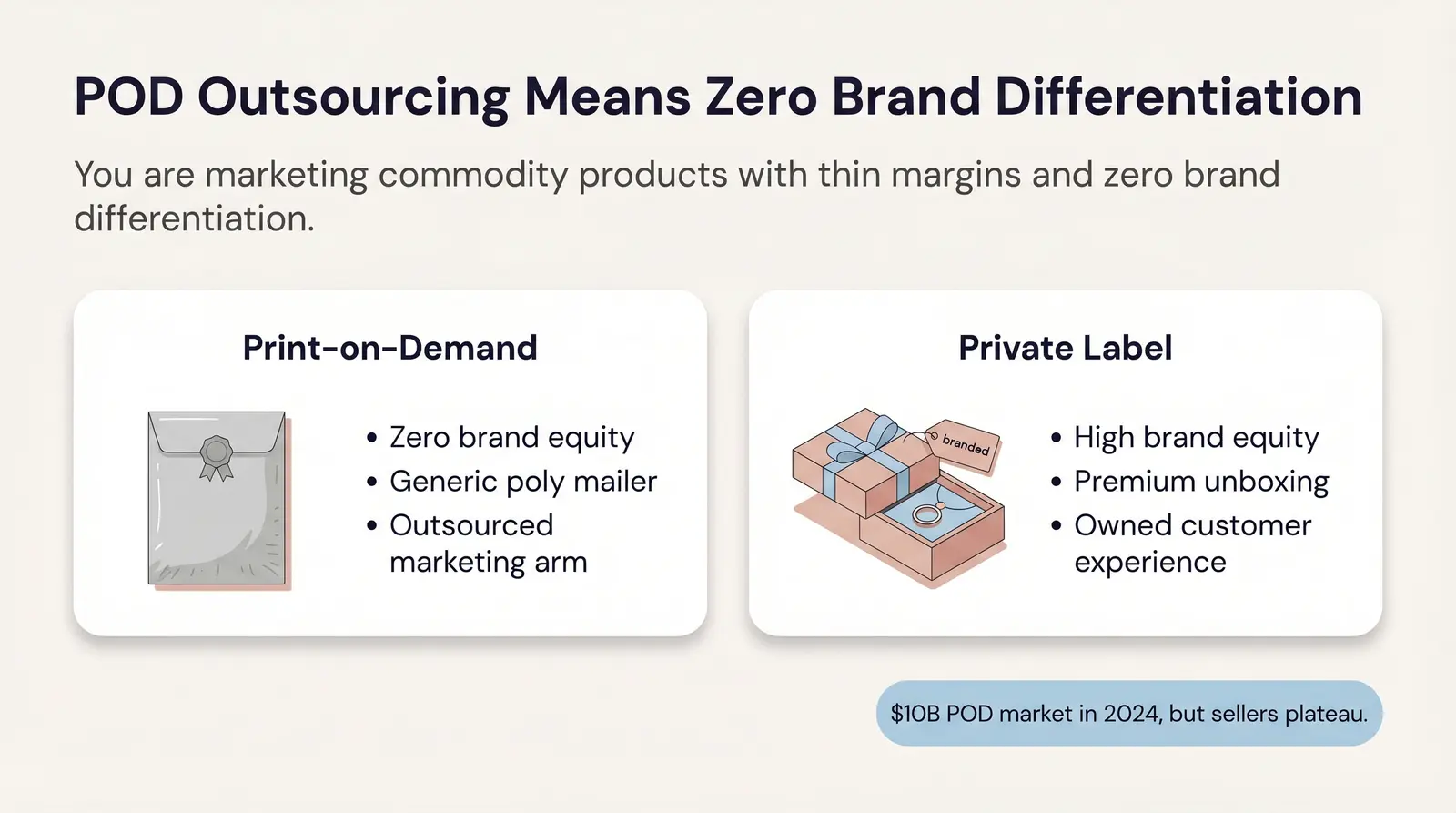
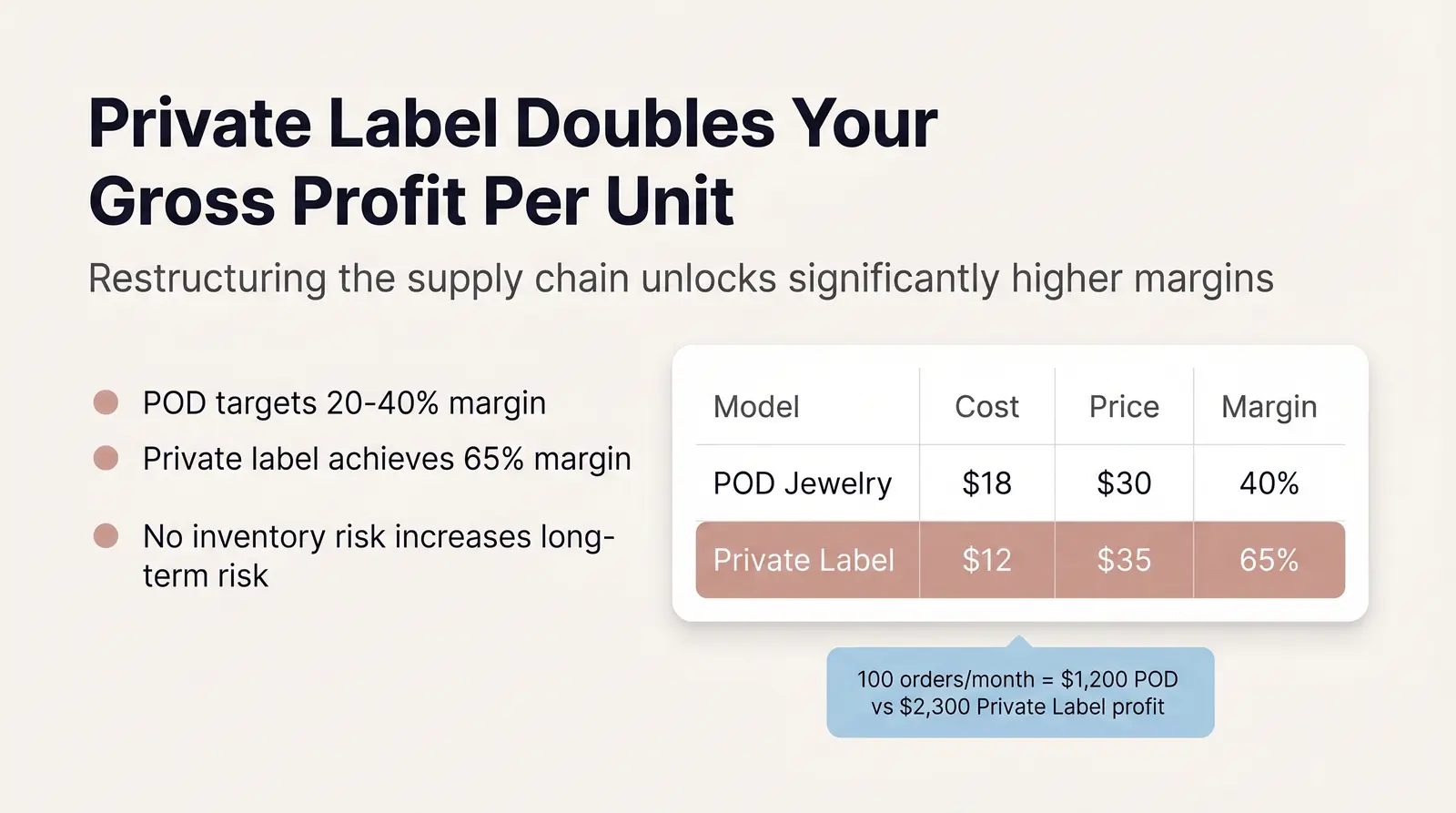
The financial reality of print-on-demand is often obscured by top-line revenue screenshots. When you break down the unit economics, the picture becomes much clearer. Most print-on-demand sellers target profit margins between 20% and 40%, but achieving the higher end of that spectrum requires premium pricing that commodity products rarely support [2].
| Model | Avg. Product Cost | Typical Retail Price | Gross Margin % | Branded Packaging | Brand Equity Built |
|---|---|---|---|---|---|
| POD – Apparel | $15.00 | $25.00 | 40% | No | Low |
| POD – Jewelry/Accessories | $18.00 | $30.00 | 40% | Paid Add-on | Low |
| Private Label – Jewelry (Branvas) | $12.00 | $35.00 | 65% | Included | High |
Consider a worked example of a seller doing 100 orders per month. If they sell a POD engraved necklace, the base cost might be $18. Selling it at $30 yields a $12 gross profit per unit, or $1,200 monthly. Now, compare this to the Branvas private-label model. A comparable, higher-quality private-label piece might cost $12 landed, including custom packaging. Because the perceived value is higher, the seller can comfortably retail it at $35. This yields a $23 gross profit per unit, or $2,300 monthly. That is nearly double the gross profit on the exact same order volume, simply by restructuring the supply chain.
There is a contrarian insight here that most dropshipping gurus ignore: the "no inventory risk" promise of POD actually increases your long-term business risk. By relying entirely on a third-party platform for generic products, you build zero defensible assets. You are locked into their pricing structure, and you suffer customer churn from unbranded unboxing experiences. As industry analysts note, private labeling involves higher upfront work, but it is the only reliable path to building a long-term brand with higher profit margins and a sellable business [3].
Brand equity is not just a marketing buzzword; it is a measurable financial asset in ecommerce. In practical terms, it translates to your repeat purchase rate, the volume of word-of-mouth referrals, and the social shareability of your product's unboxing experience. When a customer feels an emotional connection to a brand, they return.
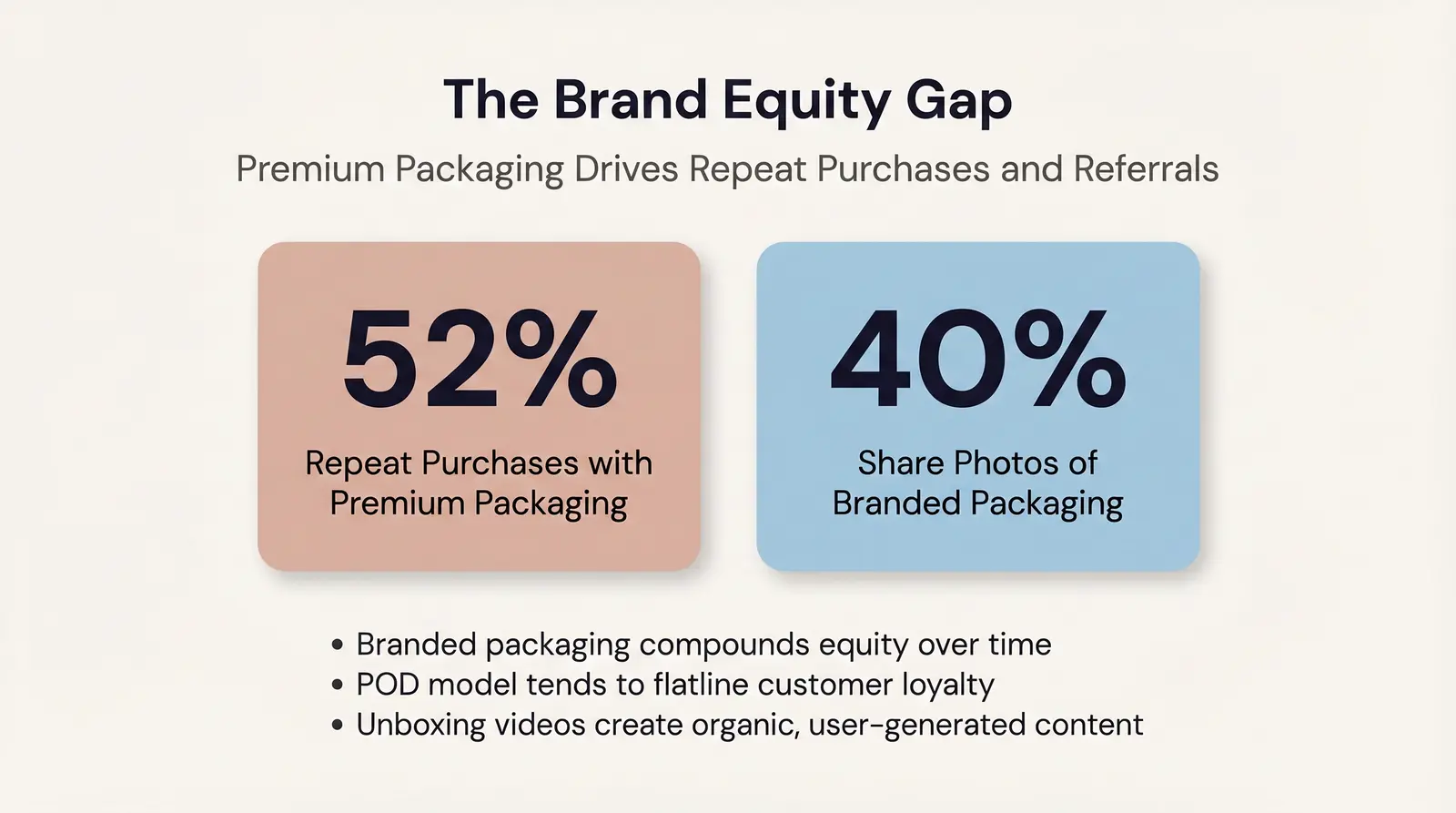
Branded packaging and private-label products compound this equity over time, whereas the POD model tends to flatline. Data shows that 52% of consumers are more likely to repeat purchases if their orders are shipped in premium packaging, and 40% of shoppers will share photos of unique or branded packaging on social media [4]. This organic, user-generated content is the lifeblood of modern ecommerce growth.
In our experience at Branvas, sellers who switch from POD to private label often report their first surprise is not the margin improvement. It's the unboxing video content their customers start creating organically. When a customer receives a beautifully packaged piece of jewelry with your logo on the box and pouch, they perceive it as a luxury experience, not a dropshipped commodity.
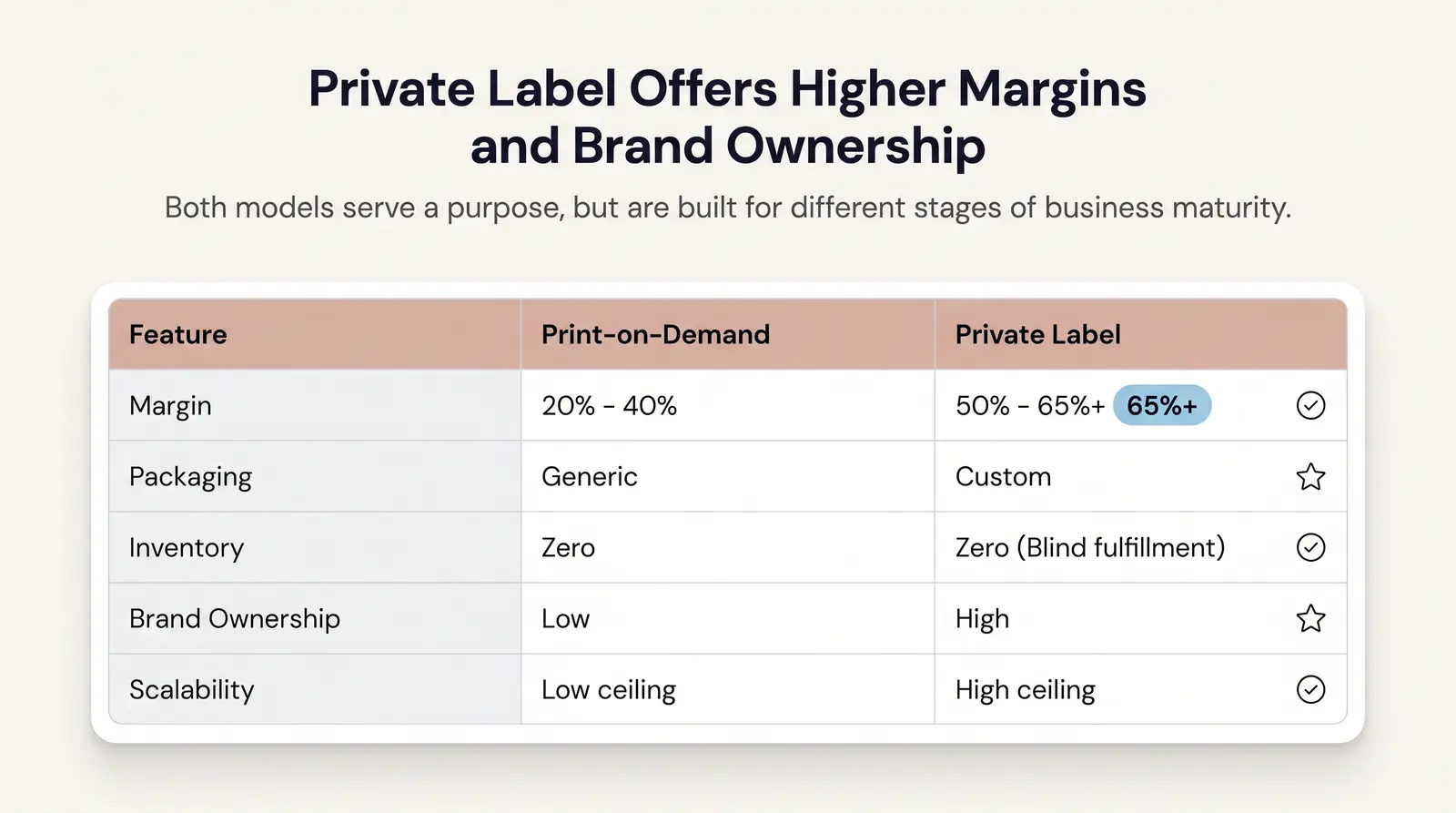
When evaluating printful alternatives or deciding whether to transition your business model, a direct comparison of capabilities is essential. Both models serve a purpose, but they are built for entirely different stages of business maturity.
| Feature | Print-on-Demand | Branvas Private Label |
|---|---|---|
| Product customization depth | Surface printing/engraving only | Full catalog of curated, high-quality pieces |
| Packaging control | Generic or expensive manual add-ons | Custom boxes, pouches, and cards included |
| Margin range | 20% – 40% | 50% – 65%+ |
| Time to launch | Instant | Fast (under 10 minutes via Shopify) |
| Inventory required | Zero | Zero (Blind fulfillment model) |
| Brand asset ownership | Low (Platform dependent) | High (You own the customer experience) |
| Fulfillment model | Third-party printed and shipped | Blind direct fulfillment from curated warehouses |
| Scalability ceiling | Low (Margin compression at scale) | High (Margin expansion and brand loyalty) |
It is important to acknowledge where POD still wins. If you are testing a highly specific, trend-based graphic tee and need total zero-inventory flexibility for a 48-hour sales window, POD is unmatched. However, for building a sustainable jewelry or accessories brand, the limitations quickly outweigh the benefits.
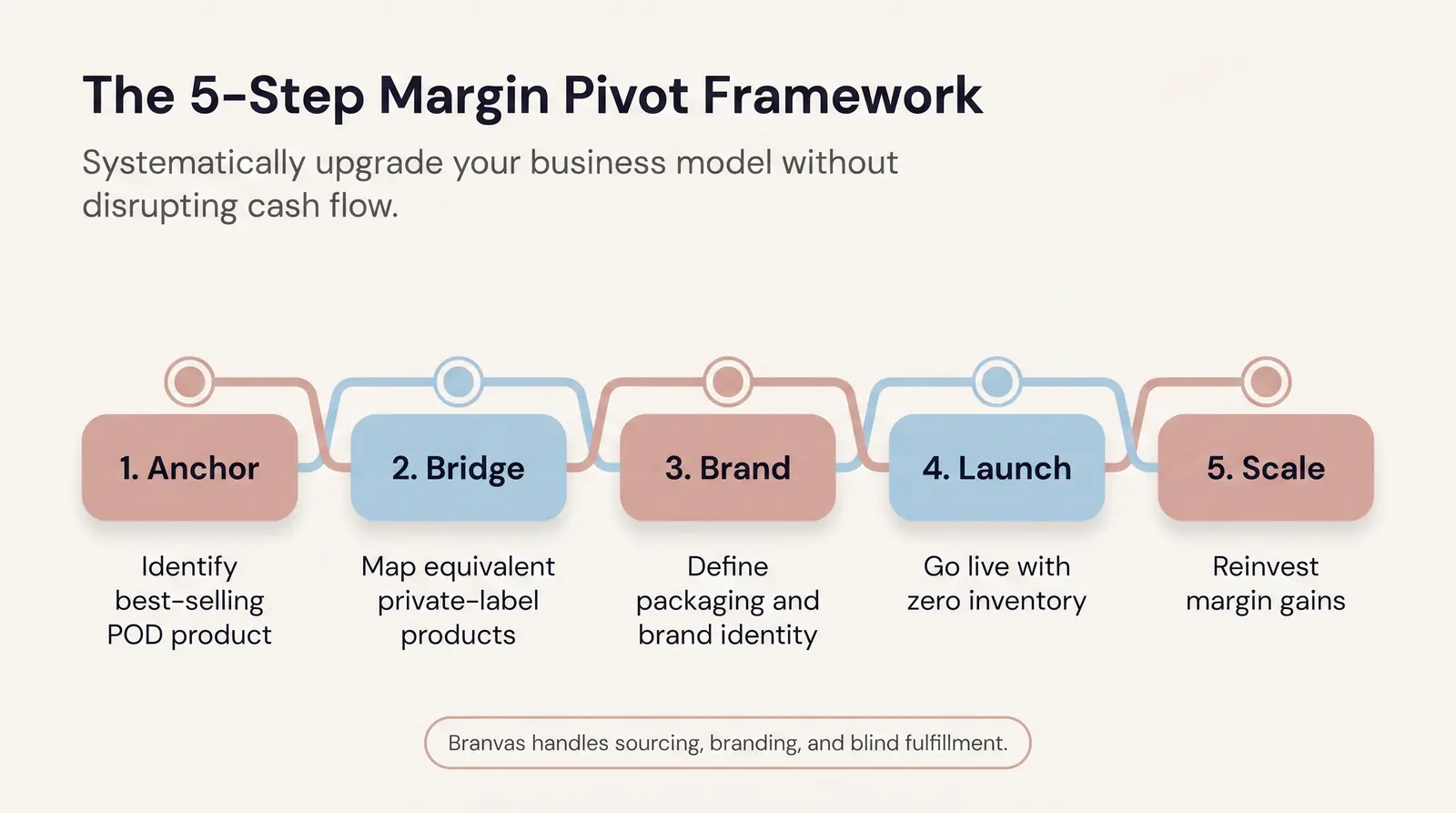
The traditional barrier to private label has always been the complexity of sourcing, negotiating minimum order quantities (MOQs), and managing warehouse logistics. Branvas eliminates this friction by operating as a Brand-as-a-Service platform. We handle the product sourcing, the branding and packaging, and the blind fulfillment, allowing you to operate a private-label brand with the agility of a dropshipper.
To navigate this transition, we developed the Branvas Margin Pivot Framework. This five-step process is designed to help sellers systematically upgrade their business model without disrupting cash flow:
This framework is a practical decision-making tool for founders who are tired of leaving money on the table. If you're curious how your current POD margins compare, Branvas's Profit Calculator lets you model the switch in under two minutes.
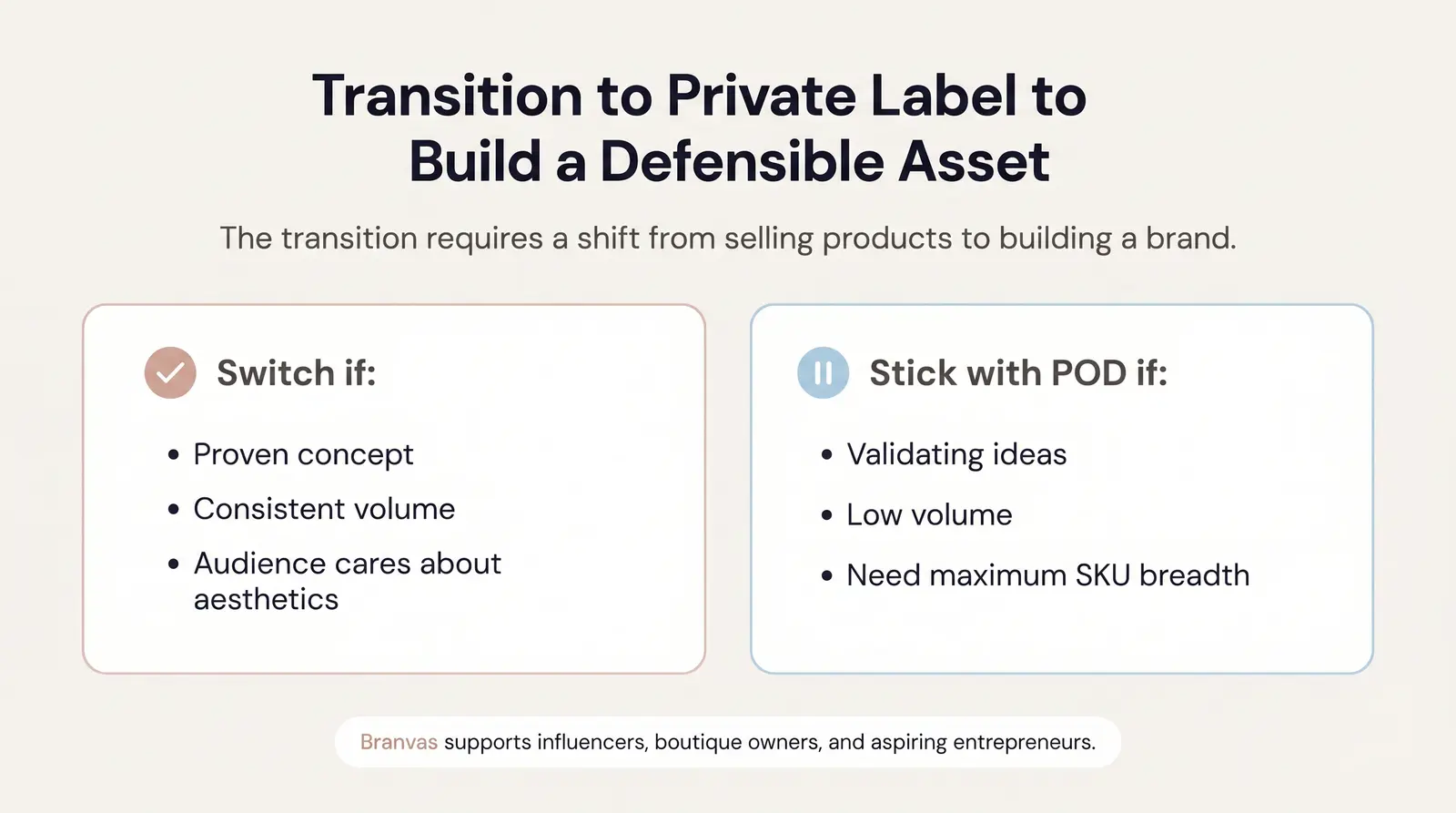
The transition from POD to private label is not for everyone. It requires a shift in mindset from simply selling products to actively building a brand.
Switch to private label if:
Stick with POD if:
The Branvas platform is specifically engineered to support this transition. It works particularly well for influencers and creators who want to monetize their existing audiences with high-quality merchandise, ecommerce and boutique store owners looking to expand their margins, and aspiring entrepreneurs who want to launch a real brand from day one.
Ready to stop leaving margin on the table? See how Branvas works →
The average gross margin for print-on-demand jewelry typically ranges from 25% to 40%. This is often lower than apparel because the base costs for engraved or custom-shaped metal items are higher, and platform fees quickly eat into the final profit.
Yes, for long-term brand building. While dropshipping offers a low barrier to entry, private label jewelry provides significantly higher profit margins (often 50% to 65%+), superior quality control, and the ability to build brand equity through custom packaging.
Absolutely. Platforms like Branvas offer a Brand-as-a-Service model that provides private-label quality and custom branded packaging with blind fulfillment, meaning you never have to hold inventory or manage shipping logistics yourself.
Traditionally, sourcing and manufacturing could take months. However, using a platform with a curated catalog and integrated Shopify apps, you can select products, upload your logo for packaging, and launch a private-label jewelry brand in under a day.
White label involves taking a generic, pre-manufactured product and selling it under your brand name. Private label typically involves more exclusivity and customization, where the product is manufactured or packaged specifically for your brand, creating a unique offering in the market.