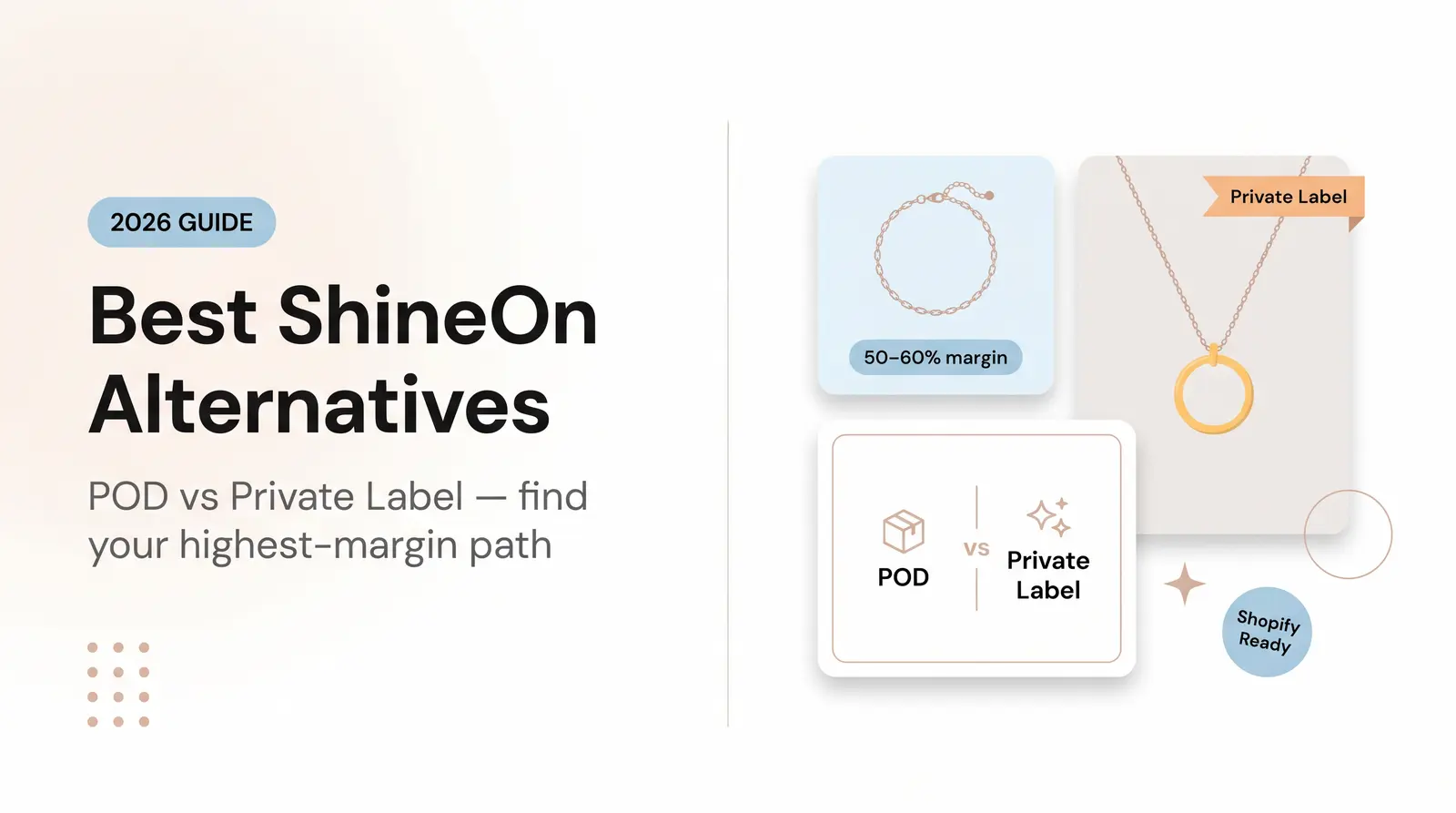


This article compares ShineOn’s print-on-demand jewelry model against private label alternatives, showing how Brand-as-a-Service platforms deliver higher margins and full brand control.
Published:
May 1, 2026
Author:
Yi Cui
ShineOn is a great POD platform for one specific playbook: personalized message necklaces sold via Facebook ads. If your brand vision is anything else, you need a different model entirely.
The print-on-demand (POD) industry is expanding rapidly. The global POD market was valued at $12.96 billion in 2025 and is projected to reach $102.99 billion by 2034, growing at a 26% compound annual growth rate [1]. Within this booming sector, jewelry has emerged as a high-margin category, with the broader online jewelry market projected to hit $85.7 billion in 2026 [2].
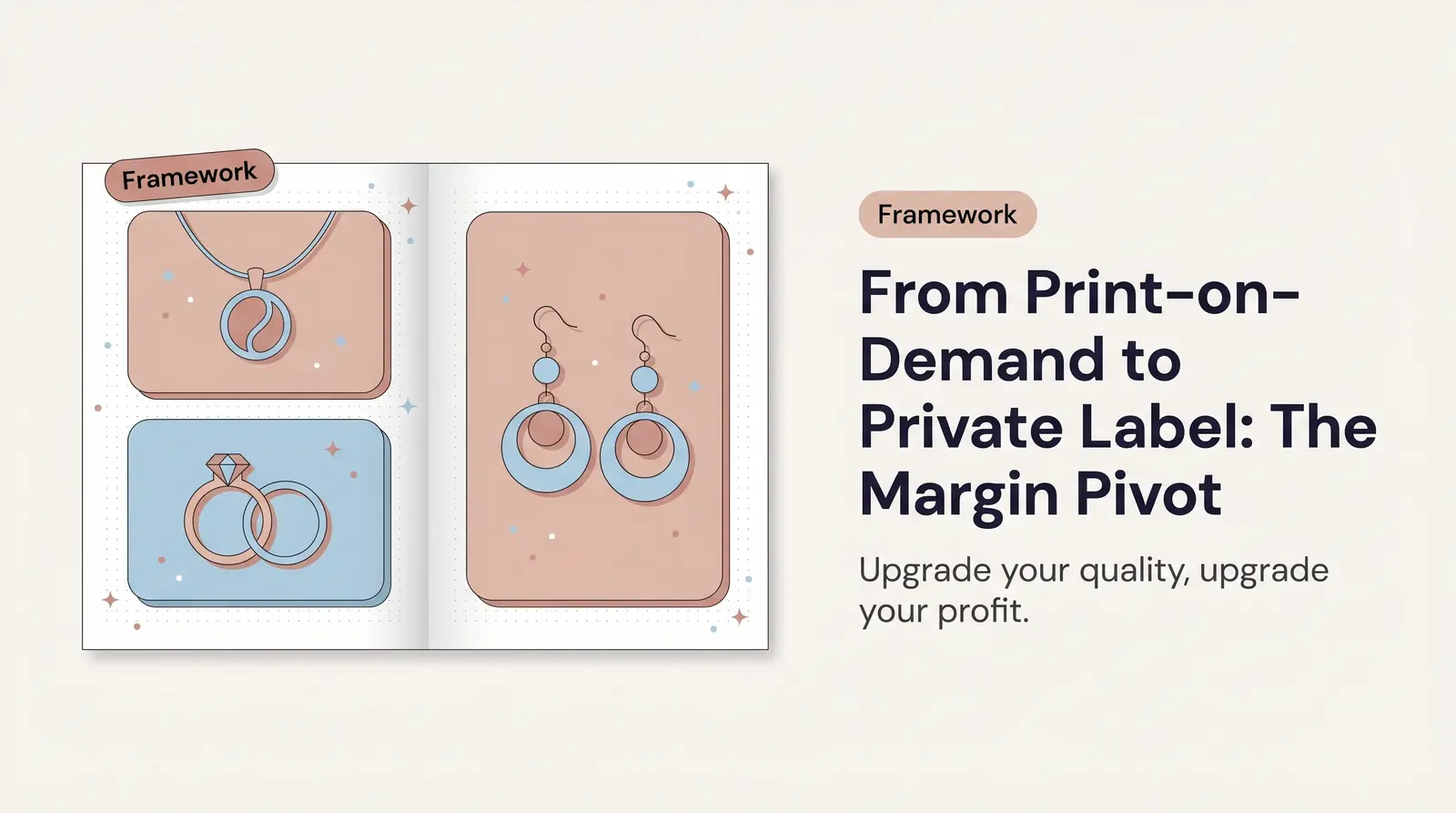
For ecommerce sellers and influencers looking to capitalize on this growth, the choice of production model is critical. While platforms like ShineOn have popularized the POD jewelry model, many sellers eventually hit a ceiling. They realize that building a long-term, scalable asset requires moving beyond generic products and into private labeling.
This article explores the differences between print-on-demand, dropshipping, and private label models, using ShineOn as the POD anchor. We will examine the margins, scalability, and brand-building potential of each approach to help you determine the right path for your jewelry business.
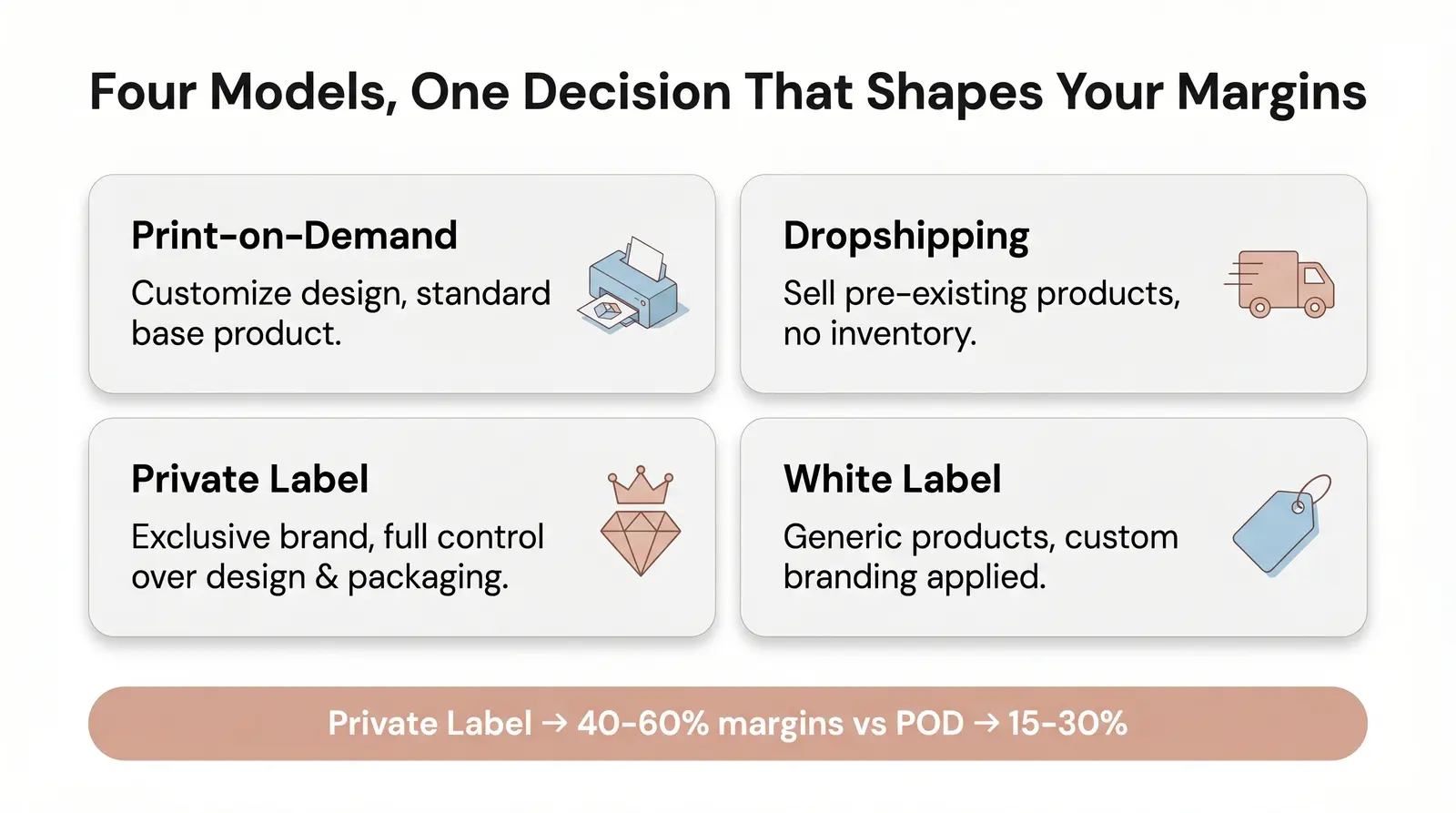
Before diving into specific platforms, it is essential to clarify the terminology. The e-commerce landscape is filled with overlapping terms that often confuse new sellers.
The distinction between these models dictates your profit margins, your operational overhead, and the perceived value of your brand in the eyes of the consumer.
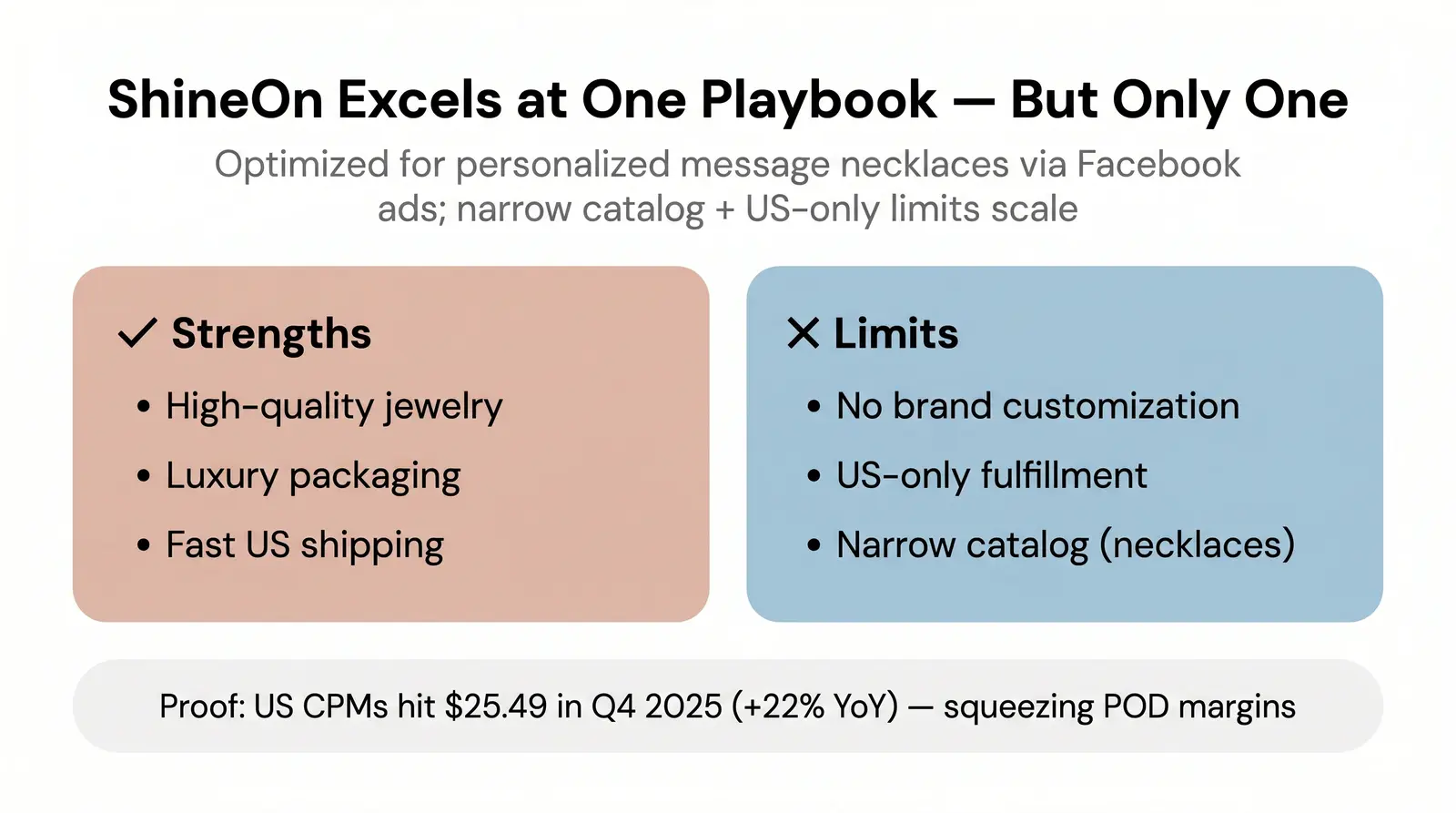
ShineOn has established itself as a dominant force in the POD jewelry space. Founded in 2016, the platform integrates directly with Shopify and offers a catalog of approximately 150 products, primarily focused on necklaces and pendants [3].
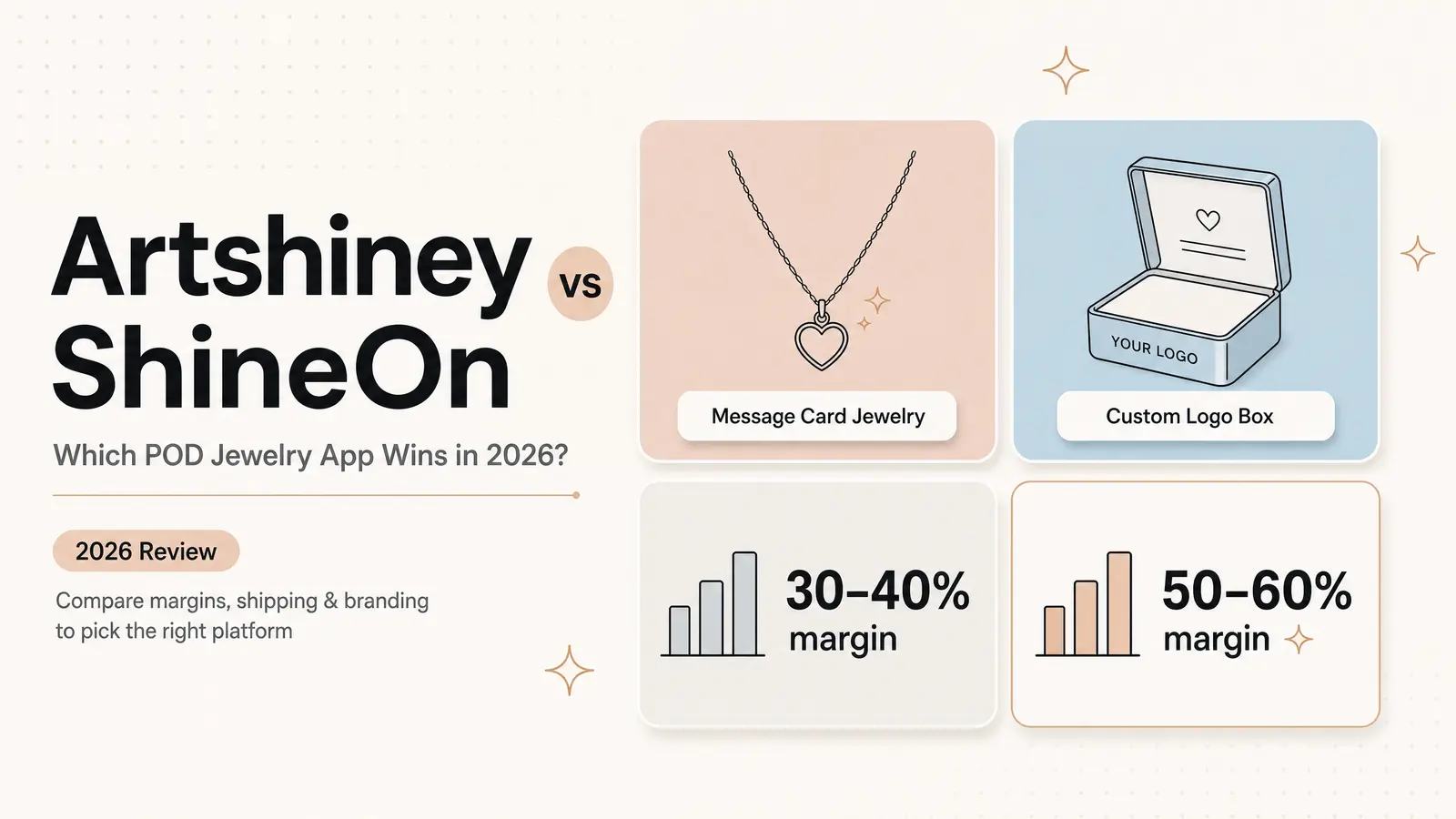
The core appeal of ShineOn lies in its specific, highly optimized playbook. Sellers use the platform to create personalized message cards that accompany standard jewelry pieces. These products are then heavily marketed through Facebook and Instagram ads, targeting specific emotional triggers (e.g., "To my daughter on her graduation").
For sellers executing this specific strategy, ShineOn offers several advantages. The platform provides high-quality products crafted from sterling silver and 18k gold, luxury box packaging, and fast shipping within the United States [4].
Furthermore, ShineOn has cultivated a strong community of sellers, offering extensive training resources and upsell features designed to maximize average order value. For an entrepreneur looking to test the waters of e-commerce without holding inventory, it provides a streamlined entry point.
However, the ShineOn model presents significant limitations for founders aiming to build a recognizable, standalone brand.
The most glaring constraint is the lack of true brand customization. While sellers can design the message card, the jewelry itself and the overall packaging experience remain largely uniform across the platform. You are essentially selling the same base products as thousands of other merchants.
Additionally, ShineOn's fulfillment is currently limited to the United States (Florida and New Jersey), restricting international expansion [3]. The catalog is also relatively narrow, focusing heavily on necklaces, which makes it difficult to build a comprehensive jewelry store offering rings, earrings, and bracelets.
Finally, the reliance on the Facebook ads playbook exposes sellers to rising acquisition costs. In Q4 2025, US CPMs on Meta averaged $25.49, a 22% increase from Q1 levels [5]. As advertising costs climb, the margins on standard POD products become increasingly squeezed.
When evaluating ShineOn alternatives, the conversation inevitably shifts from comparing specific POD platforms to comparing entirely different business models. The decision between POD and private label fundamentally alters the trajectory of your business.
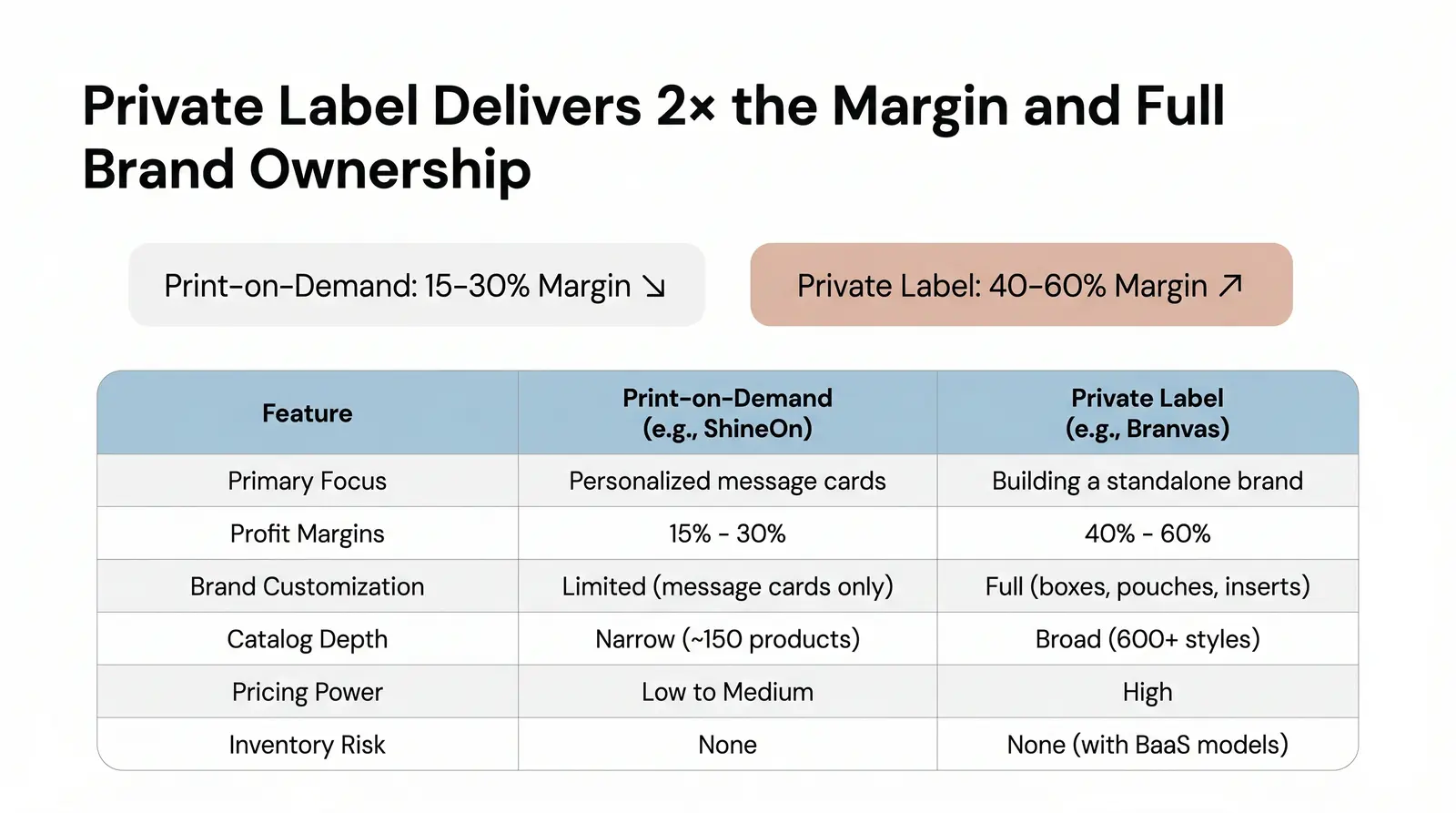
Profit margins are the lifeblood of any e-commerce operation. In the print-on-demand model, margins typically range from 15% to 30% [6]. The per-unit cost is higher because the manufacturer is producing items one at a time and absorbing the inventory risk.
Private label, conversely, offers significantly higher margins, generally falling between 40% and 60% [7]. Because you are building a distinct brand identity, you possess greater pricing power. Consumers are willing to pay a premium for a cohesive brand experience, custom packaging, and perceived exclusivity.
The most profound difference lies in brand control. With POD platforms like ShineOn, your brand is often secondary to the product's emotional message. The customer's relationship is transactional.
Private label allows you to engineer every touchpoint. From the logo on the box to the custom inserts and the unboxing experience, you control the narrative. This level of detail is what transforms a one-time buyer into a loyal brand advocate. As customer acquisition costs rise, maximizing lifetime value through strong branding is no longer optional; it is mandatory.
Scaling a POD jewelry store often means launching more message card variations or testing new ad creatives. Your product catalog is entirely dependent on what the platform chooses to offer.
A private label approach provides the flexibility to curate a comprehensive collection. You can source rings, bracelets, earrings, and trending styles that align with your specific aesthetic, rather than being confined to a platform's limited selection.
| Feature | Print-on-Demand (e.g., ShineOn) | Private Label (e.g., Branvas) |
|---|---|---|
| Primary Focus | Personalized message cards | Building a standalone brand |
| Profit Margins | 15% - 30% | 40% - 60% |
| Brand Customization | Limited (message cards only) | Full (boxes, pouches, inserts) |
| Catalog Depth | Narrow (~150 products) | Broad (600+ styles) |
| Pricing Power | Low to Medium | High |
| Inventory Risk | None | None (with BaaS models) |
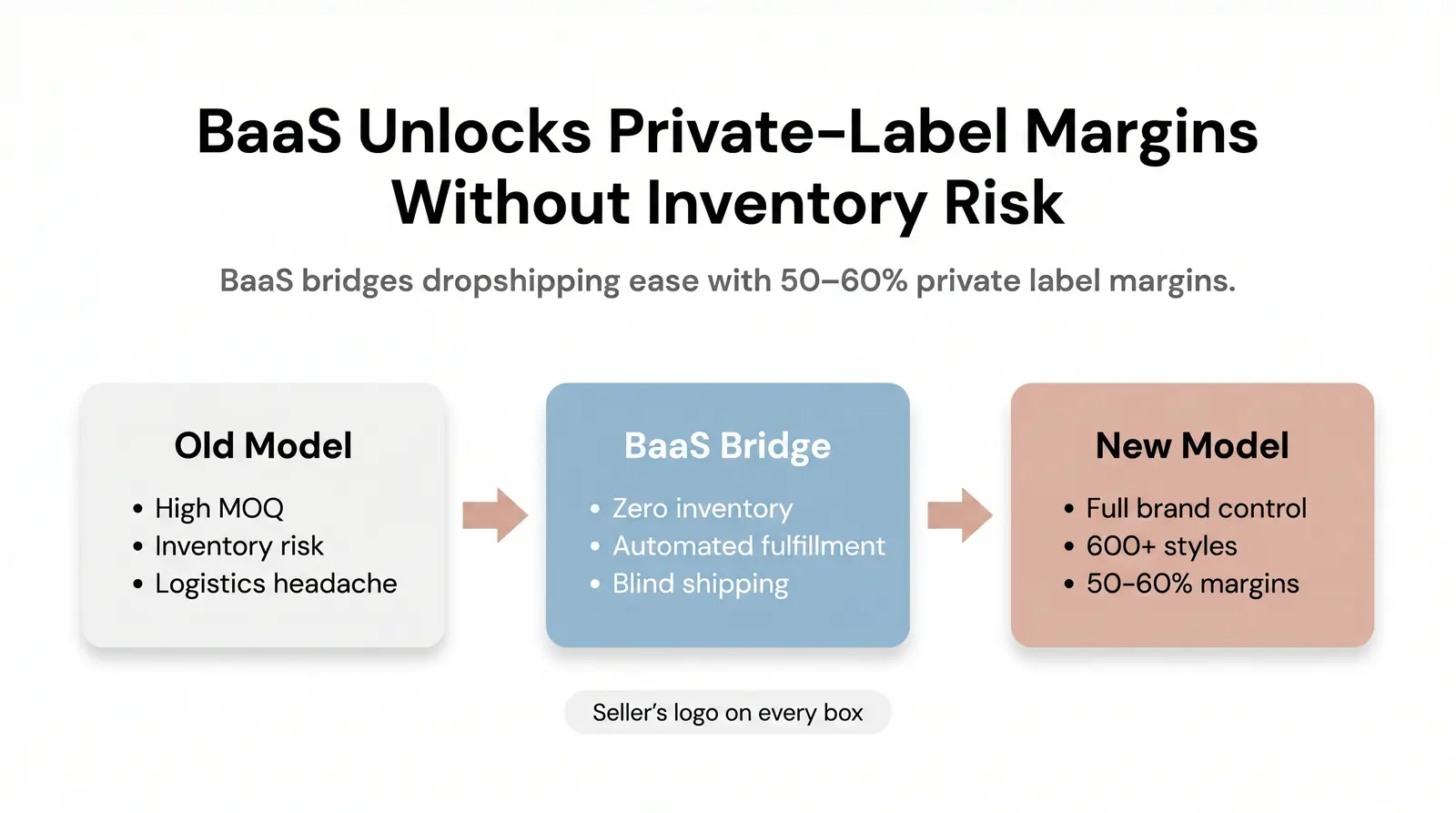
Historically, the barrier to entry for private label jewelry was high. It required significant capital for minimum order quantities (MOQs), complex supplier negotiations, and the logistical headache of managing inventory and fulfillment.
This dynamic has shifted with the emergence of Brand-as-a-Service (BaaS) platforms. These solutions bridge the gap between the low-risk nature of dropshipping and the high-margin, brand-building potential of private label.
Branvas exemplifies this new model. It is a private-label jewelry and accessories platform designed for influencers and e-commerce sellers who want to launch a real brand without the traditional operational hurdles.
Unlike ShineOn, which focuses on engraving standard products, Branvas provides a full private-label experience. Sellers have access to a curated catalog of over 600 styles, including rings, necklaces, earrings, and bracelets, with new trending items added monthly [3].
The critical differentiator is the packaging and fulfillment. Branvas handles product sourcing, quality inspection, and global blind shipping. Every order is shipped in premium, brand-ready packaging featuring the seller's logo on the boxes, pouches, and inserts. The customer never sees the Branvas name; they only experience the seller's brand.
This model allows founders to achieve the 50% to 60% margins associated with private label while maintaining the zero-inventory, automated fulfillment benefits of dropshipping [3]. It is a clean split of responsibilities: the seller focuses on brand identity, marketing, and customer relationships, while the platform handles the logistics.
The decision between a platform like ShineOn and a private label solution like Branvas depends entirely on your long-term objectives.
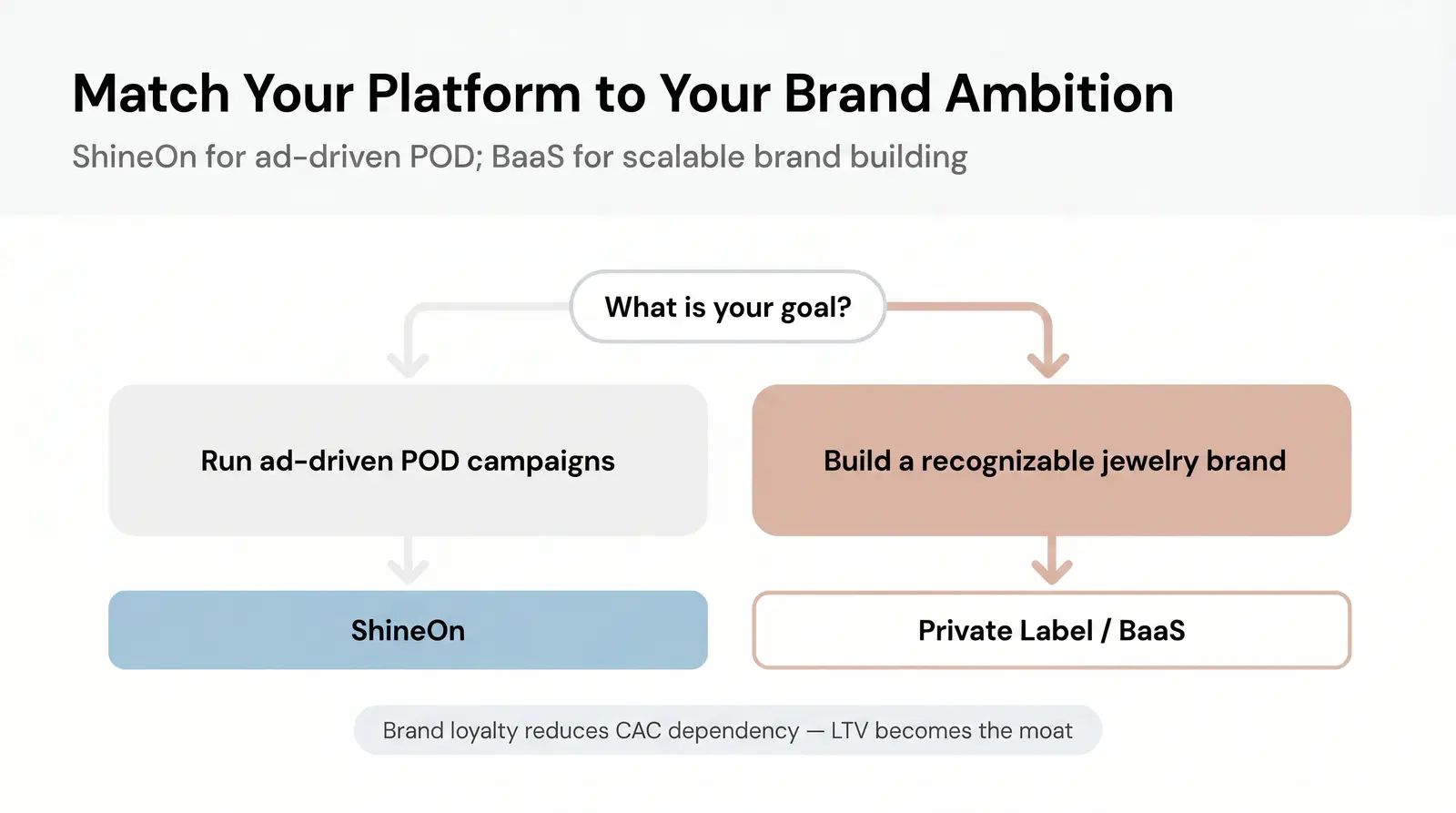
If your goal is to execute a highly specific marketing strategy—selling emotionally driven, personalized message necklaces via social media ads—ShineOn remains a viable tool. It is optimized for that exact playbook.
However, if your vision is to build a recognizable, scalable jewelry brand with loyal customers, premium unboxing experiences, and a diverse product catalog, the print-on-demand model will eventually become a bottleneck.
Transitioning to a private label model offers the margins, the brand control, and the flexibility required to compete in the modern e-commerce landscape. By leveraging Brand-as-a-Service platforms, sellers can now access the benefits of private labeling without the traditional risks, allowing them to focus on what truly matters: building a brand that resonates.
[1] Printful. "Print-on-demand statistics in 2026: Market data + insights." https://www.printful.com/blog/print-on-demand-statistics
[2] Branvas. "2026 Jewelry E-commerce Report: $408B Market Data & Trends." https://branvas.com/blogs/news/jewelry-ecommerce-market-data-2026
[3] Branvas. "Branvas vs ShineOn: Which Jewelry Platform Is Better? [2026]." https://branvas.com/comparison/branvas-vs-shineon
[4] GemPages. "11 Best Print on Demand Jewelry Suppliers." https://gempages.net/blogs/shopify/print-on-demand-jewelry-suppliers
[5] AdsWize. "Facebook Ads for Ecommerce: The 2025 ROAS Playbook." https://adswize.app/blog/facebook-ads-for-ecommerce
[6] ReferralCandy. "Print on Demand vs Private Label Comparison: Which Business Model is Right for Your Ecommerce Store." https://www.referralcandy.com/blog/print-on-demand-vs-private-label-comparison-which-business-model-is-right-for-your-ecommerce-store
[7] Branvas. "Private Label vs White Label Jewelry: Choose Right." https://branvas.com/blogs/news/private-label-vs-white-label-jewelry