


Brand-as-a-Service replaces traditional wholesaling by giving creators full brand ownership, private-label packaging, and integrated fulfillment without upfront inventory investment.
Published:
May 7, 2026
Author:
Yi Cui
Picture the classic $10,000 "inventory trap." A first-time ecommerce seller mortgages their kitchen table, maxes out a credit card, and buys 500 units of a trending product from an overseas supplier. The boxes arrive, fill the garage, and sit there. The trend passes, the ad costs spike, and the capital is frozen in dead stock. Now contrast that with a modern creator who launches a branded jewelry line on a Tuesday, connects her storefront, and ships her first order by Thursday—without ever touching a single box. This is not a cyclical retail trend. It is a structural shift in how commerce operates. The old model of buying inventory in bulk is dying, replaced by a smarter, lower-risk alternative: Brand-as-a-Service (BaaS).
The shift from traditional wholesaling to BaaS represents a fundamental rewiring of the e-commerce supply chain. For decades, the barrier to entry for building a physical product brand was capital. You needed money to buy inventory, rent warehouse space, and hire fulfillment staff. Today, the barrier to entry is audience and brand identity. The infrastructure of commerce has been abstracted into software and service layers, allowing anyone with a vision and a community to launch a brand. This article explores why the old model is breaking down, what BaaS actually is, and why it is the dominant model for the future of retail, particularly in high-margin, trend-sensitive categories like jewelry and accessories.
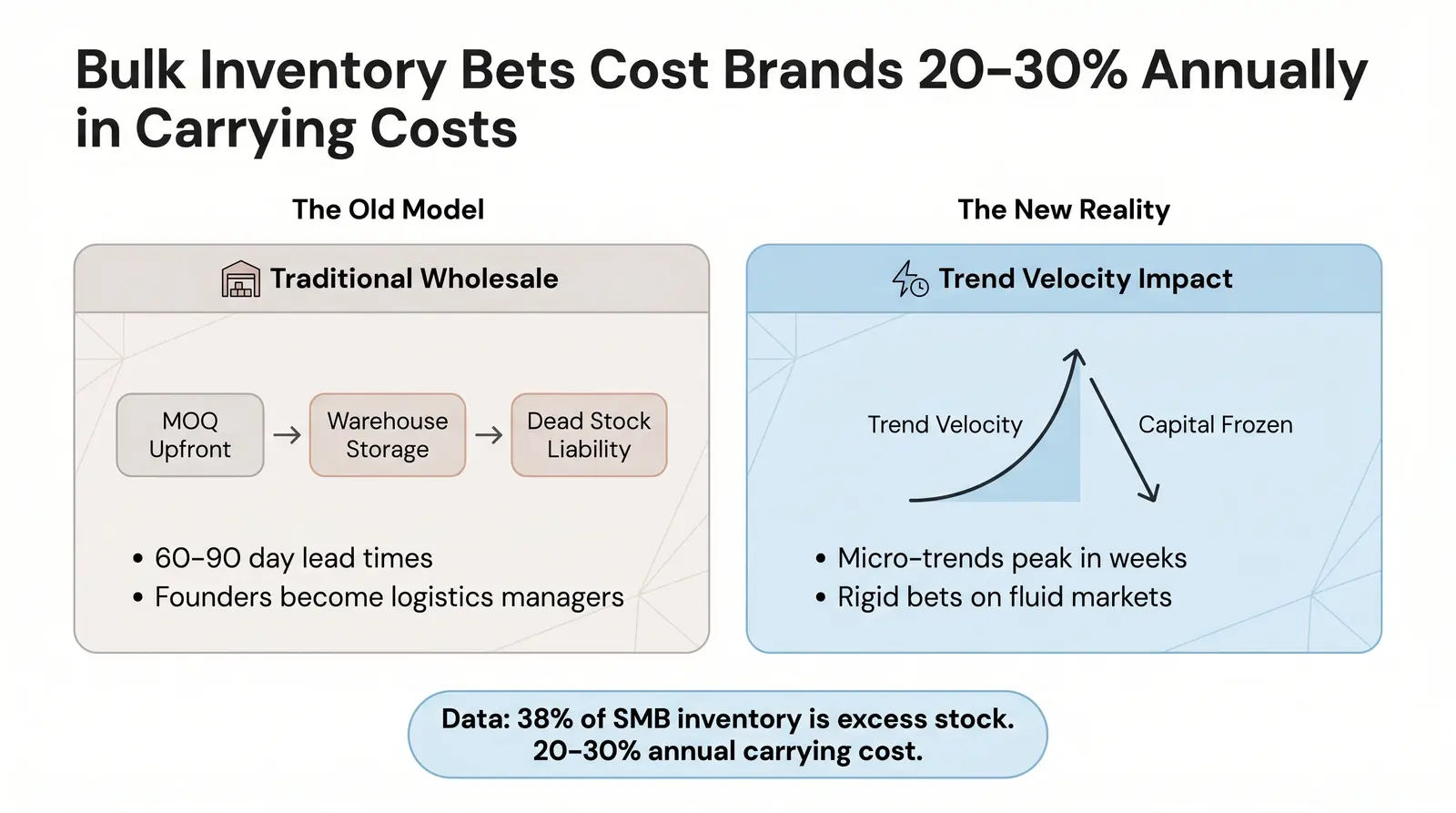
The mechanics of traditional wholesale are built for an analog world. A brand identifies a product, negotiates a Minimum Order Quantity (MOQ), wires upfront capital, and waits weeks or months for freight delivery. Once the product arrives, the brand assumes total responsibility for warehousing, quality control, pick-and-pack logistics, and outbound shipping. This model concentrates all financial risk on the brand owner before a single customer has validated the product.
In today's trend-velocity economy, the perceived "security" of owning physical inventory is actually a massive liability. Trend cycles have compressed dramatically, driven by TikTok virality and micro-trends that can peak and fade within weeks. When a brand buys 1,000 units of a specific style, they are placing a rigid bet on a fluid market. If the market shifts, that inventory becomes dead stock. Industry data shows that carrying costs typically consume 20% to 30% of a company's total inventory value annually, and excess stock grew to represent 38% of small and medium-sized business inventory in recent years [1] [2].
We often see founders struggle with the moment they realize their inventory bet was placed on last season's trend. The capital required to hold that inventory chokes cash flow, preventing the brand from pivoting to what consumers actually want today. Furthermore, the operational burden of managing a warehouse—even a small one—distracts founders from their core competency: marketing and community building. Every hour spent packing boxes is an hour not spent creating content or optimizing ad campaigns. The traditional wholesale model forces entrepreneurs to be logistics managers first and brand builders second. In 2026, that is a losing strategy.
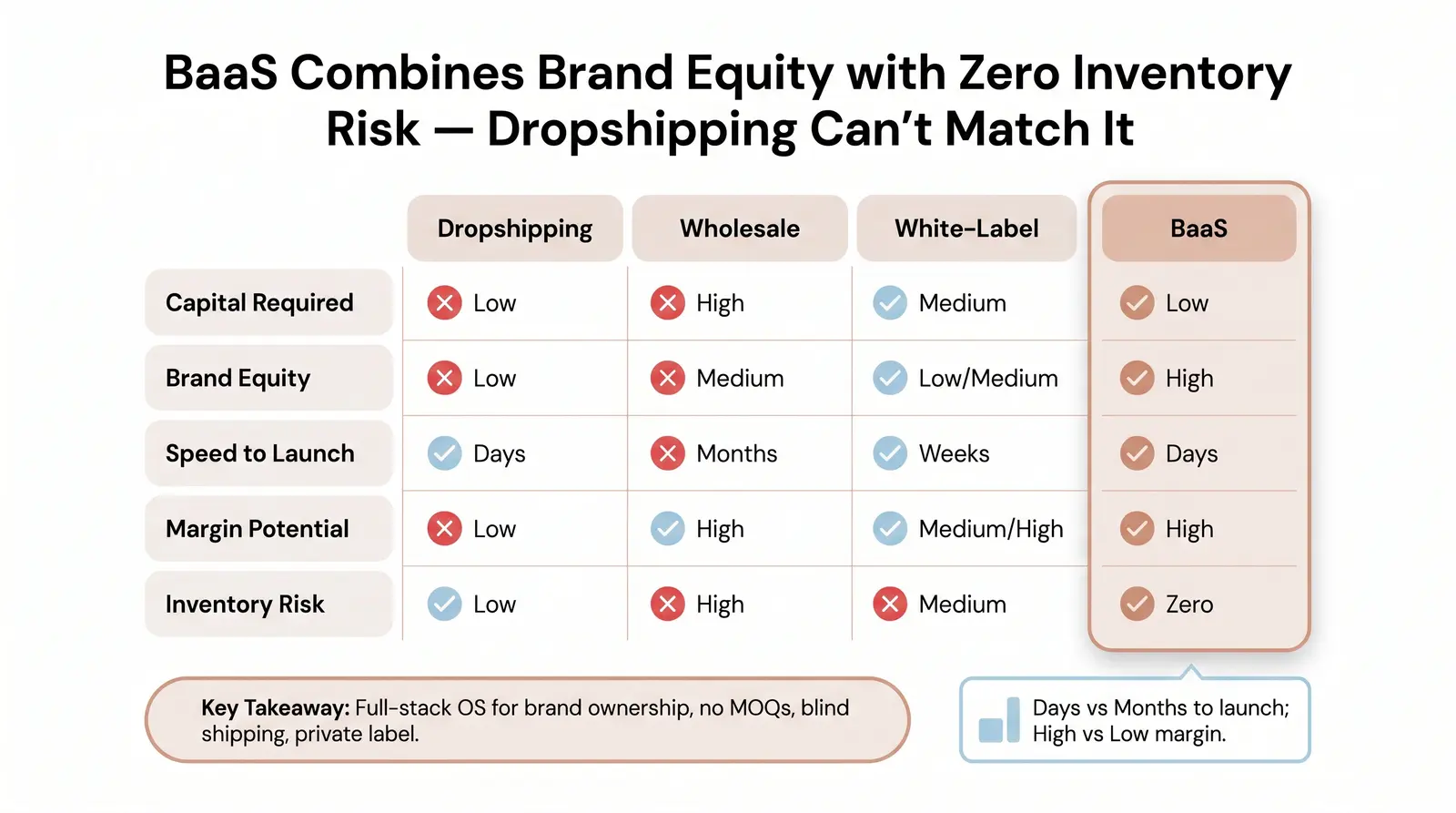
Brand-as-a-Service (BaaS) is a full-stack operating system for brand ownership. It delivers product curation, brand identity, logistics, and fulfillment as a seamless service layer. Unlike traditional models where a founder must assemble a fragmented supply chain, BaaS provides the infrastructure on demand. It allows entrepreneurs to focus entirely on community building and marketing while the platform handles the physical complexities of commerce.
To understand BaaS, it helps to distinguish it from legacy models:
| Feature | Dropshipping | Traditional Wholesale | White-Labeling | Brand-as-a-Service (BaaS) |
|---|---|---|---|---|
| Upfront Capital Required | Low | High ($2K–$10K+) | Medium | Low |
| Brand Ownership & Equity | None | High | High | High |
| Speed to Launch | Fast (Days) | Slow (Months) | Medium (Weeks) | Fast (Days) |
| Margin Potential | Low (10%–30%) | High (30%–50%+) | Medium to High | High (Private Label Pricing) |
| Inventory Risk | None | High (Dead Stock Risk) | Medium to High | None |
| Fulfillment & Logistics | Handled by Supplier | Handled by Brand | Varies | Fully Integrated & Blind Shipped |
BaaS is not just a fulfillment method; it is a strategic advantage. By removing the friction of physical logistics, BaaS democratizes brand ownership. It allows a solo creator to offer the same unboxing experience and shipping speed as a venture-backed DTC darling.
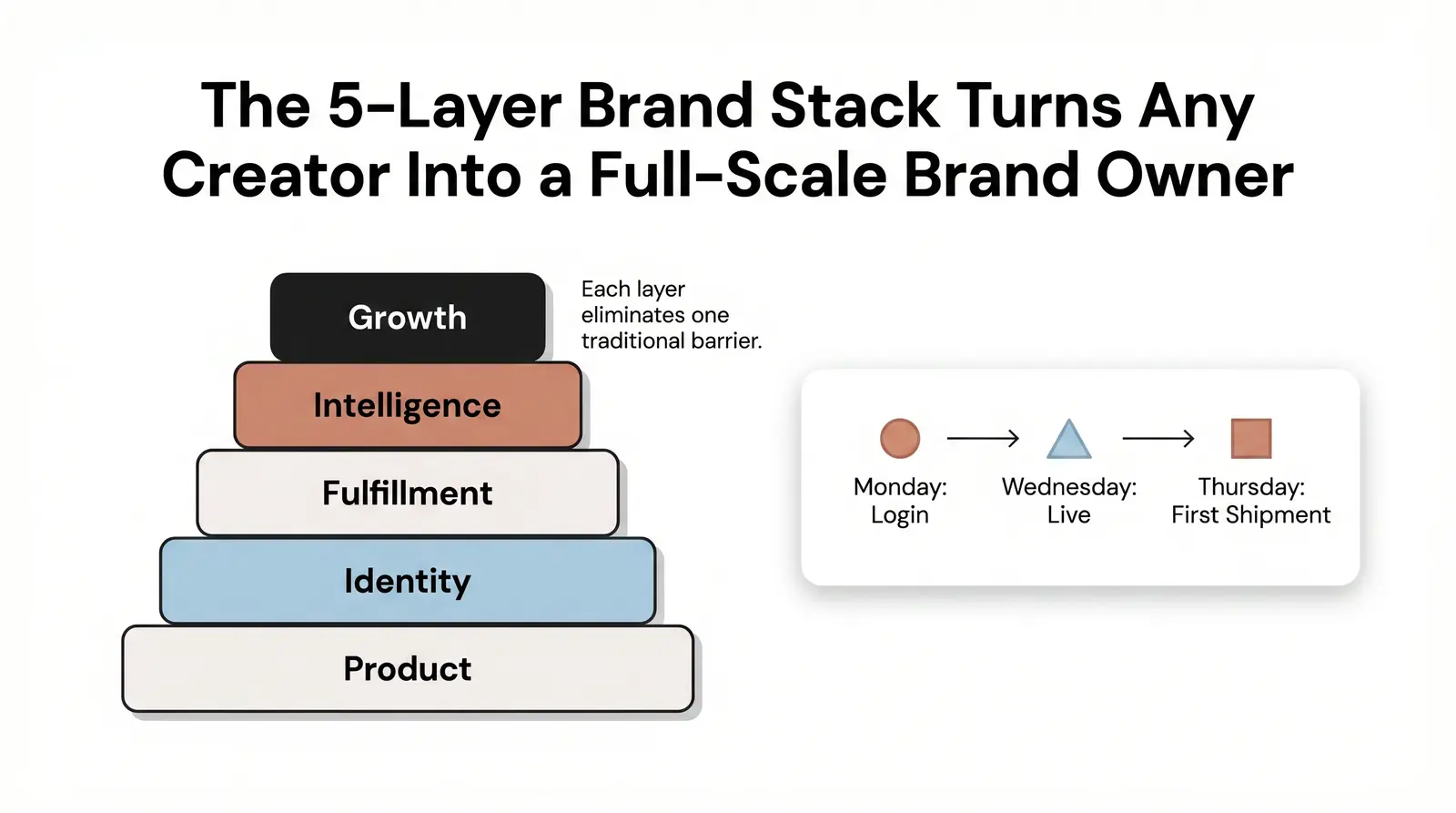
To operationalize this shift, we developed the Branvas Brand Stack—a proprietary five-layer model that defines what a complete Brand-as-a-Service platform must deliver to empower modern founders.
Imagine a lifestyle influencer with 80,000 Instagram followers. She logs into Branvas on a Monday, selects 12 SKUs from the catalog, uploads her logo for packaging, connects her Shopify store via API, and by Wednesday her storefront is live—with zero inventory purchased. Her first customer order ships blind under her brand by Thursday. The Product Layer gave her the catalog, the Identity Layer made it hers, the Growth Layer connected her store, and the Fulfillment Layer delivered the physical good.
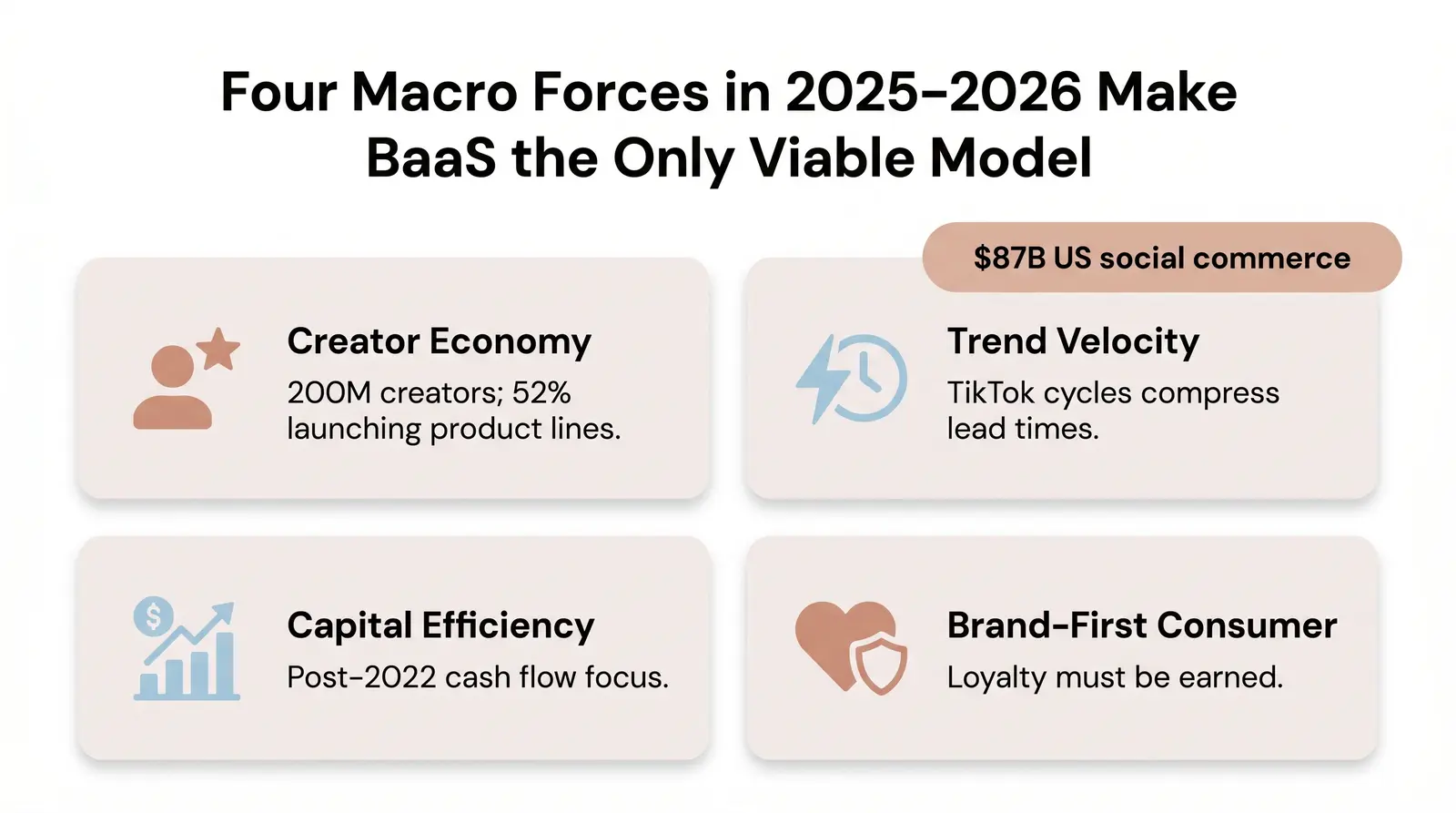
The rise of BaaS is not an accident; it is the inevitable result of macro forces reshaping the e-commerce supply chain in 2025 and 2026. The creator economy has exploded, with over 200 million people identifying as creators and 52% launching their own product lines [3]. These social-first brands require agile infrastructure that traditional wholesale cannot provide. Creators are realizing that monetizing their audience through affiliate links leaves too much money on the table. Owning the brand is the ultimate monetization strategy, and BaaS makes that possible without the operational nightmare.
Simultaneously, trend cycles have compressed. Platforms like TikTok Shop have accelerated the velocity of micro-trends, making long lead times fatal to profitability. In 2025, US social commerce sales reached $87.02 billion, growing at a rate nearly three times faster than traditional e-commerce [4]. When a product goes viral on TikTok, a brand needs to capture that demand immediately. Traditional wholesale, with its 60-90 day lead times, misses the window entirely. BaaS allows brands to react in real-time.
Furthermore, the capital efficiency movement post-2022 has fundamentally changed how businesses operate. Rising interest rates made inventory financing expensive, forcing brands to seek non-dilutive, inventory-light models to preserve working capital. The era of cheap money masking inefficient supply chains is over. Today, cash flow is king, and BaaS is the ultimate cash flow hack.
Finally, consumer behavior has shifted from "product-first" to "brand-first." A recent McKinsey study revealed that three out of four consumers have changed brands in the last two years, indicating that brand loyalty must be actively earned through unique identity and community connection, rather than just product utility [5]. Consumers are buying into the story, the aesthetic, and the community behind the product. BaaS allows founders to focus 100% of their energy on telling that story.
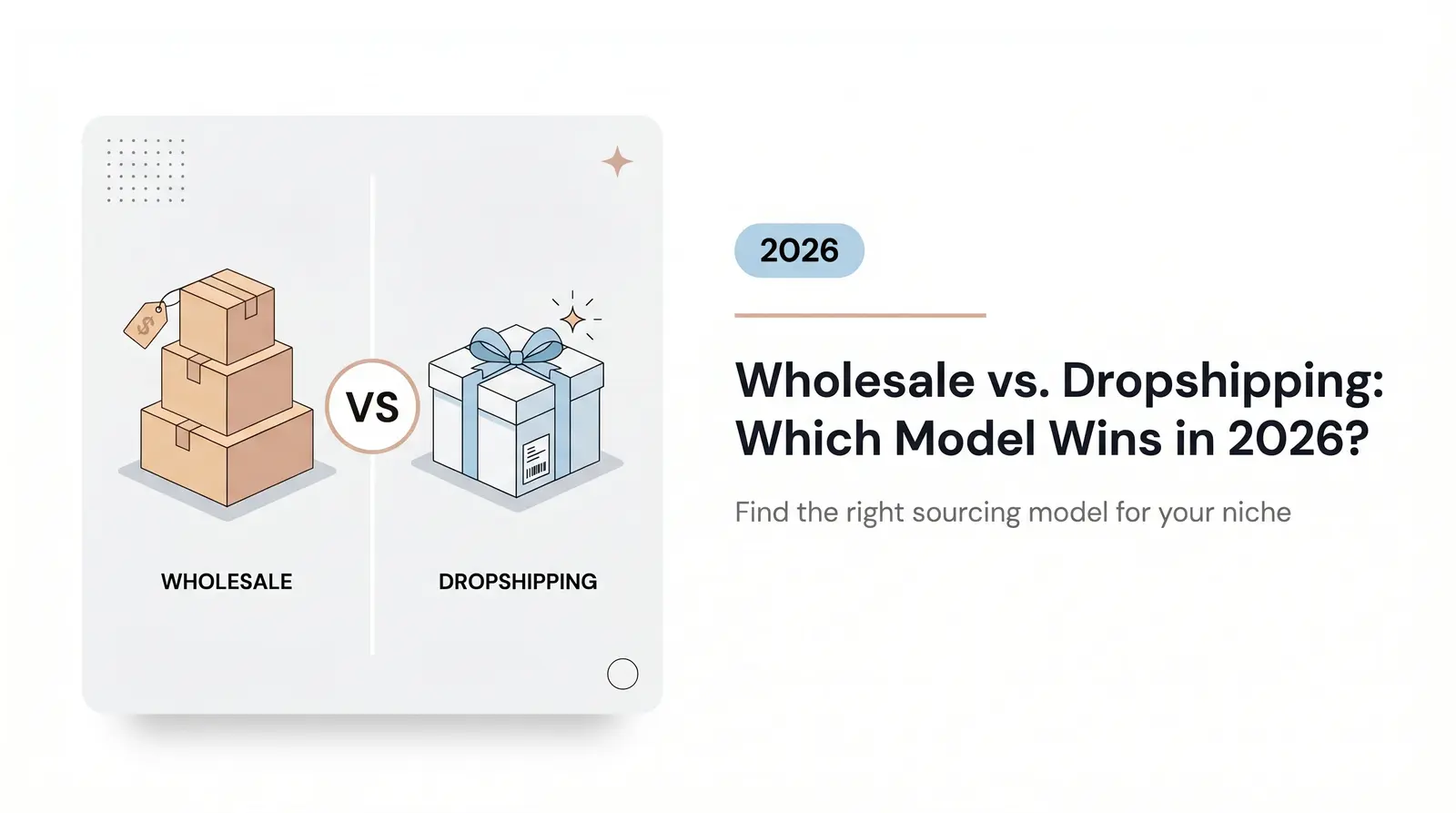
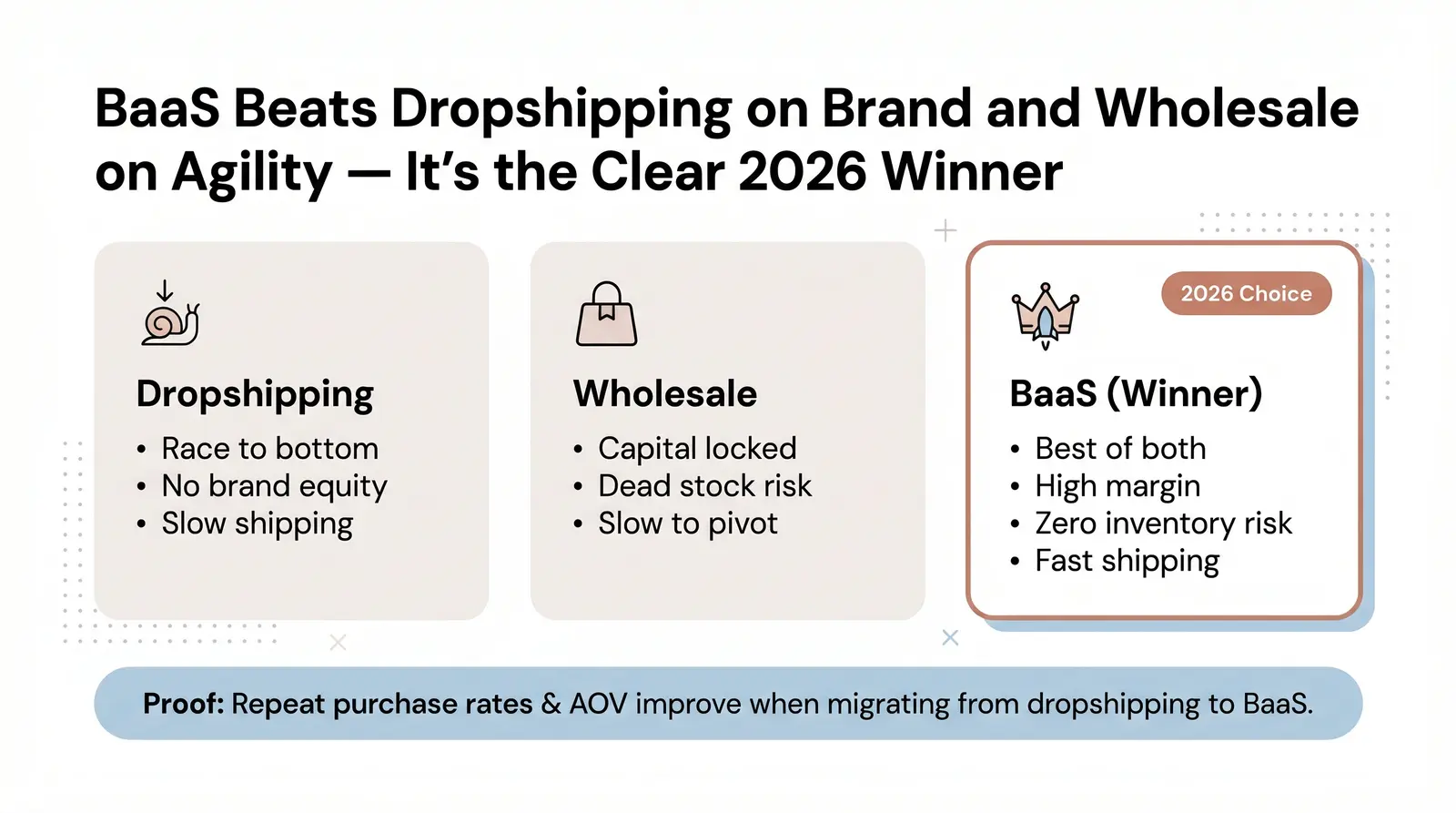
When evaluating dropshipping vs wholesaling 2026, the verdict is clear: BaaS is the dominant model for brand-building entrepreneurs. Dropshipping fails on brand equity. It forces sellers into a race to the bottom on price, selling commoditized goods with slow shipping times that erode customer trust. You cannot build a lasting brand when your product arrives in a crushed ePacket three weeks after the customer ordered it.
Wholesaling fails on agility. It locks capital in physical goods, making it impossible to pivot when a TikTok trend dies overnight. The stress of managing a warehouse and the constant fear of dead stock stifle innovation and growth.
BaaS wins because it combines the capital efficiency of dropshipping with the brand equity and margin profile of traditional wholesale. In our experience at Branvas, sellers who migrate from dropshipping to private-label BaaS typically see meaningful improvements in repeat purchase rates and average order value—because the brand experience becomes the product. They control the pricing, the packaging, and the customer relationship, all without the anchor of dead stock. BaaS is the only model that aligns with the realities of modern commerce: fast, branded, and capital-efficient.
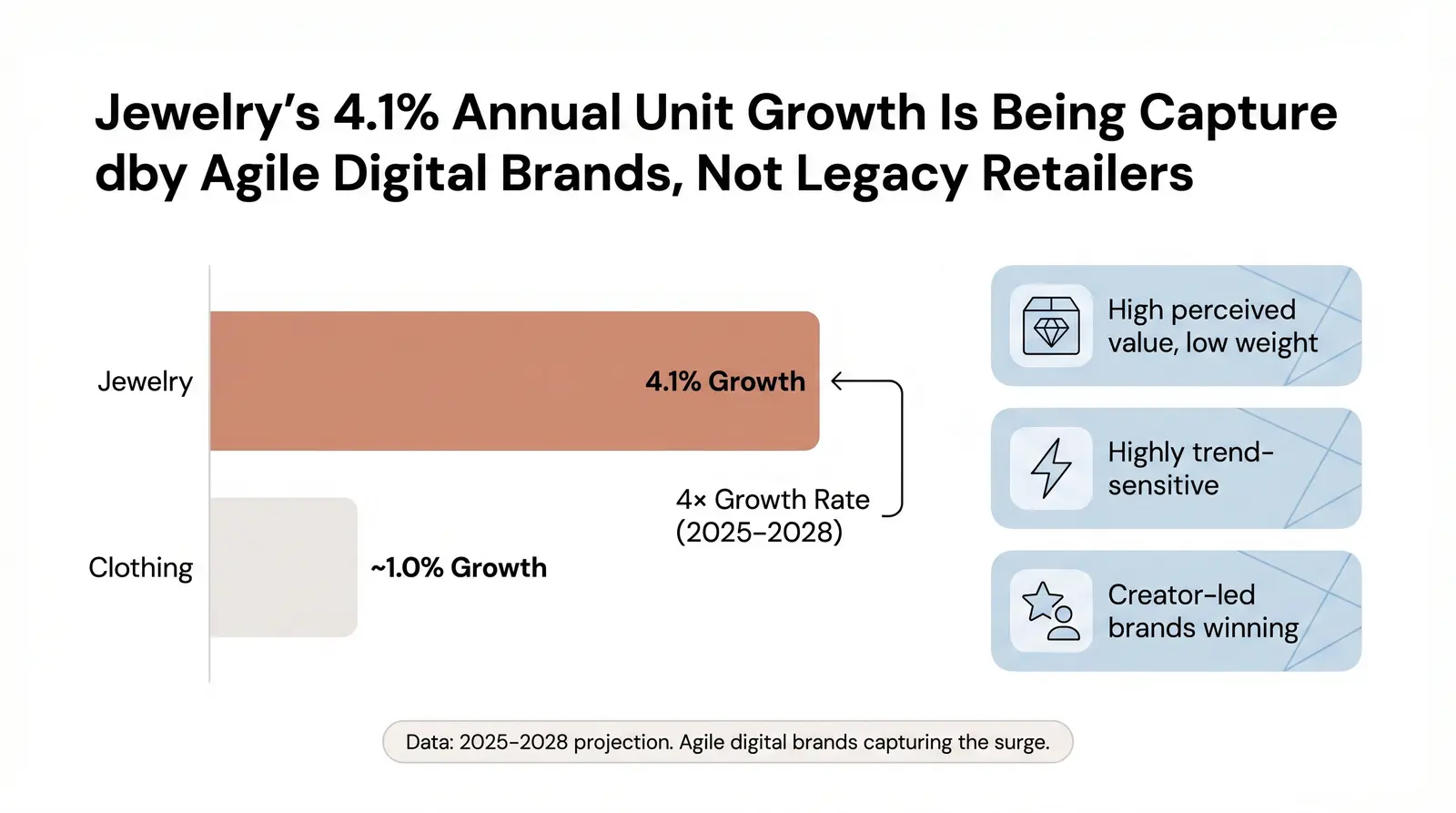
The future of jewelry wholesale is undergoing a radical transformation. Jewelry is uniquely suited to the BaaS model. It boasts high perceived value, low weight, and inexpensive shipping costs. It carries a strong identity and gifting signal, making it perfect for creator-led brands. At the same time, it is highly trend-sensitive, requiring the agility that bulk importing lacks.
Traditional jewelry trade shows and bulk import models are declining as the cost of attendance rises and the return on investment falls. The days of flying to a trade show, walking the floor for three days, and writing massive purchase orders are fading. In their place, we are seeing a surge of independent jewelry brands launched by creators and boutique owners who leverage digital infrastructure.
Between 2025 and 2028, jewelry is projected to record annual unit growth of 4.1 percent—four times the rate of clothing [6]. This growth is not being captured by legacy mall jewelers; it is being captured by agile, digitally native brands. Branvas is positioned specifically for this vertical, providing the exact infrastructure needed to capture this growth. Explore Branvas's full jewelry catalog at branvas.com/catalog to see how private-label products are structured for brand-ready launch.
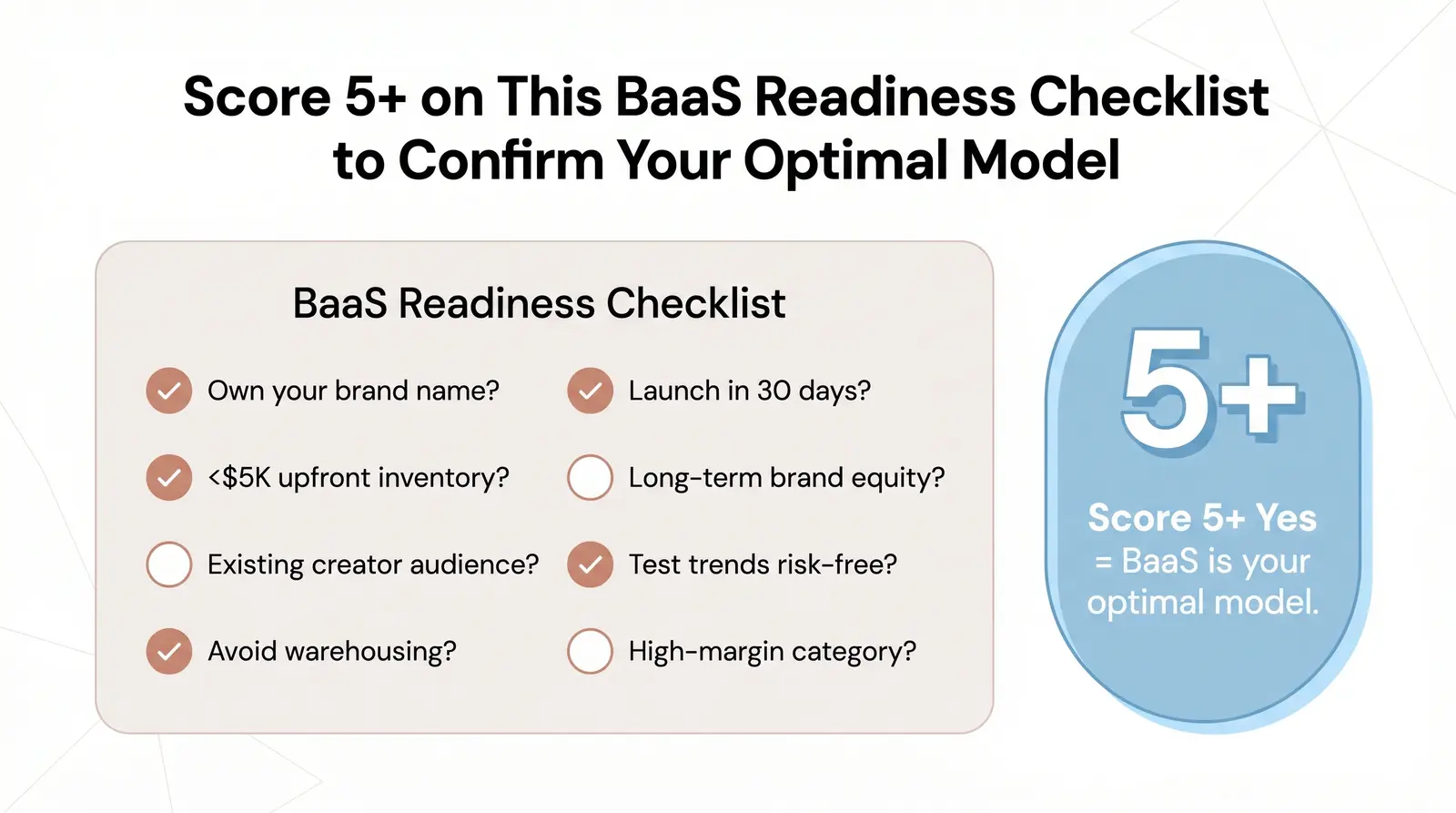
Not every business model fits every founder. Use this BaaS Readiness Score to determine if an inventory-free, private-label approach is your best path forward. Answer yes or no to the following:
Scoring Key: If you answered "yes" to 5 or more questions, BaaS is likely your optimal model. If you scored 5 or higher, Branvas was built for you. Start your brand at branvas.com/how-it-works—no inventory required. You can also use our Profit Calculator to see exactly how your margins stack up.
1. What is Brand-as-a-Service (BaaS) and how is it different from dropshipping?
BaaS provides a complete infrastructure for brand ownership, including curated products, custom packaging, and integrated fulfillment. Unlike dropshipping, which sells generic, unbranded items shipped directly from overseas suppliers, BaaS allows you to build true brand equity with private-label products and fast, domestic blind shipping.
2. Is traditional jewelry wholesale dying?
Yes, the traditional model of buying jewelry in bulk is declining. High upfront costs, rigid MOQs, and the risk of dead stock make it incompatible with today's fast-moving trend cycles. The future of jewelry wholesale is shifting toward agile, on-demand fulfillment models like BaaS.
3. How does private-label fulfillment work for small ecommerce sellers?
Private-label fulfillment allows sellers to offer products under their own brand name without manufacturing them. A BaaS platform like Branvas supplies the product, applies the seller's custom branding and packaging, and ships the order directly to the customer, making the process seamless and inventory-free.
4. What are the biggest risks of buying inventory wholesale in 2025–2026?
The primary risks are capital lockup and dead stock. With trend cycles compressing rapidly due to social media, buying in bulk means betting that consumer demand will remain static. If trends shift, sellers are left with unsellable inventory and carrying costs that erode profitability.
5. Can influencers launch their own jewelry brand without upfront inventory?
Absolutely. Using a BaaS platform, influencers can select products, apply their branding, and connect their storefronts in days. The platform handles all fulfillment on demand, allowing creators to monetize their audience with zero upfront inventory costs.