

This article ranks 25 passive income ideas for 2026 using a five-dimension scoring framework covering startup cost, effort, speed, scalability, and beginner-friendliness.
Published:
July 20, 2026
Author:
Yi Cui
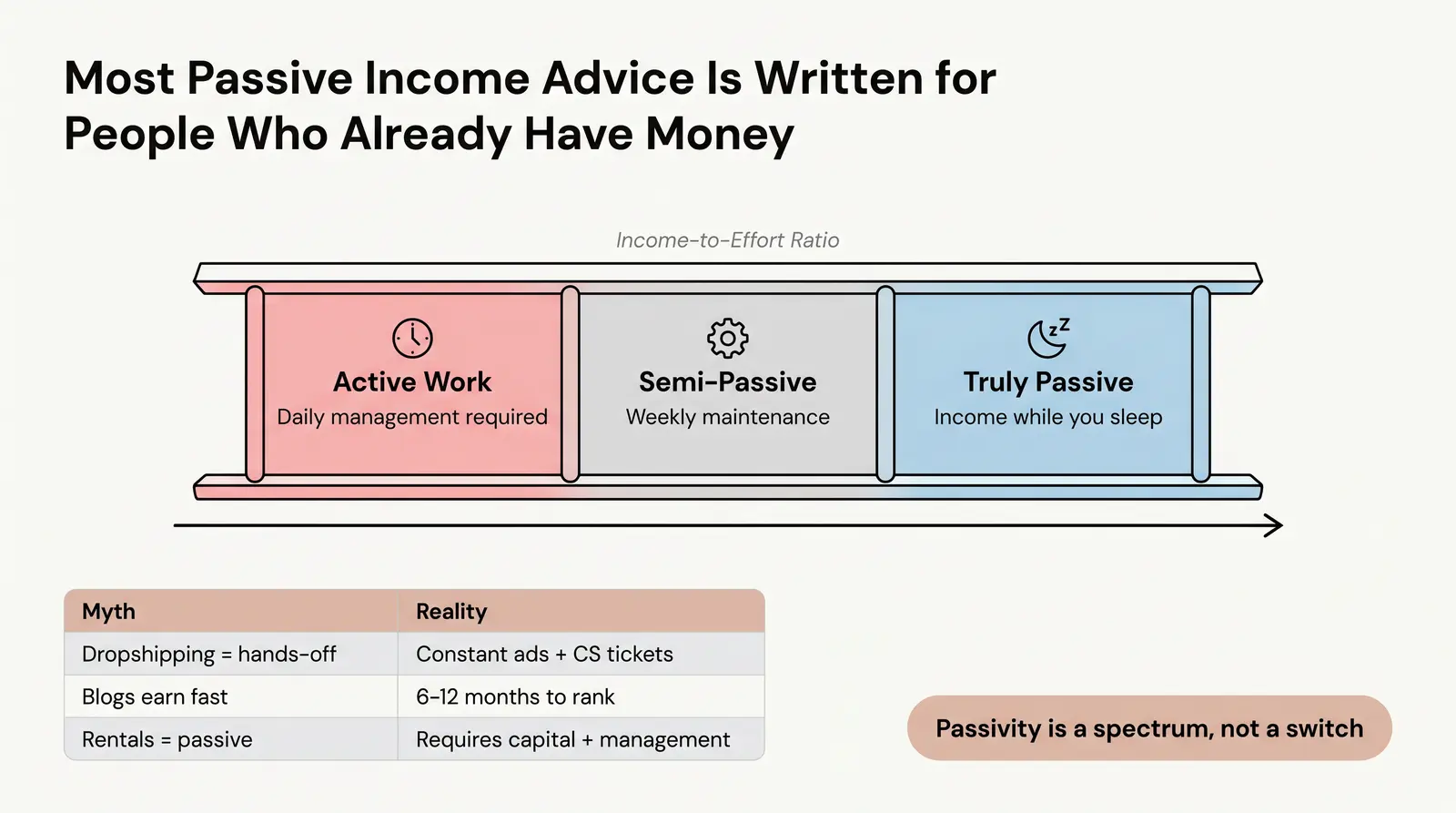
If you search "passive income ideas" right now, you will find the same recycled list: buy rental property, start a blog, try dropshipping. The advice is not wrong, exactly. It is just incomplete, and often dangerously misleading for the person who actually needs it.
Most people looking for passive income in 2026 do not have $50,000 to put down on a rental property. They do not have two years to wait for an affiliate blog to rank on Google. And they definitely do not have the stomach for the customer service nightmare that comes with generic dropshipping.
Here is the core problem: most passive income content is written by people who already have capital, an audience, or specialized skills. The advice is optimized for their situation, not yours. A dividend investing strategy that makes perfect sense for someone with $100,000 in savings is completely useless for someone starting from zero.
The second problem is that "passive" is a spectrum, not a binary. Almost nothing is truly passive from day one. Every income stream requires either upfront money, upfront time, or both. The question is: which streams give you the best return on that upfront investment, and which ones stay passive once they are running?
In our experience at Branvas, the number one mistake new passive income seekers make is choosing a model that scales their workload alongside their revenue. The goal is to build an asset where the income ceiling is decoupled from the hours you put in.
This article gives you an honest, scored ranking of 25 passive income ideas for 2026, evaluated using a proprietary framework built around what actually matters: how much it costs to start, how passive it really is, how fast you see money, how high the ceiling goes, and how easy it is for a beginner to execute.
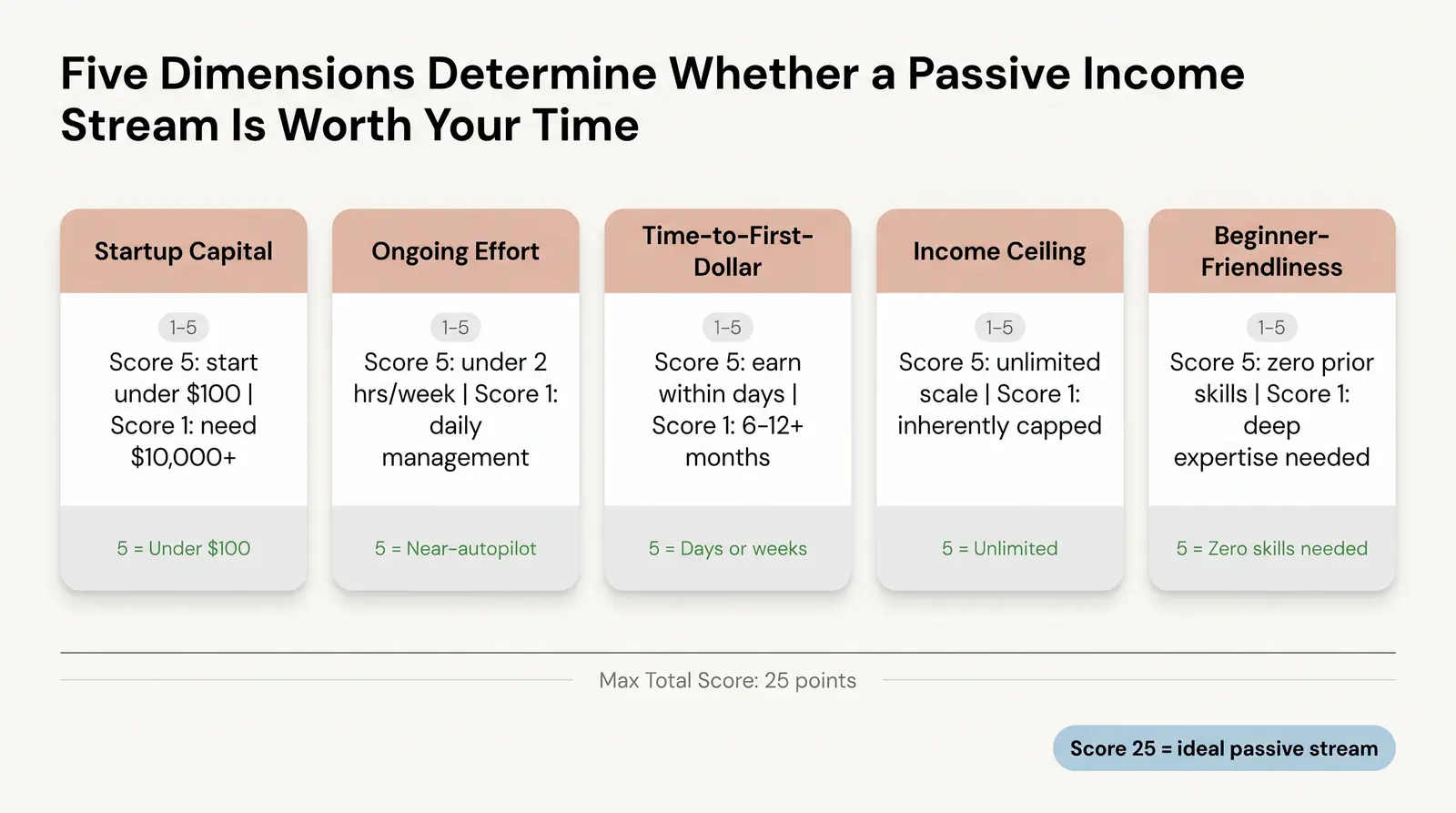
To cut through the noise, we built the Branvas Passive Income Scoring Framework™ (BPISF™), a proprietary five-dimension rubric for evaluating any passive income opportunity. Each dimension is scored from 1 to 5, where 5 is always the most favorable outcome. The maximum Total BPISF™ Score is 25.
Dimension 1: Startup Capital Required
Scored 1-5, where 5 means you can start for under $100 and 1 means you need $10,000 or more upfront.
Dimension 2: Ongoing Effort/Time
Scored 1-5, where 5 means the stream runs on near-autopilot once launched (under 2 hours per week) and 1 means it requires significant daily or weekly active management.
Dimension 3: Time-to-First-Dollar
Scored 1-5, where 5 means you can realistically earn your first dollar within days or a few weeks, and 1 means it typically takes 6 to 12 months or longer.
Dimension 4: Income Ceiling / Scalability
Scored 1-5, where 5 means the income potential is effectively unlimited and scales without proportional labor increases, and 1 means the ceiling is inherently capped.
Dimension 5: Beginner-Friendliness
Scored 1-5, where 5 means zero prior expertise or specialized skills are required, and 1 means you need deep technical, financial, or creative knowledge to succeed.
This framework lets us compare a Treasury bill against a YouTube channel against a branded jewelry store on the same objective scale. The scores below are honest. No idea was inflated to serve a narrative.
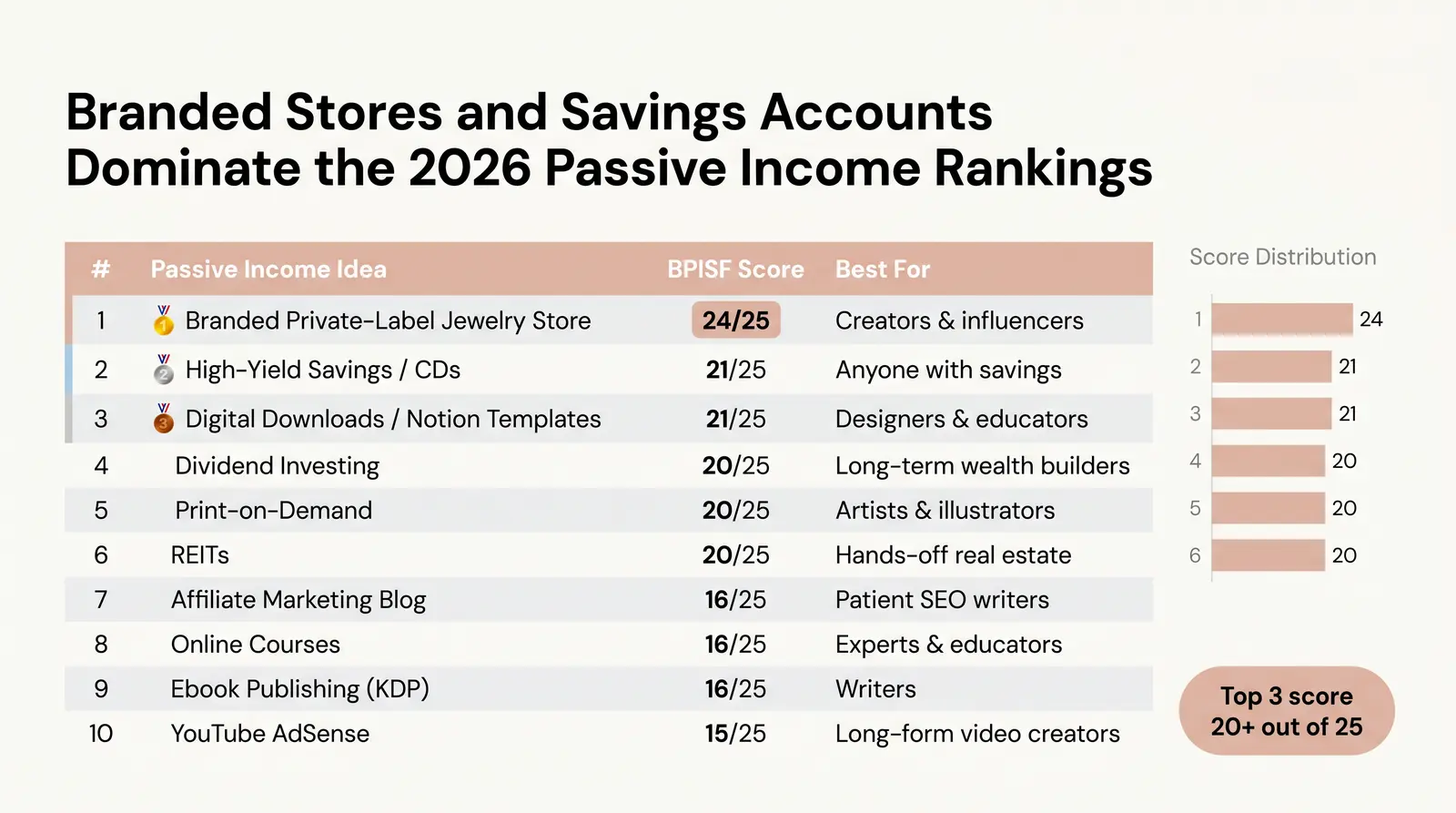
The table below ranks all 25 passive income ideas by their Total BPISF™ Score, from highest to lowest.
| Rank | Passive Income Idea | Capital (1-5) | Effort (1-5) | Speed (1-5) | Ceiling (1-5) | Beginner (1-5) | Total | Best For |
|---|---|---|---|---|---|---|---|---|
| 1 | Branded Private-Label Jewelry Store | 5 | 4 | 5 | 5 | 5 | 24 | Creators, influencers, aspiring entrepreneurs |
| 2 | High-Yield Savings / CDs | 4 | 5 | 5 | 2 | 5 | 21 | Anyone with existing savings |
| 3 | Digital Downloads / Notion Templates | 5 | 4 | 4 | 4 | 4 | 21 | Designers, organizers, educators |
| 4 | Dividend Investing | 3 | 5 | 4 | 4 | 4 | 20 | Long-term wealth builders |
| 5 | Print-on-Demand Merchandise | 5 | 3 | 4 | 4 | 4 | 20 | Artists and illustrators |
| 6 | REITs | 4 | 5 | 4 | 3 | 4 | 20 | Hands-off real estate investors |
| 7 | Affiliate Marketing Blog | 4 | 2 | 2 | 5 | 3 | 16 | Patient writers and SEO practitioners |
| 8 | Selling Online Courses | 3 | 3 | 2 | 5 | 3 | 16 | Experts and educators |
| 9 | Ebook Publishing (Amazon KDP) | 4 | 3 | 3 | 3 | 3 | 16 | Writers and storytellers |
| 10 | YouTube AdSense | 4 | 2 | 1 | 5 | 3 | 15 | Long-form video creators |
| 11 | Stock Photography / Video Licensing | 4 | 4 | 2 | 3 | 2 | 15 | Photographers and videographers |
| 12 | Social Media Creator Fund | 5 | 2 | 2 | 4 | 2 | 15 | Short-form viral content creators |
| 13 | Dropshipping (Generic, Non-Branded) | 3 | 2 | 4 | 3 | 3 | 15 | Experienced media buyers |
| 14 | Podcast Sponsorships | 3 | 2 | 1 | 4 | 3 | 13 | Niche communicators with loyal audiences |
| 15 | Peer-to-Peer Lending | 3 | 4 | 3 | 2 | 1 | 13 | Investors comfortable with credit risk |
| 16 | Selling Stock Music / Sound Effects | 4 | 4 | 2 | 2 | 1 | 13 | Musicians and audio engineers |
| 17 | Niche Website / Display Ads | 3 | 2 | 1 | 4 | 2 | 12 | SEO specialists |
| 18 | Mobile App or SaaS Micro-tool | 2 | 2 | 2 | 5 | 1 | 12 | Developers and coders |
| 19 | Licensing Artwork or Photography | 4 | 4 | 1 | 2 | 1 | 12 | Professional artists |
| 20 | Vending Machine Routes | 2 | 3 | 3 | 3 | 1 | 12 | Local hands-on operators |
| 21 | Bond Laddering / Treasury Bills | 2 | 5 | 3 | 1 | 1 | 12 | Conservative capital preservers |
| 22 | Rental Income (Real Estate) | 1 | 3 | 2 | 4 | 1 | 11 | High-capital investors |
| 23 | Laundromat Ownership | 1 | 2 | 2 | 4 | 1 | 10 | Business operators with capital |
| 24 | License a Patent or Invention | 2 | 4 | 1 | 2 | 1 | 10 | Inventors with IP |
| 25 | Parking Space Rental | 2 | 4 | 3 | 1 | 0 | 10 | Urban property owners |
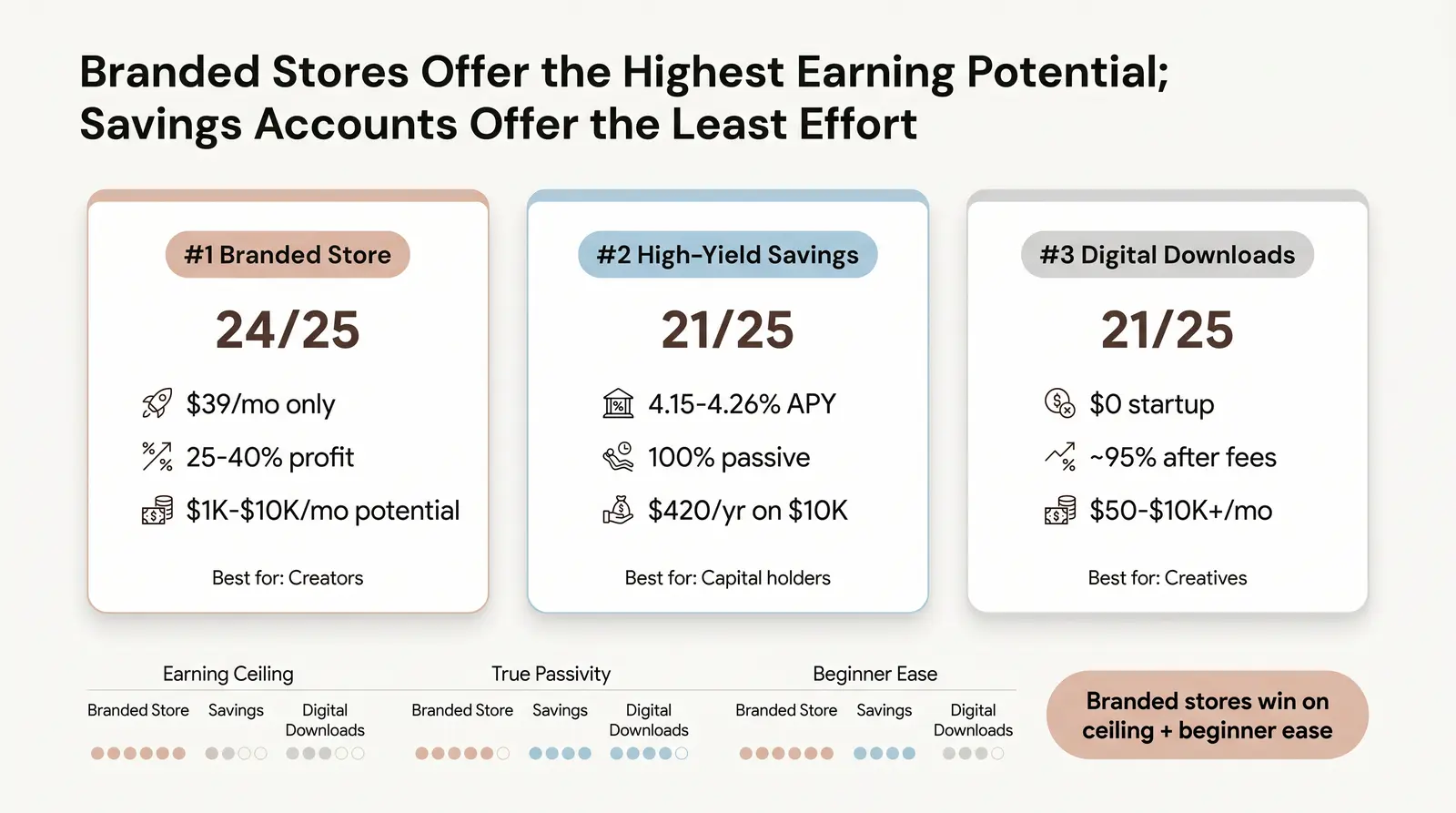
A branded private-label store, specifically one using an inventory-free fulfillment model, scores 24 out of 25 on the BPISF™. That near-perfect score is not an accident. It is the result of a business model that genuinely solves the three biggest problems with passive income: high startup cost, ongoing operational burden, and a low income ceiling.
Why it scores high. The startup cost is essentially the price of a Shopify subscription (around $39 per month). There is no inventory to purchase, no warehouse to manage, and no packing tape to buy. The fulfillment is automated. The income ceiling is unlimited because you are building a brand, not just reselling commodities. And the beginner-friendliness is as high as it gets: no prior ecommerce experience, no design degree, and no technical skills are required.
Realistic earning potential. Because you are selling a branded experience rather than a generic product, profit margins typically sit between 25% and 40% [6]. That is a significant advantage over generic dropshipping, where net margins after ad spend often compress to single digits. A creator with a modest existing audience of 10,000 to 20,000 followers can realistically generate $1,000 to $3,000 in monthly profit within the first 90 days. A well-optimized store with consistent marketing can scale to $5,000 to $10,000 per month within the first year.
What "passive" really means here. The upfront work involves choosing your brand name, selecting products from the catalog, setting your pricing, and connecting your store. That process takes hours, not weeks. Once live, fulfillment is entirely handled by your partner. Your ongoing role is marketing, which can itself be largely automated through scheduled social media content and email sequences. The store earns money while you sleep.
How to get started. The Branvas model is built specifically for this. Influencers and ecommerce sellers launch a branded jewelry line with zero inventory. Branvas handles product sourcing, branding, premium packaging, and blind fulfillment. You choose from over 800 curated jewelry and accessories pieces via the Catalog, set your retail prices, sync to Shopify, and start selling. Every order is packed in your branded packaging and shipped directly to your customer, with no Branvas branding visible anywhere. Learn more about how it works or explore the solutions built specifically for influencers and creators.
Key risks and caveats. The main challenge is traffic. A branded store without an audience or a marketing strategy will not generate sales. You need to commit to either organic social media content, paid advertising, or leveraging an existing following. The good news is that a branded product gives you far more compelling content to post than a generic item ever could.
In our experience at Branvas, the founders who succeed fastest with this model are those who treat their store like a real brand from day one, focusing on a cohesive aesthetic and a clear customer identity rather than just chasing quick sales.
If you are curious whether a branded jewelry line fits your audience, Branvas's Profit Calculator gives you a realistic revenue estimate in under 2 minutes, with no commitment required.
High-yield savings accounts and Certificates of Deposit score 21 out of 25, and they earn that score by being the most genuinely passive option on this entire list. There is no content to create, no store to manage, and no audience to build. You deposit money, and the bank pays you.
Why it scores high. It earns a perfect 5 for ongoing effort, speed, and beginner-friendliness. If you have capital, you can open an account in ten minutes and begin earning interest the next business day. The barrier to entry is essentially zero in terms of skill.
Realistic earning potential. As of mid-2026, the Federal Reserve's benchmark rate sits in the 3.50% to 3.75% range following several rate cuts in late 2024 and 2025 [3]. The best high-yield savings accounts are currently offering APYs between 4.15% and 4.26% [2]. On a $10,000 deposit, that translates to roughly $420 in completely passive income annually. On $100,000, it is $4,200 per year with zero effort.
What "passive" really means here. It is 100% passive. You deposit the money, and the bank does the rest. There is no ongoing management required.
How to get started. Compare rates at online banks such as Marcus by Goldman Sachs, Ally, or Discover. Transfer your funds. Set up automatic interest compounding. Done.
Key risks and caveats. The income ceiling is inherently low and directly proportional to the capital you already have. This model does not work for someone starting from zero. Interest rates are also subject to Federal Reserve policy changes, meaning your yield can shrink if rates fall further.
Digital downloads score 21 out of 25 and rank third because of a slightly lower Time-to-First-Dollar score compared to high-yield savings. But in terms of long-term passive income potential, this model is arguably more powerful than anything on this list for someone who is creative and willing to put in upfront work.
Why it scores high. The startup cost is zero. The margin is effectively 100% after platform fees (typically 5% to 10%). Once a digital product is created, it can be sold an infinite number of times with no additional cost. A Notion template you build in a weekend can generate revenue for years.
Realistic earning potential. The creator economy is projected to reach $480 billion by 2027, and digital products are a core driver of that growth [4]. Successful digital product creators on platforms like Etsy, Gumroad, and Payhip report monthly earnings ranging from a few hundred dollars to well over $10,000, depending on niche, quality, and marketing. The median is lower, but the ceiling is genuinely high for those who find product-market fit.
What "passive" really means here. The passivity is back-loaded. You must invest significant time upfront creating a high-quality product that solves a specific, real problem. Once listed, the sales process is entirely automated. The challenge is that most digital product creators underestimate how much marketing is required to drive consistent traffic to their listings.
How to get started. Identify a specific, painful problem your target audience faces. Build a solution using Canva, Notion, or Google Sheets. Price it between $5 and $47 depending on complexity. List it on Etsy or Gumroad. Then promote it consistently through social media, Pinterest, or a newsletter.
Key risks and caveats. The market is saturated with low-quality templates. Differentiation requires excellent design, a specific niche, and a genuine distribution channel. Without an audience, discoverability on Etsy alone is increasingly difficult.
How a Creator Launched a Branded Jewelry Store in 6 Days
Meet Maya, a 28-year-old lifestyle content creator with 18,000 Instagram followers. Maya had been posting content for two years and had a loyal, engaged audience, but her only income was occasional brand deals that paid inconsistently. She wanted a passive income stream that felt authentic to her brand, required no inventory, and could be live fast.
Here is exactly how she did it.
Day 1: Brand Concept. Maya decides on a minimalist, gold-focused aesthetic that matches her Instagram feed. She names her brand "Aura by Maya" and spends 30 minutes creating a simple logo in Canva.
Day 2: Store Setup. She signs up for a basic Shopify plan at $39 per month and installs the Branvas app. This is her only upfront cost.
Day 3: Product Curation. Browsing the Branvas Catalog, she selects 15 gold-plated jewelry pieces that match her aesthetic. She uses the Profit Calculator to set retail prices that achieve a 35% profit margin on each item.
Day 4: Store Design. Maya customizes her Shopify theme, uploads her logo, and configures her custom packaging preferences in Branvas. Every order will arrive in a premium box with her logo on the insert card and no Branvas branding visible.
Day 5: Teaser Campaign. She posts a behind-the-scenes Instagram Story hinting at "something new coming," building anticipation without revealing the product.
Day 6: Launch and First Sale. Maya announces Aura by Maya to her followers. Within four hours, a follower purchases a $45 gold necklace. The wholesale cost is $29, leaving Maya with a $16 profit on that single order. Branvas automatically receives the order, inspects the piece, packs it in Maya's branded packaging, and ships it directly to the customer. Maya never touches the product.
By month three, Maya is averaging 40 orders per month. At a $16 average profit per order, that is $640 in monthly passive income, with no inventory, no packing, and no customer service overhead for standard orders.
Ready to write your own version of this story? Launch your branded jewelry line with Branvas today.

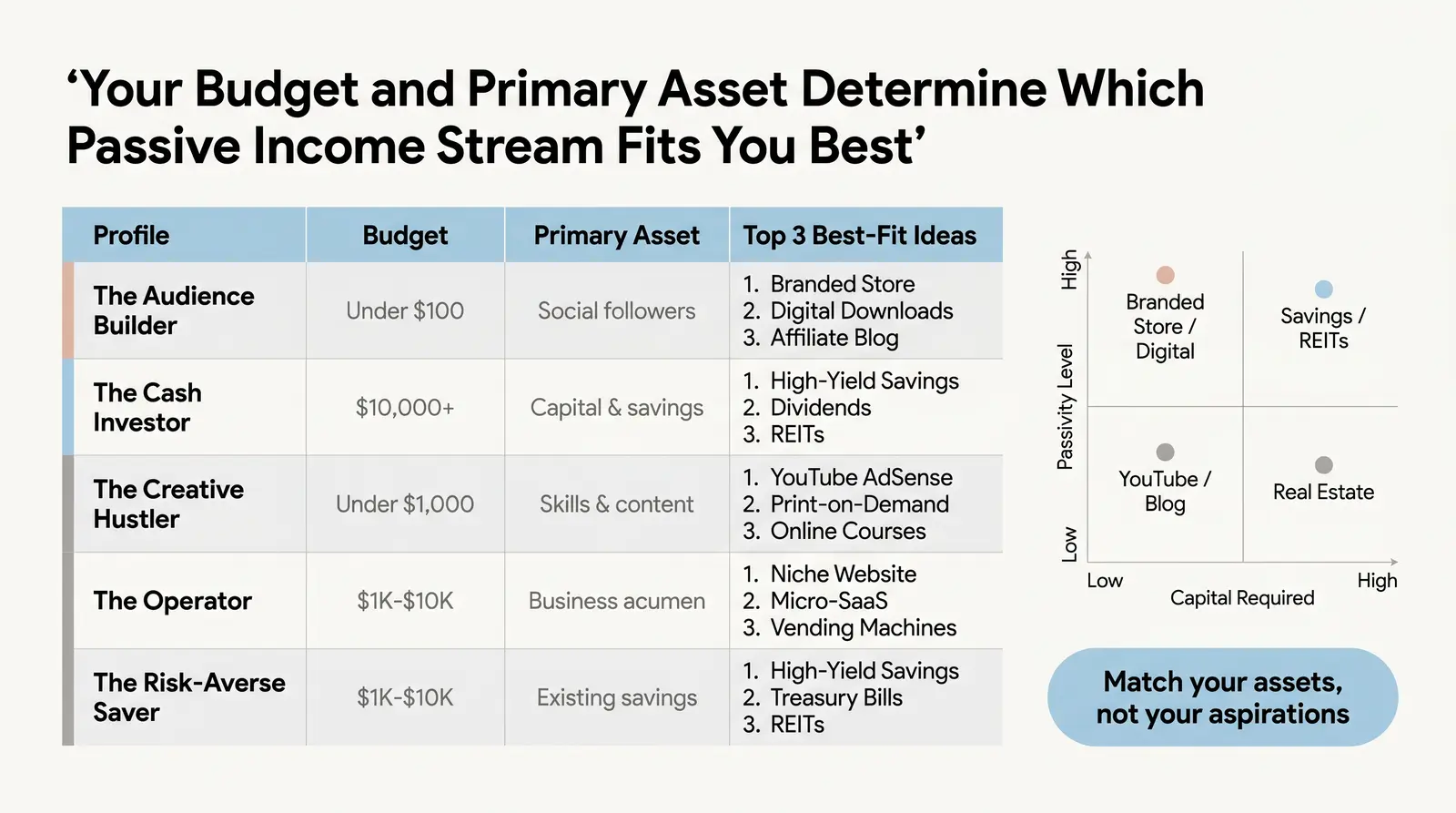
Not every passive income stream is right for every person. The right model depends on what you already have: capital, an audience, skills, or time. Use this matrix to find your best fit.
| Your Profile | Budget | Time Available | Primary Asset | Best-Fit Ideas |
|---|---|---|---|---|
| The Audience Builder | Under $100 | 2-10 hrs/week | Followers and social reach | 1. Branded Jewelry Store (Branvas), 2. Digital Downloads, 3. Affiliate Marketing |
| The Cash Investor | $10,000+ | Under 2 hrs/week | Capital and savings | 1. High-Yield Savings / CDs, 2. Dividend Investing, 3. REITs |
| The Creative Hustler | Under $1,000 | 10+ hrs/week | Skills and content creation | 1. YouTube AdSense, 2. Print-on-Demand, 3. Selling Online Courses |
| The Operator | $1,000-$10,000 | 10+ hrs/week | Business acumen | 1. Niche Website / Display Ads, 2. Mobile App / Micro-SaaS, 3. Vending Machines |
| The Risk-Averse Saver | $1,000-$10,000 | Under 2 hrs/week | Existing savings | 1. High-Yield Savings / CDs, 2. Bond Laddering / Treasury Bills, 3. REITs |
If you are a creator or aspiring entrepreneur with an audience but limited capital, the Branvas model for aspiring entrepreneurs and ecommerce and boutique store owners is specifically designed for your situation.
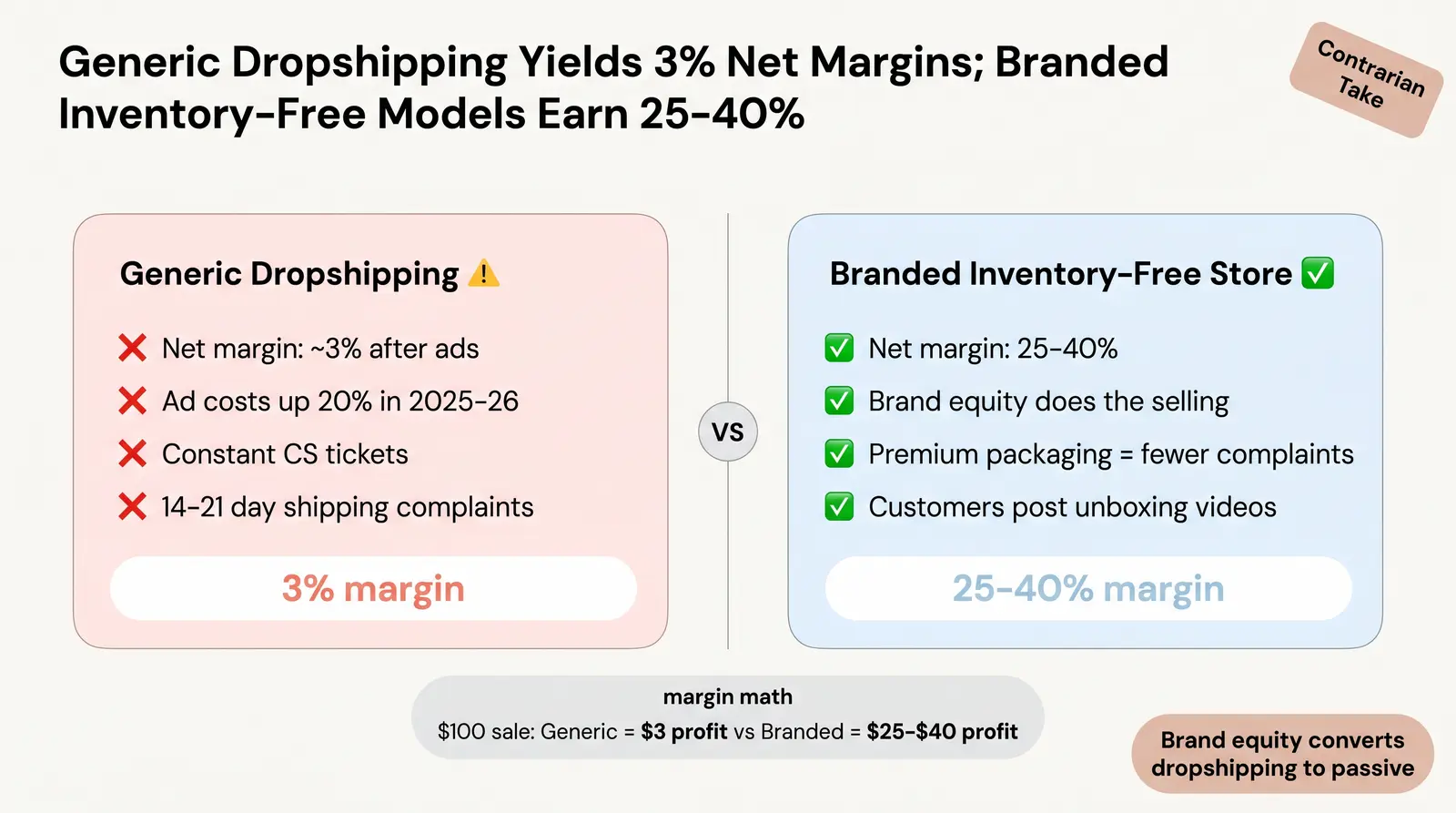
Here is something the passive income influencer world does not want you to hear: the most heavily promoted passive income models on social media consistently score among the worst on actual passivity.
Generic dropshipping is the clearest example. It is marketed as a hands-off business where you simply list products, run ads, and collect profits. The reality is more complicated. Ad costs on Facebook and TikTok jumped by approximately 20% in 2025-2026 as more sellers competed for the same eyeballs [5]. Generic products, which compete purely on price, have the thinnest margins to absorb those rising costs. A Quora thread analyzing real dropshipping results found that the most successful generic dropshippers often end up with net margins around 3%, meaning you need to generate enormous volume just to earn a modest income [1].
But the hidden cost that no one talks about is the customer service burden. When you sell a generic product with 14-to-21-day shipping from an overseas supplier, you are essentially setting yourself up for a constant stream of "where is my order?" tickets, refund requests, and chargebacks. That is not passive income. That is a part-time customer service job with unpredictable pay.
Branded inventory-free models score higher on true passivity for a structural reason: brand equity does the selling, and quality fulfillment reduces the service burden. When a customer receives a beautifully packaged, premium product that matches the brand they fell in love with on Instagram, they do not file a complaint. They post an unboxing video. The product quality and packaging experience that Branvas provides are not just nice to have; they are the mechanism that converts a dropshipping operation into a genuinely passive income stream.
We often see aspiring entrepreneurs overlook branded models because they assume that "building a brand" requires years of work and a large marketing budget. In practice, a focused brand identity, a curated product selection, and a consistent aesthetic can be established in a weekend. The infrastructure, from fulfillment to packaging to Shopify integration, already exists. The only thing left is to show up and market it.
1. What is the easiest passive income stream for beginners with no money?
The easiest options with zero startup capital are digital downloads and branded private-label stores. With a platform like Branvas, you can launch a jewelry line without purchasing any inventory upfront. You only pay for products after a customer buys them, meaning your first sale funds your first fulfillment. Digital downloads require only your time to create a template, guide, or planner that can then be sold an unlimited number of times.
2. How long does it take to make passive income?
It depends entirely on the model. High-yield savings accounts generate income immediately. A branded product store can generate its first sale within days if you have an existing audience to promote to. Content-heavy strategies like YouTube AdSense and affiliate marketing blogs typically require 6 to 12 months of consistent effort before generating meaningful passive returns, because they depend on search engine ranking and audience growth.
3. Is passive income actually passive?
Rarely is it 100% passive from day one. Almost every income stream requires either significant upfront time (creating content, building a store, designing a product) or significant upfront capital (investing in dividend stocks or real estate). The honest definition of passive income is a stream where the ongoing maintenance effort is small relative to the income generated. The goal is not zero work; it is a high income-to-effort ratio.
4. How much can you realistically earn from passive income in your first year?
Realistic first-year earnings vary widely by model and effort. A high-yield savings account on $10,000 might generate $400 to $420. A well-executed branded jewelry store with a modest existing audience can generate $500 to $3,000 per month in profit by month three, scaling higher with consistent marketing. Digital products can generate anywhere from $50 to $5,000 per month depending on niche and distribution. Be skeptical of any model promising five-figure monthly income in the first 30 days.
5. What passive income ideas work best for content creators and influencers?
Creators are uniquely positioned to succeed with branded private-label stores and digital products because they already have the hardest thing to build: a trusted audience. They bypass the most expensive part of ecommerce, which is customer acquisition. Solutions for Influencers and Creators like Branvas allow creators to monetize their audience with premium branded products without managing any logistics, making it the highest-leverage passive income model available to someone with an existing following.
[1] Quora (2025). "Is dropshipping still profitable in 2025 or is it too saturated?" https://www.quora.com/Is-dropshipping-still-profitable-in-2025-or-is-it-too-saturated
[2] Bankrate (2026). "Best High-Yield Savings Accounts Of July 2026." https://www.bankrate.com/banking/savings/best-high-yield-interests-savings-accounts/
[3] Federal Reserve Board (2026). "Selected Interest Rates (Daily) — H.15 Release." https://www.federalreserve.gov/releases/h15/
[4] Goldman Sachs Research (2023). "The creator economy could approach half-a-trillion dollars by 2027." https://www.goldmansachs.com/insights/articles/the-creator-economy-could-approach-half-a-trillion-dollars-by-2027
[5] Meta / Ezra Firestone (2026). "Ad costs jumped 20% in 2025-26, and shoppers are spending less." https://www.facebook.com/MeetEzra/posts/ad-costs-jumped-20-in-202526-and-shoppers-are-spending-less-than-ever-heres-the-/1553683122781180/
[6] Branvas (2026). "The New Era of Dropshipping: Building a Branded Asset in 2026." https://branvas.com/blogs/news/the-new-era-of-dropshipping-from-generic-hustles-to-brand-driven-businesses