


Solo ecommerce founders can slash support tickets and response times by fixing upstream fulfillment issues, automating communication, and building a lean self-service support system.
Published:
August 10, 2026
Author:
Yi Cui
Support volume grows faster than revenue. That's the part nobody warns you about.
You crack your marketing. Orders start flowing. And then, almost overnight, your inbox becomes the bottleneck. You're refreshing support tickets at midnight, writing the same "your order is on its way" email for the fourteenth time, and watching your refund queue grow while you should be building your brand.
The instinct is to hire. But for a solo ecommerce founder, adding headcount destroys margins and creates management overhead you don't have bandwidth for. The real answer is systems, not staff. Build the right infrastructure upstream and downstream, and most of your tickets never get created in the first place.
We see this pattern constantly at Branvas—founders who've cracked their marketing, only to find their inbox becomes the bottleneck. This playbook is the system that fixes it.
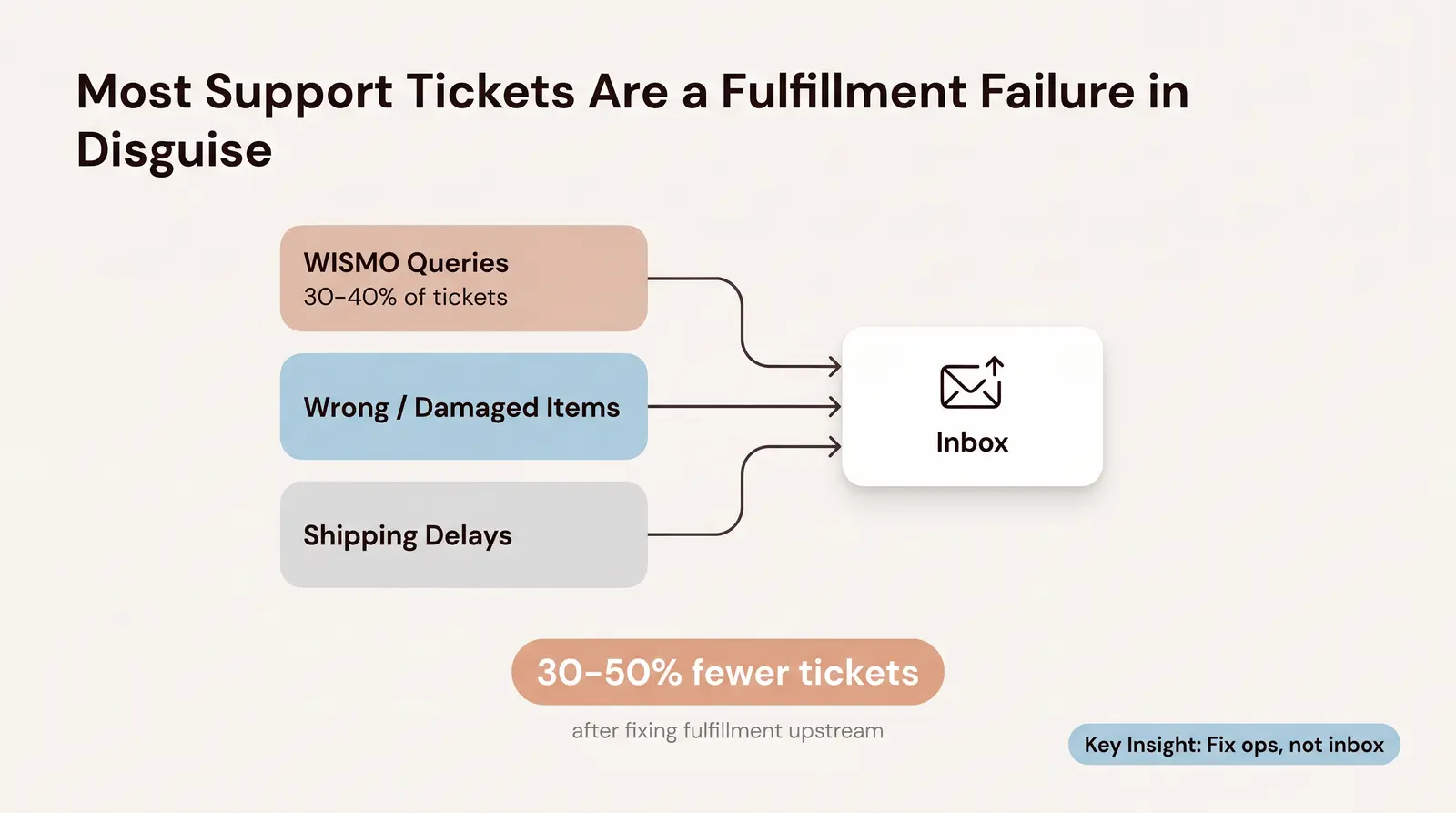
Here's the non-obvious insight most solo founders miss: the majority of ecommerce support tickets are not caused by customer behavior. They're caused by upstream failures in your product, fulfillment, and communication.
WISMO queries—"Where is my order?"—account for 30% to 40% of all ecommerce customer support volume [1]. Add in damaged goods, wrong items shipped, and shipping delays, and you're looking at a support queue that is almost entirely a fulfillment problem wearing a customer service costume.
Think about it this way. If a package ships on time, arrives intact, and matches the product description exactly, the customer has no reason to contact you. The ticket never gets created. The problem was never a people problem. It was a product and process problem.
In our experience at Branvas, founders who switch to a reliable fulfillment partner often report a 30–50% drop in support volume within the first 60 days—not because they changed their support process, but because the root cause of most tickets disappeared. Branvas's fulfillment model handles product quality, packaging, and blind shipping, which removes the most common ticket triggers for jewelry and accessories sellers before they ever reach your inbox. See how it works at branvas.com/how-it-works.
Once your upstream operations are solid, you need a lightweight system to handle the tickets that do come in. You don't need enterprise software. You need a setup that centralizes communication, automates the repetitive stuff, and empowers customers to find their own answers.
The lean stack for a solo Shopify store owner has four components: a helpdesk tool with native Shopify integration, automated order tracking, canned responses (macros) for your top ticket types, and a self-service FAQ page. The goal is to deflect tickets before they're submitted and resolve the rest in one click.
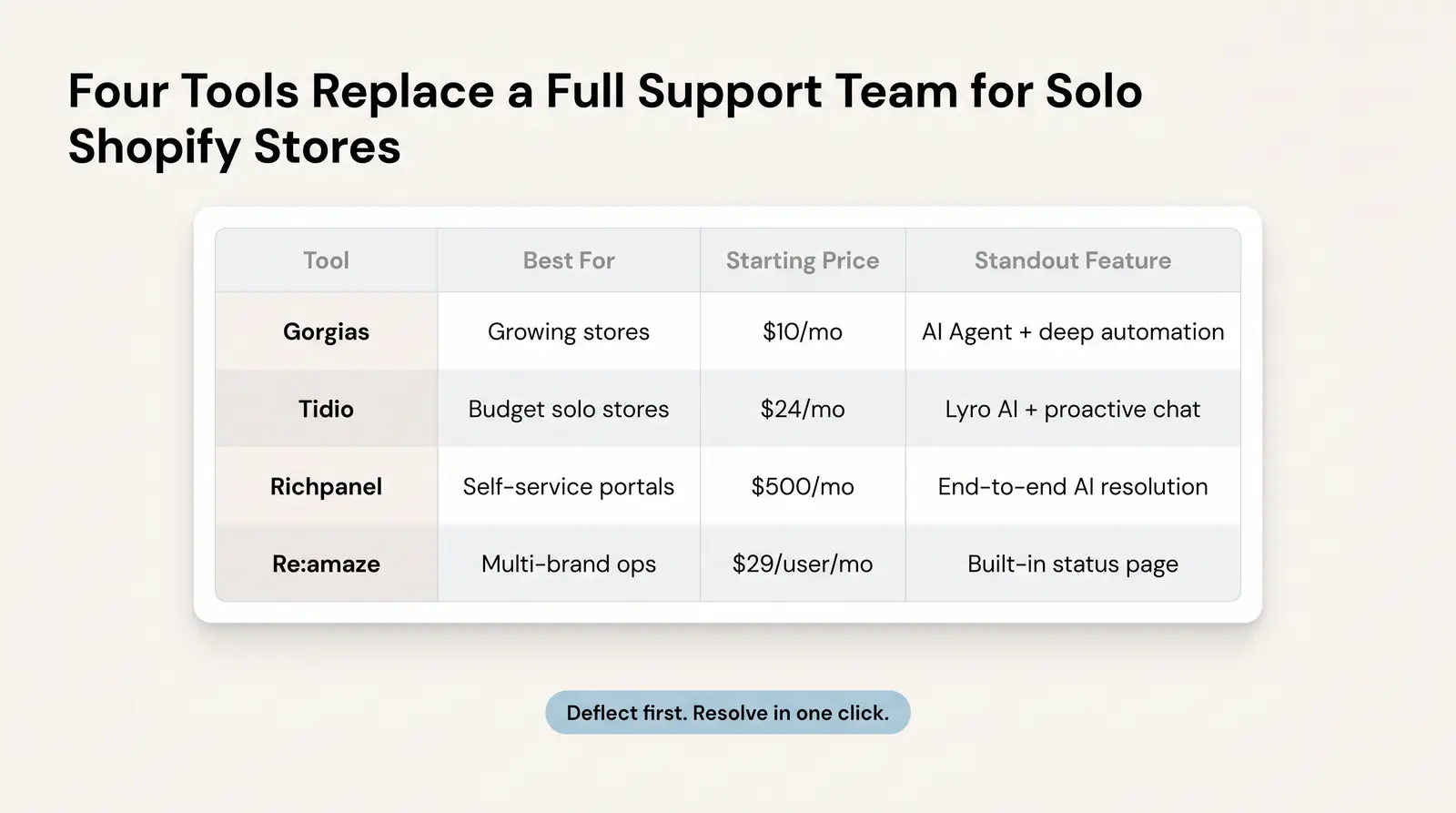
| Tool Name | Best For | Shopify Integration | Starting Price | Standout Feature |
|---|---|---|---|---|
| Gorgias | Growing ecommerce stores | Deep, native | $10/mo (Starter) | AI Agent and advanced automation rules [2] |
| Tidio | Budget-conscious solo stores | Native | $24.17/mo (Starter) | Lyro AI Agent and proactive chat flows [3] |
| Richpanel | Self-service portals | Native | $500/mo (AI Agent) | End-to-end AI resolution with self-service portal [4] |
| Re:amaze | Multi-brand operators | Native | $29/user/mo (Basic) | Built-in status page and proactive cues [5] |
Table: Lightweight Helpdesk Tools for Solo Shopify Stores (2024–2025)
Alongside your helpdesk, set up a proactive shipping notification sequence. Customers should receive automated updates at four milestones: order confirmed, shipped, out for delivery, and delivered. Proactive notifications at these touchpoints can reduce WISMO inquiries by 50% to 80% [1]. That alone can cut your ticket volume in half.
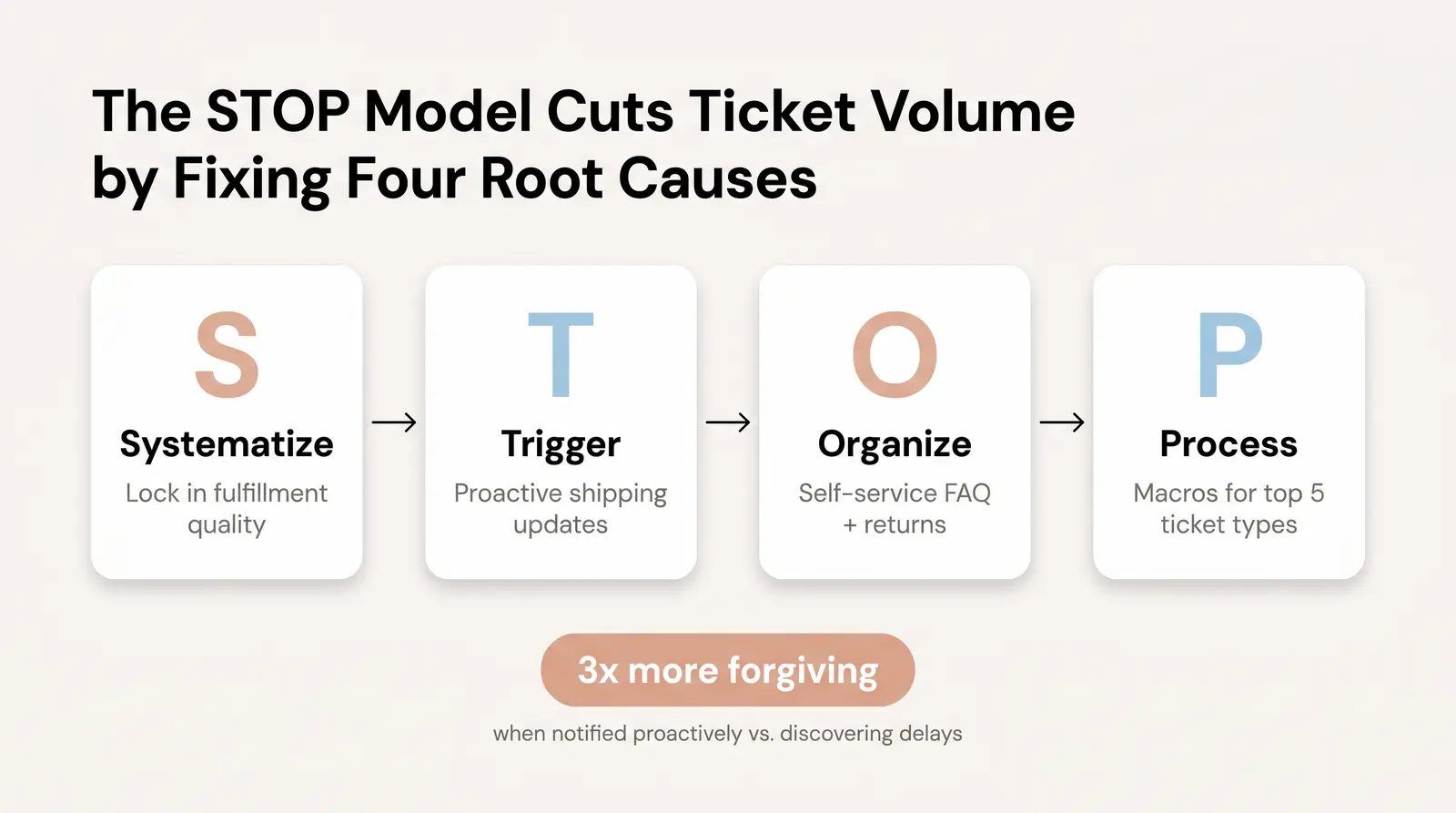
To build a support system that actually runs itself, use the STOP Model—a four-step framework for solo store owners who want to systematically reduce ticket volume and resolution time.
S — Systematize upstream quality. Your product, packaging, and fulfillment accuracy have to be locked in. Partner with a fulfillment provider that guarantees picking accuracy. Implement quality control checks before items ship. Use packaging that protects the product in transit. Every damaged-on-arrival complaint is a fulfillment failure, not a support problem.
T — Trigger proactive communication. Don't wait for customers to ask. Tell them first. Set up automated email and SMS updates for every stage of the delivery journey. If a delay occurs, trigger an exception notification immediately—explain what happened and give a new timeline. Customers are three times more forgiving of delays when notified proactively versus discovering the issue themselves [1].
O — Organize self-service resources. Build a comprehensive FAQ page that covers your shipping times, return policy, and product care instructions. Add a self-service return portal (Loop Returns integrates directly with Shopify) so customers can generate their own labels without contacting you. According to Statista, 88% of customers expect brands to offer a self-service option [2]. Give them one.
P — Process tickets by type with macros. Never type the same answer twice. Create canned response templates for your top five ticket types: WISMO, returns, exchanges, sizing, and damaged items. Personalize each macro with dynamic tags for customer name and order number. Use auto-routing rules to flag urgent tickets (like address changes before shipment) so they don't get buried.
Returns are inevitable. How you handle them determines whether they cost you a customer or keep one.
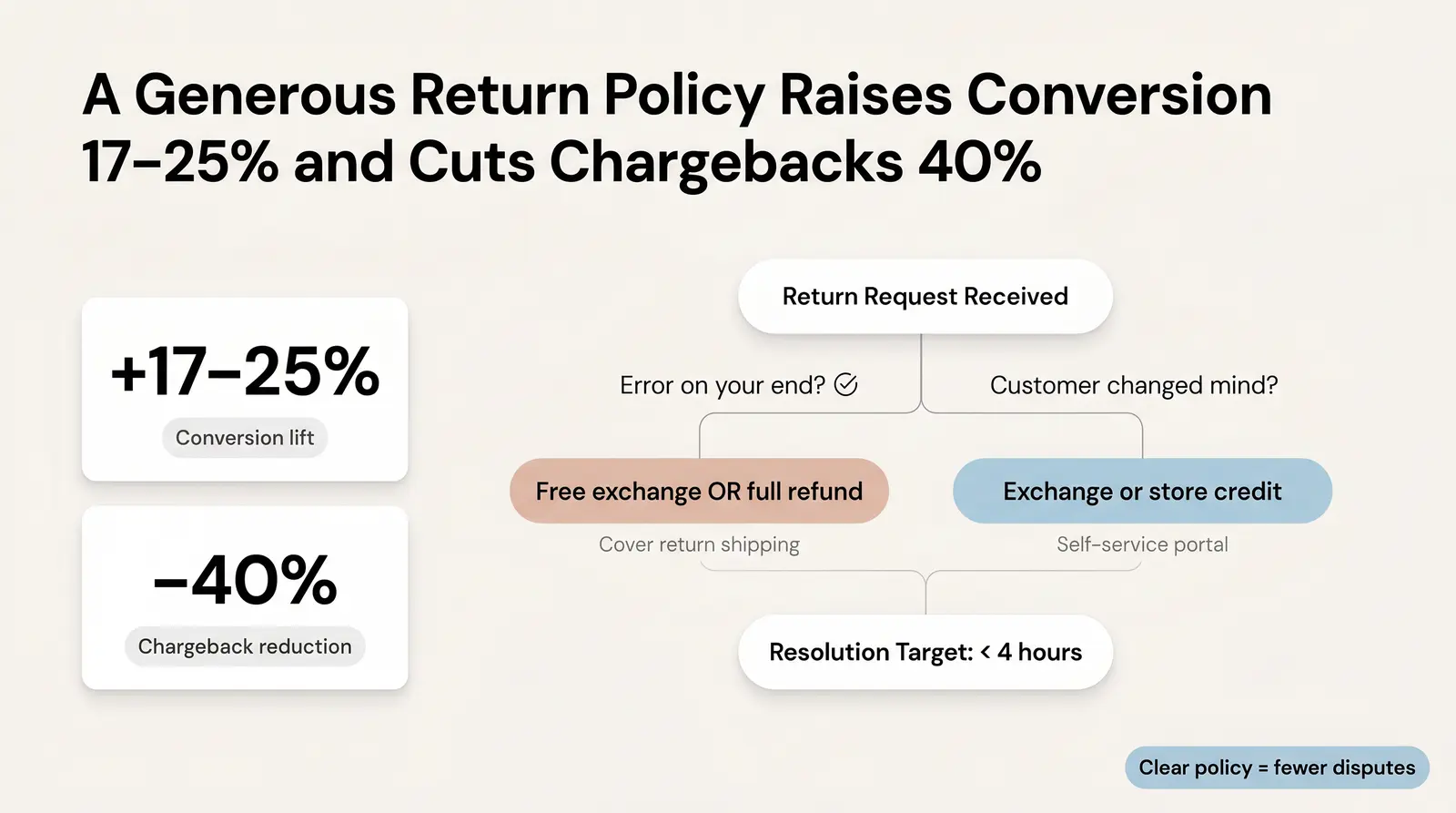
A clear, generous return policy increases conversion rates by 17–25% and reduces chargebacks by up to 40% [6]. The logic is simple: when customers know they can return something easily, they buy with more confidence. A restrictive policy doesn't reduce returns—it just redirects frustrated customers to their bank, where a chargeback costs you far more than a straightforward refund.
Write a policy that sets clear expectations: your return window (30–60 days is standard), condition requirements, who pays return shipping, and how long refunds take to process. Put it on your product pages, not just buried in the footer.
Worked Example: The "No-Drama Refund Flow" for a Solo Jewelry Store
Scenario: A customer receives a necklace that doesn't match the product photo and requests a refund.
Decision Tree:
- Is the item unworn and within the 30-day return window? Yes.
- Was the error on your end (photo mismatch, wrong item)? Yes.
- Resolution: Offer a free exchange or full refund, covering return shipping.
Response Macro (copy-ready):
"Hi [Name], I'm really sorry the [Product Name] wasn't what you expected—that's on us. I'd love to make it right. I can either send you a free exchange for a different piece, or issue a full refund to your original payment method. Just click here [Return Portal Link] to generate your prepaid return label. As soon as tracking shows it's in transit, I'll process your request right away. Let me know which you'd prefer!"Resolution Target: Under 4 hours from first contact.
If your refund requests are frequently tied to product quality or shipping issues, the fix may be upstream. See how Branvas handles fulfillment at branvas.com/how-it-works.
You can't be online around the clock. But you can manage customer expectations so that your response time feels faster than it actually is.
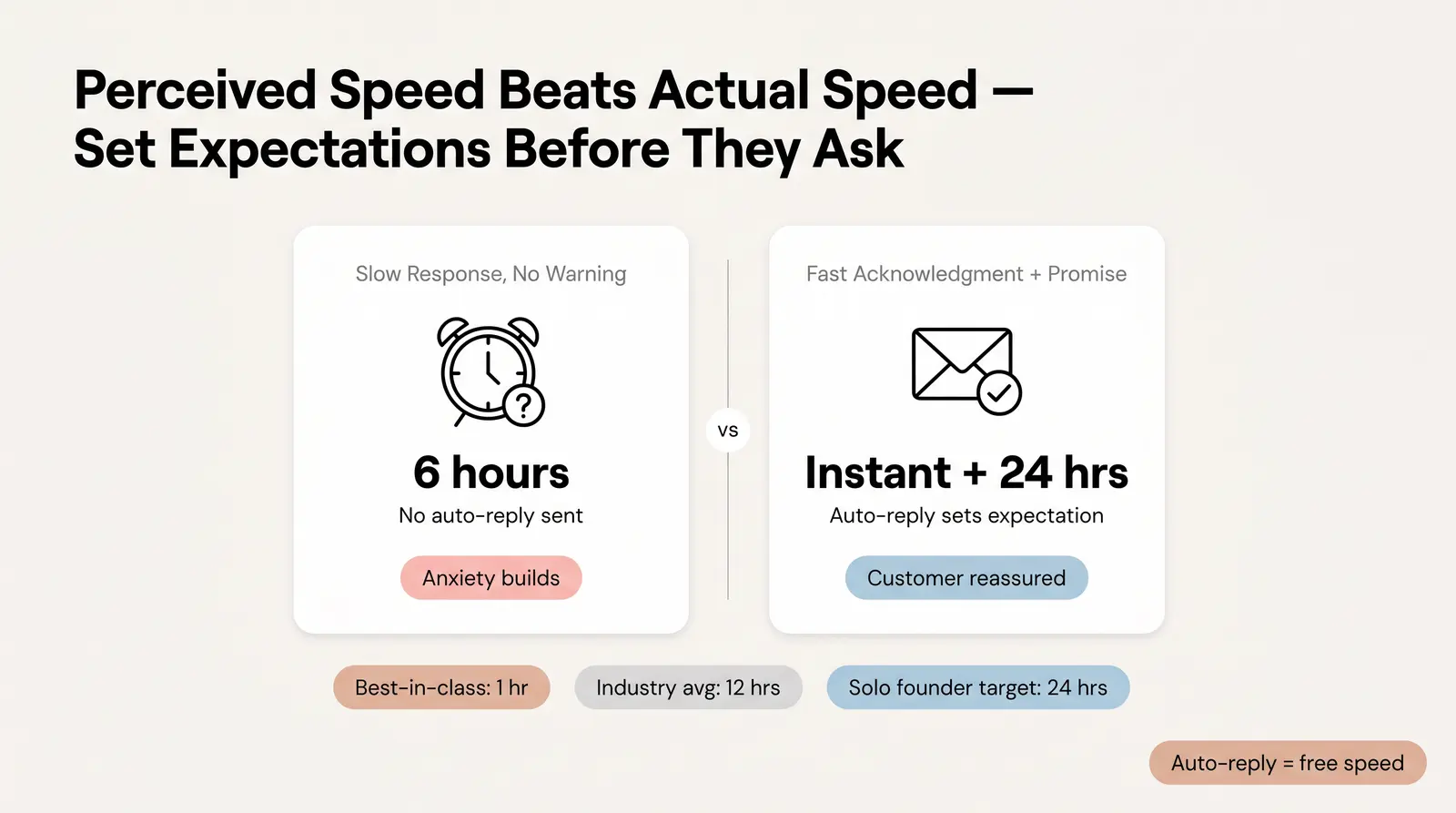
Industry benchmarks show that best-in-class ecommerce stores respond to email within one hour, while the baseline across the industry is around 12 hours [2]. For a solo founder, 12 to 24 hours is a realistic and acceptable target—as long as you communicate it upfront.
This is the concept of perceived speed versus actual speed. An auto-responder that immediately acknowledges a ticket and sets a clear 24-hour expectation outperforms a 6-hour response with no prior acknowledgment. The customer knows you've received their message. The anxiety stops building.
Set up an auto-responder that states your support hours clearly: "We're a small team and reply to all emails Monday–Friday, 9 AM–5 PM EST, within 24 hours." Use an AI chatbot for instant answers to basic questions (tracking, return policy, sizing). Reserve your time for complex issues that actually need a human response. Shopify's helpdesk ecosystem—including Gorgias and Tidio—makes this setup accessible even for a solo founder with no technical background.
Not every ticket needs a full investigation. Sometimes the fastest, cheapest resolution is to just issue the refund and move on.
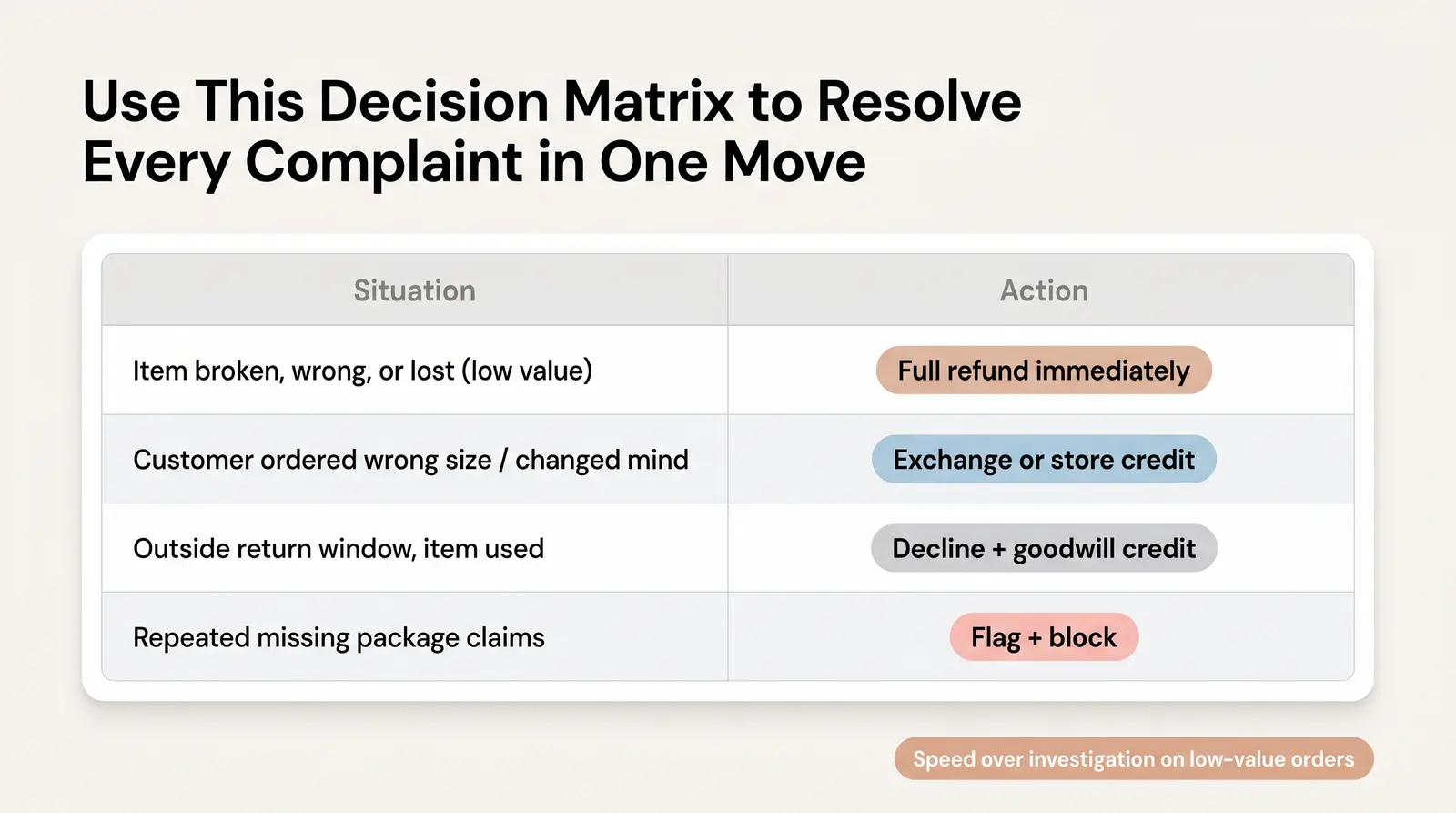
Use this decision matrix to determine your next step for any incoming complaint:
| Situation | Action |
|---|---|
| Item arrived broken, wrong item shipped, or package lost (low order value) | Issue full refund immediately. No return required. |
| Customer ordered wrong size or changed their mind | Offer exchange or store credit via self-service portal. |
| Refund request outside the return window, item clearly used | Politely decline per your policy. Offer store credit as a goodwill gesture. |
| Customer repeatedly claims packages are missing despite delivery confirmation | Flag as potential fraud. Block future purchases. |
Running a jewelry or accessories store and tired of fulfillment-related tickets eating your day? Branvas's Brand-as-a-Service model handles product quality, packaging, and blind shipping—so the most common support triggers disappear before they hit your inbox. See how it works →
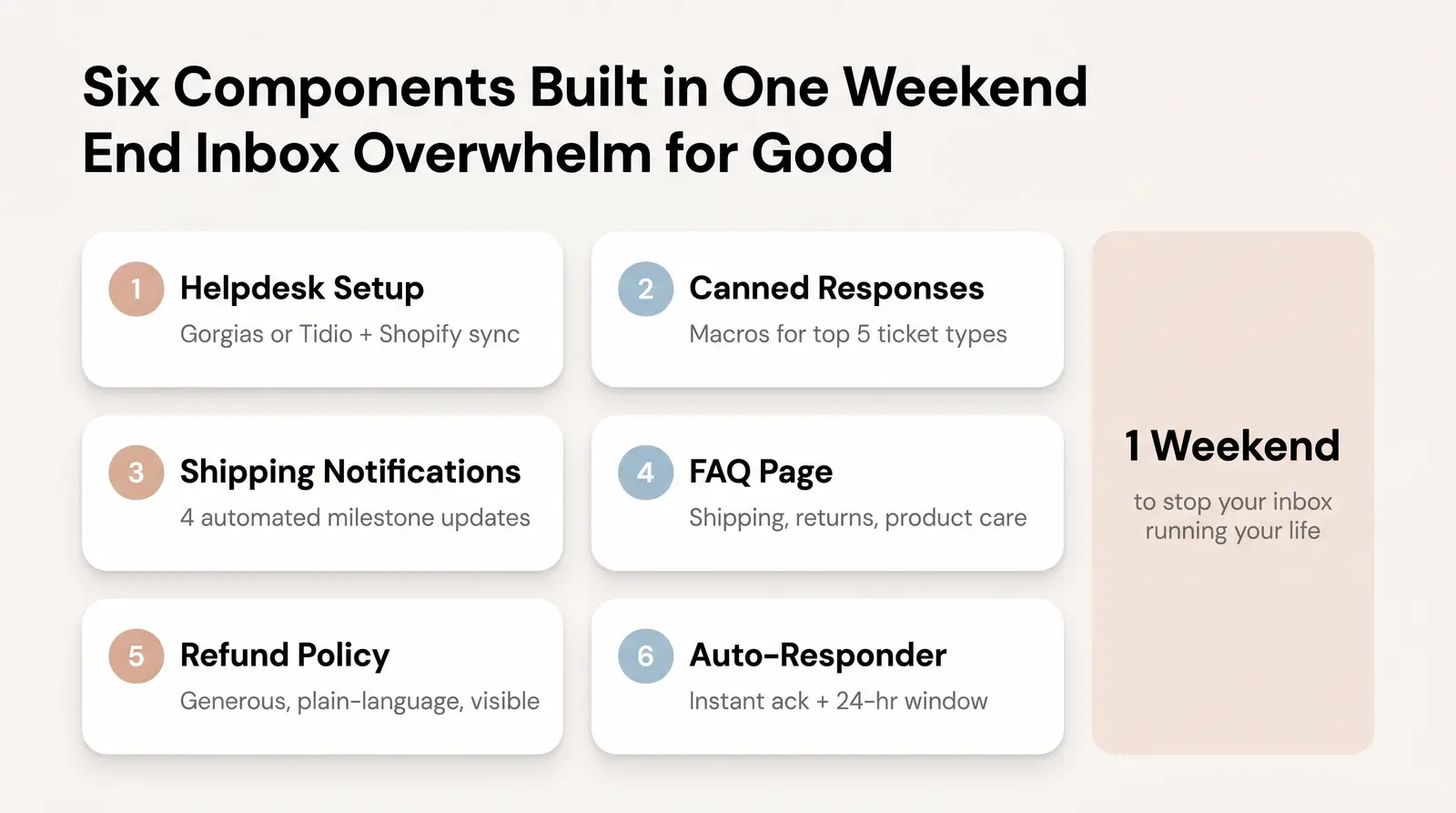
You can build this entire system in one weekend. Here's the complete checklist:
That's your Support OS. Six components, one weekend, and your inbox stops running your life.
For more resources on building lean brand operations, visit branvas.com/academy.
1. What is a good response time for ecommerce customer service?
For email, a first response time under 12 hours is the industry baseline. Best-in-class stores respond within one hour [2]. As a solo founder, set up an immediate auto-responder that acknowledges the ticket and commits to a 24-hour reply window. That single step eliminates most of the anxiety that leads to follow-up tickets.
2. How do I handle a refund request for a product I can't restock or replace?
If the item is defective and can't be restocked, issue a full refund immediately without requiring the customer to ship it back. The cost of return shipping and restocking labor often exceeds the item's margin anyway. Letting the customer keep it builds goodwill and removes friction from the process.
3. What's the best helpdesk tool for a Shopify store with no support team?
Gorgias is the strongest choice for stores focused on Shopify integration and automation. It starts at $10/month and offers deep order data sync, macros, and AI-powered responses [2]. Tidio is a solid budget alternative starting at $24.17/month, with a capable AI agent and proactive chat flows [3]. Both work well for solo operators.
4. How can I reduce WISMO ("where is my order?") tickets?
Send proactive shipping notifications at four milestones: order confirmed, shipped, out for delivery, and delivered. This answers the customer's question before they have to ask it. Proactive notifications can reduce WISMO volume by 50% to 80% [1]. For jewelry and accessories stores, reliable fulfillment with accurate tracking is the upstream fix that makes this possible.
5. When should I just issue a full refund instead of troubleshooting a complaint?
Issue a full refund immediately when the error was clearly on your end (wrong item, damaged in transit), when the order value is low enough that a return isn't worth the logistics cost, or when the cost of the dispute—in time and potential chargeback fees—exceeds the refund amount. Protecting margin on a $30 item by fighting a refund request is rarely worth it.
[1] WISMO: How AI Handles Where Is My Order Queries at Scale — Alhena AI, 2026.
[2] Customer Service Response Time: Benchmarks, Calculation, and 6 Ways to Improve — Gorgias, 2026.
[3] Tidio Pricing Plans — Tidio, 2026.
[4] Richpanel Pricing — Richpanel, 2026.
[5] Re:amaze Pricing — Re:amaze, 2026.
[6] How to Create an Effective Return and Refund Policy — LaunchMyStore, 2025.
[7] 15 Best Practices for Ecommerce Customer Service — Gorgias, 2024.