


Learn realistic dropshipping delivery windows by fulfillment model and exactly where to communicate shipping times across the buyer journey to protect customer trust.
Published:
August 6, 2026
Author:
Yi Cui
Slow shipping is a trust problem, not just a logistics problem.
Customers don't abandon brands because shipping is slow. They abandon because nobody told them it would be slow. That distinction matters more than most dropshippers realize, and it explains why some stores with 20-day shipping windows have loyal customers while others with 10-day windows are drowning in disputes.
Delivery expectation management is a brand trust issue with direct consequences: higher refund rates, worse reviews, and lower repeat purchase rates. In this article, we'll cover what realistic delivery windows look like across different fulfillment models, exactly where and how to communicate timelines across the buyer journey, and how your choice of fulfillment model can permanently change the math in your favor.
Amazon Prime has permanently altered consumer expectations. Most US shoppers now assume 2-day delivery as a baseline. When they land on a dropshipping store, that assumption doesn't disappear just because the price is lower.
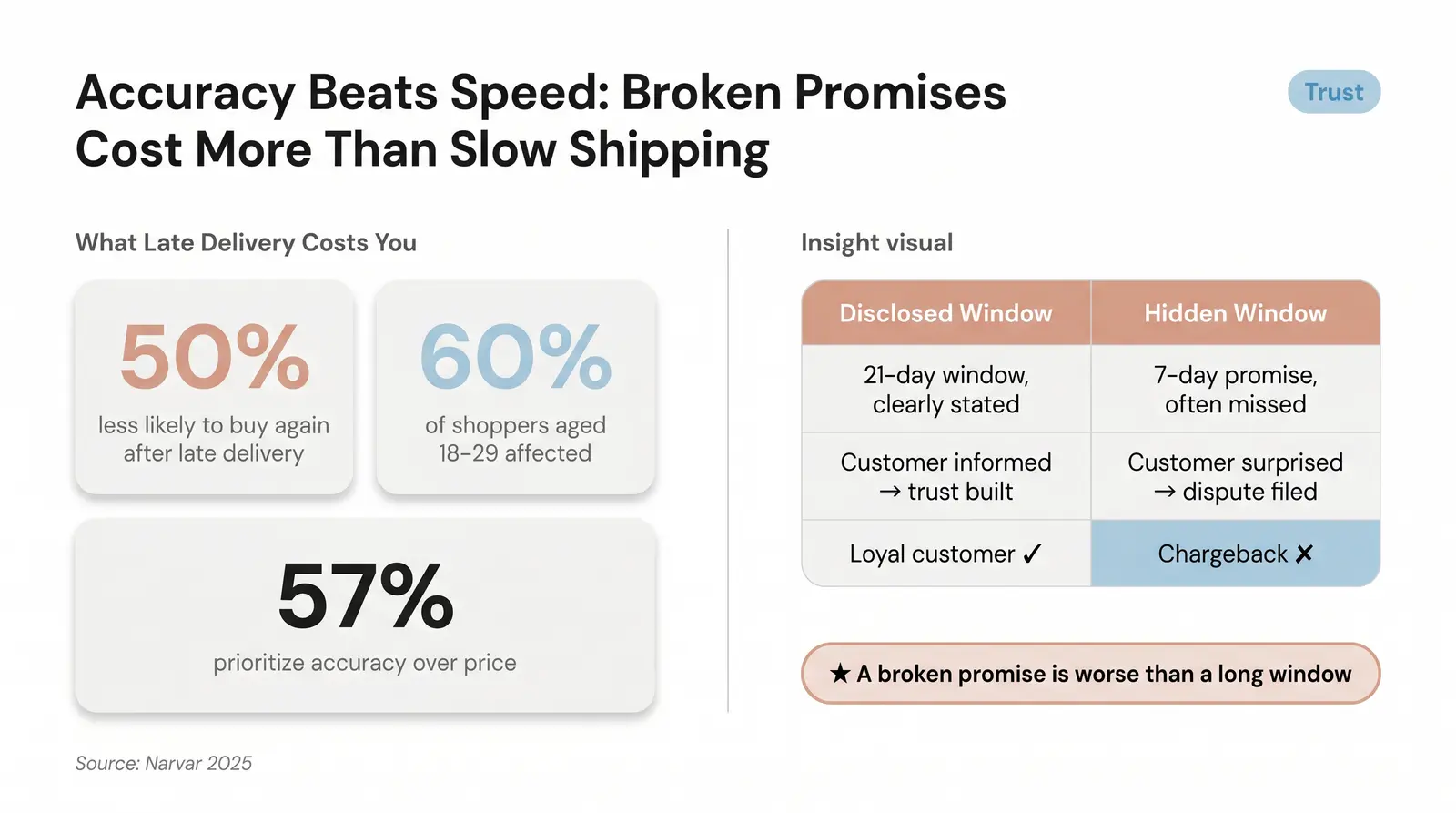
The data is clear: missed delivery dates dissolve consumer confidence. Research from Narvar's 2025 State of Post-Purchase Report found that 50% of consumers say they are less likely to shop again after a late delivery, and 6% cut ties with the brand entirely [1]. For shoppers aged 18-29, that number climbs to 60% [1]. These are not edge cases. These are your customers.
Here is the contrarian insight most sellers miss: a 21-day shipping window that is clearly disclosed upfront converts and retains customers better than a "fast" 7-day promise that is frequently missed. Accuracy outranks cost as the most important factor when consumers evaluate shipping options, with 57% prioritizing accuracy over price [1]. Baymard Institute's checkout usability research reinforces this, showing that when sites provide only a "shipping speed" (like "3-5 business days") rather than an estimated delivery date, users come to a complete halt, open calendars, and make faulty assumptions that lead to hesitation and abandonment [5].
The implication is simple: if you are honest about your timeline and communicate it clearly, a longer window is not a dealbreaker. A broken promise is.
At Branvas, we consistently see new brand founders under-communicate timelines early on, and it's almost always the number one source of their first negative reviews.
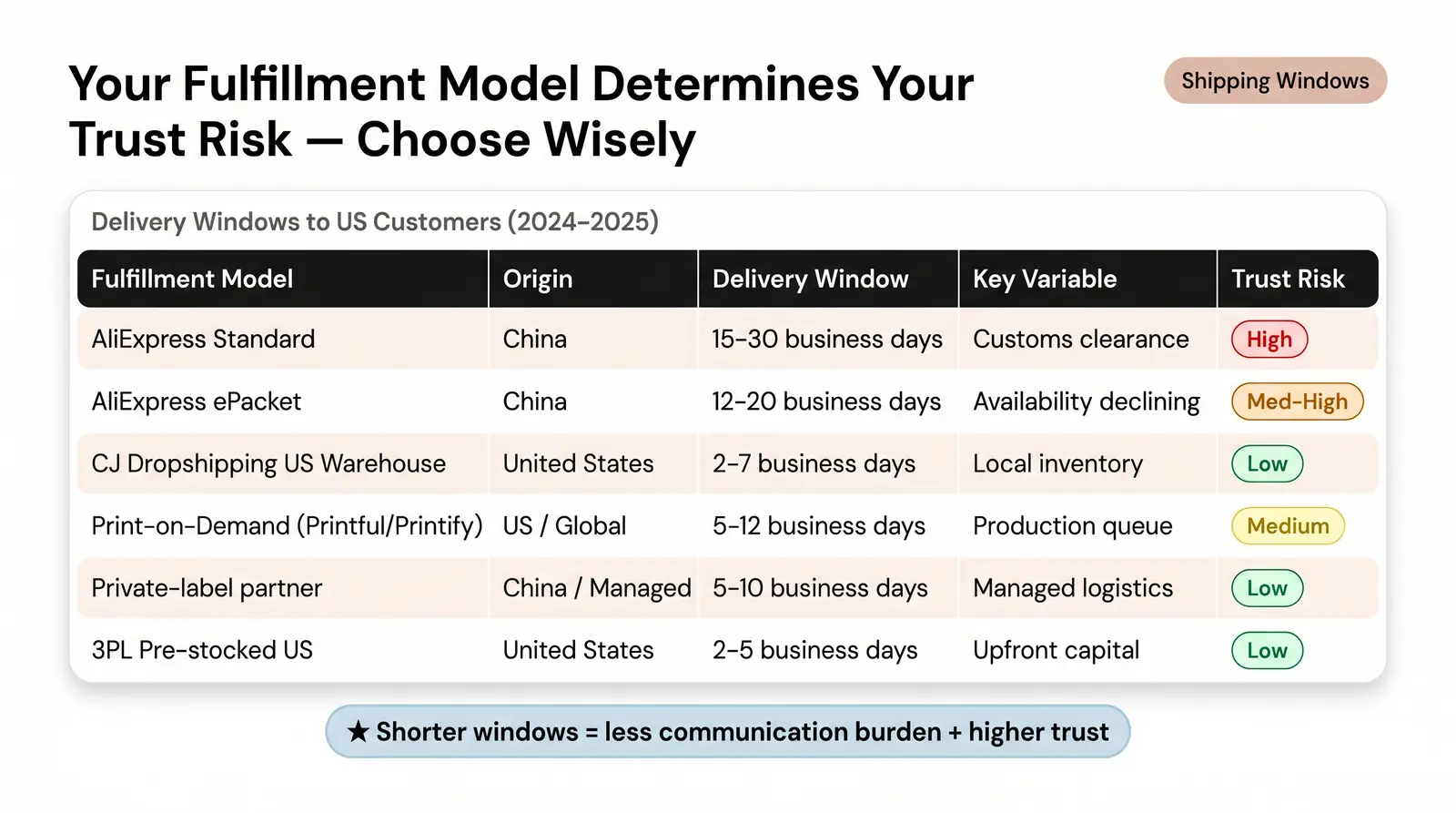
Before you can communicate timelines, you need to know what they actually are. Shipping times vary significantly based on your fulfillment model, origin country, and carrier. AliExpress delivery windows have shifted considerably post-pandemic due to carrier changes, customs backlogs, and the impact of new US tariff policies on Chinese imports [3].
The table below reflects realistic delivery windows to US customers in 2024-2025, not best-case scenarios.
| Fulfillment Model | Typical Shipping Origin | Estimated Delivery Window (to US) | Key Variable | Trust Risk Level |
|---|---|---|---|---|
| AliExpress Standard Shipping | China | 15-30 business days | Customs clearance and US final mile | High |
| AliExpress ePacket | China | 12-20 business days | Availability (declining usage on platform) | Medium-High |
| AliExpress / CJ Dropshipping with US local warehouse | United States | 2-7 business days | Local inventory availability | Low |
| Print-on-Demand (Printful / Printify) | US / Global | 5-12 business days (including production) | Production queue and carrier speed | Medium |
| Private-label fulfillment partner (Branvas model) | China / Managed | 5-10 business days | Pre-checked inventory and dedicated logistics lanes | Low |
| 3PL with pre-stocked US inventory | United States | 2-5 business days | Upfront capital commitment and stock levels | Low |
A few notes on this table. AliExpress Standard Shipping to the US typically runs 15-30 business days, and that window widens during Chinese New Year, peak shopping seasons, and periods of elevated customs scrutiny [3]. ePacket, once the preferred option for dropshippers, has become harder to find as sellers migrate to AliExpress Standard Shipping. CJ Dropshipping's US warehouse network (California, New Jersey, Texas, Indiana) can deliver in 2-7 days when inventory is pre-stocked locally. Print-on-demand services like Printful add 2-5 business days of production time before the item even ships, bringing the total window to 5-12 days for domestic US orders. A private-label partner like Branvas compresses the window through pre-checked inventory and managed logistics, without requiring the upfront capital of a full 3PL arrangement.
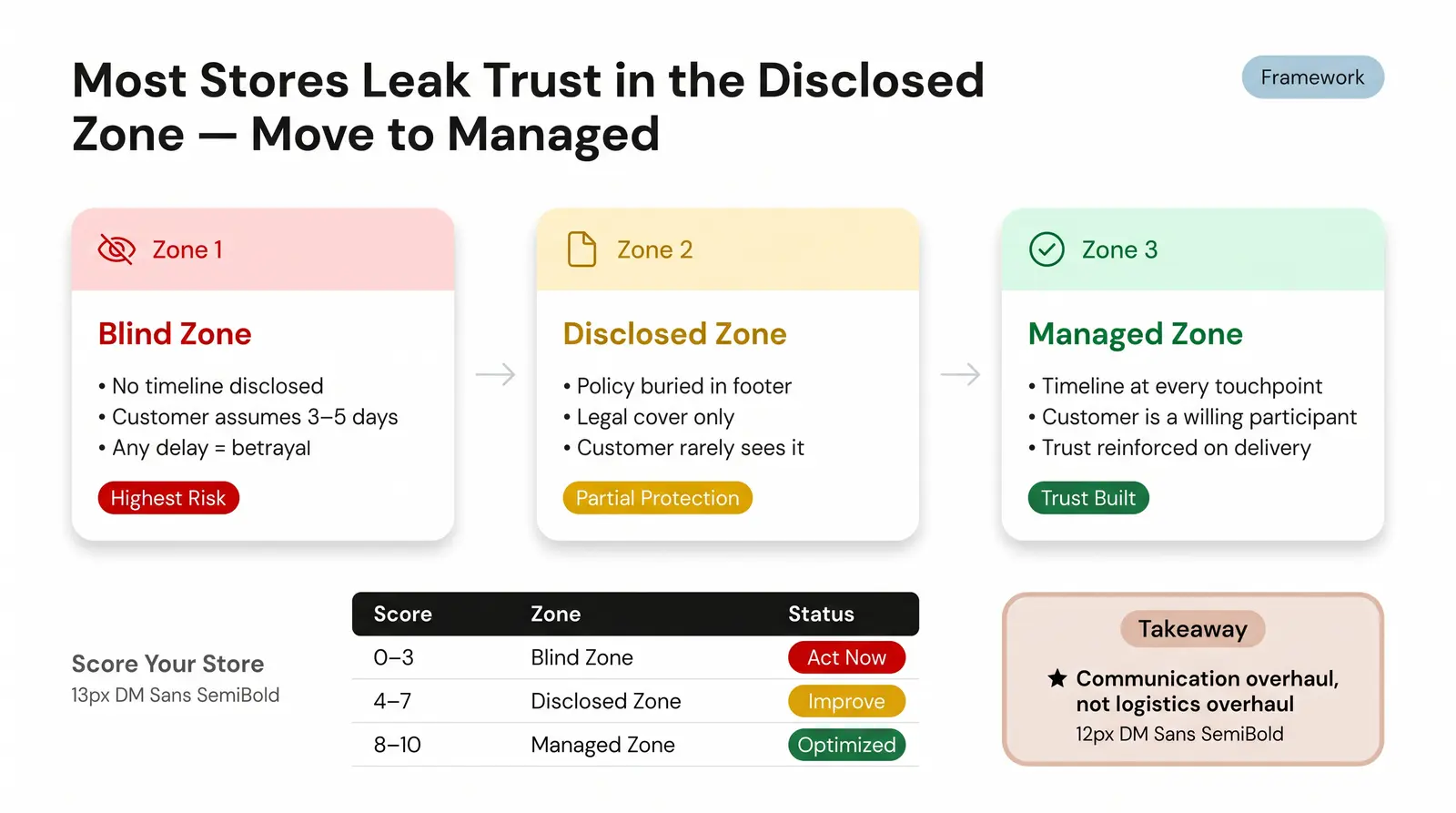
To help founders diagnose their shipping communication, we developed The Branvas Expectation Gap Framework™. It is a three-zone model for understanding how your store's communication is performing, and where trust is being lost.
Zone 1: The Blind Zone. No delivery timeline is disclosed before purchase. This is the highest-risk position. The customer defaults to an Amazon-primed assumption of 3-5 days. Any deviation from that assumption feels like a betrayal, not a delay.
Zone 2: The Disclosed Zone. The timeline exists somewhere on your site, typically in a shipping policy page or FAQ buried in the footer. It is technically disclosed, but it is not surfaced at the moments that matter. The customer may never have seen it. This offers partial legal protection but limited trust protection.
Zone 3: The Managed Zone. The delivery timeline is communicated at the product page, in the cart, at checkout, in the order confirmation email, and in the shipping notification. The customer is a willing participant in the timeline. They know what to expect, and when they get it, trust is reinforced.
Score your store. Assign yourself points for each touchpoint where your delivery timeline is clearly stated. Maximum 10 points.
| Touchpoint | Points Available |
|---|---|
| Product page (near Add to Cart) | 2 |
| Cart or mini-cart | 1 |
| Checkout page (near Place Order button) | 2 |
| Order confirmation email | 2 |
| Shipping notification email | 2 |
| Proactive delay notification system in place | 1 |
Score 8-10: You are in the Managed Zone. Score 4-7: You are in the Disclosed Zone. Score 0-3: You are in the Blind Zone, and your first negative reviews are probably already there.
Moving from Zone 1 to Zone 3 does not require a logistics overhaul. It requires a communication overhaul. The next section covers exactly how to do it.
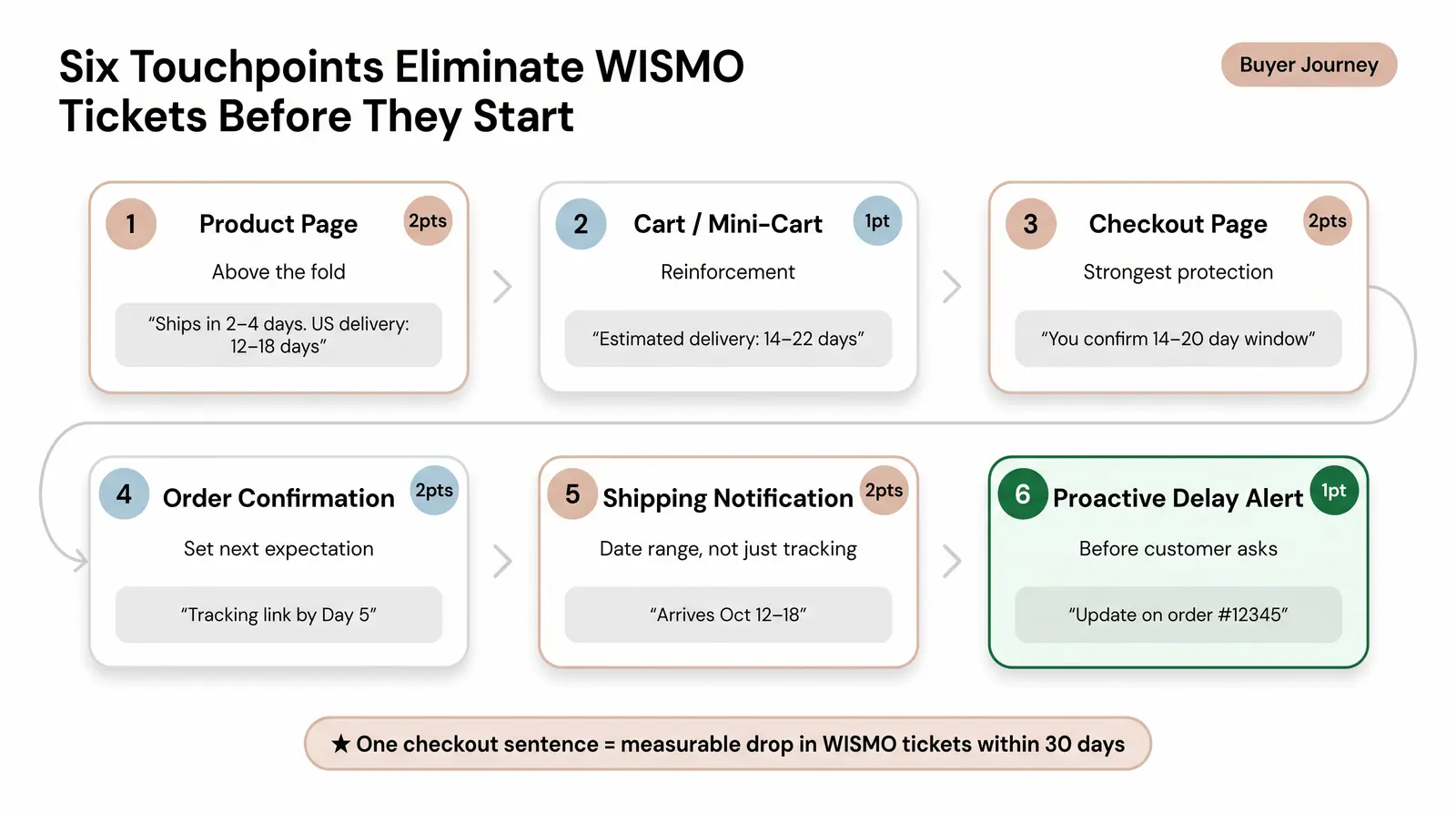
Each touchpoint in the buyer journey is an opportunity to either set a clear expectation or leave a dangerous gap. Here is how to handle each one.
1. Product page. This is where the expectation is first formed. Place the delivery estimate above the fold, near the Add to Cart button, so it cannot be missed.
Suggested copy: "Ships in 2-4 business days. Estimated delivery to the US: 12-18 days."
2. Cart or mini-cart. A single line is enough. The goal is reinforcement, not repetition.
Suggested copy: "Estimated delivery: 14-22 days."
3. Checkout page. This is the most legally and commercially important touchpoint. Displaying the delivery window near the Place Order button ensures the customer is explicitly aware of the timeline before their card is charged. This is your strongest protection against chargebacks and "item not received" disputes.
Suggested copy: "By placing your order, you confirm that you have reviewed our estimated delivery window of 14-20 days to the US."
4. Order confirmation email. Reiterate the window and set the expectation for the next communication they will receive.
Suggested copy: "Your order is confirmed. It will ship within 3 business days, and you will receive a tracking link by Day 5. Estimated delivery to the US is 14-20 days from today."
5. Shipping confirmation email. Do not just send a tracking number. Give them an estimated arrival date range. A tracking number with no context creates anxiety, not reassurance.
Suggested copy: "Your order is on its way. Estimated arrival: October 12 to October 18. Track it here: [link]."
6. Proactive delay notification. If a shipment is running behind, send an email before the customer contacts support. This single action eliminates a large percentage of WISMO (where is my order) tickets.
Suggested subject line: "A quick update on your order #12345."
Suggested copy: "Hi [Name], we noticed your package is moving a bit slower than expected due to carrier delays. It is currently in transit and should arrive by [New Date]. We are monitoring it and will keep you updated. Thank you for your patience."
In our experience at Branvas, stores that add a single sentence to their checkout page confirming the delivery window see measurable drops in WISMO support tickets within the first 30 days. The cost of that change is zero. The payoff is real.
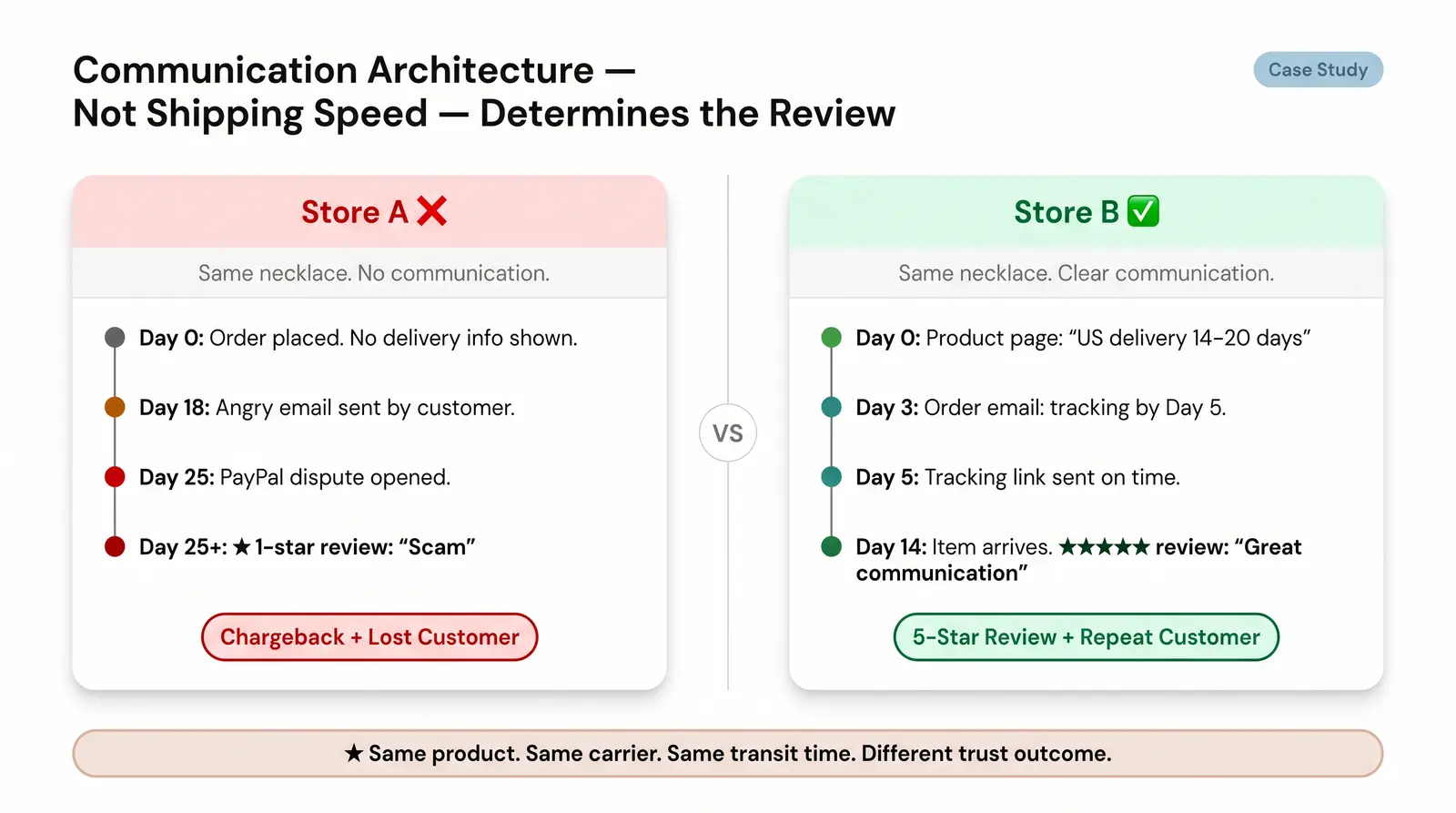
The clearest way to illustrate the impact of communication architecture is to compare two stores selling the same product.
Store A sells a necklace via AliExpress dropshipping. No shipping time is disclosed on the product page. The shipping policy is buried in the footer and vaguely states "10-30 business days." The customer orders, subconsciously expecting delivery in about a week. By Day 18, they send an angry email. By Day 25, they open a PayPal dispute. A one-star review goes live warning others about a "scam."
Store B sells the exact same necklace from the same supplier. The product page clearly states: "Handcrafted to order. Ships within 3 business days. Estimated US delivery: 14-20 days." The checkout page confirms it. The order confirmation email reiterates the timeline and adds: "Your tracking link will arrive by Day 5." On Day 5, tracking is sent. On Day 14, the item arrives. The customer leaves a 5-star review mentioning the "great communication and beautiful packaging."
Same product. Same shipping carrier. Same transit time. Radically different trust outcome. The variable was communication architecture, not speed.
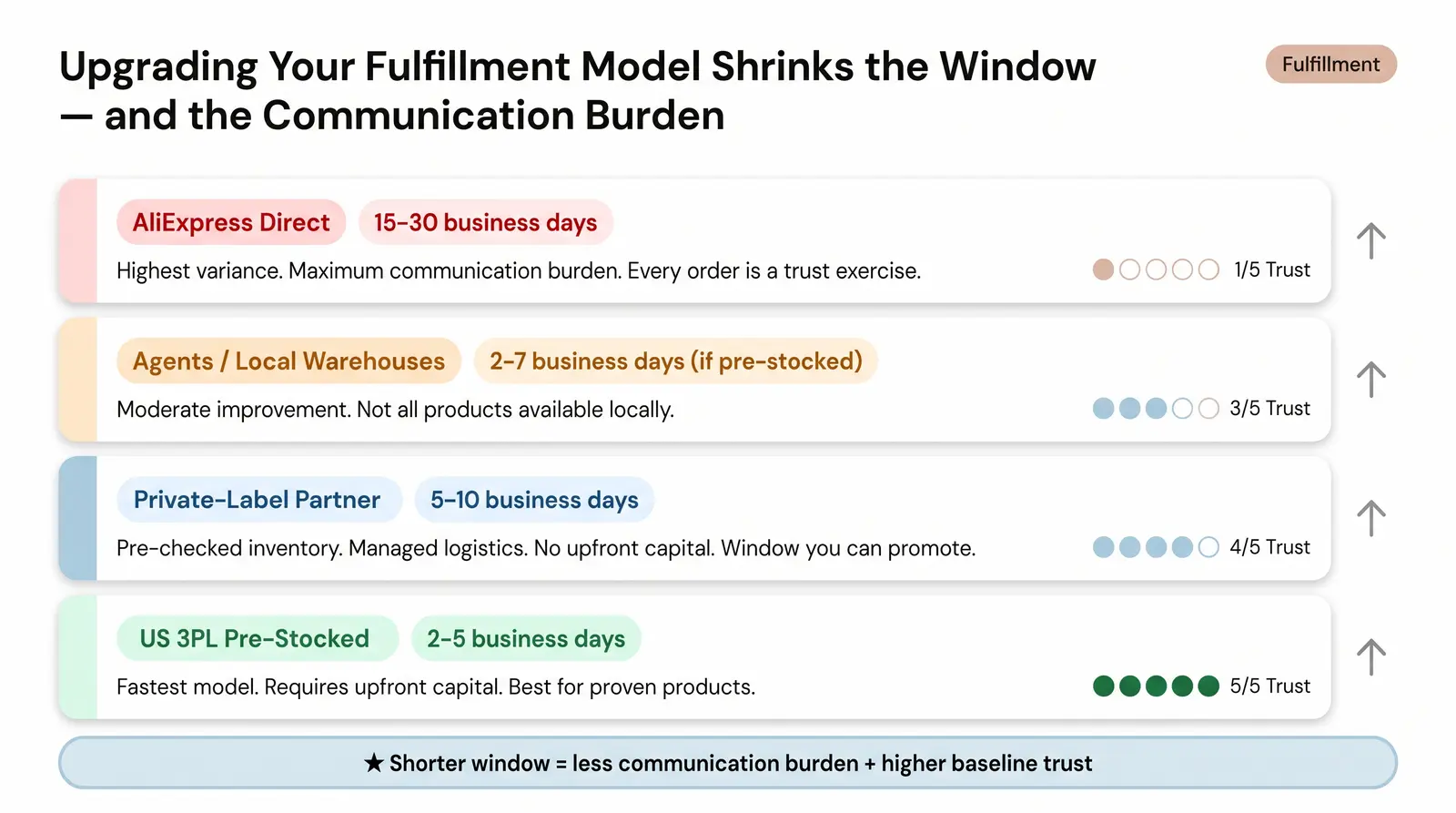
Better communication reduces the damage from long shipping windows. But the most durable fix is shortening the window itself. Here is how the math changes across fulfillment models.
AliExpress direct gives you the longest windows, the highest variance, and the most communication burden. You are managing customer expectations across a 15-30 day window with limited tracking visibility. Every order is a trust exercise.
Agents and local warehouses offer a moderate improvement. CJ Dropshipping's US warehouse network, for example, can deliver in 2-7 days when inventory is pre-stocked locally. The catch is that not all products are available in local warehouses, and pre-stocking requires some upfront planning.
Private-label fulfillment partners change the equation. If you're building a jewelry or accessories brand and want to skip the AliExpress shipping headache entirely, Branvas handles sourcing, branding, and fulfillment so your delivery windows are short enough to promote, not apologize for. Inventory is managed and quality-checked before dispatch. Branded packaging and blind shipping are built in. The communication burden drops because the actual window is shorter and more predictable. You are not managing around a logistics problem. You have removed it.
US-based 3PL with pre-stocked inventory is the fastest model (2-5 days), but it requires meaningful upfront capital to purchase and warehouse inventory before you have proven demand. It is the right move for established products, not for testing.
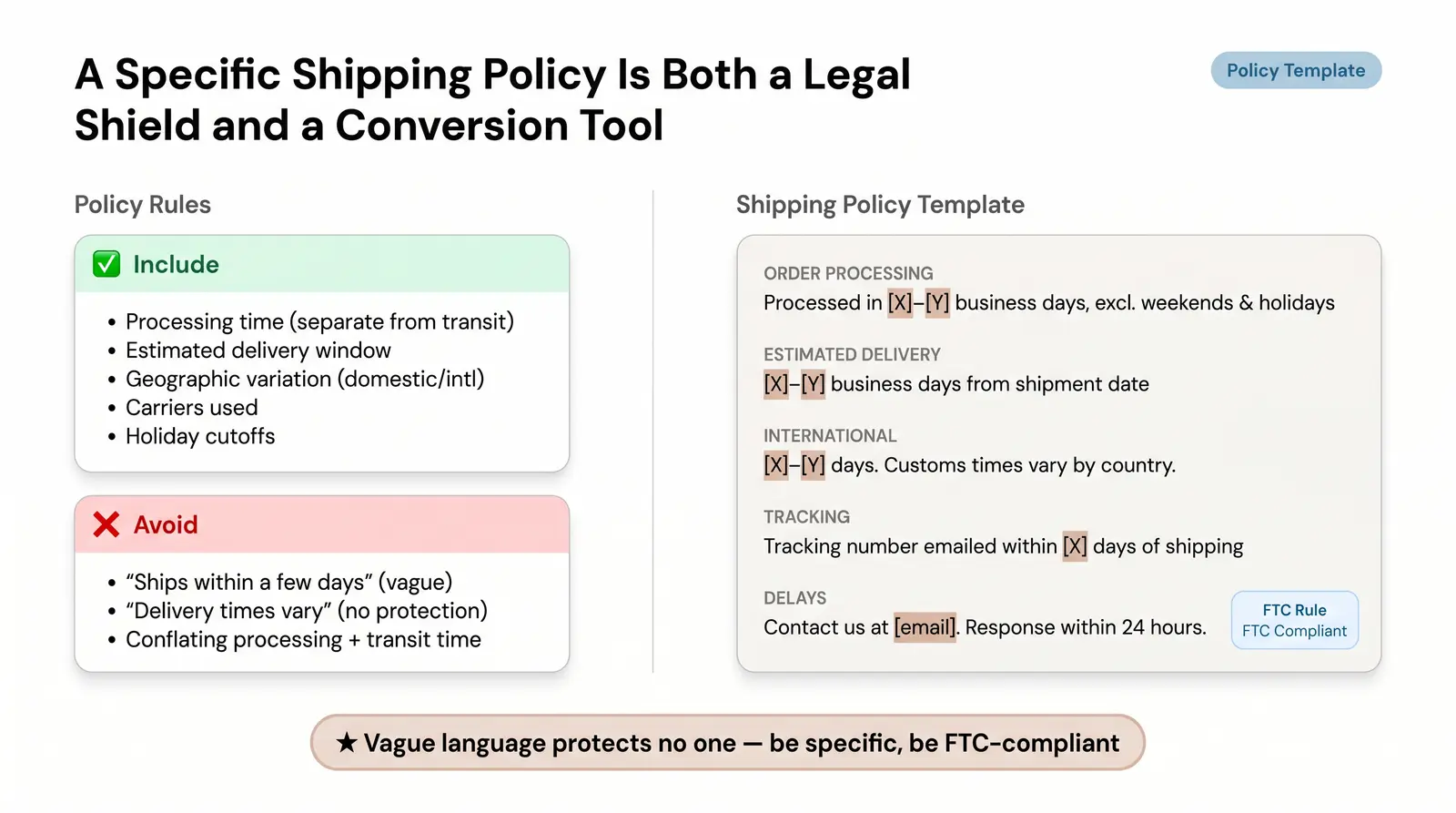
Your shipping policy is not just a legal document. It is a conversion tool and a trust signal. Under the FTC Mail, Internet, or Telephone Order Merchandise Rule, sellers must have a reasonable basis for any shipping timeline they state or imply. If no timeline is stated, the default obligation is 30 days [4]. If you cannot ship within the promised window, you are required to notify the customer, provide a revised date, and give them the option to cancel for a full refund [4].
What to include in your policy:
Processing time and transit time must be listed separately. Many sellers conflate these, which creates confusion. Processing time is how long it takes to prepare and hand off the order to the carrier. Transit time is how long the carrier takes to deliver it. The total delivery window is the sum of both.
Include geographic variation (domestic vs. international), the carriers you use, and holiday cutoffs for peak seasons.
What to avoid:
Vague language like "ships within a few days" or "delivery times vary" provides no protection and no clarity. Be specific.
Shipping policy template outline:
1. What is a realistic shipping time for AliExpress dropshipping in 2024-2025?
For AliExpress Standard Shipping to the US, a realistic window is 15 to 30 business days. Some packages arrive in 12 days. Others take 35 or more, particularly during Chinese New Year, peak shopping seasons, or periods of elevated customs activity. The wide variance is the core challenge. If you are using AliExpress Standard Shipping, plan your customer communication around the upper end of that range, not the lower end [3].
2. How do long dropshipping delivery times affect my store's conversion rate?
Long delivery times increase cart abandonment, but unclear delivery times do more damage. Baymard Institute data shows that 21% of shoppers abandon carts because delivery was too slow [5]. However, the same research shows that providing a precise estimated delivery date, rather than a vague shipping speed, reduces hesitation and improves conversion even when the timeline is long. The goal is not to hide the window. It is to present it clearly and confidently so the customer can make an informed decision.
3. Where is the most important place to display my shipping times?
The checkout page, near the Place Order button. This is where the customer is committing financially, and it is your strongest protection against chargebacks and disputes. If a customer clicks Place Order having seen the delivery window, it is very difficult for them to later claim they were not informed. The product page is the second most important location, because it sets the expectation before the customer even adds to cart.
4. Can I compete with Amazon shipping speeds as a dropshipper?
Not directly, and trying to is usually a losing strategy. Amazon's logistics infrastructure is not replicable for most independent sellers. The better approach is to compete on brand, product exclusivity, and communication quality. A customer who feels genuinely cared for and informed will tolerate a 14-day window. If you want to close the speed gap, upgrading to a local 3PL or a managed fulfillment partner like Branvas is the practical path. Explore the Branvas catalog to see what is available with managed fulfillment built in.
5. What's the difference between processing time and shipping time in a dropshipping store?
Processing time is the period between when the customer places the order and when the supplier hands the packaged item to the carrier. For AliExpress suppliers, this is typically 1-5 business days, though it can stretch longer during peak periods. Shipping time (or transit time) is the period the package spends in the carrier's network, from the origin warehouse to the customer's door. The total delivery window is processing time plus transit time. Many sellers only quote transit time, which leads customers to underestimate when their order will arrive. Always quote the full window.
Slow shipping doesn't kill brands. Hidden slow shipping does.
The stores that earn trust are not always the ones with the fastest delivery. They are the ones that tell the truth about their timeline, communicate it consistently, and follow through on what they promise. That is the Managed Zone. That is where refund rates drop, reviews improve, and customers come back.
The Expectation Gap Framework gives you a practical way to audit where you stand today. If you are in the Blind Zone, the fix is not a new supplier. It is a new communication strategy. If you are already in the Disclosed Zone, the upgrade to Managed Zone is a few copy changes and an email sequence away.
The best e-commerce founders treat fulfillment as a brand asset, not a backend chore. Every touchpoint in the delivery experience is a chance to reinforce that your brand delivers on its promises, literally and figuratively.
Ready to build a jewelry brand with fulfillment that matches your brand's standards? See how Branvas works or explore the product catalog to get started.