


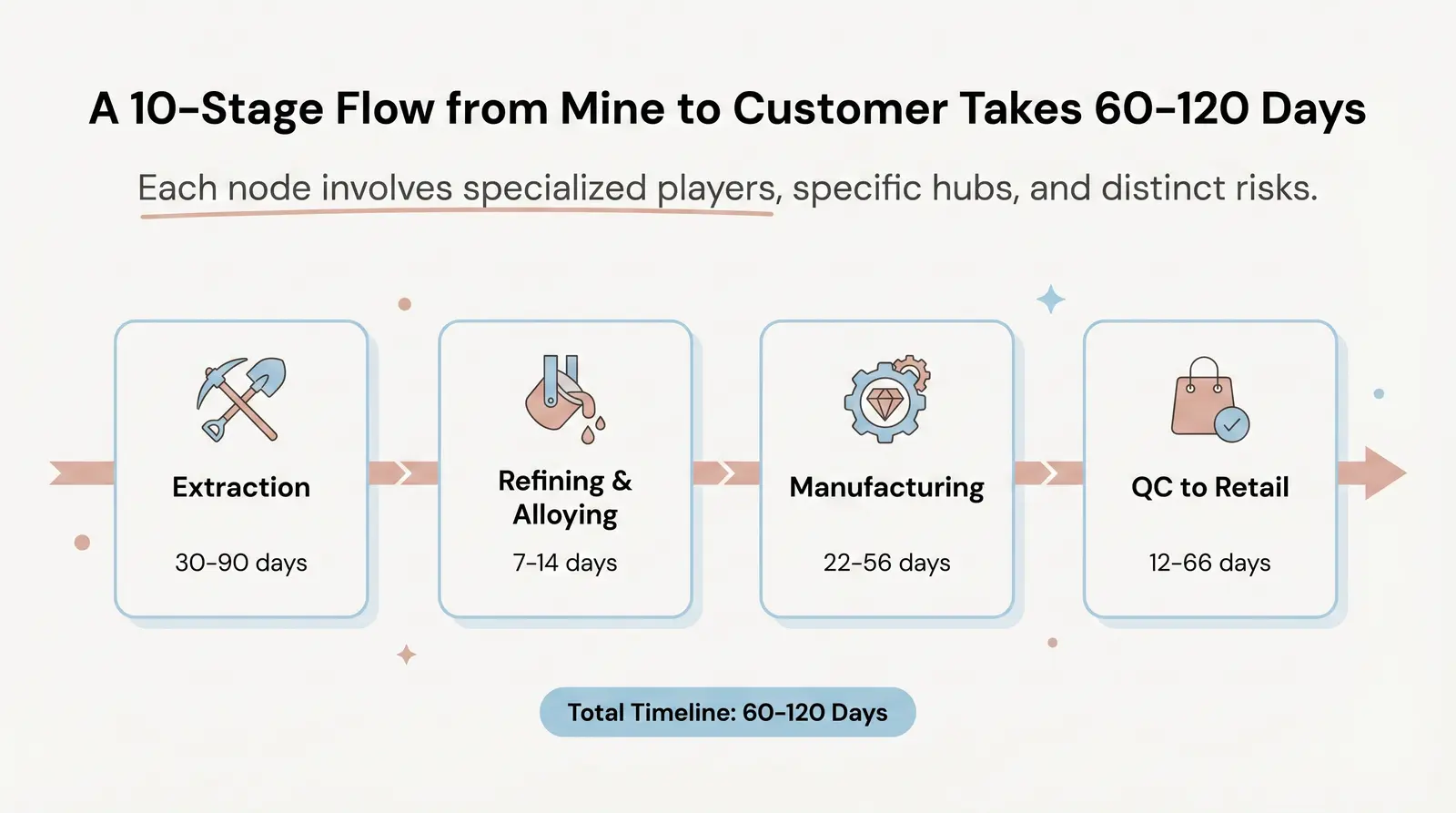
This guide maps the 10-stage global jewelry supply chain from raw material extraction to end customer, covering manufacturing hubs, lead times, key risks, and private-label sourcing models.
Published:
September 17, 2026
Author:
Yi Cui
Supply chain infographics age well. The physical reality of making jewelry changes slowly, even as trends come and go. This article maps the global jewelry supply chain from raw material extraction all the way to the end customer, covering both fashion and fine jewelry from a global perspective.
Whether you are an aspiring brand founder, an ecommerce seller evaluating suppliers, or a student researching global trade, this node-by-node breakdown gives you the depth to cite it, teach from it, or make sourcing decisions with confidence. At Branvas, we mapped this supply chain in detail to build our private-label fulfillment model, and we are sharing the full framework here.
📥 Download the PDF Version
Want a print-ready version of the Jewelry Supply Chain Infographic for classroom or research use? Download the free PDF here (No email required.)
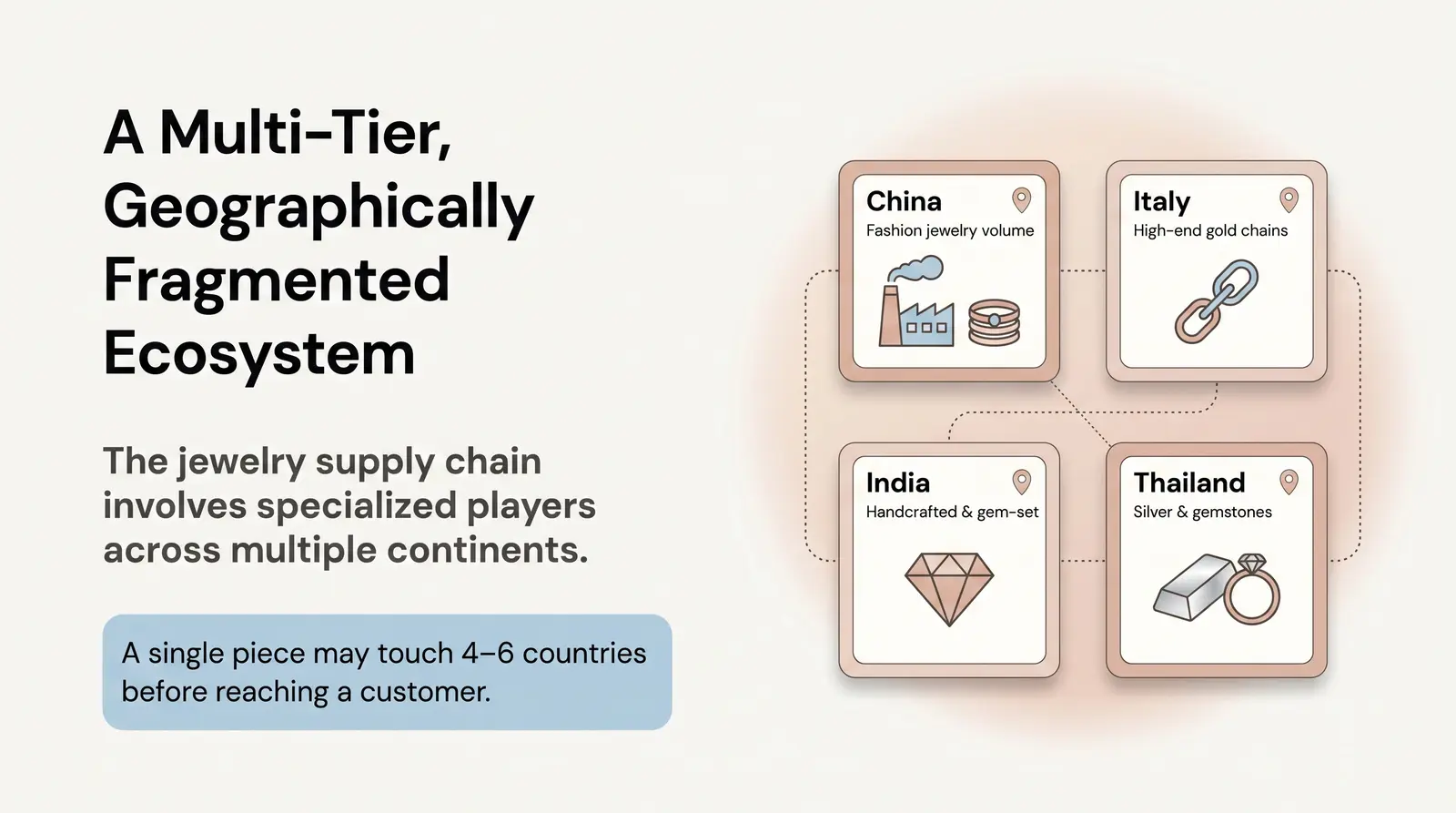
The jewelry supply chain is a multi-tier, geographically fragmented ecosystem. A single piece of jewelry often begins as ore in one continent, gets refined in another, is manufactured in a third, and then sold in a fourth. The path from miners to refiners, component makers, manufacturers, brands, distributors, retailers, and consumers involves significant logistical coordination and compliance tracking at every step.
In 2023, the global jewelry market was valued at approximately $353 billion, with steady growth projected through the end of the decade [1].
Here is the contrarian insight most people miss. Most assume China dominates jewelry manufacturing entirely. The reality is a more nuanced multi-hub ecosystem. China dominates fashion and costume jewelry at volume, yes. But Italy dominates high-end gold chain making, with Vicenza alone processing nearly 40% of Italy's gold production [2]. India dominates handcrafted and gem-set work, exporting $12.6 billion worth of jewelry in 2022 [3]. Thailand dominates silver and gemstone work, leveraging Bangkok's position as a global trading hub for gems [4].
A single bracelet may touch four to six countries before reaching a customer. That complexity is the supply chain.
Each node in the supply chain involves specialized players, specific geographic hubs, and distinct risks. Here is the full breakdown.
Stage 1: Raw Material Extraction
The supply chain starts with mining. Gold, silver, and platinum are extracted from mines in countries like China, Australia, and South Africa. Gemstones, including diamonds, rubies, sapphires, and emeralds, originate in places like Myanmar, Colombia, and Zambia [5]. Base metals like brass, stainless steel, and copper are also sourced at this stage for fashion jewelry production.
Time at stage: 30 to 90 days. Key risks: conflict minerals, environmental damage, and ethical sourcing violations.
Stage 2: Refining and Alloying
Extracted metals move to precious metal refineries where they are purified and alloyed to meet purity standards. Common standards include 14K gold (58.5% pure), 18K gold (75% pure), and 925 sterling silver. Major refinery hubs are located in Switzerland, the UK, and the UAE.
Time at stage: 7 to 14 days. Key risks: purity discrepancies and traceability gaps.
Stage 3: Component Manufacturing
Refined metals are drawn into wire, rolled into sheets, or cast into grain. This stage also produces findings: clasps, jump rings, ear wires, and machine-made chains. Component manufacturers are often separate from the final jewelry manufacturer, adding another geographic node to the chain.
Time at stage: 7 to 21 days. Key risks: inconsistent sizing and alloy brittleness.
Stage 4: Jewelry Manufacturing
This is the core production stage. It includes several sub-processes:
Time at stage: 15 to 35 days. Key risks: casting porosity, insecure stone settings, and uneven plating.
Stage 5: Quality Control and Hallmarking
Finished pieces undergo inspection. In many jurisdictions, this includes independent testing at assay offices to verify metal purity. Hallmarking requirements vary by country. The UK Assay Office marks pieces with a fineness stamp (375 for 9ct gold, 925 for sterling silver). India's Bureau of Indian Standards (BIS) operates its own mandatory hallmarking system.
Time at stage: 3 to 7 days. Key risks: failing assay tests and non-compliance with country-specific regulations.
Stage 6: Branding and Packaging
The jewelry is paired with brand tags, boxes, pouches, and certificates of authenticity. For private-label brands, this stage involves customizing packaging to match the brand identity. It is often the most underestimated stage in terms of lead time.
Time at stage: 5 to 14 days. Key risks: packaging delays holding up finished inventory.
Stage 7: Logistics and Freight
Products move globally via sea freight for bulk B2B orders, or air freight for high-value and rush shipments. Last-mile couriers handle final delivery. Incoterms define who bears responsibility for costs and risk at each transfer point.
Time at stage: 3 to 30 days depending on freight method and destination. Key risks: customs holds, theft, and shipping delays.
Stage 8: Wholesale and Distribution
Jewelry enters the wholesale market through major trade shows, including JCK Las Vegas (17,300 attendees and 1,900 exhibitors in 2024), the Hong Kong Jewellery and Gem Fair (50,000 visitors from 140 countries in 2024), and the Bangkok Gems and Jewelry Fair [7]. Wholesale platforms and brand-as-a-service distributors also operate at this node.
Time at stage: Variable, often seasonal. Key risks: inventory obsolescence and shifting consumer trends.
Stage 9: Retail and Ecommerce Fulfillment
Products reach consumers through direct-to-consumer channels like Shopify or Amazon, boutique retail stores, or via blind shipping and dropship fulfillment models.
Time at stage: 1 to 5 days for fulfillment processing. Key risks: stockouts, high return rates, and fulfillment errors.
Stage 10: End Customer
The final node. The consumer receives the piece, wears it, and potentially reviews it, returning value signals back up the chain.
📊 Figure 1: The Jewelry Supply Chain — From Mine to Customer
+-----------------------------------------+
| 1. Raw Material Extraction              |
|    Gold, silver, gemstones, base metals |
|    ⏱ 30–90 days                         |
+-----------------------------------------+
                     |
                     v
+-----------------------------------------+
| 2. Refining & Alloying                  |
|    Swiss, UK, UAE refineries            |
|    ⏱ 7–14 days                          |
+-----------------------------------------+
                     |
                     v
+-----------------------------------------+
| 3. Component Manufacturing              |
|    Wire, sheet, findings, chain         |
|    ⏱ 7–21 days                          |
+-----------------------------------------+
                     |
                     v
+-----------------------------------------+
| 4. Jewelry Manufacturing                |
|    Casting, setting, plating, polishing |
|    ⏱ 15–35 days                         |
+-----------------------------------------+
                     |
                     v
+-----------------------------------------+
| 5. Quality Control & Hallmarking        |
|    Assay offices, BIS, UK Assay         |
|    ⏱ 3–7 days                           |
+-----------------------------------------+
                     |
                     v
+-----------------------------------------+
| 6. Branding & Packaging                 |
|    Tags, boxes, certificates            |
|    ⏱ 5–14 days                          |
+-----------------------------------------+
                     |
                     v
+-----------------------------------------+
| 7. Logistics & Freight                  |
|    Sea, air, last-mile courier          |
|    ⏱ 3–30 days                          |
+-----------------------------------------+
                     |
                     v
+-----------------------------------------+
| 8. Wholesale / Distribution             |
|    Trade shows, platforms, BaaS         |
|    ⏱ Variable (seasonal)               |
+-----------------------------------------+
                     |
                     v
+-----------------------------------------+
| 9. Retail / Ecommerce Fulfillment       |
|    DTC, boutique, blind ship            |
|    ⏱ 1–5 days                           |
+-----------------------------------------+
                     |
                     v
+-----------------------------------------+
| 10. End Customer                        |
+-----------------------------------------+
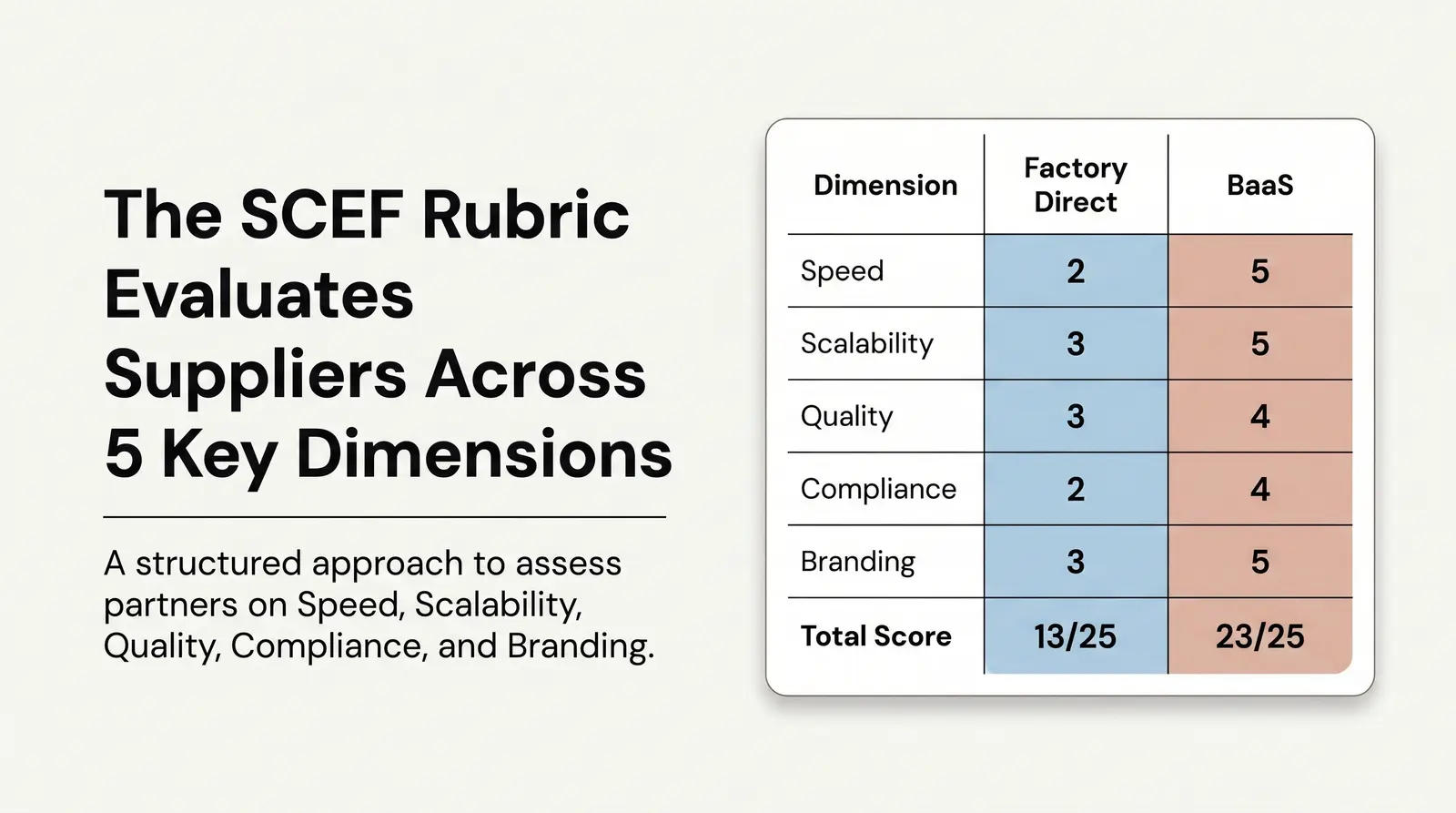
Evaluating a supplier or manufacturer requires a structured approach. We developed the Branvas Supply Chain Efficiency Framework (SCEF) as a scoring rubric for jewelry brand founders and ecommerce sellers. It assesses partners across five dimensions on a 1 to 5 scale.
Worked Example: Shenzhen Factory Direct vs. Branvas BaaS
| SCEF Dimension | Shenzhen Factory Direct | Branvas BaaS | Reasoning |
|---|---|---|---|
| Speed | 2 | 5 | Factories require 4 to 8 weeks for production. Branvas ships catalog items in days using on-demand fulfillment. |
| Scalability | 3 | 5 | Factories enforce MOQs of 50 to 100 units per style, tying up capital. Branvas offers no-minimum ordering. |
| Quality Consistency | 3 | 4 | Factory quality varies by batch and requires third-party QC. Branvas standardizes QC before items enter the catalog. |
| Compliance | 2 | 4 | Direct factory sourcing puts the compliance burden on the buyer. Branvas manages supply chain vetting centrally. |
| Branding Capability | 3 | 5 | Factories can do custom packaging but require high MOQs for boxes. Branvas integrates custom cards and blind shipping natively. |
| Total Score | 13 / 25 | 23 / 25 | Direct sourcing offers lower unit costs at scale but shifts all operational complexity to the founder. BaaS trades a margin percentage for speed and zero inventory risk. |
The honest takeaway: factory direct is the right choice for brands with proven demand, high volumes, and dedicated operations staff. BaaS is the right choice for founders who want to validate a brand concept before committing capital.
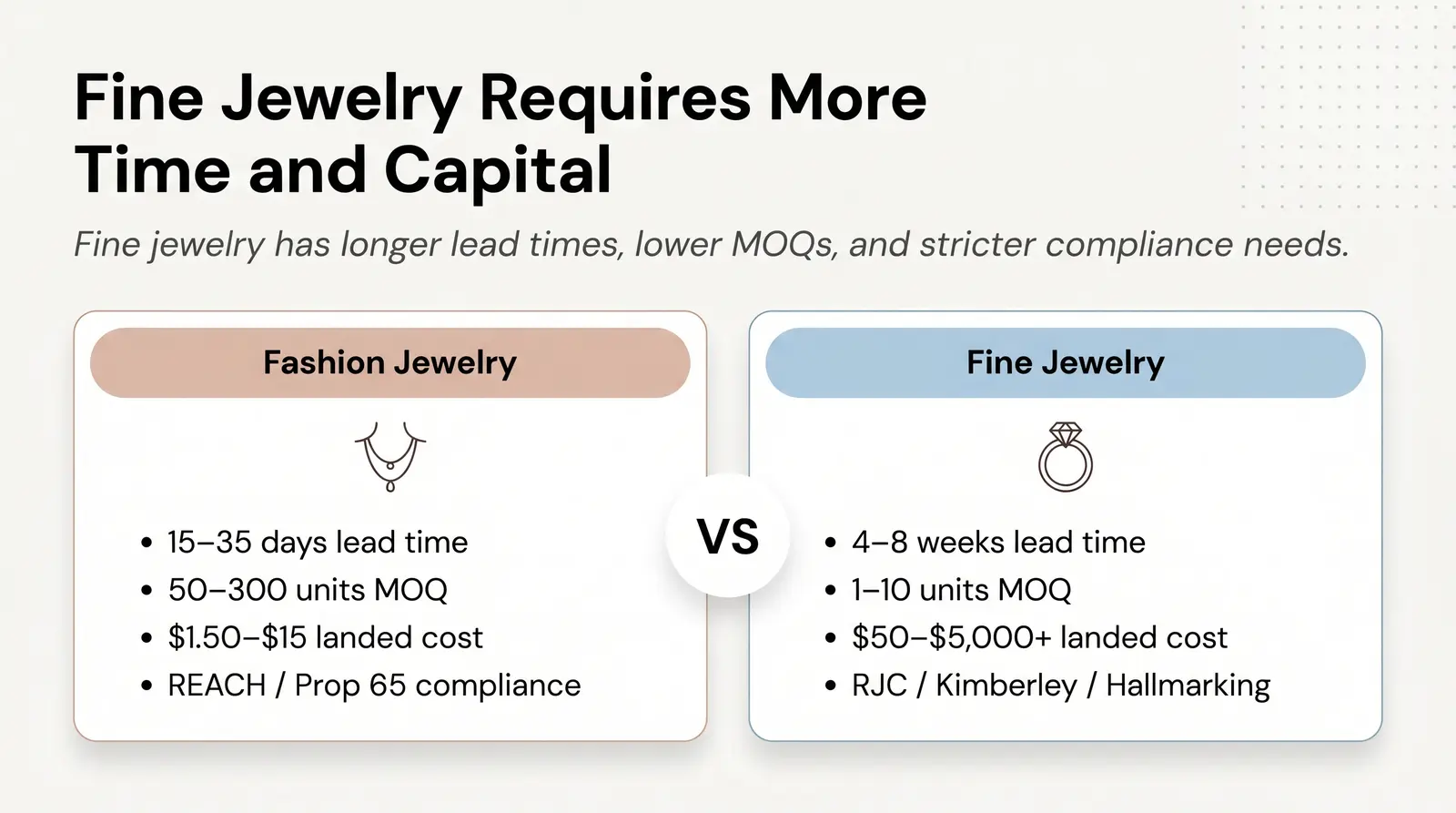
In our experience at Branvas, most first-time brand founders underestimate the lead-time difference between fashion and fine jewelry. They over-index on fine jewelry aesthetics without accounting for the compliance requirements and capital intensity involved.
| Feature | Fashion / Costume Jewelry | Fine Jewelry |
|---|---|---|
| Base Materials | Brass, stainless steel, copper, zinc alloy | Solid gold (9K to 24K), platinum, sterling silver |
| Primary Manufacturing Hubs | China (Shenzhen, Yiwu), South Korea | Italy (Vicenza, Valenza), India (Jaipur), Thailand (Bangkok) |
| Typical Lead Time | 15 to 35 days | 4 to 8 weeks |
| Typical MOQ | 50 to 300 units per style | 1 to 10 units per style |
| Average Landed Cost | $1.50 to $15.00 per unit | $50.00 to $5,000+ per unit |
| Certifications Required | REACH (EU), Prop 65 (US) for lead and cadmium | RJC, Kimberley Process, Assay Hallmarking |
| Private-Label Suitability | Excellent: high margin, fast trend cycles | Moderate: requires high trust and capital commitment |
The fine jewelry supply chain is not just slower. It is fundamentally more regulated. Hallmarking alone can add a week to the timeline, and sourcing certified conflict-free materials requires a level of supplier vetting that most new founders are not equipped to do independently.
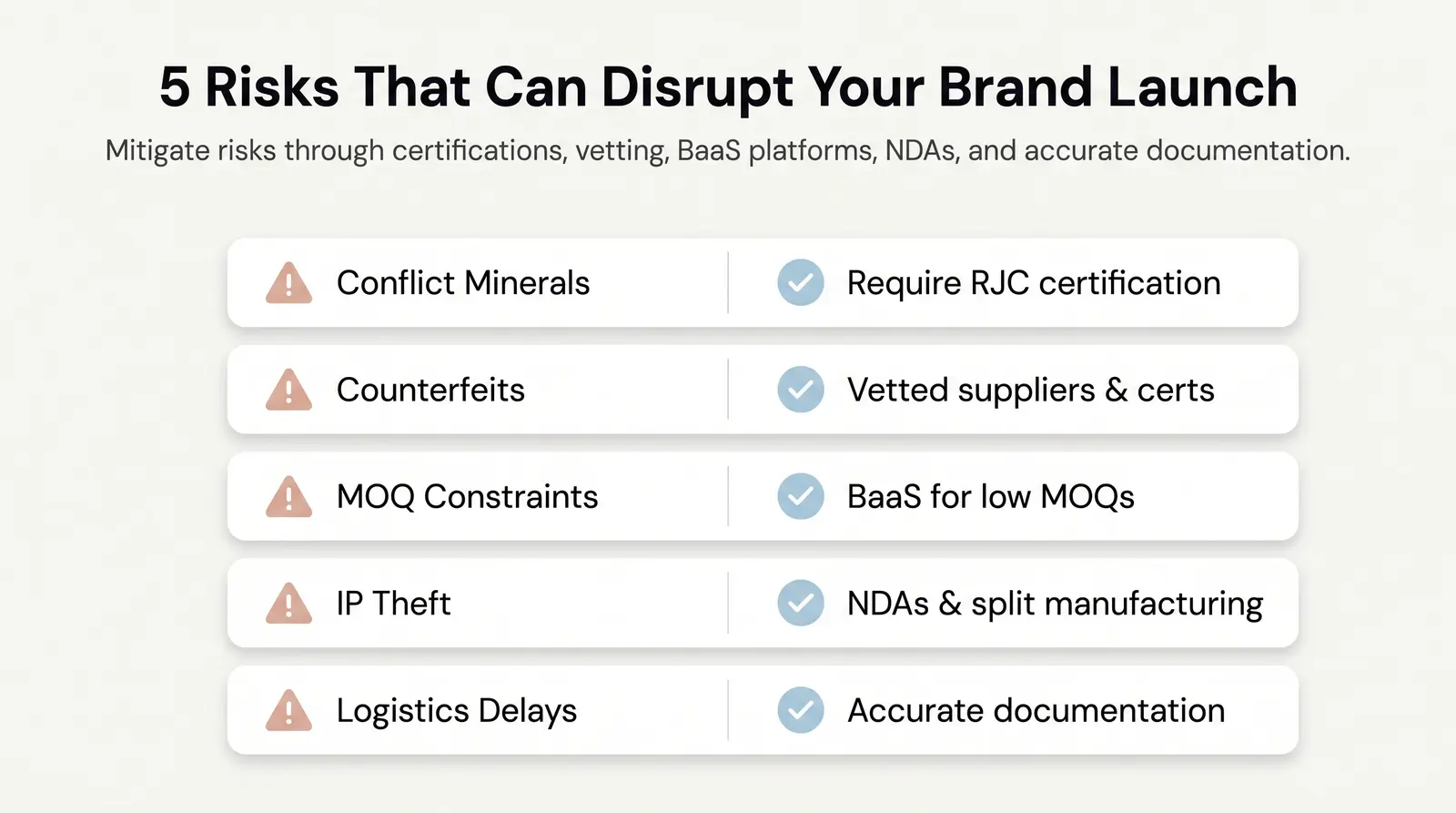
A single failure at any node can disrupt an entire brand launch. Here are the five risks that matter most.
1. Conflict Minerals and Ethical Sourcing
The mining of precious metals and stones carries the risk of funding armed conflict or utilizing forced labor. The Dodd-Frank Act (Section 1502) requires US-listed companies to disclose the use of conflict minerals from the Democratic Republic of Congo and adjoining countries. The EU Conflict Minerals Regulation extends similar requirements to European importers [8].
Mitigation: Require suppliers to hold Responsible Jewellery Council (RJC) certification. The RJC's 2024 Code of Practices sets standards from mine to retail, covering human rights, labor practices, and environmental impact.
2. Counterfeit or Substandard Stones
The market is flooded with synthetic stones sold as natural, or glass sold as cubic zirconia. Counterfeit jewelry can also contain dangerous levels of cadmium and lead, creating product liability exposure.
Mitigation: Work only with vetted suppliers who provide third-party gemological certificates for high-value stones. For fashion jewelry, request material safety data sheets confirming compliance with REACH and Prop 65 limits.
3. MOQ Constraints Locking Up Capital
Traditional manufacturers require high Minimum Order Quantities, forcing brands to buy inventory that may not sell. A 100-unit MOQ at $8 per unit is $800 tied up before a single sale is made.
Mitigation: Use Brand-as-a-Service platforms that offer low or zero MOQs for initial market testing. Scale into factory-direct sourcing once demand is proven.
4. IP Theft and Design Copying
Sending custom CAD files to overseas factories carries the risk of your designs appearing on wholesale marketplaces within weeks. This is a documented problem in the industry, particularly for unique or trend-forward designs.
Mitigation: Use non-disclosure agreements before sharing designs. Split component manufacturing across different facilities. Where possible, use private-label catalogs where the IP is already managed by the platform.
5. Logistics Delays and Customs Holds
Precious metals and high-value goods are frequently flagged for customs inspections, causing unpredictable delays. Incomplete documentation is the most common trigger.
Mitigation: Ensure all commercial invoices, country-of-origin certificates, and material declarations are accurate and complete before shipping. Work with a freight forwarder experienced in jewelry and precious metals.
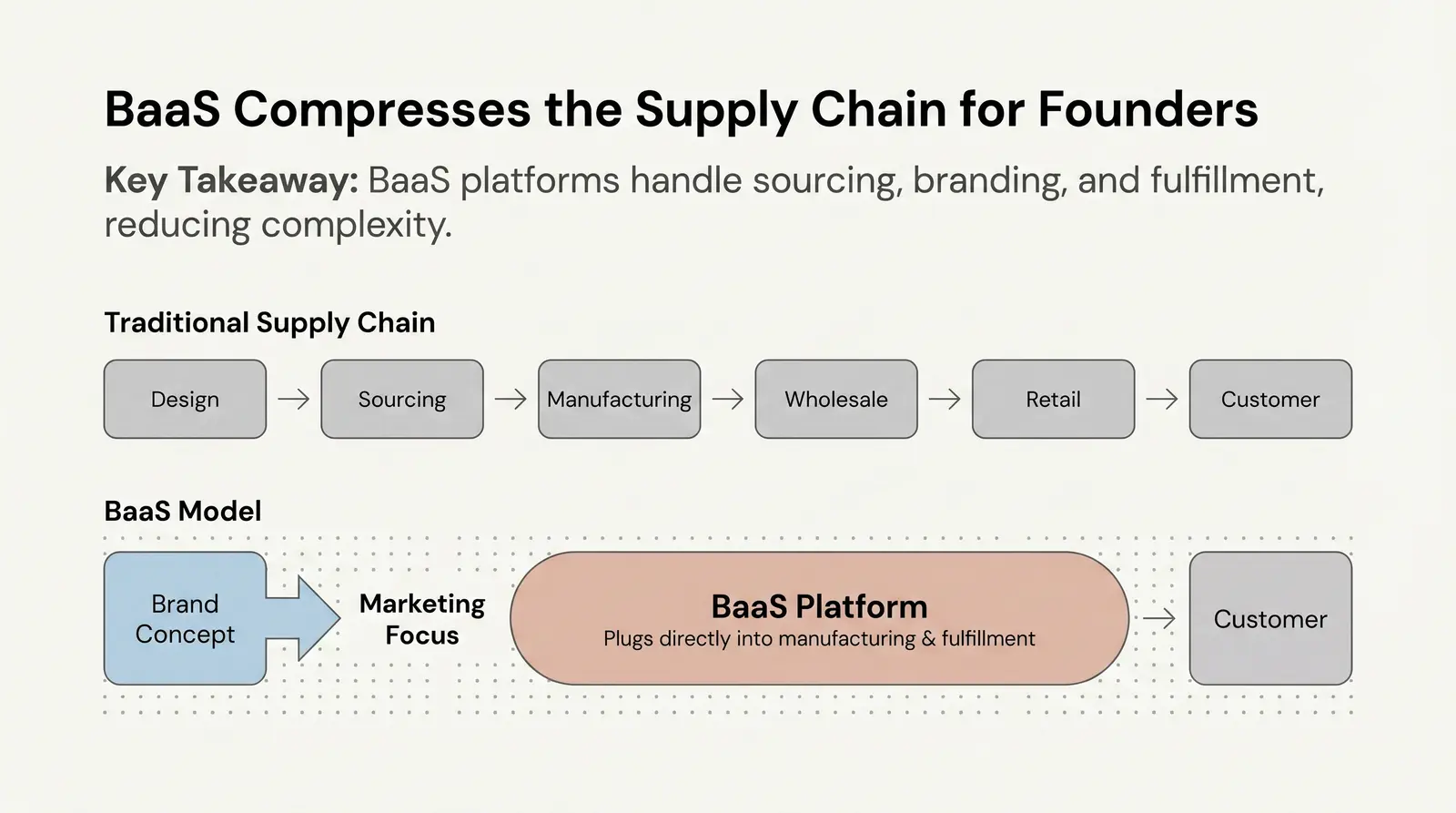
Brand-as-a-Service models are compressing the traditional jewelry supply chain in a meaningful way. By removing the wholesale and distribution layers, BaaS enables brands to plug directly into manufacturing and fulfillment infrastructure.
We often see founders struggle with the jump from "I have a product idea" to "I have a shippable, branded product." The supply chain complexity is what stops most of them. The gap between having a design concept and having a box with your logo on it, ready to ship to a customer, involves at least six of the ten nodes described above.
Platforms like Branvas handle product sourcing, branding, packaging, and blind shipping. This allows an influencer or ecommerce seller to launch a brand without negotiating with overseas factories, managing freight forwarders, or tying up cash in inventory. The BaaS model shifts the focus from supply chain management to marketing and customer acquisition.
If you are mapping your own jewelry brand supply chain, Branvas's How It Works page shows exactly how we compress these stages for private-label brand founders. If you are evaluating whether the aspiring entrepreneur path or the ecommerce seller path is right for you, both start with understanding the supply chain you are stepping into.
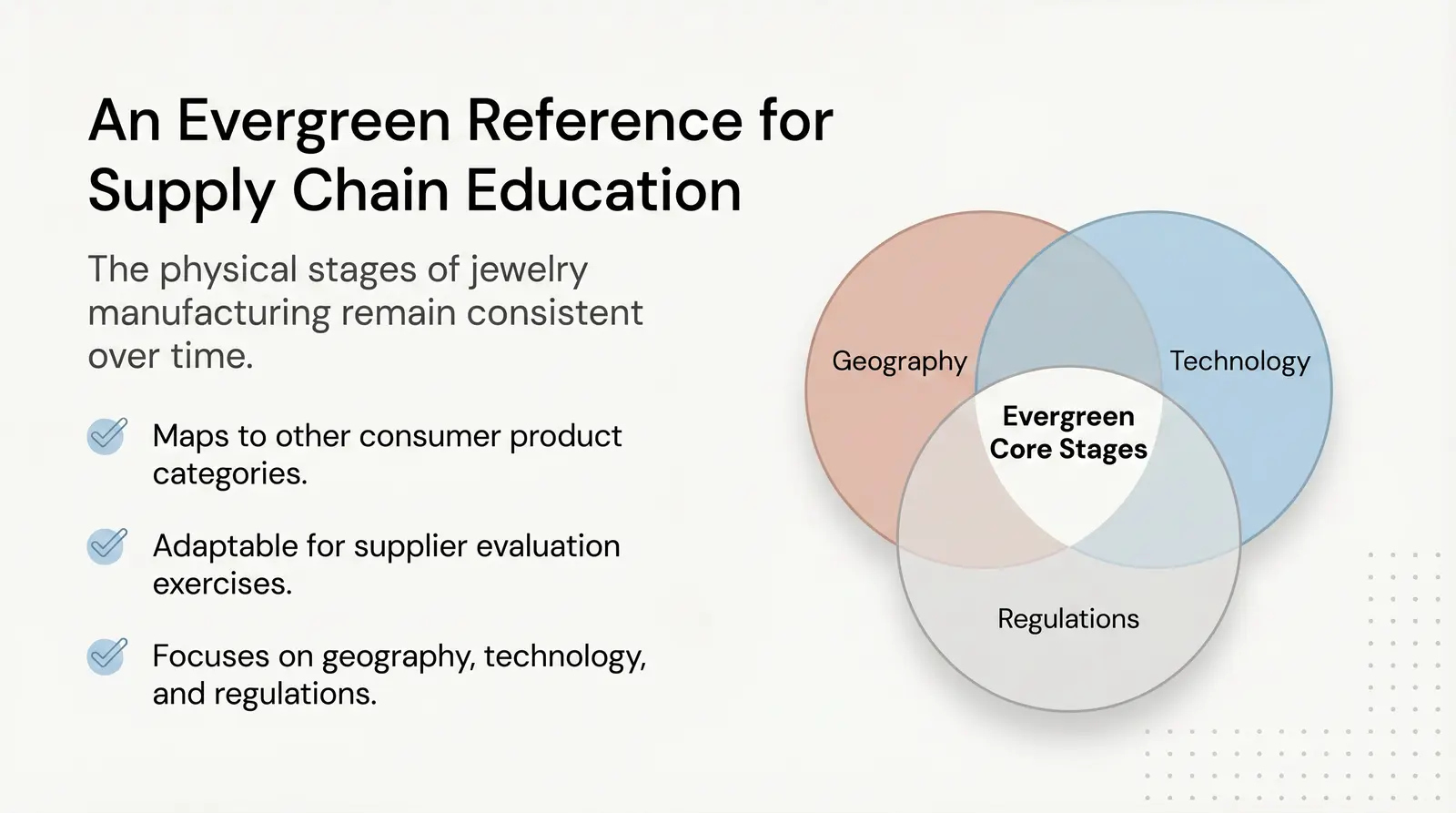
This supply chain diagram is designed as a foundational reference for academic programs, supply chain management courses, and trade journalists. The node-by-node framework maps closely to other consumer product categories, including apparel and accessories, with minor modifications for material sourcing and hallmarking stages.
The diagram is intentionally evergreen. The physical stages of jewelry manufacturing have not changed substantially in decades. What changes is the geography, the technology within each stage (CAD/CAM, 3D printing, PVD coating), and the regulatory environment. Those changes are noted within each node, but the framework itself will remain accurate for years.
For classroom use, the SCEF scoring rubric in the previous section can be adapted as a supplier evaluation exercise. Students can apply the five dimensions to any manufacturing category, not just jewelry.
📥 Download the PDF Version
Want a print-ready version of the Jewelry Supply Chain Infographic for classroom or research use? Download the free PDF here (No email required.)
What are the main stages of the jewelry supply chain?
The jewelry supply chain has ten main stages: raw material extraction, refining and alloying, component manufacturing, jewelry manufacturing (casting, stone setting, plating, and polishing), quality control and hallmarking, branding and packaging, logistics and freight, wholesale distribution, retail or ecommerce fulfillment, and the end customer. Each stage involves different geographic hubs, lead times, and compliance requirements.
Where is most jewelry manufactured in the world?
Jewelry manufacturing is highly specialized by region. China dominates high-volume fashion and costume jewelry production in hubs like Shenzhen and Yiwu. Italy is the global leader in high-end gold chain making, centered in Vicenza and Valenza. India leads in handcrafted and gemstone-set work, primarily in Jaipur. Thailand is the dominant hub for silver jewelry and colored gemstone cutting, centered in Bangkok.
How long does it take to manufacture jewelry?
The manufacturing stage alone typically takes 15 to 35 days for fashion jewelry and 4 to 8 weeks for fine jewelry. This includes CAD modeling, wax printing, casting, finishing, stone setting, and quality control. When you add raw material sourcing, refining, packaging, and shipping, the end-to-end supply chain timeline for a new product can range from 60 to 120 days.
What is private-label jewelry and how does it fit into the supply chain?
Private-label jewelry involves selecting pre-designed, manufactured pieces from a supplier and selling them under your own brand name. It compresses the supply chain by bypassing the design, raw material sourcing, and manufacturing stages. The brand enters the chain at the branding and packaging node, which significantly reduces lead time and capital requirements for new founders.
What certifications should I look for when sourcing jewelry?
For fine jewelry, look for Responsible Jewellery Council (RJC) certification to confirm ethical practices from mine to retail, Kimberley Process compliance for diamonds, and local assay office hallmarking for metal purity. For fashion jewelry, confirm compliance with REACH (EU) and Prop 65 (US) regarding lead and cadmium content. For any supplier, request a documented conflict-minerals policy.
Ready to skip the supply chain complexity? Explore Branvas's private-label jewelry catalog and launch your brand in weeks, not months.