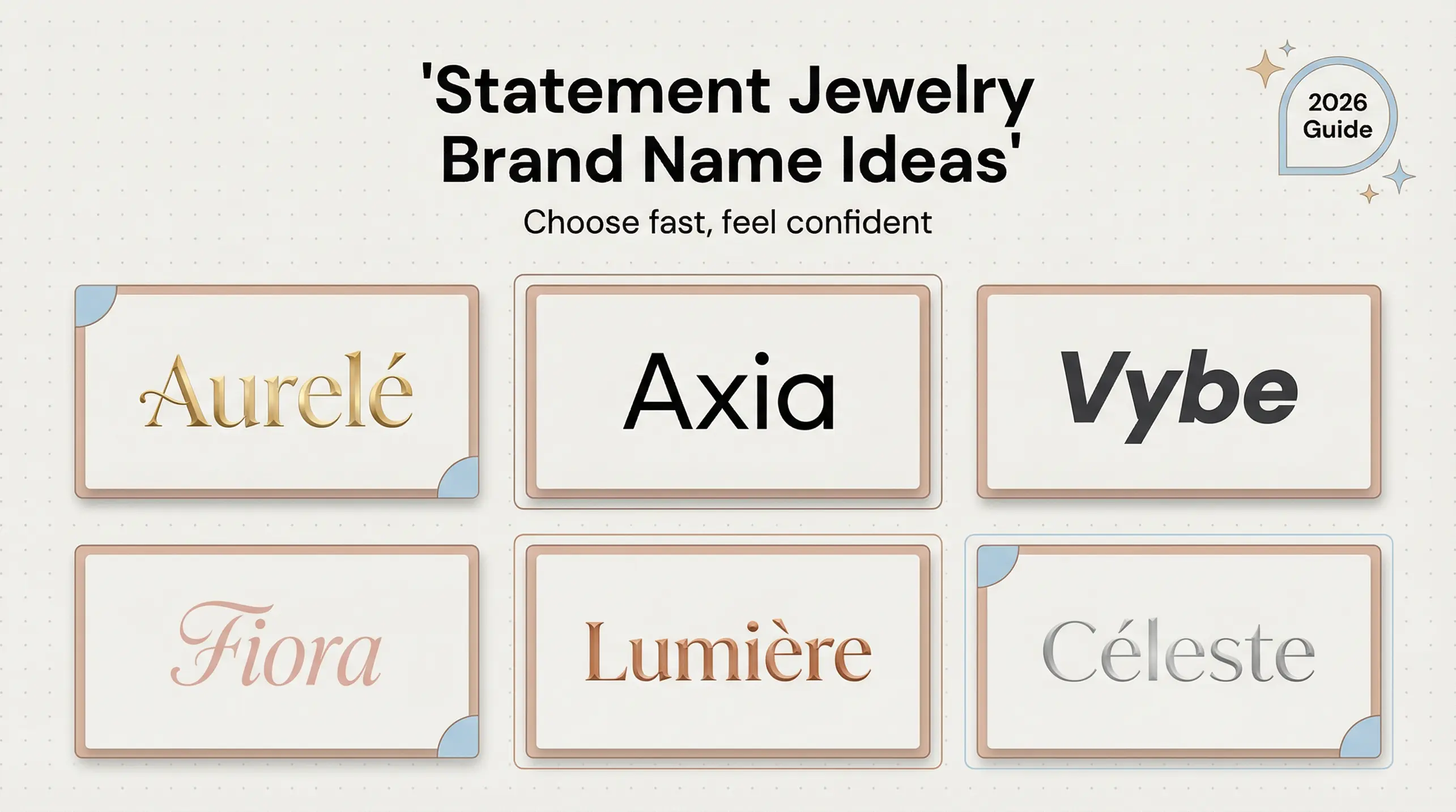



Use our free jewelry store name generator with domain and handle availability checks, plus 100+ curated name ideas and a 5-criteria naming framework to launch your brand.
Published:
October 9, 2026
Author:
Yi Cui
Most jewelry entrepreneurs spend hours on product design and minutes on naming, only to regret it when their chosen name is taken, hard to spell, or impossible to trademark. At Branvas, we've helped hundreds of founders launch jewelry brands, and the number one thing that delays launch day isn't product selection or pricing. It's the name.
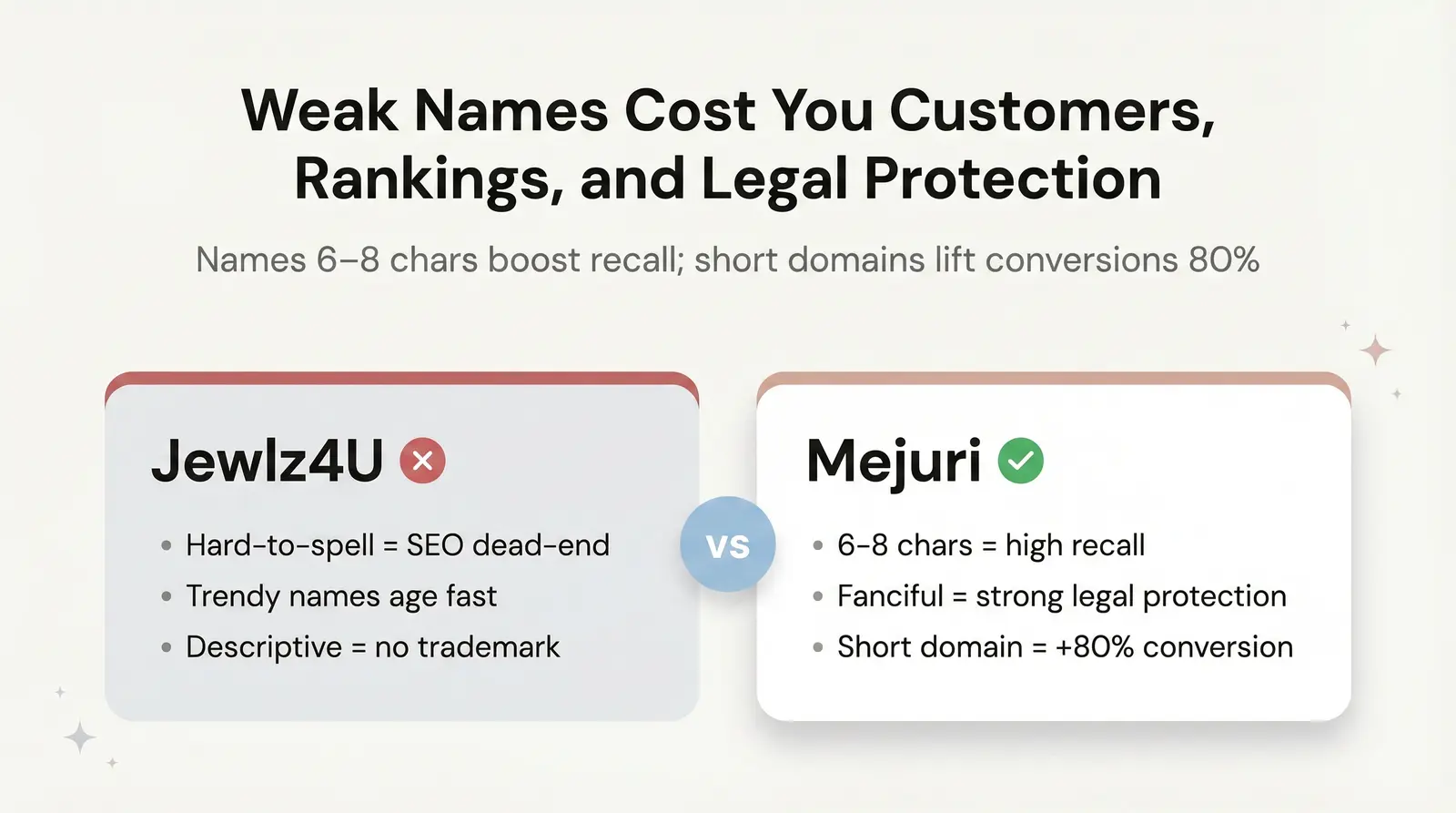
A "pretty" name is often a bad business name. Names that are overly poetic, use unusual spellings like "Jewlz" or "Kloze," or rely on fleeting trends age quickly and create SEO dead-ends. Research consistently shows that brand names between six and eight characters perform best in memory tests, allowing for sufficient distinctiveness while maintaining ease of recall [1]. Furthermore, short and simple domains can boost brand recall by up to 80% and increase conversions [2].
When you choose a name that is difficult to pronounce or spell, you introduce friction into the customer journey. A strong trademark, which is inherently distinctive, quickly and clearly identifies you as the source of your goods [3]. Fanciful or arbitrary names offer the strongest legal protection, whereas descriptive names merely describe the product and are much harder to protect against competitors.
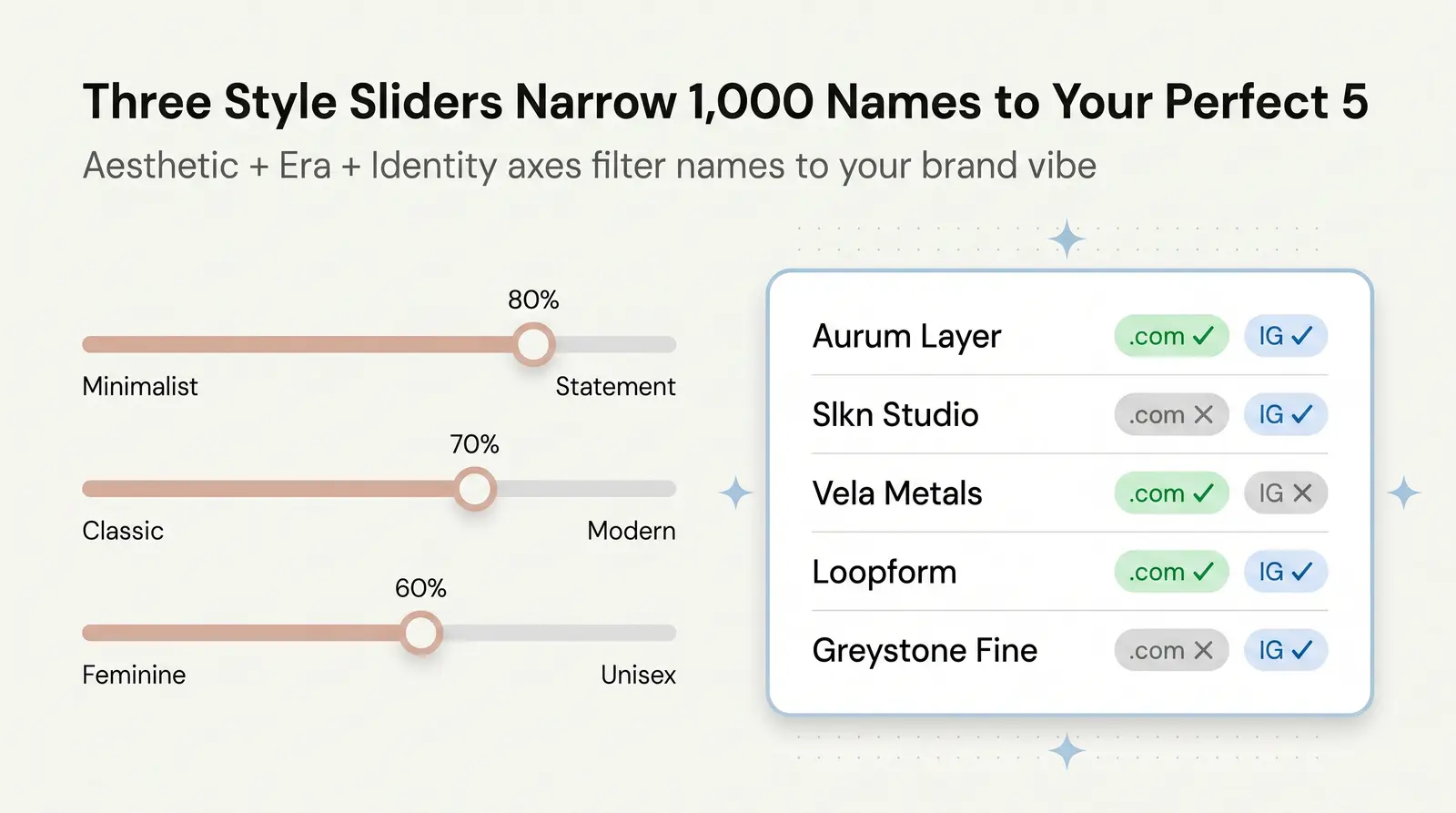
Our jewelry store name generator is designed to help you find a name that fits your specific aesthetic and business goals. Instead of spitting out random words, it uses three style sliders to filter and refine the output:
By adjusting these sliders, you influence the word combinations and the overall vibe of the generated names. For example, leaning towards "Minimalist" and "Modern" will produce clean, architectural names, while "Statement" and "Classic" might yield more ornate, heritage-inspired options.
Worked Example:
Let's say you are selling rings and layered necklaces. You set the sliders to Minimalist (8/10), Modern (7/10), and Unisex (6/10).
The generator might output these 5 sample names:
Pro tip: Run your top 3 names through the USPTO trademark search and a quick Google search before committing.
Through our experience onboarding new brand founders, we developed a proprietary framework to evaluate potential names. We call it The CLEAR Name Test™.
Here is how some example jewelry brand names score against the CLEAR criteria (scored 1–3 for each category):
| Brand Name | Concise | Linkable | Evocative | Adaptable | Registerable | Total /15 |
|---|---|---|---|---|---|---|
| Mejuri | 3 | 3 | 2 | 3 | 3 | 14 |
| Gold Ring Store | 3 | 1 | 1 | 1 | 1 | 7 |
| Aurum Layer* | 3 | 3 | 3 | 3 | 2 | 14 |
| Jewlz4U | 2 | 1 | 1 | 2 | 1 | 7 |
| Vela Metals* | 3 | 3 | 3 | 3 | 3 | 15 |
| BlingQueen | 2 | 2 | 2 | 1 | 2 | 9 |
*Hypothetical names from the worked example above.

Use these as inspiration or as a starting point to remix in the generator above.
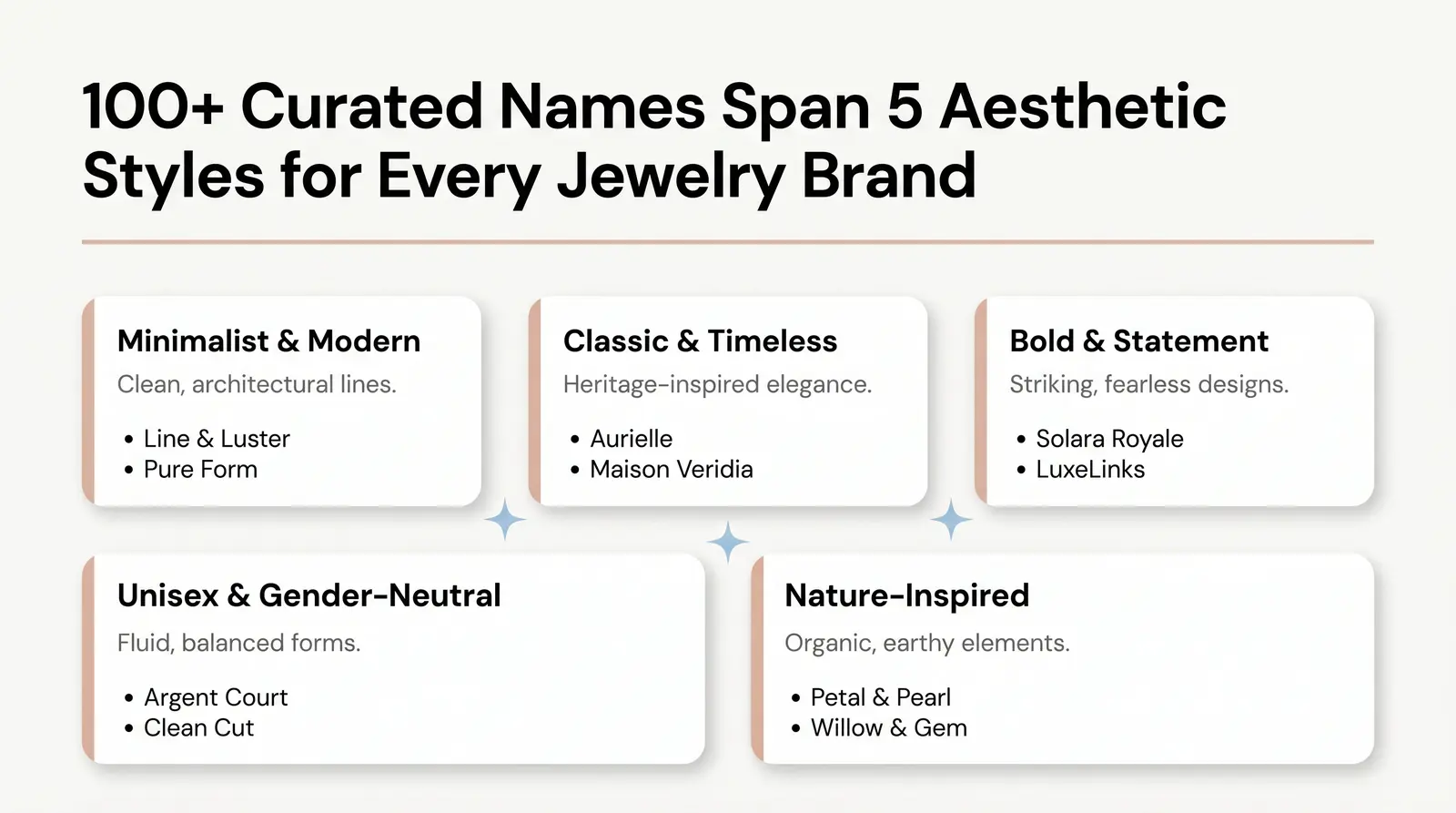
Minimalist & Modern
Classic & Timeless
Bold & Statement
Unisex & Gender-Neutral
Nature-Inspired
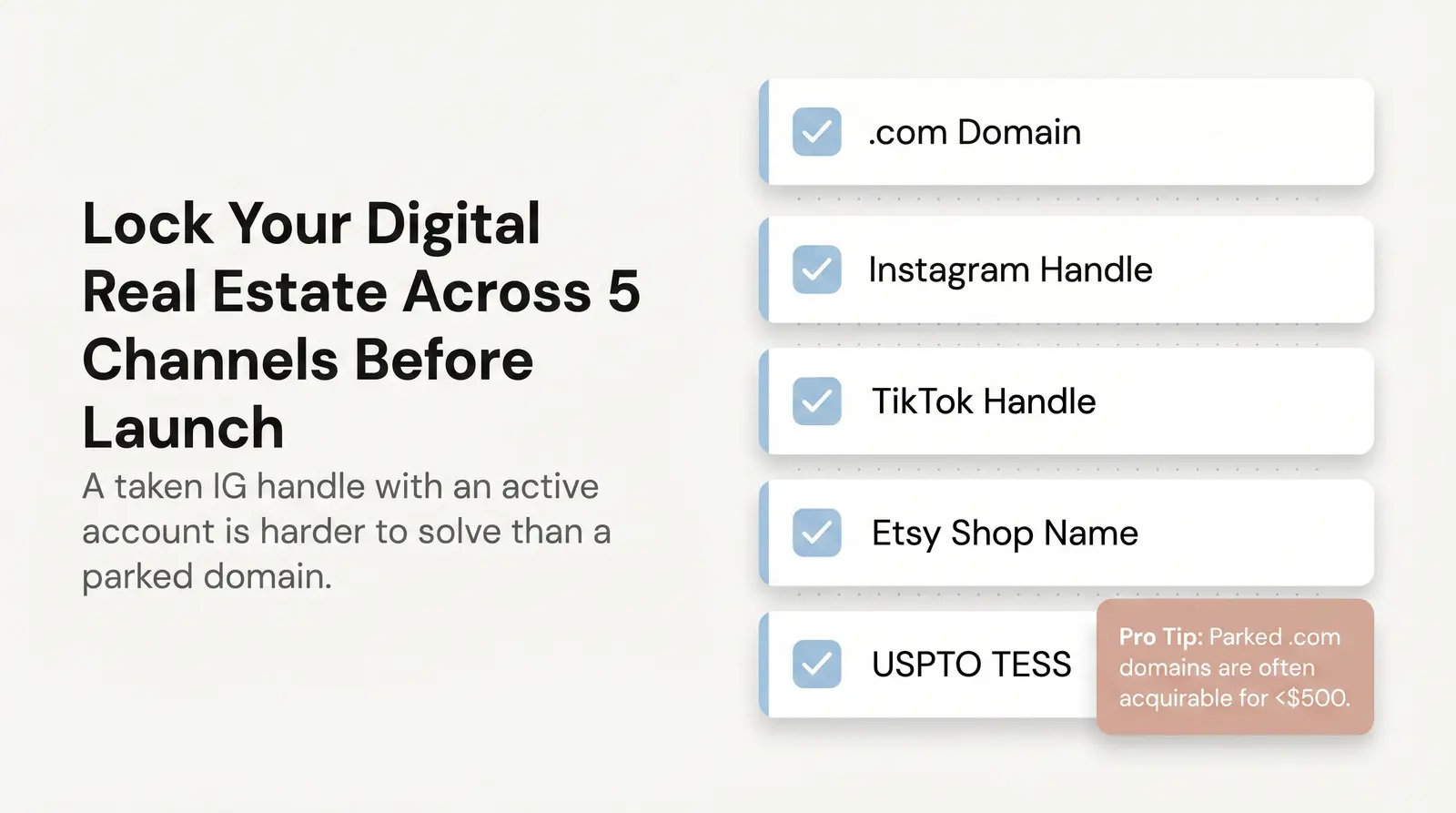
Securing your digital real estate is just as important as the name itself. Here is a step-by-step checklist to verify availability:
We often see founders spend weeks perfecting a name, then rush the product side, which is the opposite of where the real differentiation lives. After naming, the real work begins: building a visual identity, sourcing products, and setting up fulfillment.
Once you've locked your name, the next decision is where your products come from. At Branvas, we make it possible to launch a fully branded private-label jewelry line with custom packaging, blind shipping, and no minimum order chaos, avoiding the usual 6-month supplier scramble. Whether you are an influencer looking to monetize your audience or an ecommerce boutique owner expanding your catalog, we handle the logistics. Explore how it works at branvas.com/how-it-works.
Ready to go from name to live jewelry brand? Branvas gives you private-label products, custom packaging, and hands-off fulfillment, so you can focus on building your audience, not managing supply chains. Start building your brand at branvas.com →

What makes a good jewelry store name?
A good jewelry store name is concise, memorable, and easy to spell. It should evoke the style of your pieces without being overly descriptive. The best names pass the CLEAR test: Concise, Linkable, Evocative, Adaptable, and Registerable. Avoid trends and focus on longevity.
How do I check if a jewelry brand name is taken?
Start with a simple Google search to see if anyone is operating under that name. Next, check domain availability on sites like Namecheap. Then, search social media platforms like Instagram and TikTok. Finally, run a search on the USPTO TESS database to check for registered trademarks.
Should my jewelry brand name describe what I sell?
Not necessarily. While descriptive names tell customers exactly what you do, they are hard to trademark and can limit your growth if you expand beyond your initial product line. Fanciful or suggestive names often build stronger, more protectable brands over time.
Can I use my own name as my jewelry brand?
Yes, many successful jewelry brands are eponymous. Using your own name adds a personal touch and authenticity, which works well for artisan or creator-led brands. However, it can make the business harder to sell later and requires you to be the face of the brand permanently.
What are the most common jewelry business naming mistakes?
The most common mistakes include choosing names that are hard to spell or pronounce, relying on cliché terms like "sparkle" or "bling," and failing to check trademark availability before launching. Another major error is picking a name so specific that it prevents future product expansion.
The process of naming a jewelry brand is a critical step in establishing a successful business. A well-chosen name can set the tone for your brand, attract your target audience, and create a lasting impression. Conversely, a poorly chosen name can hinder your growth, confuse customers, and lead to legal issues. Therefore, it is essential to approach the naming process with careful consideration and strategic planning.
When brainstorming potential names, consider the emotional and psychological impact of different words and sounds. Research has shown that certain sounds can evoke specific feelings and associations. For example, sharp consonants like "k" and "t" can suggest precision and energy, while softer sounds like "m" and "l" might evoke gentleness and comfort. By understanding these linguistic nuances, you can create a name that resonates with your target audience on a deeper level.
In addition to linguistic considerations, it is also important to think about the visual representation of your brand name. How will it look on a logo, packaging, or website? A name that is visually appealing and easy to read can enhance your brand's overall aesthetic and make it more memorable. Consider the length of the name, the balance of letters, and the potential for creative typography.
Another crucial factor to consider is the adaptability of your brand name. As your business grows and evolves, you may want to expand your product offerings or target new markets. A name that is too specific or restrictive can limit your potential for growth. For example, if you name your brand "Gold Ring Store," it may be difficult to sell silver necklaces or other types of jewelry in the future. Instead, opt for a name that is broad enough to encompass a variety of products and styles.
Once you have a list of potential names, it is essential to conduct thorough research to ensure that they are available and legally protectable. This includes checking domain availability, social media handles, and trademark databases. Failing to do so can result in costly legal disputes and the need to rebrand down the line.
When checking domain availability, keep in mind that a .com domain is generally the most desirable and recognizable option. However, if your preferred .com domain is taken, you may want to consider alternative extensions such as .co, .net, or .io. Alternatively, you can try adding a modifier word to your name, such as "shop," "studio," or "jewelry," to find an available domain.
In addition to domain availability, it is also important to check the availability of social media handles on platforms like Instagram, TikTok, and Facebook. Consistency across all of your digital channels is key to building a strong and recognizable brand. If your preferred handle is taken on one platform, try to find a variation that is available across all platforms.
Finally, conducting a trademark search is a critical step in the naming process. A trademark provides legal protection for your brand name and prevents others from using it without your permission. To ensure that your chosen name is available for trademark registration, you can search the USPTO TESS database or consult with a trademark attorney. Keep in mind that descriptive or generic names are generally more difficult to trademark than fanciful or arbitrary names.
In conclusion, naming a jewelry brand is a complex and multifaceted process that requires careful consideration and strategic planning. By understanding the psychological and linguistic nuances of naming, considering the visual representation and adaptability of your name, and conducting thorough research to ensure availability and legal protection, you can choose a name that sets your brand up for long-term success. Remember, your brand name is more than just a label; it is the foundation of your business identity and a key driver of your future growth.