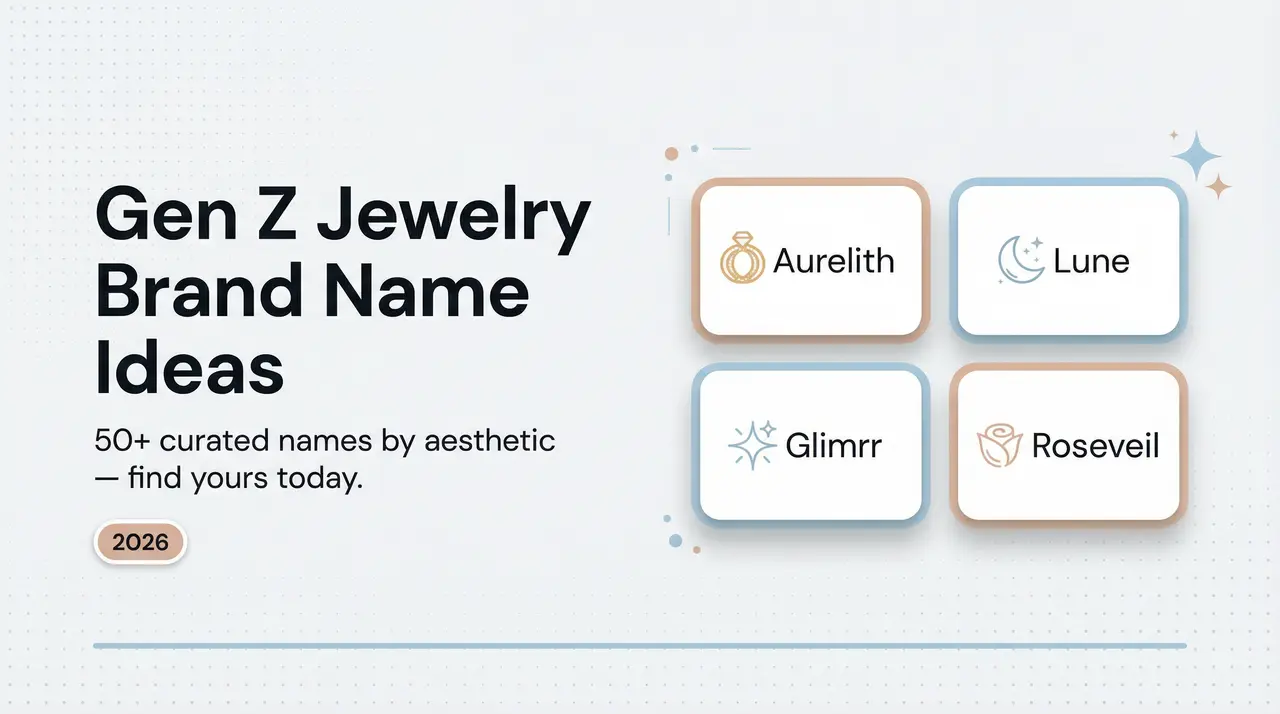



Explore 50+ everyday jewelry brand name ideas organized by style, with meanings and a practical name-selection framework to help founders choose confidently.
Published:
March 15, 2026
Author:
Yi Cui
Steal-worthy everyday jewelry brand name ideas with meanings, organized by style so you can choose fast and feel confident.
Finding the perfect name for your everyday jewelry brand can feel as delicate as crafting the jewelry itself. You want something that resonates with your target audience, reflects your brand's unique style, and is memorable enough to stand out in a crowded market. The global jewelry market was estimated at USD 381.54 billion in 2025 and is projected to reach USD 578.45 billion by 2033, growing at a CAGR of 5.5% [1]. That means more competition, but also more opportunity for a well-named brand to carve out a loyal niche. This guide provides a curated selection of brand name ideas, organized by style, to help you find the perfect fit for your new venture.
Luxury is about more than just a price point. It is about a feeling of timelessness, quality, and aspiration. These names evoke a sense of enduring value and sophisticated taste, perfect for a high-end everyday jewelry line. Research in brand naming confirms that names evoking specific imagery and emotion are more memorable and drive stronger purchase intent [5].

Minimalism is the art of saying more with less. These names are clean, modern, and effortlessly chic. They reflect a brand that values simplicity, quality, and understated elegance. The best minimalist everyday jewelry brand names often draw from single syllables, natural concepts, or stripped-back language that feels intentional rather than empty.

Modern everyday jewelry is all about what's happening now. These names are fresh, edgy, and on-trend. They are perfect for a brand that is constantly evolving and pushing the boundaries of style. A modern brand name should feel like it belongs on a phone screen, a TikTok caption, and a shipping label all at once.

Romantic everyday jewelry evokes a sense of feeling, emotion, and timeless beauty. These names are soft, feminine, and full of grace. They are perfect for a brand that celebrates love, beauty, and the art of adornment. The best romantic brand names often borrow from poetry, nature, and languages that carry inherent softness.

Choosing a name is more than just picking something that sounds good. It's about finding a name that tells a story, connects with your customers, and sets you up for long-term success. In our experience at Branvas working with hundreds of jewelry founders, the names that stick tend to pass five tests. We call it the WEARS Name Test.
W - Wearability. Does the name fit the style of your jewelry? A name for a minimalist brand should feel different from a name for a luxury brand. If your pieces are delicate and understated, your name should carry that same energy. A name like "Riot" belongs to a different brand than "Aeterna." Think about whether your name and your product feel like they belong together.
E - Emotion. Does the name evoke a feeling? The best brand names connect with customers on an emotional level, making them feel something before they even see the product [5]. "The Keepsake" makes you think of something precious. "Flux" makes you feel movement. The emotion should match the promise your brand makes.
A - Availability. Is the name available? This is a crucial step that many founders skip in the excitement of finding a name they love. You need to check for domain availability, social media handles, and, most importantly, trademark conflicts before committing. See the checklist in the next section for a step-by-step guide [2] [3].
R - Recall. Is the name easy to remember and pronounce? Research on brand naming suggests that short, phonetically simple names are easier to recall and share [4]. A name that is hard to spell or say is a name that is hard to recommend. If you have to spell it out every time someone asks, it may be working against you.
S - Story. Does the name have a story behind it? A name with a clear origin, meaning, or narrative gives your brand something to talk about on social media, in your packaging, and on your About page. "Aurae" has a Latin root. "Wisteria" has a visual image. "The Vow" has an emotional anchor. Story is what turns a name into a brand.
Once your name feels right, the next question is how to actually build the brand behind it. That is where most founders get stuck. Building a brand is more than just a name and a logo; it is about creating a consistent experience for your customers, from your packaging to your website. To learn more about how to build a successful jewelry brand, check out branvas.com/how-it-works.

Before you fall in love with a name, do your due diligence. Use this checklist to confirm your chosen name is clear to use.
| Step | What to Check | Where to Check |
|---|---|---|
| 1 | .com domain availability | GoDaddy, Namecheap, or any domain registrar |
| 2 | Instagram and TikTok handles | Search directly on each platform |
| 3 | Pinterest and Facebook page names | Search directly on each platform |
| 4 | US trademark conflicts | USPTO TESS database at tmsearch.uspto.gov [2] |
| 5 | International trademark conflicts | WIPO Global Brand Database at wipo.int [3] |
Disclaimer: This checklist is provided for general informational purposes only and is not legal advice. Readers should conduct their own trademark and domain searches and consult a qualified legal professional if needed.

Once you have a name, it's time to bring your brand to life. You'll need to think about your brand identity, your product sourcing, your packaging, and your fulfillment. Most founders underestimate how much work lives between "I have a name" and "I have a brand." Sourcing jewelry, designing packaging, and managing shipping can each become a full-time job on their own.
Branvas makes it possible to launch your private-label everyday jewelry brand without sourcing, packaging, or fulfillment headaches. Your name can become a real brand, fast. You can browse the full product catalog at branvas.com/catalog to see what's available for private labeling. When you're ready to take the next step, visit branvas.com/solutions/aspiring-entrepreneurs to see how the platform works for founders at exactly your stage.

Q: What makes a good everyday jewelry brand name?
A: A good everyday jewelry brand name is memorable, easy to pronounce, and reflects the style and feeling of your pieces. It should also be available as a .com domain and on the social platforms where your customers spend their time.
Q: How do I know if my jewelry brand name is already taken?
A: Start by checking domain availability through a registrar like Namecheap or GoDaddy. Then search the USPTO trademark database at tmsearch.uspto.gov and run a quick search on Instagram, TikTok, and Pinterest to see if the handle is already in use.
Q: Should my jewelry brand name describe what I sell?
A: It can, but it doesn't have to. A descriptive name like "The Fine Line" communicates style immediately, while an abstract name like "Kalon" builds intrigue and can be more distinctive. The right choice depends on whether clarity or memorability matters more to your brand.
Q: Can I use my own name as a jewelry brand?
A: Yes, many successful jewelry brands are named after their founders. However, personal names can be harder to trademark and may limit the brand's ability to grow beyond one person's identity, which matters if you plan to scale or sell the business.
Q: How do I pick between a minimalist vs. luxury brand name style?
A: Think about your target customer and the price point you're aiming for. A minimalist name appeals to someone who values restraint and simplicity, while a luxury name signals prestige and craftsmanship. Your name should match the experience your customer expects when they open the box.