


Implement zero-stress SOPs for jewelry returns and sizing issues to reduce costly returns, handle complaints professionally, and protect your ecommerce margins.
Published:
May 24, 2026
Author:
Yi Cui
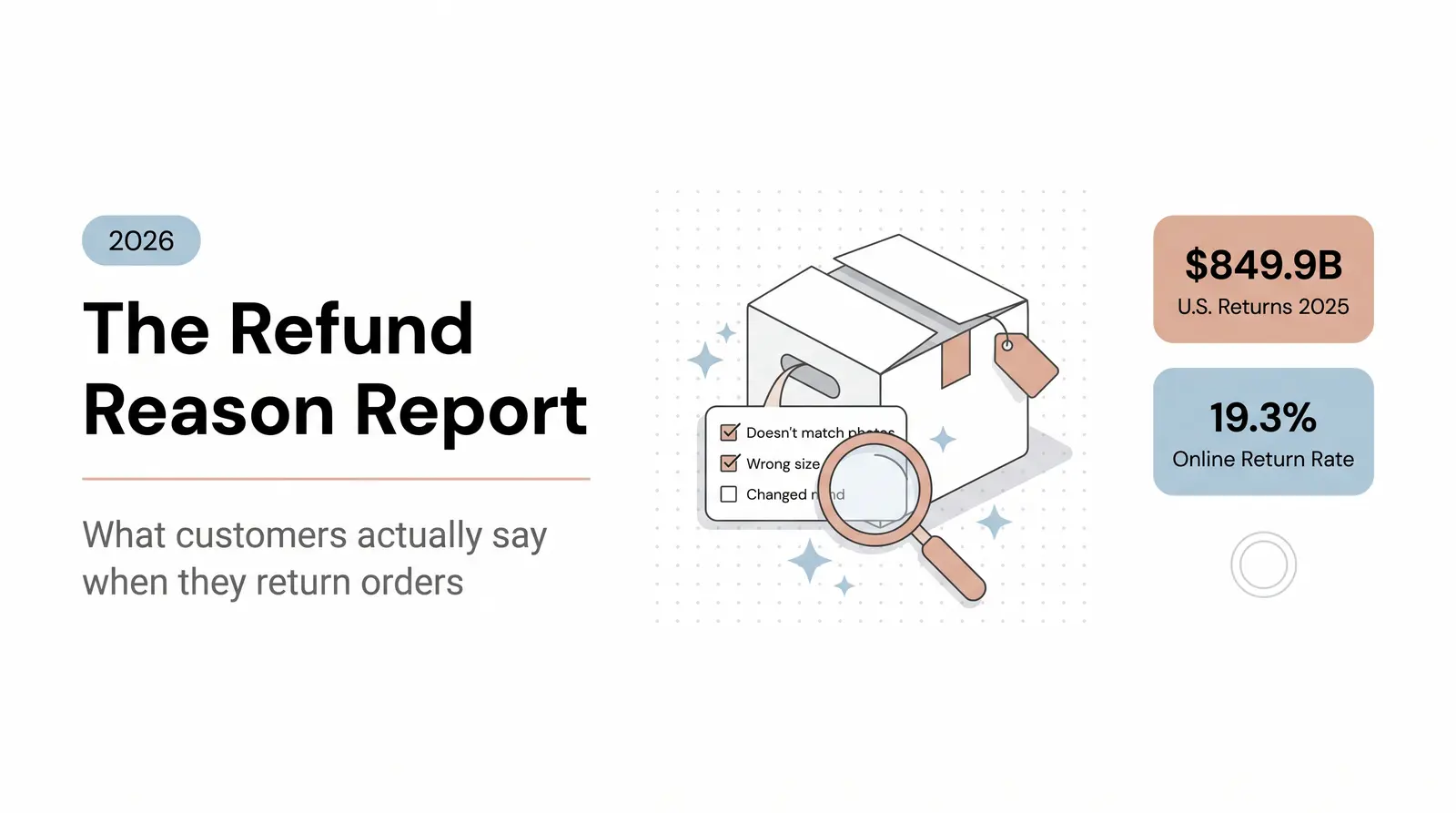
Returns and sizing complaints are the #1 silent margin killers in jewelry ecommerce. In 2024, the estimated return rate for ecommerce orders reached approximately 16.9%, representing a staggering $890 billion in returned merchandise across the United States alone [1]. For jewelry and accessories specifically, style preferences and sizing issues dominate the reasons for returns, with fit accounting for a significant portion of customer dissatisfaction [2]. While the jewelry sector generally enjoys a slightly lower return rate than fast fashion, the high average order value (AOV) of jewelry means that every single return hits your bottom line much harder.
If you are running a jewelry brand, you know the sting of a return request. It is not just the lost revenue; it is the reverse logistics, the damaged packaging, the potential for fraud, and the risk of losing a customer forever. But fewer returns are not a matter of luck. They are the result of clear Standard Operating Procedures (SOPs), proactive sizing education, and a policy built specifically for the nuances of jewelry.
At Branvas, we work with hundreds of jewelry brand owners, and sizing confusion is almost always in the top three reasons customers reach out post-purchase. This guide provides a set of zero-stress SOPs you can implement today to handle jewelry returns and sizing issues professionally, minimize their frequency, and protect your margins—without losing customers.
Jewelry returns are uniquely complex compared to general apparel or electronics. When a customer buys a t-shirt, they know their general size. When they buy a ring, they are often guessing. The nuances of jewelry ecommerce create specific challenges that require specialized handling:
A liberal return policy may not always reduce purchase hesitation for jewelry—because the tactile and emotional gap between online and in-person cannot be fully bridged by policy alone. The better lever is pre-purchase education. Research indicates that strengthening the pre-purchase journey, such as providing detailed sizing guides and AR try-on tools, can reduce returns by 15–40% [4]. Customers need confidence before they click "buy," not just the reassurance that they can send it back. If they are unsure about the size or the metal quality, a "free returns" badge might encourage them to buy, but it also guarantees they will return it if it is not perfect.

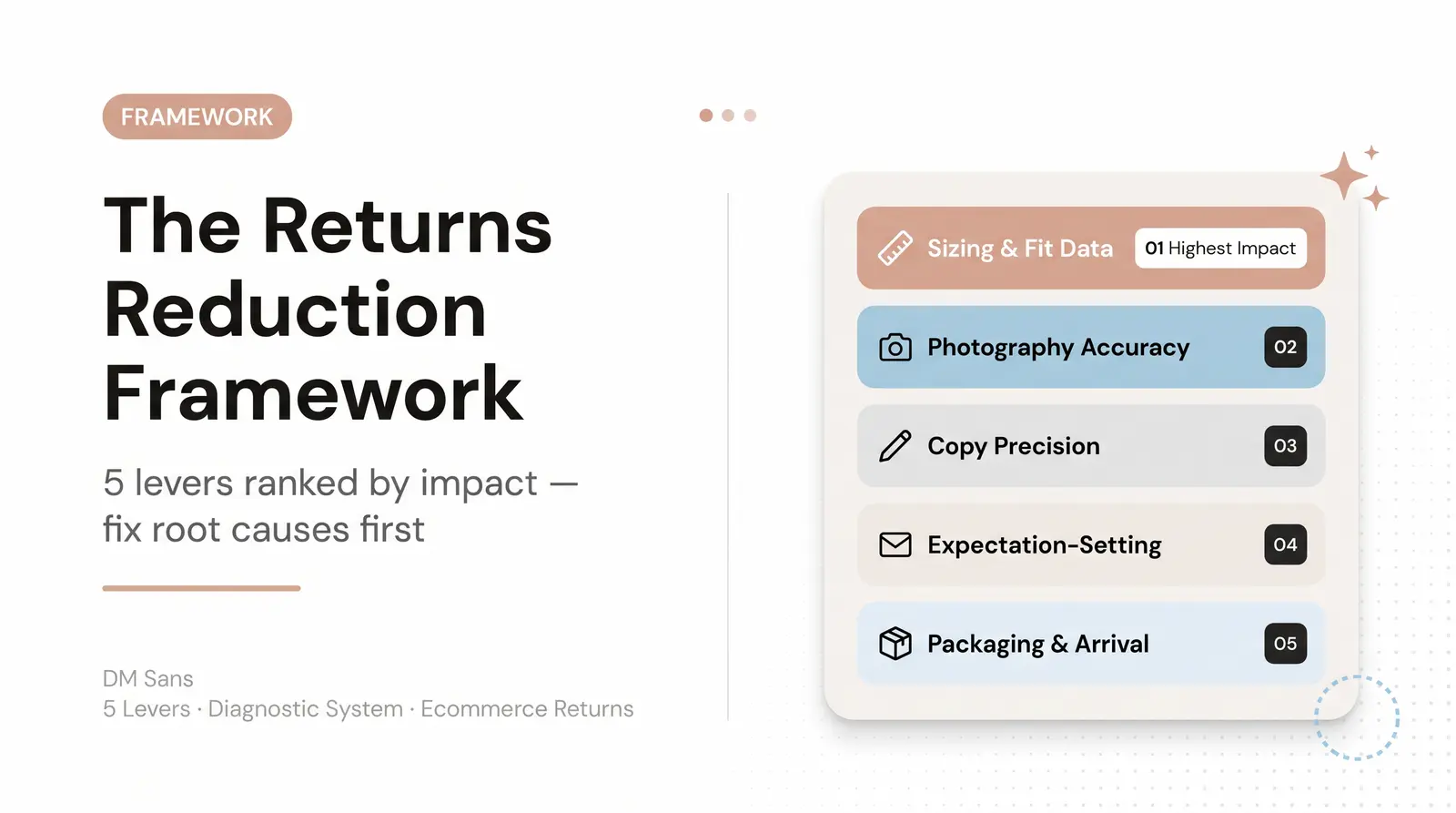
To manage these complexities, we recommend the CLEAR SOP System. This is a step-by-step operational framework that any jewelry brand owner can implement to handle issues efficiently and extract valuable data from every return.
This is the framework Branvas uses and recommends for its brand partners to turn returns from a chaotic cost center into a streamlined, data-driven process.

Ring sizing confusion is a primary driver of jewelry returns. The US, UK, and EU all use different sizing scales. For example, a US size 6 corresponds to a UK size L and an EU size 51.5 [5]. Without clear guidance, customers will guess, and they will often guess wrong.
We've seen brands cut sizing-related returns by simply adding a 60-second sizing video to their product pages—the lift in confidence is measurable. When customers see exactly how to measure their finger, they are far less likely to order multiple sizes with the intent to return the ones that do not fit (a practice known as bracketing).
If you use Branvas for fulfillment, our catalog products are standardized, and sellers can request or customize size guides via branvas.com/catalog to ensure accuracy across all listings.

A generic ecommerce return policy will not protect a jewelry business. Your policy must explicitly address the unique nature of your products. It needs to cover the return window, condition requirements (e.g., unworn, original packaging), hygiene exclusions for earrings, and policies on custom or engraved items.
Here is a comparison of three policy tiers to help you decide what fits your brand:
| Policy Tier | Return Window | Condition Requirement | Exchanges Allowed? | Refund Type | Best For |
|---|---|---|---|---|---|
| Strict | 7 days | Unworn, tagged, original packaging | Yes | Store credit only | High-AOV custom jewelry |
| Standard | 14–30 days | Unworn, original packaging | Yes | Store credit or refund | Mid-market jewelry brands |
| Flexible | 30–60 days | Unworn | Yes + free returns | Full refund | High-volume / competitive markets |
When crafting your policy, consider the psychology of the buyer. A strict policy might protect your margins in the short term, but it can severely depress conversion rates. A flexible policy encourages buying but requires a robust reverse logistics setup to handle the influx of returns.
If you operate a dropshipping model or use a fulfillment partner, your return policy must account for blind shipping. Blind shipping keeps your supplier anonymous, ensuring the customer only sees your brand name on the package [6]. You must decide whether returns go back to your supplier or to your own facility for inspection. You also need to determine who absorbs the return shipping costs. Your policy should clearly state the return address and process without revealing your backend operations.
If you're running a private-label jewelry brand through Branvas, your return flow is already built around blind shipping—see how it works at branvas.com/how-it-works. We handle the logistics so your customers experience a seamless, branded return process.

When a complaint comes in, your team should not have to improvise. Use this resolution playbook to handle the top five jewelry issues efficiently. These are not scripts to copy verbatim, but frameworks to adapt to your brand voice.

Tracking return reasons over time is a competitive advantage, not just a cost-center exercise. If you do not know why products are coming back, you cannot fix the underlying issues. A high return rate is a symptom; the return reason is the diagnosis.
Implement a simple return reason tagging system in your helpdesk or returns portal. Categories should include: Sizing, Style/Preference, Damaged, Defective/Quality, and Wrong Item. Review this data on a monthly cadence.
In our experience at Branvas, sellers who review their return data monthly identify product issues 3–4x faster than those who treat returns as one-off events. If a specific ring has a 25% return rate for sizing, you know the product page needs an update or the manufacturer's sizing is off. If a necklace is constantly returned for arriving tangled, you need to change your packaging inserts. Branvas's Academy has resources for brand operations and quality control to help you analyze this data effectively and make informed decisions.

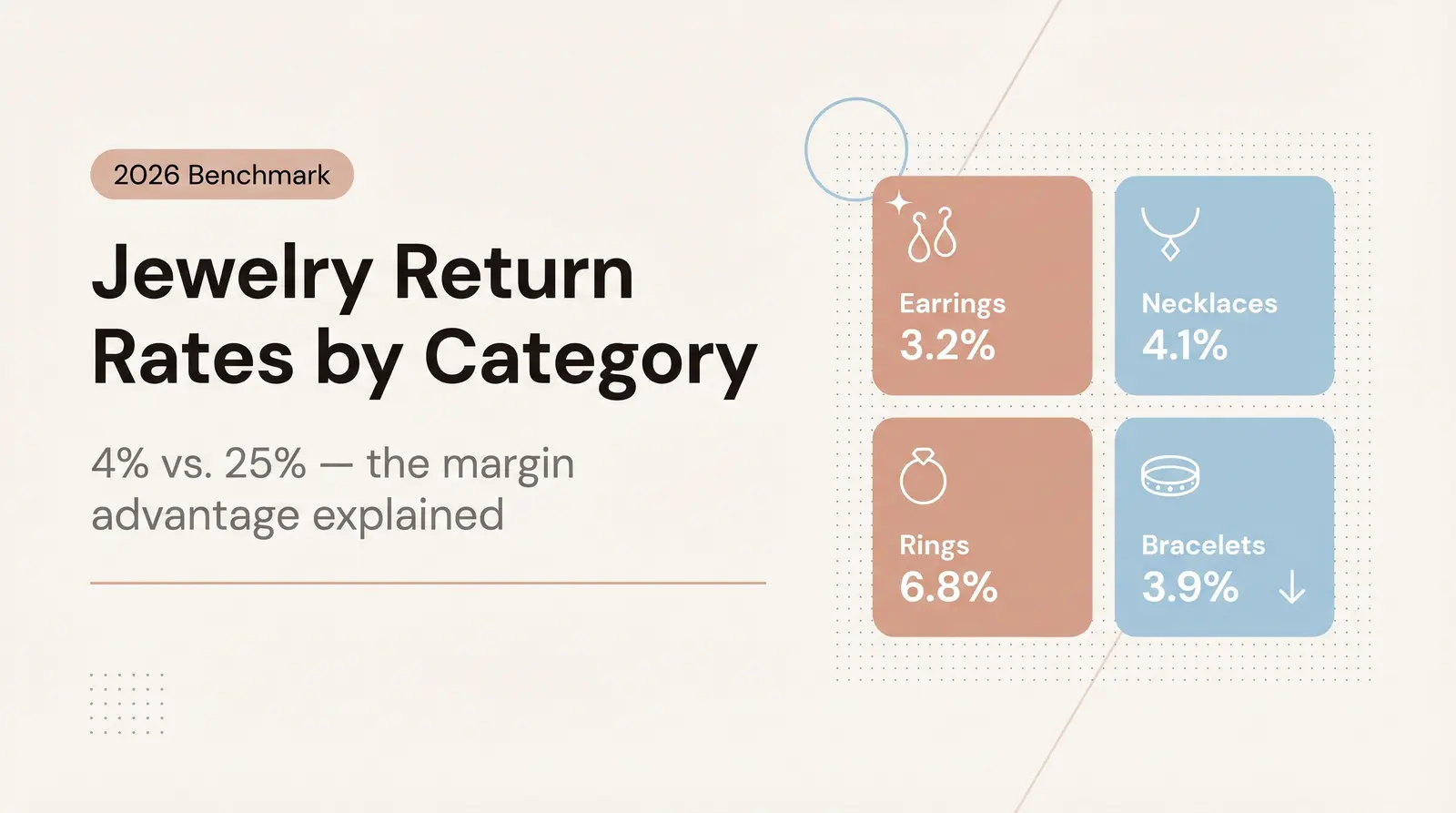
The average return rate for ecommerce jewelry is generally lower than apparel, often hovering around 8% to 10% [7]. However, this varies significantly by price point and product type. Rings typically see higher return rates due to sizing complexities, while adjustable necklaces and earrings see lower rates. Keeping your overall return rate below 10% is a healthy benchmark for a jewelry brand.
A dropshipping return policy must be transparent without revealing your supplier. Clearly state your return window (e.g., 30 days) and condition requirements. Specify that customers must contact your support team to receive a Return Merchandise Authorization (RMA) and the correct return address. Decide whether you or the customer will cover return shipping costs, and state this clearly to avoid disputes. Never use your supplier's overseas address as the return destination, as this breaks the illusion of your brand.
Provide multiple methods for customers to find their size. Include an international conversion chart, a printable to-scale ring sizer, and instructions for measuring finger circumference with string or paper. Additionally, advise customers to measure their fingers at the end of the day when they are largest and to size up for wide-band rings. Adding a short video demonstrating these methods can drastically reduce sizing errors.
Yes. It is standard industry practice to refuse returns on custom, personalized, or engraved jewelry because these items cannot be resold. However, you must state this policy explicitly on the product page and at checkout. If a custom item arrives damaged or defective, you should still offer a repair or replacement to maintain customer trust.
Coordinate closely with your 3PL or fulfillment partner. Establish a clear SOP for receiving and inspecting returned items. Determine if the 3PL will restock pristine items, quarantine damaged goods, or forward returns to your headquarters. Ensure your customer-facing policy aligns with your partner's processing timelines so you can set accurate expectations for refunds. Communication is key to preventing customer frustration during the return transit period.
Fewer returns aren't luck—they're the result of clear SOPs, proactive sizing education, and a policy built for jewelry specifically. By implementing the CLEAR SOP System, enhancing your pre-purchase education, and handling complaints with structured playbooks, you can protect your margins and build long-term customer loyalty. Returns will never be zero, but they do not have to be a source of stress.
Ready to launch or scale a jewelry brand without the operational chaos? Branvas handles sourcing, branding, packaging, and blind fulfillment—so you can focus on growing. Explore how Branvas works →
For more tailored solutions, check out our resources for ecommerce and boutique store owners.
[1] NRF and Happy Returns Report: 2024 Retail Returns to Total $890 Billion
[2] Most common return reasons in ecommerce by vertical (2026 data and trends)
[3] Nickel Allergy Jewelry Statistics: A 2026 Research Guide
[4] How to reduce returns in e-commerce
[5] Ring Size Chart: US, EU, UK & International Conversion Table
[6] What Is Blind Shipping? Definition, Benefits, and Best Practices
[7] Return policy strategies for jewelry brands in 2025