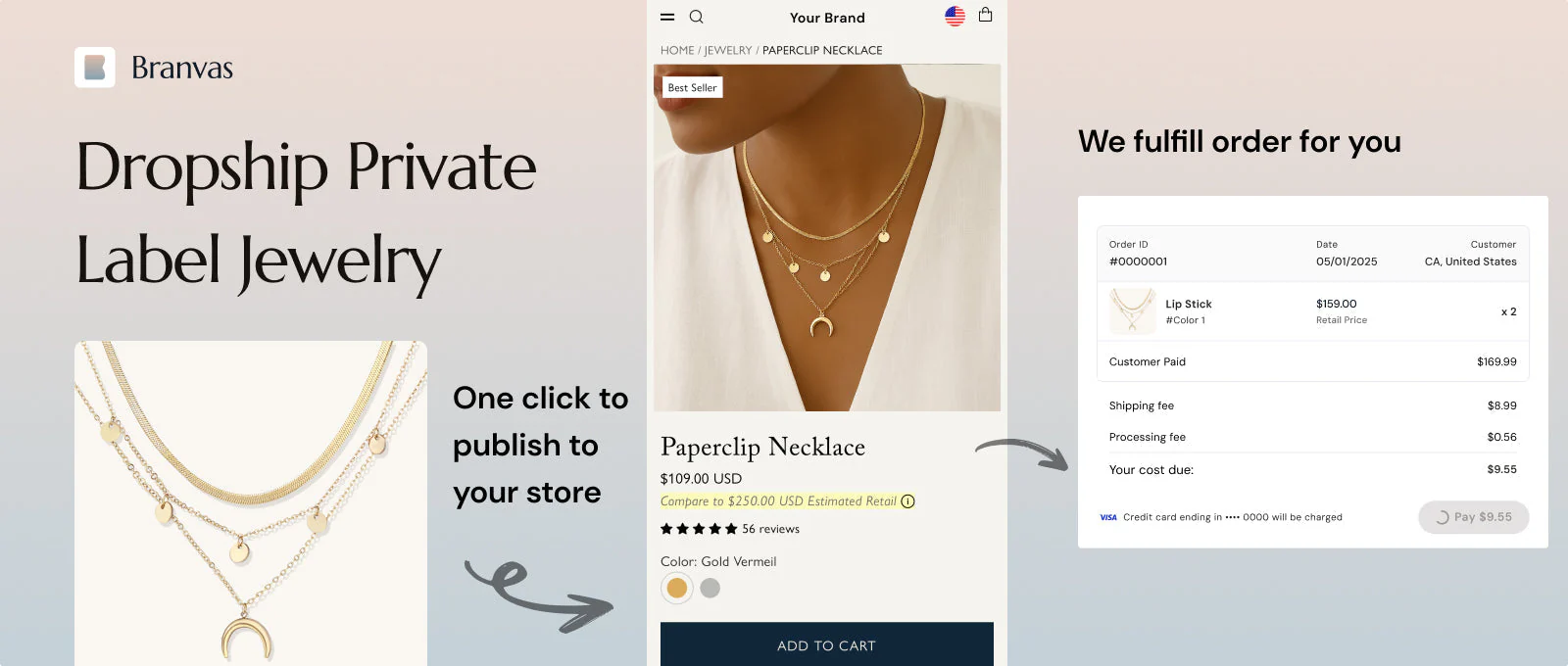



Dropshipping is worth it in 2026 only with a branded, niche-focused approach — generic stores are dead, but the market is projected to exceed $500 billion.
Published:
October 13, 2026
Author:
Yi Cui
Every year someone declares dropshipping dead. Every year it generates billions in revenue. Here's what's actually true: where dropshipping works, where it doesn't, and what's changed that matters.
If you are evaluating whether to start or continue a dropshipping business in 2026, you have likely seen the contradictory information. On one side, YouTube gurus promise overnight wealth with zero effort. On the other side, skeptics claim the model is entirely broken, citing rising ad costs and saturated markets. The reality exists somewhere in the middle. This article gives a conditional "yes" to the question of whether dropshipping is worth it. It is not a cheerleader answer, nor is it a hit-piece. It is a data-grounded look at the exact conditions that make dropshipping profitable today, and why the old playbook no longer works.
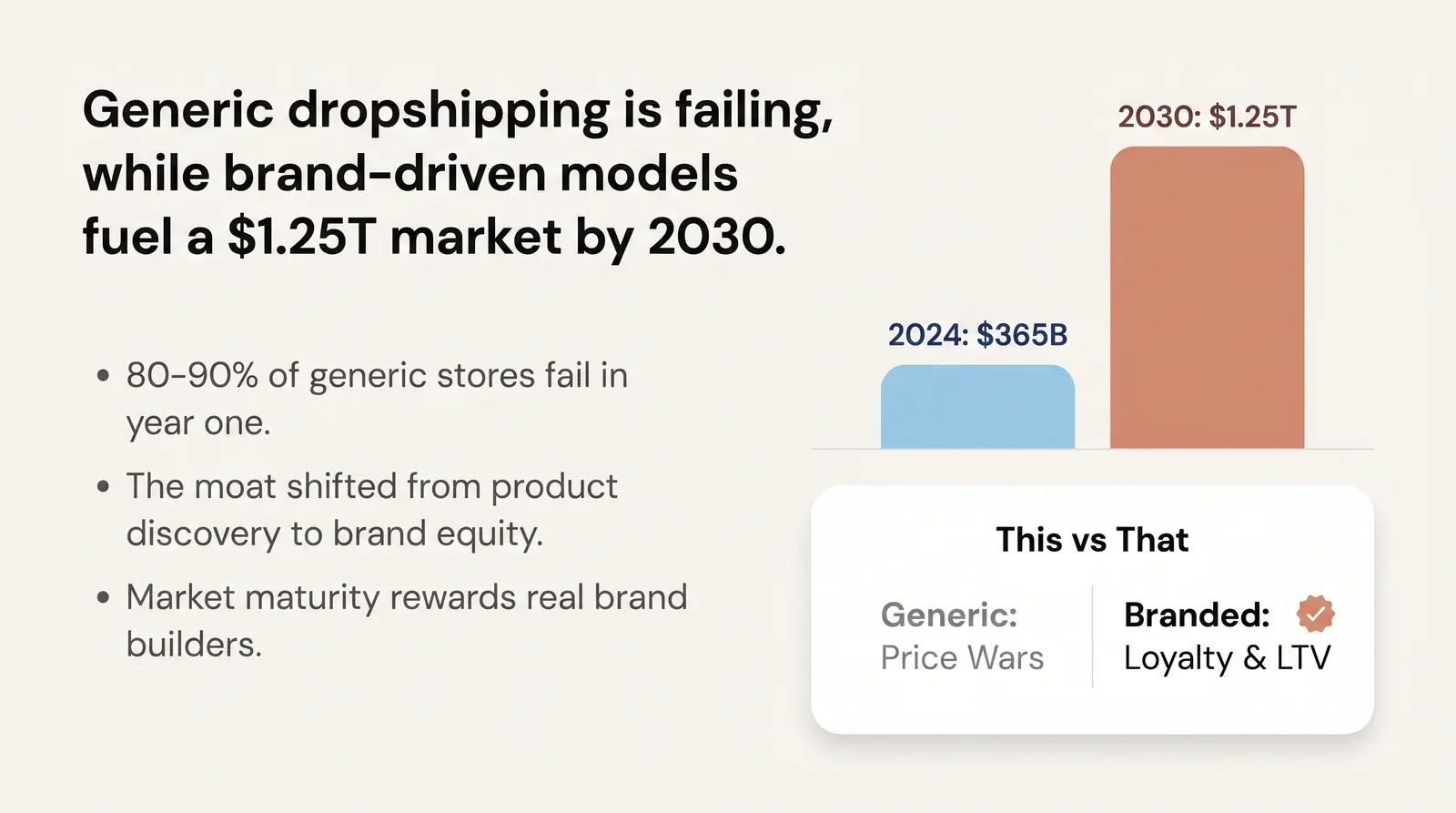
The criticism surrounding dropshipping is partly legitimate. Real problems exist within the industry, primarily driven by low-quality entrants flooding the market with generic products, long shipping times, and poor customer service. These issues have led to a high failure rate, with data showing that 80% to 90% of dropshipping stores fail, and only 10% to 20% achieve profitability in their first year [1]. This high failure rate fuels the "dropshipping is dead" narrative, creating a survivorship bias where the loud failures overshadow the quiet successes.
The market size data tells a completely different story. The global dropshipping market was valued at $365.67 billion in 2024 and is projected to reach $1,253.79 billion by 2030, growing at a CAGR of 22.0% [2]. Another analysis projects the market to reach $507.18 billion in 2026 and $1.35 trillion by 2031 [3]. A model generating hundreds of billions of dollars annually is far from dead.
The narrative persists because the generic dropshipping model is indeed dying. Here is the non-obvious insight: the same forces that "killed" generic dropshipping, rising ad costs, increased competition, and higher consumer expectations, are exactly what created the opportunity for branded dropshipping. When anyone can spin up a Shopify store and import the same AliExpress products in minutes, the product itself is no longer a competitive advantage. The moat has shifted from product discovery to brand equity and customer experience [4]. The market is not dying. It is maturing, and maturity rewards operators who build real brands.
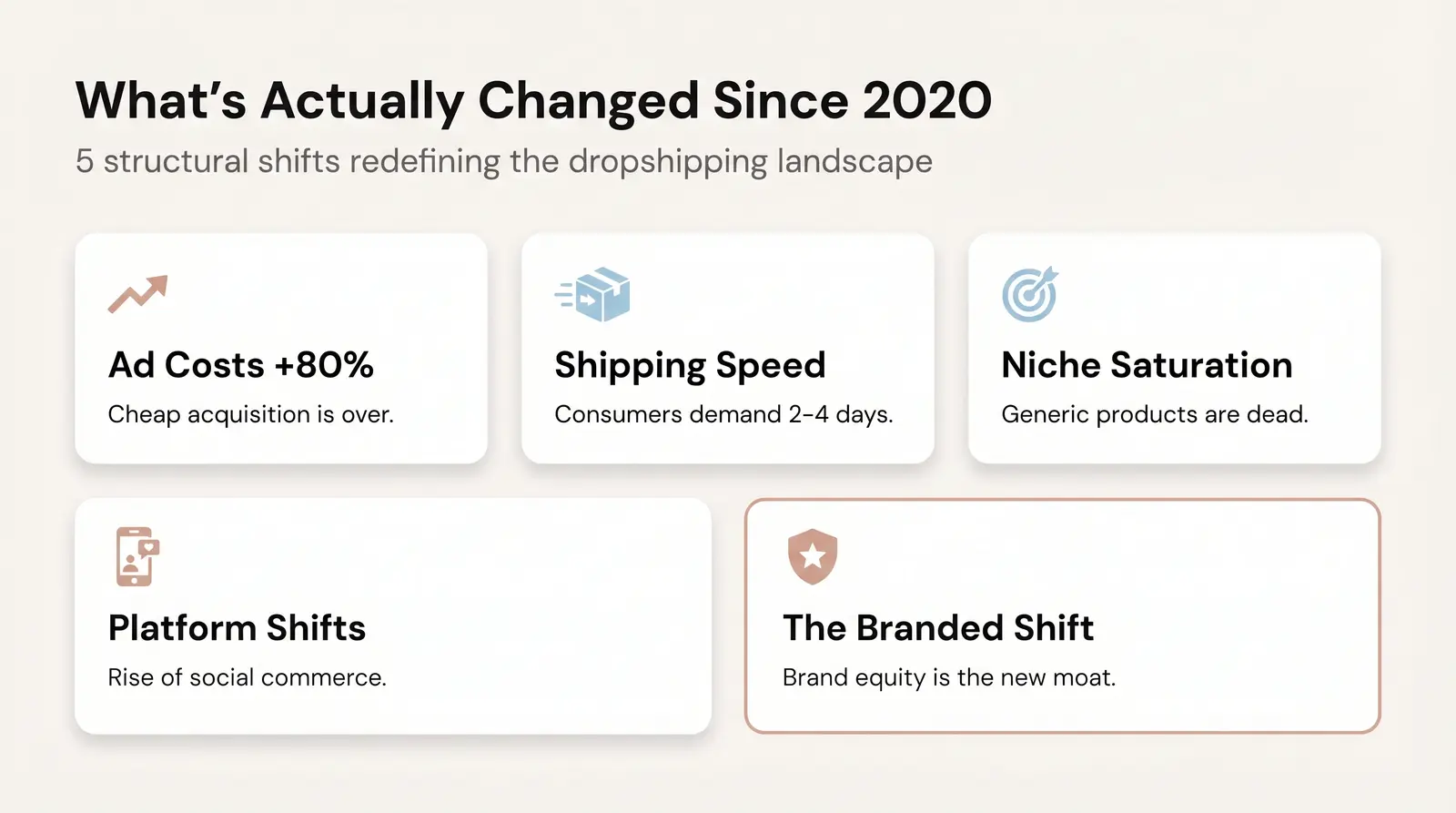
The dropshipping landscape of 2026 looks fundamentally different from the boom years of 2020. Several structural shifts have altered the unit economics and operational requirements for success.
Ad costs have risen sharply. The era of cheap customer acquisition on social media is over. The average Facebook CPM fluctuated from approximately $5 in 2020 to $9 in 2024, representing an 80% increase over four years [5]. In 2025 alone, the platform-wide CPM increased by 20.03%, with the median CPM reaching $13.48 across all industries. Every single industry on Meta saw CPM increase year-over-year in 2025, with no exceptions [6]. For dropshippers operating with thin margins on cheap, generic products, these rising acquisition costs completely erode profitability.
Shipping expectations have shifted. The "Amazon Prime effect" has permanently altered consumer tolerance for long delivery windows. A 2025 McKinsey survey of over 1,000 US consumers found that 90% are willing to wait two or three days for deliveries, especially if it allows them to avoid shipping costs. However, the historical dropshipping standard of two to four weeks via ePacket is no longer acceptable. The average parcel delivery speed accelerated by about 40% between 2020 and 2023, dropping from 6.6 days to 4.2 days [7]. Consumers now demand reliable, trackable shipping within a reasonable timeframe, and cost is now the number one delivery factor, not speed.
Saturation is real, but niche-specific. The concept of saturation must be applied at the niche level, not the industry level. Categories with low barriers to entry and high commoditization, such as generic phone cases, basic print-on-demand apparel, and cheap gadgets, are structurally saturated. Conversely, niches with emotional buying triggers, high perceived value, and structural advantages, such as jewelry, pet accessories, and specialized beauty tools, continue to offer strong margin potential [8].
The platform landscape changed. AliExpress, once the default sourcing platform, has faced reliability issues and UI changes that create friction for sellers. Meanwhile, social commerce has exploded, with platforms like TikTok Shop advancing at a 25.49% CAGR through 2031 [3]. The Shopify ecosystem has matured, powering approximately 5.7 million active stores as of early 2025, but with stricter enforcement against low-quality merchants.
The branded shift. The most significant change is the transition from transactional dropshipping to brand building. Top dropshippers now operate as brand builders rather than order-forwarders. They focus on private-label products, custom packaging, and a distinct brand identity to foster customer trust and repeat purchases. Research shows that 87% of shoppers will pay more for products from a brand they trust, and 71% are likely to buy again from a brand that has earned their loyalty [4].
In our experience at Branvas, the sellers who struggle most are those still operating with a 2018 playbook, chasing viral products with no brand equity and wafer-thin margins.
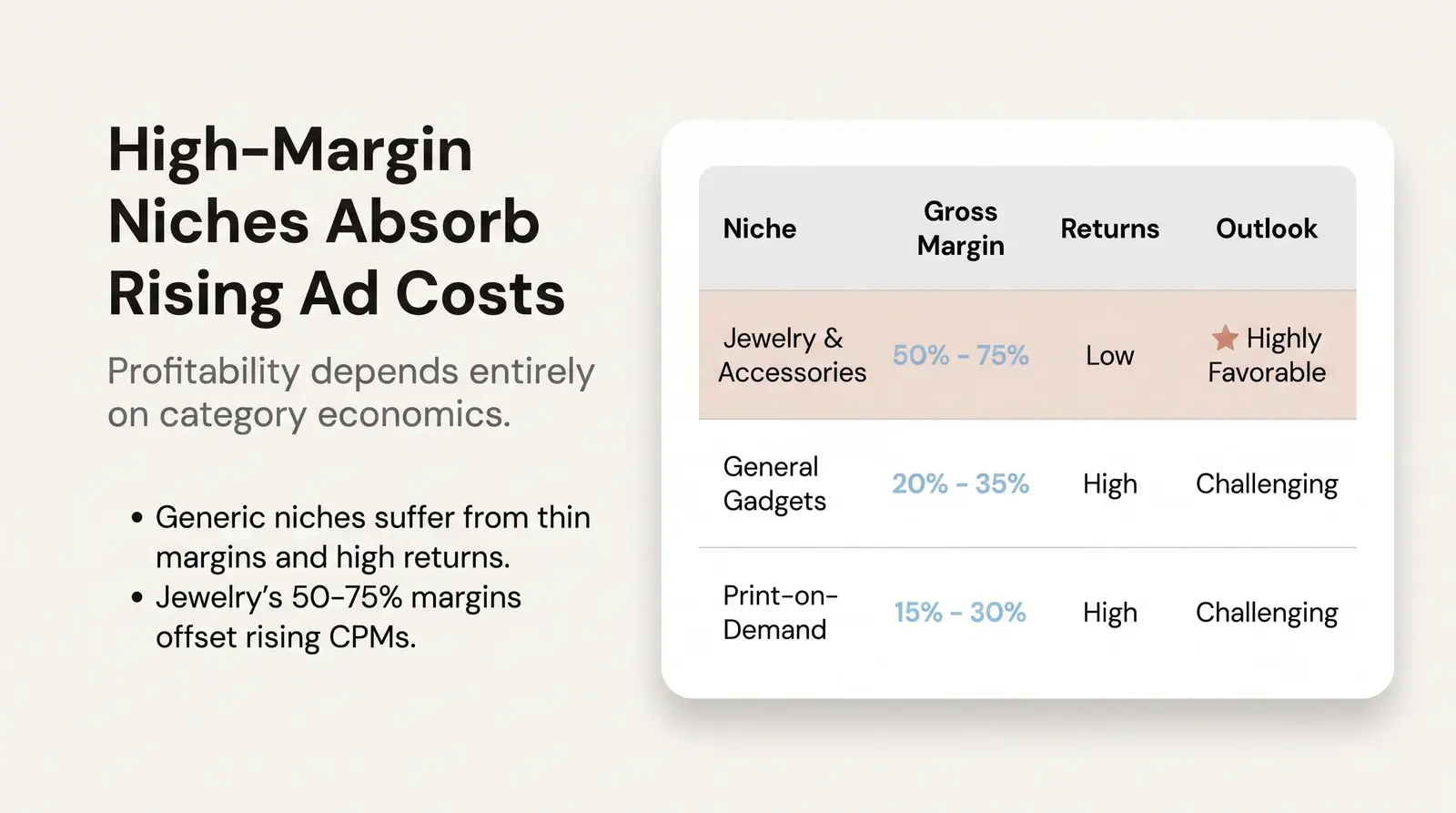
Profitability in dropshipping is highly dependent on the chosen niche. While the average profit margin for successful dropshipping stores ranges from 15% to 25% [1], specific categories perform significantly better or worse based on their inherent economics.
| Niche | Typical Gross Margin Range | Saturation Level | Avg. Return Rate | Shipping Sensitivity | 2026 Outlook |
|---|---|---|---|---|---|
| Jewelry & Accessories | 50% - 75% | Low / Medium | Low | Low (lightweight) | Highly Favorable |
| Pet Accessories | 40% - 65% | Medium | Low | Medium | Favorable |
| Beauty & Skincare | 40% - 60% | High | Medium | High (quality concerns) | Moderate |
| Print-on-Demand Apparel | 15% - 30% | High | High (sizing) | Medium | Challenging |
| General Gadgets | 20% - 35% | High | High (defects) | High | Challenging |
| Phone Cases | 30% - 50% | Very High | Low | Low | Highly Challenging |
The numbers in this table illustrate why generic dropshipping is failing while specific niches thrive. Print-on-demand apparel and general gadgets suffer from a combination of high saturation, high return rates, and lower gross margins. When you factor in the rising CPMs on advertising platforms [6], these margins are quickly consumed by customer acquisition costs. Jewelry and Accessories, by contrast, present a highly favorable profile. The category offers exceptional gross margins, low return rates because products are generally not size-dependent, and low shipping sensitivity due to the lightweight nature of the items. This structural advantage allows sellers to absorb higher ad costs while remaining profitable.
The jewelry and accessories market is experiencing significant growth, driven by a combination of evergreen demand and the shift toward online purchasing. The global online jewelry market is projected to reach approximately $85.7 billion in 2026, growing at a CAGR of 13.08% through 2032 [9]. This is not a temporary trend. It is a structural shift in how consumers buy high-value, emotionally resonant items.
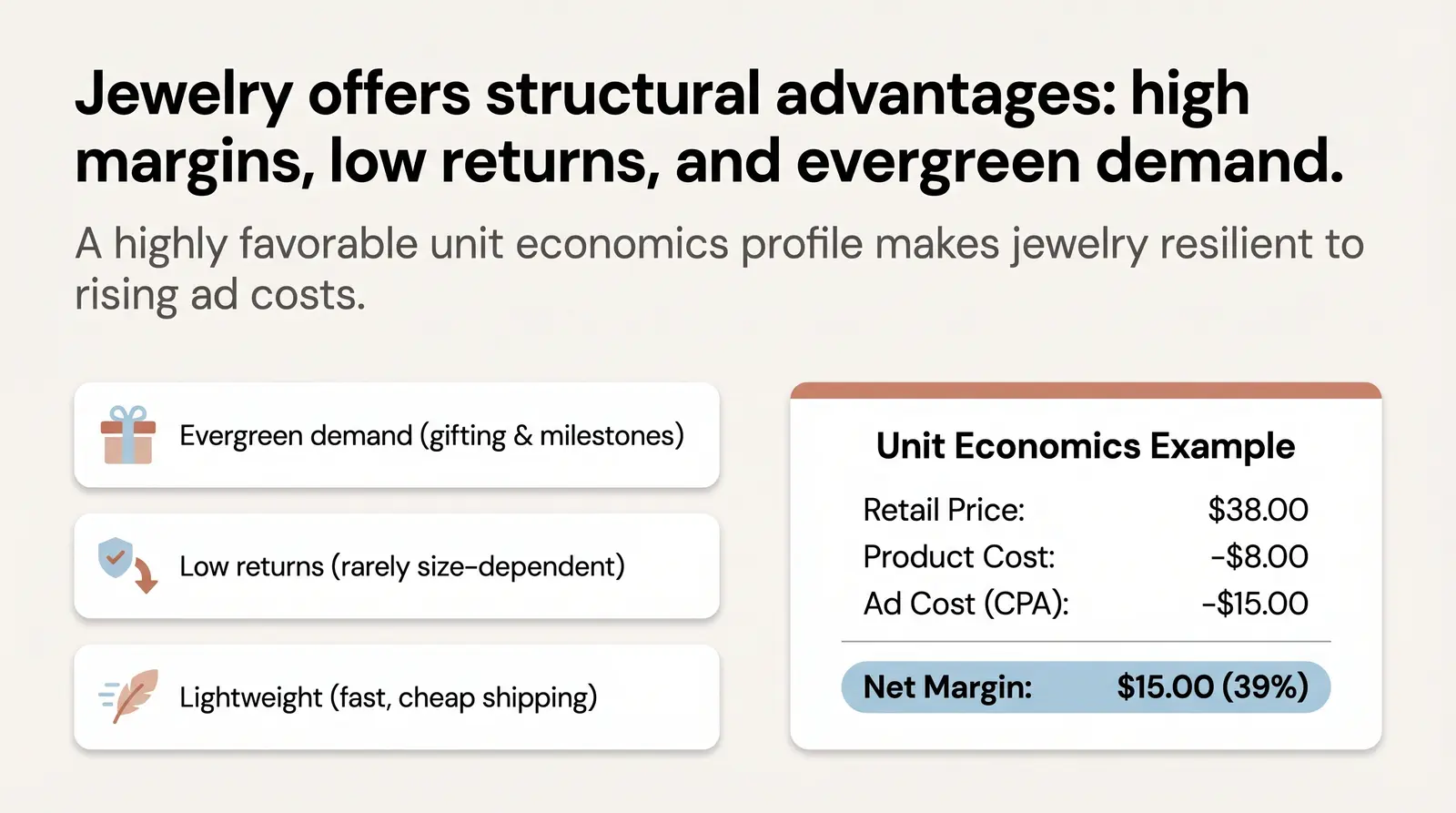
Jewelry possesses several unique characteristics that make it an ideal dropshipping niche in 2026. Demand is evergreen, driven by gifting, self-expression, and milestones such as weddings, anniversaries, and birthdays. This consistency provides a stable foundation that trending gadgets can never match. The perceived value of jewelry is often significantly higher than its actual production cost, creating a substantial margin opportunity for sellers who can brand and market effectively. Unlike apparel, jewelry returns are relatively low because the products are rarely size-dependent, which improves cash flow and reduces operational complexity. Jewelry is also small and lightweight, resulting in lower shipping costs and faster delivery times. This is a meaningful advantage when consumers are highly sensitive to both shipping cost and delivery reliability [7].
The niche also has a natural fit with influencer and creator marketing. Jewelry is highly visual and translates perfectly to platforms like Instagram and TikTok, where social proof drives purchase decisions. Private-label jewelry is now accessible to sellers of all sizes, not just large brands.
Consider a realistic unit economics example for a creator-brand selling a curated jewelry collection using Branvas:
| Line Item | Amount |
|---|---|
| Product Cost (Sourced) | $8.00 |
| Branded Packaging | Included |
| Retail Price | $38.00 |
| Gross Margin | $30.00 (79%) |
| Estimated Ad/Influencer Cost (CPA) | $15.00 |
| Estimated Net Margin Per Unit | $15.00 (39%) |
These are illustrative estimates intended to show the structural economics of the niche.
Even with a $15 customer acquisition cost, the high gross margin allows the seller to retain a healthy net profit per unit. That math simply does not work in a generic gadget or print-on-demand apparel store at current ad prices. If you're evaluating jewelry as your niche, Branvas's catalog and pricing is a good place to start — no minimums, private-label ready.
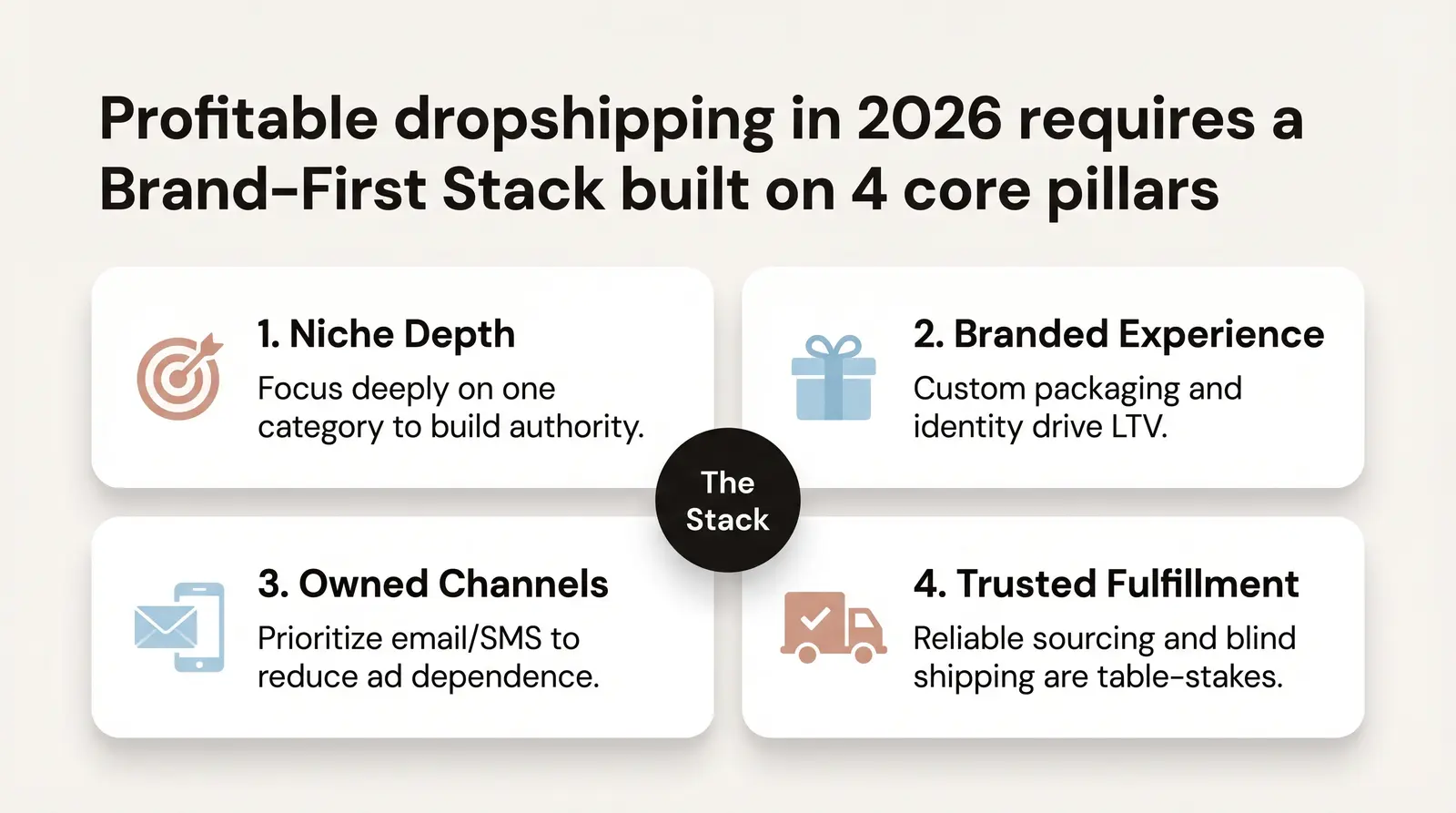
To succeed in 2026, dropshippers must adopt a new operational model. We call this The Brand-First Dropship Stack. This framework reflects what genuinely separates profitable businesses from those that fail. It is built around four core pillars.
1. Niche Depth over Breadth. The days of the general store selling everything from dog toys to kitchen gadgets are over. Successful brands own a specific category and serve a defined audience. By focusing deeply on one niche, you build authority, improve marketing efficiency, and create a cohesive brand experience that customers remember and return to.
2. Branded Experience. Generic products shipped in unbranded ePacket bags destroy customer lifetime value (LTV). The unboxing experience, store aesthetics, and brand voice matter enormously. Custom packaging, logos, and a consistent identity transform a transactional purchase into a brand relationship that earns repeat business and word-of-mouth.
3. Owned Channel Priority. Relying purely on paid ads is increasingly risky due to rising CPMs [6]. Profitable brands prioritize owned channels, such as email and SMS lists, and maintain their own storefronts on Shopify or similar platforms. This reduces dependence on algorithmic platforms and lowers the blended cost of acquisition over time.
4. Fulfillment You Can Trust. Reliable sourcing, blind shipping, and real tracking are no longer optional. They are table-stakes. Consumers expect transparency and reasonable delivery times [7]. Partnering with a fulfillment provider that guarantees quality control and timely shipping is essential for maintaining trust and preventing chargebacks.
We built Branvas specifically around this stack, because we kept seeing talented creators and ecommerce sellers lose not because of bad products, but bad infrastructure.
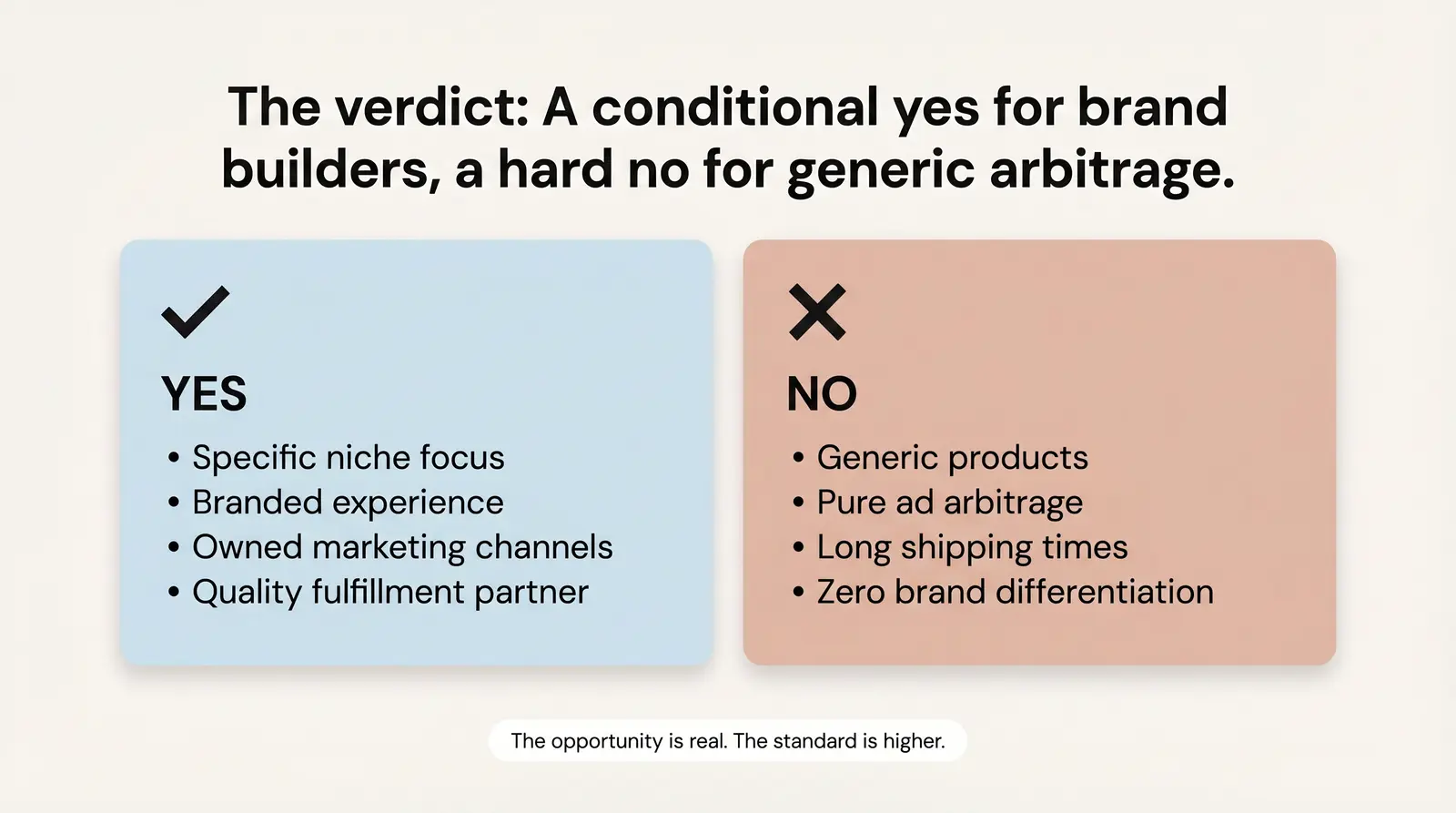
The honest answer is a nuanced yes, but only under specific conditions.
Yes, if you focus on a specific niche, adopt a branded model, prioritize owned marketing channels, and partner with a quality fulfillment provider. The dropshipping model remains a highly capital-efficient way to launch and scale an ecommerce business, provided you treat it as a brand-building exercise rather than a quick hustle.
No, if you plan to sell generic products, rely purely on ad arbitrage, accept long AliExpress shipping times, and offer no brand differentiation. That model is structurally saturated and mathematically broken in 2026.
The opportunity is real. The market is growing. The barrier is not the model itself. It is the willingness to operate at a higher standard.
If you're ready to build a dropshipping brand that's actually built for 2026, see how Branvas works — from sourcing to branded packaging to blind fulfillment. Whether you are an influencer looking to monetize your audience or an entrepreneur seeking a scalable business model, the infrastructure is available. You can also explore our solutions for influencers and creators to see how a brand-first approach translates directly into a sustainable business.
1. Is dropshipping still worth it in 2026?
Yes, dropshipping is still worth it, but the model has evolved. Generic, unbranded dropshipping is highly saturated and difficult to scale due to rising ad costs. Branded dropshipping, where you focus on a specific niche, offer private-label products, and provide a strong customer experience, remains a highly profitable and capital-efficient business model. The key distinction is operating like a brand builder, not a product arbitrageur.
2. What is a realistic profit margin for dropshipping?
A realistic net profit margin for a successful dropshipping store in 2026 is between 15% and 25% [1]. Gross margins vary significantly by niche. Print-on-demand apparel might offer 15-30% gross margins, while jewelry and accessories can yield 50-75% gross margins. The higher the gross margin, the more room you have to absorb rising customer acquisition costs and still generate a meaningful net profit per order.
3. Which dropshipping niches are oversaturated?
Niches with low barriers to entry and high commoditization are generally oversaturated in 2026. This includes generic phone cases, basic print-on-demand apparel, cheap consumer electronics, and fidget toys. These categories suffer from intense competition, thin margins, and high customer acquisition costs. The saturation problem is not about the number of competitors alone. It is about the collapse of information asymmetry, where any seller can identify the same trending product within minutes using widely available research tools.
4. Is jewelry a good niche for dropshipping?
Jewelry is one of the strongest dropshipping niches in 2026. It benefits from evergreen demand driven by gifting and milestones, high perceived value relative to cost, low return rates because it is rarely size-dependent, and lightweight shipping that keeps fulfillment costs low. The global online jewelry market is projected to reach $85.7 billion in 2026 [9], reflecting consistent and growing consumer demand. These factors combine to offer excellent gross margins and a highly favorable unit economics profile.
5. What's the difference between dropshipping and private-label dropshipping?
Traditional dropshipping involves selling generic, unbranded products sourced directly from a supplier, often resulting in a commoditized customer experience with no brand differentiation. Private-label dropshipping involves partnering with a supplier to sell products under your own brand name, complete with custom packaging and logos. This approach builds brand equity, fosters customer loyalty, and allows for higher profit margins. It is the difference between being a reseller and being a brand owner, and that distinction determines your competitive durability in 2026.
[1] 80+ Ecommerce & Dropshipping Statistics for 2026 — Carro, April 9, 2026
[2] Dropshipping Market Size, Share | Industry Report, 2030 — Grand View Research
[3] Dropshipping Market Size, Growth & Share Report 2031 — Mordor Intelligence, April 4, 2026
[4] The New Era of Dropshipping: Building a Branded Asset in 2026 — Branvas, January 29, 2026
[5] Facebook Ads cost (2025) — Business of Apps, February 27, 2025
[6] Facebook Ad Benchmarks by Industry (Updated Data) — Triple Whale, April 7, 2026
[7] What do US consumers want from e-commerce deliveries? — McKinsey & Company, February 13, 2025
[8] 7 Lucrative Dropshipping Niches for 2025: Boost Your Profit! — Daylily, February 26, 2026
[9] Online Jewelry Market Size in 2026, and Future Forecasts — IceCartel, April 22, 2026