


Compare Instagram and TikTok conversion rates, AOV, and organic reach to choose the best social commerce platform for selling products in 2026.
Published:
July 28, 2026
Author:
Yi Cui
Social commerce is no longer an experimental channel; it is the primary engine of ecommerce growth. In 2026, social commerce sales are projected to account for 8.9% of all US ecommerce sales, representing a massive shift in how consumers discover and buy products [1]. For a new ecommerce seller or influencer launching a brand, choosing the right platform is the most consequential decision you will make in your first year.
Getting the platform wrong early is costly. It wastes limited capital on the wrong content formats and burns precious time trying to reach an audience that isn't primed to buy your specific product. We often see founders make the mistake of choosing a platform based on where they personally consume content, not where their buyer shops.
Here is the contrarian truth about social commerce in 2026: Discovery and conversion happen in entirely different mental states. TikTok has trained users to discover products passively while being entertained, driving massive impulse purchases for low-ticket items. Instagram, conversely, has evolved into a digital catalog where users actively evaluate brand aesthetics and lifestyle alignment before making considered purchases. If you try to force an impulse-buy strategy onto Instagram, or a slow-burn aesthetic strategy onto TikTok, you will fail, regardless of how good your product is.

To make an informed decision, you need to understand the current state of both platforms.
TikTok in 2026
TikTok has reached 1.99 billion monthly active users globally, with its Shop feature projected to hit a staggering $112.2 billion in global Gross Merchandise Value (GMV) [2]. The platform's algorithm is entirely content-centric; it evaluates every video based on engagement signals rather than follower count [3]. This means a brand new account can achieve viral reach overnight. Content formats lean heavily into raw, authentic, and trend-driven videos (Reels, LIVE, TikTok Shop integrations). The buying behavior is highly impulsive, driven by scarcity and creator recommendations.
Instagram in 2026
Instagram surpassed 3 billion monthly active users in late 2025, maintaining its position as the largest visual platform [4]. While organic reach for standard feed posts has declined, Instagram Reels now account for 50% of time spent on the app and drive the majority of non-follower discovery [4]. Instagram's infrastructure is built for brand storytelling, utilizing high-quality photography, Stories for behind-the-scenes engagement, and seamless Instagram Checkout. The buying behavior here is more considered, driven by aesthetics, trust, and lifestyle aspiration.
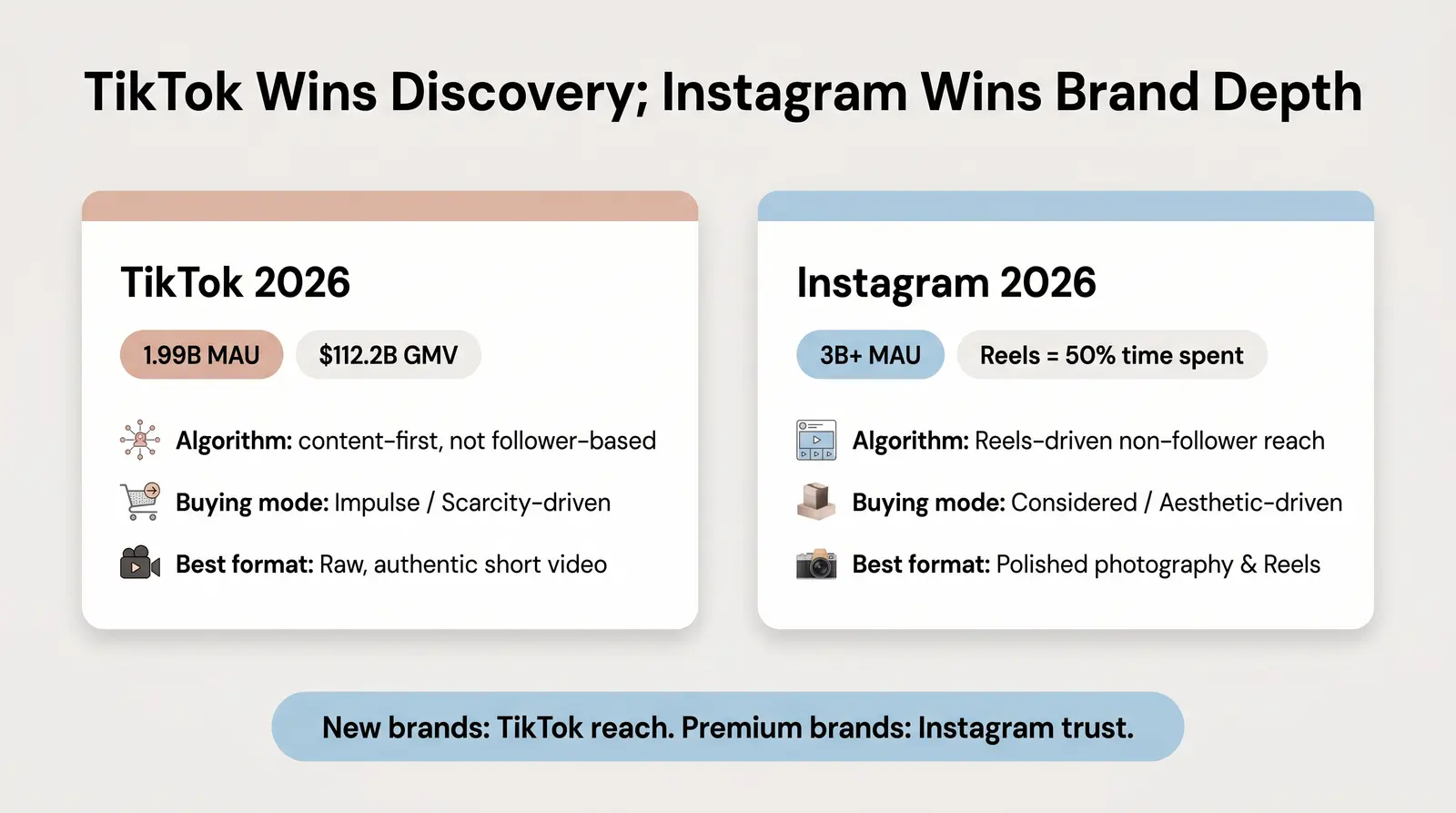
To clarify the differences, we have synthesized the latest 2026 data into a direct comparison for ecommerce sellers.
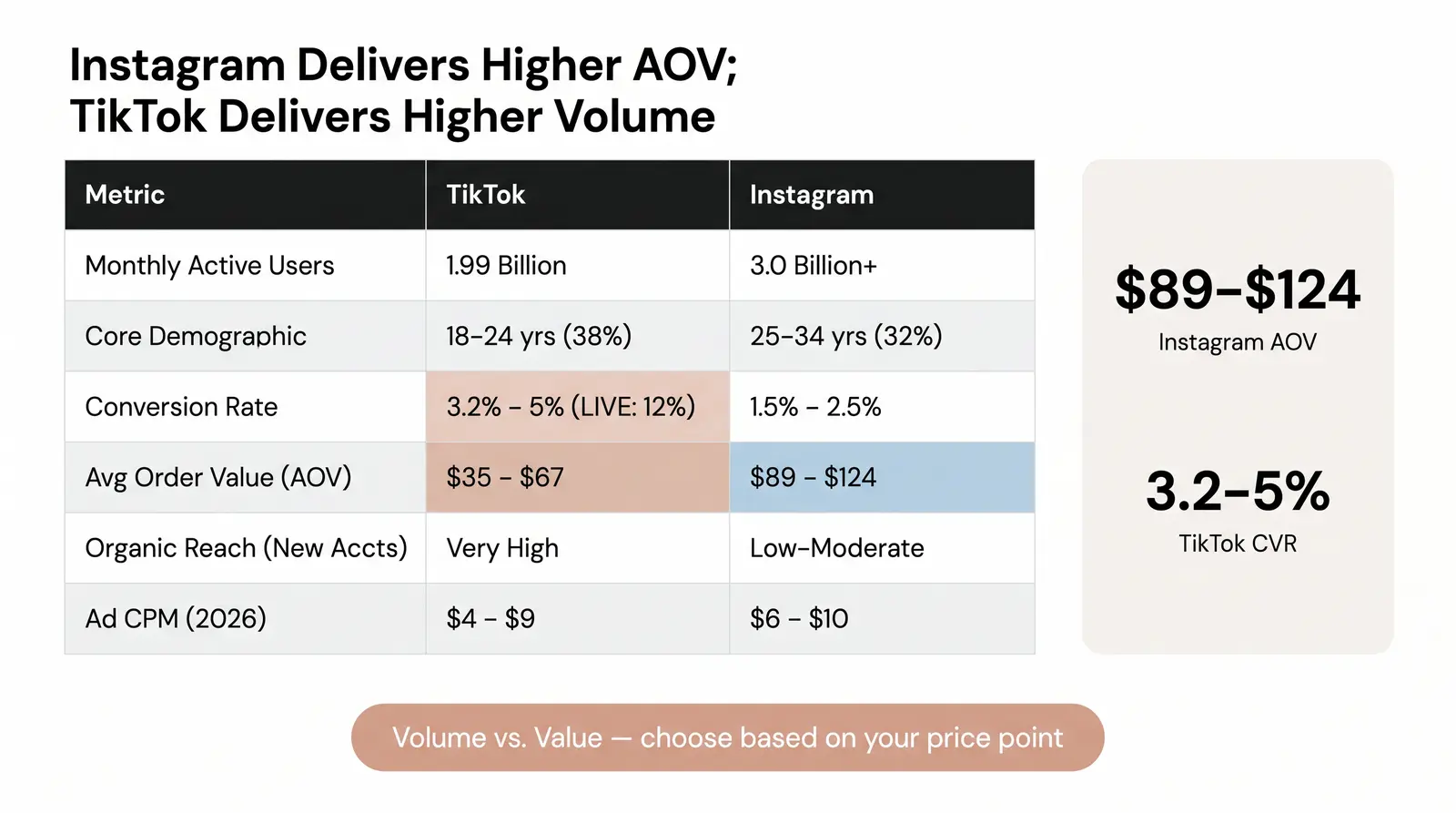
| Metric | TikTok | |
|---|---|---|
| Global Monthly Active Users | 1.99 Billion [2] | 3.0 Billion+ [4] |
| Core Demographic | 18–24 years old (38%) [4] | 25–34 years old (32%) [4] |
| Organic Reach (New Accounts) | Very High (Algorithm favors content over followers) [3] | Low to Moderate (Requires heavy investment in Reels) [3] |
| Conversion Rate (Social Commerce) | 3.2% – 5% (Up to 12% on LIVE) [5] | 1.5% – 2.5% [6] |
| Average Order Value (AOV) | $35 – $67 (Impulse focus) [5] | $89 – $124 (Premium focus) [6] |
| Shopping Features | TikTok Shop (Native, frictionless) | Instagram Shopping, Checkout, Product Tags |
| Best Content Format | Raw, entertaining, trend-driven short video | Polished visual aesthetics, Reels, lifestyle imagery |
| Ad CPM Benchmarks (2026) | $4.00 – $9.00 [7] | $6.00 – $10.00 [8] |
| Influencer Marketing Fit | Micro-creators, affiliate volume, authentic reviews | High-tier influencers, polished endorsements, aesthetic alignment |
| Best For (Product Types) | Affordable jewelry, beauty, gadgets, trend apparel | Fine jewelry, premium fashion, home goods, lifestyle brands |
For a founder reading this data, the narrative is clear. TikTok offers an unparalleled opportunity for rapid audience acquisition and high-volume, lower-ticket sales. If your strategy relies on volume and virality, TikTok is your engine. However, Instagram offers a higher Average Order Value and better tools for long-term brand equity. If you are selling a premium product where trust and visual identity are paramount, Instagram provides the necessary infrastructure to justify higher price points.
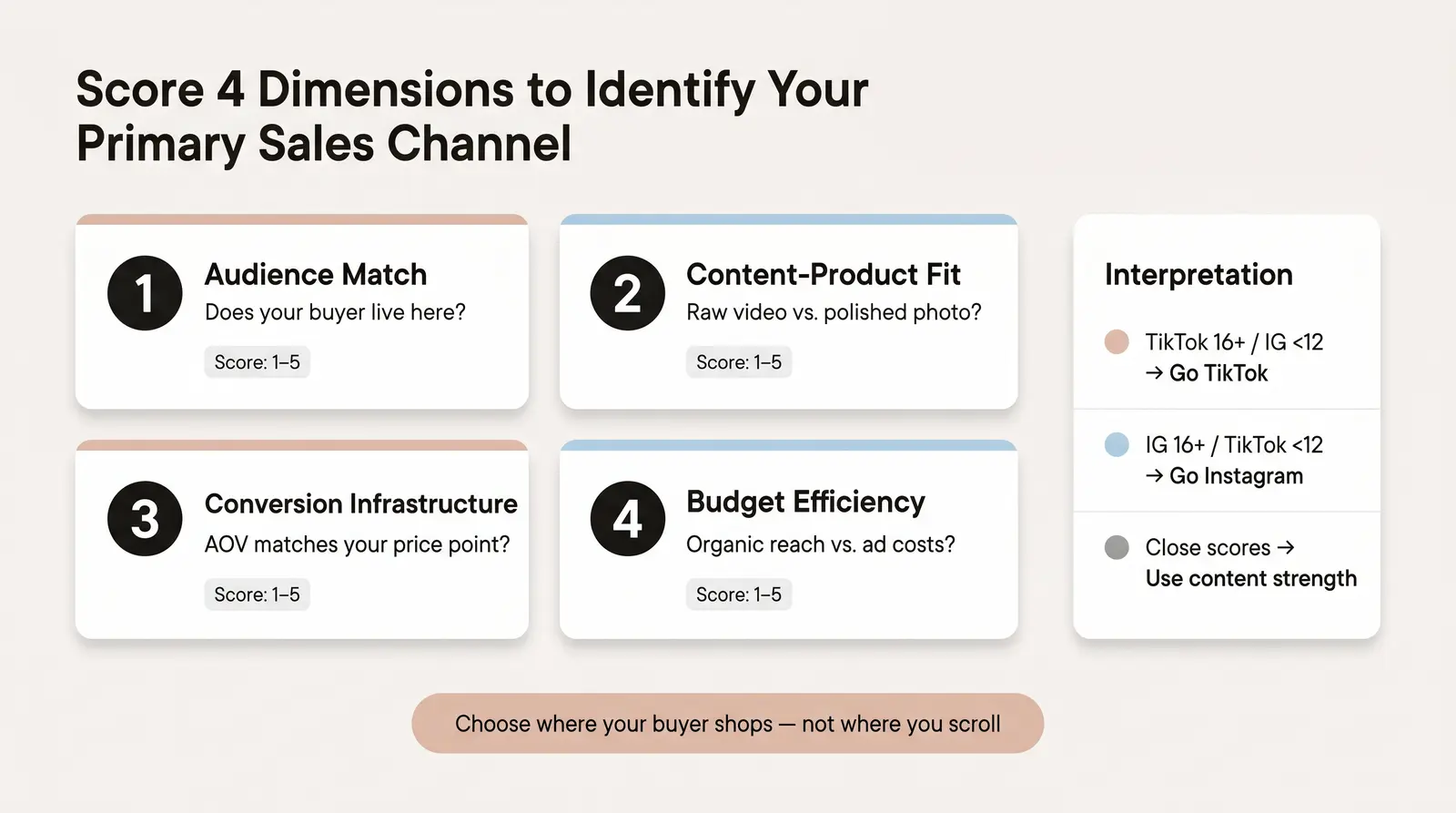
At Branvas, we advise brand founders using a proprietary model to determine their primary sales channel. This framework helps sellers choose based on four scored dimensions. Rate each dimension from 1 to 5 for both platforms, then tally your score.
Interpretation Guide:
In our experience at Branvas, the founders who struggle most are those who choose a platform based on where they personally consume content, not where their buyer shops.
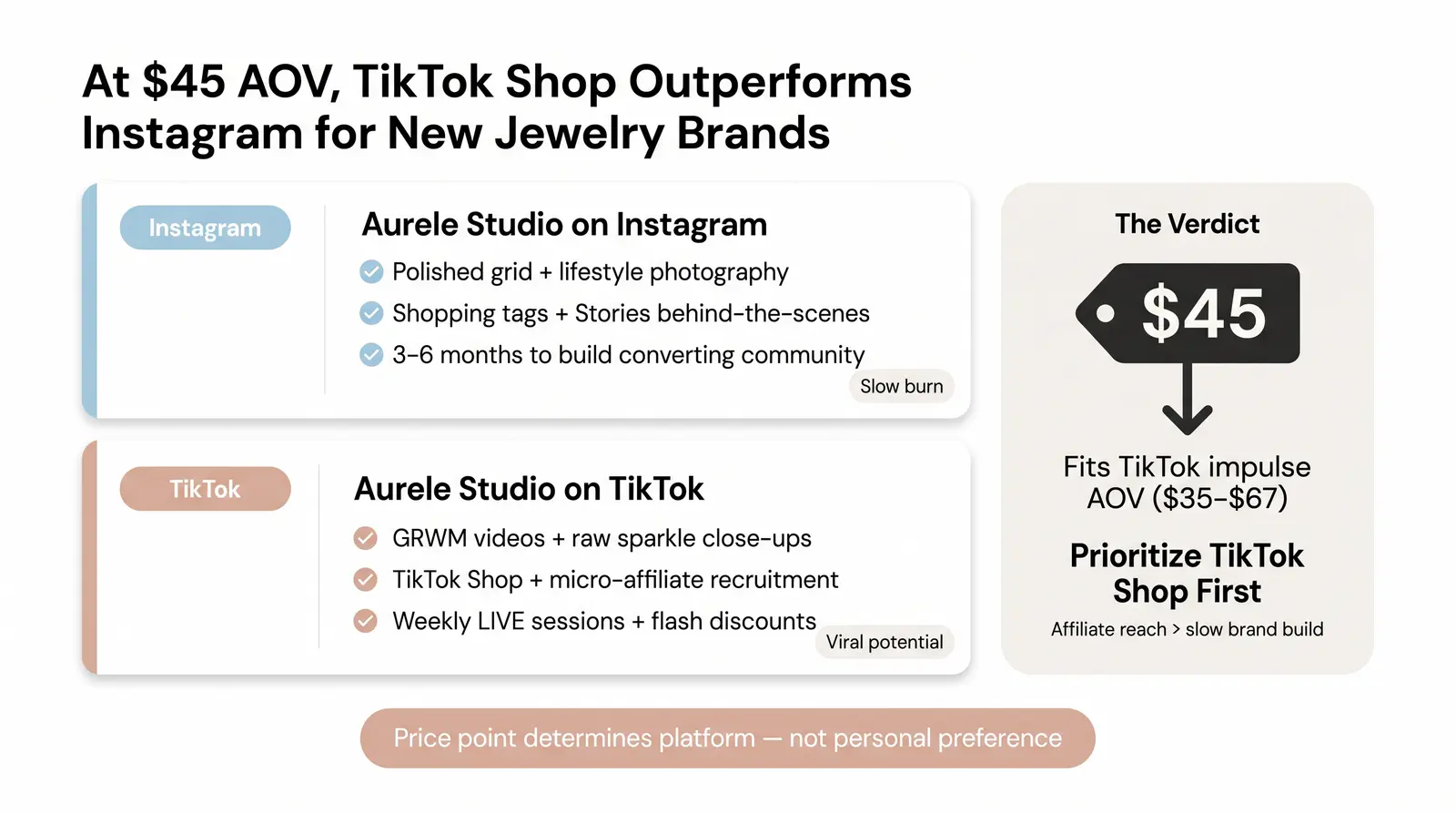
To illustrate how these strategies diverge in practice, let's look at a fictional private-label jewelry brand: Aurèle Studio. Aurèle sells mid-tier, gold-plated minimalist jewelry with an average price point of $45.
The Instagram Strategy for Aurèle Studio
On Instagram, Aurèle Studio must focus on building a premium aesthetic. The grid needs to be visually cohesive, mixing high-quality product photography with aspirational lifestyle shots. The growth strategy relies heavily on Instagram Reels that match the brand's color palette, showcasing how the jewelry elevates an everyday outfit. They will use Shopping tags on every post and leverage Stories for behind-the-scenes glimpses of the design process. Growth will be steady but slow; it may take 3–6 months of consistent posting and strategic influencer gifting to build a loyal community that converts reliably.
The TikTok Strategy for Aurèle Studio
On TikTok, Aurèle Studio abandons the polished grid. Instead, the founder gets in front of the camera. Content focuses on "Get Ready With Me" (GRWM) styling videos, packing orders, and raw, close-up shots showing the jewelry's sparkle under phone flashlights. They immediately set up TikTok Shop and aggressively recruit micro-affiliates to review the pieces. They host weekly LIVE selling sessions to answer questions and offer flash discounts. Because of the algorithm, a single viral video could generate their first 50 sales in week one.
The Verdict for Aurèle Studio
Given the $45 price point (which fits perfectly into TikTok's impulse-buy AOV) and the need for rapid initial sales, Aurèle Studio should prioritize TikTok Shop first. The ability to leverage affiliate creators and organic reach outweighs the slow-burn aesthetic building of Instagram for a bootstrapped launch.
If you're building a jewelry brand like Aurèle Studio, Branvas's catalog and fulfillment infrastructure means you can start creating content on day one — no warehousing required.
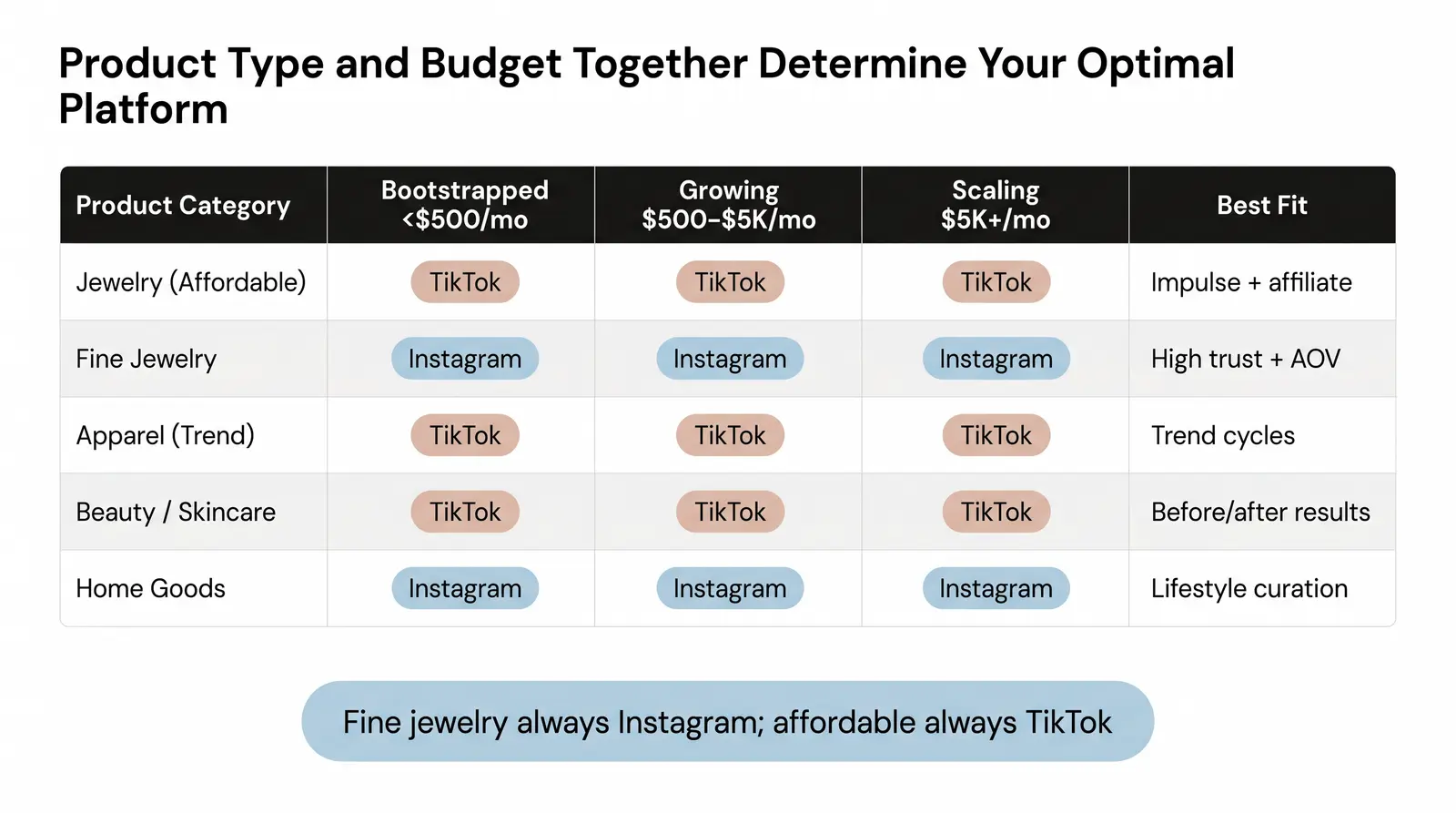
Choosing a platform isn't just about the product; it is about how much capital you have to deploy. Here is our decision matrix mapping categories to platforms based on budget.
| Product Category | Bootstrapped (<$500/mo) | Growing ($500–$5K/mo) | Scaling ($5K+/mo) | Rationale |
|---|---|---|---|---|
| Jewelry (Affordable) | TikTok | TikTok | Both (TikTok Lead) | High visual impact, perfect for impulse buying and affiliate marketing. |
| Fine Jewelry | Requires high trust, aesthetic curation, and supports higher AOVs. | |||
| Apparel (Trend) | TikTok | TikTok | Both | Trend cycles move fastest on TikTok; highly demonstrable. |
| Beauty/Skincare | TikTok | TikTok | Both | Before/after results and tutorials perform exceptionally well on short-form video. |
| Home Goods | Highly aesthetic; buyers want to see how items fit into a curated lifestyle. |
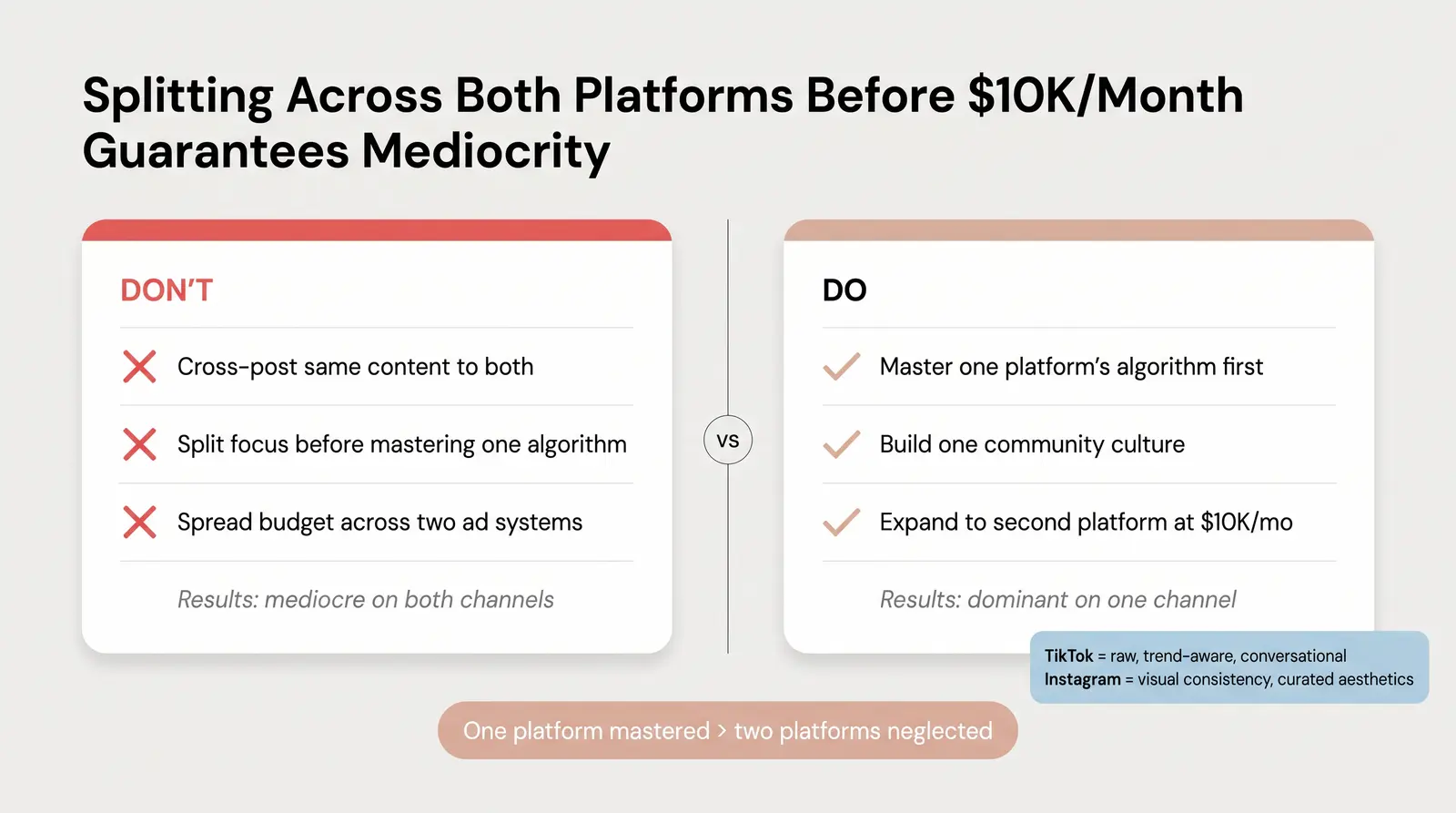
The most common advice given to new ecommerce founders is to "be everywhere." This is terrible advice in 2026. Spreading across both platforms early is a mistake for most founders because it dilutes your focus and guarantees mediocrity on both channels.
TikTok and Instagram require entirely different content muscles. TikTok demands raw, native, trend-aware content that feels conversational. Instagram demands visual consistency, curated aesthetics, and polished Reels. Brands that try to cross-post the exact same content to both platforms usually underperform on both [3].
Until you have the revenue to hire a dedicated team, you only have the bandwidth to master one algorithm, one community culture, and one set of shopping features. Pick the platform that best fits your product and budget, and ignore the other until you reach $10K/month in consistent revenue. The only exception is if you are using an automated syndication tool, but even then, native content will always win.
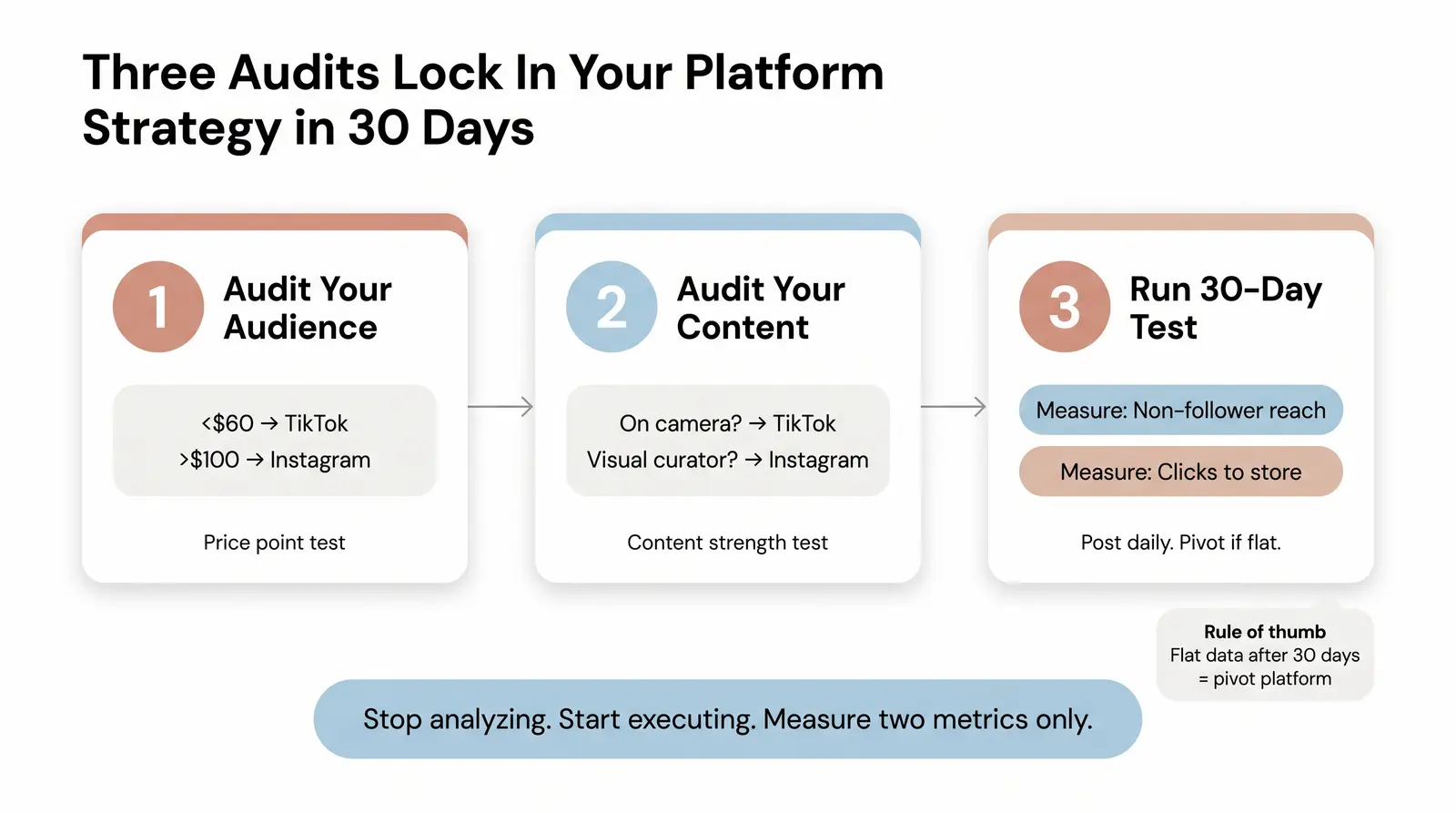
Stop analyzing and start executing. Follow these three steps to lock in your platform strategy:
Founders using Branvas can run this 30-day test aggressively because they don't have to worry about fulfillment bottlenecks if a video goes viral.
1. Is TikTok Shop or Instagram Shopping better for selling jewelry?
It depends entirely on your price point. TikTok Shop is vastly superior for affordable, trend-driven jewelry ($20–$60) due to its high conversion rates on impulse buys and robust affiliate network. Instagram Shopping is better for fine jewelry and premium pieces ($100+) because the platform supports the visual storytelling necessary to build high-trust brand equity.
2. Which platform has better organic reach for new sellers in 2026?
TikTok, without question. TikTok's algorithm evaluates each piece of content independently of follower count, meaning a brand new account can achieve massive reach. Instagram's organic reach has compressed significantly, requiring heavy investment in Reels to reach non-followers.
3. What is the average conversion rate for TikTok Shop vs Instagram Shopping?
TikTok Shop typically sees conversion rates between 3.2% and 5%, with live shopping events occasionally spiking to 8%–12% [5]. Instagram Shopping generally converts at a lower rate of 1.5% to 2.5%, but it compensates with a significantly higher Average Order Value [6].
4. Do I need a big following to sell on TikTok or Instagram?
You do not need a big following to sell on TikTok; the algorithm will push good product content to interested buyers regardless of your audience size. On Instagram, having an engaged following is much more critical for consistent sales, as discovery is harder for new accounts.
5. Can I sell on both Instagram and TikTok at the same time?
Yes, technically you can, but it is not recommended for new sellers. Managing two distinct content strategies, two shopping integrations, and two different algorithms splits your focus. Master one platform first before expanding to the other.
Ready to launch your jewelry brand and start selling on your platform of choice? See how Branvas works →
[1] Social Commerce Statistics Of 2026 (Demographics And Trends) — SellersCommerce, 2026
[2] 47 TikTok Shop statistics you need to know in 2026 — Ringly.io, 2026
[3] TikTok vs Instagram for Business: Which Platform Is Better? — Conbersa, 2026
[4] TikTok vs. Instagram Statistics 2026: Who’s Winning the Social Media Race? — SQ Magazine, 2026
[5] TikTok Shop Statistics 2026: GMV, Sellers & Category Benchmarks — Branvas, 2026
[6] Social Commerce Optimization: TikTok Shop vs Instagram Shopping Performance — ATTN Agency, 2026
[7] TikTok Ads Cost: Minimum Budget, CPC & CPM Rates — AdManage.ai, 2026
[8] Instagram Advertising Costs in 2026: CPM, CPC & CPA Benchmarks — AdLibrary, 2026