


Learn how to sell jewelry on Instagram without inventory using private-label dropshipping, smart product selection, and a 12-step launch checklist.
Published:
March 16, 2026
Author:
Yi Cui
Ready to launch a jewelry brand on Instagram without the risk of holding inventory? This guide covers everything you need: what sells, how to price it, how to brand it, and how to fulfill orders reliably. By the end, you'll have a clear action plan to go from thinking about it to ready to launch.

Yes, Instagram is one of the best channels available for selling jewelry, and the data backs it up. The platform's highly visual format is a natural fit for products that depend on aesthetics to drive desire. Reels, Stories, and Instagram Shopping all create multiple touchpoints where a potential buyer can discover your brand, fall in love with a piece, and complete a purchase without ever leaving the app.
The audience demographics also work in your favor. According to a 2026 report from Capital One Shopping, 70% of global Instagram users shop on the platform, and 81% use it to research new products or brands [1]. Millennials and Gen Z, who together account for over 70% of social buyers in the US, are the primary drivers of social commerce activity and are also among the most active jewelry purchasers online [5]. These are not passive scrollers. They are actively looking for products that resonate with their style and identity.
That said, it's worth being honest about the limitations. Instagram is an algorithm-driven platform, which means visibility is never guaranteed. Sellers who rely entirely on organic reach often find that growth is slow without a consistent posting schedule and a willingness to experiment with different content formats. The platform's commerce policies have also evolved over time, so it's worth reviewing Meta's current guidelines before setting up your shop [3]. Despite these challenges, for a first-time or early-stage seller, Instagram offers a low-cost, high-potential starting point, especially when paired with a fulfillment model that removes the need to hold physical stock.
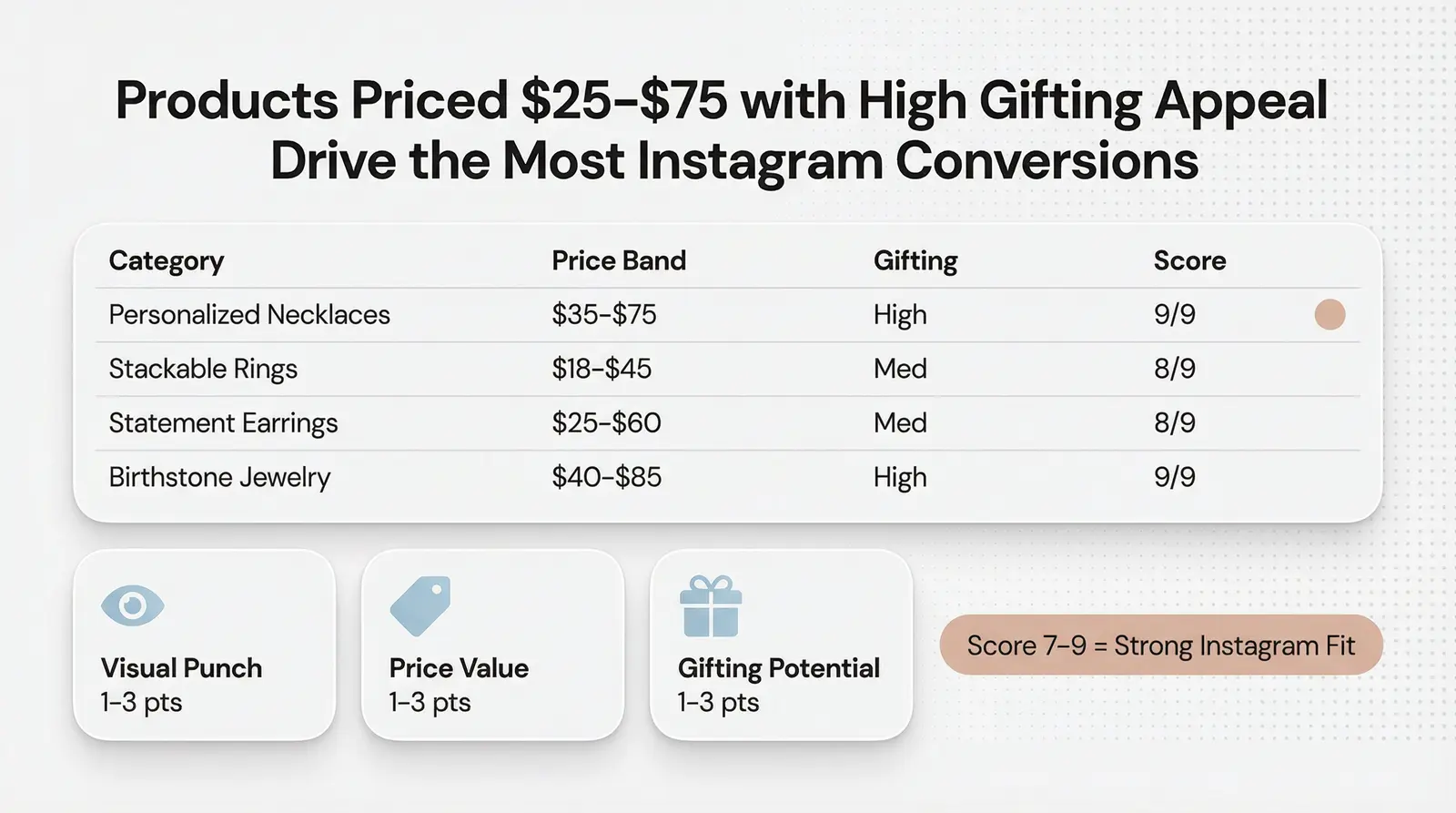
Not all jewelry performs equally well on Instagram. The categories that tend to convert best share a few common traits: they photograph beautifully, they feel like a great deal at first glance, and they have an obvious gifting angle. The sweet spot for impulse-buy conversion on Instagram typically falls between $25 and $75, based on commonly reported data from social commerce sellers. Products priced above $100 can still sell well, but they generally require more trust-building content and a longer consideration period.
Here are seven categories that consistently perform well on the platform.
Before you commit to a product, run it through this quick scoring heuristic. Score your idea on three dimensions, then add up the points. A total of 7-9 means the product is a strong fit for Instagram. A score of 4-6 means it could work but may need stronger creative or a price adjustment. A score of 3 or below suggests you look for a different product.
Your photos are your storefront. On Instagram, the quality of your imagery is directly tied to how much trust a new visitor places in your brand. There are three core shot types every jewelry seller should master.
Flat lays are the bread and butter of jewelry content. Arrange your pieces on a clean, neutral surface and shoot from directly above. The key is simplicity: a white marble board, a linen cloth, or a plain wooden surface all work well. Add one or two complementary props (a dried flower, a small candle) to add context without distracting from the product.
Lifestyle shots show the jewelry being worn in a real-world context. These are your highest-converting content type because they help the viewer imagine themselves wearing the piece. You don't need a professional model. A friend with good skin tone and natural light near a window is enough to get started.
Close-up detail shots are essential for building trust. They show the quality of the finish, the texture of the metal, and the clarity of any stones. These shots perform particularly well in Stories and as the second or third image in a carousel post.
The most common mistake new sellers make is shooting in artificial indoor lighting. It flattens the product and makes metals look dull. Natural light, ideally diffused through a sheer curtain, is almost always better. If you're shooting at night, a ring light is a reasonable investment, but position it carefully to avoid harsh reflections on metallic surfaces.
A strong brand name does three things: it's easy to remember, it's easy to search, and it's available as an Instagram handle. A simple naming formula to start with is [Feeling or Aesthetic Word] + [Material or Silhouette]. Think "Solis Gold," "Luna Hoops," or "Mira Chains." This structure creates a name that is evocative but also descriptive enough to be searchable.
A few practical principles to keep in mind. First, keep it short. Names with two syllables or fewer are easier to remember and type into a search bar. Second, avoid words that are overused in the jewelry space (words like "luxe," "gem," or "sparkle" date quickly and are hard to differentiate). Third, before you commit to a name, it's worth checking for trademark conflicts and confirming the handle is available across Instagram and any other platforms you plan to use. In our experience at Branvas, the sellers who build the strongest brands are the ones who treat their name as a long-term asset from day one.
Packaging is often an afterthought for new sellers, but on Instagram it's a legitimate marketing channel. Unboxing content drives significant organic reach, and branded packaging is what makes that content worth sharing. When a customer receives a package with custom tissue paper, a logo-stamped pouch, and a handwritten-style thank-you card, they are far more likely to film it and post it to their Stories.
The elements that matter most are consistency and intentionality. Your packaging should feel like an extension of your brand, not an afterthought. Custom tissue paper in your brand color, a small card with your logo and a short message, and a branded outer mailer are enough to create a memorable unboxing moment. Private-label services that include branded packaging as part of their offering make this accessible from the very first order, without requiring a large upfront investment in custom materials.

Fulfillment is where many Instagram jewelry sellers run into trouble. The platform is great at generating demand, but if your operations can't keep up, that demand quickly turns into negative reviews and lost customers. Here are the most common pitfalls and how to fix them.
Slow shipping erodes trust fast. On Instagram, the relationship between seller and buyer is often personal. Customers have seen your content, engaged with your posts, and maybe even sent you a DM before buying. When their order takes two weeks to arrive with no tracking update, that trust evaporates. The fix is to partner with a fulfillment service that offers fast processing times and provides tracking information automatically. Set clear shipping expectations in your bio and on your product pages.
Unbranded packaging kills repeat purchases. If you're using a standard dropshipping supplier, your customer's order will likely arrive in a plain poly mailer with the supplier's name on the return label. This is a brand-killing experience. The fix is to use a private-label or blind shipping service, where the package arrives with your branding and no trace of the underlying supplier. Branvas offers blind shipping as a core part of its fulfillment model, which means your customers only ever see your brand.
No visible return policy costs you sales. A significant number of potential buyers will check your return policy before making a first purchase. If they can't find one, they often won't buy. The fix is simple: create a clear, easy-to-understand return policy and link to it in your bio. A 14-day return window for unworn items is a common standard that balances customer confidence with seller protection.
Overselling before confirming inventory. This is a particularly painful mistake. You post a product, it goes viral, and then you discover your supplier is out of stock. The fix is to work with a fulfillment partner that provides real-time inventory data, or to start with a small, curated collection of products you've verified are consistently available.
No process for handling complaints publicly. On Instagram, a complaint in the comments is visible to everyone. If you don't have a process for responding quickly and professionally, it can damage your brand's reputation. The fix is to respond to every complaint promptly, move the conversation to DMs, and resolve it generously. A customer who had a problem and got it fixed quickly is often more loyal than one who never had an issue.
If you're evaluating fulfillment partners, Branvas's how-it-works page walks through the full model.
This checklist follows the logical order of a jewelry brand launch, from defining your niche to scaling your first wins.
Ready to skip the sourcing headache? Launch your private-label jewelry brand with Branvas. Product sourcing, branding, and fulfillment handled for you.

Q: Do I need a business account to sell jewelry on Instagram?
A: Yes. You need an Instagram Business Account to access Instagram Shopping, product tagging, and performance analytics. Converting from a personal account is free and takes only a few minutes in your account settings.
Q: How much does it cost to start selling jewelry on Instagram?
A: Startup costs can be very low if you use a private-label dropshipping model, since you won't need to purchase inventory upfront. Your main ongoing costs will typically include a Shopify subscription, any paid advertising you choose to run, and the per-order cost from your fulfillment partner.
Q: Can I sell jewelry on Instagram without holding inventory?
A: Yes. Private-label dropshipping services handle sourcing, branding, and fulfillment on your behalf. You sell the product under your brand name, and the supplier ships directly to your customer without you ever touching the inventory.
Q: What's the best way to price jewelry for Instagram?
A: A common approach is to start with your product cost and apply a 3x to 4x markup to arrive at a retail price. For Instagram specifically, products priced between $25 and $75 tend to convert well as impulse purchases. Products above $100 can still sell, but they typically require more social proof and trust-building content.
Q: How do I handle returns as a small jewelry seller on Instagram?
A: Publish a clear return policy in your bio and on your store. A standard 14-day return window for unworn items is a reasonable starting point. If you use a fulfillment partner, confirm their return handling process before you launch so you're not caught off guard by your first return request.