


This guide sequences 10 free marketing channels for ecommerce brands, showing how to build compounding organic traffic through SEO, email, content, and Pinterest without ad spend.
Published:
July 7, 2026
Author:
Yi Cui
Customer acquisition costs keep rising. For most ecommerce brands, the math on paid-only acquisition is breaking. Between 2023 and 2025, ecommerce CAC jumped roughly 40% to 60%, reaching an average of $68 to $84 across categories [1]. Meta's median cost per acquisition hit $38.17 in 2025, and Google Shopping CPCs jumped nearly 34% year-over-year [1]. TikTok CPMs climbed 16% in the same period [1]. Every major paid channel is getting more expensive, and the trend isn't reversing.
This article is not a bag of tricks for getting your first sale. It is a compounding organic acquisition system for ecommerce and product-brand owners who are past the testing phase and want to build traffic that doesn't evaporate when the ad budget runs dry.
Let's be honest about the cost of organic marketing. It costs time, consistency, and content production resources. A blog post takes hours to write. SEO takes months to compound. Building an email list requires a real offer and a real strategy.
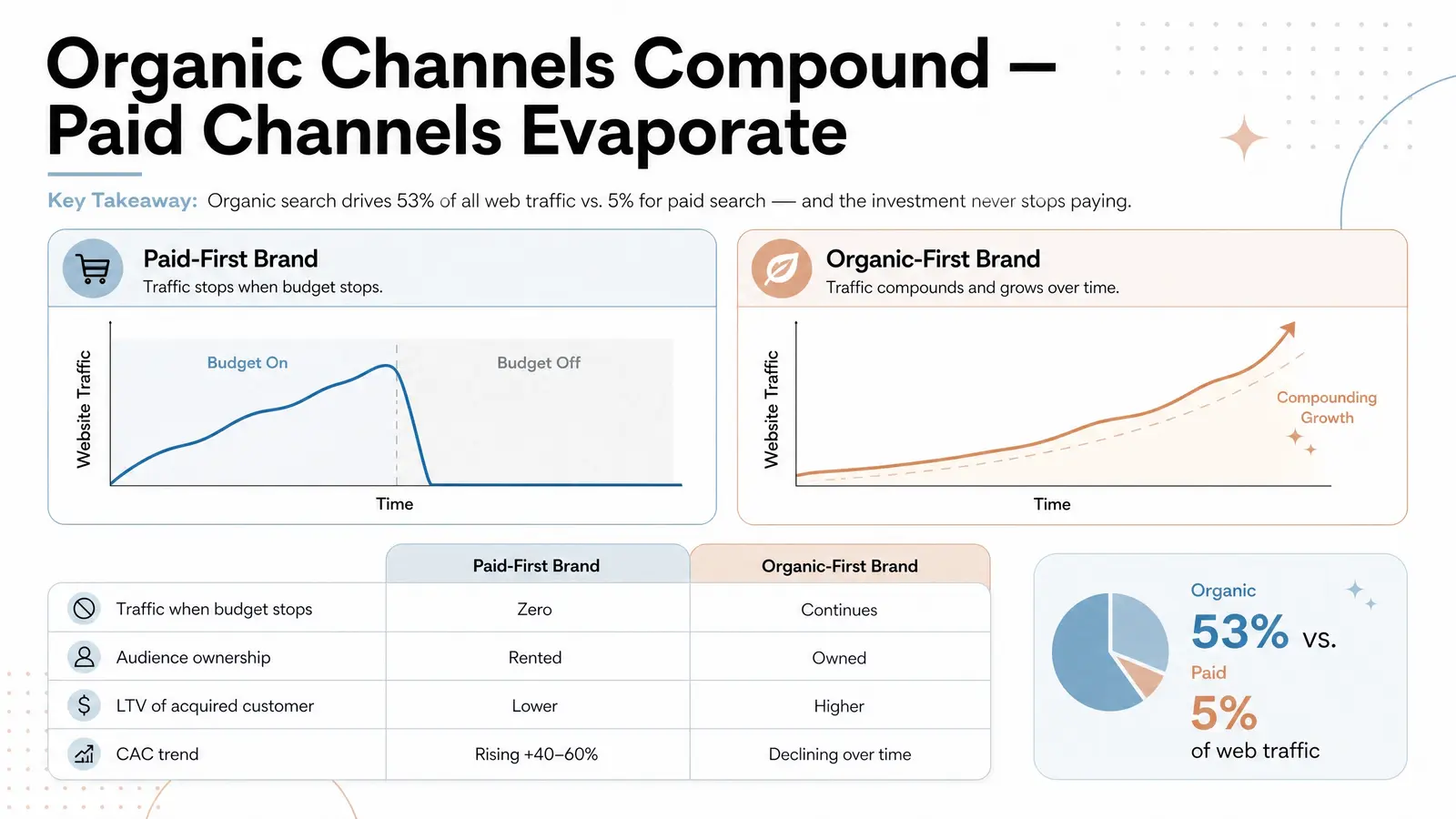
But unlike paid ads, organic investments compound. A well-optimized product page, a YouTube video, or a strong backlink profile keeps paying dividends for years. Organic search drives about 53% of all website traffic, making it the dominant channel by a wide margin [2]. Paid search accounts for just 5% [2].
Here is the non-obvious insight most brands miss: they sequence channels wrong. They treat organic as a backup to paid, when structurally it should be the foundation. Starting with organic, even when it is slow, creates a defensible brand moat. Paid-first brands are perpetually renting their audience. When you turn off the ad spend, the traffic stops. Every dollar and hour spent optimizing a paid funnel is a dollar and hour not invested in an asset that compounds.
The opportunity cost framing matters here. Customers acquired through owned channels, like email and organic search, consistently show higher lifetime value than paid-acquired customers, because the relationship starts with intent rather than interruption.
The Branvas Organic Channel Stack is a prioritization and sequencing model for ecommerce brands building free traffic. This is the framework we use when advising new brand owners on where to invest their time before scaling ad spend.
The framework organizes channels across two axes: Time-to-First-Result (how quickly you can expect to see any return) and Compounding Velocity (how much more valuable the channel becomes over time with consistent investment).
| Channel | Time-to-First-Result | Compounding Velocity | Best For | Effort Level |
|---|---|---|---|---|
| SEO (on-page + technical) | 3-6 months | Very High | Long-term discovery | Medium-High |
| Content Marketing (blog/video) | 1-4 months | Very High | Authority + SEO flywheel | High |
| Email List Building | Immediate (list), weeks (revenue) | High | Retention + repeat purchase | Medium |
| Pinterest / Visual SEO | 2-6 months | High | Product discovery, especially jewelry/fashion | Medium |
| Social Media (organic) | Days-weeks | Medium | Brand awareness, community | Medium-High |
| User-Generated Content (UGC) | 1-4 weeks | Medium-High | Trust + social proof | Low-Medium |
| Strategic Partnerships / Collabs | 2-8 weeks | Medium | Audience borrowing | Medium |
| PR + Earned Media | 1-3 months | Medium | Authority + backlinks | Medium-High |
| Community / Forum Marketing | Weeks | Medium | Niche trust-building | Medium |
| Referral / Word-of-Mouth | Weeks-months | High | Highly qualified traffic | Low |
The recommended sequencing logic breaks into three phases.
Phase 1: Foundation (Months 1-3). SEO fundamentals, email capture, and on-site content. Before you build an audience anywhere else, your site needs to be technically sound and your email capture needs to be live. These are the assets that compound everything else.
Phase 2: Amplification (Months 3-6). Content marketing flywheel, UGC activation, Pinterest, and one social platform. Once the foundation is in place, you start feeding the engine. Content drives SEO. UGC builds trust. Pinterest extends your reach into visual search. Social media builds community.
Phase 3: Leverage (Month 6+). PR and earned media, partnerships, referral program, and community. At this point, you have an audience, some content, and some proof. Now you use those assets to borrow other audiences, earn press, and turn customers into advocates.
In our experience at Branvas, founders who try to run all channels simultaneously end up doing none of them well. Sequencing is everything.

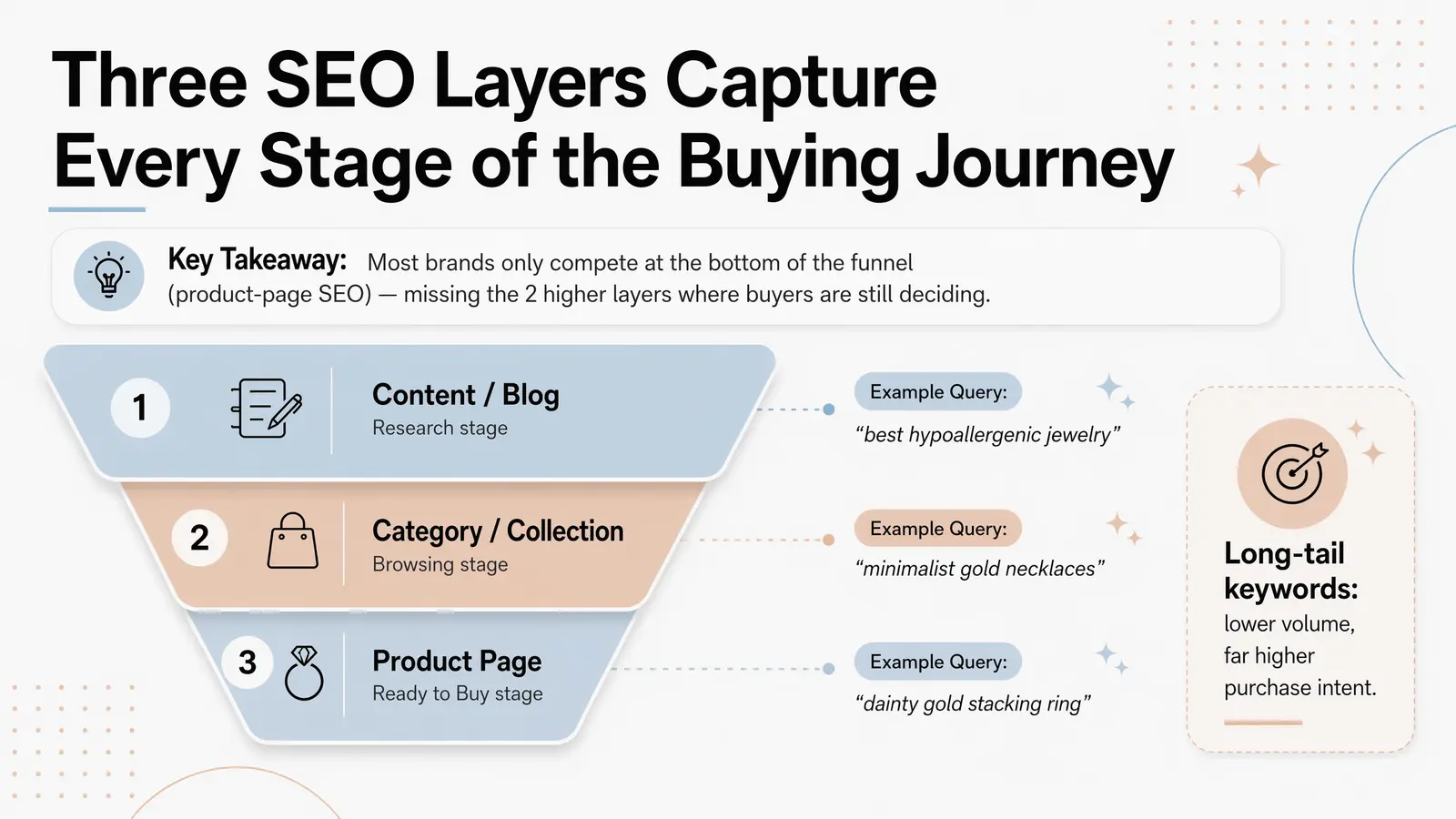
Most ecommerce brands only focus on product-page SEO. They optimize the product title and description and call it done. But they miss two other critical layers: collection and category SEO, and content and blog SEO.
Product-page SEO targets buyers who already know what they want. Category SEO targets buyers who are browsing a type of product. Content SEO targets buyers who are still in the research phase, asking questions like "what is the best hypoallergenic jewelry for sensitive skin?" Each layer captures a different stage of the buying journey, and most brands only compete at the bottom.
Keyword research for buyer intent is the starting point. You want to find queries where the searcher has clear commercial intent, not just curiosity. Internal linking is critical to guide search engines through your site hierarchy and pass authority from high-traffic content pages to your product and collection pages. Implement structured data (schema markup) for products so search engines can display rich snippets like prices, availability, and reviews directly in the search results. Page speed and Core Web Vitals are also ranking factors, and a slow site hurts both rankings and conversion rates.
For niche product brands, long-tail and category-specific keywords convert far better than broad terms. A jewelry brand will never outrank Zales or Kay for "gold rings." But they can absolutely rank for "dainty gold stacking rings for women" or "minimalist gold-filled necklace for layering." These long-tail queries have lower search volume but much higher purchase intent, and the competition is far more manageable.
The key insight is that organic search rewards specificity. The more precisely you match the language your ideal customer uses, the more likely you are to rank and convert.
Content marketing is the engine that powers long-term SEO. It targets informational queries that bring top-of-funnel readers who later convert. The mechanism is straightforward: someone searches "how to style gold layered necklaces," finds your blog post, reads it, discovers your brand, and eventually buys.
The strategy requires content pillars and topic clusters. A content pillar is a comprehensive guide on a broad topic, like "The Complete Guide to Jewelry for Sensitive Skin." Topic clusters are supporting articles that link back to the pillar, covering related subtopics like "best metals for sensitive ears" or "hypoallergenic earring materials explained." This structure signals topical authority to search engines and improves rankings across the entire cluster.
Internal linking is the connective tissue. Every blog post should link to relevant product and collection pages. This passes SEO authority from your content to your commercial pages and creates a natural path for readers to become buyers.
For product brands, content must bridge lifestyle and product. A blog post about "how to build a capsule jewelry collection" is educational, but it should also link to your minimalist gold collection and include real product recommendations. Content with no commercial thread is a missed opportunity.
Repurposing is where the ROI multiplies. One well-researched blog post can become a Pinterest pin, a short-form video script, an email newsletter, and a series of social media posts. Each piece of content should work in three to four formats.
If you're building a product brand and not sure where to start with content, Branvas Academy offers resources specifically for ecommerce brand builders.
Email is the highest-ROI channel in ecommerce, period. For every $1 spent on email marketing, businesses see an average return of $36 [3]. Retail and ecommerce have the highest email ROI of any sector, reaching 4500% [3]. Automated workflows generate 30 times higher returns compared to one-off campaigns [3].
The reason email outperforms every other channel is ownership. You own your list. No algorithm change, no platform policy update, no ad auction can take it from you. That is a fundamentally different risk profile than any social or paid channel.
List-building starts with a compelling reason to subscribe. A lead magnet, like a style guide or a discount, works well for product brands. Pop-ups with exit intent or scroll triggers capture visitors who are already engaged. Post-purchase sequences are often overlooked but highly effective, because someone who just bought from you is at peak engagement with your brand.
Every ecommerce brand needs five core email flows: a welcome series that introduces the brand and drives a first purchase, an abandoned cart sequence that recovers lost revenue, a post-purchase flow that builds loyalty and encourages a second purchase, a re-engagement campaign for dormant subscribers, and back-in-stock notifications for high-demand products.
The non-obvious insight is that most ecommerce brands underinvest in post-purchase email sequences. Yet this is where lifetime value is built. A customer who buys twice is far more valuable than two single-purchase customers. The probability of selling to an existing customer is 60% to 70%, compared to 5% to 20% for a new prospect [1].
Pinterest is one of the most underrated channels for product-first brands, especially in jewelry, fashion, and home goods. It functions as a visual search engine with high buyer intent, not a social media platform where content disappears in 24 hours.
The numbers are compelling. Pinterest reaches 619 million monthly active users globally [4]. Around 40% of US households earning over $150K are on the platform [4]. About 96% of Pinterest searches are unbranded, meaning users are searching for ideas and products, not specific brands. That is a massive opportunity for discovery. And 85% of weekly Pinners have made a purchase based on a brand Pin [4].
The key difference from Instagram is shelf life. An Instagram post is essentially dead after 24 to 48 hours. A well-optimized Pinterest pin can continue driving traffic for months or years. Pinterest functions more like SEO than social media.
To make Pinterest work, use keywords in your pin titles and descriptions, the same way you would optimize a blog post. Create boards that reflect how your customers shop and search, not just how you categorize your products. Use Rich Pins for products to automatically sync pricing and availability. And create pins that are visually compelling at a small size, because most users are browsing on mobile.
Organic social reach has declined significantly on most platforms. The days of posting a product photo and getting meaningful reach for free are largely over. But organic social still works when used correctly, for community building, trust signals, and UGC amplification.
The most important decision is platform selection. Do not spread yourself across every channel. Pick one platform where your target customer is most active and go deep before expanding. For jewelry and accessories brands, Instagram and TikTok are the natural starting points. For home goods, Pinterest and Instagram. For B2B or professional products, LinkedIn.
Content formats that still get organic reach include Reels and short-form video on Instagram and TikTok, Stories for engagement and behind-the-scenes content, and carousel posts for educational or inspirational content. Consistency matters more than virality. Showing up three times a week with quality content will outperform posting once a week hoping for a viral moment.
Frame social media as a brand trust amplifier, not a primary traffic driver. When someone discovers your brand through SEO or Pinterest, they will often check your social media before buying. A consistent, active social presence converts those visitors into customers. It is the trust layer of your organic stack.
Product brands that invest in great packaging get a bonus: organic unboxing content. Customers who receive a beautiful, well-branded package will often share it. That UGC drives discovery and social proof simultaneously.
Strategic Partnerships and Collabs. Audience-borrowing without ad spend. Approach complementary brands, for example a jewelry brand partnering with a clothing boutique, to co-host giveaways, cross-promote to each other's email lists, or create co-branded content. The key is finding brands with overlapping audiences but no direct competition.
PR and Earned Media. Pitching product features, gift guides, and press coverage is a high-leverage activity. A single feature in a relevant publication can drive traffic, build backlinks, and establish credibility. Use platforms like Connectively (formerly HARO) to find journalists looking for product recommendations. Focus on gift guides and roundups, which are evergreen and continue driving traffic long after publication.
Referral Programs. Turning existing customers into acquisition channels is one of the highest-ROI moves available to a product brand. Referral traffic is high-intent because it comes from a trusted source. A simple program offering a discount to both the referrer and the new customer can generate a meaningful percentage of new orders at near-zero cost.
Community Marketing. Showing up in niche forums, Reddit threads, Facebook groups, or Discord servers as a genuine contributor, not a spammer, builds trust and drives qualified traffic. The rule is simple: provide value first, always. Answer questions, share expertise, and only mention your brand when it is genuinely relevant.

Here is a realistic scenario. An entrepreneur launches a private-label jewelry brand featuring a collection of minimalist gold-filled pieces. They have zero ad budget and six months to build organic traffic.
Month 1. They start with a technical SEO audit: fixing crawl errors, improving page speed, adding product schema markup, and ensuring the site is mobile-optimized. They set up an email capture pop-up with a 10% discount offer and connect it to a welcome flow in Klaviyo. They publish two blog posts targeting long-tail queries: "how to layer gold necklaces without tangling" and "best hypoallergenic earrings for sensitive ears." Neither ranks immediately, but the content is indexed.
Month 2-3. They create a Pinterest business account and set up five boards: Minimalist Jewelry, Gold Jewelry Styling, Earring Inspo, Gift Ideas for Her, and Hypoallergenic Jewelry. They create five to ten pins per board, each optimized with keyword-rich descriptions. They set up an automated post-purchase email asking first customers to share a photo wearing their jewelry in exchange for a discount on their next order. They choose Instagram as their one social platform and commit to posting four times per week. They also send one PR pitch to a lifestyle blog running a "best jewelry gifts under $50" roundup.
Month 3-4. The first blog posts start appearing in search results for long-tail queries. Pinterest pins begin getting repinned. The email list grows to 200 subscribers. The first UGC photos come in from customers and get shared on Instagram. The PR pitch lands, securing a feature in the gift guide with a backlink to the site.
Month 4-6. Compounding accelerates. The blog posts are now ranking on page one for several long-tail queries and driving consistent organic traffic. Pinterest is generating 200 to 300 sessions per month on its own. The email list hits 500+ subscribers. A referral program is launched, offering $10 off for both the referrer and the new customer. The press mention continues driving referral traffic.
By month six, targeting 1,000 organic sessions per month from SEO and Pinterest alone is realistic for a niche product brand. The traffic mix is diverse, sustainable, and highly qualified compared to a purely paid competitor who is constantly battling rising CAC and creative fatigue.
Brands that launch through Branvas start with an advantage here. Because sourcing, packaging, and fulfillment are handled, founders can redirect energy toward building their organic acquisition engine from day one. See how it works, and use the profit calculator to model what your margins look like with organic traffic as your primary acquisition channel.

The debate shouldn't be framed as SEO vs. paid ads. It is about sequencing and role clarity.
Paid ads are best for validating offers fast, scaling proven winners, and running time-sensitive promotions. They provide immediate feedback on what resonates with your audience. Organic and SEO are best for building durable discovery, reducing long-run CAC, and owning your audience relationship.
The risk of a paid-only strategy is platform dependency, margin compression, and constant CAC inflation. The risk of an organic-only strategy is a slow start that requires patience and consistency. The recommended model is to use organic as the foundation and use paid selectively to accelerate proven content or offers.
| Dimension | Paid Ads | Organic / SEO |
|---|---|---|
| Cost Structure | Pay per click or impression | Time and content production |
| Time to Result | Immediate | 3-6+ months |
| Scalability | High, but gets more expensive | High, with compounding value |
| Ownership | Renting the audience | Owning the audience |
| Risk Profile | Platform changes, rising CAC | Slow start, requires consistency |
| Best Use Case | Validating offers, promotions | Durable discovery, lowering CAC |
The brands that win long-term are the ones that use paid ads to learn and organic to scale. They test offers with small paid budgets, identify what converts, and then build organic content and SEO around those proven winners.

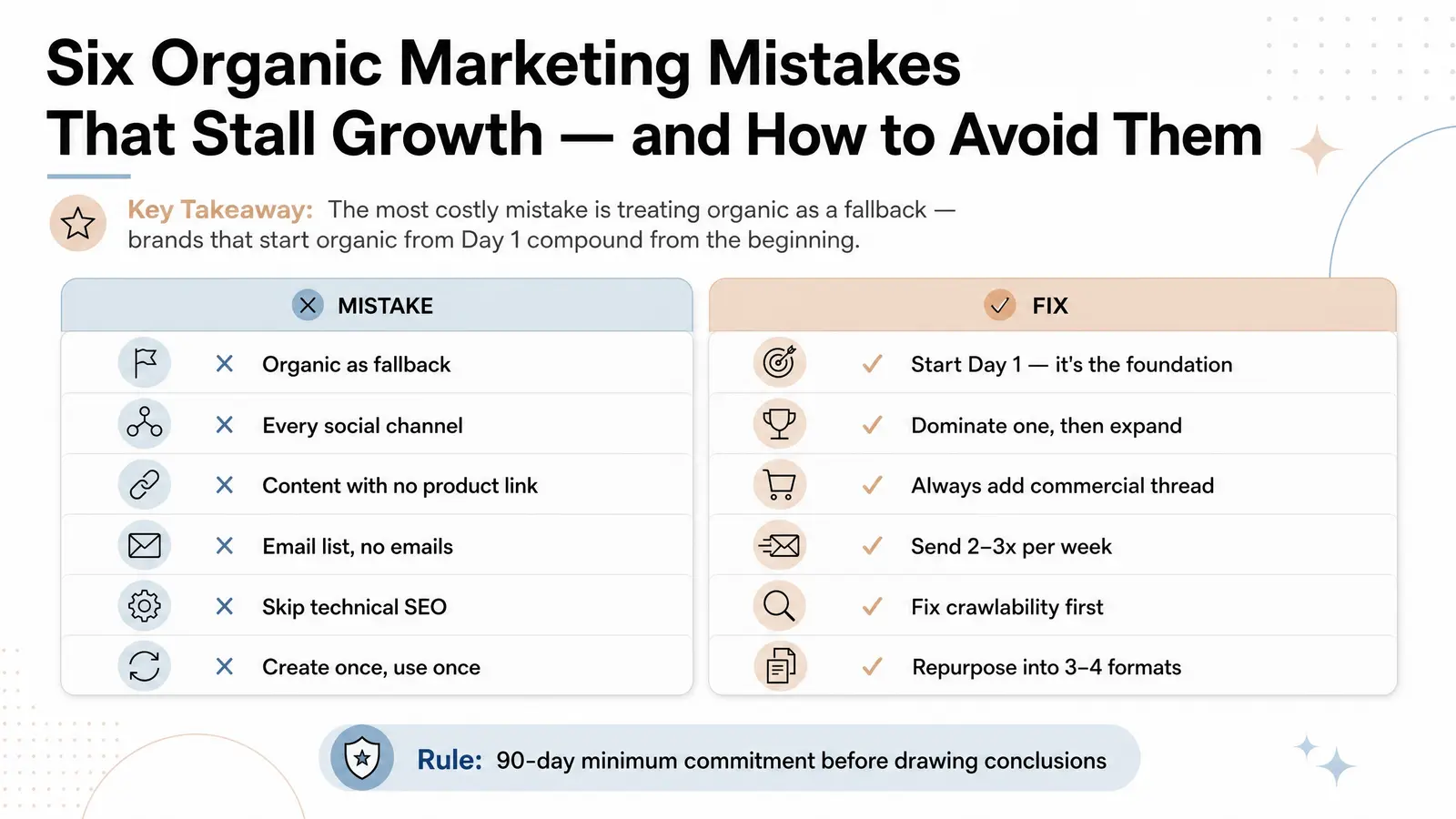
1. Treating organic as a fallback when ad budgets run out. This is the most common and most costly mistake. Organic should be the foundation of your acquisition strategy, not a consolation prize. Brands that start building organic channels on day one are compounding from the beginning. Brands that wait until paid ads stop working are starting from zero with urgency.
2. Spreading across every social channel instead of dominating one. Trying to maintain a presence on Instagram, TikTok, Pinterest, YouTube, and Facebook simultaneously leads to burnout and mediocre content everywhere. Pick one platform, go deep, build an audience, and then expand.
3. Creating content with no connection to product or purchase intent. Educational content is valuable, but it needs a commercial thread. A blog post about "the history of gold jewelry" might get traffic, but it will not convert. A blog post about "how to choose the right gold karat for everyday wear" gets similar traffic and naturally leads to your product collection.
4. Building an email list but never mailing it. Collecting emails is only half the battle. Brands that set up a pop-up, grow a list to 1,000 subscribers, and then send one email per month are leaving significant revenue on the table. A consistent email cadence, even two to three emails per week, drives far more revenue than sporadic campaigns.
5. Ignoring technical SEO while producing content. Great content won't rank if your site speed is terrible, crawlability is broken, or structured data is missing. Technical SEO is the foundation that makes all your content work. Fix it first.
6. Not repurposing content across channels. Each piece of content should work in three to four formats. A blog post becomes a Pinterest pin, a short-form video script, an email newsletter, and a series of social posts. Brands that create once and distribute widely get far more value from their content investment.
We often see brand owners at Branvas make this exact mistake in the early months. They publish three blog posts, don't see immediate traffic, and abandon the channel. Organic content requires a 90-day minimum commitment before drawing conclusions.
1. How long does it take to get organic traffic to an ecommerce store?
Organic traffic typically takes 3 to 6 months to start showing meaningful results. SEO is a long game. It requires consistent effort in content creation, technical optimization, and link building. Some long-tail keywords may rank faster, particularly if competition is low. But building domain authority and seeing consistent organic traffic takes time. The brands that win at SEO are the ones that commit to it for 12+ months without expecting overnight results.
2. What is the best free marketing channel for a new ecommerce brand?
Email marketing is arguably the best channel once you have a list, offering the highest ROI of any channel. But for initial discovery, long-tail SEO and Pinterest are excellent starting points for visual product brands. They offer high compounding velocity and long-term value. The right answer depends on your product category: visual products like jewelry and home goods benefit enormously from Pinterest, while brands with strong educational content can build significant SEO traffic relatively quickly.
3. Can I grow an ecommerce store without paid ads?
Yes. Many successful brands have built their foundations entirely on organic traffic. It requires a strategic approach to SEO, content marketing, email, and community building. It will take longer than turning on paid ads, but the resulting traffic is more sustainable, more profitable, and more defensible. The key is committing to the long game and not abandoning channels before they have time to compound.
4. How much content do I need to publish to see SEO results?
Quality matters more than quantity. Focus on creating comprehensive, authoritative content that fully answers the searcher's intent. One well-researched, well-optimized 1,500-word article will outperform ten thin 300-word posts. Aim for one to two high-quality articles per week, supported by strong internal linking and technical SEO. Consistency over time matters more than volume in any single month.
5. Is social media or SEO better for ecommerce traffic?
They serve different purposes and work best together. SEO is better for capturing high-intent traffic from users actively searching for solutions. It provides durable, long-term traffic that compounds over time. Social media is better for brand awareness, community building, and visual inspiration. A balanced strategy uses SEO for discovery and social media for trust and engagement. For most product brands, SEO drives more traffic and more conversions, while social media converts the visitors that SEO brings in.
[1] 45 Ecommerce Customer Acquisition Cost Statistics for 2026 — Ringly, 2026
[2] How Much Traffic Is From Organic Search — SEO Inc, 2026
[3] Email Marketing ROI Statistics: The Ultimate List for 2026 — Emailmonday, 2026
[4] 29 Essential Pinterest Statistics for Marketers in 2026 — Sprout Social, 2026
[5] The True Cost of Social Media Ads in 2025 — Gupta Media, 2025
[6] Google Ads Benchmarks 2024: New Trends and Insights for Key Industries — WordStream, 2024
[7] 107 SEO Statistics for 2026 — Ahrefs, 2026