


The Branvas First-Year Arc framework guides ecommerce founders through four sequential stages—Exploration, Validation, Momentum, and Scale—to avoid premature scaling and build profitable brands.
Published:
September 22, 2026
Author:
Yi Cui
Branvas's 4-stage framework categorizes new ecommerce brands as Explorers, Validators, Momentum builders, or Scalers. Knowing which one you are right now is the difference between making smart decisions and making expensive ones.
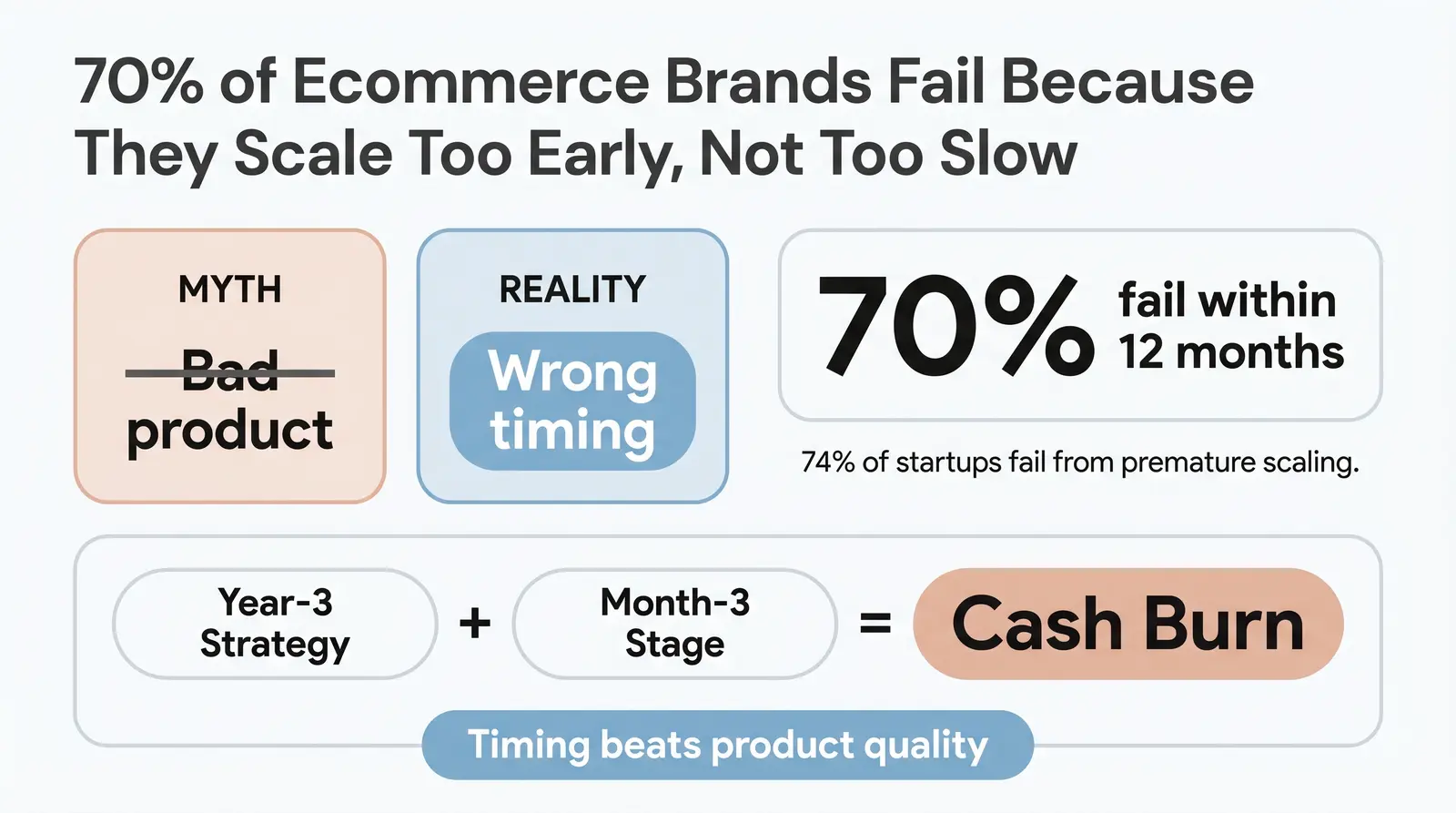
The reality of launching an online store is stark. Approximately 70% of ecommerce businesses fail within their first twelve months, a rate more than double the average for traditional startups [1]. That number is not a warning about the difficulty of the market. It is a warning about sequencing. Most founders who fail are not selling bad products. They are executing year-three strategies in month three, burning through capital before they have established the proof needed to justify it.
The core thesis is this: ecommerce failure is usually a timing problem, not a product problem. According to the Startup Genome Report, 74% of high-growth internet startups fail because they scale prematurely, spending on customer acquisition, team, and infrastructure before validating their core business model [2]. The pattern is the same in ecommerce. A founder sees a 2x ROAS on a small Meta Ads test and immediately scales to $5,000 a month in spend. Six months later, they are out of cash and wondering what went wrong.
To address this, we built a framework called The Branvas First-Year Arc.
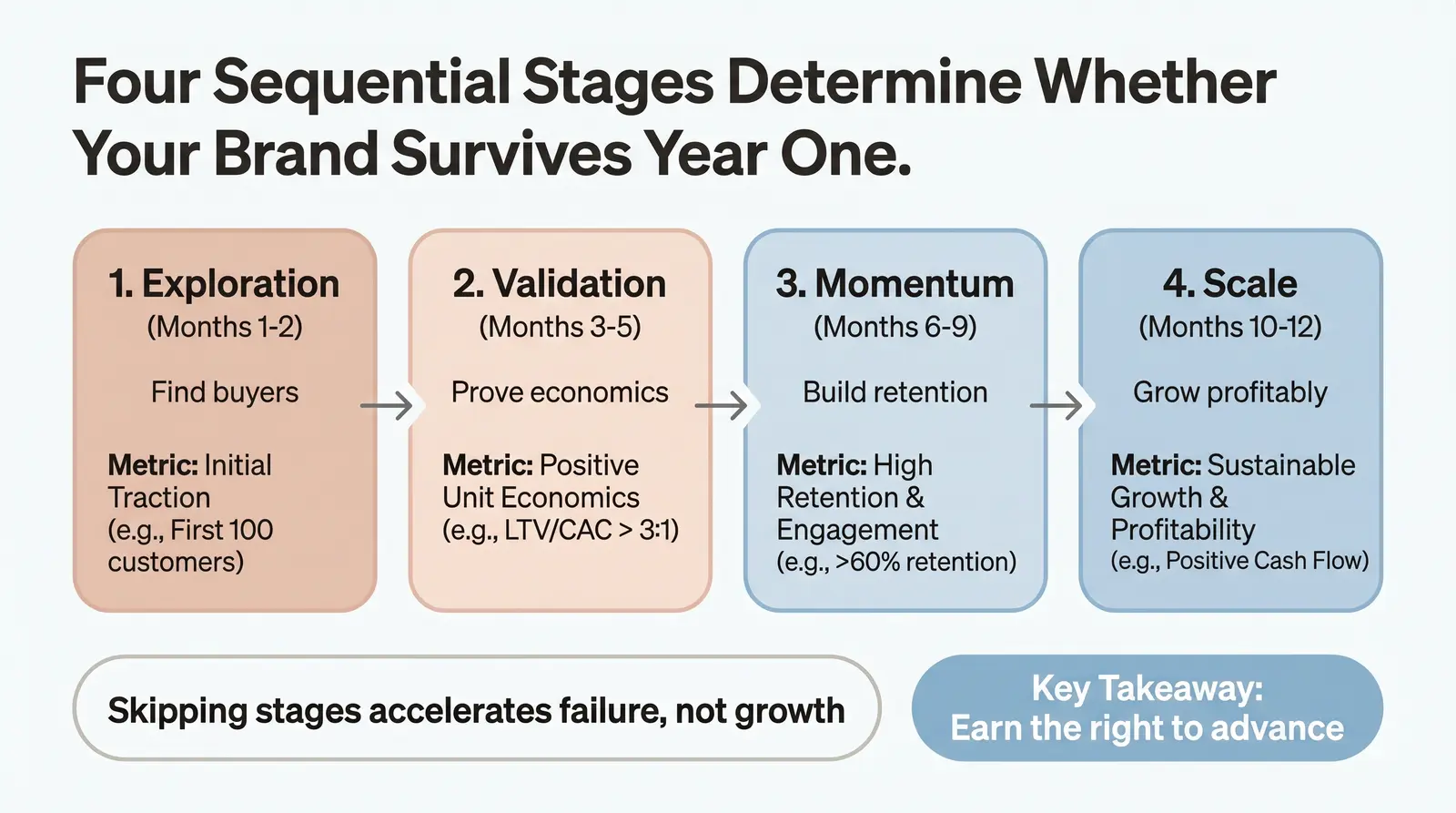
The Branvas First-Year Arc emerged from patterns observed across hundreds of Branvas members. In our experience working with early-stage founders, the brands that make it to month twelve share one behavioral trait: they resist the urge to skip stages. They treat each phase as a distinct research project with its own success criteria, and they do not advance until they have earned the right to.
The framework divides the first year into four stages: Exploration (Months 1-2), Validation (Months 3-5), Momentum (Months 6-9), and Scale (Months 10-12). Each stage has a specific founder focus, a set of metrics to track, a primary challenge, and a stage gate, a concrete milestone that signals readiness to move forward.
The logic is sequential. You cannot optimize what you have not validated. You cannot scale what you have not optimized. Skipping stages does not accelerate growth. It accelerates failure.
| Stage | Months | Primary Focus | Key Metrics | #1 Challenge | Stage Gate Decision |
|---|---|---|---|---|---|
| Exploration | 1-2 | Product-market fit and organic traction | Site traffic, conversion rate, email subscribers, first-sale count | Converting strangers into buyers without paid ads | 10 organic sales from non-friends/family |
| Validation | 3-5 | Unit economics and customer proof | AOV, gross margin, return rate, repeat purchase rate | Staying profitable while testing acquisition channels | 1.4% conversion rate with positive unit economics |
| Momentum | 6-9 | Repeat purchases and operational stability | Repeat purchase rate, CAC, ROAS, email revenue | Managing fulfillment and inventory at growing volume | 15% repeat purchase rate with stable ROAS above 2x |
| Scale | 10-12 | Profitable acquisition at volume | LTV, blended ROAS, contribution margin, email list size | Scaling ad spend without compressing margins | Profitable growth at 3x initial ad spend, contribution margin above 20% |
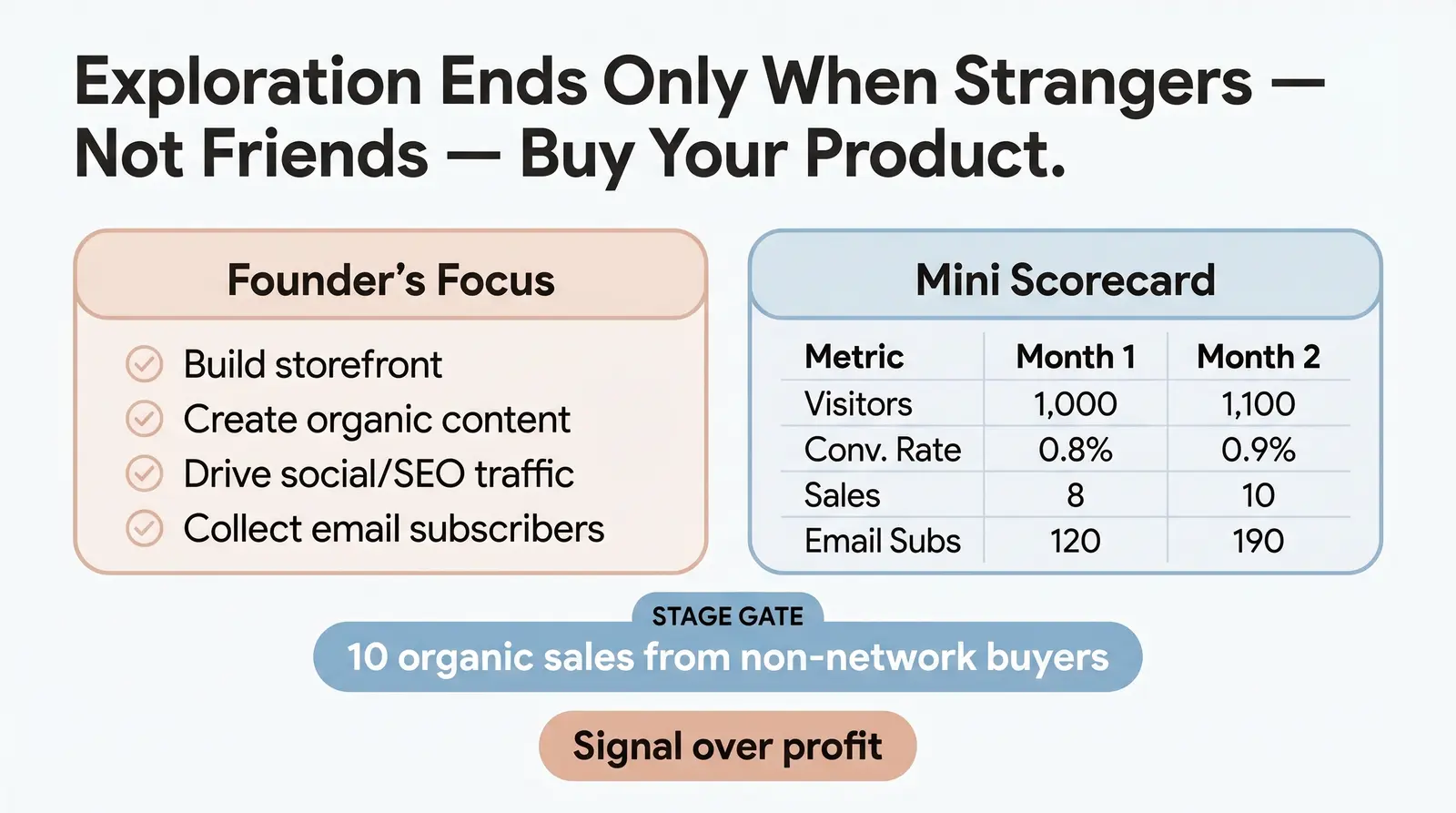
The Exploration stage has one job: find out if strangers will pay for your product. Not friends. Not family. Strangers on the internet who found you through a TikTok video or a Google search and decided your product was worth their money.
The founder's primary activities during this stage are building the storefront, creating initial content, and driving organic traffic through social media, SEO, and personal networks. Tools like Shopify make the technical setup fast. The real work is in the content. Every post, every reel, every product description is a test of whether your brand's message resonates with real buyers.
The key metrics to track in Exploration are: monthly site traffic, conversion rate, email subscriber count, and total first-sale count. At this stage, you are not optimizing for profit. You are optimizing for signal.
Take the fictional jewelry brand Lune & Co. In month one, the founder launched with eight SKUs: four minimalist gold-fill necklaces and four earring styles. She drove roughly 1,000 visitors to the site through organic Instagram reels and two TikTok videos that each got 8,000 views. Her conversion rate was 0.8%, yielding eight sales at an AOV of $68, for total revenue of $544. She spent zero dollars on ads. She collected 120 email subscribers by offering a 10% discount at checkout.
Month two looked similar: 1,100 visitors, 0.9% conversion rate, 10 sales, $680 in revenue. The email list grew to 190 subscribers. She noticed that her layered necklace set was the top seller, accounting for 60% of all orders.
The most common mistake in Exploration is treating it like a launch event rather than a research phase. Founders spend weeks perfecting their logo and homepage layout while neglecting the content that drives traffic. Another frequent error is turning on paid ads immediately, which masks poor conversion rates and burns budget before the site is ready to convert.
The stage gate for Exploration is simple: achieve 10 organic sales from people who are not in your personal network. That milestone proves the product has pull beyond your immediate circle. For founders still deciding which products to build their brand around, the Branvas catalog offers a curated selection of private-label jewelry and accessories with proven market demand.
Validation is the most misunderstood stage in the First-Year Arc. Most founders treat it as the revenue phase. It is not. It is the research phase. The goal is to validate that your unit economics work, that customers come back, and that your acquisition channels are efficient enough to build on.
The founder's primary activities during Validation are: refining product positioning, testing small paid advertising budgets on one or two channels, building out email flows in Klaviyo, and gathering direct customer feedback. Key metrics to track are Average Order Value (AOV), gross margin, return rate, and the early signs of a repeat purchase rate. The primary challenge is staying profitable on each order while beginning to pay for customer acquisition.
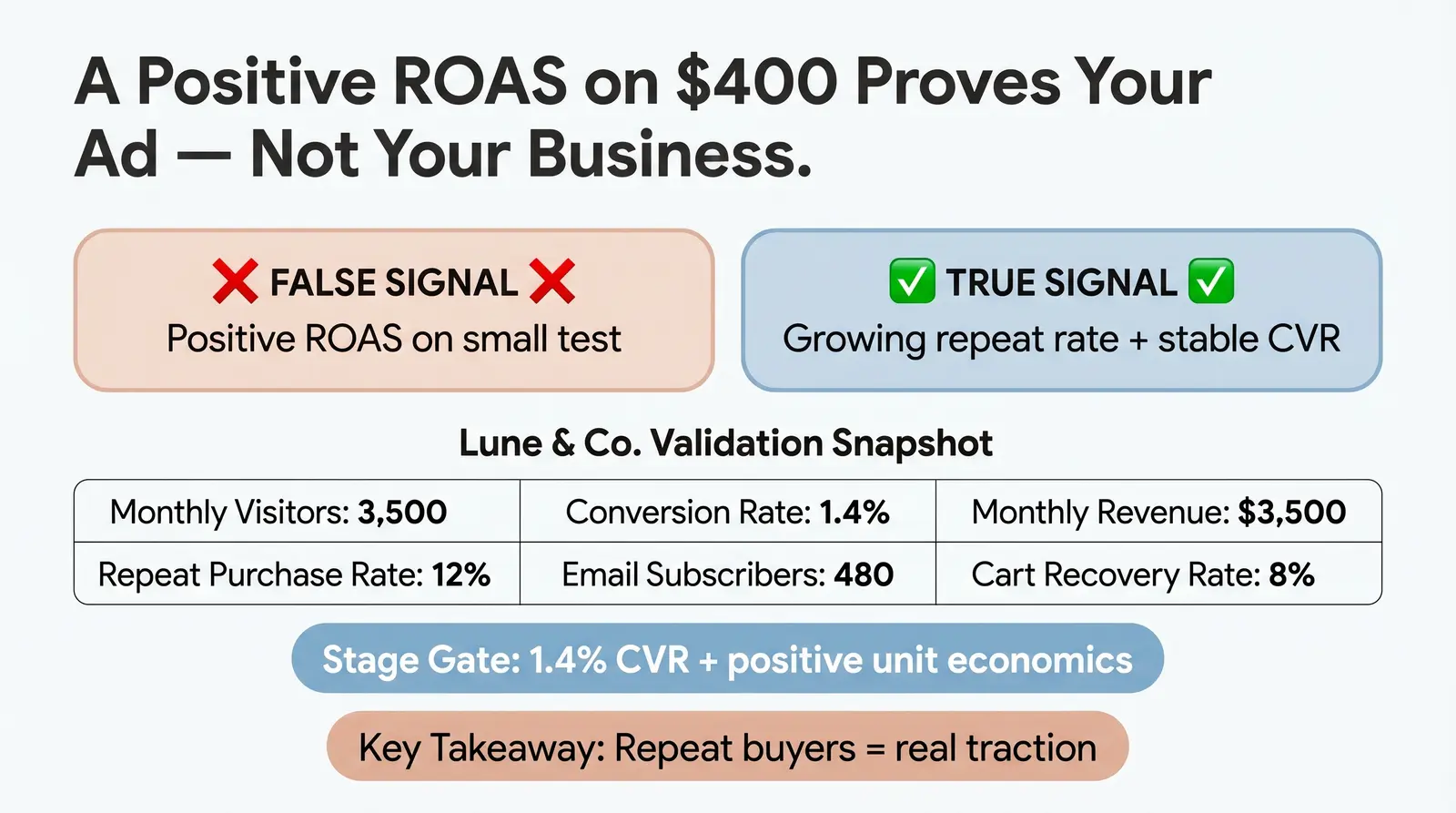
By month four, Lune & Co. had expanded to 12 SKUs, adding two new necklace styles and a bracelet collection based on customer requests. Traffic grew to 3,500 monthly visitors, partly from organic content and partly from a small $400 Meta Ads test targeting women aged 22-35 interested in minimalist fashion. Through better product photography and cleaner copy, the conversion rate improved to the industry average of 1.4% [3]. Monthly revenue hit $3,500, with AOV rising to $72 as customers began adding multiple items to their carts.
Crucially, the email list grew to 480 subscribers, and Klaviyo data showed that the abandoned cart flow was recovering 8% of abandoned checkouts. A 12% repeat purchase rate began to emerge: customers who had bought in months one and two were coming back for the new bracelet styles.
Here is where most ecommerce advice leads founders astray. The conventional wisdom says: if your ROAS is positive, scale your ad spend. But a positive ROAS on a small test budget does not mean your business is ready to scale. It means your ad creative worked on a narrow, highly targeted audience. When you scale, you expand to broader audiences, your CPMs rise, and your ROAS degrades.
More importantly, a positive ROAS on first-order revenue tells you nothing about whether customers will return. Research published in the Harvard Business Review confirms that scaling early, particularly within the first 12 months, significantly raises the risk of startup failure [4]. The Startup Genome Report found that 93% of startups that scale prematurely never break $100,000 in monthly revenue [2]. We consistently see founders skip Validation and jump straight to paid ads, and it almost always costs them.
The signal you want before scaling is not a positive ROAS. It is a growing repeat purchase rate, an engaged email list, and a conversion rate that holds steady as traffic increases. Those signals mean your brand has genuine pull. A positive ROAS on $400 in spend means your ad creative is decent.
The stage gate for Validation is reaching a stable 1.4% conversion rate with positive unit economics on every order. Founders should use the Branvas profit calculator to model their margins before increasing spend, accounting for product cost, shipping, platform fees, and returns.
By the time a brand enters Momentum, the hard questions have been answered. The product works. The unit economics are positive. Customers are coming back. Now the job is to grow, and growth at this stage introduces a new set of problems.
The founder's primary activities in Momentum are: scaling the ad campaigns that proved efficient in Validation, building out a full email marketing calendar in Klaviyo, launching a loyalty or referral program, and expanding the SKU count based on validated customer demand. Key metrics are Repeat Purchase Rate, Customer Acquisition Cost (CAC), and Return on Ad Spend (ROAS). The primary challenge is operational. As order volume grows, so does the complexity of inventory management, customer service, and fulfillment.
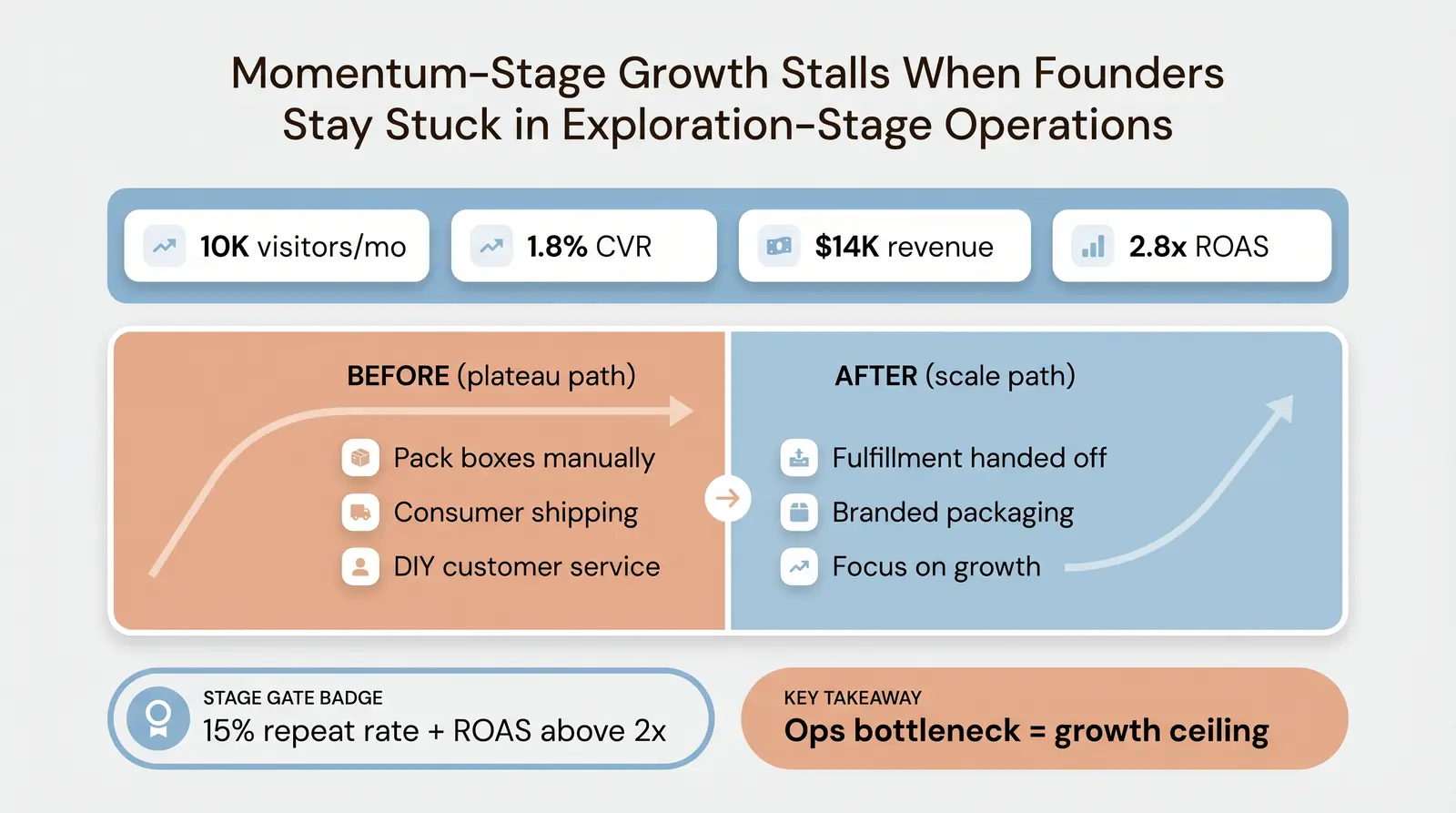
Lune & Co. hit their stride in month eight. Traffic surged to 10,000 monthly visitors, driven by a combination of scaled Meta Ads, a growing organic TikTok presence, and referral traffic from a micro-influencer partnership. The conversion rate climbed to 1.8%. With 18 SKUs, AOV reached $78, driving monthly revenue to $14,000. Ad spend increased to $2,000 per month, maintaining a 2.8x ROAS. The email list reached 1,800 subscribers, and the repeat purchase rate hit 18%.
But the founder was drowning. She was packing 180 orders a month in her apartment, spending 60% of her working hours on fulfillment and customer service emails about shipping delays. Every hour spent on logistics was an hour not spent on content, ads, or product development. The operational bottleneck was threatening to stall the growth she had worked eight months to build.
This is the stage where the brands that make it to Scale separate from those that plateau. The ones that plateau try to manage Momentum-stage volume with Exploration-stage infrastructure. They pack boxes themselves, use consumer shipping accounts, and handle customer service manually. The ones that scale hand off the operational complexity to purpose-built systems and redirect their energy toward growth.
Branvas's fulfillment and private-label infrastructure is specifically designed to absorb the operational chaos of the Momentum stage. Blind shipping, branded packaging, and inventory management are handled on the backend, so founders can stay focused on what drives revenue. If you are approaching Momentum and feeling the operational squeeze, branvas.com/how-it-works walks through exactly how the platform handles this.
The stage gate to exit Momentum is achieving a 15% repeat purchase rate alongside a stable ROAS above 2x. Both signals together confirm that the brand has genuine retention and efficient acquisition. Either one alone is not enough.
Scale is the stage most founders fantasize about, but it is also the stage that exposes every weakness in the business model. The founder's focus shifts to profitable acquisition at volume: diversifying ad channels beyond Meta into Google Shopping and Pinterest, launching major seasonal collections, and building the systems that will carry the brand into year two.
The key metrics in Scale are Customer Lifetime Value (LTV), Blended ROAS (total revenue divided by total ad spend across all channels), and Contribution Margin. The primary challenge is scaling ad spend without compressing margins, because as targeting broadens and audiences saturate, CAC rises. The brands that navigate this successfully do so by leaning on their owned channels (email, SMS, and organic social) to reduce dependence on paid acquisition.
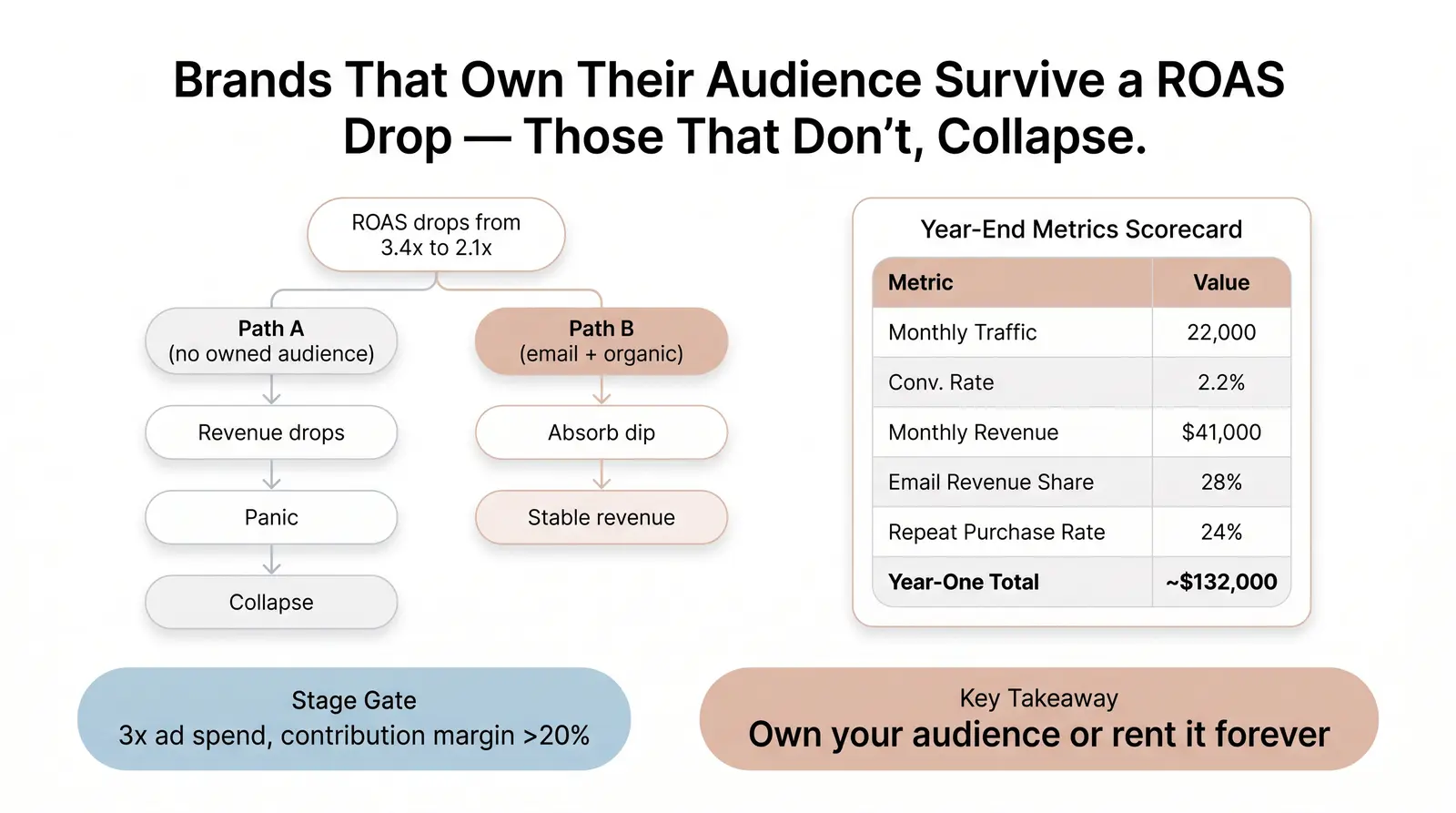
By month twelve, Lune & Co. had become a real business. Monthly traffic reached 22,000 visitors, with a 2.2% conversion rate. The catalog had grown to 24 SKUs. AOV peaked at $85 as the brand introduced a gift-packaging option that customers loved. Monthly revenue hit $41,000. Ad spend scaled to $6,000 per month across Meta and Google Shopping, maintaining a 3.4x ROAS. The email list reached 4,200 highly engaged subscribers, generating 28% of total revenue through Klaviyo flows and campaigns [5]. The repeat purchase rate reached 24%.
Total year-one revenue: approximately $132,000.
The brands that plateau at this stage share a common trait: they are entirely dependent on paid ads for new customer acquisition. When their Meta ROAS drops from 3.4x to 2.1x (which it will, as audiences saturate), they have no fallback. Revenue drops, panic sets in, and they either overspend to compensate or pull back and watch revenue collapse.
The brands that scale into year two have built an owned audience. Their email list is generating 25-30% of revenue. Their organic content is driving meaningful traffic. Their repeat purchase rate means that a significant portion of each month's revenue comes from customers they already paid to acquire. These brands can absorb a ROAS dip without a crisis.
The stage gate for Scale, and the definition of "Year 2 ready," is sustaining profitable growth at three times the initial ad spend while maintaining a contribution margin above 20%. If you can do that, you have a business. If you cannot, you have a marketing channel with a product attached to it.
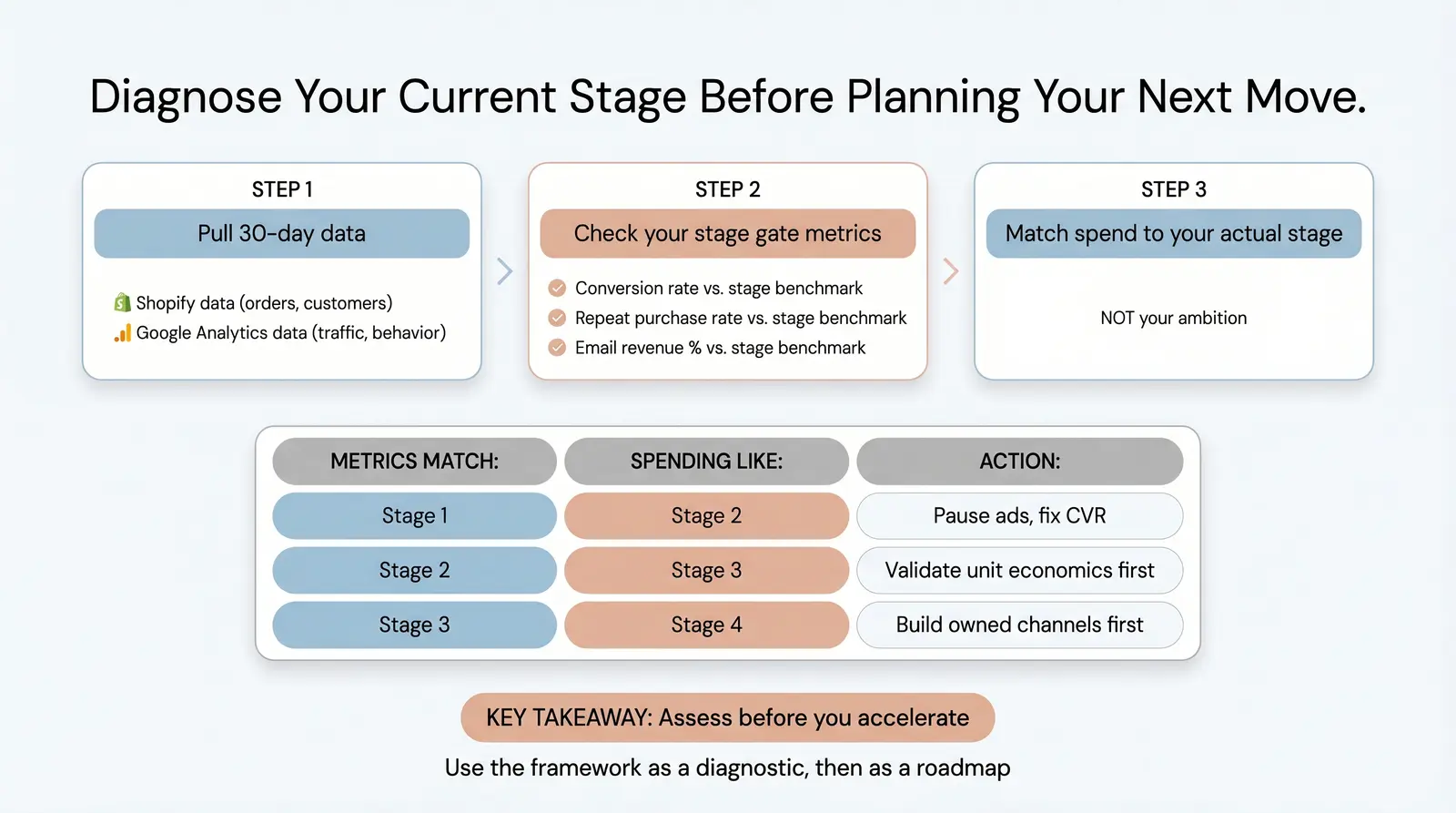
The Branvas First-Year Arc is a diagnostic tool first and a roadmap second. Before using it to plan forward, use it to assess where you actually are right now.
If you are just getting started and have not yet chosen a product or niche, branvas.com/solutions/aspiring-entrepreneurs is the right place to begin. Branvas is built specifically for founders in the Exploration stage who want to launch a private-label jewelry or accessories brand without managing supply chains.
Pull your last 30 days of data from Shopify and Google Analytics. What is your conversion rate? What is your repeat purchase rate? What percentage of your revenue comes from email? Compare those numbers against the stage gate criteria above. If your metrics match Stage 2 but you are spending like you are in Stage 3, you have identified a problem worth fixing before it becomes a crisis.
For founders who want tactical guidance on moving through each stage, the Branvas Academy covers the specific playbooks for each phase, from building your first email flow in Klaviyo to structuring your first Meta Ads campaign.
If you are ready to use The Branvas First-Year Arc as your year-one planning framework and want the infrastructure to support you from Exploration through Scale, explore your options at branvas.com/solutions/aspiring-entrepreneurs. Branvas handles the sourcing, branding, and fulfillment so you can stay focused on building a brand that lasts.
What is the most common reason ecommerce brands fail in year one?
The most common reason is premature scaling: founders increase ad spend or expand their product line before validating their unit economics and conversion rate. This accelerates losses rather than growth. The Startup Genome Report found that 74% of high-growth startups fail due to premature scaling [2], and the pattern is just as prevalent in ecommerce.
How long should I spend in the Validation stage before scaling ads?
Until your conversion rate is at or above 1.4%, your unit economics are positive on every order, and you are seeing at least a 10-12% repeat purchase rate. Those three signals together indicate that your product has genuine demand and your store can convert traffic efficiently. Without all three, scaling ad spend will accelerate losses.
What is a realistic revenue target for a first-year ecommerce brand?
This varies widely by category and investment level, but a well-executed brand following the First-Year Arc can realistically reach $10,000-$15,000 in monthly revenue by month six and $30,000-$45,000 by month twelve. The fictional Lune & Co. example in this article, ending the year at $132,000 in total revenue, represents a strong but achievable outcome for a focused founder.
When should I start building an email list?
Day one. The email list is the most valuable asset a first-year ecommerce brand can build. It is an owned channel that does not depend on algorithm changes or rising CPMs. Set up a Klaviyo account before you launch, install a popup with a 10% discount offer, and start capturing subscribers from your first visitor.
Does the Branvas First-Year Arc apply to product categories outside jewelry?
Yes. The framework is built on universal ecommerce dynamics: organic traction, unit economics, repeat purchase behavior, and operational scaling. The Lune & Co. example uses jewelry because that is Branvas's core category, but the stage gates and metrics apply equally to apparel, home goods, beauty, and accessories brands.