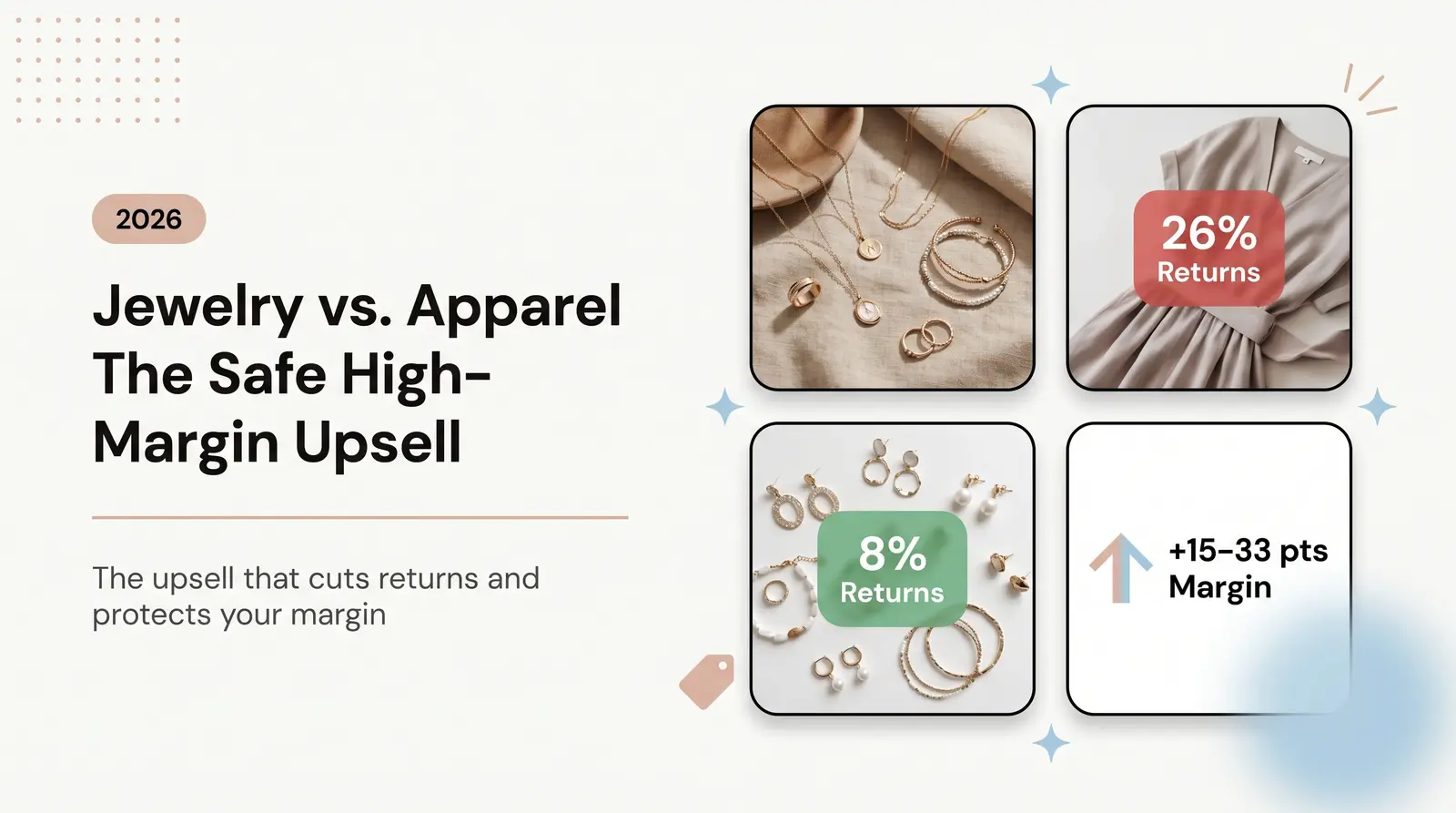



Jewelry and accessories rank as the best dropshipping category for 2026, combining 60–80% gross margins with an 8% return rate to maximize profitability.
Published:
July 17, 2026
Author:
Yi Cui
Most "best dropshipping products" listicles rank by trend recency or search volume alone. They ignore the two numbers that actually determine whether you build a profitable business or just a very busy hobby: gross margin and return rate. It doesn't matter how many units you sell if chargebacks and reverse logistics eat your cash flow. In this guide, we rank the top dropshipping categories by both metrics, using Branvas's own operational data (jewelry sees an ~8% return rate and 60–80% gross margins) to show why the math favors certain niches over others. You'll get a ranked comparison table, a framework to score any product, and a starter SKU shortlist so you can launch with confidence, not guesswork.
If you search for the best products to dropship or the best dropshipping products 2026, you will find endless listicles optimizing for search volume or the latest TikTok trend. But trend recency doesn't pay the bills. Unit economics do.
The two metrics that matter most are gross margin percentage and return rate percentage. Most guides ignore both, which is why so many new dropshippers launch into electronics accessories or print-on-demand apparel, see strong early sales, and then watch their margins collapse when the chargebacks start rolling in.
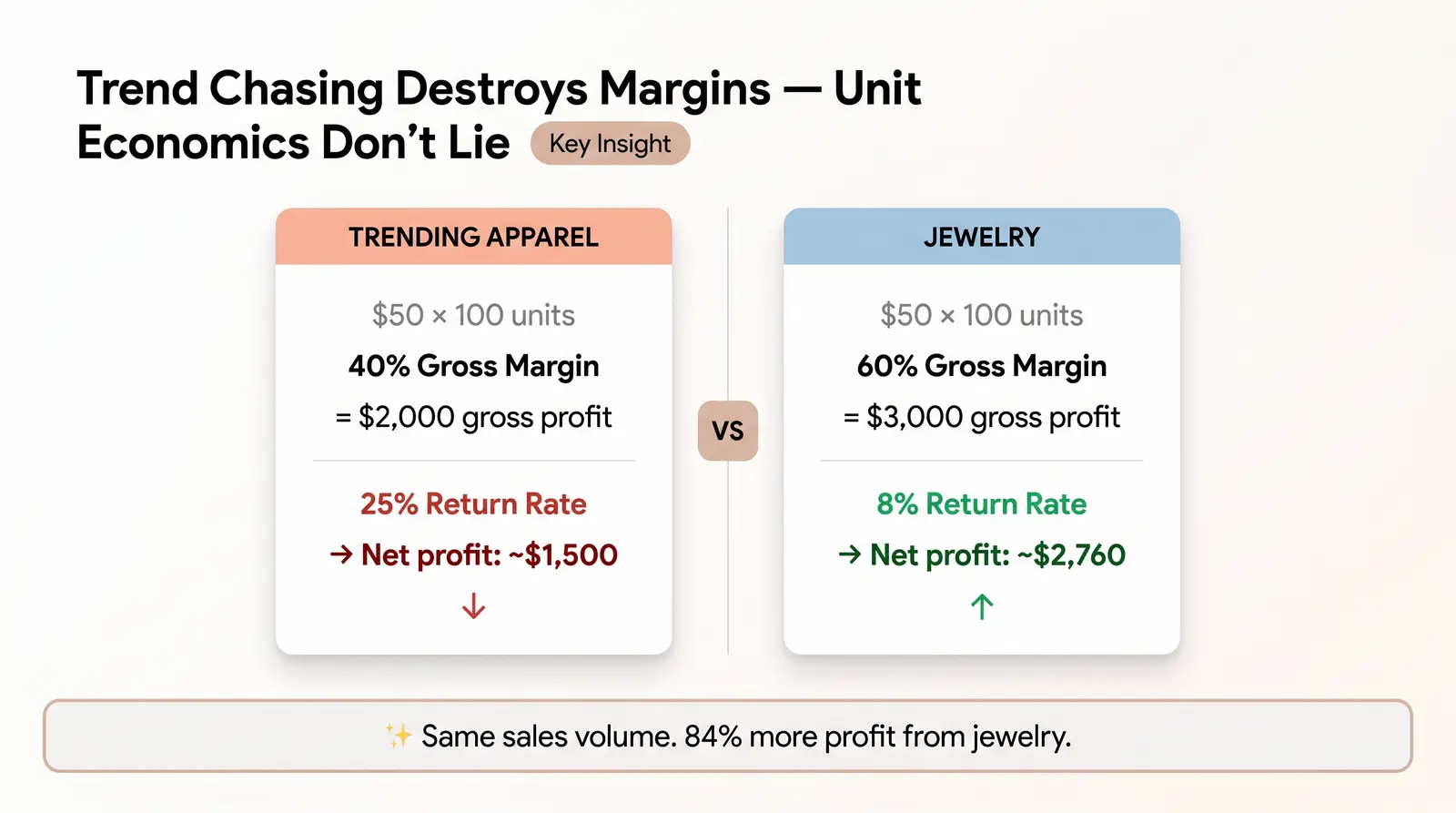
Here is a non-obvious truth worth working through: a product with 40% margins and a 25% return rate can be less profitable than one with 60% margins and an 8% return rate, even at the exact same sales volume. Take 100 units of a $50 apparel item at 40% margin. Your gross profit is $2,000. But if 25 of those items are returned, you lose $500 in profit plus the cost of reverse logistics, leaving you with well under $1,500. Now take a $50 jewelry item with a 60% margin. 100 sales yield $3,000 in gross profit. With an 8% return rate, you lose roughly $240, leaving you with approximately $2,760. The math is not close.
According to the National Retail Federation's 2025 Retail Returns Landscape report, the average ecommerce return rate sits at approximately 19.3% of online sales, with categories like apparel reaching 20–40% [1]. Industry analysis from Rocket Returns confirms that fashion and accessories return rates vary dramatically by subcategory, with accessories and jewelry running significantly lower than apparel [2].
At Branvas, we see new sellers gravitate toward electronics accessories or print-on-demand apparel because the trend data looks compelling. Then the return chargebacks arrive.
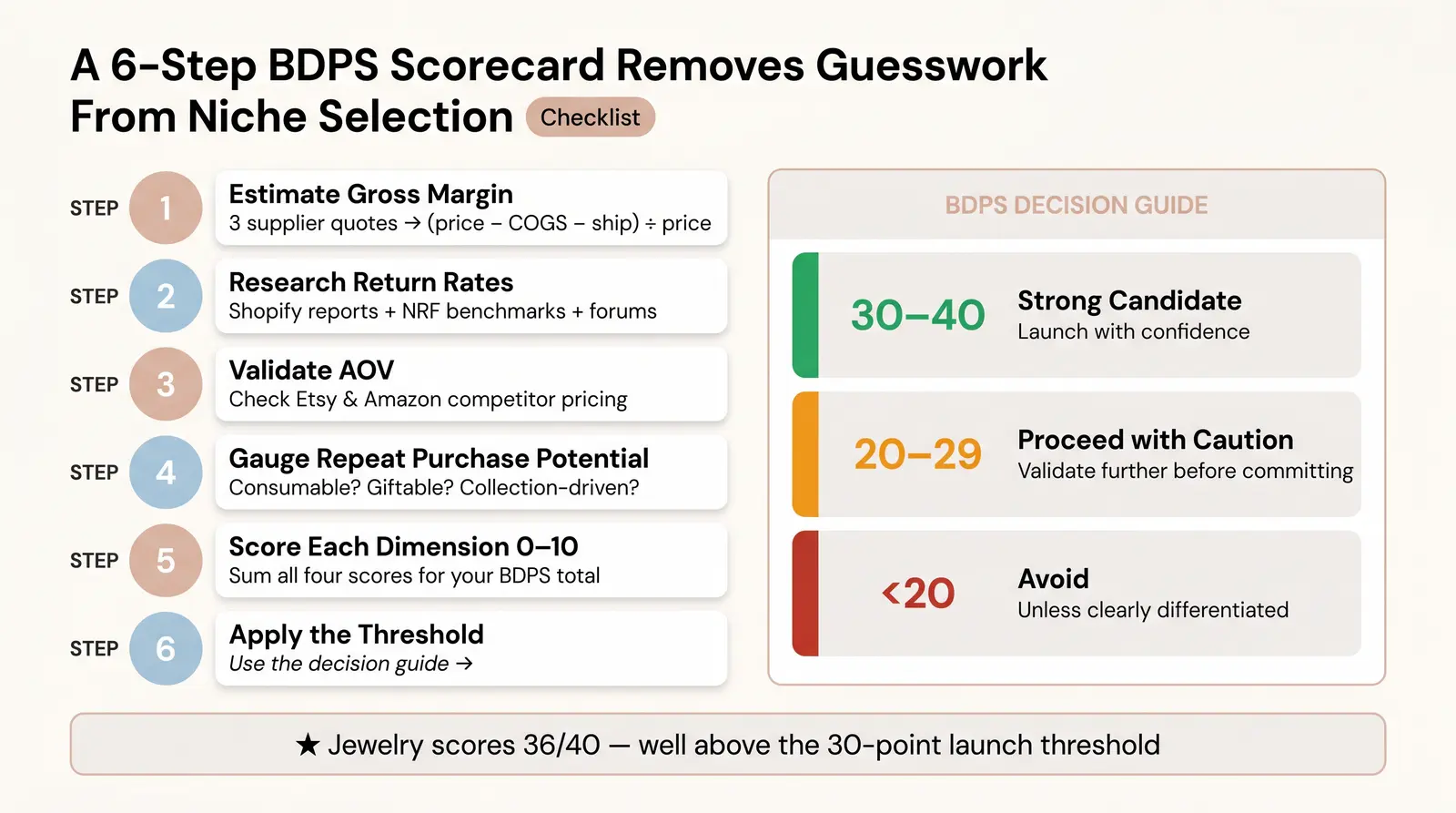
To help sellers make data-driven decisions, we use a proprietary framework: the Branvas Dropshipping Profitability Score (BDPS).
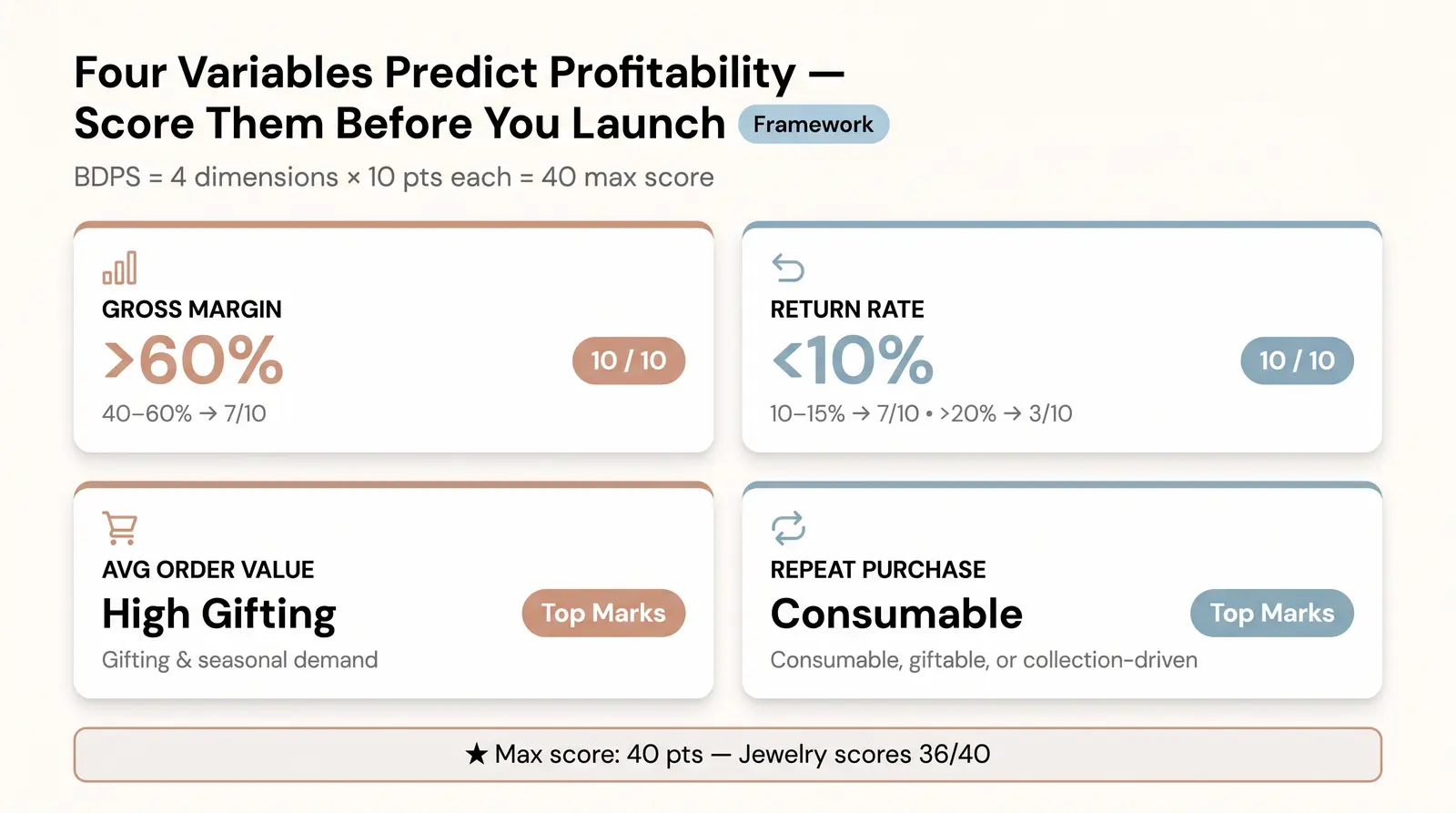
The BDPS scores each product category on four equally weighted dimensions, each rated 0–10, for a maximum score of 40.
| Dimension | What It Measures | Why It Matters |
|---|---|---|
| Gross Margin % | Revenue minus COGS, after shipping | More margin means more room to acquire customers profitably |
| Return Rate % | Percentage of orders returned or disputed | Returns destroy margin and brand reputation |
| Average Order Value (AOV) | Typical cart size | Higher AOV means better lifetime value math per ad dollar |
| Repeat Purchase Rate | Percentage of customers who buy again within 90 days | Repeat buyers create compounding CAC efficiency |
The scoring logic works as follows. For gross margin, anything above 60% scores 10/10; the 40–60% range scores 7/10; below 40% scores 4/10 or less. For return rate, below 10% scores 10/10; 10–15% scores 7/10; above 20% scores 3/10 or lower. AOV and repeat purchase rate are scored relative to category benchmarks, with high-gifting and consumable categories receiving top marks.
Branvas applies this score internally when evaluating which product categories to support for its brand partners. It is not a perfect model, but it is a far better filter than chasing search volume.
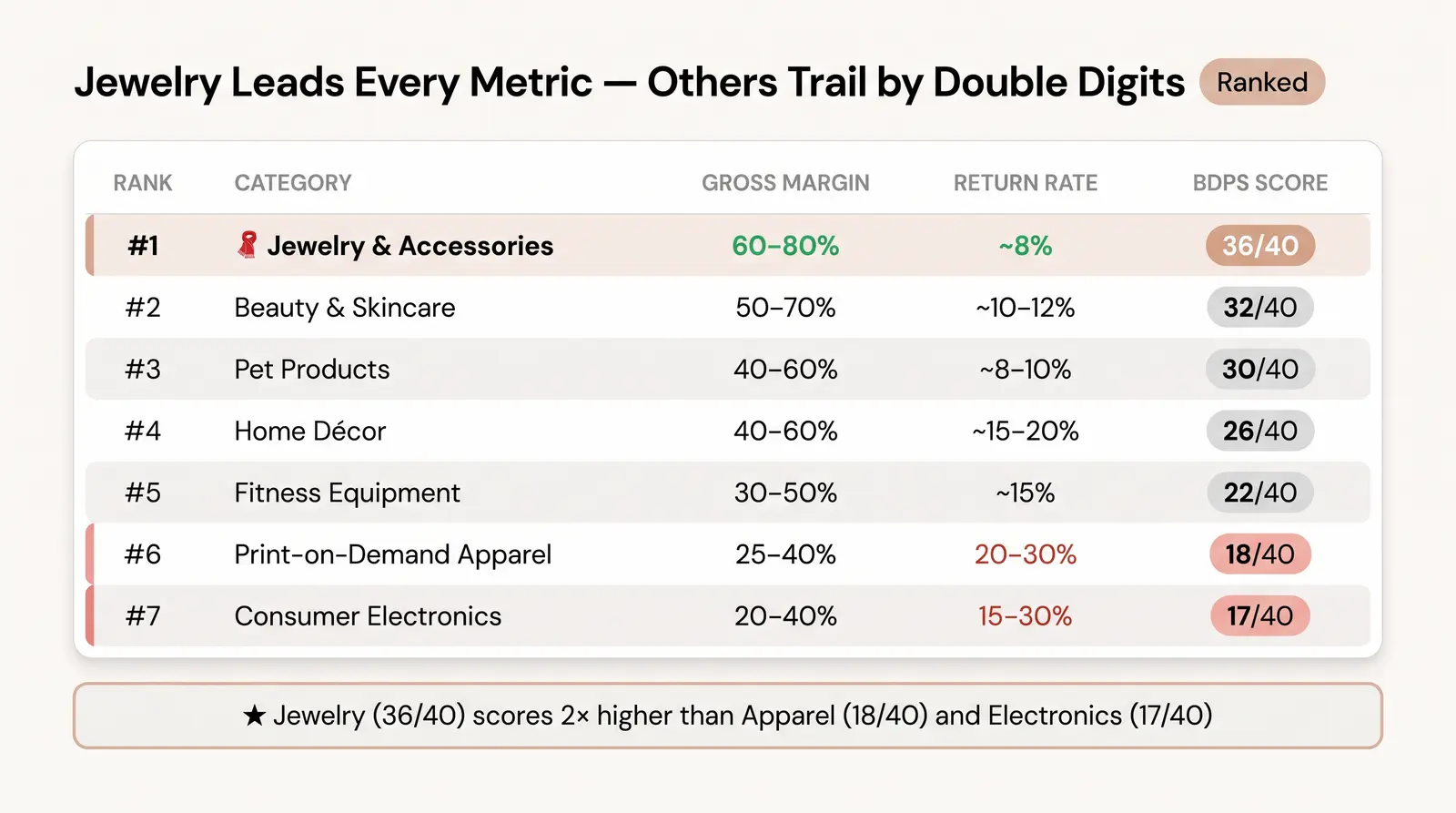
We evaluated the top dropshipping categories using the BDPS framework, pulling from industry benchmarks [1] [2] [3] and Branvas's operational data. Jewelry data reflects Branvas's known figures.
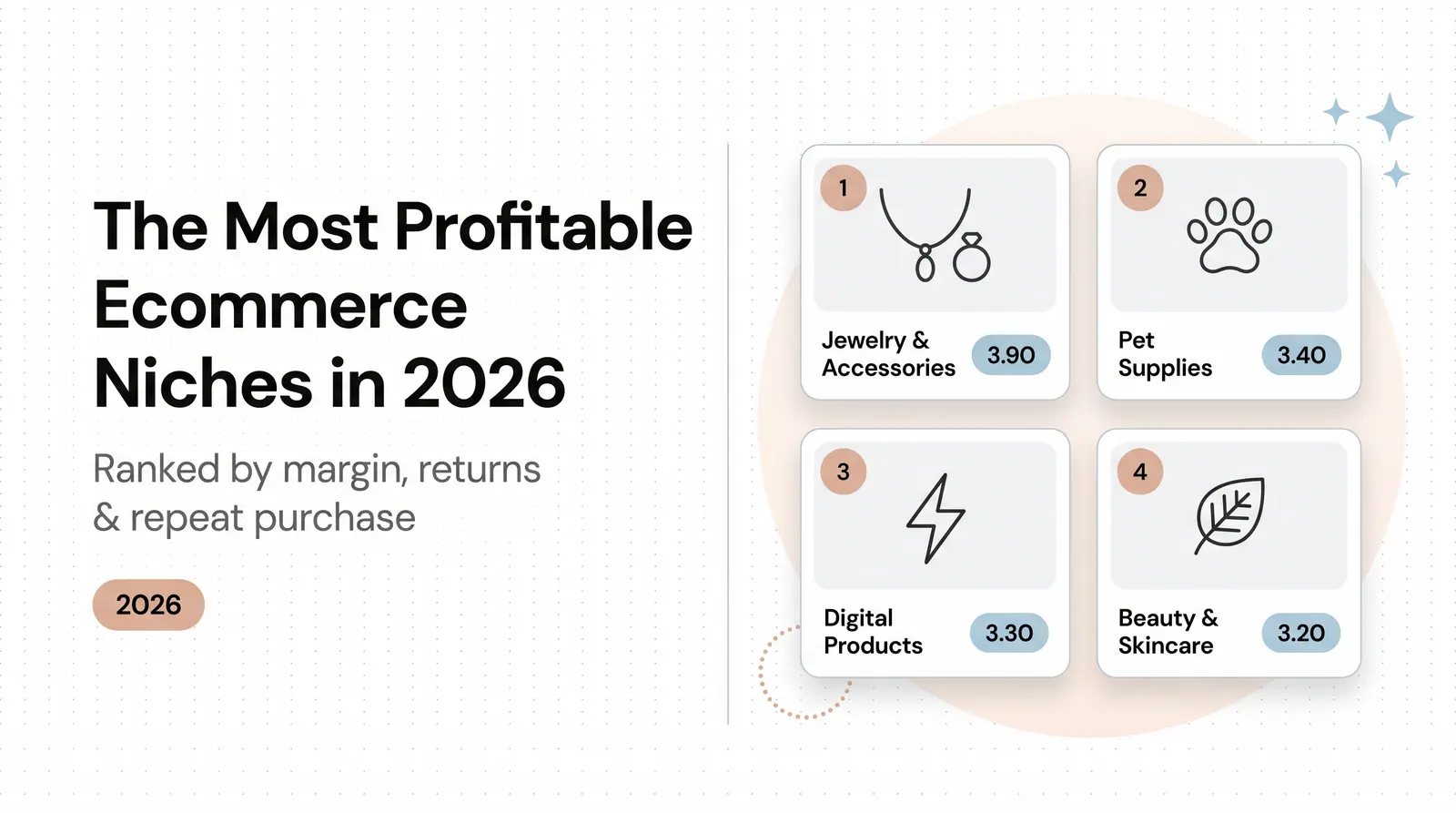
| Rank | Category | Est. Gross Margin | Est. Return Rate | Avg. AOV | Repeat Purchase Rate | BDPS Score (/40) |
|---|---|---|---|---|---|---|
| 1 | Jewelry & Accessories | 60–80% | ~8% | $35–$75 | High (gift + repurchase) | 36 |
| 2 | Beauty & Skincare | 50–70% | ~10–12% | $30–$60 | High | 32 |
| 3 | Pet Products | 40–60% | ~8–10% | $25–$50 | High | 30 |
| 4 | Home Décor | 40–60% | ~15–20% | $40–$90 | Medium | 26 |
| 5 | Fitness Equipment | 30–50% | ~15% | $40–$100 | Low | 22 |
| 6 | Print-on-Demand Apparel | 25–40% | ~20–30% | $30–$55 | Low | 18 |
| 7 | Consumer Electronics/Accessories | 20–40% | ~15–30% | $25–$70 | Low | 17 |
Sources: NRF 2025 Retail Returns Landscape [1]; Rocket Returns 2025 Industry Analysis [2]; TrueProfit Dropshipping Margin Guide 2026 [3]; Branvas operational data; Dropified Pet Dropshipping 2026 [6]; ScaleOrder Beauty Dropshipping Guide [7].
Jewelry and accessories rank first because they combine high margins, low return rates, and strong repeat purchase dynamics driven by gifting. Beauty and skincare follow closely, benefiting from consumable repeat rates, though margins can tighten after ad spend. Pet products are a strong third, with loyal buyers and low return risk on accessories.
Conversely, print-on-demand apparel and consumer electronics rank at the bottom despite high search popularity. Apparel suffers from fit-related returns that routinely exceed 20–30% [2]. Electronics face high return rates due to defects and compatibility issues, with some subcategories hitting 15–30% [2]. The compounding effect of combining high margin with low return rate is what separates a scalable business from a treadmill.
In our experience at Branvas, the sellers who scale fastest aren't chasing the trending SKU. They are in categories where the unit economics compound quietly in their favor.
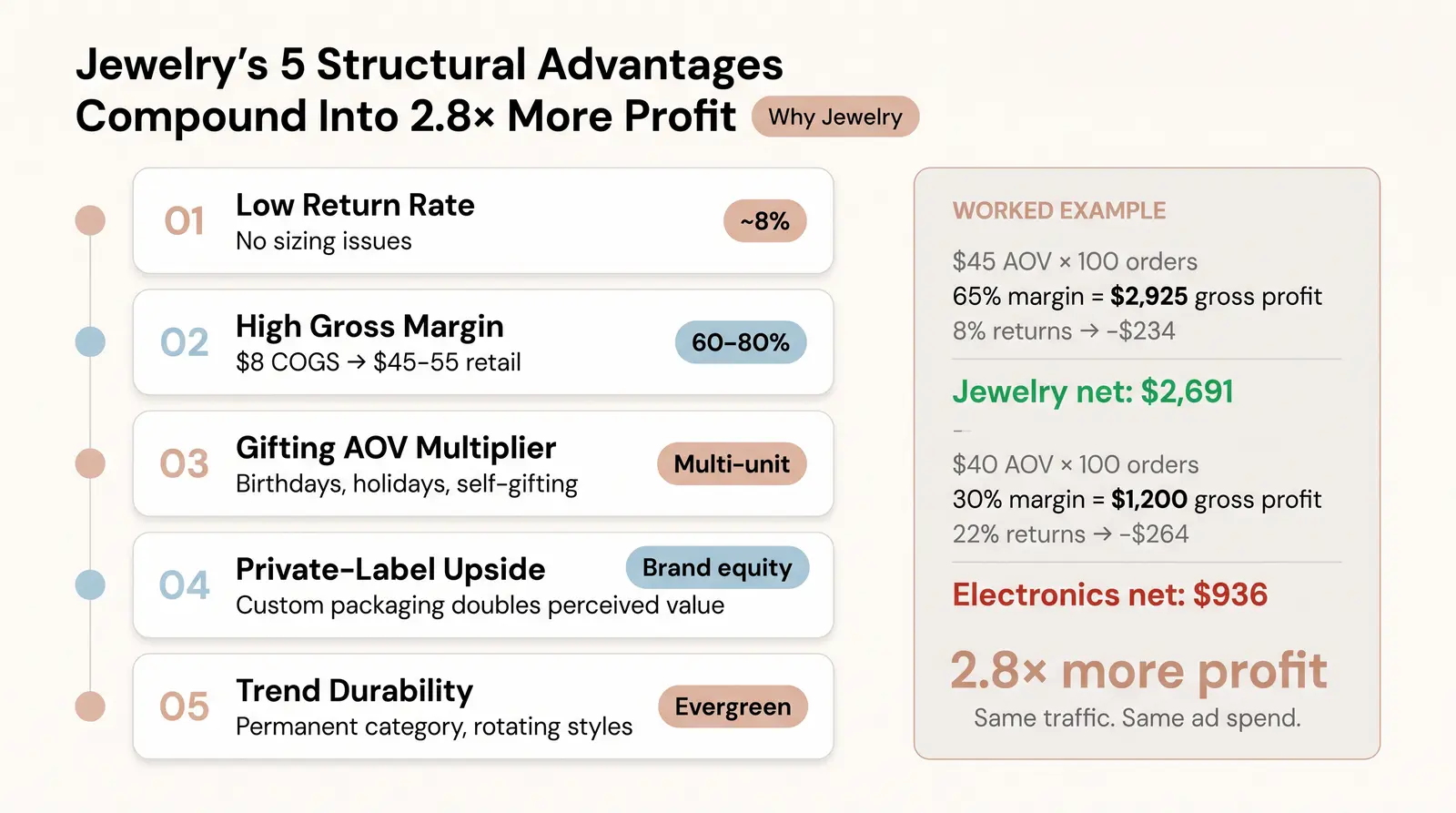
Jewelry is the undisputed winner of the dropshipping math for five structural reasons.
Low return rate mechanics. Most jewelry pieces are non-size-dependent. Necklaces, earrings, and bracelets fit virtually everyone, which eliminates the primary driver of ecommerce returns: fit and sizing. Jewelry is also lightweight, durable, and emotionally purchased, which reduces regret-returns significantly compared to apparel or electronics.
Margin structure. The cost of goods sold for jewelry is remarkably low relative to its perceived value. A private-label necklace that costs $8 to source and ship can comfortably retail at $45–$55 with the right branding and packaging. That gap between COGS and selling price is where dropshipping businesses are built.
AOV and the gifting multiplier. Jewelry is one of the top gifted product categories year-round, from birthdays and anniversaries to holidays and self-gifting. This drives multi-unit orders and increases average order value in ways that most other categories cannot match.
Private-label upside. Unlike commoditized electronics or generic home goods, jewelry can be branded with minimal SKU investment. Custom packaging, a brand name, and a coherent aesthetic can double perceived value without touching the product itself. This is directly relevant to Branvas's model.
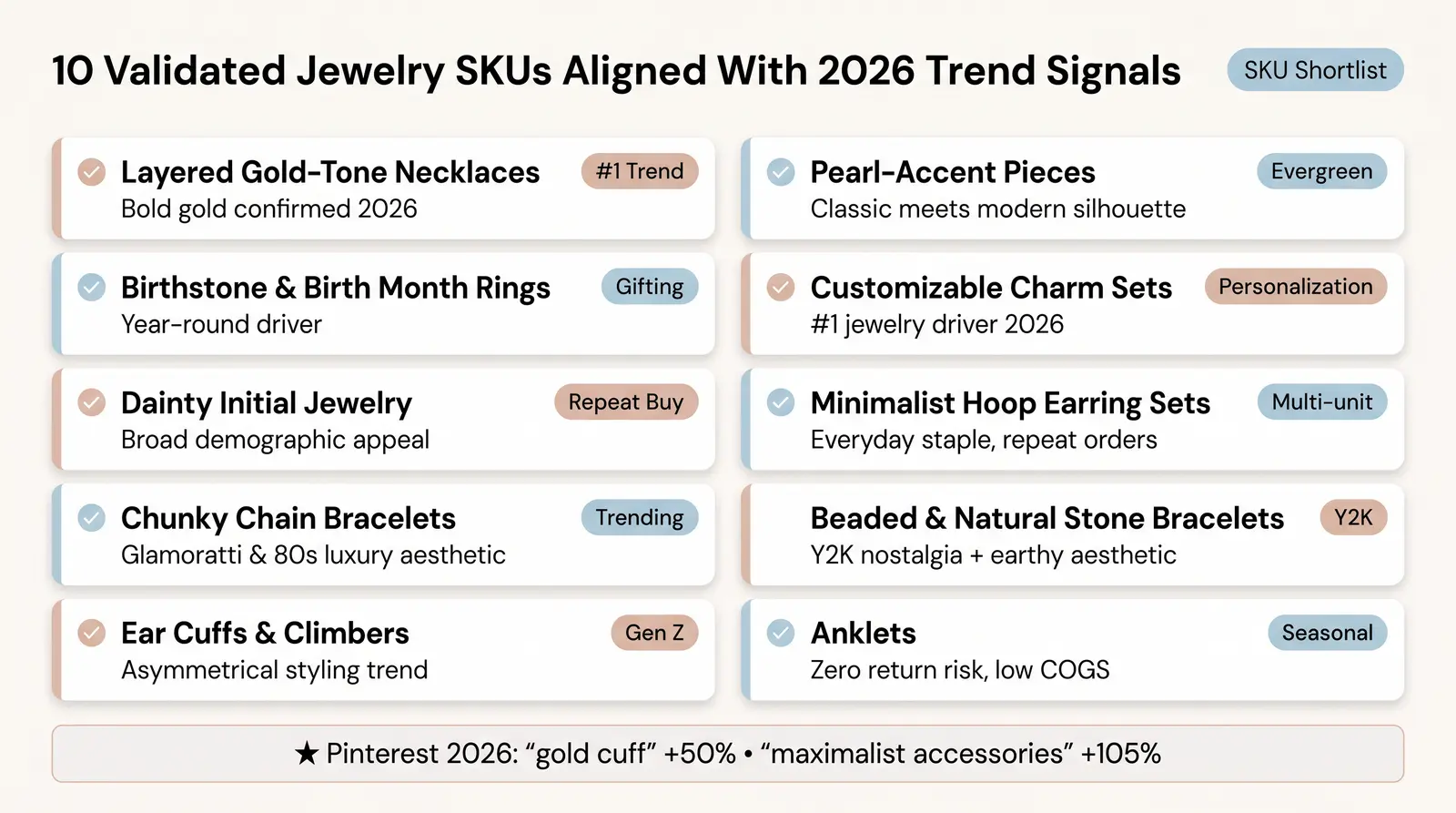
Trend durability. Jewelry is not a trend. It is a permanent category with trend-driven SKU rotation. Chunky gold chains, layered necklaces, and birth month styles cycle in and out, but the category itself never fades. Pinterest Predicts 2026 confirms bold gold and chunky statement pieces as ascending trends, with searches for "gold cuff" up 50% and "maximalist accessories" up 105% [5].
Here is a worked example that puts the math in concrete terms:
You sell a private-label necklace at $45 AOV with a 65% gross margin and an 8% return rate. On 100 orders: gross revenue = $4,500; gross profit before returns = $2,925; returns reduce that by approximately $234 (8 returns at $29.25 average cost impact). Net gross profit is approximately $2,691. Compare that to a trending electronics accessory at $40 AOV, 30% margin, and a 22% return rate: gross revenue = $4,000; gross profit before returns = $1,200; returns wipe out another $264. Net gross profit is approximately $936. Same traffic. 2.8 times more profit from jewelry.
If jewelry's unit economics align with how you want to build, the Branvas profit calculator lets you model your own numbers before you commit to a single SKU.
If you are ready to move, here is a validated shortlist of jewelry SKUs with strong trend signals heading into 2026 [4] [5]:
Branvas's catalog covers private-label versions of these SKUs with branded packaging and blind fulfillment. You can explore the full range at branvas.com/catalog.
You can apply the Branvas Dropshipping Profitability Score to any category or SKU you are considering. Here is the process:
Branvas's brand partners use this exact framework when selecting their launch SKUs. It removes the guesswork from niche selection and replaces it with a repeatable process. Whether you are evaluating trending products to sell or trying to build a long-term brand, the BDPS gives you a consistent filter to apply before you spend a dollar on ads.
Ready to launch a private-label jewelry brand with pre-vetted, high-margin SKUs and built-in blind fulfillment? See how Branvas works
1. What are the best products to dropship for beginners in 2026?
For beginners, the best products to dropship are those with high margins, low return rates, and lightweight shipping profiles. Jewelry, pet accessories, and certain beauty tools fit this description well. They minimize logistical complexity and provide enough margin to absorb the learning curve of paid advertising. Jewelry in particular is forgiving for new sellers because the low return rate means fewer disputes and chargebacks while you are still optimizing your operations.
2. What dropshipping products have the highest profit margins?
Jewelry and accessories consistently offer the highest gross profit margins in dropshipping, often ranging from 60% to 80% [3]. Because the perceived value of jewelry is high relative to its manufacturing cost, sellers can command premium prices, especially when the product is presented with strong branding and packaging. Beauty and skincare can also reach 50–70% gross margins, but require more active customer education and have higher ad costs in competitive niches.
3. Why does return rate matter so much in dropshipping?
Return rate is the silent killer of dropshipping businesses. Every return wipes out the profit from that sale and adds reverse logistics costs, payment processing fees, and customer service labor. A 22% return rate on a 30% margin product means you are effectively losing money on roughly one in five sales before you account for advertising. The NRF estimates that U.S. retail returns totaled $849.9 billion in 2025, with ecommerce running at 19.3% [1]. Choosing a low-return category is one of the highest-leverage decisions you can make before you launch.
4. Is jewelry a good product to dropship?
Yes. Jewelry is one of the strongest dropshipping categories available in 2026. It offers low return rates (around 8%), high gross margins (60–80%), cheap shipping due to its light weight, and strong gifting demand that drives repeat purchases and higher average order values. The private-label opportunity also means you can build real brand equity rather than competing purely on price. That is what separates sustainable dropshipping businesses from short-lived arbitrage plays. If you are looking for high-margin products to sell with a durable business model behind them, jewelry is the answer the data keeps pointing to.
5. How do I find trending products to dropship without chasing fads?
The key is to look for products within evergreen categories that experience stylistic updates rather than categories that live and die on a single trend. Jewelry is a permanent category. Specific styles like chunky gold or birthstones trend upward, but the category itself never disappears. Use tools like Pinterest Predicts, Google Trends, and Etsy trend reports to identify aesthetic shifts within stable niches. This gives you the best of both worlds: a durable business foundation with room to capitalize on short-term trend spikes.
[1] 2025 Retail Returns Landscape - National Retail Federation
[2] Ecommerce Return Rates 2025: Complete Industry Analysis + Benchmarks by Category - Rocket Returns
[3] The Complete Guide to Dropshipping Profit Margins 2026 - TrueProfit
[4] Top Dropshipping Jewelry Suppliers for 2026 Trends - CJ Dropshipping
[5] Pinterest 2026 Trend Report: Brooches, Bold Gold, Cool Blue - National Jeweler
[6] Pet Products Dropshipping in 2026: Best Selling Items, Suppliers, Profit Margins - Dropified
[7] How to Make Big Money from Dropshipping Beauty Products - ScaleOrder