


A realistic 10-point checklist helps ecommerce beginners validate unit economics, supplier reliability, and brand differentiation before launching—cutting through guru hype with actionable math.
Published:
July 2, 2026
Author:
Yi Cui
The best ecommerce advice is usually less glamorous than the shortcut advice. If you have spent any time researching how to start an online store, you have likely been bombarded with YouTube thumbnails promising passive income, TikToks flashing rented supercars, and courses guaranteeing you will make $10K in your first 30 days. It is entirely rational to be skeptical. In fact, that skepticism is your best asset. This guide cuts through the noise to deliver a practical, checklist-style approach rooted in realistic expectations, unit economics, and sustainable brand building.
If you browse communities like r/entrepreneur or r/dropship, the sentiment is overwhelmingly critical of influencer-led ecommerce advice. Beginners are frequently frustrated when they realize the "winning products" pitched by gurus are already saturated, or that the profit margins shown in flashy screenshots completely ignore ad spend, returns, and software fees.
The structural problem with influencer-style ecommerce advice is that it is systematically biased. Gurus often rely on affiliate incentives from software platforms or rely on course upsells to make their actual money. They highlight survivorship bias by showcasing the 1% who hit it big while omitting the 90% who fail within their first 120 days [1].
The guru's advice isn't always wrong — it's incomplete. The real problem is that it's optimized to sell hope, not to prepare you for unit economics. They teach you to chase trends rather than build a business model that can withstand rising customer acquisition costs. We often see founders at Branvas arrive after burning $2,000 on ads for a product they picked because a YouTube channel told them it was 'winning' — with no real brand differentiation.

Before you launch your store, verify these ten grounded realities.
Do your unit economics actually work?
You must calculate your true break-even point. If a product costs $10 to source and ships for $5, selling it for $30 leaves you $15. If your customer acquisition cost (CAC) is $25, you are losing $10 on every sale. You need a path to profitability on the first order or a high repeat purchase rate.
Is your product selection based on data or content you passively consumed?
Selecting a product because an influencer said it was trending is a recipe for entering a saturated market. Validate demand using search volume, competitor analysis, and real market gaps, not just TikTok views.
Have you mapped your real customer acquisition cost (CAC)?
Ad costs are rising. The median CPA across all industries on Meta was $38.19 in 2025 [2]. You must realistically project how much you will need to spend to acquire a single paying customer before committing to a product.
Do you have a differentiated brand, or are you selling the same SKU as 400 other Shopify stores?
If your product is identical to hundreds of others on AliExpress, your only competitive advantage is price, which leads to a race to the bottom. Building a distinct brand identity and offering a unique value proposition is essential for survival.
Have you stress-tested your supplier reliability — not just product quality?
A great product means nothing if your supplier takes three weeks to ship it or frequently runs out of stock. Unreliable fulfillment destroys customer trust and leads to chargebacks that can get your payment processor shut down.
Do you have a 90-day cash flow model, not just a revenue projection?
Revenue is vanity; cash flow is sanity. You need to model how you will fund inventory, pay for ads, and cover software subscriptions during the months before your store becomes consistently profitable.
Have you read negative reviews of your competitor's products, not just studied their successes?
Analyzing what customers hate about existing products reveals your best opportunities for improvement. If every review complains about flimsy packaging, upgrading your unboxing experience becomes a key selling point.
Do you know your return/refund policy math at scale?
Returns are an inevitable part of ecommerce. If you do not factor a 5% to 15% return rate into your pricing model, a few bad weeks can completely wipe out your profit margins.
Have you picked a niche you can speak to authentically, not just one with "high margins"?
Consumers can spot an inauthentic brand quickly. If you do not understand the pain points and language of your target audience, your marketing will fall flat, regardless of how profitable the niche appears on paper.
Is your business model built to build a brand, or just to arbitrage temporarily?
Arbitrage — buying cheap and selling slightly higher — works until ad costs rise or competitors copy you. A brand builds equity, trust, and a list of customers who will buy from you repeatedly without needing a paid ad to reach them.

Understanding the difference between the math shown in YouTube thumbnails and the reality of running an online store is crucial. Let's walk through a beginner scenario selling a $39 product.
The Guru Math (The Illusion):
This math looks incredible, but it completely ignores the costs required to actually run the business and acquire the customer.
The Real Math (The Reality):
To make this viable, you must either increase the perceived value so you can charge $59, bundle products to increase the average order value, or build a brand that encourages repeat purchases so you do not have to pay $25 to acquire that customer a second time.

Before investing capital into a new product line, you need a systematic way to evaluate its potential. We use The BRAND Score™ to help sellers validate product-market fit before they launch.
| Criteria | Description | 1 (Poor) | 5 (Excellent) | Weight |
|---|---|---|---|---|
| Brand Differentiation | Can you make this product uniquely yours? | Identical to generic dropship items. | Custom packaging, unique design, clear brand story. | 25% |
| Repeat Purchase Potential | Will customers buy this again? | One-time novelty purchase. | Consumable or part of a collectible line. | 20% |
| Supplier Reliability | Are lead times and quality consistent? | Unknown overseas supplier with 3-week shipping. | Vetted partner with fast, domestic fulfillment. | 20% |
| Margin Viability | Does the math work with realistic CAC? | Loses money on first purchase. | Profitable even with a $40 CAC. | 20% |
| Audience Authenticity | Does this fit your existing audience or expertise? | Chosen solely for perceived profit. | Deeply aligns with your content and community. | 15% |
A score below 15 indicates a high-risk venture likely to struggle with ad costs. A score above 20 suggests a strong foundation for a sustainable brand. If you're evaluating whether a private-label jewelry or accessories brand fits your audience, Branvas's How It Works page walks through exactly how we help sellers validate and launch without the guesswork.

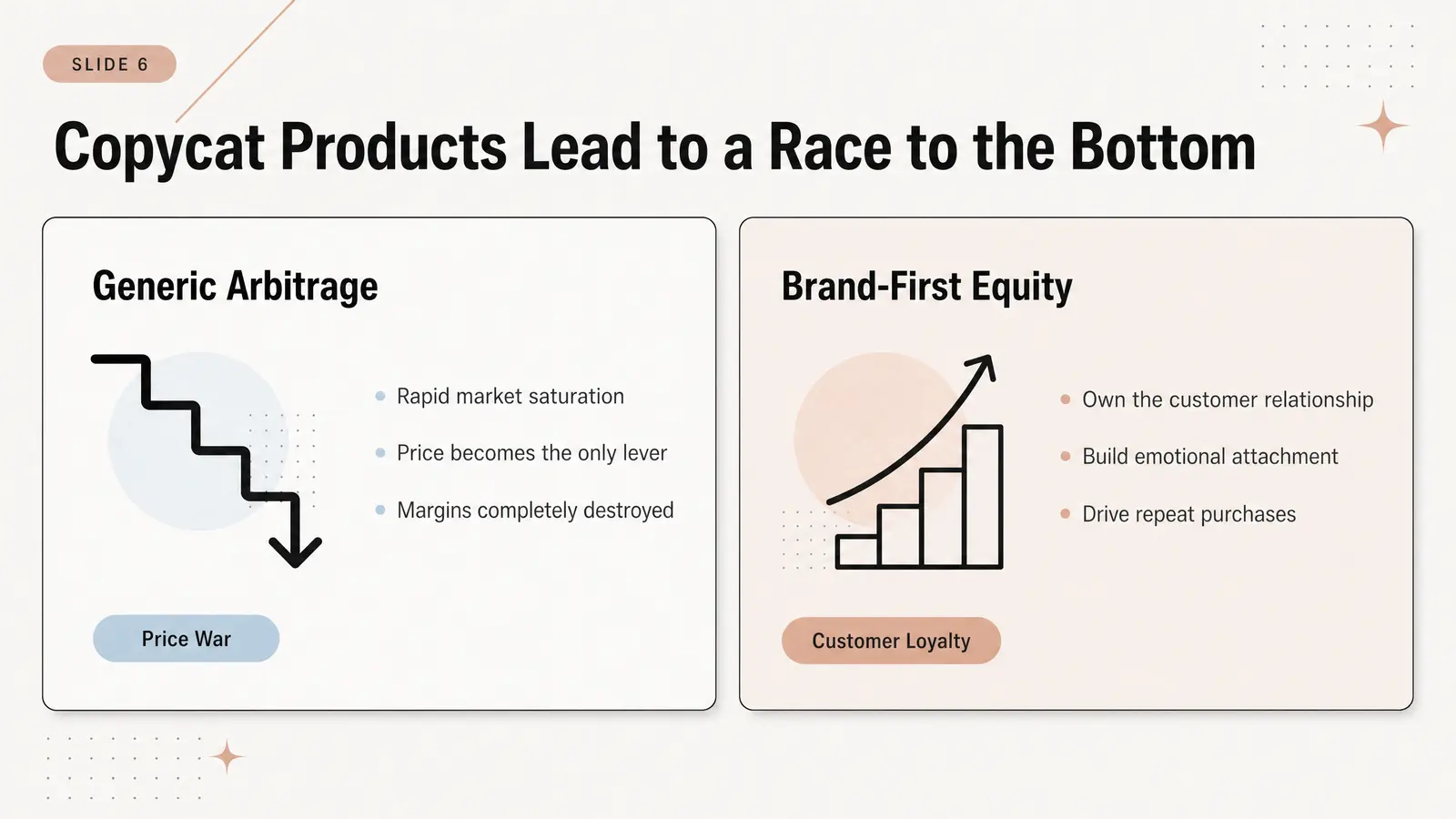
Copycat products fail at scale because they rely entirely on market arbitrage. When you sell the exact same item as hundreds of other stores, using the same supplier and similar ad angles, market saturation happens quickly. Your only lever is to lower your price, which destroys your margins. Furthermore, customers feel no loyalty to a generic store; they experience brand amnesia the moment the transaction is complete.
A brand-first model changes the dynamic. It focuses on owning the customer relationship and creating an emotional attachment. In our experience at Branvas, the sellers who scale past $50K/month aren't the ones who found the best product — they're the ones who built the most recognizable brand around a product category their audience already trusted them in.
Private-label and white-label models allow beginners to launch real branded products without the massive manufacturing minimums traditionally required. This is exactly why creators are moving away from generic dropshipping and utilizing models like ours. You can explore how this works for your specific needs at branvas.com/solutions/influencers-creators.
Setting honest expectations is your best defense against early burnout. The data is sobering: roughly 70% of ecommerce businesses fail in their first year, and up to 90% fail within the first 120 days, largely due to poor unit economics and weak marketing [1] [3].
However, this high failure rate is often driven by people treating ecommerce as a get-rich-quick scheme rather than a real business. Realistic success means understanding that it typically takes 6 to 18 months to find consistent traction and reach profitability. This timeline is not discouraging — it's a competitive moat against impatient, guru-following beginners.
If you're ready to start with a model built for long-term brand equity — not short-term arbitrage — explore how Branvas works or check the Branvas Profit Calculator to run your numbers before you commit to a product.

1. Is dropshipping actually worth it in 2025?
Dropshipping as a fulfillment method is still viable, but dropshipping as a business model selling generic, unbranded goods with long shipping times is incredibly difficult. Success requires transitioning to branded dropshipping or private labeling to build trust and justify higher margins.
2. How much money do I really need to start an ecommerce business?
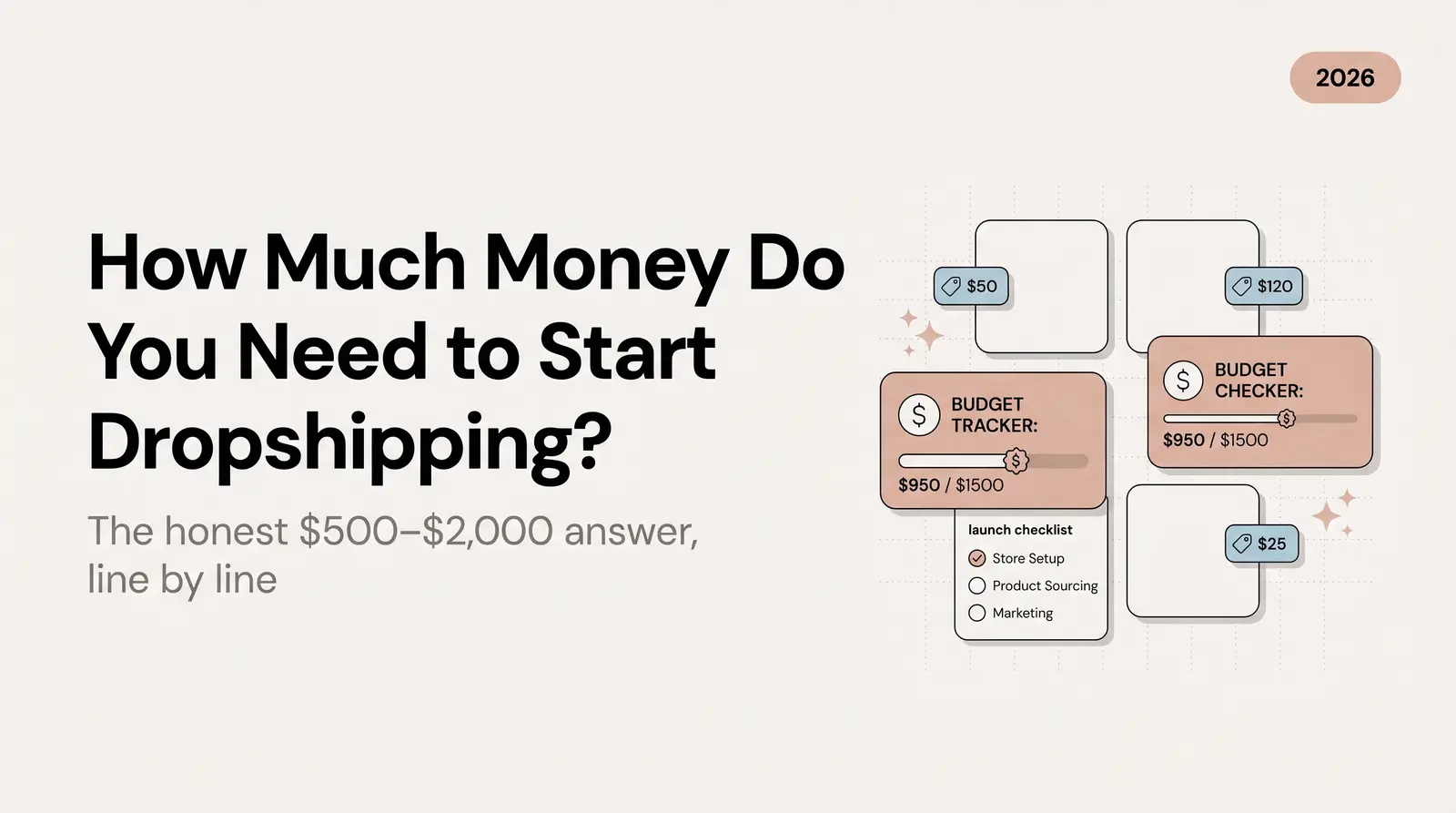
While you can start a store for under $100, you need realistic capital to test marketing. A safer starting budget is $1,500 to $3,000 to cover platform fees, initial ad testing, and small inventory runs if you are private labeling.
3. Why do most Shopify stores fail in the first year?
Most stores fail due to poor unit economics and an inability to acquire customers profitably. Founders often underestimate customer acquisition costs (CAC) and lack a strategy for retaining customers for repeat purchases.
4. What's the difference between dropshipping and private-label ecommerce?
Dropshipping involves selling existing products fulfilled by a third party, often resulting in generic branding. Private labeling involves contracting a manufacturer to create unique products sold exclusively under your brand, offering higher margins and brand equity [4].
5. How do I know if my product idea is actually viable before spending money on ads?
Use frameworks like The BRAND Score™ to evaluate margins, differentiation, and supplier reliability. Validate demand through search trends, competitor analysis, and ensuring you have a clear path to profitability on the first order.
[1] Shopify Store Churn Rate 2026: Why 70% of E-commerce Businesses Fail
[2] Facebook Ad Benchmarks by Industry (Updated Data)
[3] What Percentage of E-commerce Businesses Fail And Why So Many Don't Succeed
[4] Dropshipping vs. Private Label: Which is Best For Your Business
[5] Survivorship Bias: Why Success Stories Mislead and How Better Decisions Are Made
[6] FTC Takes Action to Combat Bogus Money-Making Claims Used to Lure People into Dead-end Debt Traps