

Printify vs ShineOn: Print Apparel vs Print Jewelry

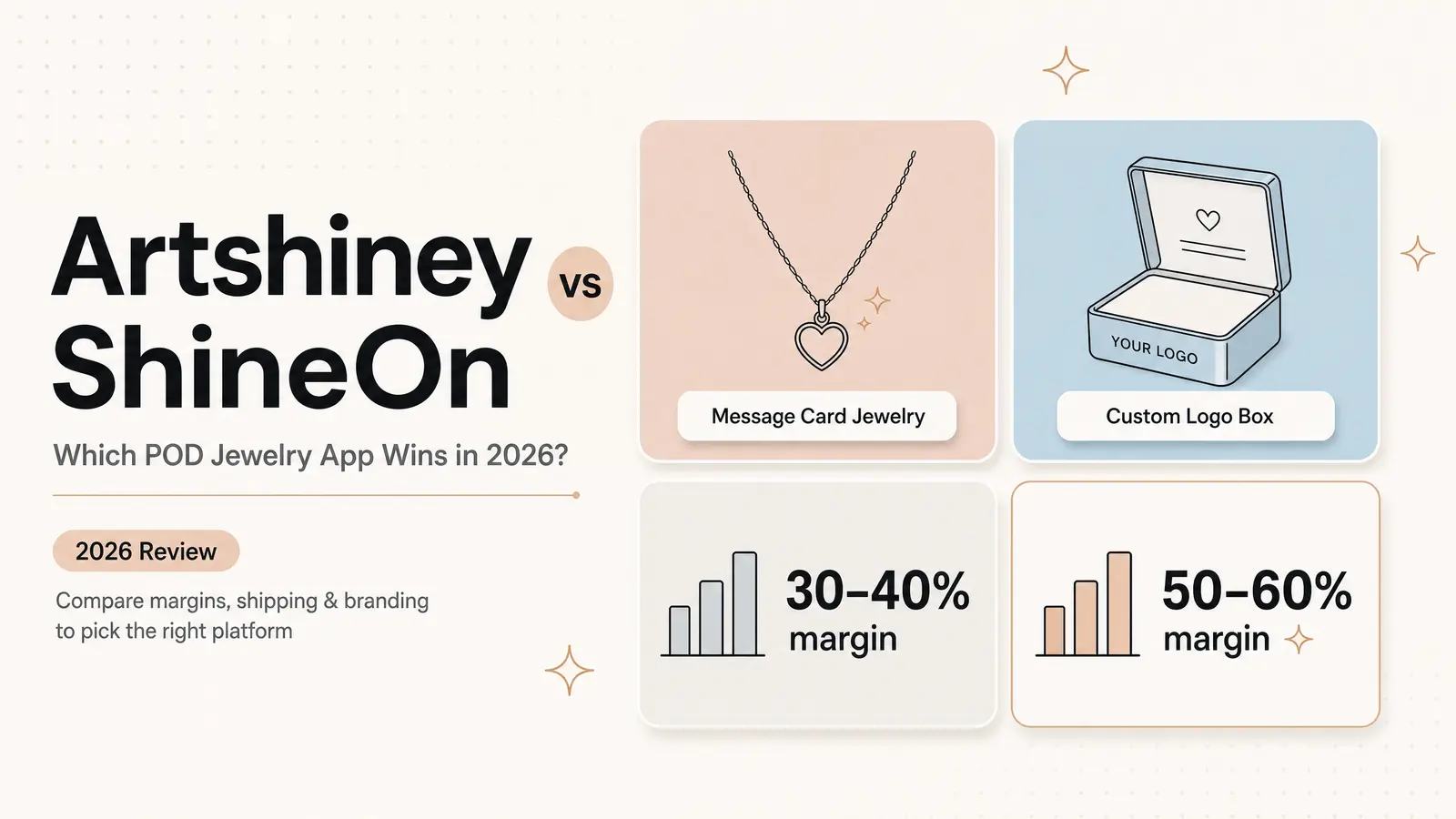
This Printify vs ShineOn comparison breaks down margins, quality, and product range to help sellers choose the best POD platform for jewelry or apparel.

Published:

June 18, 2026

Author:

Yi Cui

How Branvas works

1

Select products

Browse our catalog and choose the products that align with your brand vision.

2

Uplaod logo

Upload your labels, logos, and packaging designs to make the products truly yours.

3

Make sales

List products on your store and set your profit margins, we take care of fulfillment.

Join Branvas to explore our private label jewelry.

Table of Contents

TL;DR

  • The verdict: Printify is the undisputed king of catalog breadth and rapid apparel testing, while ShineOn completely dominates the high-margin, print-on-demand (POD) jewelry space [1] [2].
  • The key trade-off: Printify gives you access to 1,300+ products and 80+ print providers, but you sacrifice quality control and consistency. ShineOn gives you excellent quality and packaging for a narrow, specialized catalog of jewelry [1] [2].
  • The main gotcha: Printify's base margins can be surprisingly thin unless you pay for their Premium plan, and inconsistent suppliers can lead to high reprint rates [3] [4]. ShineOn's monthly subscriptions for advanced features can be very expensive [5].
  • The Reddit consensus: Sellers use Printify to test apparel widely, but explicitly recommend ShineOn if you want to sell jewelry with decent margins [6] [7].
  • The higher-margin upgrade: If you want to move beyond the limitations of POD jewelry, Branvas offers a private-label jewelry model with 50–60% margins, branded packaging, and no inventory risk, acting as the natural evolution for a growing jewelry brand [8].

TL;DR

Printify vs ShineOn: at a glance

When choosing between Printify and ShineOn, you are fundamentally choosing between a massive, multi-category apparel and home goods network versus a highly specialized, premium jewelry fulfillment service.

Feature Printify ShineOn Branvas
Model Print-on-demand marketplace (routes to 80+ providers) Print-on-demand jewelry & custom gifts Private-label jewelry dropshipping
Best for Broad apparel, home goods, testing multiple niches Message card jewelry, engraved pendants, custom watches Scaling a premium, private-label jewelry brand
Quality Highly variable (depends entirely on the chosen provider) Consistently high (in-house fulfillment, premium feel) Premium finished jewelry, retail-ready
Typical margin 15–20% (often lower after ad spend and shipping) 40–60% (due to high perceived value of jewelry) 50–60%
Branding Basic neck labels (on select items); generic packaging Good packaging (mahogany boxes available) Full branded packaging + blind shipping standard
Monthly cost $0 Free / $29 Premium ($24.99 annually) $0 Free / $27 Starter / $77 Side-Hustle / $87 Empire Builder $0 Free / $29 Growth / $79 Scale / $149 VIP
Returns risk High (inconsistent sizing and print quality across providers) Low (jewelry has fewer sizing/quality issues) Low (finished products, strict quality control)

Printify vs ShineOn: at a glance

Printify

Printify is a massive print-on-demand network rather than a single printing facility. It connects merchants to over 80 different print providers globally, offering a staggering catalog of more than 1,300 customizable products [1]. This makes it the go-to platform for sellers who want to test a wide variety of designs across t-shirts, hoodies, mugs, and home decor without committing to inventory.

Because Printify routes your orders to third-party facilities, your experience—and your customer's experience—depends entirely on which print provider you select.

Printify Pricing

Printify's core platform is free to use, but they offer a Premium tier that significantly reduces base product costs, which is almost mandatory if you want to maintain healthy profit margins [1].

Plan Monthly Cost Key Features
Free $0 5 stores, unlimited designs, standard product pricing
Premium $29.00 (or $24.99 billed annually) 10 stores, up to 20% discount on all products [1]
Enterprise Custom Unlimited stores, custom API, dedicated account manager

Pros of Printify

  • Massive Product Catalog: With over 1,300 items, you can sell almost anything, from standard apparel to niche items like car mats and shower curtains [1].
  • Global Fulfillment Network: You can choose print providers located near your target customers (e.g., US, EU, UK, Australia) to reduce shipping times and costs [1].
  • Low Barrier to Entry: The free plan allows you to start testing designs immediately with zero upfront financial risk.
  • Easy Integrations: Seamlessly connects with Shopify, Etsy, WooCommerce, and other major platforms [1].

Cons of Printify

  • Inconsistent Quality: Because you are using different third-party printers, print quality, garment feel, and shipping speeds vary wildly. A design might look great from one provider but terrible from another [3] [4].
  • Thin Profit Margins: The POD apparel space is highly competitive. Once you factor in Printify's base costs, shipping, and your own ad spend, margins are notoriously slim [9].
  • Fragmented Shipping: If a customer orders a t-shirt (printed by Provider A) and a mug (printed by Provider B), they will receive two separate packages and you will pay two separate shipping fees.

Printify

ShineOn

ShineOn is a specialized print-on-demand and fulfillment company focused almost exclusively on high-margin jewelry and personalized gifts [2]. Instead of routing orders to a sprawling network of third parties, ShineOn fulfills orders from their own facilities (primarily in the US and EU) [2].

Their signature product is "message card jewelry"—a standard piece of jewelry (like a necklace) packaged in a box with a highly customized, emotionally resonant message card designed by the seller. This model allows sellers to target specific emotional niches (e.g., "To my daughter on her graduation") and command premium prices.

ShineOn Pricing

ShineOn is free to install, but they heavily push their tiered subscription models which offer discounts on base costs and access to premium features [5].

Plan Monthly Cost Key Features
Free $0 Standard base costs, basic mockups
Starter $27.00 Up to $1 off per unit, product personalizer, upsell tools
Side-Hustle $77.00 Up to $2 off per unit, expedited shipping, priority support
Empire Builder $87.00 Up to $4 off per unit, exclusive products, dedicated account manager [5]

Pros of ShineOn

  • High Profit Margins: Because jewelry has a high perceived value, sellers routinely see margins of 40–60%, significantly higher than standard POD apparel [2].
  • Emotional Selling: The message card model allows you to create highly targeted, emotionally driven ads that convert well.
  • Consistent Quality: In-house fulfillment means strict quality control, fast shipping (2-5 days from the US), and premium packaging options like mahogany boxes with LED lights [2].
  • Built-in Upsells: The platform includes native tools to offer engravings or box upgrades, easily increasing average order value (AOV) [2].

Cons of ShineOn

  • Narrow Product Focus: If you want to sell anything other than jewelry, watches, or basic engraved items, ShineOn cannot be your only provider.
  • Expensive Subscriptions: To get the best base costs and access crucial features, you need to pay for their higher-tier monthly subscriptions, which can eat into profits for low-volume sellers [5].
  • Saturated "Message Card" Market: The specific style of message card jewelry has become very common, meaning you need excellent ad creative and unique copy to stand out [10].

ShineOn

Head-to-head: who wins on what

  • Price & Margins: ShineOn wins. While Printify's Premium plan is cheaper than ShineOn's upper tiers, the sheer profit margin you can command on ShineOn's jewelry easily outpaces the slim margins of POD t-shirts [2] [9].
  • Product Variety: Printify wins. With 1,300+ items compared to ShineOn's specialized catalog, Printify is the clear choice for building a broad lifestyle brand [1].
  • Quality Control: ShineOn wins. ShineOn controls its own production, ensuring consistent quality and beautiful packaging. Printify's quality is entirely at the mercy of whichever third-party provider you select [2] [4].
  • Shipping & Fulfillment: ShineOn wins. Because ShineOn fulfills in-house, shipping times are highly predictable. Printify's shipping speeds vary drastically depending on the provider and the season [2] [4].
  • Ease of Scaling: Tie. Printify makes it easy to scale across multiple product categories, while ShineOn makes it easy to scale revenue quickly through high-ticket items and built-in upsells.

Head-to-head: who wins on what

What sellers say on Reddit

The print-on-demand community on Reddit is highly vocal about the realities of both platforms. When searching through subreddits like r/printondemand and r/EtsySellers, a clear consensus emerges regarding Printify and ShineOn.

  • Printify's quality is a major pain point: Numerous sellers report significant issues with inconsistent print quality, especially when using the "Printify Choice" routing feature. One seller noted, "Print quality is inconsistent… roughly 45% of my items I manually ordered required reprinting" [4]. The general advice is to rigorously vet specific suppliers rather than trusting the platform blindly [6].
  • Apparel margins are brutal: Sellers frequently lament the difficulty of turning a real profit with Printify. A common sentiment is that once you factor in Printify's base costs, shipping, and platform fees (like Etsy's), "the profit margins are quite shocking… mostly due to Printify print + shipping being so expensive" [9].
  • ShineOn is the undisputed king of POD jewelry: When users ask about selling jewelry, the community almost unanimously points to ShineOn. In a 2026 ranking of top POD companies, one highly upvoted guide stated: "Selling jewelry? → ShineOn, full stop" [6].
  • ShineOn's subscriptions frustrate some users: While sellers love the products, there is grumbling about ShineOn's pricing tiers. Some users feel the higher-tier subscriptions are "way out of line with other print on demand service providers" just to access better base costs [11].
  • The "Message Card" saturation: Several Etsy sellers note that the ShineOn message card model is highly saturated. Because you are only designing the paper card and not the jewelry itself, it can be difficult to stand out without exceptional marketing copy [10].

What sellers say on Reddit

The third option: surfaces the jewelry-POD category, then positions private-label jewelry as the upgrade.

If you are reading this comparison, you have likely realized two things: standard POD apparel (Printify) suffers from razor-thin margins, and POD jewelry (ShineOn) offers a much more lucrative path.

However, ShineOn's model—printing a 2D message card to sit behind a generic piece of jewelry—is ultimately a stepping stone. As your brand grows, you will inevitably want to move away from the saturated "message card" look and start selling actual, premium jewelry that feels like a cohesive, high-end brand.

This is where Branvas comes in [8].

Branvas is not a print-on-demand company; it is a B2B private-label jewelry dropshipping platform designed specifically for Shopify [8]. It acts as the natural evolution for sellers who want the high margins of jewelry without the limitations of the POD model.

Instead of designing paper cards, Branvas gives you access to a catalog of over 600+ premium, finished jewelry SKUs [8]. You curate the pieces that fit your brand, and Branvas handles the sourcing, branded packaging, and global fulfillment.

Why Branvas is the ultimate upgrade:

  • True Brand Ownership: Branvas provides branded packaging and blind shipping as standard [8]. Your customers receive a premium jewelry box with your logo, not a generic POD package.
  • Superior Margins: Because you are sourcing finished private-label pieces, you can comfortably achieve 50–60% margins [8]. You can calculate your exact potential using their profit calculator.
  • Zero Inventory Risk: Just like POD, members pay for products only after their customer pays [8]. There is no upfront inventory cost.
  • Simplified Global Shipping: Branvas offers a flat $8.99 DDP shipping worldwide (duties paid), making international expansion incredibly simple [8].
  • No Design Bottleneck: There are no print files to manage or message cards to design. The jewelry ships as a beautiful, finished product [8].

Branvas offers plans scaling from Free ($0) to Growth ($29/mo), Scale ($79/mo), and VIP ($149/mo) [8]. If you are ready to transition from selling "printed cards" to selling a true jewelry brand, explore the Branvas catalog and see how it works.

The third option: surfaces the jewelry-POD category, then positions private-label jewelry as the upgrade.

Which should you pick?

  • Choose Printify if… you are building a broad lifestyle brand, want to sell t-shirts, hoodies, and home goods, and need to test dozens of different product categories quickly with zero upfront cost.
  • Choose ShineOn if… you want to specialize in high-margin, emotional gifting, and your marketing strategy relies heavily on personalized message cards and engraved items.
  • Add Branvas if… you have validated the jewelry niche and want to upgrade to a true private-label brand. It is the perfect backend to scale a premium jewelry store with custom packaging, 50-60% margins, and zero inventory risk.

Which should you pick?

FAQ

Is Printify completely free to use?
Yes, Printify's core platform is free. You only pay the base cost of the product and shipping when a customer makes a purchase. However, their Premium plan ($29/month) offers up to 20% off base costs, which is highly recommended for serious sellers [1].

How long does ShineOn take to ship?
ShineOn is known for fast fulfillment. Most orders produced in their US facilities ship within 2 to 5 business days [2].

Do I have to buy inventory upfront with these platforms?
No. Printify, ShineOn, and Branvas all operate on a dropshipping model. You only pay for the product after your customer has paid you, completely eliminating inventory risk [1] [2] [8].

Why are Printify's margins so low?
Apparel is a highly competitive market with an established ceiling on what consumers will pay for a t-shirt. Once you deduct Printify's base production cost, shipping fees, and your own advertising or marketplace fees, the remaining profit is often very slim [9].

Can I use Printify/ShineOn and sell jewelry too?
Absolutely. Many successful Shopify stores use a hybrid approach. You can use Printify for your branded apparel and merchandise, while seamlessly integrating ShineOn or Branvas to handle a high-margin jewelry collection on the exact same storefront.

What's the most profitable product to add to a store like this?
Jewelry is consistently the highest-margin product you can add to an e-commerce store. Because of its high perceived value and low shipping weight, jewelry allows for 50–60% profit margins. Transitioning from POD apparel to private-label jewelry (via a platform like Branvas) is one of the fastest ways to increase your store's profitability [8].

References

[1] Printify Pricing & Plans
[2] ShineOn Platform Overview
[3] Reddit: Printify Choice causing random cancellations and quality issues?
[4] Reddit: 30% of products require reprint. Printify is beginning to look like a garbage business venture.
[5] ShineOn Shopify App Pricing
[6] Reddit: Top Print on Demand Companies in 2026
[7] Reddit: I'm a POD seller who used to print on their own, but now thinking about switching
[8] Branvas: Private Label Jewelry Dropshipping
[9] Reddit: How to actually make any $? Profit margins are so low!
[10] Reddit: Does anyone here sell print on demand jewelry like shine on?
[11] ShineOn Zendesk: Subscription Tiers - Benefits and access (Comments)
Related articles