

A complete playbook for sourcing, branding, and marketing personalized name jewelry in 2026, covering supplier vetting, seasonal demand calendars, and profit margin benchmarks.
Published:
April 7, 2026
Author:
Yi Cui
Turn personal stories into your best sellers. The global personalized jewelry market is projected to reach $118.07 billion by 2035, growing at a compound annual rate of 8.4% [^1]. But beyond the headline numbers lies a more urgent reality for ecommerce founders: personalized items are no longer a nice-to-have category. They are the engine driving the highest conversion rates, the strongest average order values, and the most loyal repeat customers during peak gifting seasons.
This guide is written for aspiring and active ecommerce sellers, influencers, and boutique owners who want to capture that demand. By the time you finish reading, you will know exactly how to source, brand, and market a custom name jewelry dropshipping operation profitably in 2026, without tying up capital in upfront inventory.
The psychology behind personalized gifting runs deep. When a recipient receives a customized item, it activates emotional centers in the brain associated with social connection and trust [^2]. A 2024 study from the University of Bath found that recipients of personalized gifts show significantly higher appreciation and enhanced self-esteem compared to recipients of standard gifts, regardless of the effort the giver actually put in [^3]. Researchers called this effect "vicarious pride." The recipient feels the thought and care embedded in the customization.
That emotional resonance translates directly into ecommerce metrics. Engraved and name jewelry consistently outperforms generic jewelry in both Average Order Value (AOV) and repeat purchase rates. Consumers view personalized items as inherently more valuable, and the data backs this up: 77% of consumers say they are willing to pay a premium for customized fashion accessories and jewelry [^4].
There is a persistent idea in ecommerce circles that consumers are growing tired of personalized products. The data tells a different story. Consumers are fatigued by low-effort personalization, such as generic print-on-demand mugs with a first name slapped on them. Demand for high-quality, bespoke engravings grew 28% year-on-year according to recent market tracking data [^1]. Low-competition niches inside this category, including handwriting jewelry, coordinate engravings, and custom signet rings, are still wide open in 2026.
The contrarian insight worth internalizing: the sellers who are struggling in personalized jewelry are the ones treating it as a commodity. The sellers who are winning are the ones treating each SKU as a story.
In our experience at Branvas, the sellers who double down on personalized SKUs are the ones who build the most resilient brands, insulated from the race-to-the-bottom pricing that plagues generic dropshipping.

The personalized jewelry market is diverse, but certain categories dominate search volume and consumer spending. "Necklace engraving" and "personalized jewelry supplier" are high-intent search queries that signal strong buyer readiness. The current landscape is led by name necklaces, initial pendants, birthstone pieces, coordinate engravings, custom signet rings, handwriting jewelry, and couples sets.
Name necklaces and initial pendants are the search-volume leaders for "necklace engraving," making them essential anchor products for any new catalog. Handwriting jewelry and couples sets command the highest AOV and are particularly strong around Valentine's Day and anniversaries.
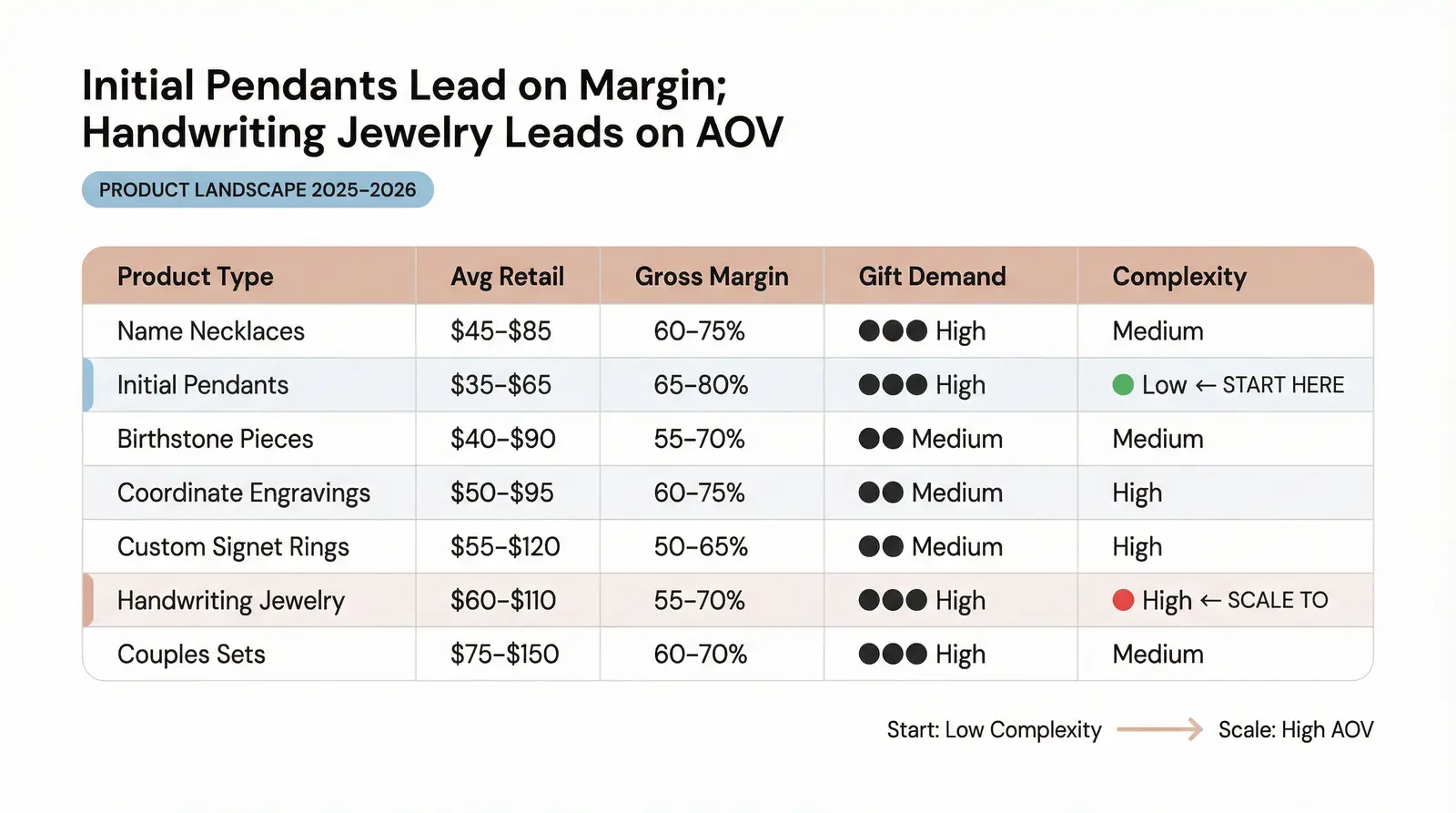
The table below provides a practical comparison of the major product types, including typical margins and sourcing complexity.
| Product Type | Avg. Retail Price | Typical Gross Margin | Gift Demand Score | Complexity to Source |
|---|---|---|---|---|
| Name Necklaces | $45 - $85 | 60% - 75% | High | Medium |
| Initial Pendants | $35 - $65 | 65% - 80% | High | Low |
| Birthstone Pieces | $40 - $90 | 55% - 70% | Medium | Medium |
| Coordinate Engravings | $50 - $95 | 60% - 75% | Medium | High |
| Custom Signet Rings | $55 - $120 | 50% - 65% | Medium | High |
| Handwriting Jewelry | $60 - $110 | 55% - 70% | High | High |
| Couples Sets | $75 - $150 | 60% - 70% | High | Medium |
The "Complexity to Source" column deserves attention. High-complexity products like handwriting jewelry require suppliers with precise scanning and engraving capabilities. If your supplier cannot reliably reproduce a customer's actual handwriting, you will face high return rates and negative reviews. Start with lower-complexity products like initial pendants to validate your brand before expanding into more technically demanding SKUs. You can browse a curated catalog of ready-to-sell personalized pieces at branvas.com/catalog.
Finding a reliable supplier is the single biggest operational hurdle in custom name jewelry dropshipping. Most guides tell you to "just check reviews on AliExpress." That advice will cost you customers. To solve this properly, we developed the Branvas 4-Layer Supplier Vetting Framework, a proprietary process that ensures you partner with manufacturers capable of delivering quality and personalization at scale.
Personalized jewelry must look premium. A poorly plated name necklace tarnishes within weeks and destroys your brand reputation. Quality consistency covers material standards, plating thickness, and engraving depth and precision.
Ask your prospective supplier these questions before committing:
Customization requires operational precision. Your supplier must handle per-order customization at volume without lead-time blowouts during Q4, when order volumes can spike 300% or more.
Ask your prospective supplier:
This is where traditional dropshipping most commonly fails. Your customers should never know a third party shipped their order. Blind fulfillment means no supplier branding, no Chinese factory return addresses, and no promotional inserts from the manufacturer.
Ask your prospective supplier:
We often see founders struggle with Layer 3, blind fulfillment, because overseas suppliers frequently slip their own promotional materials into packages, destroying the illusion of a premium brand experience. A customer who receives a "Thank you for shopping at [Chinese Factory Name]" card inside their order will not trust your store again.
Your supplier must be able to grow with you, from 10 orders a day to 1,000. Scalability covers MOQ flexibility, SKU range, and order automation readiness.
Ask your prospective supplier:
Worked Example: How Seller A Applied the 4-Layer Framework
Seller A is launching a name necklace line on Shopify. She begins vetting suppliers using the framework. In Layer 1, she rejects three suppliers who cannot verify their plating thickness or provide sample orders. She finds a fourth supplier with excellent quality, but in Layer 2, she discovers their holiday lead time extends to 21 days. Rejected. A fifth supplier passes Layers 1 and 2 and has a Shopify app for automated routing (Layer 4), but in Layer 3, they confirm they cannot support unbranded packaging. Rejected. Seller A ultimately partners with a Brand-as-a-Service provider that passes all four layers, giving her a seamless customer experience from the first order.

Marketing personalized jewelry requires a fundamental shift in mindset. You are not selling metal. You are selling a memory, a relationship, a moment that someone wants to hold onto forever. That is the lens through which every piece of marketing copy, every ad creative, and every email should be written.
Personalized jewelry demand is intensely seasonal. Sellers who plan their campaigns at least six weeks ahead of each major gifting occasion consistently outperform those who react in real time. Here is how to approach each key window.
Valentine's Day (February): Focus on couples sets and coordinate engravings. The National Retail Federation reported that consumers were expected to spend a record $7 billion on jewelry for Valentine's Day in 2026, the single largest spending category for the holiday [^5]. Start your ad campaigns in mid-January and lean into the emotional narrative of giving something that lasts longer than flowers.
Mother's Day (May): Push birthstone pieces and handwriting jewelry. Mother's Day jewelry spending was projected at $6.8 billion in 2025, with nearly half of consumers saying finding a "unique or different" gift was their top priority [^6]. Handwriting jewelry, where a child's actual handwriting is engraved onto a pendant, is one of the most emotionally resonant products in this category.
Graduation (June): Promote initial pendants and custom signet rings. Graduation gifts skew toward meaningful, lasting items that mark a life milestone. A custom signet ring or an initial pendant with a graduation date engraved on the back performs strongly in this window.
Black Friday and Cyber Monday (November): Run your best-seller promotions and bundle deals. Personalized items are less price-sensitive than generic jewelry, so avoid deep discounting. Instead, offer a "free gift wrapping and personalized card" add-on to increase perceived value without cutting margin.
Christmas and Q4 (December): This is your biggest window. Market your entire catalog, emphasizing bundle deals and gifting sets. The demand spike here is the largest of the year.
The table below provides a practical index for planning your inventory and marketing calendar.
| Month | Key Occasion | Relative Demand Index | Recommended Product Focus |
|---|---|---|---|
| January | Post-holiday self-gifting | Moderate | Initial Pendants, Birthstone Pieces |
| February | Valentine's Day | Very High (+180%) | Couples Sets, Coordinate Engravings |
| March | International Women's Day | Low-Medium | Name Necklaces, Initial Pendants |
| April | Easter / Spring | Low | Birthstone Pieces |
| May | Mother's Day | Very High (+210%) | Handwriting Jewelry, Birthstone Pieces |
| June | Graduation, Father's Day | High (+85%) | Signet Rings, Initial Pendants |
| July | Summer | Low | Coordinate Engravings |
| August | Back to School | Low-Medium | Initial Pendants |
| September | Fall prep | Low | Name Necklaces |
| October | Pre-holiday planning | Medium (+40%) | Bundles, Gift Sets |
| November | Black Friday / Cyber Monday | High (+150%) | Name Necklaces, Best Sellers |
| December | Christmas / Hanukkah | Peak (+300%) | All Categories, High-AOV Bundles |
Generic product titles kill conversions. Instead of "14k Gold Plated Name Necklace," write "Keep Her Name Close to Your Heart: The Signature 14k Gold Nameplate." Lead with the emotional outcome, not the product specification. Your product description should answer the question the buyer is really asking: "Will this make the person I love feel seen?"
Include the story of the piece in your listing. Mention the engraving process, the care that goes into each letter, and the premium packaging it arrives in. These details justify the price and reduce purchase hesitation.
Personalized jewelry buyers over-index on sharing their unboxing and gifting moments. A customer who receives a beautifully packaged name necklace and opens it in front of their partner is almost certain to film it. Systematically capture this by including a card in every package that invites customers to tag your brand on Instagram or TikTok in exchange for a discount on their next order.
User-generated content provides the social proof necessary to convert cold traffic. A real customer's reaction video is more persuasive than any ad you can produce. Build a system for collecting, curating, and repurposing this content across your channels.
Increase your AOV by building curated gifting sets. A "Mother-Daughter Set" that includes a handwriting pendant for mom and a matching initial bracelet for the daughter tells a complete story and commands a significantly higher price than either item sold separately. Personalized items are uniquely suited for bundling because the narrative coherence of the bundle adds perceived value beyond the sum of its parts.
On TikTok and Meta, "name reveal" Reels and before/after engraving videos consistently outperform static product images. Show the transformation: a blank piece of metal becoming a meaningful keepsake with someone's name etched into it. This visual process is inherently compelling and drives high click-through rates. Gifting reaction videos, where someone opens a personalized piece on camera, are also extremely effective for driving conversions.

There is a fundamental difference between running a dropship store and building a private-label brand. Plain dropshipping means generic products shipped in generic polybags from overseas factories. Private-label brand building means custom packaging, branded thank-you cards, a cohesive visual identity, and a customer experience that feels intentional from the first click to the unboxing moment.
This distinction matters enormously for long-term profitability. When a customer receives a beautifully packaged, personalized item in a branded box with a handwritten-style card, they are far more likely to return for future gifting occasions, leave a positive review, and refer friends. Premium packaging also justifies a higher retail price, which directly improves your gross margin.
Research consistently shows that companies offering customized products report a 40% decrease in return rates compared to generic alternatives [^4]. When a customer has personalized an item, they are emotionally invested in it before it even arrives. That attachment dramatically reduces the likelihood of a return.
If you're ready to move beyond generic dropshipping and launch a real brand, explore how Branvas works. Branvas's Brand-as-a-Service model provides the complete infrastructure layer that enables this premium experience without requiring you to manage a warehouse, negotiate with factories, or design packaging from scratch.

Choosing the right platform is a strategic decision, not just a technical one. Each channel has distinct advantages and trade-offs for personalized jewelry sellers.
Shopify is the gold standard for building a standalone brand. It gives you complete control over the customer experience, branding, upsell funnels, and email marketing. It is the right choice for sellers who are focused on long-term LTV and brand equity. Shopify also integrates seamlessly with fulfillment partners like Branvas, making order automation straightforward. If you are an ecommerce or boutique store owner, Shopify is your primary home base.
Etsy provides excellent organic traffic for handmade and personalized items. Buyers on Etsy are already in a gift-buying mindset, which reduces the friction of conversion. The trade-off is that Etsy's fees are high (listing fees, transaction fees, payment processing fees), and you are building traffic for Etsy's platform, not your own brand. Use Etsy as a customer acquisition channel, then migrate repeat buyers to your Shopify store.
TikTok Shop is purpose-built for impulse purchases driven by compelling video content. Name reveal videos and engraving process videos perform exceptionally well here. If you are an influencer or creator with an existing audience, TikTok Shop allows you to convert that attention directly into sales without sending followers to an external site.
Amazon Handmade provides access to Amazon's enormous customer base, but the competition is fierce, customization workflows can be clunky, and Amazon's branding requirements make it difficult to build a memorable brand identity.
For your Shopify store, SEO is a long-term asset worth investing in from day one. Optimize product page titles and meta descriptions for high-intent queries like "necklace engraving," "custom name necklace," and "personalized jewelry supplier." Use descriptive alt text on all product images. Create collection pages organized around gifting occasions (e.g., "Mother's Day Jewelry Gifts") to capture seasonal search traffic.
A well-structured blog, like the Branvas Academy, also builds topical authority and drives organic traffic over time. Publishing guides on topics like "how to choose a name necklace" or "best personalized jewelry for graduation" targets buyers earlier in the research phase.
Email and SMS are disproportionately effective for this category because of the recurring nature of gift-giving occasions. Build the following flows into your marketing stack from launch.
A gifting reminder sequence sends automated emails and SMS messages ahead of major occasions. "Mother's Day is three weeks away. Here's how to make it unforgettable." These messages convert well because they reach buyers at the exact moment their purchase intent is highest.
An anniversary re-order sequence uses the purchase date to trigger a reminder one year later. "A year ago, you gave someone a name necklace they still wear every day. Ready to add to the collection?" This flow is uniquely powerful for personalized jewelry because the emotional connection to the original purchase makes the re-order feel natural.
A post-purchase UGC request flow asks customers to share their unboxing or gifting moment in exchange for a discount on their next order. This simultaneously generates social proof and seeds your next purchase.

Pricing personalized jewelry correctly is one of the highest-leverage decisions you will make. The core principle is the "personalization premium": buyers consistently pay 30% to 60% more for a personalized item compared to a generic equivalent because the emotional value is structurally higher [^4]. Your pricing strategy must reflect this reality.
The table below provides realistic COGS, retail price, and margin benchmarks for the major product types.
| Product Type | Typical COGS (incl. packaging) | Retail Price Range | Gross Margin Range |
|---|---|---|---|
| Name Necklaces | $15 - $25 | $65 - $85 | 60% - 75% |
| Initial Pendants | $10 - $20 | $45 - $65 | 65% - 80% |
| Birthstone Pieces | $18 - $28 | $55 - $90 | 55% - 70% |
| Coordinate Engravings | $20 - $30 | $65 - $95 | 60% - 75% |
| Custom Signet Rings | $25 - $40 | $75 - $120 | 50% - 65% |
| Handwriting Jewelry | $22 - $35 | $70 - $110 | 55% - 70% |
| Couples Sets | $35 - $55 | $95 - $150 | 60% - 70% |
A few important notes on these benchmarks. First, COGS includes premium branded packaging. A generic polybag costs almost nothing, but it also destroys perceived value. Premium packaging typically adds $3 to $8 to your COGS but allows you to price 20% to 30% higher, making it a net positive for margin. Second, your net margin after Customer Acquisition Cost (CAC) will be lower than your gross margin. The goal is to keep CAC below 25% of your retail price through a combination of organic social media, email marketing, and referral programs.
To maximize profitability, focus on two levers simultaneously: increasing AOV through bundle deals and gifting sets, and reducing blended CAC through repeat purchases and referrals. A customer who buys twice has a dramatically lower effective CAC than a one-time buyer.
Use the Branvas Profit Calculator to model your margins before you launch and stress-test your pricing against different CAC scenarios.
Ready to launch your personalized jewelry brand with private-label packaging and blind dropship fulfillment? Start with Branvas today — no warehouse, no minimums, no guesswork.

The best supplier depends on your business model, but for sellers who are serious about building a brand rather than just a store, a Brand-as-a-Service provider is the right choice. Traditional dropshipping suppliers focus on logistics only, often resulting in generic packaging and slow shipping that undermines your brand's perceived value. Branvas offers a curated catalog of high-quality personalized jewelry with 100% blind fulfillment, custom branded packaging, and Shopify integration, allowing you to build a premium brand without holding a single unit of inventory. For sellers who want to compare options, the key criteria are: blind fulfillment capability, per-order customization capacity, and API or app-based order automation.
Yes. True custom name jewelry dropshipping involves per-order manufacturing, not pre-made inventory. When a customer places an order on your store and enters their desired name or text, those details are automatically routed to the supplier via API or app integration. The supplier then uses laser engraving or diamond drag engraving technology to customize the blank piece, applies any required plating, packs the item in your branded packaging, and ships it directly to the customer. The entire process typically takes two to five business days from order to dispatch with a quality supplier. This per-order model is what makes the category so powerful: every item is unique, which eliminates the return risk associated with "wrong size" or "not as described" issues common in generic jewelry.
Personalized jewelry commands a premium price that generic jewelry cannot. Gross margins of 60% to 80% are achievable and common in this category. As a concrete example, a custom name necklace sourced for $18 (including premium branded packaging) can comfortably retail for $65 to $85. After accounting for a Customer Acquisition Cost of $15 to $20 through paid social, your net margin on that sale is approximately 40% to 50%. The key to sustaining those margins over time is building a repeat purchase engine through email marketing, gifting reminders, and exceptional unboxing experiences that drive organic referrals. You can explore detailed margin modeling at branvas.com/pricing.
No. The dropshipping model eliminates the need for upfront inventory investment entirely. Your primary startup costs are: setting up your Shopify store (approximately $39 per month), designing your brand assets including logo and packaging inserts, and funding your initial marketing campaigns. Most sellers launch their first personalized jewelry brand for under $500 in total setup costs. Platforms like Branvas allow you to launch with zero inventory risk and no minimum order quantities, making this category highly accessible for influencers and creators who want to monetize their audience, as well as ecommerce and boutique store owners who want to add a high-margin gift category to their existing store.
Standard dropshipping suppliers are logistics businesses. They store inventory, process orders, and ship packages. That is the beginning and end of what they do. Branvas operates as a Brand-as-a-Service. We handle product sourcing, quality control, custom private-label branding, premium packaging design and production, and blind fulfillment, all under your brand name. The practical difference is that your customers receive a premium unboxing experience that feels like it came from a luxury brand, not a dropshipping operation. This drives higher perceived value, lower return rates, and stronger repeat purchase rates. You can learn more about the model and explore how Branvas works, or visit the Branvas Academy for step-by-step launch guides.
[^1]: Business Research Insights. Personalized Jewelry Market Outlook 2026-2035. Last Updated: March 16, 2026.
[^2]: American Psychological Association. What happens in your brain when you give a gift?. December 9, 2022.
[^3]: ScienceDaily / University of Bath. Personalized gifts create lasting emotional connections and enhance self-esteem. December 27, 2024.
[^4]: Kickflip / Deloitte. 11 Product Customization Statistics You Need to Know. Based on Deloitte commissioned survey data.
[^5]: National Retail Federation. Valentine's Day Spending Expected to Reach New Records. January 27, 2026.
[^6]: National Retail Federation. Mother's Day Spending Expected to Reach $34.1 Billion. April 28, 2025.