


Capitalize on the $6.8 billion Mother’s Day jewelry market with top product picks, sourcing strategies, a 12-week launch timeline, and proven marketing tactics for maximum profit.
Published:
April 20, 2026
Author:
Yi Cui
Profit from the heart during the year's biggest gifting surge. In 2025, U.S. consumers are projected to spend a near-record $34.1 billion on Mother's Day, with jewelry dominating as the top gift category at $6.8 billion [1]. The window is real, the market is massive, and preparation starts much earlier than most sellers think.
Whether you are an aspiring entrepreneur, an influencer looking to monetize your audience, or a boutique owner scaling up, this season offers unparalleled potential. This guide is your definitive seasonal roadmap: exactly what to sell, when to source, and how to market your Mother's Day jewelry line for maximum profit.
Mother's Day consistently ranks as the second-largest gifting holiday of the year, surpassed only by the winter holidays [1]. When it comes to emotional resonance and perceived value, though, it stands alone. Consumers are not just buying metal and stones. They are purchasing tangible symbols of gratitude and lifelong bonds. This emotional connection drives higher average order values, with shoppers planning to spend an average of $259.04 per person in 2025 [1]. Jewelry captures the largest share of that spend, outperforming special outings, gift cards, and electronics [2].
Here is the contrarian insight most sellers miss: you do not need to be an established brand to win this season. Small, personalized sellers consistently outperform massive retailers on Mother's Day because personalization beats volume. Nearly half of all consumers (48%) say finding a gift that is "unique or different" is their top priority [1]. Big-box stores simply cannot offer the bespoke, meaningful touches that independent creators and boutique owners can. In our experience at Branvas, we consistently see new sellers generate their first meaningful revenue spike during Mother's Day, often before they have fully figured out their brand.

To maximize your seasonal revenue, you must select products that balance emotional impact with healthy profit margins. We developed the Mother's Day Opportunity Matrix to help sellers evaluate which jewelry categories to prioritize. This framework scores products based on two critical dimensions: Personalization Potential (how easily the item can be customized for the recipient) and Perceived Gift Value (how premium the item feels to the buyer).
| Quadrant | Personalization Potential | Perceived Gift Value | Recommended Products | Strategy |
|---|---|---|---|---|
| Tier 1: The Goldmine | High | High | Birthstone sets, engraved lockets, custom name necklaces | Prioritize. These items command premium prices and drive the highest conversion rates for Mother's Day. |
| Tier 2: The Upsell | Low | High | Fine metal chains, diamond studs, premium stackable rings | Bundle. Use these high-value, low-customization items to increase average order value alongside Tier 1 products. |
| Tier 3: The Entry Point | High | Low | Simple initial charms, stamped metal bracelets | Acquire. Perfect for budget-conscious shoppers or younger buyers; use these to build your customer list. |
| Tier 4: The Distraction | Low | Low | Generic fashion earrings, plain pendants | Avoid. These lack the emotional weight required for Mother's Day gifting and face fierce competition from big-box stores. |
By focusing your inventory on Tier 1 products, you align perfectly with the 48% of shoppers seeking unique, meaningful gifts. This framework ensures you invest your capital in items that justify a "gift premium" markup, rather than competing on price with generic alternatives.

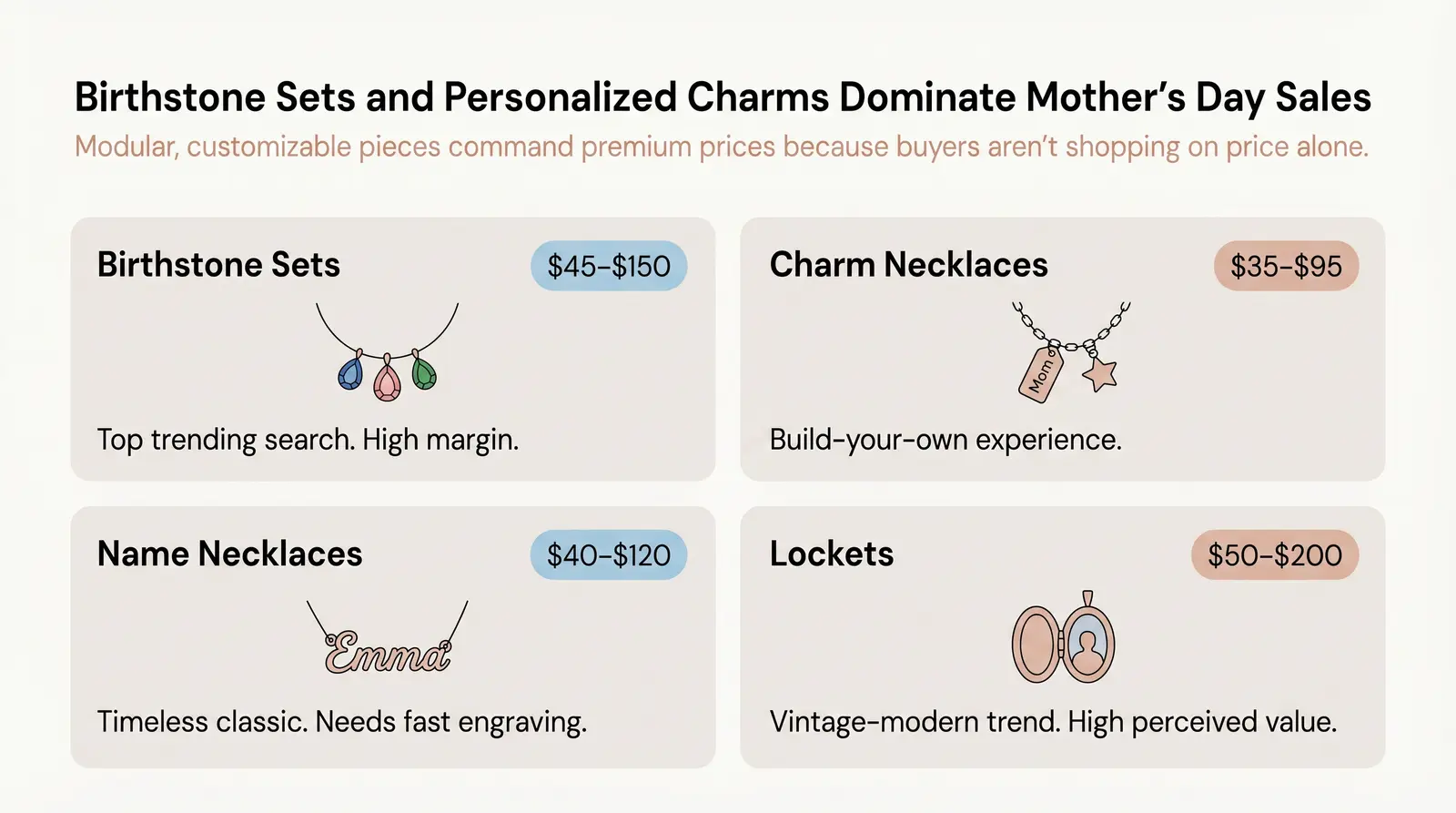
Based on current market data and consumer search trends, certain product categories consistently dominate the Mother's Day landscape. The table below summarizes the top five, followed by a closer look at each.
| Product Category | Retail Price Range | Personalization Angle | Key Sourcing Note |
|---|---|---|---|
| Birthstone Jewelry Sets | $45–$150 | Stones for each child/family member | Modular base-plus-charm designs reduce inventory risk |
| Personalized Charm Necklaces | $35–$95 | Initials, symbols, "Mom" tags | Buy base chains in bulk; source charms separately |
| Name or Initial Necklaces | $40–$120 | Engraved names, monograms | Require rapid-turnaround engraving; cannot be pre-stocked |
| Lockets (Photo or Engraved) | $50–$200 | Hidden photos or secret messages | Seek suppliers offering pre-shipment photo insertion |
| Stackable Rings | $30–$85 per ring | Birthstone stacks for mother and children | Adjustable or open designs minimize sizing returns |
Birthstone Jewelry Sets are the undisputed top performer. Birthstone necklaces ranked as the number one trending Mother's Day gift search in 2025 [3], and it is easy to understand why. A set of birthstones representing each child transforms a simple piece of metal into a permanent family portrait. Retail prices typically run $45 to $150, and because buyers are assembling a custom combination, they rarely shop on price alone.
Personalized Charm Necklaces offer a playful, layered approach to gifting. Buyers select initials, meaningful symbols, and "Mom" tags to build a one-of-a-kind piece. Retailing between $35 and $95, they are accessible for a wide range of budgets. The smartest sourcing strategy here is to purchase high-quality base chains in bulk and stock a wide variety of individual charms, giving customers a "build-your-own" experience.
Name or Initial Necklaces are a timeless classic that converts reliably year after year. Retailing between $40 and $120, they appeal to buyers who want something personal but clean. The key sourcing consideration is rapid-turnaround engraving. These pieces cannot be pre-stocked in finished form, so your supplier's production speed is critical.
Lockets are experiencing a major resurgence, driven by the "vintage-modern" aesthetic trending across jewelry in 2025 [4]. Retailing from $50 to $200, they carry high perceived value and deep emotional weight. Look for suppliers who offer photo-insertion services before shipping, as this single feature dramatically increases the perceived gift value.
Stackable Rings are highly collectible and encourage repeat purchases year over year. Retailing at $30 to $85 per ring, they are often sold as sets representing a mother and her children's birthstones. Stock adjustable or open-band designs to minimize sizing issues and reduce post-holiday returns.
Securing the right inventory at the right time is the most critical step in your Mother's Day strategy. The sourcing landscape generally falls into three tiers.
Generic wholesale marketplaces offer low minimum order quantities (MOQs) but limited customization and generic packaging. They are useful for testing concepts, but difficult to build a premium brand around. Private-label suppliers allow you to apply your branding to their designs. They require higher MOQs and longer lead times, but they offer better margins and brand cohesion. Brand-as-a-Service platforms are comprehensive solutions that handle sourcing, custom packaging, and fulfillment. Platforms like Branvas are built specifically for this model, handling sourcing, branded packaging, and blind fulfillment so sellers can focus entirely on marketing and community.
The biggest mistake new sellers make is ordering too late. For a May Mother's Day, serious sellers need inventory or supplier relationships confirmed by late February or early March at the absolute latest [5]. Post-Chinese New Year production backlogs can severely delay shipments, leaving you empty-handed during peak buying weeks.
Do not ignore packaging quality. A premium unboxing experience is non-negotiable for gifting holidays. And avoid choosing rigid, non-customizable products for a season driven entirely by personalization.

Success during Mother's Day requires a disciplined, multi-channel approach. This 12-week roadmap outlines exactly when to execute each phase of your launch.
| Week | Phase Name | Key Actions | Marketing Focus | Milestone |
|---|---|---|---|---|
| Weeks 1–3 (Feb) | Foundation & Sourcing | Finalize product selection; contact suppliers; confirm MOQs and lead times. | Seed email list with "Early Access" sign-ups; tease upcoming collections on social media. | Supplier contracts signed; initial inventory ordered. |
| Weeks 4–6 (Mar) | Asset Creation | Receive samples; shoot lifestyle and product photography; finalize pricing and packaging. | Begin educational content (e.g., "Birthstone Meanings"); launch Pinterest campaigns. | Website updated with new products; visual assets complete. |
| Weeks 7–9 (Apr) | The Soft Launch | Launch "Early Bird" promotions; activate influencer partnerships; ensure inventory is fully stocked. | Send segmented email campaigns; run targeted paid social ads focusing on gift-givers. | First wave of sales secured; influencer content goes live. |
| Weeks 10–11 (Late Apr/Early May) | The Final Push | Highlight guaranteed delivery cutoffs; offer bundled gift sets; manage customer service inquiries. | High-urgency messaging ("Last Chance," "Selling Out Fast"); retargeting ads for cart abandoners. | Peak sales volume achieved; shipping deadlines met. |
| Week 12+ (Post-Holiday) | Retention & Review | Process returns; analyze sales data; restock evergreen bestsellers. | Send "Thank You" emails; request reviews and user-generated content (UGC). | Post-mortem analysis complete; Q3 planning begins. |
Worked Example: "Luna & Bloom" - A Hypothetical Creator Launching a Birthstone Charm Line
Imagine Sarah, an Instagram creator with 15K followers, launching "Luna & Bloom." In early February (Week 1), she partners with a Brand-as-a-Service platform to source high-quality gold-filled chains and birthstone charms. By Week 4, she receives her samples and shoots unboxing videos highlighting the premium packaging.
To build her list, she offers a lead magnet: "The Ultimate Guide to Meaningful Mother's Day Gifts." In Week 7, she launches her "Build-Your-Own Mom Necklace" campaign to her email list, offering a 15% early-bird discount. Because she started her Pinterest strategy in March, she captures organic search traffic just as it peaks. By Week 10, she shifts to urgency messaging ("Order by May 1st for guaranteed delivery!"). Through disciplined timing and a focus on personalization, Sarah generates $8,500 in revenue over the 12-week period, establishing a profitable foundation for her new brand.

To convert browsers into buyers, your marketing must be strategic, emotional, and timely. Here is what actually works.
Email marketing is your highest-ROI channel, but only if you segment properly. Do not send the same email to everyone. Split your list into "buying for mom" (partners, adult children) and "mom buying for herself," since self-gifting is a significant and growing trend. Tailor your subject lines to each group: "The Gift She Actually Wants" performs very differently from "Treat Yourself This Mother's Day."
Social content should lead with emotion, not product specs. Unboxing videos, gift reveal moments, and curated "Gift Guide" Reels consistently outperform standard product posts. Encourage user-generated content by inviting followers to share stories about their mothers alongside your products.
Pinterest and Google Shopping deserve special attention. Here is the non-obvious insight: Pinterest traffic for Mother's Day jewelry gifts peaks 4 to 6 weeks before the holiday, meaning most sellers start too late and miss the organic window entirely [6]. You need to begin pinning seasonal content in February or March to ride the full organic curve. Google Shopping ads, meanwhile, capture high-intent buyers who are already searching for specific products.
Paid social targeting on Facebook and Instagram should focus on the gift-givers, not the recipients. Use demographic and behavioral targeting to reach spouses and adult children, and frame your ad copy around solving their problem: finding a meaningful, stress-free gift that will actually land.
Micro-influencer partnerships (10K to 50K followers) are often more effective than celebrity placements for jewelry because the audience trust is higher and the content feels authentic. Send personalized pieces in exchange for unboxing content and dedicated discount codes.
Urgency messaging is your most powerful late-stage conversion tool. Clear, specific shipping deadlines, such as "Order by May 1st for Guaranteed Mother's Day Delivery," consistently outperform vague calls to action. Pair this with countdown timers on your product pages and in your email subject lines.

Pricing jewelry for a gifting holiday requires a different approach than everyday retail. In gifting contexts, perceived value is paramount. Mother's Day buyers consistently pay a 20–40% premium over everyday buyers for the same product when it is positioned as a "meaningful gift" rather than a simple accessory.
Your pricing framework should follow this progression: Cost of Goods (COGS), then Landed Cost (including shipping and packaging), then Keystone Markup (2x to 3x), and finally the Gift Positioning Premium.
Here are example margin scenarios for popular Mother's Day items:
| Product Type | Landed Cost (Wholesale + Packaging) | Standard Retail Price (2.5x Markup) | Mother's Day "Gift Premium" Price | Estimated Gross Margin |
|---|---|---|---|---|
| Birthstone Pendant Set | $18.00 | $45.00 | $65.00 | 72% |
| Custom Charm Bracelet | $24.00 | $60.00 | $85.00 | 71% |
| Engraved Locket | $35.00 | $87.50 | $120.00 | 70% |
To maximize your average order value, implement bundling strategies. Offer a "Mom + Child" matching bracelet set or bundle a necklace with premium gift wrapping for an additional $15. You can use the Branvas Profit Calculator to model your specific margins and optimize your pricing strategy.

Q: When should I start selling jewelry for Mother's Day?
You should begin sourcing your inventory and planning your campaigns in February. Your marketing efforts, including Pinterest pins and early email teasers, should launch by mid-March to capture early shoppers and ensure you have stock ready for the peak buying window in late April.
Q: What is the best-selling jewelry for Mother's Day?
Personalized jewelry consistently tops the charts. Birthstone necklaces, custom name pendants, engraved lockets, and stackable rings are the most popular categories because they offer the emotional resonance and unique touch that gift-givers are looking for.
Q: How do I source personalized jewelry for my Mother's Day store?
You can source through generic wholesale marketplaces, private-label manufacturers, or Brand-as-a-Service platforms. For personalized items, look for suppliers that offer modular designs (like add-on birthstone charms) or rapid engraving services to minimize your inventory risk.
Q: How much profit can I make selling Mother's Day jewelry?
Jewelry offers excellent margins, typically ranging from 65% to 80%. Because buyers are willing to pay a "gift premium" for meaningful, personalized items, a piece that costs you $20 to source and package can comfortably retail for $65 to $85 during the Mother's Day season.
Q: Do I need a big following or existing brand to sell jewelry for Mother's Day?
No. Small sellers and independent creators often outperform big-box retailers during Mother's Day because they can offer the bespoke, personalized touches that buyers crave. A highly targeted, emotional campaign can drive significant sales even with a small, engaged audience.
Mother's Day represents a $6.8 billion opportunity in the jewelry sector alone. The formula for success is straightforward: secure your inventory early, focus relentlessly on personalization, and partner with a sourcing platform that elevates your brand presentation.
We built Branvas specifically for sellers who want to move fast on moments like this, without sacrificing brand quality or professionalism. Whether you are an influencer monetizing your audience or an entrepreneur launching your first store, the time to prepare is now.
Ready to launch your Mother's Day jewelry line? Explore Branvas →
For more insights on building a profitable jewelry brand, visit the Branvas Academy for additional resources and guides.