



This article compiles actionable jewelry consumer behavior statistics covering demographics, gifting vs. self-purchase patterns, channel preferences, pricing, and emerging trends to help brand founders optimize strategy.
Published:
May 14, 2026
Author:
Yi Cui
While 80% of American adults now buy fine jewelry for themselves, gifting remains the undisputed heavyweight champion of the jewelry industry's revenue model [1]. During peak seasons like Valentine's Day and Mother's Day, jewelry consistently ranks as the number one gift category by total dollars spent, driving billions in sales in a matter of weeks [2] [3]. For marketers, agency strategists, and brand founders, understanding the nuances of jewelry consumer behavior is the difference between a record-breaking quarter and a warehouse full of unsold inventory.
This article compiles the most actionable jewelry consumer behavior statistics available today. We have organized the data by purchase occasion, demographics, channel preferences, price sensitivity, and gifting behavior. Furthermore, we have updated these insights with proprietary data from the Branvas platform. Whether you are planning a Q4 campaign or launching a new private-label collection, these statistics provide the empirical foundation needed to build a profitable jewelry brand.
Most "jewelry statistics" articles are broad market-size roundups that offer little practical value for brand strategy or campaign planning. Knowing that the global jewelry market is projected to reach $578 billion by 2033 is interesting macroeconomic data, but it does not help a founder decide whether to allocate their Q1 marketing budget to TikTok influencers or Google Search ads [4]. This article takes a narrower, more decision-useful cut: we focus on behavior, not just market size.
The data reveals a contrarian insight that challenges conventional jewelry marketing: most jewelry brands optimize their entire strategy for the wearer, but the data suggests the gifter is often the real customer. Gifters behave completely differently from self-purchasers. They operate with higher urgency, exhibit lower price sensitivity, and face higher emotional stakes [5]. When a customer is buying an anniversary gift two days before the event, they are not price-shopping across ten different websites; they are looking for a beautiful product, premium packaging, and guaranteed overnight shipping.
At Branvas, we work with dozens of jewelry brand founders each year, and one of the first mistakes we see is building a product and marketing strategy entirely around the wearer — when the data consistently points to the gifter as the primary revenue driver. Understanding this distinction is the key to unlocking higher average order values and better conversion rates.

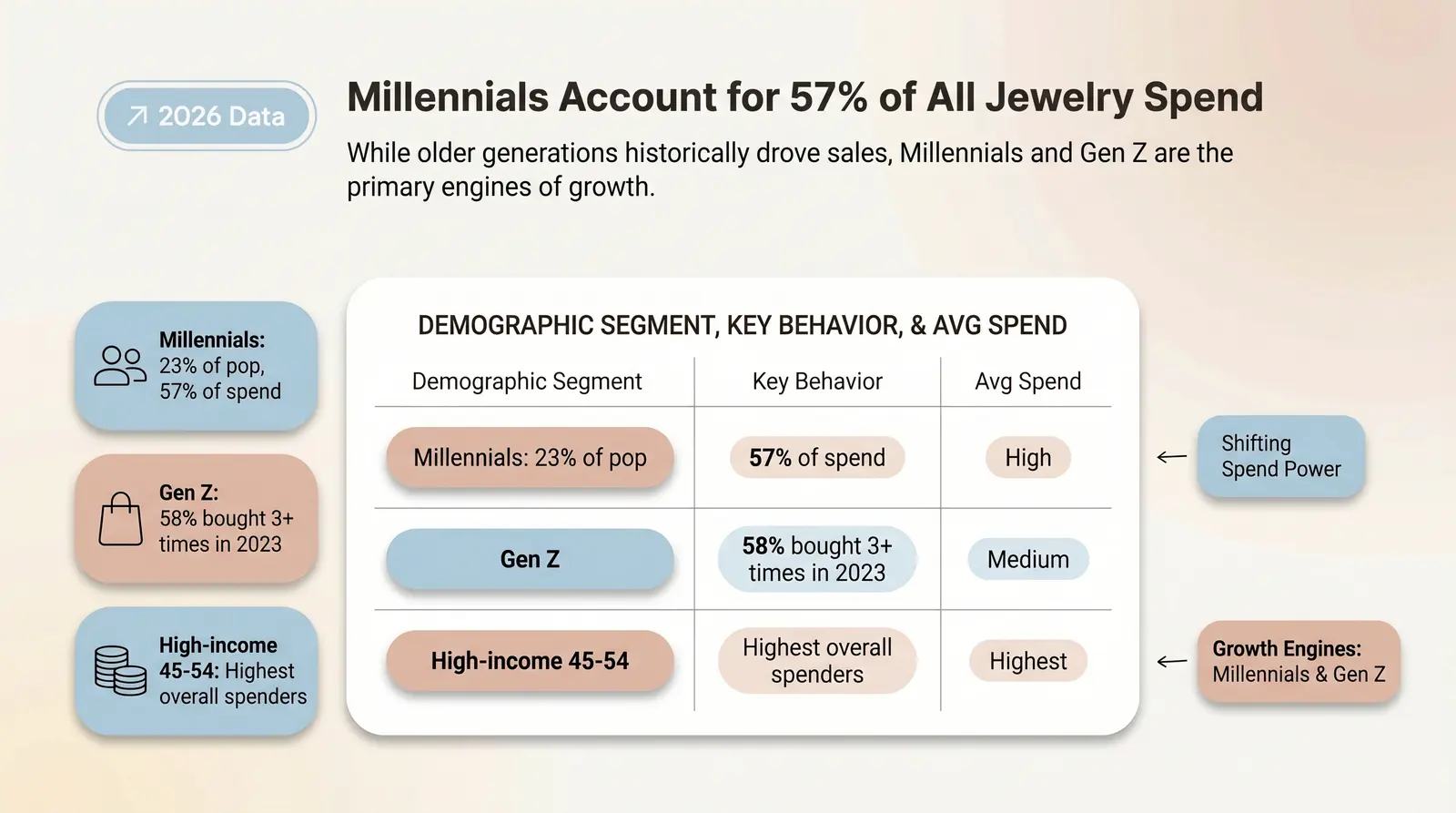
The demographic profile of the modern jewelry buyer is shifting rapidly. While older generations historically drove fine jewelry sales, Millennials and Gen Z are now the primary engines of growth and trend adoption. Millennials, in particular, represent a disproportionate share of the market; despite making up roughly 23% of the global population, they account for an estimated 57% of all jewelry spend [6].
Age plays a critical role in both purchase frequency and category preference. Consumers aged 25 to 34, particularly married women with average to above-average salaries, are the most active shoppers in terms of transaction volume [6]. However, the highest overall spenders remain high-income individuals (earning over $200,000 annually) in the 45 to 54 age bracket, who tend to purchase higher-ticket fine jewelry and luxury watches [6]. Gen Z consumers, while more cost-conscious, are highly engaged; 58% of Gen Z shoppers reported buying jewelry three or more times in 2023, compared to just 41% of Baby Boomers [7].
Gender dynamics in jewelry purchasing are also evolving. While women are the primary wearers and increasingly the primary self-purchasers, men remain a crucial demographic for high-value gifting occasions. Income levels strongly correlate with channel preferences; affluent buyers are more likely to seek out omnichannel experiences that blend digital discovery with in-store consultation, whereas middle-income buyers are increasingly comfortable completing even fine jewelry purchases entirely online [8].
| Demographic Segment | Key Behavior | Avg. Spend Tendency | Preferred Channel | Primary Purchase Driver |
|---|---|---|---|---|
| Gen Z (18–29) | High frequency, trend-driven | Under $500 | Mobile / Social Commerce | Self-expression, sustainability |
| Millennials (30–44) | High volume, milestone gifting | $500 – $2,500+ | Omnichannel (Online heavy) | Personal style, milestone celebration |
| Gen X (45–60) | High value, investment pieces | $2,500+ | In-Store / Desktop | Quality, brand prestige, gifting |
| High-Income Men | Low frequency, high urgency | $1,000+ | In-Store / Desktop | Milestone gifting, convenience |
| Married Women | Highest purchase frequency | $100 – $1,000 | Mobile / Desktop | Self-purchase, everyday wear |
Jewelry is inherently tied to the calendar. Unlike everyday apparel, jewelry purchases spike dramatically around specific holidays and personal milestones. Understanding these occasions is essential for inventory planning and marketing allocation.
Holiday gifting remains the bedrock of the industry. During the winter holiday season (Q4), jewelry stores can generate between 40% and 70% of their annual revenue [9]. Valentine's Day is another massive driver; in 2026, the National Retail Federation projected that Americans would spend a record $7 billion on jewelry for Valentine's Day alone, making it the top gift category by total dollars spent [2]. Mother's Day follows a similar pattern, with 2026 projections indicating $7.5 billion in jewelry spending, again outpacing all other gift categories [3].
Beyond calendar holidays, milestone occasions such as engagements, anniversaries, graduations, and birthdays provide a steady baseline of demand throughout the year. The average cost of an engagement ring in the United States currently sits at approximately $5,200, representing a highly considered, research-intensive purchase journey [10]. Conversely, the "treat yourself" self-purchase behavior is growing rapidly, driven by consumers buying jewelry to celebrate personal achievements or simply to enhance their everyday style [1].
Worked Example: Planning a Jewelry Brand Content Calendar Around Purchase Occasions
A founder launching a private-label brand on Branvas should map their marketing budget directly to these occasion spikes. Since Valentine's Day drives a massive percentage of Q1 fine jewelry revenue, social ad spend should begin six weeks prior (early January), focusing on gift guides and shipping deadlines. Mother's Day campaigns should launch in early April, targeting both spouses and adult children. Q3 should be dedicated to list-building and brand awareness, preparing for the Q4 holiday rush where aggressive retargeting and promotional offers will convert the highest volume of gifters. The months between these major holidays (June through August) are ideal for promoting lower-priced, self-purchase fashion jewelry via influencer partnerships.

The jewelry market is defined by a fundamental dichotomy: the person buying the product is often not the person wearing it. While recent surveys indicate that 80% of American adults have purchased fine jewelry for themselves, gifting still accounts for the majority of high-value transactions and seasonal revenue spikes [1].
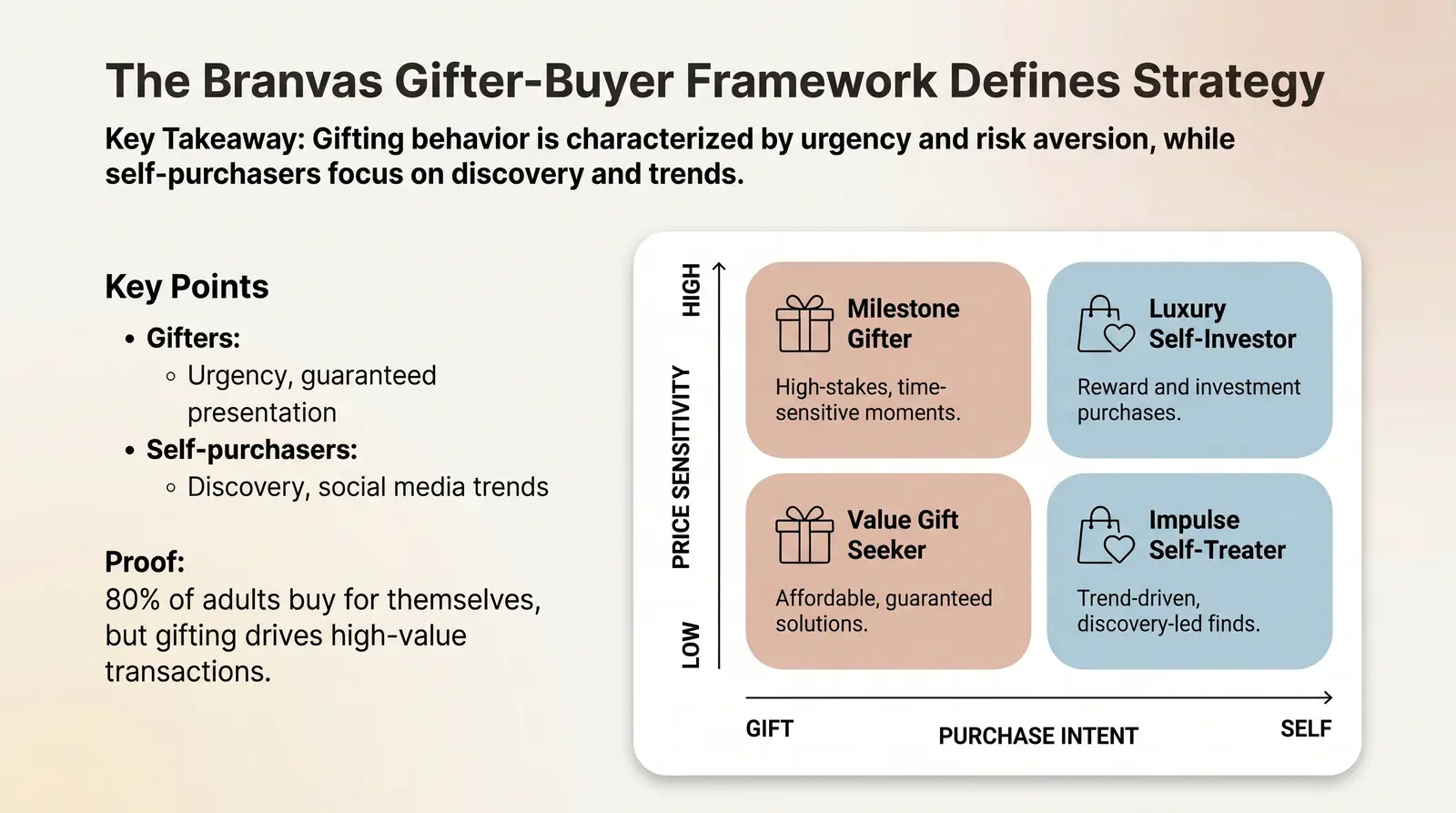
Gifting behavior is characterized by urgency and a desire for guaranteed presentation. Gifters, particularly men buying for partners, are often less price-sensitive but highly sensitive to risk. They want assurance that the piece is high quality, that it will arrive on time, and that the packaging will impress the recipient. Self-purchasers, on the other hand, are highly engaged in the discovery process. They skew heavily female, prefer to shop online, and are heavily influenced by social media trends and influencer recommendations [11]. Self-purchasers are more likely to buy fashion or demi-fine jewelry for everyday wear, whereas gifters lean toward fine jewelry and classic styles [12].
To help founders navigate this split, we developed the Branvas Gifter-Buyer Framework. This 2×2 matrix classifies jewelry shoppers along two axes: Purchase Intent (Gift vs. Self) and Price Sensitivity (High vs. Low).
This framework is a tool Branvas uses when advising new brand founders on product line and marketing strategy, ensuring that every SKU has a clear target audience.
The jewelry industry has historically been dominated by brick-and-mortar retail, where consumers could physically inspect and try on high-value items. However, the shift toward e-commerce has accelerated dramatically. In the United States, online jewelry sales now account for approximately 28.9% of total jewelry purchases, a figure that is projected to reach nearly 40% by 2028 [13].
This digital migration is not uniform across all demographics or price points. While 79% of consumers report researching jewelry products online first, 47% still end up purchasing in-store [14]. This omnichannel behavior highlights the importance of a seamless digital-to-physical experience for traditional retailers, but for direct-to-consumer (DTC) brands, it underscores the critical need for high-quality product imagery, virtual try-on technology, and frictionless return policies.
Mobile commerce is particularly dominant in the discovery phase. Among consumers who research jewelry online, 39% prefer to do so on mobile devices, compared to 34% on laptops [14]. However, when it comes to actual conversion, desktop still holds an edge for fine jewelry. Desktop conversion rates for U.S. jewelry and accessories sit at roughly 1.85%, while mobile conversion lags behind [15]. This discrepancy suggests that while consumers discover and browse jewelry on their phones—often via social media—they prefer the larger screen and perceived security of a desktop computer when completing a high-value transaction.
Social media's influence on jewelry purchasing cannot be overstated. A staggering 85% of jewelry consumers are active on social platforms, with Facebook (93%) and Instagram (73%) leading the pack [14]. More importantly, 59% of these consumers have made a purchase directly through these platforms [14]. For Gen Z and Millennials, platforms like Instagram and TikTok serve as the primary engines for brand discovery, heavily driven by influencer marketing and user-generated content.

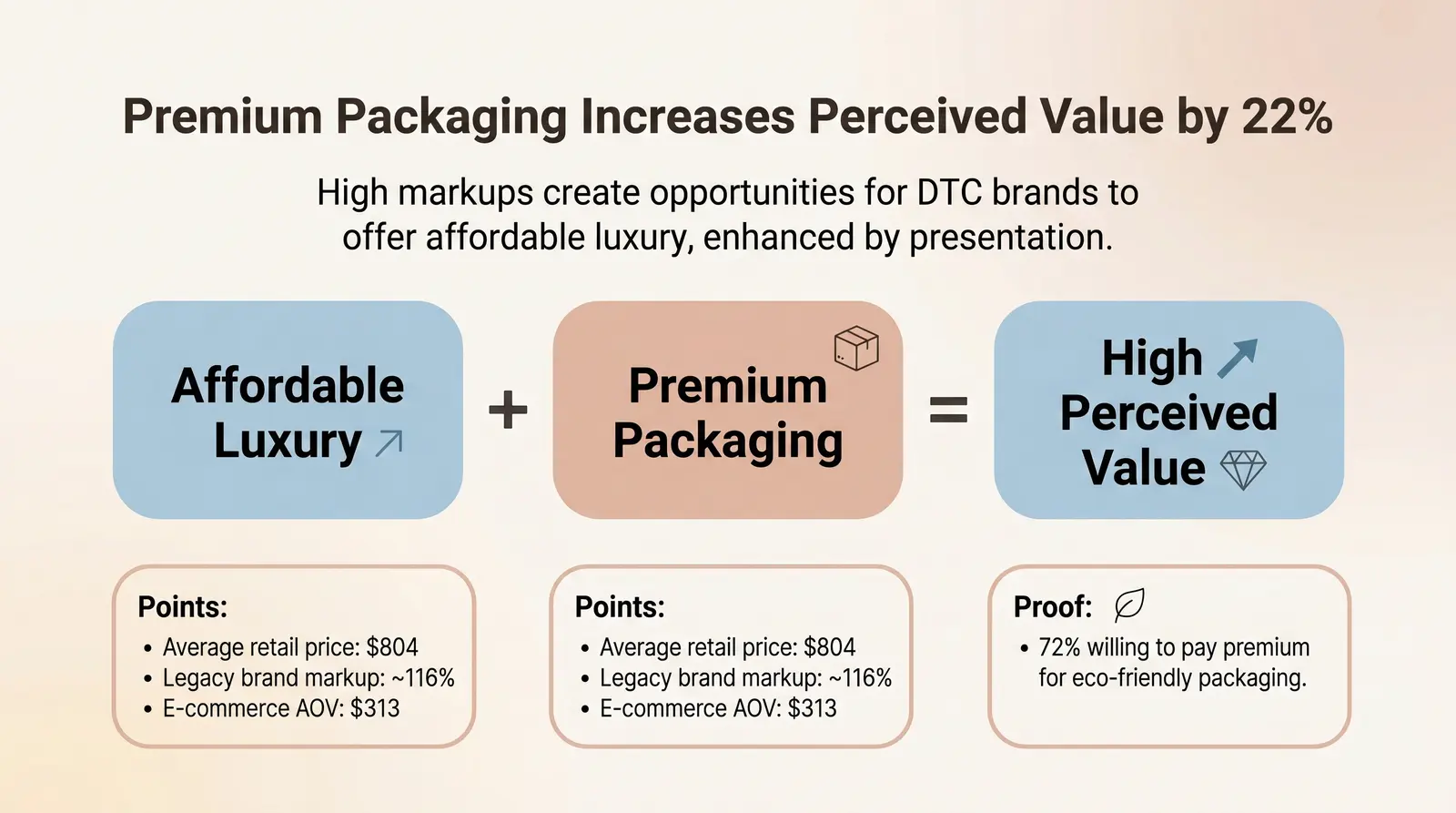
Pricing strategy in the jewelry market is complex, as price often serves as a proxy for quality and prestige. The average retail price for a piece of jewelry, based on data from over 100 jewelers, is approximately $804 [6]. However, the markup on fine jewelry is notoriously high, averaging around 116% (or 2.16 times the acquisition cost) for major legacy brands [6].
This high markup creates a massive opportunity for DTC and private-label brands to offer "affordable luxury." By bypassing traditional wholesale and retail markups, brands can offer high-quality materials (like solid gold or lab-grown diamonds) at significantly lower price points. This positioning resonates strongly with modern consumers; data shows that the Luxury & Jewelry category boasts the highest average order value (AOV) in e-commerce, sitting at $313 [16].
However, price is only one component of the value equation. Presentation and packaging play a disproportionate role in how consumers perceive the value of jewelry, especially for gifting occasions. Research from Oxford University indicates that heavier, more luxurious packaging can increase the perceived value of a product by up to 22% [17]. Furthermore, 72% of consumers report a willingness to pay a premium for eco-friendly or sustainable packaging [18].
Launch Your Own Jewelry Brand Today
Want to capitalize on these consumer trends without the hassle of inventory management or fulfillment? Branvas provides everything you need to launch a private-label jewelry brand. From sourcing high-quality pieces to custom packaging and blind shipping, we handle the logistics so you can focus on marketing and building your brand. Explore our catalog and use our profit calculator to see your potential margins.
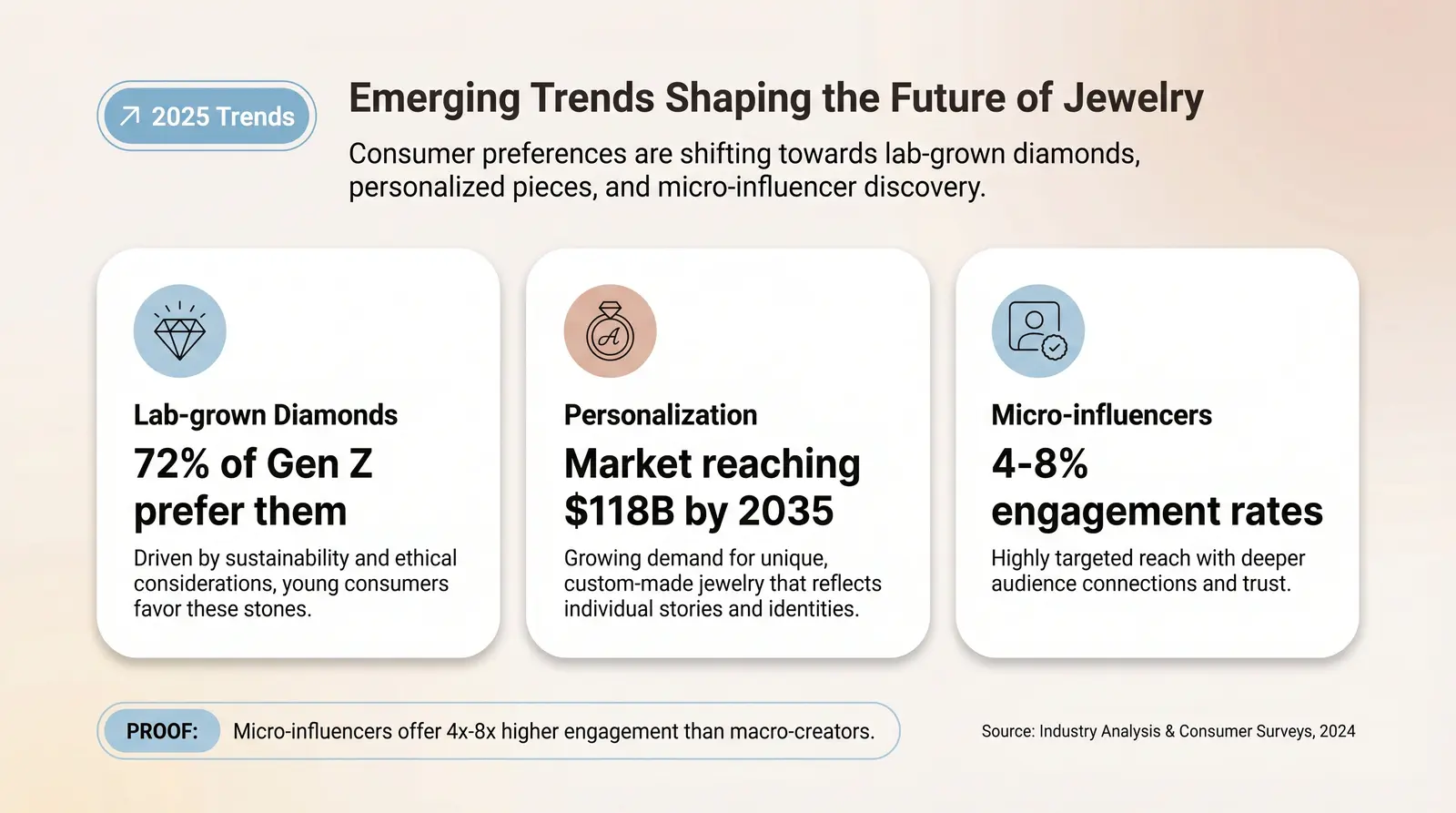
The jewelry market is not static; consumer preferences are evolving rapidly, driven by technological advancements and shifting cultural values. Three key trends are currently reshaping the industry landscape:
The data paints a clear picture: the jewelry market is growing, but the rules of engagement have changed. Success is no longer guaranteed simply by having a beautiful product; it requires a deep understanding of how and why your specific target audience buys.
For brand founders, the actionable takeaways are straightforward:
Building a profitable jewelry brand requires more than just good taste; it requires strategic alignment with consumer behavior. By leveraging these insights, founders can build brands that not only capture attention but drive sustainable, long-term revenue.
Ready to Build Your Brand?
Stop letting logistics hold you back. Branvas is the premier Brand-as-a-Service platform for aspiring jewelry entrepreneurs. We provide the infrastructure—sourcing, branding, packaging, and fulfillment—so you can focus on growth. Visit the Branvas Academy to learn more about brand strategy, or start building your empire today.
[1] BriteCo. (2025). 80% of Americans Now Buy Fine Jewelry for Themselves. Retrieved from https://brite.co/blog/buying-jewelry-for-yourself/
[2] National Retail Federation. (2026). Valentine's Day Spending Expected to Reach New Records. Retrieved from https://nrf.com/media-center/press-releases/valentine-s-day-spending-expected-to-reach-new-records
[3] National Retail Federation. (2026). Mother's Day Spending Expected to Hit Record $38 Billion. Retrieved from https://nrf.com/media-center/press-releases/mother-s-day-spending-expected-to-hit-record-38-billion
[4] Grand View Research. (2025). Jewelry Market Size, Share & Trends Analysis Report. Retrieved from https://www.grandviewresearch.com/industry-analysis/jewelry-market
[5] 1stDibs. (2021). Two-Thirds of Jewelry Gift Recipients Don't Want a Surprise. Retrieved from https://www.1stdibs.com/blogs/the-study/surprise-gift-survey/
[6] Bridgewater Jewelers. Jewelry Statistics and Consumer Shopping Behavior. Retrieved from https://bridgewaterjewelers.com/jewelry-statistics-and-consumer-shopping-behavior/
[7] Kaleya Studio. (2025). 5 Jewellery Trends Gen Z is Actually Buying. Retrieved from https://kaleyastudio.com/blogs/news/5-jewellery-trends-gen-z-is-actually-buying
[8] GlobalWebIndex (GWI). What to Know About Targeting Fashion and Jewelry Buyers. Retrieved from https://www.gwi.com/blog/fashion-and-jewelry-buyers
[9] H&CO. Jewelry Store Holiday Marketing: 90-Day Plan. Retrieved from https://www.itshco.com/blog/jewelry-store-holiday-marketing-90-day-countdown
[10] The Knot. (2024). The Average Engagement Ring Cost, According to Real Couples. Retrieved from https://www.theknot.com/content/how-much-to-spend-on-engagement-ring
[11] Sterling Jewelers. (2025). New Survey Shows Millennials Driving America's Jewelry Self-Purchase Trend. Retrieved from https://www.shopsterlingjewelers.com/blog/music-friday/new-survey-shows-millennials-driving-americas-jewelry-self-purchase-trend
[12] Plumb Club. (2021). Courting Jewelry Self-Purchasers. Retrieved from https://plumbclub.com/courting-jewelry-self-purchasers/
[13] Forgecraft Mens Jewelry. 13 Shocking Online Jewelry Statistics for 2025. Retrieved from https://forgecraftmensjewelry.com/blogs/articles/online-jewelry-statistics
[14] Plumb Club. (2021). Elevate Engagement: Profiling Gen Z Jewelry Consumers. Retrieved from https://plumbclub.com/profiling-gen-z-jewelry-consumers/
[15] Rawshot.ai. (2026). Digital Transformation In The Jewelry Industry Statistics. Retrieved from https://rawshot.ai/statistic/digital-transformation-in-the-jewelry-industry
[16] Dynamic Yield. Average order value benchmarks for eCommerce. Retrieved from https://marketing.dynamicyield.com/benchmarks/average-order-value/
[17] CaratX. (2025). The Power of Packaging: How Luxury Presentation Improve Jewelry Sales. Retrieved from https://caratx.com/blog-post/the-power-of-packaging-how-luxury-presentation-improve-jewelry-sales-and-customer-experience
[18] RichPKG. (2024). Research Report on Jewelry Packaging Design Innovation and Market Demand. Retrieved from https://richpkg.com/wp-content/uploads/2024/11/Research-Report-onJewelry-Packaging-Design-Innovation-and-Market-Demand.pdf
[19] CaratX. (2025). The US Jewelry Industry's Market Update. Retrieved from https://caratx.com/blog-post/the-us-jewelry-industrys-market-update
[20] Business Research Insights. Personalized Jewelry Market Outlook 2026-2035. Retrieved from https://www.businessresearchinsights.com/market-reports/personalized-jewelry-market-119638
[21] JoinStatus. (2025). Why Micro-Influencers Are So Effective in 2025. Retrieved from https://brands.joinstatus.com/why-micro-influencer-are-effective


