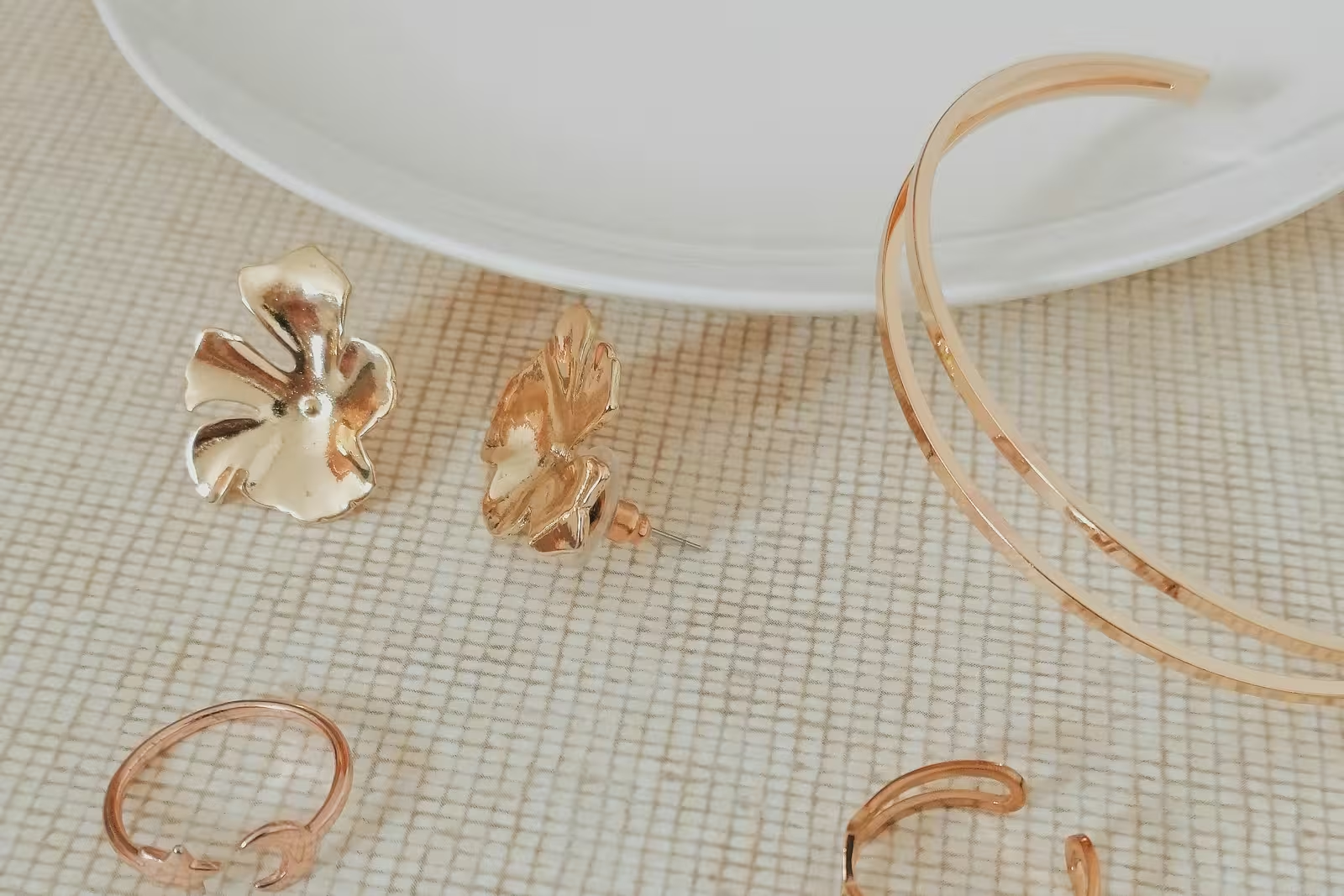



Learn which minimalist earring styles to stock, how to price for 50-70% gross margins, and how to launch jewelry alongside your women’s apparel line.
Published:
March 7, 2026
Author:
Yi Cui
If you're targeting women's apparel stores, here's the fastest way to pick, price, and launch minimalist earrings - without getting stuck in sourcing or inventory.
Earrings are not a side category. For boutique and Shopify apparel sellers, they're one of the highest-leverage additions you can make to your product mix. No sizing. Low returns. Impulse-friendly price points. And they sit naturally inside a fashion brand without requiring a separate identity. This guide covers exactly what to stock, how to price it, and how to get to market fast - with a clear lens on the women's apparel context throughout.
Jewelry is the natural next step for any women's apparel store, and earrings are the easiest entry point within jewelry. Unlike necklaces (which compete with necklines) or bracelets (which can feel disconnected from clothing), earrings frame the face and complete an outfit in a way that photographs well, displays cleanly at retail, and sells without a sizing conversation.
The data backs this up. According to the BoF-McKinsey State of Fashion 2026, jewelry is projected to grow at 4.1% unit growth annually through 2028 - four times the rate of clothing. [1] That growth is not happening in spite of apparel trends; it's happening because of them. Consumers who are buying fewer, better clothing pieces are investing more in accessories that elevate what they already own.
For apparel store owners, the AOV case is equally clear. In our experience at Branvas, adding jewelry as a structured add-on category can lift average order value by 20-30% without requiring new traffic. [2] If 15-20% of your apparel orders attach a $35 earring, that's a meaningful revenue layer built on customers you already have.
Three trends are running in your favor right now.
Quiet luxury has been a dominant aesthetic since 2021 and shows no sign of fading. [3] The look centers on understated, high-quality pieces that signal taste rather than trend. Minimalist earrings - thin gold hoops, delicate studs, clean geometric drops - are the jewelry expression of that aesthetic. They don't compete with the outfit; they complete it.
Capsule wardrobe culture is accelerating demand for versatile, everyday-wear pieces. Consumers building intentional wardrobes want jewelry that works across multiple outfits and occasions. A pair of fine gold-plated huggie hoops fits that brief perfectly. A statement chandelier earring does not.
Self-purchasing is now the dominant motivation for jewelry buying. According to the BoF-McKinsey 2026 report, 42% of women report buying more jewelry for themselves than two or three years ago, with a 58% increase in self-purchase sales between 2021 and 2024. [1] Separately, a 2025 consumer survey found that 80% of US adults now purchase fine jewelry for themselves. [4] This matters for apparel stores because it means your customer is already in a self-investment mindset when she's shopping your clothing. An earring add-on is a natural extension of that intent.
Earrings outperform other jewelry categories in the apparel retail context for three structural reasons.
First, there are no sizing issues. A ring requires knowing the customer's size. A bracelet requires knowing wrist circumference. An earring is universal. That eliminates friction at the point of sale and dramatically reduces return rates. Jewelry overall averages an 8-10% return rate - well below apparel's 24% online average. [5] Earrings often sit even lower because many retailers apply a no-return hygiene policy once a pair has been worn.
Second, earrings are easy to merchandise near checkout. A small display of four to six styles takes up minimal counter space and captures impulse purchases at the moment of highest buying intent. At a $25-$45 price point, the decision is low-stakes enough to happen without deliberation.
Third, earrings photograph well alongside apparel. On-model shots that show earrings paired with a specific outfit create natural cross-sell opportunities in your product listings, emails, and social content - without requiring a separate campaign.

The primary buyer of minimalist earrings in a women's apparel context is a woman between 25 and 40, shopping for herself. [6] She's building a wardrobe with intention - she's not chasing every trend, but she wants to look put-together with minimal effort. She's price-aware but not price-driven: she'll pay $35-$65 for a pair that feels quality and matches her aesthetic, but she won't pay $120 for something she can't wear every day.
Her purchase motivation is split roughly between self-expression and occasion. She buys a pair of gold studs because they work with everything she owns. She buys a birthstone drop because it's her birthday month or she's treating herself after a milestone. Gift buyers are a secondary segment - particularly relevant around holidays and Mother's Day - but self-purchase is the primary driver and should shape your merchandising language.
Not all minimalist earrings suit all apparel stores. The right earring aesthetic depends on your store's positioning. A contemporary workwear brand and a bohemian lifestyle brand are selling to different customers with different visual expectations.
The Positioning Matrix below maps the most common apparel store archetypes to the earring aesthetics and merchandising messages that convert best in each context.
| Apparel Store Archetype | Recommended Earring Aesthetic | Key Merchandising Message |
|---|---|---|
| Contemporary / Elevated Basics | Fine gold-plated huggie hoops, thin gold drop earrings, hammered disc studs | "Wear it every day. Dress it up Friday." |
| Workwear / Professional | Sterling silver geometric studs, small pearl accent studs, thin bar drops | "Clean, polished, effortless." |
| Bohemian / Lifestyle | Natural stone drops, hammered disc earrings, threader earrings in gold or mixed metal | "Handcrafted feel, everyday wearability." |
| Coastal / Resort | Pearl accent studs, gold hoop sets, ear cuff sets | "Sun-ready, sea-worthy." |
| Minimalist / Scandinavian | Thin gold or silver geometric studs, open circle drops, single bar earrings | "Less, but better." |
| Romantic / Feminine | Pearl drops, birthstone mini drops, delicate floral studs | "Soft details that make the outfit." |
Use this matrix as a starting filter when selecting your first assortment. You don't need to cover every archetype - pick the two or three rows that match your store's identity and start there. Depth in the right aesthetic beats breadth across all of them.

Pricing minimalist earrings for a boutique or Shopify apparel store is more straightforward than most sellers expect. The category has well-established margin norms, and the numbers work in your favor.
Typical retail price range. Minimalist earrings in the boutique and DTC apparel context typically retail between $18 and $75 per pair, with the sweet spot for impulse-purchase volume sitting at $22-$45. Styles with semi-precious stones or higher-grade plating can support $55-$85 retail pricing when positioned and packaged correctly.
Typical landed cost per unit. For private-label or white-label minimalist earrings - gold-plated brass or sterling silver, standard minimalist styles - landed cost typically ranges from $4 to $15 per unit depending on materials, plating thickness, and order volume. Sterling silver styles with genuine stones will sit at the higher end of that range. You can explore current product pricing at branvas.com/catalog to benchmark against live options.
Typical gross margin range. At standard boutique pricing, gross margins on minimalist earrings can range from 50% to 70%. This is structurally higher than most apparel categories, where margins of 40-55% are more common. The lightweight nature of earrings also keeps shipping costs low, which protects net margin. [7]
Keystone vs. premium keystone pricing. Keystone pricing - doubling the wholesale cost - is the baseline for boutique retail. A pair with a $10 landed cost retails at $20 under keystone. Premium keystone (2.5x-3x cost) is achievable when packaging, branding, and photography signal quality. A $10 landed cost can support a $28-$32 retail price when the product arrives in branded packaging with a care card and is photographed on-model. That difference is not about the earring - it's about the presentation. See branvas.com/pricing for context on how platform costs factor into your margin model.
Bundle pricing and AOV. Pairing earrings with an apparel SKU - for example, "Complete the look: add these earrings for $28" on a dress product page - typically increases perceived value for both items. The earring feels intentional rather than random, and the outfit feels more complete. In our experience at Branvas, bundled jewelry add-ons at $25-$40 convert at higher rates than standalone jewelry listings because the customer's purchase intent is already high.
Inventory-free vs. holding inventory. Dropship and inventory-free models typically carry 10-20% lower gross margins per unit compared to buying wholesale and holding stock, because you're paying a per-order fulfillment premium. However, the inventory-free model eliminates upfront capital risk, dead stock exposure, and warehousing costs. For apparel stores testing jewelry for the first time, the margin trade-off is usually worth it. Once you identify your top three to five styles by sell-through, buying those in small quantities can improve margins meaningfully. [8]

The goal with your first earring assortment is not to offer everything - it's to offer the right eight to twelve styles that map tightly to your apparel aesthetic and customer profile. Here are ten styles worth considering, with notes on fit, variants, and merchandising angle.
1. Fine Gold-Plated Huggie Hoops. The most versatile minimalist earring in the market. Huggies sit close to the ear, work with any neckline, and photograph beautifully. Offer in 10mm and 14mm diameter, yellow gold and rose gold finish. Merchandising note: position as the "everyday hoop" and pair with your core basics - white tees, blazers, linen sets.
2. Sterling Silver Geometric Studs. Clean triangles, squares, or hexagons in sterling silver. Strong fit for workwear and minimalist aesthetics. Variants: polished finish and brushed finish. Merchandising note: works as a "desk to dinner" story. Pair with tailored trousers or a structured blazer in product photography.
3. Thin Gold Drop Earrings. A delicate bar or elongated teardrop in 14K gold-plated brass. Adds movement without bulk. Variants: yellow gold and silver tone. Merchandising note: pairs naturally with midi dresses and elevated casual looks. Strong gift purchase - easy to position as a birthday or self-treat item.
4. Pearl Accent Studs. Freshwater or synthetic pearl in a simple post setting. Pearl is having a sustained moment across all fashion aesthetics - it reads as both classic and contemporary. Variants: white, cream, and blush pearl; gold or silver post. Merchandising note: works across romantic, coastal, and contemporary archetypes. Bundle with feminine dresses or blouses.
5. Hammered Disc Earrings. A circular disc with a hammered texture in gold or silver. The texture catches light and adds visual interest without being loud. Variants: 12mm and 18mm diameter, gold and silver. Merchandising note: strong fit for bohemian and lifestyle brands. Pairs well with linen, natural fabrics, and earthy tones.
6. Ear Cuff Sets (No Piercing Required). A growing category that expands your addressable market to customers without piercings. Typically sold as a set of two to three cuffs in gold or silver. Merchandising note: position as a "try something new" option. Works well as a social content hook - "no piercing needed" is a shareable angle.
7. Mixed-Metal Duo Sets. Two pairs sold together - one gold, one silver - at a slight bundle discount. Solves the "which metal?" question for customers who wear both. Merchandising note: strong gift item. Position as "the starter set" for customers new to minimalist jewelry.
8. Birthstone or Semi-Precious Mini Drops. Small drops featuring a genuine or synthetic semi-precious stone - amethyst, turquoise, labradorite, or similar - in a simple gold-filled or gold-plated setting. Variants: multiple stone options. Merchandising note: strong self-purchase motivation. "Your birthstone, every day" is a simple, effective message.
9. Threader Earrings in Gold or Silver. A thin chain or bar that threads through the ear, creating a floating effect. Elegant and modern. Variants: plain chain and twisted chain; gold and silver. Merchandising note: strong fit for contemporary and minimalist archetypes. Pairs well with off-shoulder or deep-V necklines.
10. Seasonal Capsule Sets. A curated two- or three-piece set designed around a seasonal theme - holiday (gold and pearl), spring (pastel stone drops), summer (gold hoops and ear cuffs). Sold as a set at a price point that represents slight savings vs. individual purchase. Merchandising note: strong for email campaigns and holiday gifting. Creates urgency through limited availability.
Three of these styles lend themselves particularly well to apparel bundles. Pearl accent studs paired with a floral midi dress create a natural "complete the look" moment. Thin gold drop earrings alongside a linen blazer or elevated basics set reinforce the contemporary aesthetic. Seasonal capsule sets bundled with a holiday dress or a spring linen set create a gift-ready package that increases both AOV and perceived value. In each case, the earring should appear in the apparel product photography - not just as a separate listing - so the customer sees the combination before she's asked to buy it.

In a standalone jewelry store, packaging is expected. In an apparel store, it's a differentiator. When a customer orders a dress from your store and receives a pair of earrings in a plain poly bag, the earrings feel like an afterthought - and the brand experience suffers. When those same earrings arrive in a branded card backing with your logo, a care card, and a small branded envelope, the order feels intentional. That distinction drives repeat purchases and word-of-mouth.
Gifting perception is the other factor. A significant portion of earring purchases - whether self-gifted or bought for someone else - are emotionally driven. Packaging that looks gift-ready removes the need for the customer to do anything extra. It also justifies a slightly higher price point, because the perceived value of the total package is higher.
Branded card backing with insert is the most common format for minimalist earrings at retail and the most practical for apparel stores. The earring posts through the card, your logo sits at the top, and a brief brand message or care note appears on the back. It's lightweight, cost-effective, easy to display, and ships flat. The limitation is that it feels less premium than a box, which matters if you're positioning at the higher end of the price range.
Small rigid box with a foam or velvet insert signals quality and is the right choice for earrings retailing above $50 or for any style you're positioning as a gift item. The trade-off is higher per-unit cost and more shipping bulk. For a Shopify store, a rigid box inside a branded mailer creates a strong unboxing moment.
Organza pouch is low-cost and common in the wholesale market, but it offers minimal brand impact and feels generic. It's acceptable for a free-with-purchase add-on but not ideal for a paid product you're asking customers to value.
Branded kraft box works well for stores with an eco-conscious or natural aesthetic. It signals sustainability without sacrificing brand presence, and it photographs well for social content.
The single biggest lever for premium pricing in the minimalist earring category is not the earring itself - it's the brand presentation. A $6 gold-plated huggie hoop in a plain poly bag is a commodity. The same earring on a custom card backing with your logo, a care card explaining the materials, and a brand message that connects to your store's identity is a $32 product. The materials are identical. The brand experience is not.
Custom card backing with your logo and colorway, a brief brand story on the reverse, and a care note covering metal type and cleaning instructions - that combination does three things. It elevates perceived value. It reduces return rates by setting accurate expectations. And it creates a consistent brand experience that makes the earring feel like a natural part of your apparel line rather than a random add-on.
At Branvas, we handle custom branding and packaging for sellers launching jewelry alongside their apparel line - including card backing design, branded inserts, and premium packaging formats. You can explore options at branvas.com/brand-studio or see the full service model at branvas.com/how-it-works.
A care card - even a simple one - does meaningful work. It tells the customer what the earring is made of, how to clean it, and how to store it. That transparency reduces the "I don't know what I'm getting" anxiety that drives returns, and it signals that you stand behind the product. For hypoallergenic claims, a care card that specifies the post material (surgical steel, titanium, or sterling silver) gives sensitive-skin customers the confidence to buy.

Getting the product right before you launch saves significant time and customer service overhead later. The checklist below covers the four areas that matter most for apparel stores adding earrings - with a note on why each category is specifically relevant to your context.
Why this matters for apparel stores specifically: Your customers already trust you for clothing quality. A poor-quality earring - one that turns green after a week, has a sharp post, or arrives in damaged packaging - doesn't just create a return. It damages the trust you've built with your apparel brand. The checklist below is a pre-launch filter, not a one-time exercise.
Use this five-step sequence to move from decision to live listing without getting stuck:
If you want to skip the sourcing checklist entirely, Branvas manages product quality, blind fulfillment, and branded packaging for you. See how it works or explore the catalog.

Q: What are the best minimalist earring styles to add to a women's apparel store?
A: The strongest starting styles are fine gold-plated huggie hoops, sterling silver geometric studs, and pearl accent studs - because they work across the widest range of apparel aesthetics and customer profiles. If your store skews bohemian, add hammered disc earrings and natural stone drops. If it skews contemporary or workwear, thin gold drops and bar studs are the right additions.
Q: How much should I charge for minimalist earrings in a boutique setting?
A: The typical retail range for minimalist earrings in a boutique or Shopify apparel context is $22-$65 per pair, with the impulse-purchase sweet spot at $28-$42. Pricing above $50 is achievable when packaging, photography, and brand presentation signal quality - the earring alone rarely justifies the premium, but the full brand experience can.
Q: Can I sell minimalist earrings without holding inventory?
A: Yes. Inventory-free models - where a fulfillment partner handles sourcing, packaging, and shipping on your behalf - are well-suited to apparel stores testing jewelry for the first time. The trade-off is a slightly lower gross margin per unit (typically 10-20% less than buying wholesale), but you eliminate upfront capital risk and dead stock exposure. Branvas offers this model with branded packaging included.
Q: How do I brand minimalist earrings to match my clothing store's aesthetic?
A: The most effective approach is to use your existing brand identity - logo, colorway, and brand voice - on the earring's card backing and care insert. The earring itself should be selected to match your apparel aesthetic (see the Positioning Matrix above), but the packaging is what makes it feel like your brand rather than a generic product. Custom card backing design, a brief brand message, and a care note are the minimum viable branding set.
Q: What materials should I look for to avoid customer complaints about earrings?
A: Prioritize hypoallergenic post materials: surgical steel (316L stainless steel), titanium, or sterling silver are the three most reliable options for sensitive ears. For the earring body, gold-plated brass with a plating thickness of at least 2.5 microns offers a reasonable balance of affordability and durability. Always request nickel-free certification from your supplier and include material information on your care card - transparency reduces complaints and returns before they happen.